1642: Thomas Granger and the beasts he lay with

On this date in 1642, a teenager was hanged in the Plymouth colony for bestiality — in accordance with the law of the Pentateuch.

William Bradford — we just met him, trying to keep things cool with the Indians — relates the “very sadde accidente of the like foule nature in this govermente”:

Ther was a youth whose name was Thomas Granger; he was servant to an honest man of Duxbery, being aboute 16 or 17 years of age. (His father and mother lived at the same time at Sityate.) He was this year detected of buggery (and indicted for the same) with a mare, a cowe, tow goats, five sheep, 2 calves, and a turkey. Horrible it is to mention, but the truth of the historie requires it. He was first discovered by one that accidentally saw his lewd practise towards the mare. (I forbear perticulers.) Being upon it examined and committed, in the end he not only confest the fact with that beast at that time, but sundrie times before, and at severall times with all the rest of the forenamed in his indictmente; and this his free-confession was not only in private to the magistrates, (though at first he strived to deney it,) but to sundrie, both ministers and others, and afterwards, upon his indictemente, to the whole court and jury; and confirmed it at his execution. And whereas some of the sheep could not so well be knowne by his description of them, others with them were brought before him, and he declared which were they, and which were not. And accordingly he was cast by the jury, and condemned, and after executed about the 8 of Sept 1642. A very sade spectakle it was; for first the mare, and then the cowe, and the rest of the lesser catle, were kild before his face, according to the law, Levit: 20.15 and then he him selfe was executed.* The catle were all cast into a great and large pitte that was digged of purposs for them, and no use made of any part of them.

So, pilgrims: weird about sex, a bit rough with the punishment. No wonder they got a rep.

Granger is the first juvenile known to be executed in the territory of the modern United States — if you like, you could read it as the start of a pattern, even though almost a century would pass before the next such execution. “Juvenile” is a relative term, of course, since we see our day’s victim across a historical redefinition (arguably, outright creation) of “childhood” in the centuries to come: Granger left a wife and daughter.

“Sodomy, rapes, buggery,” were one of the five classes of crimes punishable by death according to the Plymouth Colony’s 1636 statutes. Still, Granger’s is the only one of ten recorded Plymouth Colony executions not imposed for murder (Source, via.) — not that other hot-blooded Puritans, including later zoophiles, didn’t get themselves into hot water.

American poet Charles Olson reimagined Thomas Granger in the 1940’s by remixing William Bradford’s narrative into a startlingly poignant piece, “There was a Youth whose Name was Thomas Granger”:

From the beginning, SIN
and the reason, note, known from the start

says Mr. Bradford: As it is with waters when
their streames are stopped or damed up, wickednes

(Morton, Morton, Morton)
here by strict laws as in no more,
or so much, that I have known or heard of,
and ye same nerly looked unto
(Tom Granger)
so, as it cannot rune in a comone road of liberty
as it would, and is inclined,

it searches every wher (everywhere)
and breaks out wher it getts vente, says he

Rest, Tom, in your pit where they put you
a great & large pitte digged of purposs for them
of Duxbery, servant, being aboute 16. or 17. years of age
his father & mother living at the time at Sityate

espetially drunkennes & unclainnes
incontinencie betweene persons unmaried
but some maried persons allso
And that which is worse
(things fearfull to name)

HAVE BROAK FORTH OFTENER THAN ONCE
IN THIS LAND

2
indicated for ye same) with
a mare, a cowe, tow goats, five sheep, 2. calves
and a turkey (Plymouth Plantation)

Now follows ye ministers answers

3
Mr Charles Channcys a reverend, godly, very larned man
who shortly thereafter, due to a difference aboute baptising
he holding it ought only to be by diping
that sprinkling was unlawful, removed him selfe
to the same Sityate, a minister to ye church ther

in this case proved, by reference to ye judicials of Moyses
& see: Luther, Calvin, Hen: Bulin:. Theo: Beza. Zanch:
what greevous sin in ye sight of God,
by ye instigation of burning lusts, set on fire of hell,

to procede to contactum & fricationem ad emissionem seminis,
&c.,
& yt contra naturam, or to attempt ye grosse acts of

4

Mr Bradford: I forbear perticulers.
And accordingly he was cast by ye jury,
and condemned.

It being demanded of him
the youth confessed he had it of another
who had long used it in old England,
and they kept cattle together.

And after executed about ye 8. Of Septr, 1642.
A very sade spectakle it was; for first the mare,
and then ye cowe, and ye rest of ye lesser catle,

were kild before his face, according to ye law
Levit: 20.15.

and then he him selfe

and no use made of any part of them

* The hangman, John Holmes — no, not that one — claimed a fee “for x weeks dyett for Granger £1., and for executing Granger and viij beasts, £2.10.0.” His count of executed beasts falls short of the total (12) enumerated by Bradford, presumably accounted by the difficulty in identifying the sheep.

On this day..

1638: Three (of four) English colonists for murdering a Native American

Four hundred years removed from the events surrounding the colonization of Massachusetts by English settlers through the 1620’s, it’s difficult to properly evaluate the mindsets of either colonist or colonizer in this time of violent encounters and expansive cultural shifts.

The 1638 case of Arthur Peach, Thomas Jackson, Richard Stinnings, and Daniel Cross serves as a potent reminder that the relationship between the interlopers and natives in the early years of these meetings was driven as much by tribal politics as by interpersonal attitudes.

Peach, by all accounts, was not on track to be elected Plymouth Man of the Year. A servant of Edward Winslow, one of the Mayflower originals responsible for political gaming with the native leaders, Peach was dispatched to serve in the Pequot War in 1637. The war pitted English colonists and some of their tribal neighbors against the Pequots and resulted in the slaughter of hundreds of Pequot in several attacks.

Peach went work-idle in the post-war years, enjoying his remaining youth: he frequently drank and spent evenings in merriment with his friends, accumulating a sizable debt in the process; said merriment also extended to impregnating Dorothy Temple, a servant of Stephen Hopkins (who was, in one of the less surprising twists, later charged with allowing drunken merriment of his servants in his house).

Plymouth Colony leader William Bradford: Can’t we all get along?

William Bradford speculates that it was to escape punishment for this latter social offense that Peach convinced three other indentured servants to break their bonds and follow him to the nearby Dutch plantations. No matter the motive, they were ill-advised to join him.

Along the way, the quartet came across a man of the Nipmuc tribe (allied with the English and Narragansett during the recent war) named Penowanyanquis. They convinced him to stay, smoked a pipe and talked trade, then stabbed and robbed him, leaving him for what they thought was dead; Penowanyanquis was found on the road and lived for several more days, plenty of time to describe his attackers to first his tribesmen, then the Englishman Roger Williams.

The Plymouth authorities accepted the case (in Plymouth, though the event occurred far from its apparent jurisdiction) in the interests of maintaining the tenuous peace with the New England natives — in Bradford’s words, “The Gov[ernment] in the Bay were aquented with it, but refferrd it hither, because it was done in this jurissdiction; but pressed by all means that justice might be done in it; or els the countrie must rise and see justice done, otherwise it would raise a warr.”

Peach, Jackson, and Stinnings were caught at Aquidneck Island, while Cross fled to Piscataqua (New Hampshire), where it was traditional for locals to refuse to help Plymouth colonials. The three detainees were tried, with much of the trial devoted to proving that Penowanyanquis was, in fact, dead. It took two Narragansett to affirm upon pain of their own heads that Penowanyanquis had succumbed to his injuries, but their testimony sent three whites to the gallows for killing an Indian; for the second time since the Plymouth colony was established 18 years prior, a murderer was hanged.*

The oddity of the affair is not that such a conviction occurred — it was a long-standing colonial tradition to uphold treaties with natives through civil law and break them in a variety of other ways — but the reaction of persons involved before and during the trial. To wit:

Ousamequin coming from Plymouth told me that the four men were all guilty. I answered but one; he replied true, one wounded him, but all lay in wait two days and assisted. Also that the principal must not die, for he was Mr. Winslow’s man; and also that the Indian was by birth a Nipmuck man, so not worthy that any other man should die for him.

Ousamequin, here making the case that Peach should be spared, was another name for Massasoit, the old chief of the Pokanoket whose special kinship with Peach’s indenturerer Winslow was cemented after the settler brought a severely ill Massasoit European remedies when the chief was struck with an unnamed ailment in 1623.

Nor, indeed, were the colonists uniformly positive about the event: Bradford reports that “[s]ome of the rude and ignorant sorte murmured that any English should be put to death for the Indean.”

Massasoit himself seems to have been the only thing holding the colonial relationship together: Metacomet (“King Philip”) took the title of Great Sachem shortly after Massasoit’s death, and his alliances with other tribes exacerbated the harsh feeling towards English attempts to Christianize their neighboring “heathens”. With the white population expanding swiftly beyond its early boundaries, a small event was bound to spell trouble, and when the Christian convert John Sassamon (an Indian) was found murdered and three Wampanoag were executed for the deed, Indian sovereignty was impugned.

King Philip’s War was on, and it did not end well for the native Americans.

No.

To his credit, Peach still produced a son, and Temple’s pregnancy ended the public life of Hopkins. Hopkins was charged with mistreating Temple, who was his indentured servant, and ordered to pay for both her and her child through the two years remaining on her contract.

Hopkins dissented and was jailed, bailed out four days later by John Holmes, who purchased Temple’s servitude for a whopping three pounds (somewhere between 1/4 and 1/2 the price of a cow). Her son remains unnamed in the record, but after giving birth, Temple was charged with producing a bastard child and whipped. Her fate thereafter is lost to the mists of history, as are the future exploits of Daniel Cross.

* The first was Mayflower original John Billington, who was executed in 1630 for shooting John Newcomen to resolve what was apparently a long-standing dispute.

On this day..

1724: Half-Hangit Maggie Dickson

Allegedly on this date in 1724, a young woman was hanged at Edinburgh’s Grassmarket for concealing her pregnancy.

Any number of details in this horrible/wonderful story are shaky, including the date: some sources make it 1728, a few say 1723, and only a handful attest a specific calendar date. Nobody seems to doubt the tale in the main, however — and it’s certainly excellent enough lore to deserve even a heavily asterisked entry.

Deserted by her husband, young Maggie Dickson took lodgings at an inn in exchange for work, and became pregnant by either the innkeeper or his son. (Again — details in the various sources available read like a game of telephone.) Since single* pregnant working-class women had about as many employment options as birth control options, Maggie kept quiet about her condition in the interest of keeping her job.

And since male parliamentarians figured their job was to keep young lasses of loose character and modest means on the straight and narrow by criminalizing their options, Maggie’s sleight-of-womb put her in violation of a law against concealing a pregnancy. (The same situation was playing out elsewhere in the British sphere at this time.)

When the resulting infant turned up dead, the trail led straight to Dickson … but the concealment of the pregnancy and birth were capital crimes on their own, making it immaterial whether it had been a miscarried pregnancy, an act of infanticide, or simply one of the many early 18th century babies to die in the cradle. The law was an indiscriminate instrument to prevent women terminating their pregnancies.

Nothing noteworthy about the hanging itself is recorded; it seems to have been one of the routine public stranglings of the age, and even the scuffle over the body between family and medical students hunting dissection-ready cadavers was a normal occurrence.

The family won. And en route to Musselburgh for burial, Maggie started banging on the inside of the coffin, and was forthwith revived. Officials decided the sentence of hanging had already been carried out … and her awestruck neighbors suddenly started seeing Maggie sympathetically

And they all lived happily ever after. This day’s principal, at any rate, gained a foothold in adequate prosperity, bore more children, and answered to the nickname “Half-Hangit Maggie Dickson” all the many more years of her life.

The story passed into legend; the dates, as we’ve alluded, fuzzed. One entrepreneurial English broadside publisher of the 19th century even transported the affair to February 1, 1813 — four years after a Concealment of Pregnancy Act reduced the penalty for Maggie Dickson’s “crime” to penal servitude. And near the site of the not-quite-Passion, should you call sometime in Edinburgh, you can raise Half-Hangit Maggie a pint at Maggie Dickson’s Pub.

I’le crye as fu’ o’ tears an egg,
‘Death, I’ve ae favour for to begg,
That ye wad only ge a flegg,
And spare my life,
As I did to ill hanged Megg,
That graceless wife

-Broadside, ‘The last speech and dying words of John Dalgleish, Hangman of Edinburgh’

* Technically, she was still married but separated.

Part of the Themed Set: Judging Abortion.

On this day..

1538: Cratwell, a hangman

This yere, the first daye of September, beinge Sondaye, at Clerkenwell, where the wrestlinge is kept, after the wrestlinge was done, there was hanged on a payre of gallowes, newe made, in the same place, the hangman of London and two more for robbinge a bouth in Bartlemewe fayre, which sayd hangman had done execution in London since the Holy Mayde of Kent was hanged, and was a conninge butcher in quarteringe of men.

A Chronicle of England During the Reigns of the Tudors, from A.D. 1485 to 1559

On this day..

1593: Pierre Barrière, undeterringly

On this date in 1593, a would-be assassin of France’s King Henri IV was broken on the wheel.

An Orleans boatman turned Catholic League soldier in France’s internecine Catholic-Huguenot wars, he was among the numerous Catholics who looked askance at victorious Huguenot Henri IV‘s expeditious conversion to Catholicism.

In the months while Henri IV still held Paris under siege, the Jesuit father Jacques Commolet had called for his assassination from the pulpit. The Bourbon’s (nominal) switch to Catholicism with the words “Paris is worth a mass” had not persuaded hard-core Catholic partisans of the king’s sincerity.

Henri was a practical guy. And with civil slaughter afoot for most of the late 16th century, he took a dim view to loose talk about assassinations, especially his.

The safety of the king’s person was a paramount consideration of magistrates during this period. Thirty years of political assassinations during which the rule of law proved largely ineffective in bringing the guilty to justice had ultimately left a fundamental law of France, the inviolability of the king’s person, subverted. Magistrates … focused their attention on re-establishing the enforcement of this law …

Pierre Barriere was nabbed for planning to subvert that inviolability — arrested August 27, tried August 30, horribly broken on the wheel August 31.

Henri would keep the throne 17 more years, laying the basis for French absolutism. But continual assassination bids — nearly 20 documented — would pursue him throughout his reign … until one finally got him.

On this day..

1850: Prof. John Webster, for the timeless conflict between donors and academics

On this date in 1850, a 57-year-old Harvard professor expiated upon a gallows at Boston’s Leverett Square the murder of one of the university’s donors.

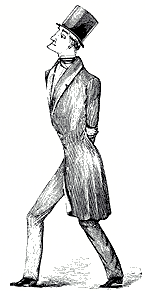
The buzz of Boston in 1849-50, the Parkman-Webster murder case began with the disappearance of one of the crimson’s great benefactors, George Parkman, a Boston Brahmin known for his Ministry of Silly Walks gait about town (see right). According to Oliver Wendell Holmes, Sr. (who appeared as a witness at the trial of Parkman’s accused murderer), “he abstained while others indulged, he walked while others rode, he worked while others slept.”

Also, he inherited a ridiculous sum of money, and was tight with the debtors to whom he lent it.

Back before collection agencies, Parkman disappeared in November 1849 while making the rounds to shake down his borrowers. Within days, suspicion settled on Harvard anatomy and geology professor John Webster, who had squandered his own pile of money buying rock collections and maintaining appearances and such, and sank into desperate hock to the jutting-chinned ambulator who had helped him land the Ivy League appointment in the first place.

A weighty circumstantial case soon formed against Webster, with the invaluable aid of a snoopy janitor who turned up human remains in the office and testified to incriminating-sounding conversations.

Elites-on-elite crime epidemics always churn the scandal mills. Henry Wadsworth Longfellow’s wife Fanny wrote a friend,

You will see by the papers what dark horror overshadows us like an eclipse. Of course we cannot believe Dr. Webster guilty, bad as the evidence looks. … Many suspect the janitor, who is known to be a bad man and to have wished for the reward offered for Dr. Parkman’s body. … I trust our minds will be soon relieved, but, meanwhile, they are soiled by new details continually.

“Harvard professors do not often commit murder,” or so they say. (This was still a century before Robert McNamara.)

Boston high society was about to see a whole different side of Harvard.

Although perhaps individually explicable — anatomists had plausible reasons to have human remains at work, and other anatomists than Webster could have had access to his office — the cumulative weight of Webster’s ham-handed attempts to declare that he had paid up his debts to Parkman just before the latter’s mysterious disappearance, of the discovery of what (disputed) dental forensics declared to be Parkman’s dentures, of the ghastly appearance of a torso (disputedly) declared to be Parkman’s stuffed in a tea chest at Webster’s offices started to really make the man look guilty.
In view of a mediocre defense, the jury convicted Webster of whacking his own professional benefactor, in the university building erected on said benefactor’s donated plot of land.

Talk about donor recognition.

While the prof’s seeming post-conviction acceptance of guilt — in a plain strategem to secure clemency — and generally shifty demeanor have cemented him as the definitive perpetrator in the standard historical reading,* Fanny’s snobbish take on the “bad man,” janitor (and moonlight body-snatcher) Ephraim Littlefield, has not been entirely lost to the tradition.

At the end of the day, everything about the case is circumstantial — indeed, besides being historically noteworthy for the first use of dental forensic evidence in a murder trial (forensics we might find rather speculative and unconvincing today), Webster’s case generated a landmark ruling from the judge’s jury instruction establishing “reasonable doubt” as the threshold for criminal conviction rather than the “absolute certainty” Webster’s prosecutors had no hope of attaining; that ruling influences American jurisprudence down to the present day.

And one cannot but notice how many of the circumstances — creepily playing Sherlock Holmes with a freelance dig into the professor’s furnace to discover charred bones, for instance — were provided by the fellow-suspect-turned-star-witness Littlefield, who niftily reaped the $3,000 reward for his offices in substituting Webster for himself under the pall of suspicion.

According to peripatetic crime blogger Laura James, a forthcoming (2009) book promises to revisit the sensational trial, “to examine all the intricacies for ourselves — not aided by the eager voice of the janitor.”

* Bemis, one of the prosecutors, wrote the go-to source on the Webster trial, available from Google Books; another contemporaneous account is here.

On this day..

1807: James McLean, twice

On this date in 1807, James McLean survived one hanging but not a second at Batavia, N.Y.

Subject of the first public execution in Genesee County, the drunken Scottish immigrant had axed to death a fellow squatter in an argument … and then a second man who ran to his victim’s aid … and then almost a third who was saved by flight.

This minor execution is the subject of an extensive historical inquiry* by a descendant of one of the victims full of period color: the defendant claiming the (then-recognized) right to a jury consisting of half non-citizen aliens as a “jury of his peers”; the billing receipts for the manhunt and the gallows construction (including gallons of brandy for the guards); and the indeterminate legends about what happened when the rope broke the first time.

The story has been told and retold that during the hanging the rope broke and McLean fell to the ground, shaken and stunned but alive. While another rope was being secured, McLean was reputed to remark, “As I killed two men, I deserve two hangings.” Another version has McLean protesting a second hanging since he had been convicted of only the one murder and had already been hung for that.

However, a historian’s recounting of the era’s newspaper accounts claims

that when the weight fell, the rope broke and McClean fell to the ground. He soon recovered from the shock and rising to his feet, expressed a strong desire not to be “hung again.” Some insisted that one hanging was a fulfillment of the law. Others, however, thought differently and informed McClean that “as he had killed two men, he ought to be hung twice.”

* The writer’s use of “gibbet” to mean an apparatus for a “sudden suspension” hanging, where the prisoner is not dropped but jerked into the air by a countervailing weight, is non-standard; “gibbet” means a gallows (or certain types of gallows structures, if you’re persnickety about it), and became a verb signifying the salutary posthumous display upon such a structure of an executed prisoner’s remains.

On this day..

1979: Eleven by a Firing Squad in Iran

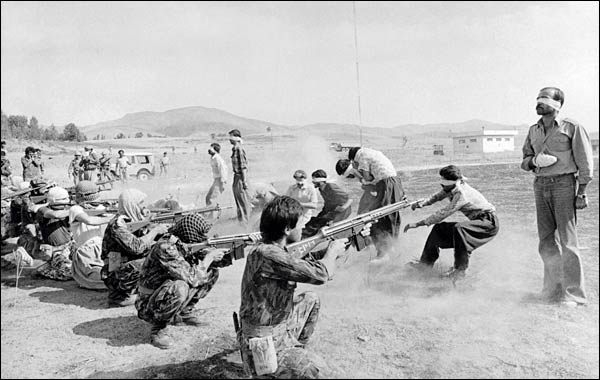
On this date in 1979, the only anonymous photograph to win a Pulitzer Prize captured nine Kurdish rebels and two of the Shah’s policemen executed by firing squad in revolutionary Iran.

This shot, one of a series taken of the event with the permission of the judge who condemned the men to immediate death in a half-hour trial at the Sanandaj airfield, ran the next day in the Iranian paper Ettela’at, whose editor prudently kept the photographer’s identity secret. Within two days, the stunning photo had rocketed around the world.

It won the Pulitzer Prize for Spot News Photography the following spring, still credited anonymously.

Two years ago, the Wall Street Journal revealed — with the photographer’s permission — the identity of the man who shot this indelible image: Jahangir Razmi, who had gone on to a career as one of Iran’s top photographic journalists. He came to New York to collect the prize 27 years late.

The article breaking the story is still available on the Journal‘s website, and on the personal site of reporter Joshua Prager. An NPR story discussing the search for Razmi’s identity is here.

On this day..

1305: William Wallace, Braveheart

On this date in 1305, Scottish knight Mel Gibson — er, William Wallace — was hanged, drawn and quartered at Smithfield for treason to a British crown he refused to recognize.

Just like so:

Well, close enough. Some wags have alleged one or two historical liberties in Braveheart.

Among the lesser (but more pertinent here): that they weren’t — you knew this already — offering the former Guardian of Scotland the opportunity to reduce his suffering with a public submission, or use the stage for theatrical defiance. Hanging, drawing and quartering was a brand new execution Edward I was experimenting with for emasculating, disemboweling, and (so the idea went) utterly cowing the rebellious hinterlands of the British Isles. Wallace may have been just the second person to suffer it.

But only a pointy-headed blogger could possibly care when the main point is that back before Christendom succumbed to nancy decadences like Vatican II, men wore woad, defenestrated queers, and tapped top-shelf babes.


Among the few things known for certain about William Wallace is that he did not score with Isabella of France. Or with Sophie Marceau.

Facts? This is show business!

Mel’s bloodbath only riffs the already-fantastic 15th century epic of “the Wallace” by Scottish minstrel Blind Harry, which in turn got a lyrical call-out in Robert Burns’ 18th century Scottish patriotic tune Scots Wha Hae.

National martyrs — and, sure, it helps to die at the right time, as Wallace did just before Robert the Bruce secured Scottish independence — feed a train of hungry authors and ready audiences in every time, place and medium.

However genuinely flesh-and-blood the limbs that wrought his feats and were torn apart on this day, Wallace returns to his generations of interlocutors half-shrouded in mythology. Seven centuries on, his contested (and sometimes absurd) use as precedent or metaphor stakes a claim to his Truth at least as compelling as battlefield tactics at Stirling Bridge. What does he “really” have to tell us? No matter how grisly his end, William Wallace doesn’t get to decide: it’s between you, me, Mel, and a few billion other folks.

Only a character really worth remembering is worth that kind of fictionalizing.

On this day..

1191: Muslim prisoners at Acre

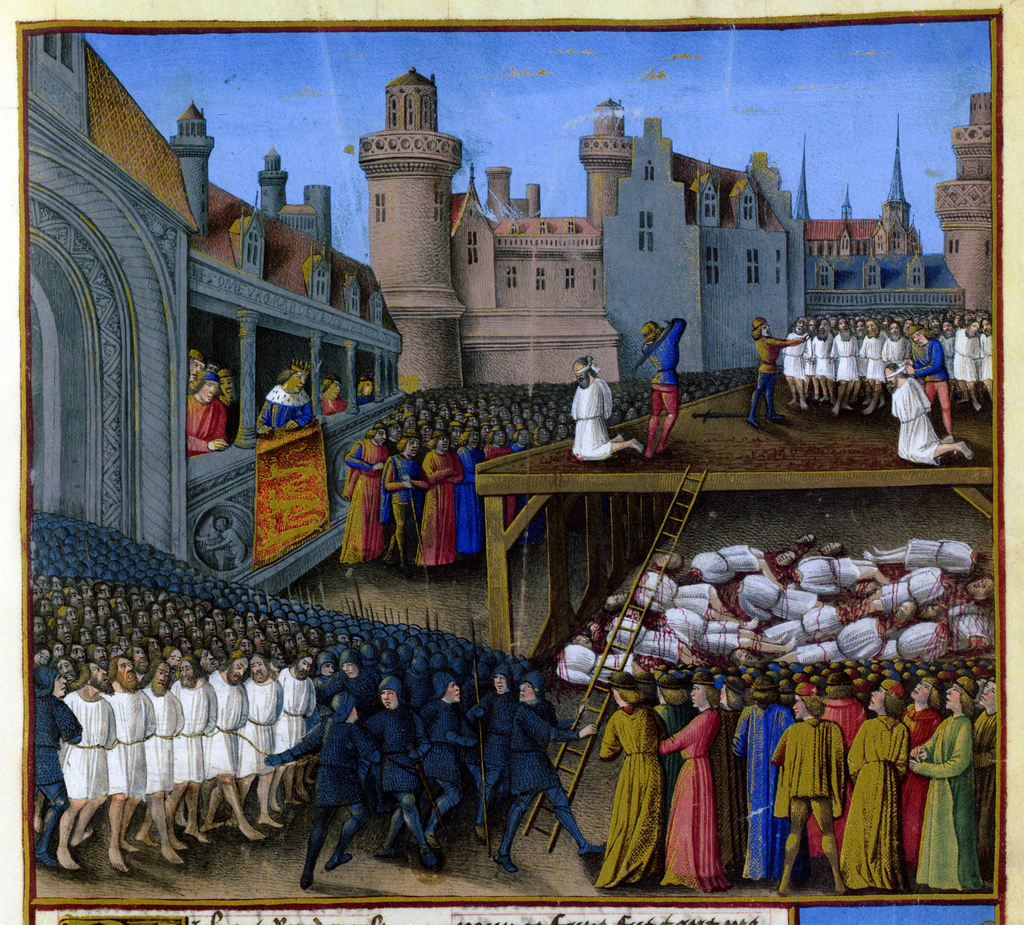
On this date in 1191, Richard the Lionheart had 2,700 Muslim prisoners of Acre demonstratively executed before his opposite number Saladin, when ransom arrangements dilated.

Courtesy of Project Gutenberg, here is Guizot on this ugly prod to action from the Third Crusade

From the 1st of August, 1191, to the 9th of October, 1192, King Richard remained alone in the East as chief of the crusade and defender of Christendom. He pertains, during that period, to the history of England, and no longer to that of France. We will, however, recall a few facts to show how fruitless, for the cause of Christendom in the East, was the prolongation of his stay and what strange deeds—at one time of savage barbarism, and at another of mad pride or fantastic knight-errantry—were united in him with noble instincts and the most heroic courage. On the 20th of August, 1191, five weeks after the surrender of St. Jean d’Acre, he found that Saladin was not fulfilling with sufficient promptitude the conditions of capitulation, and, to bring him up to time, he ordered the decapitation, before the walls of the place, of, according to some, twenty-five hundred, and, according to others, five thousand, Mussulman prisoners remaining in his hands.

The only effect of this massacre was, that during Richard’s first campaign after Philip’s departure for France, Saladin put to the sword all the Christians taken in battle or caught straggling, and ordered their bodies to be left without burial, as those of the garrison of St. Jean d’Acre had been. Some months afterwards Richard conceived the idea of putting an end to the struggle between Christendom and Islamry, which he was not succeeding in terminating by war, by a marriage. He had a sister, Joan of England, widow of William II., king of Sicily; and Saladin had a brother, Malek-Adhel, a valiant warrior, respected by the Christians. Richard had proposals made to Saladin to unite them in marriage and set them to reign together over the Christians and Mussulmans in the kingdom of Jerusalem. The only result of the negotiation was to give Saladin time for repairing the fortifications of Jerusalem, and to bring down upon King Richard and his sister, on the part of the Christian bishops, the fiercest threats of the fulminations of the Church. With the exception of this ridiculous incident, Richard’s life, during the whole course of this year, was nothing but a series of great or small battles, desperately contested, against Saladin. When Richard had obtained a success, he pursued it in a haughty, passionate spirit; when he suffered a check, he offered Saladin peace, but always on condition of surrendering Jerusalem to the Christians, and Saladin always answered, “Jerusalem never was yours, and we may not without sin give it up to you; for it is the place where the mysteries of our religion were accomplished, and the last one of my soldiers will perish before the Mussulmans renounce conquests made in the name of Mahomet.”

Good thing that Jerusalem issue has since been cleared up.

The BBC treated the scenario — complete with the resultant loss of the last chunk of the supposed True Cross — in a chunk of its 90-minute documentary on the Third Crusade:

On this day..