1894: Sante Geronimo Caserio, anarchist assassin

On this date in 1894, Sante Geronimo Caserio was guillotined in Lyon, where he had assassinated the president of France two months before.

In the day when the terror stalking European order brandished the black flag of anarchy, the Italian immigrant Caserio (his first name can be rendered either Sante or Santo, and his middle name alternately as Jeronimo, Ironimo or Heironymus) escalated the “propaganda of the deed” into the nightmares of Europe’s executives.

Retaliating for the executions of two previous anarchists, August Vaillant and Emile Henry, Caserio (English Wikipedia entry | Italian | French) stepped up to the carriage of Marie Francois Sadi Carnot on the night of June 24-25 and efficiently planted a dagger in his heart.

Before the decade was out, the Prime Minister of Spain, the King of Italy and the Empress of Austria-Hungary would all likewise be murdered by Italian anarchists.

As one might imagine, Caserio played the role of cocksure martyr to the hilt: asked whether he repented, he vowed to kill another president if given a few minutes; he refused to pursue a mental illness defense or inform on comrades; and at the guillotine, he exhorted the onlookers, “Forza, compagni! Viva l’anarchia!” (The New York Times account of the beheading recounts Caserio’s background, from an obviously hostile class position.)

By the time Caserio lost his head, the propaganda of his deed had already provoked mass arrests of Italians, and a tightening of the lois scelerates (“villainous laws”) cracking down on dissidents.

But as always, one person’s evildoer is another’s hero, and Caserio has his online monuments — like this Italian page, or this blog entry, or this rendition of one of the several songs in his honor:

In an artsier vein, one can also follow the thread of the story to Les Bal des Innocents, a downloadable French production billing itself as “The first feature film under Creative Commons Licence.”

On this day..

1936: Rainey Bethea, America’s last public hanging

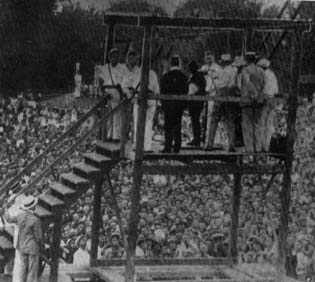
On this date in 1936, thousands thronged Owensboro, Kentucky, for a glimpse of what would prove to be the last public hanging in the United States.

The U.S. followed the trend of its onetime mother country, England, in moving the formerly iconic public hanging increasingly behind closed doors, but its federalist structure made that change uneven. In Kentucky itself at this time, the law displayed sedimentary layers of death penalty history.

Caught up for killing a 70-year-old woman — done in the midst of a drunken burglary, he had left a telltale ring at the scene; fingerprint analysis also helped establish his guilt — Rainey Bethea was on the hook for murder, robbery and rape. The former two indictments would have subjected him to (private) electrocution at the state penitentiary. The latter charge still carried the punishment of public hanging in the local county seat.

Bethea was charged only with rape.

While the explicit sentencing disparity between the crimes bears the clear marks of racism and patriarchy that made purported black-on-white sexual crimes such live fodder for lynch law, and the four-and-a-half-minute jury deliberation doesn’t have the look of solemnity, Bethea’s actual guilt seems fairly well-established.

But the case attracted a nationwide media swarm not for any exceptional quality of the crime or the anachronistic nature of the punishment, but for the involvement of a female sheriff. The “matronly” (virtually all descriptions of her gravitate to this adjective) Florence Thompson had inherited the top law enforcement post upon the death of her husband … and that meant she had inherited the responsibility of hanging Rainey Bethea, which would make her the first American woman to supervise an execution.

Would she or wouldn’t she? The press descended on Owensboro to cover the edifying spectacle of a plump mother stringing up a rapist, or else maneuvering her way out of the job. Thompson played cagey until the very last moment, when the ringers she had secretly hired appeared on the scaffold while she watched from a nearby vehicle.

In this photo, Bethea — almost totally obscured between his escorts — has just begun ascending the gallows.

The man who threw the trap showed up drunk and performed appallingly, but press reports subsequently focused on the beastly behavior of the “jeering” crowd rushing the gallows to tear souvenirs from the corpse. (For instance, Time and the New York Times.)

But according to Perry T. Ryan’s 1992 review of the case — including interviews with surviving witnesses — little to nothing of the kind occurred. Ryan claims Bethea faced about the most dignified hanging mob imaginable.

Maybe hyped-up atrocities in the hinterlands were part of what distant editors demanded after H.L. Mencken at the Scopes trial. Certainly, the local Messenger-Inquirer painted a sharply different picture from more prominent outlets in this August 16 editorial (titled “Panderers Galore”) whose themes could have stepped fresh from a modern cable TV gabfest:

Ambitious and irresponsible reporters and photographers who swarmed into Owensboro for the Bethea hanging dipped their ready hands into the cloaca of evil designs and plastered over the name of this fair city the dirty results of their pandering.

Those who saw the dawn kindling in the east and ushering in the last sunrise of the despicable creature about to die, did not expect all of the watchers to be in reverent mood, but a calm, quiet demeanor characterized their behavior, as a group, throughout their long wait, surprisingly moderate for an occasion on which the law was exacting the supreme penalty.

Considering the size of the throng that witnessed the hanging Friday morning and that it was composed largely of people, who journeyed to Owensboro from distant places, the wonder is that there was no demonstration, no emotional outburst. There was not the semblance of ‘mob impulse’ or ‘eagerness for the kill.’ For the sensation seeking star scribes of quacks of American journalism, it was entirely too tame an affair. This is the reason that some of them reported it as they wanted it to be — not as it was.

They heard a very few people on the outskirts of the crowd call out at different times: ‘Hurry up,’ ‘Get it over’ or ‘hang him.’ To give screaming bulletins to the yellow press and to ruthless radio commentators, they magnified and colored it into a scene of ‘great disorder’ though there was never a general outcry of any kind.

When a priest held up his hand from the scaffold for silence, as Bethea was about to go to his death, there was no ‘blood thirst’ mob ‘shouting and yelling.’ Present were several thousand, who came from near and far to see a man legally hanged for the most heinous crime ever committed in Daviess county, and several thousand more, who turned out to see how the rest would act. When that hand went up in a gesture for silence, the buzz of the multitude’s conversations died down till the fall of the proverbial pin could have been heard.

The smart scribes and sob sisters looked on. All they saw was a black man standing on a scaffold with a rope around his neck and a mass of people peering up at him. That was too tame, they would call it a ‘jeering’ throng. All they heard was the click of the trap door. That would not do. There would have to be ‘cheering.’ So they said there was. Then they heard cameramen from cities where nothing is cared about the horrible crime Bethea committed. They were bawling at officials to ‘move out of the way,’ to ‘give us a break.’ They had to have their souvenirs to show the half civilized readers of their yellow sheets. The boys and girls who had to tell the story needed more color to regale them with atrocious accounts of how the people behaved. They found a few individuals who had gone in the bizarre which inspired thundering headlines about ‘gayety’ and ‘carnival’ spirit.

In administering the last sacrament, the Rev. H. J. Lammers, of Louisville, made an opening in the hood. When the doctors pronounced Bethea dead, one of the attendants at the scaffold took a tag off the hood. Another then took a fragment and others, who were at arms length from the dead man, followed suit. The blunder of tearing off that tag gave the high powered thrill-writers their big opening. They pictured the crowd as tearing Bethea’s clothes from his body. The crowd was never in disorder and Bethea’s clothes were never torn.

The ‘souvenir hunting mob’ did not even pick up the sox [sic] and shoes the doomed man left at the foot of the gallows. It did not so much as touch the basket in which Agnew and Wheatley, colored undertakers, placed the body, clothes and all, or molest it or them in the slightest as they bore it away.

The scavenger writers who came to depict a ‘jolly holiday’ and ‘gala occasion’ had both, but they never saw a more orderly throng at a baseball game.

The public hanging of Bethea was not a disgrace to Kentucky. But, a disgrace to Illinois, Missouri, Tennessee, and some other states, was the spectacle made of it in their scandal monger press. Owensboro should not be surprised at the scurrilous attack upon it by lurid writers and glib tongued talkers in northern and eastern states for they delight to distort any news from Kentucky into weird barbaric tales. We have learned how best to protect our women from rapists-murderers, white or colored. The only way, it seems, that we will ever be able to protect them from the cruelties of a sordid section of the press, will be by softening the state’s anti-rape law, which makes public hanging mandatory. So many as favor that will please tell the legislature.

Vendors of news occupy an important place in the nation, and their purpose should always be to maintain unquestioned exactness of facts. Where the subject matter is susceptible to coloring there should be no sacrifice of truth. To pervert the high honor of the profession for the paltry reward of more readers is a dangerous venture and one that should be curbed.

Owensboro’s citizenry, than which no finer representatives of high-bred Americans can be found anywhere, regrets that it was necessary to invoke the Mosaic law, but a sobered regret and a more solemn memory is that the hanging was eagerly seized upon and transformed into a picturization of the exhibition of low passions loosed.

We are proud of our city, and justly so, for no people are of finer fiber. The putrid pens of those who wore the garb of the news profession painted in lurid colors purported happenings, and it is sad but true that such distorted reports are accepted while the plain statement of facts is discarded as an attempted apology.

Thousands of those who witnessed the Bethea hanging came from outside the county. They belonged to good families in their communities, temporarily bereft of their better judgment and bent on viewing a scene which ordinarily would be extremely repugnant to them. And the out-of-town reporters found in the visitors elements to embody in their sordid stories.

A thoughtless word here and there, expressed without cognizance of its probability of misuse, and the staid citizen away from home becomes to the wild-eyed correspondent a Kentuckian gunning for human game. There should be available means of calling to account the writer who for a few filthy shekels diverts his sense of justice into the recording of things that never were.

As the editorial intimates, regardless of what actually happened in Owensboro, the circus atmosphere quickly brought the matter of public hangings into question. In 1938, the Kentucky legislature moved all executions behind prison walls … and Bethea secured an indefinite claim to the status of last person publicly executed in the United States.

Part of the Themed Set: At the End of the Rope.

On this day..

1676: Malin Matsdotter and Anna Simonsdotter, ending a witch hunt

On this date in 1676, two starkly contrasting women were executed for sorcery in Stockholm.

Anna Simonsdotter Hack — also known as “Tysk-Annika” — is the forgotten one of the pair, who played the expected role of a condemned witch and meekly gave herself over to the judgment. There were rewards for good behavior: Tysk-Annika had her head cleanly lopped off.

Malin Matsdotter, however, did not plan any reciprocal back-scratching with the men who came to kill her.

Accused by her own daughters of carrying their children — Malin’s grandchildren — to Satanic masses, “Rumpare-Malin” obstinately refused to cop to the charge. (Naturally, not confessing was a further indicator to the court that Satan was fortifying her defiance.) Without a confession, the authorities couldn’t assuage themselves by giving her the easy-ish death of decapitation; the law required burning at the stake.* A sack of gunpowder around the neck to speed things up was the best they could offer her.

Matsdotter maintained her innocence to the stake, frustrating the confessors, and when one of her daughters called on her to admit the crime, “she gave her daughter into the hands of the devil and cursed her for eternity.”

And maybe it worked. Judges may well have been wearying of the eight-year-old witch craze, but Matsdotter’s discomfiting end was the turning point; the cases dried up, existing sentences were overturned, and the clergy was summoned to draw a line under the proceedings by announcing from the pulpits that witches had been driven out of Sweden for good. Only one more witchcraft execution ever took place in Sweden — and that in 1704.

By the end of 1676, several of the most notorious accusers in the witch trials were being hunted for perjury by those very same courtrooms. Reportedly, Matsdotter’s daughter was herself executed for her fatal accusation.

* Previously, the law had not allowed a witchcraft execution without a confession, and in a notable case a few years before Matsdotter’s burning, two other women had escaped death by refusing to confess. Evidently, they closed that loophole.

On this day..

1343: Olivier III de Clisson, husband of the Lioness of Brittany

On this date in 1343, a noble widow’s career in piracy got its start where such ventures more usually end: the scaffold.

Olivier III de Clisson beheaded with his knights, in an illustration of Froissart.

Olivier III de Clisson, a powerful Breton noble nominally loyal to France, had been persuaded to ally with England’s Edward III in what nobody yet realized was the opening stage of the Hundred Years’ War.

Intriguing to advance a claim to the French throne, Edward knew right where to look. “Brittany was France’s Scotland, choleric, Celtic, stony, bred to opposition and resistance, and ready to use the English in its struggles against its overlord as the Scots used the French in theirs,” Barbara Tuchman wrote. And the Breton War of Succession was just the sort of pretext for meddling.

Clisson was one of the great lords of the region, and in the feudal era where liege relationships counted more than “nationality,” his alliance would swing a considerable network of retainers to the English cause.

He was hardly the only one, according to Jonathan Sumption’s The Hundred Years War:

The duchies of Brittany and Normandy seemed to [the French king Philip VI] to be seething with rebels, led by the very noblemen who had promised to serve him till his dying day. He was shocked and puzzled.

When Clisson’s (apparent) lord Philip VI got wind of the secret deal, he invited Olivier to a joust in Paris and had him arrested. Then, as knight follows day …

In the year of grace one thousand three hundred and forth-three, on Saturday, the second day of August, Olivier, lord of Clisson, knight, prisoner in the Chatelet of Paris for several treasons and other crimes perpetrated by him against the king and the crown of France, and for alliances that he made with the king of England, enemy of the king and kingdom of France, as the said Olivier … has confessed, was by judgement of the king given at Orleans drawn from the Chatelet of Paris to Les Halles … and there on a scaffold had his head cut off. And then from there his corpses was drawn to the gibbet of Paris and there hanged on the highest level;* and his head was sent to Nantes in Brittany to be put on a lance over the Sauvetout gate [as a sign of his treason]. (Cited here.)

That’s chivalry for you.

The unexpected turn came while Clisson’s headless corpse was clanking away on the gibbet: his warlike, 40-something wife Jeanne de Clisson vowed vengeance, sold off the Clisson estates to buy a small fleet, and turned privateer, murderously ravaging French shipping along the Breton coast and reportedly personally beheading aristocrats she could get her hands on.

After more than a decade of avenging Olivier, the “Lioness of Brittany” retired triumphantly to England to remarry the sort of British toff whose preference ran towards strong women.

Her son, also named Olivier de Clisson, returned to fight in the Hundred Years War on the side of England … and eventually defected back to the French.

* Meaning, at the imposing tiered gallows of Montfaucon.

On this day..

1963: 21 Iraqi Communists

On this date in 1963, Iraq’s infant Ba’ath government executed at least 21 soldiers — all Shi’a — who had participated in a Communist coup attempt on July 3.

The Ba’ath were newly in the saddle after overthrowing Qasim earlier that year, and would be ousted again a few months hence before their definitive seizure of power several years later.

For the moment, they were a fledgling government trying to tilt away from the Soviet bloc and towards the west while navigating a minefield of domestic politics. If the coup really occurred as described, it was the fruit of an Iraqi Communist Party with daggers drawn for the regime after the Ba’athists had massacred their membership with CIA help in the course of offing Qasim. (The name is also transliterated Qassim or Kassem.) If it was bogus, it was probably an official cover story to keep massacring Shi’a Communists.

The affair, in either guise, amounted to a minor hazard in the jagged path of the Ba’ath — but of course, we come by that judgment with benefit of hindsight. Far more interesting to follow, courtesy of this site‘s library of historic cables, the perceived unfolding of the situation through the anxious American diplomatic pouch:

On this day..

1747: Alexander Blackwell, who left them smiling

On this date in 1747,* the Swedes beheaded Scottish-born adventurer Alexander Blackwell for meddling with their line of succession.

Blackwell, “a man of mercurial and adventurous temperament,” had his printing business busted in England for having failed to precede it with the required apprenticeship, and was thrown in jail as a debtor.

To extricate the family from poverty, Blackwell’s wife Elizabeth thereupon launched an amazing career as an herbal limner, drawing, engraving, and hand-coloring editions with hundreds of plants that became a standard reference in the field in the late 1730’s, and whose revenues managed to liberate her spouse. (Elizabeth is still remembered on a plaque at the Chelsea Old Church, in her old neighborhood.)

That mercurial ex-deadbeat might have done better to stick close by his now highly esteemed wife (or possibly his brother, a bloviating classicist), but the wanderlust sent Alex abroad to wash ashore in Stockholm as physician to King Frederick I, where he was soon convicted (on evidence uncertain, apart from the torture-extracted confession) of having intrigued to alter the royal line of succession further to enmeshing Sweden in an alliance with Britain.

He protested his innocence on the scaffold. More memorably, perhaps, he laid his head the wrong way upon the chopping block, requiring the executioner to correct him — whereupon Blackwell cracked wise that he, after all, lacked experience at the art of being beheaded.

Mental Floss mined this outstanding exemplar of gallows humor in a cartoon about memorable exits. (Via History News Network.)

* Some sources, like this Google Books biography, offer August 9 as Blackwell’s execution date. The 11-day discrepancy is due to the still-pending adoption of the Gregorian calendar: July 29 was the date on the Julian calendar still in use in the realms both of Blackwell’s birth and death; in 1752 and 1753, respectively, Britain and Sweden would adopt the Gregorian system.

On this day..

1794: Maximilien Robespierre, Saint-Just and the Jacobin leadership

On this date in 1794, the curtain — and the blade — fell on the Terror.

Maximilien Robespierre, who had breakfasted the previous day as master of France, was guillotined this evening with his chief lieutenants and partisans.

His fall came as sudden and inevitable as his rise had been unpredictable.

Five years before, Robespierre was an unprosperous Arras attorney of fashionably liberal philosophies, and you wouldn’t have given a sou for the prospects of his being remembered five minutes after he died. Yet it would come that his inseparable lieutenant Saint-Just would remark with understatement, “The words we have spoken will never be forgotten on earth.”

The historic convocation of the Estates-General thrust him onto the political stage where he would make the dread name that follows him, starting off in the Revolution’s inception as a far-left deputy. He took a notable early stand against the death penalty, with several arguments that are quite familiar by our day:

The first obligation of a legislator is to form and preserve public morals, the source of all freedom, source of all social happiness. When in running to a particular goal he turns away from this general and essential goal he commits the most vulgar and dire of errors. The king must thus present to the people the purest model of justice and reason. If in place of this powerful, calm and moderate severity that should characterize it they place anger and vengeance; if they spill human blood that they could spare and that they have no right to spread; if they spread out before the people cruel scenes and cadavers wounded by torture, it then alters in the hearts of citizens the ideas of the just and the unjust; they plant the seed in the midst of society of ferocious prejudices that will produce others in their turn. Man is no longer for man so sacred an object: we have a less grand idea of his dignity when public authority puts his life at risk. The idea of murder inspires less fear when the law itself gives the example and the spectacle. The horror of crime is diminished when it is punished by another crime. Do not confuse the effectiveness of a penalty with the excess of severity: the one is absolutely opposed to the other. Everything seconds moderate laws; everything conspires against cruel laws.

For Robespierre, it was an abomination for the nation to deal out death within its community, but his Rousseauan elevation of the collective and abstract People made extirpating existential threats to the community itself an altogether different matter.

The future tyrant’s anti-death penalty case for executing the deposed Louis XVI, flowing directly from those principles, makes interesting reading and is excerpted at length (all emphases added) here for its topicality:

When a nation has been forced to resort to the right of insurrection it returns to a state of nature as regards its tyrant. How can the latter invoke the social compact? He has annihilated it. The nation can preserve it still, if it thinks fit, in whatever concerns the interrelations of its citizens: but the effect of tyranny and insurrection is to break it entirely as regards the tyrant; it is to throw them into mutual war; the tribunals, the judiciary procedures, are made for the members of the city. … The right to punish the tyrant and that to dethrone him are the same thing. The one does not admit of different forms from the other. The tyrant’s trial is insurrection; his judgment is the fall of his power; his penalty, whatever the liberty of the people demands.

Peoples do not judge like judiciary courts. They pass no sentences; they hurl the thunderbolt. They do not condemn kings: they thrust them back into oblivion; and this justice is not inferior to that of courts. If they arm themselves against their oppressors for their own safety, why should they be bound to adopt a mode of punishing them which would be a new danger to themselves?

…

As for me, I abhor the penalty of death so lavish in your laws, and I have neither love nor hatred for Louis. Crimes only I hate. I have asked the Assembly, which you still call Constituent, for the abolition of the death penalty, and it is not my fault if the first principles of reason seem to it moral and political heresies. But if you never bethought yourselves to invoke them in favor of so many unfortunates whose offenses are less their own than those of the government, by what fatality do you remember them only to plead the cause of the greatest of all criminals? You ask an exception to the death penalty for him alone against whom it can be legitimate! Yes, the penalty of death generally is a crime, and for that reason alone, according to the indestructible principles of nature, it can be justified only in cases when it is necessary for the safety of individuals or the social body. Public safety never demands it against ordinary offenses, because society can always guard against them by other means and make the offender powerless to harm it. But a dethroned king in the bosom of a revolution which is anything but cemented by laws, a king whose name suffices to draw the scourge of war on the agitated nation, neither prison nor exile can render his existence immaterial to the public welfare: and this cruel exception to ordinary laws which justice approves can be imputed only to the nature of his crimes.

It is with regret that I utter this fatal truth. But Louis must die, because the country must live.

“Pity is treason.”

Months later, as head of the Committee of Public Safety — the Orwellian name harkens to the body’s power to judge who lay inside the community and who, lying outside, made war upon it — he would find an inexhaustible fifth column of kindred threats to the Revolution.

But Revolutionary France really was in a war for its survival, against external and internal foes alike. The monarchist for whom crime multiplied upon crime every day after the Tennis Court Oath has the easiest time of this period, for every step brings a new monstrosity. And it is well enough to call Robespierre illiberal, to shudder at his prim and icy persona.

But if the French Revolution’s liberte, egalite, fraternite is a legacy for celebration — as it is to much of the west, and much of the world — one must grapple with the place of this man and his methods.

Merely because they are the paths not taken, one hardly seems entitled to assume that at that tumultuous moment the rule of a constitutional monarchy heir to all the monstrosity of the ancien regime, the government of the Girondins who had launched the nearly fatal war against Austria, or that of Danton‘s haute bourgeoisie would necessarily have delivered France to a better place, or even a different one.

For a Dickens, Robespierre’s Terror is simply the appalling wrong turn of a high-minded movement. For Trotsky, “the Incorruptible”* is the admirable sword of France’s bourgeois revolution who effects the needful task of annihilating the feudal nobility, who presses fearlessly forward seeing that the only alternative is the slide into Bonaparte. Between the two lie many readings of the man.

Whether an aberration, a visionary, or a necessity, he waded a sea of blood for his frightening twins Virtue and Terror.

The fall of 9 Thermidor preceded Robespierre’s execution by a full — and very eventful — day. Arrested by the Convention, he was promptly liberated by his base in the Paris Commune which came within a whisker of overthrowing the Convention at that very moment. Instead, a frantic few hours of marshaling the armed power of the Revolution’s rival claimants to leadership ensued ending in a fray which saw the Robespierrists overpowered.

Robespierre was shot through the jaw in the process of signing an appeal to arms — some say a botched suicide, but a wound from the invading national guard is more generally believed; at any rate, the bloodied document with his signature begun “R-o-” is one of the age’s most arresting historical artifacts.

Horrifically injured, he lay most of the following day exposed for public derision before he was hauled with his party to the guillotine, re-erected in the Place de la Revolution for this most memorable execution. In Carlyle’s florid (and free) narration:
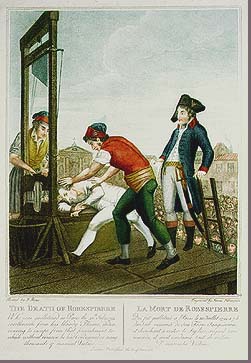
Robespierre lay in an anteroom of the Convention hall, while his Prison-escort was getting ready; the mangled jaw bound up rudely with bloody linen: a spectacle to men. He lies stretched on a table, a deal box his pillow; the sheath of the pistol is still clenched convulsively in his hand. Men bully him, insult him: his eyes still indicate intelligence; he speaks no word. … -O reader, can thy hard heart hold out against that? His trousers were nankeen; the stockings had fallen down over the ankles. He spake no more word in this world.

…

Fouquier had but to identify; his Prisoners being already Out of Law.** At four in the afternoon, never before were the streets of Paris seen so crowded. From the Palais de Justice to the Place de la Revolution … it is one dense stirring mass; all windows crammed; the very roofs and ridge-tiles budding forth human Curiosity, in strange gladness. … All eyes are on Robespierre’s Tumbril, where he, his jaw bound in dirty linen, with his half-dead Brother, and half-dead Henriot, lie shattered; their “seventeen hours” of agony about to end. The Gendarmes point their swords at him, to show the people which is he. A woman springs on the Tumbril; clutching the side of it with one hand; waving the other Sibyl-like; and exclaims: “The death of thee gladdens my very heart, m’enivre de joie;” Robespierre opened his eyes; “Scelerat, go down to Hell, with the curses of all wives and mothers!” — At the foot of the scaffold, they stretched him on the ground till his turn came. Lifted aloft, his eyes again opened; caught the bloody axe. Samson wrenched the coat off him; wrenched the dirty linen from his jaw: the jaw fell powerless, there burst from him a cry; — hideous to hear and see. Samson, thou canst not be too quick!

Samson’s work done, there bursts forth shout on shout of applause. Shout, which prolongs itself not only over Paris, but over France, but over Europe, and down to this generation. Deservedly, and also undeservedly. O unhappiest Advocate of Arras, wert thou worse than other Advocates? Stricter man, according to his Formula, to his Credo and his Cant, of probities, benevolences, pleasures-of-virtue, and such like, lived not in that age. A man fitted, in some luckier settled age, to have become one of those incorruptible barren Pattern-Figures, and have had marble-tablets and funeral-sermons. His poor landlord, the Cabinet-maker in the Rue Saint-Honore, loved him; his Brother died for him. May God be merciful to him, and to us!

Part of the Themed Set: Thermidor.

* Even his enemies agreed — sometimes adding it to the bill of particulars against him — that Robespierre lived a life of personal moderation; he lived as a boarder with a working-class family, and disdained to avail the politician’s typical harvest of political graft.

** The Convention had decreed Robespierre’s outlawry when he escaped custody; his immediate execution was, of course, akin to the logic he had once turned against the king.

On this day..

1794: The last cart of the Terror, not including the Marquis de Sade

July 27th, 1794 — the 9th of Thermidor, year II — is inscribed in history as the day Robespierre fell, when a parliamentary coup d’etat between the right and the remnants of the parties he had destroyed shouted him down as he readied the National Convention for his next purge.

This scene from the multinational bicentennial epic La Revolution Francaise conflates the events of 8 Thermidor — when Robespierre delivered a menacing two-hour address but provoked outcries by failing to name the deputies he implicated in “conspiracy” — and 9 Thermidor, when Robespierre’s lieutenant Saint-Just was shouted down from the podium and Robespierre ended up staggering through the benches appealing against the imprecations of his colleagues as his arrest is decreed.

Even as the month of Thermidor’s eponymous epochal event was unfolding, the daily gears of Revolutionary justice were turning: the usual haul of unfortunates condemned, including seven women from the previous day’s batch of Saint Lazare prison conspirators who had pled their bellies to buy a day.

That day was one day too little.

Stanley Loomis is overtly hostile to the Revolution, but his middlebrow sensibilities are well-tuned for the pathos of the scene:

Indifferent to the storms that were raging in the Convention, the Revolutionary Tribunal continued to go about its implacable business with cold efficiency. The arrest of its President [the Robespierrist Rene-Francois Dumas (the link is French), who was taken in the courtroom] startled no one. Since its inception that court had been witness to too many dramas to be astonished any further. Dumas quietly departed; the trials continued. Forty-two prisoners were sentenced to death. By four o’clock their hair had been cut and they were ready to be sent on their way. But Samson, aware of disturbances in the St. Antoine quarter of the city, suggested to [prosecutor] Fouquier[-Tinville] that the executions be deferred until the morrow.*

“Justice must take its course,” snapped the Public Prosecutor. “Do your work.”

And so the last “batch” lumbered off in the direction of the Faubourg St. Antoine and the Place de la Nation. With the exception of the Princesse de Monaco, they were nearly all obscure and humble members of the petite bourgeoisie. Hanriot, waving his sabre, conducted the procession to the place of execution. By seven o’clock that evening, as the minutes of the military escort poignantly show, the unfortunate victims, who had been so close to deliverance, had all been executed.

Henriot proceeded directly from his escort service to the Convention to liberate Robespierre for the night’s brief pitched battle against the Convention, and here we take our leave of them, for now. We shall meet both of them on the scaffold tomorrow.

Not on the wagon** with the Princess of Monaco was a man whom Loomis would have pitied rather less.

The bloated, penniless 54-year-old fruit of an ancient noble house, Donatien Alphonse François de Sade, Marquis de Sade had, in the most recent chapter of his astounding career, navigated the Revolution in the improbable guise of a proletarian section head and revolutionary tribunal judge, until his own arrest late the previous year.

This day, de Sade’s name was on a list of prisoners to be seized from Madelonnettes Prison — “Sade, former count, captain of Capet’s guards in 1792, has corresponded with enemies of the republic,” it said — which he had occupied until a recent transfer to Picpus, a monastery converted into a prison adjacent to the guillotine’s place at the Place de la Nation. Whether the result of another of the many bureaucratic snafus we’ve witnessed this week or a well-placed bribe from his friend and/or mistress Marie-Constance Quesnet, the guards were in the wrong place, didn’t find him, and didn’t care to dig any further.

Three months later, he was — for the last time in his life — a free man.

One could hardly say that the Revolution made the author of Justine the man he so (in)famously was — but having lived within sight of the blade that might any day be called upon to chop off his own head, and the entire tableau of the years preceding, left their impression. Hundreds of bodies from the Terror were stuffed in the unpropitious clay of the makeshift jail’s yards under de Sade’s cell. “Those few months in the shadow of the guillotine did me more harm than all the years of my incarceration under the King,” he wrote a friend.

According to Writing the Orgy: Power and Parody in Sade, Revolutionary France would inexorably influence his subsequent work,

strangely mixing real memories with very Sadean embellishments … Plots, betrayals, denunciations, beheadings: these fictional motifs and Sadean phantasies are linked with the reality and the imaginary of the Revolution.

Good for what ails you.

* Sanson’s diaries — a memoir of the family business constructed by the famous executioner’s grandson — leave off before the events of Thermidor and suggest that the hecatombs of the Terror were taking their toll on the aging headsman. Other accounts of this day have the tumbrils stopped in the streets by clemency-inclined onlookers, only to be forcibly extricated by Henriot.

** Also not (really) on the cart: the fictional occultist Zanoni, who is beheaded in this batch in the novel of the same title by legendary awful writer Edward George “it was a dark and stormy night” Bulwer-Lytton.

Part of the Themed Set: Thermidor.

On this day..

1794: Loizerolles and others for the Conspiracy of the Prisons

On this date in 1794, the Jacobin government struck what would prove to be its last blow against the “Conspiracy of the Prisons.”

The “conspiracy” was really a cover story for Robespierre‘s boys to wield their purifying torch against prisons and (of course) tighten the grip of authority by wild reference to treasonable plots abroad.

Supposedly, the prisons had birthed a scheme to effect a mass escape further to some sort of counterrevolutionary insurrection, or assassination of Robespierre. Marvelously, these conspiracies simultaneously spanned most all of Paris’ prisons, and their “authors” formed a dominant demographic among the Terror’s last tumbrils as the authorities purged each prison in turn.

While we have tarried to profile select victims individually this week, we have in fact repeatedly met so-called prison conspirators.

Luxembourg Prison — whose warders had concocted the earlier “conspiracy” involving Camille Desmoulins’ wife — had been purged repeatedly earlier in the month; its last spasm swept up the Noailles women.

An efficient detour to the Carmelite Monastery converted by revolutionary Paris into another gaol netted Alexandre de Beauharnais.

And the first batch of St. Lazare Prison felled Andre Chenier, where, as elsewhere, dozens were punished for some impressively villainous designs.

Being convicted of having declared themselves the enemies of the republic, by keeping up communications with the enemies of the state; by furnishing them with assistance; by participating in the plots, conspiracies, and assassinations of the tyrant and his wife, against the people; by conspiring in the maison d’arret (lock-up house), called Lazare, to escape, and to dissolve, by the assassination and murder of the representatives of the people, and more especially of the members of the committees of public safety and general security, the republican government, and to re-establish royality; — in fine, by wishing to destroy the unity and indivisibility of the republic.

(The march of the penal inquisitors through the plots is covered in a French Wikipedia page.)

Charles-Louis Muller’s 19th century painting of the Saint Lazare Prison “conspirators” being summoned to their doom. Seated in the center is Andre Chenier.

Each of these famous figures is a noticeable face among dozens of hapless wretches, largely drawn from the Third Estate and often laughably implausible escape artists and assassins — such as, among this day’s victims, an 80-year-old priest. The most poignant fate among the many forgotten threads threads of life clipped short is undoubtedly one Jean Simon Loizerolles, who was imprisoned with his son.

On the 7th Thermidor, about four o’clock, p.m., the bailiff of the tribunal presented himself at the prison with the mortuary list, or, in other words, the death-warrant.

Loizerolles was called for: it was Loizerolles, junior, whom death surrounded. Loizerolles, the father, did not hesitate to present himself; and, comparing his sixty-one years to the twenty-two years of his son, he determined to give him life a second time: the father went down, and was conducted to the Conciergerie.

He there received the bill of accusation, drawn up by order of the Committee of Public Safety, and headed Prison Conspiracy.

This bill bore the name of Loizerolles, junior.

The next day the father appeared for examination, with his twenty-five companions of misfortune.

The bill of accusation, which was joined to the depositions, stated that it was Francois Simon Loizerolles, junior, aged twenty-two.

The declaration of the sentence, prepared in anticipation upon the bill, bore the same designations. The recorder contented himself with effacing the name of Francois, and putting above it Jean.

Finally, the questions submitted, for the sake of form, to the jury, and drawn up in anticipation upon the same bill of accusation, contained the names and the designation mentioned in the accusation. But, at the time of the trial, when the charge was made to the jury, Coffinhal took care to efface the name of Francois, to substitute that of Jean, and to erase te word son, which was replaced by the word father. He rudely altered the two figures from twenty-two to sixty-one, and added the former profession of the father, which the accusation did not state.

And Jean Simon Loizerolles, against whom there was no accusation, was put to death on the 8th Thermidor.

Loizerolles is renowned for nothing in life save the touching valor of his death, but his name was a watchword for paternal devotion in France in the 19th century; Jadin wrote a short opera to his honor, and Victor Hugo references Loizerolles (bizarrely side by side with Robespierre’s younger brother) in Les Miserables as the sort of paragon of loyalty disdained by a gauche skeptic. But the gambit worked: Loizerolles junior survived the last days of the Terror, and was later pensioned by Charles X.

For every triumph, there were countless tragedies. The prisoners had wind of the enterprise to decimate their number days before; an anonymous account printed here (also the source of the Loizerolles story) describes a ramping-up of abuses great and petty in an effort to provoke a rising that would license a bloodbath, and the fear and desperation of the prisoners as death circled them.

Our melancholy and dejected hearts prepared themselves for death. The prison appeared surrounded by a funeral veil, and the death-like silence which pervaded it produced a dreadful feeling of misery in its inmates. Games and amusements were banished from the grounds, and our cadaverous countenances afforded an index of our afflicted souls; the refectory, which was wont to inspire a sentiment of cheerfulness, became a meeting of moving spectres, who quitted each other without exchanging a word.

…

The prisoners at St. Lazare could no longer indulge in illusions on the fate that awaited them … old age and infancy had ceased to be respected; all were alike condemned as guilty of the project of escape; and the man who was the most harmless and the most devoted to his country was no longer exempt from accusation.

But there was a small favor: a third repetition of the scene was postponed two days, which turned out to be all the difference between life and death.

[T]he Robespierrists, delighted in perpetuating our terrors, announced that the tragic scene would be renewed on the 10th.

The two days which we passed in anticipation of our destiny were two days of unmitigated agony: a general mourning reigned through our asylum; our eyes, in fancy, beheld on all sides the palpitating and struggling bodies of the victims of Robespierre, and of the villainy of his agents; tranquility quite abandoned us; death was hovering over our heads; and the prison appeared, to our diseased fancies, like a sea of blood, on which we had suffered shipwreck …

In this deplorable situation we saw no end to our sorrows but in death; and, however terrifying the grim visitant may naturally be, yet we deemed his arrival too long delayed, and invoked his coming, while we regretted that we had not been of the number of the first victims. When, about ten o’clock, p.m., of the 9th Thermidor, it was reported in the prison, that Robespierre was formally accused, the news, which had been brought by three new prisoners from without, inspired distrust, and savoured too much of the miraculous to be easily believed.

…

The following morning … the information was confirmed … in such a positive and circumstantial manner that we could no longer entertain a doubt of its truth.

It may easily be conceived how sudden was the change which was effected in the prison of St. Lazare: the prisoners began, for the irst time, since the 5th, to breathe more freely; their hearts, which had been so long cast down, received a fresh inspiration; their countenances cleared up; the full use of their suspended faculties was restored; and the images of death, which had affrighted them, were dissipated; and if they could have forgotten the assassination of their companions, they might have entirely lost the recollection of their misfortunes.

The death of Robespierre, and the close of his dark crimes, were the subject of an epigram, which an individual wrote upon the wall; it describes the monster too accurately, not to find a place here:

Il s’abreuva du sang d’un million de victimes, —
Il parla de vertus, et commit tous les crimes.

A thousand victims slaked his thirst for blood,–
He spoke of virtues while he swam in crimes.

Part of the Themed Set: Thermidor.

On this day..

1794: Andre Chenier, poet

On this date in 1794, proto-Romantic poet Andre Chenier went to the guillotine the unfortunate victim of his father’s love.

In the operatic version of this Istanbul-born poet‘s life story, Chenier is accused by a rival in love, convicted, and guillotined the next day together with his beloved Maddalena, who effects a Sydney Carton-like swap into the lot of the condemned in order to share his fate.

Chenier’s real end was both more mundane, and far more tragic.

A revolutionary of the constitutional monarchist variety and an open opponent of the Jacobins bold enough to compose an ode to Marat’s murderess, Chenier had spent a year staying out of sight when the police picked him up almost accidentally.

Prisoners suffocating in the Paris jails were suspended horribly between life and death, but the anonymity of this living tomb offered — as with Tom Paine — a measure of occasional safety.

When Chenier’s father blunderingly appealing to the authorities for his son, he accidentally stripped away that anonymity. Chenier had been under lock and key for three-plus months — writing, the whole time, in minuscule letters on scraps of paper he arranged to have smuggled out to his father — but once reminded of the writer’s existence, the authorities promptly had it snuffed out. (A friend and fellow poet, Jean-Antoine Roucher, shared his tumbril.)

Chenier’s prison verses are among the most affecting of his 32 years — like the acidic Iambes blistering his persecutors, and the heartbreaking “La Jeune Captive”, in which he gives voice to the young fellow-prisoner who has smitten him, excerpted here:

Mon beau voyage encore est si loin de sa fin!
Je pars, et des ormeaux qui bordent le chemin
J’ai passé les premiers à peine.
Au banquet de la vie à peine commencé,
Un instant seulement mes lèvres ont pressé
La coupe en mes mains encor pleine.

Je ne suis qu’au printemps, je veux voir la moisson;
Et comme le soleil, de saison en saison,
Je veux achever mon année.
Brillante sur ma tige et l’honneur du jardin,
Je n’ai vu luire encor que les feux du matin:
Je veux achever ma journée.

Chenier was not broadly published or extremely well-known in his own lifetime; many critics think he was pinched out while still maturing. The poet himself told a friend in parting, “I leave nothing for posterity; and yet, (touching his forehead) I had something there.” In the backstory to one of the tales in Balzac’s La Comedie Humaine, a grocer who annoys one of Robespierre‘s associates is also among this day’s batch and arouses more notice than the man of letters:

Though Descoings died, he had the honour, at any rate, of going to the scaffold with Andre de Chenier. There, no doubt, grocery and poetry embraced for the first time in the flesh; for they have always had, and will always have, their private relations. Descoings’ execution made a far greater sensation than Andre de Chenier’s. Thirty years elapsed before it was recognised that France had lost more by Chenier’s death than by that of Descoings.

Robespierre’s sentence had this good result — until 1830 grocers were still afraid of meddling in politics.

The salutary effect upon grocers has long faded, but Chenier’s reputation has steadily ripened like wine since his demise. And the title part of the late-19th century opera Andrea Chenier — however scant its resemblance to the man who inspired it — is one of the most gorgeous tenor roles in opera.

Part of the Themed Set: Thermidor.

On this day..