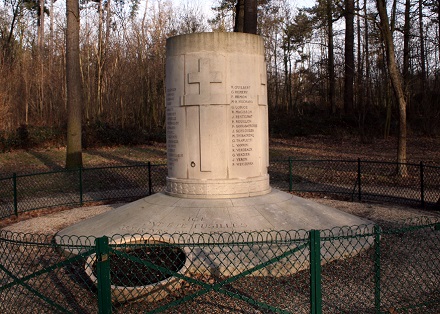
1944: Victor Gough, of Operation Jedburgh

On this date in 1944, British Capt. Victor Gough was shot at Ehrlich Forest as a German POW.

Gough had been parachuted into occupied France a few months before as part of Operation Jedburgh — a campaign to grow internal anti-German resistance to complement the Allied push via Normandy.*

Unfortunately as Colin Burbidge details in Preserving the Flame, Gough’s destignated stomping-grounds — the Vosges Mountains on the eastern borderlands — had some of France’s most pro-German populace. (Burbidge is Gough’s nephew.)

His complications were exacerbated when his wireless operator was injured — and the wireless set wrecked — in the parachute jump. The British wireless man was soon captured and their third, a French officer, killed in a gunfight, leaving Gough on his own. “Great difficulty working alone,” he managed to report to SOE headquarters. He was finally captured in October of that year, tortured by the Gestapo, and eventually shipped to the labor camp at Gaggenau.

In accordance with Hitler’s anti-saboteur Commando Order Gough was shot at a nearby forest in a gaggle of 14 POWs — six British special forces, four American airmen, and four French civilians. Their fate was discovered in part thanks to a German fellow-prisoner, a former officer in the Wehrmacht who had been sent to the camps for refusing orders to issue his men sawed-off shotguns, a weapon prohibited by the Hague Convention, who escaped shortly before the executions using a British map that Gough gifted him. That Captain Werner Helfen survived the war and gave evidence to a British war crimes investigation.

Many years later, Helfen gave something else too: according to Burbidge, his mother — Gough’s sister — in 1991 received a package from Germany containing a photo of Werner Helfen by Victor Gough’s grave, and the escape map that Gough had given to Helfen.

* Future CIA director William Colby was a notable Jedburgh alumnus.

On this day..

1941: Francisc Panet

On this date in 1941, “the Romanian Einstein” Francisc Panet was shot with his wife Lili and three other Communists at a forest near Jilava.

A chemical engineer by training, Panet or Paneth (English Wikipedia entry | Romanian) was fascinated by the theoretical research then revolutionizing physics.

While studying in Czechoslovakia, his work on elementary particles brought him to Einstein’s attention, and the two met in 1932 and corresponded thereafter. Panet’s advocates claim that Einstein foresaw for him a brilliant future.

But back in a Romania dominated by fascism, his scientific gifts would be required for more urgent and less exalted purposes: cooking homemade explosives in his bathroom for Communist saboteurs.

Eventually the secret police traced the munitions back to Panet, and he and his wife were arrested in a Halloween raid. Condemned to death in a two-hour court martial on November 5, they allegedly went before the fascists’ guns with the Internationale on their lips.

On this day..

1607: Jan Le Loup, Maastricht werewolf

A Dutchman known as Jan Le Loup (John the Wolf) was burned at the stake on this date in 1607 as a werewolf.

In a Europe where wolf attacks were still a real threat, the werewolf superstition waxed in partnership with the witch superstition. “Werewolf witch trials” form a distinct subspecies of the regular old witch trial; one of them even constitutes the maiden post of this here execution blog and it’s not very difficult to imagine predatory megafauna terrorizing a region could be attributed supernatural powers; the occultist Montague Summers devoted a whole book to plumbing the records of bygone werewolf cases for evidence of genuine lycanthropy.


This illustration of Beast of Gevaudan, a notorious man-eater from the 1760s, looks like the animal leaped straight out of hell. (via this fantastic Pinterest gallery)

Werewolves could likewise be rolled up via the familiar machinations of the witch-hunter. In John the Wolf’s case, he was accused out of the trial against Henry Gardinn of having used their transmogrifying beast personas to devour a child in Limburg. Gardinn burned in 1605; John was able to flee to Heusden but was recognized in 1607 and returned to Maastricht for the inevitable.

Though John tried claiming that Henry’s indictment had been to revenge himself for an altercation between the two, torture soon changed The Wolf’s story and placed he, Gardinn, and a third companion into a forest coven with a devil-avatar with whom they danced and feasted on human flesh.

After execution, his remains were exhibited on a pole surmounted by a wooden illustration of a werewolf.

On this day..

1543: Pietro Fatinelli, betrayed by Lando

On this date in 1543, a young nobleman named Pietro Fatinelli was executed for plotting to overthrow the mercantile oligarchy of the Tuscan city-state Lucca.

The Fatinelli family “was of ancient lineage, but had recently played little part in the running of the government,” according to Mary Hewlett in The Renaissance in the Streets, Schools, and Studies. Lucca itself was beginning to wane in importance in the 16th century in the shadow of her Italian rivals and the Holy Roman Emperor Charles V

The young Pietro was able enough to establish himself as an envoy to the imperial court, and ambitious enough to conceive it the platform from which he would redeem the fortunes of Lucca and Fatinelli alike.

Complicit with his friend Captain Giambattista Bazzicalupo di Chiavari, Fatinelli pltted to do away with some of the principal families whom Fatinelli detested, as they represented the merchant oligarchy that spurned his more ancient and noble family.

News of the plot came to the ears of the Lucchese government when Fatinelli unadvisedly mentioned his intentions to Count Agostino Lando, an opprtunistic nobleman from Piacenza, while the two were residing in Venice.


You can’t trust Lando.

Thinking to make some profit at no risk to himself, Lando secretly informed the Lucchese of Fatinelli’s intentions. The signoria acted with utmost secrecy and was able to seize the unsuspecting Bazzicalup di Chiavari while he was reconnoitring in Lucca. They put him to the torture and he cnfessed and revealed the details of the plot, after which he was summarily executed. [August 25, 1542 -ed.]

As Fatinelli resided at the imperial court and had powerful prtoectors, the Lucchesi had a difficult time extraditing him. It took all their powers of persuasion to prove to the emperor that Fatinelli was a traitr. Eventually convinced, Charles V handed Fatinelli over to the Lucchesi, who tried him and publicly executed him after he apologized to the citizens of Lucca. The emperor insisted that, as a last favour, the young man be given the name of his denouncer, as a reward for having repented and admitted his guilt.

Though Fatinelli was defeated, the disaffection with his native city-state proved far deeper-seated than his own person. Just four years after Fatinelli’s hot head fell on the scaffold, another Lucchese nobleman attempted an even more daring revolution.

On this day..

1783: Jacques Francois Paschal, rapist monk

For this date’s post, we are indebted to Rictor Norton, who maintains the invaluable Homosexuality in Eighteenth-Century Enland site. Norton wrote a book about England’s proto-gay “molly house” culture, and his site includes a nigh-comprehensive index of 18th century reportage touching same-sex activity.

Norton quotes these reports — luridly horrible, if slightly contradictory — here.


Wednesday 29 October 1783

A correspondent from Paris, who was present at the late execution of the Friar convicted of an unnatural crime, has favoured us with the following particulars: the monk who murdered a young boy that would not submit to his infernal solicitations, was tried at two o’clock in the afternoon, and sentenced to be broke alive on the cross, and then burnt to ashes at four the same day. He was allowed some time in a house to prepare himself for the awful moment, but did not remain there half an hour. He was then taken to the Grève, the place of execution, tied to the cross of St Andrew, and broke with amazing celerity. He had eight bones broken, and was thrown alive into the fire. It is usual for criminals on these occasions to receive the coup de grace, that is, the criminal being tied down on the cross, which is fixed upon a scaffold, the executioner sets a halter round the said criminal’s neck, and passing the ends of the rope through two holes made on purpose in a board of the scaffold, one of Jack Ketch’s* men, who attends underneath, joins the aforesaid ends in a kind of press, and takes care to strangle the malefactor at the very instant he receives the first stroke. The Friar in question was denied this extraordinary favour, though he begged it with many dreadful cries. Monsieur Jack Ketch made his appearance in his own coach, dressed in scarlet laced with gold, with three of his men behind. (Caledonian Mercury)

Thursday 30 October 1783

On Friday, the 10th inst. a friar was executed at Paris for an unnatural crime, and afterwards attempting to murder a young boy of 14, a commissionaire, a kind of porter to waits at the corner of the streets to run of errands. the sentences on criminals are published in France by the Courts of Justice in which they are passed; the present runs in the following manner: Jacques François Paschal, is condemned to the amende honorable, before the principal door of L’Eglise de Paris, where he shall be conducted by the executioner of haute justice, in a tumbril, in his shirt, his feet and head naked, holding in his hand a burning torch of yellow wax of two pounds weight, having a rope about his neck and a label before and behind, on which shall be written these words: Debauche contre nature & assassin: “The crime against nature, and murder”; and there, on his knees shall declare in a loud and intelligible voice that wickedly, rashly, and ill-advisedly, he had delivered himself up to an excess the most criminal towards a young commissionaire, aged fourteen, and had enticed him into his chamber, on the 3d of the present month of October, where, irritated by his resistence [sic], he had attempted to murder him, by giving him a great number of stabs with a knife on the head, reins, and in the back; of which he repents, and demands pardon of God, the King, and Justice: He shall then be taken in the same tumbril to the Place de Greve, to have his arms, legs, thighs, and reins, broken on a scaffold erected for that purpose in the said Place de Greve, and shall afterwards be cast into a burning fire, there to be consumed to ashes, and his ashes scattered in the wind, &c. The boy, though desperately wounded, we hear is not dead.

from Thursday 30 October to Thursday 6 November 1783

A Gentleman who arrived in Town a few Days ago from Paris, was present at the Execution of the Monk on the 10th Inst. for Murder, and an Attempt to commit a detestable Crime, says, the Particulars on the Subject, as stated in some of the English News-papers, are erreoneous; but the following may be depended on as a Fact. — The Monk, who belonged to the Convent of Montmartre, having formed a Design of gratifying his unnatural Passion on a Savoyard Boy, Commisionaire, or Messenger frequenting the Boulevards, Corner of Rue Poissoniere, enticed him to the Convent, and pretending to confess him, took him into his Cell, where, under the Mask of Religion, the Monster in Iniquity attempted to satisfy his brutal Desires, which the Boy resisting, he gagged, and bound him with Cords, to prevent his crying out, or making any Noise, and then stabbed him in several Parts of the Body, locked the Door and fled. Being missed in the Evening at Vespers, the Superior sent to his Cell, the Door of which remaining fastened, notwithstanding being repeatedly knocked at, was ordered to be broke open, when a most shocking Scene presented itself to View, the poor Boy weltering in his Blood, and near expiring. Every possible Assistance was immediately given, but in vain; for he survived no longer than just to be able to relate the dreadful Story, and to discover who was the nefarious Perpetrator of so inhuman a Deed; in pursuit of whom the Police instantly dispatched the Marrechausse, and he was apprehended the next Morning in the Forest of St. Germain, disguised as a Peasant. Being conveyed to the Prison of the Grand Chatelet at Paris, he was privately tried according to the Custom of that Country, though on this particular Occasion his Sentence was not announced so soon as is usual; for it was not till after the Expiration of twenty Days allotted for the Arrival of the Chief Executioners from the provincial Cities, summoned to give their personal Attendance at this Execution extraordinary, that his Sentence was read to him, that within forty-eight Hours he was to be broke on the Wheel, and his Body, whilst yet alive, burnt; at which he seemed very little affected. About one o’Clock on the Day mentioned, under strong Guard, and escorted by a very numerous Procession of Capuchin Friars, bareheaded, with lighted Torches in their Hands, chanting a Requiem for his departing soul, he was brought on Foot to the Church of Notre Dame, where, bare-footed, and stripped to his Shirt, with Labels behind and before, denoting, in Capital Letters, his Crimes, he made his final Confession, and asked Pardon from God, his King, and Country. He was, then, in the same Order, conducted to the Grève, the Place of Execution, where a large Scaffold, with the Apparatus of Death, was erected. At the same Time arrived the Executioner of the Capital, stiled Monsieur de Paris, who alighted from a most elegant Cabriolet, beautifully ornamented with his Arms and Crest on the Pannels, and two Servants in rich Liveries behind. He was a tall, handsome Man, between thirty and forty Years of Age, dressed in Scarlet and Gold, with the Insignia of his Order embroidered over the right Shoulder, a Sword by his Side, and from Head to Foot fashionably and well equipped. After bowing three Times to the Spectators, who were amazingly numerous, he ascended the Scaffold, whereon the Criminal had, in the Interim been placed, and accompanied by a large Body of provincial Executioners, and other Officers of Justice, his Confessor now took leave, and he being fastened to the Cross, Monsieur de Paris, by Means of an Iron Bar, which he used with both Hands, very expeditiously executed Part of the first of the Sentence; and then ordered the Body to be trussed on a Wheel, they were together thrown into a large Fire, kindled at a little Distance from the Scaffold. The poor Wretch mounted the Steps with seeming Composure; but from the Moment he received the first Blow, he continued to utter the most piercing Shrieks, till the Fire put a Period to his Life and Misery. (Derby Mercury)

* The reference here is to the notorious English hangman whose name became the metonym for an executioner. The high executioner of Paris by this point would have been Charles-Henri Sanson, the man who would eventually guillotine Louis XVI. (Sanson was 44 years old at this date, contrary to the estimate in the the excerpt quoted above.)

On this day..

1675: Katharina Paldauff, the Flower Witch

It was likely on, and certainly about, this date in 1675 that the Riegersburg Castle keeper’s wife was burned as the “flower witch”.


Riegersburg Castle. (cc) image from Tobias Abel.

This dramatic keep roosting atop a volcanic crag in southeast Austria today hosts a Witch Museum exhibiting the treatment meted out to those infernal agents.

This castle had perhaps become identified as a hostelry of sorceresses by dint of its long management under the Countess Katharina Elisabeth Freifrau von Galler, an iron-willed noblewoman who did not fear to assert prerogatives of power more commonly reserved for male hands — not least of which from the standpoint of posterity’s tourism industry was much of the castle construction one beholds there today.

“The bad Liesl” — one of her chiding nicknames — died in 1672 and coincidentally or not a witch hunt swept the surrounding region of Styria from 1673 to 1675.

The best-remembered of the accused was the commoner who almost literally personified the Bad Liesl’s fortress: Katharina Paldauf (English Wikipedia entry | German), the wife of Riegersburg Castle’s chief administrator.

She was ensnared in the usual way, when accusations from other defendants, who were being tortured for the identities of their witches’ sabbath affiliates, compounded against her. These charges credited Paldauf with the power to conjure foul weather from the depths of hell, as well as murdering children and pitching them into the castle well. In a more grandmotherly vein (Paldauf was 50; older women appear to have been disproportionately vulnerable to witch charges) she’s said to have had the power to pluck blooming flowers even in the dead of winter — the source of her Blumenhexe repute, although this legend, er, stems from folklore rather than anything in the documentary record.

Torture broke her.

On this day..

1937: Lev Karakhan, Marina Semyonova’s husband

On this date in 1937, the dancer Marina Semyonova lost her husband to the Great Purge.

Semyonova was perhaps the premier Soviet ballerina in the interwar era before the ascent of Maya Plitsetskaya* but artistic genius conferred no safety from the purges.

Least of all was that so for family members who happened to be that choicest of Stalin’s prey, an Old Bolshevik.

Semyonova’s husband Lev Karakhan (English Wikipedia entry | Russian) was an Armenian revolutionary and former Menshevik who joined the Bolsheviks before the October Revolution. He spent the 1920s and 1930s in various foreign policy roles, right up until the end: just a few months before his death, he had been the USSR’s ambassador to Turkey, when he received that ominous recall.

He even gave his name to a 1919 “Karakhan Manifesto”, which was Moscow’s attempt to get friendly with China.

Its author was more successful getting friendly with the Bolshoi’s prima ballerina around 1930, when both were married to other people. Their affair turned civil marriage without hampering the career of either partner; indeed, Semyonova had the honor and terror of accepting the Order of the Red Banner from Stalin’s own hands in June 1937, just a month after her husband had been arrested.

Semyonova just continued performing, because what choice did one have? She only recently died, in 2010, just shy of her 102nd birthday — as one of the legends of her craft.

* Maya Plisetskaya was also touched by Stalin’s terror: in 1937, when Maya was only 11, her father was disappeared into the gulag and killed; her mother was arrested shortly after and survived a forced labor camp in Kazakhstan.

On this day..

9: The Battle of Teutoburg Forest


Zum Kampf! Zum Kampf! from Max Bruch‘s 1877 oratorio about Teutoburg Forest victor Arminius. Also be sure to check out the Handel opera.

September 11 in the year 9 AD marked the bloody conclusion of the Battle of Teutoburg Forest — the engagement that permanently scared the Romans off Germany.

One of history’s true turning-point battles, Teutoberg Forest abruptly stanched decades of expansion that had seen Roman arms ascendant from Britain to the Levant. Indeed, the Roman commander who had the dishonor of falling on his sword at this legendary defeat, Publius Quinctilius Varus, was an experienced imperial patrician as well-traveled as the Roman standards who has been seen in these very pages collaborating with the Judean King Herod to execute Herod’s former heir.

But it was in the shadows and bogs of Germany’s primeval forests that Varus made his legacy to the world, which was to have his name famously bemoaned by facepalming Emperor Augustus once news of the disaster made its way back to the Eternal City.

Prior to this cataclysm, the empire had been working a years-long plan to annex fringe chunks of the vast Magna Germania beyond the Rhine and Danube rivers with its customary view towards eventually bossing the whole place. “Upper Germania” and “Lower Germania” to the west of Magna Germania already answered to Rome, testament to recent campaigns launched from neighboring Gaul;* the vast frontier beyond peopled by fractious warring barbarian tribes, with whom Rome cut strategic divide-and-conquer alliances, appeared to promise a future march of Roman glories all the way to the Baltic Sea.

This imperial hubris was shattered at a blow by the Cheruscan chief Arminius, who thereby made his name immortal to Germany.**

He had the element of surprise on his side, because his family had been such loyal Roman allies that Arminius had been trained up in the Roman army as a youth, and even held Roman citizenship. Whatever it was he experienced seems to have nurtured an implacable desire him to keep it away form his homeland. When the time came his familiarity with Roman military orders would be a high card in his hand, too.

Back in Germania, Arminius maintained his overt affiliation with Rome but started sending out feelers to assemble a confederation against the legions. He played this double game so adroitly that Varus still trusted his “ally” implicitly when Arminius reported a Germanic uprising that wanted Roman chastisement. Blind to his danger, Varus duly (and with casual discipline that would read very culpably in retrospect) marched his 17th, 18th, and 19th legions out through the unfamiliar glooms of the Teutoburg Forest.

It was a right massacre.

Their column broken up by rough terrain and pounding autumn rains, the Romans were ripe pickings for German sorties beginning on September 9. Harried by the Germans over two days’ panicked marching, the Romans were pressed into a dead end where palisades trapped the desperate legions at the edge of a slough and put them to slaughter. A bare handful escaped to tell the tale, and no future legion would bear the numerals of those annihilated on this day.


Varusschlacht, by Otto Albert Koch (1909).

The scale of the defeat, by rude tribesmen the empire always counted on being able to bully, beggared the Roman imagination.

“An army unexcelled in bravery, the first of Roman armies in discipline, in energy, and in experience in the field, through the negligence of its general, the perfidy of the enemy, and the unkindness of fortune was surrounded,” Paterculus lamented. “Hemmed in by forests and marshes and ambuscades, it was exterminated almost to a man by the very enemy whom it had always slaughtered like cattle, whose life or death had depended solely upon the wrath or the pity of the Romans.”

To judge by Roman reports — and what gives this event a purchase on the annals of Executed Today — the battlefield rout transitioned directly to the ceremonial butchery of captives. (As well as the posthumous beheading of the suicide Varus.) While some suffered torture and execution, others were offered as ritual sacrifices to the Germanic gods who had so magnificently delivered the day.

Several years later, a Roman force out to re-capture the lost standards of the Teutoburg legions reached the site of the empire’s humiliation. Tacitus describes the scene as a horror.

In the center of the field were the whitening bones of men, as they had fled, or stood their ground, strewn everywhere or piled in heaps. Near lay fragments of weapons and limbs of horses, and also human heads, prominently nailed to trunks of trees. In the adjacent groves were the barbarous altars, on which they had immolated tribunes and first-rank centurions.

Some survivors of the disaster who had escaped from the battle or from captivity, described how this was the spot where the officers fell, how yonder the eagles were captured, where Varus was pierced by his first wound, where too by the stroke of his own ill-starred hand he found for himself death. They pointed out too the raised ground from which Arminius had harangued his army, the number of gibbets for the captives, the pits for the living, and how in his exultation he insulted the standards and eagles.

And so the Roman army now on the spot, six years after the disaster, in grief and anger, began to bury the bones of the three legions, not a soldier knowing whether he was interring the relics of a relative or a stranger, but looking on all as kinsfolk and of their own blood, while their wrath rose higher than ever against the foe.

Despite the devastation, Teutoburg Forest was no extinction-level event for the Roman Empire. The Rhine and Danube frontiers remained an ongoing source of action for the many centuries to come, but despite raids and incursions here or there Rome never more seriously aspired to Magna Germania.

A few books about the Battle of Teutoburg Forest

* The future emperor Tiberius campaigned heavily in Germania, the last of which was post-Varus operations from 10 to 12 AD sufficient to permit the Romans to declare an honorably victorious conclusion to the project. (Tiberius celebrated a Triumph afterwards.)

** Arminius — whose name has been held equivalent with “Hermann” — has been the subject of many literary celebratins in a nationalist vein, great business especially in the 19th century.


The Hermannsdenkmal nomument in the Teutoburg Forest, the life’s labor of sculptor Ernst von Bandel who was able to finish it thanks to a mood of national exultation after the triumph of the Franco-Prussian War. For some reason it has a sister in Minnesota. ((cc) image by Hubert Berberich.)

On this day..

2016: 36 for ISIS’s Camp Speicher massacre

This morning, Iraq hanged 36 men in Nasiriyah prison for a 2014 sectarian massacre perpetrated by the emerging Islamic State (ISIS or ISIL).

After months’ gestation in the Syrian civil war, the Sunni ISIS in June 2014 burst out of its enclaves and in the course of a few jeep-racing weeks gobbled upper Mesopotamia. It publicly declared its border-straddling conquests the Caliphate on June 29, 2014.

Iraq’s army mostly melted away ahead of the onrushing threat that summer, abandoning weapons and fleeing while ISIS overran Mosul on June 10, then advanced another 200 km to snatch Saddam Hussein‘s birthplace of Tikrit the very next day.

On June 12, ISIS fighters proceeded out of Tikrit to the adjacent air academy Camp Speicher.* There they abducted only the Shia cadets, including about 400 from southern Iraq’s Shia Dhiqar province, and mass-executed an estimated 1,600 — atrocities they took pains to document in a nauseating propaganda video showing dazed and pleading youths trucked to a forlorn ditch where they are laid flat and fusilladed by the dozen, while others are shot from a gore-soaked pier into the Tigris. (The video is available here.)

Of all ISIS’s many bloodbaths, Camp Speicher might be the very bloodiest.

“The executions of 36 convicted over the Speicher crime were carried out this morning in Nasiriyah prison. The governor of Dhiqar, Yahya al-Nasseri, and the justice minister, Haidar al-Zamili, were present to oversee the executions,” according to an Iraqi spokesman a few hours ago.

* The Iraqi Al Sahra air base was renamed by U.S. occupation forces in honor of the first American combat casualty of the 1991 Gulf War.

On this day..

1944: Fusilles de la Cascade du Bois de Boulogne

August 16 is a day of reverence in France for the execution on that date in 1944 — just days ahead of the allied liberation of Paris — of 35 young Francs Tireurs partisans.

In a dastardly operation, a French collaborator known as “Jacques” — actually Guy Glebe d’Eu, who was himself executed after the war — who had insinuated himself into resistance networks lured the youths, all aged about 18 to 22, to a purported weapons-smuggling operation. They were unarmed when they arrived, but the Gestapo was not.

By nightfall the victims were being lined up at in the Bois de Boulogne and shot. The site today is marked by a stately monument that hosts public memorials every August 16.


(cc) image by Remi Jouan.


“Pass this oak with respect: it bears the scars of the balls that slew our martyrs.” (cc) image by Mickael Denet.

On this day..