1482: Richard Puller von Hohenburg and Anthony Mätzler


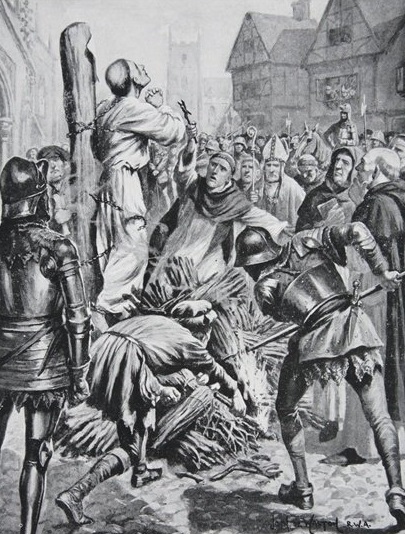
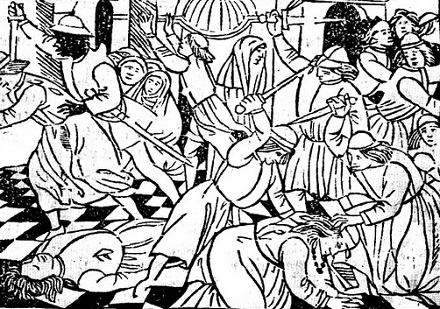
The Alsatian knight Richard Puller von Hohenburg and his servant, Anthony Mätzler, burned for sodomy at Zurich. From illustration in Die Grosse Burgunderchronik by Diebold Schilling de Altere, c. 1483.

On this day..

1430: La Pierronne, visionary

On this date in 1430, the Breton visionary La Pierronne was handed over to the secular authorities and burnt for blasphemy.

Not much is known of La Pierronne, save that she was a companion and follower of Joan of Arc — one of several women, who all shared Joan’s confessor, an itinerant monk known as Friar Richard. (Not much is known of him, either.)

La Pierronne was captured by the English at Corbeil in the spring of 1430, along with a younger companion whose name is not known. Rumor had it that she and Joan had both taken communion multiple times the previous Christmas, which was an irregular activity but not technically an outlawed one.

Still, cavalier behavior with the Host plus a surfeit of fealty to the Maid put our seer squarely in the sights of the Grand Inquisitor Jean Graverent. It was a preview of the sort of interrogation Joan herself would soon face.*

Like Joan of Arc, La Pierronne maintained that God spoke to her — and not only spiritually but in the shape of a physical apparition. This was clear heresy in the Church’s eyes — a direct ticket to the fire in the absence of speedy abjuration.

On the third of September, both women were presented with their options in the form of a sermon presented in the presence of the stakes that would otherwise receive them. Joan herself would face this test of faith, and would fail it on her first encounter. Here, the younger woman recanted — but La Pierronne held to her visions at the cost of her life.

Two women, who about half a year before had been captured at Corbeil and brought to Paris, had a sermon preached over them in the court before Notre Dame. The elder of these was Pierronne, and she was from Bretagne speaking Breton. She asserted and maintained that dame Joan (the Maid), who fought for the Armagnacs, was a good woman, and that what she did was well done and according to God.

Also she admitted having received the precious Body of our Lord twice in one day. Also she asserted and swore that God often appeared to her in human form, and spoke to her as one friend speaks to another, and that the last time she had seen Him, He was clad in a long white robe with a crimson doublet under it; which is nothing short of blasphemy. And she would never retract this statement that she often sees God clothed in this form, for the which, on this same day, she was sentenced to be burned, and so it was done and she died on the Sunday named persisting in this assertion, but the other woman was set at liberty at the same time.

* Joan had been captured by the Burgundians in May 1430. The Inquisitor Graverent was engaged by a different inquisition when Joan was prosecuted, so he didn’t take part in her trial.

On this day..

1483: Anthony Woodville, Earl Rivers

On this date in 1483, Anthony Woodville, 2nd Earl Rivers, was beheaded with his nephew Sir Richard Grey and royal chamberlain Sir Thomas Vaughan at Pontefract Castle.*

These noble heads rolled a bare 10 weeks after the death of King Edward IV to whom Woodville was certainly quite loyal: the Earl’s sister, Elizabeth Woodville, was Edward’s queen Consort.

This marked the acme of the family’s meteoric, single-generation rise from gentleman nobodies. Anthony’s dad, Richard Woodville, vaulted the family into the nobility with an illicit marriage to the Duke of Bedford’s widow. Their pretty daughter Elizabeth scandalized Britain’s elite by conquering Edward’s heart and his hand in 1464 — though this was her second marriage: the first, to Sir John Grey of Groby, had produced two children, one of whom was the Richard Grey who went to the block with Sir Anthony Woodville.

But while heads were still attached to shoulders, Woodville employed his in literary pursuits: he’s credited with publishing (via the pioneering English printer William Caxton) some of the very first books in English: Earl Rivers’s own translation into “right good and fayr Englyssh” of Jean Mielot‘s Cordyale, or Four last thinges (image); and, the 1477 Dictes and Sayings of the Philosophers, another Rivers translation that he knocked out while on pilgrimage to Santiago de Compostela. It’s distinguished as the first English printed book that dates itself (November 18, 1477).


Earl Rivers presents Edward IV with the fruits of movable type.

But for sure, circa Regna tonat — especially here during the long-running War of the Roses for control of the English throne.

The reason that Anthony Woodville and not his father was the current Earl Rivers was because dad had his own head cut off when King Edward was temporarily deposed in 1469. (Exile to Bruges was also the reason that the second Earl Rivers met William Caxton.)

After Edward came roaring back at the Battle of Tewkesbury in 1471, the Woodville family would have been feeling pretty well set up: their Yorkist faction seemed to have won as decisive a victory as could be imagined over the Lancastrians.

But King Edward’s early death meant that Anthony’s nephew Edward V inherited all too early — which is to say that he did not truly inherit at all. The 12-year-old Edward and his younger brother Richard, Duke of York, both of them children of Elizabeth Woodville, were the boy-princes left to the care of Edward IV’s brother Richard, Duke of Gloucester.

Now, they believe it; and withal whet me
To be revenged on Rivers, Vaughan, Grey:
But then I sigh; and, with a piece of scripture,
Tell them that God bids us do good for evil:
And thus I clothe my naked villany
With old odd ends stolen out of holy writ;
And seem a saint, when most I play the devil.

Shakespeare’s Richard III, Act 1, Scene 3

The next part of the story is quite notorious, and it directly concerns the Woodvilles: the reason that Richard infamously disappeared those tragic princes into the Tower of London was because they were in Elizabeth Woodville’s own custody — and Richard, soon to seize power for himself as King Richard III, feared that if given the opportunity to gather themselves the Woodvilles and not he would dominate English politics.

Events could easily have turned out differently — even with Richard on the blade end of the Woodvilles’ executioner. In the chaotic days following Edward’s death, as news made its way ponderously around the realm, Richard raced to get ahead of the Woodvilles before they were secure in their patrimony. On April 30 of 1483, Richard intercepted the royal party traveling to London and took king into custody along with Rivers, Thomas Vaughan, and Richard Grey.

Gloucester-cum-Richard III acted with dispatch from that point. He had Elizabeth Woodville’s marriage to the late king invalidated, effectively disinheriting her children. While Gloucester made ready for his coronation, Anthony Woodville and his friends made sad poetry and last wills and testaments.

Glories are fleeting. Two years later, Richard III was unhorsed, too.

“I dye in right, beware you dye not in wrong.”

Purported last words of Sir Thomas Vaughan

* There are some citations equivocating on Vaughan’s precise death-date. Yet another man, Sir Richard Haute (Hawte) is also sometimes numbered a fourth in the doomed party; however, a man of this name took part in Buckingham’s Rebellion against King Richard III, and received a pardon in 1485.

On this day..

1432: Francesco Bussone da Carmagnola, scheming condottiero

Italian mercenary Francesco Bussone da Carmagnola was beheaded on this date in 1432.

A successful condottiero was defined by a mixture of battlefield success and cutthroat scheming, and it was his clumsiness with the latter that did in Carmagnola.

His name denotes his origin, from a town in the Piedmont where despite his low birth, his talents raised him to a command for Filippo Maria Visconti‘s brutally successful campaign* to reunite his father’s divided patrimony and make the Duchy of Milan a peninsular power.

So you might think that Carmagnola stood to reap ample rewards for fastening himself to a rising star. But Visconti, perhaps fearing the prospect of a subordinate accumulating enough power to mount a coup d’etat, used a niggardly hand with the emoluments that his general was anticipating — and this led Carmagnola to ditch the Duchy and make an arrangement with its rival, Venice.

The turncoat had the satisfaction of smashing his former Milanese mates at the 1427 Battle of Maclodio, a battle that helped to achieve for Serene Republic its largest-ever Italian territorial expanse.

But his failure to follow up the victory aggressively soon tested the patience of his new patrons. After a short interval of peace, Venice resumed war with Milan in 1431, and here Carmagnola dilated unacceptably (Italian link), failing to advance on Cremona and instead proposing to winter his army — in August.

The Venetian Council of Ten also caught wind that Carmagnola was maintaining a secret correspondence with Milan and exploring the prospect of changing teams yet again.

Determined to have done with the snake, it summoned him back to Venice under the pretense of convening a war council for the 1432 campaign season. He arrived to find that it was too late in the day to meet the Doge, but as he started for his gondola to retire one of the Venetian gentlemen who had been sent to meet him instead directed his steps away.

“That is not my way,” Carmagnola objected.

“Yes, yes, this is your right path,” the man insisted — and Bussone, beholding him gesturing to the yawning gate of the Piombi dungeon, could only exclaim, “I am lost!”


The arrest of Francesco Bussone da Carmagnola

He was beheaded as a traitor between the scenic columns of San Marco and San Todaro. His widow returned to Milan and eventually repatriated the late commander’s remains to his native soil.

* Carmagnola left a nasty legacy to the world’s architectural heritage during this time by collapsing the Trezzo sull’Adda Bridge, the widest-spanning single-arch bridge ever built before the industrial age.

On this day..

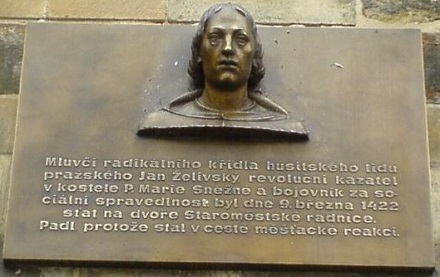
1422: Jan Zelivsky, Hussite defenestrator

Radical Hussite Jan Želivský was beheaded on this date in 1422.


1952 memorial plaque of Zelivsky in Prague

Zelivsky (English Wikipedia entry | Czech), a priest, emerges in the 1410s as a fiery populist orator at Prague’s Church of Our Lady of the Snows.

After the treacherous capture and execution of Jan Hus, the Hussite movement split between radical and moderate factions. The firebrand Zelivsky became the chief voice of the lower-class, radical Hussites and led the dramatic Defenestration of Prague wherein a Hussite mob pitched several Catholic city ministers out the window of the Prague town hall — triggering a revolution and 15 years of war.

Over the ensuing year, Zelivsky came to dominate politics in Prague. But he had to struggle for his power against both the external threat of Hapsburg armies, and the internal rivalry of moderate Hussites — and these factions did not scruple to deploy the executioner for mastery of Prague.

Zelivsky in the summer of 1421 mounted a coup against moderate Hussites who were negotiating with the Catholic nobility, and even executed some of those movement apostates. But power was wrested away from him in the ensuing months and he was arrested by surprise at a town meeting and secretly put to death.

On this day..

1401: William Sawtre, Lollard heretic

On this date in 1401, Lollard priest William Sawtre(y) was burned at Smithfield for heresy — the first known heresy execution in England.

The highlight of late 14th century English literature, Piers Plowman, was a great favorite of Lollards. Though this lengthy allegorical poem is not itself a Lollard text, it spawned a Piers Plowman tradition with many spinoffs that are overtly Wycliffite.

Witness Wycliffe, who told them the truth;
For in good nature he greatly warned
To mend their wickedness and sinful works.
Who these sorry men damned his soul
And overall lolled him with heretics’ works!

Piers Plowman’s Creed*

Sawtre was a follower of John Wycliffe, the Biblical translator and church reformer 16 years dead as we lay our scene.

Wycliffe anticipated much of Luther’s later critique of the Catholic Church. His call to study Scripture directly without the intercession of doctors in Rome touched a spiritual thirst; his summons to apostolic poverty for the wealthy vicars of Christ was a message with a ready audience.

“From about 1390 to 1425, we hear of the Lollards in all directions,” notes this public domain history, “so that the contemporary chronicler was ale to say that of every two men found on the roads, one was sure to be a Lollard.”

Lollardy did not immediately manifest as an outlaw movement; it had many adherents among England’s elites and even the royal household. Although the papacy had declared various Wycliffe doctrines heretical in that prelate’s time, England had shown little appetite for calling an Inquisition — a step that would project papal authority into the kingdom.**

But with a ferocious ecclesiastical pushback and a change in the occupancy of the throne,† the English state gradually shifted over the course of the 1390s and 1400s towards recognizing Wycliffe’s principles as heresy — and towards treating that heresy into a capital crime. Through spectacles like Sawtre’s burning, Lollards were gradually made to understand that the price of their scruples might run all the way to martyrdom.

This was novel territory for English jurisprudence, and part of a centuries-long European transition towards treating doctrinal dispute as capital crime. There are only a bare handful of alleged quasi-precedents in English history, sketchily documented — like the unnamed apostate deacon burnt to ashes for Judaizing. It was only as late as William Sawtre that Old Blighty clearly established the practice and legal machinery for putting men and women to death for heresy.

Many Lollards capitulated as they came under pressure. This was true of our man Sawtre, a humble parish vicar. When put to questioning by the bishop in 1399, Sawtre initially recanted his unorthodox skepticism as to the transubstantiation of communion bread into Christ’s own literal body — a doctrinal mystery that would be a tougher and tougher sell to dissidents yet to come.

But upon moving from Lynn to London where he served at St. Osyth’s, Sawtre relapsed — and some stirring moved his soul to vindicate himself in the face of mortal peril.

Charged before Parliament, Sawtre now defended his heresies under close questioning by the Archbishop of Canterbury, Thomas Arundel. Arundel was even then pressuring this same Parliament for a statute, which he did indeed soon receive — one with the ominous title De Heretico Comburendo, at last elevating heresy to a death penalty offense and making the bishops themselves the decisive arbiters on the matter. It is overtly and all-but-explicitly aimed at the Lollards.

divers false and perverse people of a certain new sect, of the faith of the sacraments of the church, and the authority of the same damnably thinking and against the law of God and of the Church usurping the office of preaching, do perversely and maliciously in divers places within the said realm, under the color of dissembled holiness, preach and teach these days openly and privily divers new doctrines, and wicked heretical and erroneous opinions contrary to the same faith and blessed determinations of the Holy Church, and of such sect and wicked doctrine and opinions they make unlawful conventicles and confederacies, they hold and exercise schools, they make and write books, they do wickedly instruct and inform people, and as such they may excite and stir them to sedition and insurrection, and make great strife and division among the people, and other enormities horrible to be heard daily do perpetrate and commit subversion of the said catholic faith and doctrine of the Holy Church …

the diocesans of the said realm cannot by their jurisdiction spiritual, without aid of the said royal majesty, sufficiently correct the said false and perverse people, nor refrain their malice, because the said false and perverse people do go from diocese to diocese and will not appear before the said diocesans…

[let] none within the said realm or any other dominions subject to his Roval Majesty, presume to preach openly or privily, without the license of the diocesan of the same place first required and obtained, curates in their own churches and persons hitherto privileged, and other of the Canon Law granted, only except; nor that none from henceforth anything preach, hold, teach, or instruct openly or privily, or make or write any book contrary to the catholic faith or determination of the Holy Church, nor of such sect and wicked doctrines and opinions shall make any conventicles, or in any wise hold or exercise schools; and also [let] none from henceforth in any wise favor such preacher or maker of any such and like conventicles, or persons holding or exercising schools, or making or writing such books, or so teaching, informing, or exciting the people, nor any of them maintain or in any wise sustain, and that all and singular having such books or any writings of such wicked doctrine and opinions, shall really with effect deliver or cause to be delivered all such books and writings to the diocesan of the same place within forty days from the time of the proclamation of this ordinance and statute.

Any Lollard not so complying could be arrested on the say-so of the diocesan bishop and tried for the offending heterodoxy; if convicted, the clergy was then empowered to hand the unfortunate fellow over to the civil authorities who were obliged to carry out an execution without any further inquiry or say-so. Judge, jury, and (virtually) executioner … the same as the guy waiting for you in the confessional.

[I]f any person … do refuse duly to abjure, or by the diocesan of the same place or his commissaries, after the abjuration made by the same person be pronounced relapsed, so that according to the holy canons he ought to be left to the secular court … [then] after such sentence promulgate shall receive, and them before the people in an high place cause to be burnt, that such punishment may strike fear into the minds of others, whereby, nosuch wicked doctrine and heretical and erroneous opinions, nor their authors … be sustained or in any way suffered.

With such wicked doctrine and heretical and erroneous opinions afoot Sawtre was not suffered to live even the enactment of the law that killed him: De Heretico Comburendo was passed only on March 10, but Sawtre was eight days’ dead by that point. It’s a bit unclear how the sentence was legally effected, but it would seemingly have proceeded under canon, not civil, law.

Both the law and the execution were great victories for the Church. “The king and the archbishop hurried to burn their victim to show that they could send a heretic to the stake whenever they wished, without relying on statute” Leonard Williams Levy writes. “Parliament could neither give nor take the authority to burn a heretic. If the scepter supported the miter, canon law prevailed.”

Be that as it may, the victims of the Lollard-burning period were not nearly so numerous as the chilling language of De Heretico Comburendo might lead one to anticipate. The next Lollard to go to the stake was John Badby in 1410; two merchants were executed in 1415, and the Lollard rebel John Oldcastle was burnt “gallows and all” in 1417. Another handful suffered in the 1420s. It’s thought that about 50 people overall (Lollards and otherwise) were executed as heretics from the enactment of De Heretico Comburendo until Henry VIII broke with Rome 133 years later — an occasion that made heresy-hunting a whole different animal.

The History of England podcast covers Sawtre and Lollardy in episode 141.

* My artless rendering from the Middle English version given in D.A. Lawton in “Lollardy and the ‘Piers Plowman’ Tradition”, The Modern Language Review, Oct. 1981.

** Despite overall caution about the authority of Rome onto Albion’s soil, the English had no overall principled rejection of Inquisitors as such: they convoked such a tribunal to deal with Joan of Arc.

† The political situation in the realm was also been a factor: the usurper Henry IV had taken the crown only in 1399 by deposing, and later murdering, King Richard II. One readily supposes Henry’s keen interest in shoring up the loyalty of the church and keeping tabs on itinerant rabble-rousers, the latter of whom appear to have disproportionately skewed towards Richard’s faction. (All those heretics in the king’s household were in Richard’s household.)

On this day..

1476: Israel, the last execution of the Trent blood libel trial

We have covered in these pages the horrific blood libel trial that sent most of the Jews of Trent to execution for the supposed ritual murder of the child Simon of Trent.

The moral panic (and torture-aided interrogation) that broke out when Trent’s Jews were suspected of having killed a Christian child led to a batch of executions in June 1475. But that was only the first act of a drama that would reach all the way to the courts of popes and emperors in the subsequent months … a conflict that would not end even when the last “murderer”, Israel, was broken on the wheel on January 19, 1476.

Trent lay at the southern fringe of the Habsburg Holy Roman Empire,* literally halfway from Vienna to Rome … and Trent’s ambitious prince-bishop Johannes Hinderbach was likewise beholden to both those poles of authority.

The sitting pope, Sixtus IV, was pretty sympathetic to Jews in general and very definitely not okay with Hinderbach’s theater of torture and execution. Sixtus was certainly also feeling plenty of pushback from other Jewish communities in Europe to make sure Trent wouldn’t be a precedent for similar freakouts in the future, and from Christian elites who didn’t want muddleheaded fanatics running around.

In Trent, “the Jews” meant literally three households — a tiny handful of people. By contrast, in cosmopolitan, humanist Rome, Jews were prominent among the intelligentsia and their presence taken for granted. Sixtus had Jewish “advisors and physicians in the papal court. They were teachers of music, theater, and science. Rome was a center of Hebrew literature and publishing … Sixtus IV, like most of his predecessors, took his role as a defender of Jews from violence more or less for granted.”**

Sixtus ordered the proceedings halted “because many and important men began to murmur,” and instituted an apostolic commission to investigate.

But Hinderbach and the Trentini refused to cooperate (Italian link) with the investigation. Hinderbach, for his part, was all-in on the Simonino story: just like today, nobody on the hook for a wrongful execution is going to advance his career by acknowledging that fact.

Resentfully, Hinderbach put his unwelcome papal visitor Battista Dei Guidici up in a crappy room, and “many people, moved more by furor than reason, temerity than devotion, threatened to kill the commissioner in the streets of the city, if he did not confirm the miracles and the asserted martyrdom” of little Simon. If anyone in Trent thought otherwise, he did not dare make it known to the closely-watched investigator.

Trent still had Jews in prison at this point, but Hinderbach resolutely prevented the pope’s agent from interviewing with them. “It was to be feared,” Hinderbach said, “that if he talked to them, he or his men could give some sign to the Jews, who would be rendered more obstinate, since they were always saying, ‘A man will come to free us.'”

Book CoverThese quotes are via R. Po-Chia Hsia’s Trent 1475: Stories of a Ritual Murder Trial, which is likewise our guide for the tense diplomatic battle ensuing over the autumn of 1475.

After having bribed a servant to deliver word to the imprisoned Jewish women that they had an advocate, Dei Guidici relocated to nearby Venetian territory — “where innocent people are not killed, where Christians do not plunder Jews, as it was in Trent” — and papers started flying.

Dei Guidici appealed to — and eventually ordered — Hinderbach to release the remaining Jews in his custody, while the pope sent out directives quashing any preaching on Simon’s “martyrdom.” Italian Jews poured into Dei Guidici’s offices appealing for their fellows and attesting that they could not travel through Trent for fear of mob violence.† A verse from a Veronese rabbi dating to late 1475 curses the nearby city: “Hills of Trent, may you not have rain or dew / Seven times may you fall and not rise.”

Hinderbach, for his part, sent his own envoys to German cities that had persecuted Jews for ritual murder in the past to get his own paper trail establishing that, yes, the Hebrew liked a good drink of Christian blood. More significantly, as a prince-bishop, Hinderbach also sent his own appeals up the Holy Roman Empire’s secular chain of command, objecting to the ecclesiastical meddling.

Hinderbach’s only concession to his apostolic scold was to release the children he had in custody. In October 1475, his political machinations with the Habsburgs yielded authorization from the powerful Tirolean Archduke Sigismund to resume judicial proceedings against “the Jewish men and women you have in prison” and “render justice as it should be, and let the death sentences be carried out.”

Interrogations for six Jewish men still in custody resumed on October 25, again with the aid of the horrible strappado to confirm and elaborate upon the already-determined official story of Simon’s martyrdom.

Denial — or even confessing, but guessing the wrong detail to “admit” — was not an option, as this October 26 interrogation record indicates.

He was asked whether he saw the murdered boy.

JOAFF [one of the Jewish households’ servants]: In the ditch.

PODESTA: Think again.

JOAFF: In the antechamber of the synagogue.

PODESTA: Anywhere else?

JOAFF: No.

He was ordered stripped, tied by the rope, and hoisted up.

JOAFF: Let me down, I’ll speak the truth.

PODESTA: Speak it on the ropes.

JOAFF: I have never done anything evil.

He was hoisted up and dropped.

This continues until Joaff has been dropped enough times to agree that he saw Simon’s body on Saturday night, on a bench in the synagogue. They knew that was the truth because it confirmed what they already wanted to hear.

This would be the end of Trent’s Jewish men in January 1476.

Israel, a 23-year-old copyist, was the last to die, and his fate is particularly poignant.

He had half-escaped the pall of death by accepting baptism the previous spring, and lived freely during the following months under the name Wolfgang. Dei Guidici interviewed him, one of the few productive sessions the pope’s man was able to arrange in Trent, and learned thereby of the details of Hinderbach’s interrogations.

Once Dei Guidici withdrew to Venetian soil, Jews of that principality would begin reaching out to “Wolfgang” in their efforts to communicate with the remaining imprisoned Jews.

This skullduggery came came apart when the persecution fired back up in October, and Israel was re-arrested, and put again and repeatedly to the rope. He was a man bound to be crushed by the legal machinery arrayed against him, but it was not only that. As Israel was well-traveled, he was tortured for information about ritual murders in other German cities; his forced denunciation of 14 named Jews in Regensburg initiated a blood-libel proceeding in that city that was only aborted by intervention from the Emperor himself.

And while Israel struggled to portray himself as a faithful convert and appeal to little Simon for an exculpatory miracle that never came, he at least once threw aside the mask to give his tormenters a piece of his mind.

PODESTA: What did he think of the Christian faith?

ISRAEL: He wants to say the truth. He does not believe in anything of the Christian faith … It is a joke to say that God came down from heaven to earth, walked around and lived among men. He believes only in God and nothing more. He believes also that the Jewish faith is right and holy.

PODESTA: Does he believe that it is right, according to Jewish law, that Jews kill Christian children and drink and eat their blood as he himself had said.

ISAREL: He believes firmly that it is right that Jews kill Christian children and eat their blood. He wants to have Christian blood at Easter, even now that he is baptized he wants to die a Jew.

Four other Jews from Trent died by hanging earlier in January 1476. The last one put to death was Israel on January 19 — “thief, eater and drinker of Christian blood, poisoner, blasphemer, traitor, and an enemy of Christ and Godly majesty.”

Even his death did not finally put a stop to the affair, for the women of the Jewish community were still in prison, and still being tortured as late as March. They would eventually accept baptism as the price of their release.

Meanwhile, Hinderbach and Dei Guidici carried their scrap to the curia. Hinderbach’s dogged advocacy of his burgeoning cult of Simon — and the odd ad hominem against his foe here and there — won some allies against Dei Guidici’s protests against “the peril which would be incumbent on the Christian religion, on account of the dealings in Trent, and the lies that would reach the ignorant.”

In the end, the Church decided it on political grounds. It could not encourage more Trents; neither could it invite the scandal of disavowing the one that had already taken place. It upheld Hinderbach’s conduct while also reiterating standing prohibitions against blood-libel trials or oppressing the Jews.

Hinderbach very naturally took this as vindication and spent the balance of his life propagating the Simonino cult. Artwork throughout northern Italy, some of it still visible in situ today in its original public monuments and chapel frescoes, attested to his success.


The Martyrdom of Simonino, by Gandolfino d’Asti.


The Martyrdom of Saint Simonio, from the Trento school of Nicklaus Weckmann. (Via)

Indeed, the city of Trent itself‡ still has a street-viewable bas-relief depiction of Simonino’s ritual murder, with the Latin inscription:

In the dungeons of these buildings, where once a synagogue stood, and now a shrine, the blessed martyr Simon of Trent, in his 29th month of life, was killed with excruciating pain by the Jews in the deep of the night of April 10, 1475 A.D.

The Simon of Trent cult — never the face of Christianity that the institutional church really wanted to feature — was only officially suppressed in the 20th century with the Second Vatican Council.

* Trent’s position on the frontier of the Italian and German worlds is also the reason the next century’s major anti-Reformation Council of Trent was held there.

** Sixtus wasn’t all good news for Jews. More from political necessity than affirmative desire, he also authorized the Spanish Inquisition and appointed Torquemada.

† During this time, Dei Guidici also managed to extract a Trent resident named Anzelino Austoch. Under Dei Guidici’s torture, Austoch accused the man named der Schweizer, “the Swiss” — the very man who had suggested that the Jewish homes be searched for Simon’s body — of committing the murder. Dei Guidici clearly believed that either the Schweizer, or Austoch, or both, had actually killed Simon and intentionally framed the city’s Jews.

‡ Trent does not, of course, still avow the legitimacy of these proceedings; the city has elsewhere put up plaques apologizing for it.

On this day..

1430: Ten men beheaded, and an eleventh man married

(Thanks to Sabine Baring-Gould for the guest post, from this piece on Helene Gillet‘s miraculously surviving her beheading. -ed.)

In the Middle Ages there were two chances of life at the last moment accorded to a malefactor condemned to death, besides a free pardon from the sovereign. One of these was the accidental meeting of a cardinal with the procession to execution; the other was the offer of a maiden to marry the condemned man, or, in the case of a woman sentenced to death, the offer of a man to make her his wife.

The claim of the cardinals was a curious one. They pretended to have inherited the privileges with which the vestal virgins of old Rome were invested. In 1309 a man was condemned to be hung in Paris for some offence. As he was being led to execution down the street of Aubry-le-Boucher, he met the cardinal of Saint Eusebius, named Rochette, who was going up the street. The cardinal immediately took oath that the meeting was accidental, and demanded the release of the criminal. It was granted.

In 1376, Charles V was appealed to in a case of a man who was about to be hung, when a young girl in the crowd cried out that she would take him as her husband. Charles decreed that the man was to be given up to her.

In 1382, a similar case came before Charles VI, which we shall quote verbatim from the royal pardon.

Henrequin Dontart was condemned by the judges of our court in Peronne to be drawn to execution on a hurdle, and then hung by the neck till dead. In accordance with the which decree he was drawn and carried by the hangman to the gibbet, and when he had the rope round his neck, then one Jeanette Mourchon, a maiden of the town of Hamaincourt, presented herself before the provost and his lieutenant, and supplicated and required of the aforesaid provost and his lieutenant to deliver over to her the said Dontart, to be her husband. Wherefore the execution was interrupted, and he was led back to prison … and, by the tenor of these letters, it is our will that the said Dontart shall be pardoned and released.

Another instance we quote from the diary of a Parisian citizen of the year 1430.* He wrote:

On January 10, 1430, eleven men were taken to the Halles to be executed, and the heads of ten were cut off. The eleventh was a handsome young man of twenty-four; he was having his eyes bandaged, when a young girl born at the Halles came boldly forward and asked for him. And she stood to her point, and maintained her right so resolutely, that he was taken back to prison in the Chatelet, where they were married, and then he was discharged.

This custom has so stamped itself on the traditions of the peasantry, that all over France it is the subject of popular tales and anecdotes; with one of the latter we will conclude.

In Normandy a man was at the foot of the gibbet, the rope round his neck, when a sharp-featured woman came up and demanded him. The criminal looked hard at her, and turning to the hangman, said: —

A pointed nose, a bitter tongue!
Proceed, I’d rather far be hung.

* This would have been during the English occupation of Paris in the Hundred Years’ War, even as Joan of Arc was delivering the country from the hands of its antagonists.

On this day..

1477: Gerolamo Olgiati, ducal assassin


Dramatization of events in this post for the video game-derived film Assassin’s Creed: Lineage.

On this date in 1477, the assassins of the Duke of Milan suffered bitter death for fame eternal.

Famous for both his astute political machinations and for cruelty verging on the sadistic, Galeazzo Maria Sforza inherited leadership of Milan in at the age of 22 with the passing of his father, the great condottiero Francesco Sforza.

Francesco, the founder of the Sforza dynasty, had dynastically married himself to one Bianca Maria Visconti, a daughter of Milan’s previous ruling house.* But not all of the Visconti were at home with the Sforza.

A brash young man of that noble family, Carlo Visconti, as full of humanistic idealism as he was of bile for the licentious Duke’s alleged violation of his sister, joined a conspiracy also compassing two other gentlemen, Giovanni Andrea Lampugnani and Gerolamo Olgiati, to do Galeazzo Sforza to death.

At a St. Stephen’s Day service in a basilica christened to Stephen Lampugnani approached the prince feigning supplication for some audience, then produced a hidden blade and stabbed Galeazzo Sforza. Visconti and Olgiati then rushed on Sforza as well and before anyone realized what was happening the Duke, croaking some half-heard invocation of Mary, was falling dead on the church floor.


Illustration of Galeazzo Sforza’s murder on the title page of a 1476 Lament for the Duke decrying the assassination.

Pandemonium ensued, and in the ensuing helter-skelter, Sforza’s bodyguards fell on Lampugnani and killed him on the spot, while Olgiati managed to escape.**

“It now only remains for us to consider those dangers which follow after the execution of a plot,” Machiavelli mused in his “Of Conspiracies” typology of his Discourses. “These in fact resolve themselves into one, namely, that some should survive who will avenge the death of the murdered prince. The part of avenger is likely to be assumed by a son, a brother, or other kinsman of the deceased.”

Well, yeah.

The assassins of the Duke of Milan appear not to have burdened themselves overmuch with advance consideration of this danger, possibly indulging the dream of Brutus that by a dagger’s stroke alone they could restore the lost republic.

Needless to say, this beautiful hope vanished in the bloody revenge carnival that actually ensued the murder. Just a few days after the assassination, having taken refuge with a priest — his justly frightened family had closed its door on him and needed to make theatrical denunciations of his treason for their own safety — Olgiati was captured, put to a torturous interrogation, and publicly butchered. He had outlived the Duke by only a week, and his gashed carcass was hung up in sections around town by way of warning. The rotting heads of the conspirators remained impaled on lances on the city’s bell tower well into the 1490s.

According once again to Machiavelli, Olgiati “exhibited no less composure at his death than resolution in his previous conduct, for being stripped of his apparel, and in the hands of the executioner, who stood by with the sword unsheathed, ready to deprive him of life, he repeated the following words, in the Latin tongue, in which he was well versed

“‘Mors acerba, fama perpetua, stabit vetus memoria facti.'”

That is,

‘Death is bitter but fame is eternal, and the memory of the deed will endure.’

This attempt, quixotic and doomed, to depose an Italian tyrant by murdering him in church might well have formed the blueprint for a similar plot in Florence in 1478, the Pazzi conspiracy. That version was even less successful than its Milanese predecessor: at least Olgiati and company could say that they actually managed to kill their target before everything else hit the fan.

And republic or not, Sforza’s murder did shake up the polity. It put the Duchy of Milan in the hands of his wife, as the unsteady regent of a seven-year-old heir. A few years later, the late duke’s brother Ludovico displaced the regent and effectively bossed Milan until the French imprisoned him in 1500 during the Italian Wars.

While he had the run of the place, Ludovico Sforza commissioned of Leonardo da Vinci a monumental equestrian statue in memory of his brother that da Vinci never finished.† Quite strangely, the master’s notes were plumbed by a 20th century Pennsylvania airline pilot who dedicated the latter part of his life to actually casting “Leonardo’s Horse”.

* The names Visconti and Sforza are also associated with some of the earliest tarot decks and among the first to introduce to playing cards the use of trionfi, or “triumph” cards — that is, “trumps”. One can readily purchase present-day reprints of this historic pack.

** There is a positively maddening inconsistency, thus far irresolvable for this author, between accounts (here’s one example | and another) asserting that Carlo Visconti was slain by Sforza’s bodyguards directly after the assassination, and other accounts (like Gregory Lubkin’s 1994 history of Sforza’s Milan) that put Visconti on the scaffold beside Olgiati.

† Da Vinci’s ponderously slow progress on this high-profile project led Michelangelo to cattily impugn the rival artist’s bronze-casting aptitude.

On this day..

1460: Richard Neville, Earl of Salisbury

On the 31st of December in 1460, the Earl of Salisbury was beheaded the day after the Lancastrians routed the Yorkists at the Battle of Wakefield.

Salisbury — Richard Neville by name — was brother-in-law to the Yorkist claimant (and namesake) Richard Plantagenet, Duke of York, so you can guess which side Neville backed during these Wars of the Roses.

Actually, although your guess is spot on for the instance at hand, overlapping kin networks and cutthroat politicking made for an indistinct border between Lancastrians and Yorkists that some actors willingly crisscrossed. Richard Neville’s cousin Thomas Neville, for example, was a Lancastrian, who switched to the Yorkists, and then switched back to the Lancastrians. All this goes to show the treacherous environment for nobles who could go from the orbit of royal power themselves straight to the headsman’s block with each new battlefield reversal. And Salisbury, he was Team White Rose* right on down the line.

(The Neville family’s running feud with their fellow northern magnates, the Percys, helped to catalyze the York-Lancaster rivalry into open warfare.)

Salisbury led the Yorkist side to a notable early victory at the September 1459 Battle of Blore Heath, cunningly baiting the Lancastrians into a disadvantageous charge across a brook by feigning retreat. Then, runs Hall’s chronicle, “the Earl of Salisbury, which knew the sleights, strategies and policies of warlike affairs, suddenly returned, and shortly encountered with the Lord Audley and his chief captains, ere the residue of his army could pass the water … [and] so eagerly fought, that they slew the [Lancastrian commander] Lord Audley, and all his captains, and discomfited all the remnant of his people.”

The Yorkists didn’t do as well at the Battle of Ludford Bridge three weeks later and their leaders (Salisbury included) had to flee England to regroup.

This 1459-1461 period has especially rapid reversals of fortune for the contending parties in the Wars of the Roses, who seemed to alternate between them the results of the latest battle and with it the leadership of England.

As the most recent losers, Salisbury and his son, the Earl of Warwick — known as the “kingmaker”, this younger Richard Neville was one of the pivotal figures of the dynastic wars — had to flee England with many of the Yorkist leaders. But they mounted a re-invasion from Calais where Warwick was constable and the Nevilles pere and fils led separate columns that overran London, and captured the Lancastrian King Henry VI. Suddenly, the ex-fugitive York was the Lord Protector, England’s de facto ruler, and its de jure successor.

But as had been the case one year before, fickle Fortune abandoned the House of York almost immediately after raising it up. Two months later, their forces ventured battle with a much larger army of the regrouping Lancastrians; as night fell on December 30, 1460, York himself lay dead in his armor while his kinsman Salisbury was a prisoner with just hours left to live.

This was, of course, very far from the end for the Yorkist party, for both men left their causes to capable heirs. York’s 18-year-old son Edward inherited his father’s claims to the throne of England; together with Warwick, they counterattacked and crushed the Lancastrians at Towton on March 29, 1461** — finally deposing Henry VI and enthroning York’s eldest son as King Edward IV.

And they all lived happily ever after.

* The competing Rose devices used by the Yorkists, the Lancastrians, and the eventual Tudors, are one of the four suit markers we’ve used in our unique Executed Today playing card set. Pick up a pack or eight today why don’t you?

** The undercard fight to Towton was February’s Battle of Mortimer’s Cross, which also featured a crushing defeat of the Lancastrians — led on that occasion by a commander whom the Yorkists subsequently put to death, Owen Tudor.

Against any odds one could care to name, it was this Owen Tudor’s descendant who would eventually emerge from the Wars of the Roses as England’s legitimate-ish king, Henry VII — founder of the Tudor dynasty so very fruitful for this here execution blog.

On this day..