1967: Ronald Ryan, the last hanged in Australia

At 8 a.m. in Melbourne this date in 1967, as a moment of silence was observed across Australia, Ronald Ryan was hanged in Pentridge Prison for killing a guard during a prison break. He would be the last man put to death Down Under.

Ryan, a small-time thief, broke out of that selfsame Pentridge Prison’s lower-security districts with fellow-prisoner Peter John Walker late in 1965, prompting a high-profile holiday season manhunt.

Still, with capital punishment fading in Australia — and especially in Victoria, where nobody had hanged since 1951 — even the jury that doomed Ryan thought its sentence was strictly pro forma. Eleven of them later joined nationwide petitions for clemency when Liberal Premier Henry Bolte made plain his intention to let the hanging go forward.

Though Bolte did in fact gain seats at the next polls, the anti-hanging campaign had a breadth hard to comprehend forty-plus years later.

A media witness recalled that he “came away from Pentridge Prison in 1967 firmly opposed to capital punishment,” and some form of that sentiment seemed to take throughout Australia. Its state and federal governments abolished their various death penalties over the ensuing generation.

Ryan’s hanging “ensured that no government anywhere in the country would politically risk imposing the death penalty again,” the criminal’s biographer said.

It also gave the man a lasting foothold in Aussie popular culture. Clips from a couple of subsequent films made about him can be seen online here and here.

Ryan’s attorney, Philip Opas, has continued to maintain his man’s innocence. (pdf)

On this day..

1826: Matthew Brady, gentleman bushranger

On this date in 1826, “gentleman bushranger” Matthew Brady was hanged in the Hobart jail for one Australia’s most colorful outlaw careers.

Shipped from England on penal transportation, Matthew Brady was repeatedly flogged for escape attempts before he successfully busted out of Macquarie Harbour prison in 1824.

He made for the bush and began an 18-month spell as an outlaw, self-consciously constructing the persona of the gentleman outlaw — polite to his victims, never violent towards women, that sort of thing.

Among Brady’s best-known exploits: after the colonial governor George Arthur posted a reward for his capture, Brady posted a public counter-offer:

It has caused Matthew Brady much concern that such a person known as Sir George Arthur is at large.
Twenty gallons of rum will be given to any person that can deliver his person to me.

The authorities hunted him doggedly, and he was at last captured by settler John Batman, later famous for his founding role in the history of Melbourne.

The love letters and gifts that filled his cell attested his place in the folklore, but his fate was never in question. Ever the gentleman, Brady’s main protest was sharing his scaffold with (among several other bushrangers) the murderous cannibal Mark Jefferies.

On this day..

1868: Henry James O’Farrell, would-be assassin

On this date in 1868, the first Australian known to have attempted a political assassination received the short drop and sudden stop that often constitutes the wages of that distinguished profession.

It was March 12 — less than six weeks before — that Henry James O’Farrell, Dublin-born alcoholic vegetable merchant fresh from the asylum, had shot the visiting Prince Alfred, Duke of Edinburgh at a picnic in the Sydney suburb of Clontarf.

Someone was smiling down on Alfred that day, because the shot was deflected by a metal buckle and inflicted only a flesh wound. Onlookers tackled the assailant before he could finish the job.

O’Farrell claimed affiliation with the Irish nationalist Fenian brotherhood, which inflamed anti-Irish passions (some cynically whipped up by New South Wales Prime Minister Henry Parkes). Paranoia redoubled when a Fenian assassin killed a Canadian politician a few weeks later.*

Under the circumstances, it was a hopeless struggle for O’Farrell’s attorney, who strove to demonstrate (probably accurately) that his charge was not so much a terrorist as a madman. Even the Duke of Edinburgh’s own intercession for clemency did not secure it, eager as the populace was to make an offering of its loyalty.**

* Irish convicts transported to Australia, especially after the 1798 uprising, formed a significant demographic among early New South Wales settlers. (Source)

** Another offering was a still-extant hospital in Sydney named for Prince Alfred.

On this day..

1900: En Hai, the murderer of von Ketteler

On the last day of the 19th century, a Chinese officer was beheaded on the public street where he had precipitated western* military intervention in the Boxer Rebellion by killing a German diplomat.

Foreign commercial penetration — and domination — was generating domestic turmoil in China. As liberal reforms foundered in the late 1890’s, a more radical anti-foreigner movement blending spiritualism and martial arts launched the Boxer Rebellion (or Yihetuan Qiyi, in the local coinage).

In addition to massacring hated missionaries, the Boxers besieged foreign diplomatic missions in Peking … and veteran German ambassador Klemens von Ketteler was killed in a firefight on a crowded street. (The particular circumstances of the killing seem highly confused, and were immediately colored by the various interested parties’ axe-grinding; it’s sometimes called an “assassination,” but there’s no proof von Ketteler was specifically targeted, and the ambassador himself managed to get a shot off in the fray.)

Given the financial interests at stake, it would be far too much to say that von Ketteler’s death caused the military intervention that ensued, but it certainly catalyzed the conflict. The next day, China’s Dowager Empress declared war against the Eight-Nation Alliance. Within two months, Peking (Beijing) was under foreign occupation.

The man detained as von Ketteler’s murderer — En Hai, or Enhai, or Su-Hai — was proud to claim the act himself, and intimations of the Chinese government’s official blessing for anti-foreigner activities were carefully massaged since the Eight-Nation powers would have need of the Qing dynasty to keep order locally.


On the afternoon of this day in 1900, En Hai was brought out from German custody to the street where von Ketteler had met his end and handed over to the Chinese for beheading. Notice the substantial foreign attendance in both the photograph and the drawing. A German officer’s diary entry cited in The Origins of the Boxer War: A Multinational Study recounted the scene.

Ketteler’s murderer was executed at last — for months past the unfortunate wretch has been begging for his execution. It took place in one of the busiest thoroughfares but there were only a few curious onlookers. Scarcely fifty yards away the usual business was being quietly transacted in the streets, people who were eating did not suffer themselves to be interrupted, and a teller of fairy-tales who was recounting his absurd stories had interested his numerous audience much more than the execution.

And to see that the lesson would not be lost on future generations of Chinese, the humiliating peace imposed upon China that December (and formally signed the following year) required China to expiate its guilt by

erect[ing] on the spot of the assassination of his Excellency the late Baron von Ketteler, commemorative monument worthy of the rank of the deceased, and bearing an inscription in the Latin, German, and Chinese languages which shall express the regrets of His Majesty the Emperor of China for the murder committed

Having been made an offer it couldn’t refuse, China honored the intersection (German link) where both the victim and his killer had died in their turns with a massive pailou archway, inscribed

This monument has been erected by order of His Majesty the Emperor of China for the Imperial German Minister Baron von Ketteler, who fell on this spot by heinous murder on the 20th of June, 1900, in everlasting commemoration of his name, as an eternal token of the Emperor’s wrath about this crime, as a warning to all.


A historical postcard of Ketteler monument.

“Everlasting commemoration,” in this case, lasted 15 years.

The national aspirations that had fired the Boxers reared up again in 1911-12 to topple the Qing. Days after Germany’s surrender in World War I, the Chinese Republic began removing the von Ketteler monument.

Visitors will need to look sharp to catch it now, in Zhongshan Park (aka Sun Yat-Sen Park or Central Park), where it has been rededicated to abstractions that age a little better than our German civil servant.

But this was still not quite the last the name von Ketteler was heard in the consular world. A relative (German link) of the man slain in Peking was a conservative diplomat of the Weimar and early Nazi period who opposed the national socialist government. Wilhelm Emmanuel von Ketteler was abducted by the Gestapo in 1938 and murdered thereafter in unclear circumstances, possibly for involvement in a very early plot to kill Hitler.

* “Western” in this case includes Japan, the regional industrial power that also flanked the Russian Empire to the east — very much a player on the European balance-of-power chessboard. Germany (obviously), France, Italy, Russia, the U.K., and the U.S.A. were the other nations involved in the intervention, along with the Austro-Hungarian Empire, whose naval deployment to China included future Sound of Music character Georg Ritter von Trapp.

A fair amount of detail on China’s foreign relations during this period is available free in the (dry, and sometimes dated) public-domain 1918 work The International Relations of the Chinese Empire.

On this day..

2008: The Bali Bombers

On this date — mere hours ago as of this writing — three of the most infamous terrorists in two nation’s histories were shot in a jungle clearing on Indonesia’s Nusa Kambangan Island.

“At around 00:15 am (1715 GMT Saturday) the three convicted men on death row, Amrozi, Mukhlas and Imam Samudra, were executed by firing squad,” said attorney general’s office spokesman Jasman Panjaitan.

“The autopsy results show that all three are dead. The family members are now bathing the bodies.” (Source.)

The men were taken from prison and tied to wooden crosses in the Indonesian prison island’s forest, where they were shot simultaneously by three separate firing squads for the October 12, 2002 bomb attack on the island of Bali that claimed 202 lives.

Though taking place in Indonesia, the strike was aimed at westerners vacationing at a tourist hot spot. Eighty-eight Australians were slain, along with 76 other (predominantly European) foreigners. The only shred of regret the late executees ever betrayed was that the infidel body count wasn’t higher.


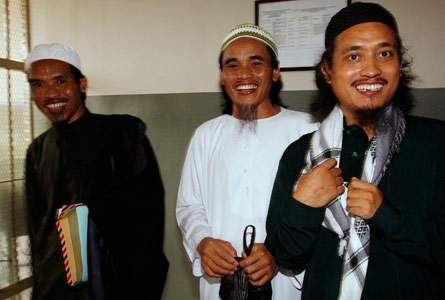
The mediagenic murderers display a range from insouciant to jocular in most of their photos. The ever-grinning Amrozi — in the middle — was known as the “smiling assassin.”

The three facing death today* have occupied most of the intervening six years endeavoring to transmute their criminal celebrity into the dearer coinage of martyrdom through the doubtful influence of the Philosopher’s Stone mass media.

Despite their body count, burial disturbances, and even the prospect of some follow-up strike by at-large members of Jemaah Islamiyah, a base metal the late bombers will remain. Picture the most fanatical devotee of any cause you care to conjure drawing any enduring inspiration from this juvenile twaddle.

Indonesia has appeared to sidle towards this execution, ginger at inflaming Islamic radicals; Australia, which has no death penalty itself, has been controversially mum and bombing victims and their families conflicted.

It remains to be seen whether the high-profile case has legs among militants. But its undertones of race, religion and national sovereignty are being very closely watched by one group of Australians in particular: the Bali Nine, Australian nationals in Indonesian custody for drug smuggling.

Three of the nine are currently on death row, reportedly “somber” at this day’s shootings — no doubt aware that they could be next.

Update: True to the publicity-savvy rep, Imam Samudra reportedly knocked out a nasheed or nasyid just before his execution that’s now a hot ringtone download.

[audio:Imam_Samudra.mp3]

* A fourth man was also death-sentenced, but that sentence was vacated on appeal.

On this day..

1824: Alexander Pearce, cannibal convict

On this date in 1824, Irish convict Alexander Pearce received the Catholic last rites and was hanged in Australia’s Hobart town jail for murdering and cannibalizing a fellow con during an escape attempt.

When Pearce, a petty thief who had been sentenced in England to penal transportation, was caught at King River after fleeing a Tasmanian prison colony. He had human flesh in his pocket … pretty much as alleged in this court scene from the docudrama “Exile in Hell”:

… or, at least, there is no record of Pearce, who was defended by no lawyer, contesting the charges. He is said to have had other food available at this time; it seems he killed his young companion when he realized the boy would hold him up … then ate him, because he liked the taste.

You’re wondering how he knew he liked human flesh, right?

Incredibly, the crime for which he was hanged was not Pearce’s first incident of cannibalism — not even his first incident of confessed cannibalism.

During a previous escape attempt in 1822 with six other men, the party had plunged ill-equipped into forbidding terrain, and fallen to … well, you know. Here’s a newspaper account by the author of a book about Pearce:

As the journey continued, one by one, the weakest man was killed with an axe and butchered to provide food for the others. After five weeks of endless walking, only three men were left: [Robert] Greenhill, Pearce and [Matthew] Travers.

Driven by extreme hunger, Greenhill finally faced the prospect of having to kill his injured friend Travers, who had been bitten on the foot by a venomous tiger snake. With Travers’ foot now gangrenous, Greenhill and Pearce half-dragged and carried their injured companion for five days until Travers begged them to kill him. The only weapon left was the axe. They killed him in his sleep, and ate his flesh.

Pearce and Greenhill struggled on for eight days, playing cat and mouse with each other, desperate to stay awake, fearing that the other would attack him if he closed his eyes and nodded off. It was Pearce who kept awake long enough to grab the axe and kill the sleeping Greenhill with a blow to the head.

Months later, when the law finally caught up with Pearce, he admitted to killing and eating his companions. He wasn’t believed: authorities figured his collaborators were still on the run and Pearce was covering for them, so they sent him back to the prison colony.

Whoops.

This unpleasant story is the subject of a forthcoming film, The Last Confession of Alexander Pearce.

On this day..

1833: Midgegooroo, Noongar rebel

On this date in 1833, an aged aboriginal Noongar (or Nyungar) was sentenced to execution and summarily shot in southwest Australia.

Midgegooroo was one of the many indigenous casualties of European settlement — Perth, in this case.

Little is documented of his life but the end and that, of course, by his enemies; he helped raise resistance to the arriving whites in 1831 after a native was killed trying to raid a potato patch. As tensions heightened over the ensuing months, he was outlawed with a £20 reward on his head. He was sentenced — possibly without any sort of formal trial — and summarily shot a few days after capture.

Midgegooroo’s son Yagan outlived his father two more months, and in that scanty condescension of destiny carved a place as one of Australia’s most illustrious native rebels. (pdf)

In the end, inevitably, Yagan’s fate was the same — not so precisely as to qualify him directly for these pages but ambush by settlers amounted to much the same as the rickety assemblage of formal semi-legalisms that thrust his father into the ground: the law of conquest without apology. It would be years yet before any white would face the law’s lethal sanction for killing Australian natives.

Yagan’s head was hewn off and packed for England as a grisly trophy-cum-souvenir-cum-“anthropological curiosity”. Not until the recent trend towards repatriating such remains was it was finally exhumed and returned to the Noongar nation — in 1997.

On this day..

1902: Harry “Breaker” Morant and Peter Handcock, “scapegoats for Empire”

On this date in 1902, two Australian officers were shot in virtual secrecy at Pretoria for atrocities they committed in service of the crown during the Second Boer War.

Harry “Breaker” Morant — he got the nickname from his aptitude with horses — was the famous one of the pair and the reason the date is so well-known to posterity as to merit its own cinematic treatment (review):

A colorful son of the Commonwealth’s hardscrabble strata, Breaker Morant led a life that has been improved into mythology, not least by his own efforts. Impoverished but educated, he migrated in 1883 from England to Australia where he carved out a larger-than-life profile as a bush poet, married the (subsequently) famous anthropologist Daisy Bates and eventually — fatefully — volunteered for service in South Africa.

The Second Boer War, Britain’s (ultimately successful) fight to corral the Dutch-descended Boer republics into the empire, started sunnily enough for the English, but as the Boers abandoned a conventional war they could not win and adopted guerrilla tactics, it descended into an exceedingly dirty conflict — notable for Britain’s pioneering use of concentration camps.

It was also notable for savagery between combatants. When Morant’s best friend in the unit was tortured and mutilated by Boer guerrillas, the poet went on a rampage, ordering a number of prisoners’ summary executions over a period of weeks. It was for this that he and his confederate were shot this day. The fact of his confinement was not communicated to the Australian government; Peter Handcock’s wife only learned of his execution weeks later, from press reports.

The defendants maintained that there was a standing order from the top to kill any Boer caught wearing British khaki, a tactic the Boers were known to employ, and that the order was frequently enforced. Though the prosecution strenuously maintained otherwise at trial, the existence of that (unwritten) directive has become accepted to posterity.

What remains murky is the matter of why — why these two, why now? And is Breaker Morant a hero or a villain? Those questions are also prisms for the many currents of Morant’s case so strikingly prescient for the century that lay ahead.*

Asymmetric warfare and the legal status of guerrillas. Human rights and war crimes. Corruption and plausible deniability. The moral culpability of subordinates for the orders of the brass. And certainly all the contradictory forces of empire and resistance entailed by an Australian adventurer shot by a Scottish detachment for killing Dutchmen in Africa at the behest of London.** It was an old-time colonial war in a world becoming, for we of the early 21st century, recognizably modern.

Hard-living to his dying breath, Morant stayed up the night before he was shot scribbling his last poem — piquantly titled “Butchered to Make a Dutchman’s Holiday”.

In prison cell I sadly sit,
A d__d crest-fallen chappie!
And own to you I feel a bit-
A little bit – unhappy!

It really ain’t the place nor time
To reel off rhyming diction –
But yet we’ll write a final rhyme
Whilst waiting cru-ci-fixion!

No matter what “end” they decide –
Quick-lime or “b’iling ile,” sir?
We’ll do our best when crucified
To finish off in style, sir!

But we bequeath a parting tip
For sound advice of such men,
Who come across in transport ship
To polish off the Dutchmen!

If you encounter any Boers
You really must not loot ’em!
And if you wish to leave these shores,
For pity’s sake, DON’T SHOOT ‘EM!!

And if you’d earn a D.S.O.,
Why every British sinner
Should know the proper way to go
Is: “ASK THE BOER TO DINNER!”

Let’s toss a bumper down our throat, –
Before we pass to Heaven,
And toast: “The trim-set petticoat
We leave behind in Devon.”

His last words were hurled at his firing squad: “Shoot straight, you bastards! Don’t make a mess of it!”

* It is no coincidence that the Australian film excerpted in this post was released while the Vietnam War was still a fresh memory.

** Breaker Morant’s memory would develop into a point of Australian suspicion towards the British military, especially after Morant’s persecutor helped author World War I’s infamous hecatomb of Australian (and New Zealand) troops at Gallipoli. Morant and Handcock turned out to be the last Australians executed by the British military.

Update: Via Airminded, an Australian history program took a skeptical look at the Breaker Morant myth a few years ago.

On this day..

1838: Seven perpetrators of the Myall Creek Massacre

On this date in 1838, seven white men were hanged for an unprovoked massacre of aborigines in Australia.

A memorial stands over the the site of the Myall Creek Massacre. Image used with permission.

Native life was cheap on the continent and countless brutalities blithely visited by European settlers have gone to that vast forgotten register of unavenged atrocities.

The Myall Creek massacre was not atypical of such incidents, save in its outcome: it was the first execution of whites for crimes against Australia’s natives, a fact that aroused furious opposition in much of Australia’s settler population.

The massacre took place on June 10, when a group of 12 whites rounded up 28 aboriginals, mostly women and children, at a remote outback station, raping some women and murdering all. Unusually, it was reported, investigated, and prosecuted. Eleven of the party (the ringleader escaped and was never punished) stood trial and were acquitted in an apparent gesture of jury nullification:

“I knew the men were guilty of murder but I would never see a white man hanged for killing a black,” one juror told a newspaper.

But he would see it, and soon.

The governor had seven of the group immediately re-arrested and tried again — technically for a different specific murder amid among the slaughter — and this time, condemned. Along with much of its readership, the Sydney Morning Herald was incensed:

We want neither the classic nor the romantic savage here. We have far too many of the murderous wretches about us already.

The whole gang of black animals are not worth the money the colonists will have to pay for printing the silly court documents on which we have already wasted too much time.

That bilious sentiment, far from expunged in Australia, has an enduring symbol in the Myall Creek Massacre. The aboriginal victims of this day’s hanged are commemorated in a monument overlooking the scene of their deaths … and they have occasioned modern efforts at reconciliation, including some of the descendants of their murderers.

On this day..

2005: Van Tuong Nguyen

On this date in 2005, Australian national Van Tuong Nguyen was hanged* in Singapore’s Changi Prison for smuggling heroin.

Three years before, in dire financial straits, Nguyen had agreed to act as a drug courier and been caught attempting to carry 396.2 grams — less than a pound — of heroin through the airport of the notoriously execution-happy city-state. He had no criminal history and cooperated with the authorities, but the quantity of contraband on his person incurred an automatic death sentence.

Nguyen became an international cause celebre and the Australian government appealed for clemency — though some detected tepid public notice for the young man of Vietnamese extraction in comparison with white Australians in similar situations.

His family’s two-year campaign mobilizing worldwide pressure to save him was the profile of a 2006 documentary that laid bare the continuing grief left to Nguyen’s family and friends … and their continuing work against the death penalty in his remembrance. This personal tribute of unidentified provenance captures both:

* By Darshan Singh, whose identity as Singapore’s hangman was exposed on the occasion.

On this day..