1794: Jacques Roux, the Red Priest, cheats the guillotine

On this date in 1794, French Revolution firebrand Jacques Roux committed suicide to avoid execution during the Terror.

Roux was a Catholic vicar on the eve of the Revolution, and “of the many priests who had left the church to join the Revolution none was more articulate and socially aware.”

He became a leading exponent of the radical enragés, a faction that really took the Revolution’s purported egalite to heart.

In early 1793, Roux was an official representative to the execution of Louis XVI — one can read his minimalistic report here; knowing that Roux was a priest, Louis tried to press him for some spiritual aid, and was rebuffed. “I am only here,” Roux answered icily, “to lead you to the scaffold.”

The man’s invective against the merchant classes packed considerably more heat.

Roux’s Manifesto of the Enrages minced no words:

Freedom is nothing but a vain phantom when one class of men can starve another with impunity. Equality is nothing but a vain phantom when the rich, through monopoly, exercise the right of life or death over their like. The republic is nothing but a vain phantom when the counter-revolution can operate every day through the price of commodities, which three quarters of all citizens cannot afford without shedding tears.

For the last four years the rich alone have profited from the advantages of the Revolution. The merchant aristocracy, more terrible than that of the noble and sacerdotal aristocracy, has made a cruel game of invading individual fortunes and the treasury of the republic; we still don’t know what will be the term of their exactions, for the price of merchandise rises in a frightful manner, from morning to evening.

Unfavorably contrasting the new haves with the ancien regime is the sort of thing that gets you into trouble in a bourgeois revolution.

Burdened by multiple wars, and then by poor harvests, France’s economy was a mess. Later that same year, Paris’s urban poor, the sans-culottes, invaded the Convention to force anti-hoarding and price control measures. Roux didn’t create that situation: he just had the nerve to risk his neck talking about it.

But by then, that prim ascetic Robespierre had already begun hounding Roux. He would hound him to his death.

Kropotkin‘s anarchist history, The Great French Revolution, 1789-1793, valorizes the courageous former priest. In Kropotkin’s narration, we find Roux ordered transferred out of ordinary police court to the Revolutionary Tribunal on some spurious charge of financial impropriety.*

Knowing what that meant, Roux stabbed himself in court thrice with a knife. The president of the court hastened to his assistance and displayed much friendliness towards him, even giving him the kiss of civic brotherhood, before he was removed to the Bicetre prison. In the prison infirmary Roux “tried to exhaust his strength,” as it was reported to the procurator of the Revolutionary Tribunal, Fouquier-Tinville, by opening his wounds; and finally he succeeded in stabbing himself once more, this time mortally, through the lung.

In terms of present-day iconographic potential, the French Revolution probably did not produce a more outstanding radical leftist; Roux’s direct critique of economic power clearly marks him as a forerunner of subsequent generations’ communist and anarchist movements … as well as even more contemporary voices.

And undoubtedly, Roux’s project remained (and remains) unfinished. Surveying the scene after the Terror, Roux’s onetime ally Jean-Francois Varlet remarked, “In my country there has only been a change of dress.”

There’s more of Roux’s writing on Marxists.org.

* A much more serious graft charge would likewise be deployed to topple Danton.

Longtime readers may recall that this post was briefly (and mistakenly) up on this date in 2011. Oops.

On this day..

1880: Prevost, predatory Parisian policeman

From a Paris Dispatch report via the New York Times. (Additional paragraph breaks have been added for readability.)

It is just 10 years ago, day for day, that the notorious Troppman, the murderer of the Kink family, was executed on the Place de la Roquette. This morning another convict of the same stamp underwent the penalty of death on the same spot.

Prevost, the policeman who murdered the woman Blondin and the jewelry-dealer, Lenoble, and afterward cut their bodies up and threw the pieces into the sewers, was guillotined there at daybreak.


Thwack: Prevost clobbers Lenoble.

It having become known last night that his appeal for mercy had been rejected by the President of the Republic, a large crowd began to assemble as early as 9 o’clock round the place of execution. To prevent a recurrence of the scenes of disorder which took place there when the young criminals Lebiez and Barre, the assassins of the woman Gilles, were put to death, a strong force of infantry and cavalry guarded the square and kept the people at a distance.

The crowd, in spite of the bitter cold and piercing north-east wind, grew more numerous toward midnight, and by the hour of execution all the thoroughfares leading to the spot were crammed with people.

The executioner arrived at 4 o’clock, and, aided by his assistants, erected the guillotine about 20 paces from the central door of the prison. The guillotine once in order, the headsman and his assistants entered the prison to arrange what is called the toilet of the culprit previous to his death.

The Abbe Crozes, the Chaplain of the jail, was the first to enter the prisoner’s cell. Prevost started up, gazed wildly at the reverend gentleman, and then buried his head in his hands, trembling and groaning.

“Alas!” said the Chaplain, “there is no hope now but in the mercy of God.”

Prevost had lured the jewel-trader Lenoble on the pretext of arranging a transaction, then for no reason save crass acquisition of his wares bludgeoned him to death with the iron rod-and-ball device used to link railroad cars.

It was a premeditated and gruesomely executed crime.

Using butchers’ knives he had pre-obtained for the purpose, Prevost spent the next several hours skinning Lenoble, dismembering Lenoble, and ultimately dicing Lenoble up into cutlets so that he could heap Lenoble in a basket and dispose of Lenoble’s bits in less-suspicious fragments in a variety of sewer grates and refuse heaps.

Such as was recovered was heaped together at the morgue, “a mass of quivering flesh, stripped of skin … bones covered with their tendons, sternum, ribs with fragments of the chest, bones of the shoulder blades and arms … the liver, heart and guts, and the fragments of skin torn off one by one from each severed part.”*

After his capture for this shocking crime, he admitted that he’d also been the author of the unsolved murder several years before of his lover, Adele Blondin — likewise for pecuniary gain, and likewise disposed of in pieces after Pevost’s ghoulish close work with corpse and saw.

The condemned man then left his bed, but he was too much overcome to dress himself. That task was done by the executioner and his assistants. He was then left alone with the Abbe Crozes to prepare his soul. He embraced the Chaplain several times and wept bitterly.

“Take courage, take courage,” said the reverend gentleman.

“Yes, yes,” replied Prevost, “I will take courage and try to meet my fate. I ask pardon of the Police administration, to which I belonged seven years.”

“If this … pawnbroker has been murdered by some one of a higher class in society,” Dostoyevsky had mused in Crime and Punishment in 1866, “how are we to explain this demoralisation of the civilised part of our society?”

Prevost’s demoralization afflicted his cognition as well as his conscience, because he had actually made previous chit-chat with fellow-officers to the effect that were he to commit the perfect crime he would surely go and butcher the body for no-fuss disposal.

The condemned man, after kissing the crucifix three or four times, marched out to the guillotine wit a firm step, and in an instant he was on the fatal bascule.

The spring was touched, a dull thud was heard, and the next second his head fell into the basket.

After the execution the body and head of the murderer were taken to the School of Medicine, and, having been sown together, electrical experiments were made on them, and in the opinion of all the doctors present death must have been instantaneous.

* This quote, and the other interspersed crime details, and the nice bashing illustration, are all via this French crime pamphlet.

Part of the Daily Triple: 1880 and Death.

On this day..

1801: Chevalier, bomb plot scapegoat

On this date in 1801, a Jacobin chemist was wrongly executed for Royalists’ plot against Napoleon.

Our scene is France, the year following Napoleon’s coup of 18th Brumaire (November 9, 1799 on the stodgy old Gregorian calendar). Marx’s “first time as tragedy”* saw the Corsican achieve monarch-esque power, and the months ensuing saw a plethora of plots against him.

The ranks of aggrieved potential assassins included both Jacobins, incensed at the military dictatorship, and Bourbons, incensed that it wasn’t their dictatorship — in both cases exacerbated by Napoleon’s decisive battlefield triumphs which consolidated his hold on power.

On Christmas Eve 1800, the man on horseback was a man in a carriage, careening through Paris to catch a performance of Haydn’s oratorio The Creation.

When, all of a sudden, a gigantic explosion on the Rue Saint-Nicaise attempted to un-create the First Consul. It failed, exploding after Napoleon had passed and before Josephine’s family followed, “merely” killing and maiming fifty-some miscellaneous Parisian bystanders instead.


Kablamo! The explosion of the Infernal Machine.

The Catherine Delors historical novel For the King (author’s teaser) is built around investigating the Plot of the Rue Saint-Nicaise.

“Every one,” wrote Sir Walter Scott,

shocked with the wild atrocity of such a reckless plot, became, while they execrated the perpetrators, attached in proportion to the object of their cruelty. A disappointed conspiracy always adds strength to the government against which it is directed; and Buonaparte did not fail to push this advantage to the uttermost.

This “Infernal Machine” had actually been built by disgruntled monarchists at the instigation of intriguer Georges Cadoudal, as was swiftly discerned by Napoleon’s Minister of Police, the ruthless ex-revolutionary Joseph Fouche.

Realpolitik exigencies — Napoleon was trying (unsuccessfully) to reach political terms with the royalist faction — instead drove a rush to pin the detonation on the Jacobins.

Who, it should be said, made themselves the primary suspects by virtue of the fact that they’d also been trying to blow up Napoleon. Chevalier had been arrested a couple of months before when a bomb of his, evidently an experiment for a similar Jacobin plot, loudly blew up near Salpetriere.

Four other Jacobins followed Chevalier to death later in January (and two royalists actually involved in the bomb got the same treatment). Some 130 other prominent Jacobins (French link) were expelled on Napoleon’s say-so — no legislative consultation — to the empire’s far-flung colonies, pretty much putting the remains of the long-supine revolutionary left permanently out of the picture as a political force.

* See the 18th Brumaire; the “second time as farce” also came with its own history-repeating-itself executions.

On this day..

1638: Four Frenchmen in effigy

We have touched in the past on the odd practice of executing effigies of criminals, a custom for which France had a particular penchant.

On this date in 1638, mannequins of Andre Armand, Gabriel Bonnaud, Sebastien Mareschal, and Simon Armand were “hanged” for murder.

As described in this French text, proceedings were delayed when, the previous November, the wife and mother-in-law of one of the absconded offenders appealed the sentence in their own inimitable way: by vandalizing the mannequins.

Thanks to Sonechka for deciphering the archaic French.

On this day..

1793: 213 or so Lyonnaise

Upon learning of the recent Republican capture of Toulon from the British and anti-revolutionary allies — a military achievement authored by a 24-year-old artillerist by the name of Napoleon Bonaparte — Joseph Fouche dispatched the following missive from the city where he his iron-fisted occupation was earning the epithet “Executioner of Lyon(s)”

Despite showing himself a ferocious Jacobin during the Terror, the Machiavellian Fouche helped author Robespierre‘s downfall and later became ennobled as the Duke of Otranto under Bonaparte. Needled by the Corsican about having voted for Louis XVI’s execution, Otranto aptly riposted, “Yes, sire; and that is the first service I had the honour of rendering your majesty!”

Joseph Fouche to Collot d’Herbois
22nd December 1793

And we likewise, my friend, have contributed to the surrender of Toulon, by spreading terror amongst the traitors who had entered the town, and by exposing to their view the dead bodies of thousands of their accomplices.

The war will be at an end if we know how to profit by this memorable victory; let us show ourselves terrible, that we may not fear becoming weak or cruel; let us annihilate in our anger, and at one single blow, every conspirator, every traitor, that we may not feel the pain, the long torture of punishing them as Kings would do.

Let us follow the example of nature in the exercise of justice. Let us be avenged as a nation, let us strike as quick as lightning, and let even the ashes of our enemies disappear from the land of liberty.

Let the perfidious and ferocious English be assailed from every quarter; let the whole republic turn into a volcano, and pour forth the devouring lava upon them: may the infamous island that produced those monsters, who no longer belong to the human species, be hurled for ever in the waves.

Farewell, my friend: tears of joy gush from my eyes, and overflow my heart. The courier is setting off. I shall write to you by the post.

FOUCHE

P.S. We have but one means of celebrating our victory. We shall this evening send 213 rebels to the place of execution: our loaded cannons are ready to salute them.

(Translation primarily as rendered in the London Times, July 18, 1815)

Whether this horrifying last bit of revolutionary braggadocio was in fact effected does not seem to be quite clear. This book claims that Fouche had 192 executed that day for the amusement of a party of Jacobins and prostitutes, which has the suspicious whiff of propaganda about it.

Hubert Cole, in Fouche: The Unprincipled Patriot reckons it “only” 67, with Fouche routinely inflating his atrocity figures a la military body counts for the benefit of ardent revolutionaries in Paris.

The use of cannon loaded with anti-personnel grapeshot — condemned tied together in pairs and then indiscriminately blasted; troops on hand to finish off survivors with bayonets — was an innovation in death-dealing technology that the National Convention did not appreciate, and Fouche was obliged to return to the more decorous methods of regular firing squads and that newfangled beheading machine.

* Not to be confused with Nazi torturer Klaus Barbie, the Butcher of Lyon. We hope the good people of Lyon will not require too many more synonymous sobriquets.

On this day..

1529: Desle la Mansenee in the Luxeuil Trial

“In 1529, the Inquisitor General of Besancori, a Dominican friar named Jean Boin, visited incognito the village of Anjeux in the bailiwick of Luxeuil, Franche-Comte, and noted down the gossip of the villagers, which centered on 27-year-old Desle la Mansenee,” begins this vignette in the only part of Nigel Cawthorne’s Witches: History of Persecution that Google books preview will cough up.

You know this isn’t going to end well.

Our incognito Inquisitor swiftly decloaked and transformed Desle la Mansenee from grist for the neighbors’ grapevine into ash for their garden plots by torturing her into confessing to — oh, you know, the usual stuff. Dancing at witches’ sabbats and flying on broomsticks and banging the devil. That sort of thing.

People, these are infernal agents. It doesn’t get any worse than that. You’ve got to use tough tactics to get information, not just start salacious rumors and hope they’ll come clean.

On this day..

1721: Cartouche, French bandit

On this date in 1721, the French outlaw Cartouche was broken on the wheel in Paris.

Your basic superstar robber during that archetype’s golden age, Louis Dominique Garthausen, aka Bourguignon, aka Cartouche was the son of a German mercenary-turned-French wineseller.

Little Cartouche — his nickname came from a Francophone corruption of his German surname — distinguished himself from childhood as the most charismatically intrepid of the local hooligans, and by adolescence was already the leader of a troupe of rascally thieves.

By his twenties, after a detour through the army, Cartouche and his merry men (the Cours des Miracles gang, after the slum they operated out of) were raiding the lucrative Versailles-Paris route, plundering the virtue of marchionesses, distributing stolen booty the poor, maintaining perfect courtesy in the society of gentlemen, and generally becoming the heroes of that species of literature that revels in bodice-busting sybaritic rakes who play by their own rules but have a heart of gold. (Sample escapade: walking a carnival parade with a cart full of police effigies — whipping them all the way, to the glee of the crowd. Thackeray celebrates more Cartouche folklore here, like the time he robbed as part of a threesome, talked one accomplice into murdering the other in order that the two survivors should have greater shares of the spoils to divide — only to round self-righteously on the killer once his pistols were safely discharged and gun him down in turn with the words “Learn, monster, not to be so greedy of gold, and perish, the victim of thy disloyalty and avarice!” That’s a pretty good one, whether it really happened or not.)

The flesh-and-blood police started to roll up this group around 1719, turning arrestees into informants and hunting ringleaders to ground. True to character, Cartouche defied with his liberty the growing price on his head, deftly giving gendarmes the slip until a confederate betrayed him into his enemies’ hands literally while his pants were down.


18th century engraving of the arrest of Cartouche.

The guy very nearly broke out of prison — tunneling out of a dungeon of the Chatelet into a neighboring basement, only to have the clank of his chains rouse the family dog into a woofing frenzy that betrayed him before he could vanish out the front door. But even back in the clink,

came a period of splendid notoriety: he held his court, he gave an easy rein to his wit, he received duchesses and princes with an air of amiable patronage … His portrait hung in every house, and his thin, hard face, his dry, small features were at last familiar to the whole of France. M. Grandval made him the hero of an Epic — “le Vice Puni.”

Cartouche was doomed to breaking on the wheel after a morning suffering the tortures of the boot in an unavailing effort to extract further incriminations from the rogue.*

Cartouche seems to have fully expected his troupe to reciprocate this heroism by rising to the dramatic occasion of a rescue from the very scaffold. But as the prisoner arrived at the Place de Greve, he perceived at last that like Christ he had been abandoned at the critical hour by the men who had sworn oaths with him. The great desperado’s final act was to retaliate upon these faithless friends (and family!) by taking aside his prosecutors and detailing his every accessory in crime, even his lovers. What the worst extremities of medieval torture could not procure from him, the compelling incentive of revenge instantly conjured.

Our hero went to his death this day but his revenant spirit stalked France for many months thereafter as dozens succumbed (pdf) to Cartouche’s scaffold indictment. One diarist recorded the following July,

Nothing but hangings and breakings on the wheel! Every day some Cartouchian executed.

* Available sources are flatly contradictory between the story that Cartouche was to die on the 27th and his confessions stalled things until the 28th, or was to die on the 28th all along, or was to die and did so on the 27th.

On this day..

1944: French collaborator in Rennes

This U.S. Army photo from a few months after D-Day is filed simply thus:

“Photo taken at the instant bullets from a French firing squad hit a Frenchman who collaborated with the Germans. This execution took place in Rennes, France.” Himes, November 21, 1944.


Click to see a larger image of this stunning photo — or, take in this huge copy.

On this day..

1793: Jean-Sylvain Bailly, moonstruck

See Bailly, likewise of Paris, time-honoured Historian of Astronomy Ancient and Modern. Poor Bailly, how thy serenely beautiful Philosophising, with its soft moonshiny clearness and thinness, ends in foul thick confusion — of Presidency, Mayorship, diplomatic Officiality, rabid Triviality, and the throat of everlasting Darkness! Far was it to descend from the heavenly Galaxy to the Drapeau Rouge: beside that fatal dung-heap, on that last hell-day, thou must ‘tremble,’ though only with cold, ‘de froid.’ Speculation is not practice: to be weak is not so miserable; but to be weaker than our task. Wo the day when they mounted thee, a peaceable pedestrian, on that wild Hippogriff of a Democracy; which, spurning the firm earth, nay lashing at the very stars, no yet known Astolpho could have ridden!

Carlyle

On this date in 1793, French astronomer turned revolutionary Jean-Sylvain Bailly was guillotined during the Paris Terror.

Bailly ditched a family trade in the arts — his father was a supervisor at the Louvre — and turned his gaze skyward.

Studying astronomy under Lacaille, Bailly made a quick splash in astronomical circles with meticulous work on Halley’s Comet and the moons of Jupiter. He was inducted into the French Academy of Sciences while still in his twenties. Not quite the guy every schoolchild knows, but a significant scientist in his time. As one twentieth-century reviewer put it,*

Bailly was not a great thinker or the discoverer of new concepts; no case can be made for placing his name beside those of Newton, Leibnitz, and Laplace. But he should not be denied a niche among the numerous competent and persevering work-a-day scientists who, perhaps, in the long run make possible the achievements of a few great men. His observations and reductions, his application of a mathematical discipline to the movements of the heavenly bodies, and his detailed publications had brought him, by 1766, considerable credit among fellow scientists.

His “considerable credit” in the public sphere, enhanced by his widely-admired writing, set him up for election to the Estates-General in 1789. Indeed, Bailly was elected to head the body’s Third Estate.

On June 20th of that pregnant year, days after the Estates-General had constituted itself a National Assembly with ambitions far outstripping the limited purpose of revenue collection the king intended them for, Louis XVI locked the delegates out of their meeting-room.

Bailly, in consequence, would lead one of the pivotal actions of the embryonic French Revolution. “I do not need to tell you in what a grievous situation the Assembly finds itself,” he said to the assembly reconvened at a nearby tennis court. “I propose that we deliberate on what action to take under such tumultuous circumstances.” The result of that deliberation was the Tennis Court Oath.


Detail view (click for the full image) of Jean-Sylvain Bailly administering the Tennis Court Oath, in Jacques-Louis David‘s sketch of the event.

When the Paris provost — an archaic municipal office — was shot by the mob on Bastille Day, Bailly became the City of Light’s first mayor.

But as with other principals of the Revolution’s earliest stirrings, like Bailly’s ally Lafayette, the man was left behind by the rapid progress of events. He’d been two years retired out of public service in Nantes when he was hailed before the Revolutionary Tribunal on the preposterous charge of having conspired in Louis XVI’s attempted flight and guillotined on that basis.

A lunar crater — the largest crater visible from earth — is appropriately named after this prolific observer of the heavens.

* Edwin Burrows Smith, Transactions of the American Philosophical Society, New Series, Vol. 44, No. 4 (1954).

On this day..

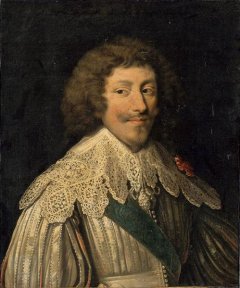
1632: Henri II de Montmorency

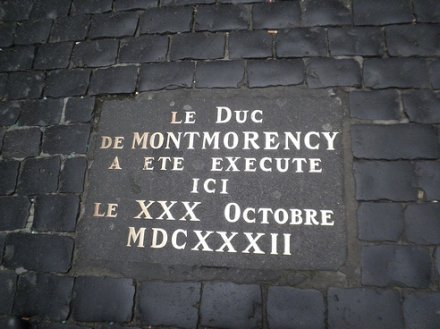
On this date in 1632, French noble Henri II de Montmorency was beheaded at Toulouse for rebellion against Louis XIII.

The lordly Montmorency (English Wikipedia page | French), sister to a famous knockout whom Henri IV wooed, was a Grand Admiral for his achievements knocking heads during the 1620s’ Huguenot rebellions. (It was Montmorency who, in the naval battle to capture Re Island, commanded the English ships controversially supplied by the Duke of Buckingham.)

His undoing? He hated Cardinal Richelieu‘s guts.

The red eminence had just attained his rank as Louis XIII’s consigliere, and set about using it to centralize the state in the king’s hands.

Toward that end, Richelieu pressed Montmorency to give up his “grand admiral” title, fearing that “grand” military generals running around the realm were liable to become a locus of sedition sooner or later. Similarly, Richelieu reduced Montmorency’s power as governor of Languedoc.* He wanted, altogether, fewer stumbling-blocks of leftover feudal authority laying about his absolute monarchy.

A seething Montmorency finally jumped — or was he pushed? — into outright rebellion in the party (French) of treacherous royal brother Gaston, duc d’Orleans. The rebel force barely materialized, and was easily beaten at Castelnauday.

Orleans fled the country, not half so committed to his revolt as Montmorency — who assailed the king’s lines practically alone. The latter, captured wounded on the battlefield, was attested to have given a ferocious account of himself in a hopeless cause: “seeing a single man charge through seven ranks and still fight at the seventh, he judged that that man could be only M. de Motmorency.”

Jolly good show, and all the more reason for Richelieu to take his head, to make an example of the man to other powerful men who demanded clemency for the rebellion as if it were Montmorency’s birthright. Richelieu would argue in his memoirs that this pitiless act to pacify the realm at the risk of his own popularity was the height of patriotism.


Plaque at the spot of Montmorency’s execution in Toulouse. Image (c) [Cova] and used with permission.

The Montmorency title eventually became that of the Dukes of Enghien, in which guise it’s associated with an altogether more famous execution.

* Among Montmorency’s other titles, less obnoxious to Richelieu, was viceroy of New France — that mysterious land across the Atlantic. There’s a Montmorency Falls in Quebec, named for him by Champlain.

On this day..