1440: Gilles de Rais, unholy

On this date in 1440, the wealthiest man in France, a noble who had once fought under Joan of Arc‘s banner, was hanged for an outlandishly demonic crime spree.


This dashing Gilles opposite Milla Jovovich in The Messenger; you’d never think he would sodomize hundreds of children.

Rivaling Hungarian blood-bather Erzsebet Bathory for the reputation of most bewitchingly depraved aristocratic sex-killer of early modern Europe, Gilles de Rais (or de Retz) hanged for abducting numberless legions of anonymous young commoners (boys, mostly) for rape and murder.

It’s a rap sheet trebly astounding given that a decade before, de Rais’s reputation for posterity would have figured to be his role as Saint Joan’s chief lieutenant when she raised the siege of Orleans, culminating with elevation to the rank of Marshall of France on the very day Charles VII was crowned in Reims. Talk about a fall from grace.

A 1440 investigation triggered by de Rais’s attack on a priest during an intra-aristocracy dispute turned up a Gacy‘s floorboards’ worth of Nantes-area kids allegedly disappeared into the Marechal’s creepy castle. Remarkably detailed trial records preserve a heartbreaking cavalcade of parents who entrusted their children to de Rais’s service or just sent them out one morning never to be heard from again. “It is notorious,” one added, “that infants are murdered in the said chateau.” (Many of these depositions and other original trial records can be read here.)

His servants and co-deviants Henriet and Pouitou admitted the most shocking stuff —

that de Rais then raped [the typical captive] as he was hanged from a hook by the neck. Before the child died, Gilles took him down, comforted him, repeated the act and either killed him himself or had him slain.

Poitou testified that the child victims were murdered sometimes by decapitating them, sometimes by cutting their throats, sometimes by dismembering them, sometimes by breaking their necks with a stick …

Gilles de Rais rarely left a child alive for more than one evening’s pleasure, Poitou claimed.

Now, it needs to be said that the servants were induced to these confessions by the threat of physical harm — and that when de Rais reversed his own denials he had likewise been menaced with torture. Nobody had been tortured, mind. But they had been given to understand that they would be corroborating the witnesses with self-incriminating statments, and we can do this the easy way or the hard way. In a world without dispositive forensics, confessions were the evidentiary gold standard … and torturing to obtain them was standard operating procedure.

It’s for that reason that there has also long persisted a revisionist thesis that de Rais was actually innocent, framed up by elite rivals who cannibalized the man’s estates. A 1992 “rehabilitation tribunal” re-tried the affair, and returned an acquittal.

Arguably, the populace — font of all those damning accusations — did likewise on the day de Rais hanged with his two servants. A crowd one might expect to be frenzied with rage actually sympathized with the doomed noble, even rescuing his hanged body from the fire. A monument his daughter put up became an unsanctioned popular pilgrimage site until it was destroyed during the French Revolution.

Whether as fact or fable, there’s something gorgeously baroque about de Rais’s dungeon mastering — especially when considered vis-a-vis his historical casting call opposite the abstemious Maid.

As a text for our latter-day edification, de Rais appears a carnivore devoured by his own appetites (and not only sexual: he also blew through the gargantuan family fortune). Reduced from hero to beast, he’s almost a literal werewolf or vampire; he’s often cast as such in video games and the like.

And he transfixes us because he personifies this uncanny bridge from the atomized digital age with its iconic serial killers, alone and psychologically deconstructed, back into the medieval — feudal, irrational, communal, violent and physical but also suffused with an omnipresent alien-to-us paranormal spirit world. It is enough to glance to experience the pull of the abyss gazing back.

Sabine Baring-Gould anticipated the modern afterlife of Gilles de Rais in the mid-19th century Book of Were-Wolves — which incorporated an extended account of de Rais’s trial into a wider narrative of folklore shapeshifting.

De Rais himself shapeshifts even within the brief arc of his dramatic trial: from indignant defendant into contrite supplicant, every drop sincere so far as one can perceive. His very prosecutors, indeed his very victims, wept for the fallen Marechal, and the “monster” reversed with this display his excommunication. (This may have been the part of the punishment de Rais feared most: again, we encounter the alien cosmology.)

“Nothing seems to me to be more beautiful –- and farthest away from our mentality of today — than the crowd of parents of the victims praying for this soul’s salvation,” one modern observed. “That is spiritual nobility.”

Agonizing ecstacist Georges Bataille wrote a whole book about de Rais, characteristically taken by the intersection of repugnance and transcendence. For Bataille, Christianity even reconciles our prisoner’s stupendous villainy with his unfeigned anticipation of spiritual salvation that “ultimately summarize the Christian situation.”

“Perhaps,” Bataille mused, “Christianity is even fundamentally the pressing demand for crime, the demand for the horror that in a sense it needs in order to forgive.”

A Few Books About Gilles de Rais

There are also several free public-domain books, such as Bluebeard: an account of Comorre the cursed and Gilles de Rais, with summaries of various tales and traditions and (already alluded to, the one with the original trial documents) Blue-beard, a contribution to history and folk-lore. Gilles de Rais is popularly, though I think not very persuasively, believed to have helped inspire the “Bluebeard” legend of the murderous aristocrat.

On this day..

1941: Forty-eight French hostages

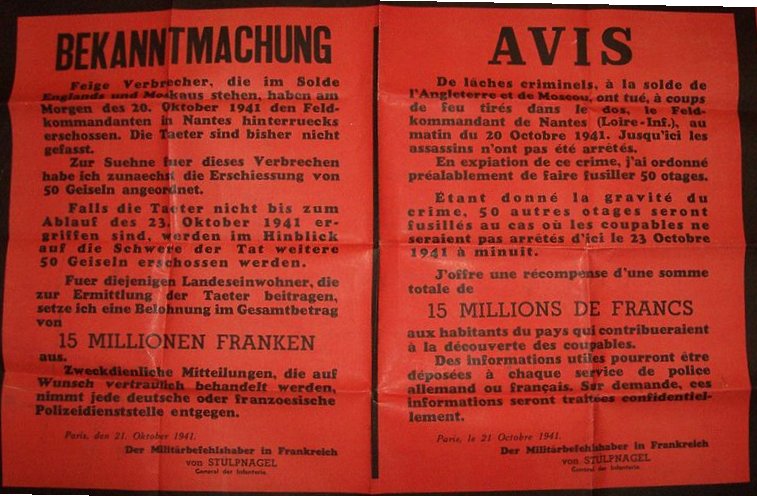
On “a beautiful autumn day” this date in 1941, four dozen French leftists were executed by that country’s occupiers as punishment for the murder of a German officer.

On October 20, 1941 — sixteen months into the German occupation — a pair of Communist commandos assassinated the Feldkommandant of Nantes, Lt. Col. Karl Hotz (French link).

News of this crime went straight to Adolf Hitler himself, who personally ordered a fearful reprisal.

The list of the executed hostages as published Oct. 23 in L’oeuvre

Accordingly, the collaborationist Petain government was induced to select 50 persons from among the ranks of detained German political prisoners. Pierre Pucheu, who would later be executed himself,* intentionally selected Communist types in an effort to confine the retaliation to fellow-travelers.

On this date, those 50 — well, 48, but who’s counting?; the numbering can get dodgy in these mass-execution scenarios — were put to death at three different locations: five at Fort Mont-Valerien; sixteen at Nantes; and most notoriously, 27 internees of Choisel (French link) at Chateaubriant.**

In three different batches of nine, the 27 reds and trade unionists were fusilladed into the ranks of Gallic martyrdom. They remain among the most emblematic French martyrs of the occupation; there’s a cours des 50-Otages named for them in Nantes, and various streets that bear individual victims’ names — such as Rue Jean-Pierre Timbaud in Paris. (Timbaud was a Communist steelworker.)


Monument to the martyrs of Chateaubriant. Image (c) Renaud Camus and used with permission.

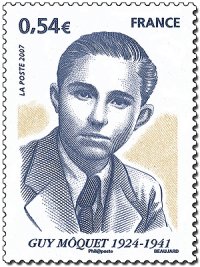
The youngest, 17-year-old Guy Moquet (you can find his name on the Paris Metro) was the son of an exiled Communist parliamentarian (French link).

He made headlines in 2009 when current French President Nicolas Sarkozy had added to the educational curriculum the reading of Moquet’s brave-but-sad last letter to his family: the decision drew some rather mean-tempered fire because of Moquet’s political persuasion. In the end, the text bore a fairly universal reading that could play inoffensively to posterity — like its postscript injunction,

“You who remain, be worthy of the 27 of us who are going to die!”

There’s a thorough roundup of the Oct. 22 executions (including poetic tribute) here.

* Vindicating Winston Churchill’s prophecy to the Times upon receiving news that “These cold-blooded executions of inocent people will only recoil upon the savages who order and execute them.” (Oct. 25, 1941, as cited in the The Churchill War Papers, vol. 3)

** Fifty more were supposed to be executed if the assassins weren’t promptly turned in, but that second batch never took place. (There was, however, a different batch of 50 executed on October 24 in retaliation for a different political assassination. Maybe they just all ran together.)

Part of the Themed Set: Illegitimate Power.

On this day..

Feast Day of Saint Denis, cephalophore

October 9 marks the feast date of the early Christian martyr Saint Denis.

Guess how he died:


(cc) image from minifig of the saint’s statue at Notre Dame.

When this missionary bishop to Paris got the Roman chop* for his conversions sometime after 250, he scooped up his own severed noggin and carried it to his preferred burial spot.

Upon that eventual pilgrimage site would spring up a medieval basilica whose 12th century renovation turned it into a pioneer of Gothic architecture.

(Denis is also sort of the namesake for the Parisian hill Montmarte where he’s supposed to have been put to death: “mountain of Mars” in heathen times, it Christianized to mons martyrium, “Martyrs’ Mountain”.)

While many Christian martyrs carry the instruments of their martyrdom in iconography, and a few others roll with the bits of severed flesh exacted by those martyrdoms, Denis is only the most notable of an entire designated sub-class who carry their own heads: cephalophores.

This subject, seemingly tailor-made for a They Might Be Giants song, finally got one in 2011: “You Probably Get That A Lot”.


A most profane footnote was appended to our holy man’s legend during the French Revolution.

Journalist Camille Desmoulins once recklessly sneered of Robespierre‘s vain lieutenant Saint-Just, “He carries his head like a sacred host.”

Saint-Just is supposed to have retorted upon hearing the slight, “I’ll make him carry his like Saint Denis.” He did it, too.

* Two companions, Rusticus and Eleutherius, were doing the same conversions and suffered the same execution. Nobody named cathedrals after them.

On this day..

1941: Nguyen Thi Minh Khai, Indochina Communist cadre

On this date in 1941, Vietnamese Communist cadre Nguyen Thi Minh Khai was shot as an anti-France insurrectionary.*

Khai (Vietnamese Wikipedia page | English) surely fit the description: she was a leader of the Indochinese Communist Party in the 1930’s, working directly with Ho Chi Minh in his Hong Kong exile. She would return in 1936 to the city later named for that redoubtable revolutionary as its ranking agitator.

Khai, the most famous of the Indochinese Wars’ vast ranks of women fighters, would marry fellow revolutionary Le Hong Phong, the chairman of the party, who died in prison in 1942. Khai’s sister’s marriage made Khai sister-in-law to the revolution’s military lion Vo Nguyen Giap.**

But her prominent position also made her a target.

Arrested by the French late in 1940, she was tortured and condemned to death. She was shot with other cadres, shouting last words that the decades yet to come would pretty well vindicate.

Long live the Communist party of Indochina. Long live the victorious Vietnamese revolution. (Source)

Readers whose Vietnamese is stronger than mine — i.e., extant in any form whatsoever — might get something out of this video:

As a national heroine, Nguyen Thi Minh Khai is the namesake of any number of public spaces in Vietnam, like schools and roads.


Paradoxical historiography: the street address visible to the right of the photo brands a revolutionary name onto an upscale coffee shop in Ho Chi Minh City. (cc) image from Lawrence Sinclair.

* Some sources give an April 1941 execution date, particularly April 25. I believe this may actually be the date Khai was condemned. There are also some sources indicating a guillotine execution; though the guillotine was certainly available, the bulk of the sources seem to say that Khai was shot.

** Giap is still going strong after all these years; he just turned 100 a few days ago. Khai’s sister was not as lucky; she died in French custody at the prison American pilots would later refer to as the “Hanoi Hilton”.

On this day..

1634: Urbain Grandier, for the Loudon possessions

On this date in 1634, a Paris tribunal “declare[d] the said Urbain Grandier duly guilty of the crime of sorcery, evil spells, and the possession visited upon some Ursuline nuns of this town of Loudon and of other laywomen mentioned at the trial, together with other crimes resulting from the above. For redress of these, he has been condemned … to be taken to the Place of Saine-Croix of this said town, to be tied to a post on a pile of faggots that is to be built in the said Place. There his body is to be burned alive … and his ashes are to be scattered to the winds.”

The sentence was immediately enforced.

These Loudon possessions were a disgraceful carnival of simulated enspellment by the local Ursuline nuns engineered to destroy Grandier, a parish priest with a knack for acquiring enemies.

Alexandre Dumas, pere would write about Grandier in his Crimes Célèbres, and later in a stand-alone play. In Dumas’s rendering, Grandier arrived in Loudon as a handsome outsider, eloquent in the pulpit and doubly so in pursuit of a pretty girl,* as inexorable as Shylock in his victorious lawsuits against the local grandees.

Most recklessly of all, he made a foe of Cardinal Richelieu — snubbing him, opposing him politically, and (so it was alleged) authoring a scathing and anonymous lampoon of the Grey Eminence.

When Richelieu’s deputy came to town, the locals got the Ursuline nuns into their fits and got Grandier fast-tracked for hell.

The nuns put on a circus of frothing, profane, hip-thrusting demoniac possession accusing Grandier of bewitchment as they melodramatically underwent exorcism. (Fabulously attended, these public displays of possession and exorcism went on for several years after Grandier’s death as a perverse tourist attraction.)

Richelieu’s guy arranged to try Grandier in his own court (no appeal possible) and threatened to arrest for treason anyone who testified in his defense. In case that were insufficient advantage, a contract with Lucifer — a literal, signed document — was produced for the magistrates’ edification.


In fairness, this “contract” must have been a hell of a lot of fun to forge.

Heck, even nuns who tried to recant were turned away. Must be back under Lucifer’s influence!

Before proceeding to the stake, Grandier was subjected to one last “extraordinary” torture. His holy persecutors, “lest the Devils should have the power to resist the blows of a profane man, such as the hangman was, they themselves took the hammers and tortured the unhappy man” until the bone marrow leaked from his legs. Satan’s subcontractor suffered the blows without confessing or naming an accomplice.

In 1952, Aldous Huxley molded the horrible Grandier story into a non-fiction novel, The Devils of Loudun. Huxley’s take helped to popularize the tale — one that polemicists in the 17th century also recognized as an injustice — for the modern era of flesh minced by ideological madness.

From beginning to end, the trial proved a farce in which the condemnation of the accused was a foregone conclusion. By means of a series of trumped-up charges reinforced by an official philosophy and falsified theological dogmas, the resources of the state were mobilized to crush the offending individual. Huxley is not slow to point to the modern counterpart of such proceedings, notably in Fascist or Communist countries.

-Book review by S. van Dantzich, The Australian Quarterly, June 1954

Evidently, it struck a chord.

A 1971 cinematic adaptation of this book, The Devils, a captivating and sacrilegious tapestry of violent, sexual, and religious iconography, won critical praise and censor board bans, as well as an “X” rating in the United States. It’s hard to find, but worth the trouble.

Huxley’s book also formed the basis for an operatic interpretation, Die Teufel von Loudun (The Devils of Loudun)

* As we’ve seen, French priests making sexy time stood in danger from their game-less counterparts.

On this day..

1523: Jean Valliere, the first Protestant burnt in France

On this date in 1523, a Norman hermit named Jean Vallière was burned at the stake at a Paris pig market, while the books of the humanistic nobleman Louis de Berquin were burned in front of Notre Dame by the Paris parlement.

Berquin would follow Valliere’s fate ere that first decade of Lutheranism was out, but the obscurity who died on this date seems to have been an Augustinian preacher whose zany idea that Jesus was the son of Joseph and not God would have been no more welcomed by Luther than by Rome.

Friend and foe alike tended to project onto Luther any old subversive project that wanted either the imprimatur of theological credibility or the brand of the heresiarch and his “pestilential doctrine full of execrable errors.” (That’s how the Sorbonne condemned Luther in 1521.)

In this case, guilt by association was intended to intimidate with Valliere’s example scholars like Berquin. A most particular threat was a clique of reform-oriented intellectuals at Meaux under the leadership of Jacques Lefevre d’Etaples; d’Etaples that very year of 1523 completed a French translation of the New Testament.

These folk in Meaux persisted only under the personal protection of the French King Francis I and his reformist sister Marguerite of Navarre. Their project of reform within the church never really took, and neither did the Meaux circle commit itself to martyrdom for the new faith(s). But Marguerite of Navarre’s grandson would be the man to settle this century’s French Wars of Religion by conquering as a Huguenot, converting to Catholicism, and ruling illustriously as Henri IV.

On this day..

1909: Georges-Henri Duchemin, matricide

On this date in 1909, Georges-Henri Duchemin was guillotined in Paris for murdering his mother. It was the first execution in that city in a decade.

An aimless gadabout, Duchemin mostly sponged off his dear mom, and the filial bond of nature proved insufficiently developed to restrain him strangling the old lady when she held out on him one time.

The ungrateful child made off with a couple hundred francs, but his sister knew right where to direct the police.

His lawyer bid to represent the killer as unbalanced (French link; most of the material on this criminal is in French). The general public horror of parricide and the undisguisedly mercenary nature of the murder made it a no-go.

France had taken a death penalty hiatus of three-plus years from late 1905 to early 1909, under the anti-death penalty president Armand Fallieres. But even those in the first half of the decade had been elsewhere than the capital: Paris hadn’t seen the national razor shave a head since Alfred Peugnez in 1899.


“[Juve] led Fandon just behind the guillotine, to the side where the severed head would fall into the basket. ‘We shall see the poor devil get out of the carriage, and being fastened on to the bascule, and pulled into the lunette.’ He went on talking as if to divert his own mind from the thing before him. ‘That’s the best place for seeing things: I stood there when Peugnez was guillotined, a long time ago now, and I was there again in 1909 when Duchemin, the parricide, was executed.-
Fantomas

With the new death penalty era in the new century came a new location for the guillotine: just outside La Sante Prison. (The guillotine had formerly been stationed outside La Roquette Prison, but that facility had closed in 1900; today, it’s a park — but look sharp and you can still find the guillotine’s old support stones.)


Le Petit Parisien provided this map to curious onlookers as part of its vast Aug. 5, 1909 coverage of Paris’s biggest crime story of the summer.

On this day..

1602: Charles de Gontaut, duc de Biron

On this date in 1602, Charles de Gontaut, duc de Biron, was beheaded in the Bastille for treason.

The son of a celebrated soldier* in the intractable French Wars of Religion, Charles de Gontaut (English Wikipedia page | French) was no slouch himself on the battlefield.

Henri of Navarre, in prevailing over his rivals for power in France and becoming King Henri IV, had good cause to appreciate Gontaut’s service, and even consider the man a friend.

But our Gontaut, having ascended the posts of Admiral, Marshal, Governor of Burgundy — and, of course, Duke — still coveted greater prestige. “Ambitious, arrogant, and of no great intelligence,” is this popular history’s judgment. (p. 360)

So he started conspiring with the Duke of Savoy — even as Gontaut bore the French standard in the field against this same character — for an arrangement to set himself up as an independent ruler or otherwise do something seriously deleterious to Henri’s kingdom.

The stories consistently report (pdf) that the lenient Henri was disposed to pardon his man if Gontaut would but make the show of submission implied in begging pardon, confessing his sin, vouchsafing loyalty, and all the rest of it, but out of pride and/or stupidity, Gontaut did not do it.

This fatal vanity recommended the Duc de Biron as a character study for his contemporary, English playwright George Chapman, whose The Conspiracy and Tragedy of Charles, Duke of Byron was published in London (heavily censored, at the insistence of the French ambassador) in 1608.

* Charles de Gontaut’s father, Armand de Gontaut, was also godfather to the child who would grow up to become Cardinal Richelieu.

On this day..

1915: Private Herbert Burden, memorial model

On this date in 1915, Private Herbert Burden was shot for desertion — at age 17, still too young to even legally enlist in the Northumberland Fusilliers he’d deserted from.

This teenager rashly joined up at the outbreak of hostilities, fudging his age up by two years to qualify. It’s more than likely that he, and his real age, were known to the recruiters who signed him up. (He wasn’t the only child soldier in that war.)

A few months on into this less-noble-than-advertised perdition, with friends and comrades becoming burger meat all around him at the dreadful Battle of Bellewaarde Ridge,* the kid panicked and ran.

Burden is the “model” for the memorial statue a later, more soft-hearted British Empire put up in 2001 commemorating 306 British and Commonwealth soldiers shot during the first World War for desertion and cowardice.

* Here’s a book about an Irish battalion that was nearly annihilated in the battle.

Shot at Dawn memorial/Herbert Burden likeness photo (cc) Noisette.

On this day..

1569: Three Huguenot Parisians

France during its intractable 16th century Wars of Religion was a scary place to be on the wrong team at the wrong time — nowhere more so than Catholic Paris, for its Protestant Huguenot minority. This, after all, is the city that Henri IV had to capture by conversion, with that quotable bow to temporal expediency, “Paris is worth a mass.”*

On this date in 1569, that settlement lay decades in the future … but looming around the corner was the era’s signature atrocity, the St. Bartholomew’s Day massacre.

But Paris was already on tenterhooks in the 1560s as an abortive peace gave way to another installment of armed conflict, the “third war”, and the city girded itself against Huguenots without and within.


The state of the discourse: Catholic anti-Huguenot propaganda (click for larger image) from 1562 shows the heretics mounting a Catholic priest on the cross and shooting him. (Hey, don’t say it could never happen)

The September, 1568 Edict of Saint-Maur deprived Protestants of religious freedom, and municipal regulations confined most Huguenots to their homes — one part religious discrimination, one part pre-emptive crowd control in a city liable to pop out an anti-Huguenot pogrom at any moment. That happened in January to our day’s victims, Philippe and Richard de Gastines (father and son, respectively) and their in-law Nicolas Croquet, when a crowd attacked their home on suspicion of celebrating a Protestant Last Supper.

the seizure of the Gastines, along with several of their relatives and neighbors, took place amid widespread public disturbances … “The Huguenots were so hated by the Parisian populace that, if the king and authorities had let them have their way, there would not have been one [Huguenot] in the whole city who was not attacked.” De Thou added that crowds of people followed after the magistrates of Parlement when they left the Palais de Justice and so threatened them that they eventually pronounced a death sentence against the Gastines for a crime that would ordinarily have warranted banishment or a mere fine.**

The crowd also destroyed the subversive house. Upon the site of the former residence, the Parisian parliament erected a pyramid surmounted by a crucifix — the “Croix de Gastines”. This popular monument of religious chauvinism was maintained against a royal demand to demolish it for two-plus years, until the Marshall of France finally did so by force.†

But the Gastines were remembered by the Huguenot party, too.

The Protestant French poet Agrippa d’Aubigne, who grew up during this delirious age, retrieved the story of their martyrdom — and the somewhat incidental fact that Richard de Gastines had also been (non-capitally) convicted for a minor incident of supposed heretical evangelizing while languishing in prison — and made Gastines the eloquent exponent of Protestant fidelity in d’Aubigne’s poetical magnum opus, Les Tragiques. The relevant bit, rousing other prisoners to embrace the torments of martyrdom, is available in French here. (There’s a bit more about d’Aubigne’s martyr-making in this book.)

* And also the city where a Catholic assassin murdered that monarch.

** Barbara Diefendorf, “Prologue to a Massacre: Popular Unrest in Paris, 1557-1572,” The American Historical Review, Dec., 1985

† The Marshal literally had to shed blood to repel the throng attempting to defend the Croix. Frustrated of its public monument, the mob proceeded to sack two neighboring homes believed occupied by Protestant fellow-travelers. Both those domiciles were again of mob violence during the St. Bartholomew’s Day Massacre. (Diefendorf)

On this day..