1793: Adam Philippe, Comte de Custine

The best defense would have been a good offense for French General Adam Philippe, Comte de Custine — guillotined in Paris this date in 1793 for inadequacy in command of the French revolutionary armies fighting continental monarchist armies.

You must be this tall to go on the General Moustache* ride, and poor results in the field at this time could leave you shorter. Losing to the enemy looked an awful lot like conspiring with the enemy, especially when there was a “Comte” in your name.

Custine spent the winter of 1792-1793 coughing up French conquests across the Rhine. (In his defense, several of them were things that he’d previously conquered himself.)

Recalled once to Paris to justify himself, the bewhiskered general was defended by no less than Robespierre, and thereafter returned to the field. Given this background, it was not wise of him to resume the losing streak — but he did.*

The resultant second recall saw the moustache — and its associated head — permanently shaved for treacherously throwing battles like the 1919 White Sox. This met with the great approval** of Hebert‘s Pere Duchesne :

“Epitaph on General Custine”

Here lies an headless General—(I’ll say dead)
As many living Generals want an head.

You have just done something worthy of me by denouncing Custine. You have brought into broad daylight his plots and his treason. If we had waited a few more days to recall him freedom would have been fucked. This infamous rascal, after having had the French in Frankfurt massacred, after having abandoned Mainz, after having allowed Valenciennes to be encircled, after having delivered Condé, only awaited the right moment to lead his army into a slaughter and to deliver the coup de grace to the republic by sacrificing its last resources. Fortunately, the bugger has been put to the side. His crimes have been proved, let his head promptly fall under the national razor, but let his not be the only one! Let all the scoundrels who compose his headquarters also be shortened. Pursue, denounce without rest the infamous Tourville, who was the right arm of Lameth, and who will deliver Maubeuge if we leave him in command. Make known the swindler Lapallière, and especially the ci-devant marquis de Verigni, known in all the gaming houses under the name of Debrulis. Tell the Sans Culottes in the army that this rat has emigrated twice. Don’t forget Leveneur, the intimate friend of Lafayette, and the henchman of Custine. Don’t allow these bandits a moments rest until they’ve been chased and punished as traitors.

Custine’s son also got the chop for defending his old man.

Surviving the purge: Adam Philippe’s then-three-year-old grandson, Astolphe Custine. Custine would become famous as “the de Tocqueville of Russia,” and for his aphoristic and still-current travelogue La Russie en 1839.

* Actual nickname.

** And characteristically profane. Pere Duchesne would not have had a lot of patience for coy little cunnilingus references where a salty sans-culotte f-bomb would do instead.

On this day..

1527: Jacques de Beaune, baron de Semblançay

On this date* in 1527, Jacques de Beaune was hanged on the gallows of Montfaucon for peculation.

Beaune (French Wikipedia entry) was an aged man well into his 70s or 80s, and had served four kings’ treasuries, rising to become Superintendent of Finance for Francis I.

His slow-motion ruin began with France’s military involvement in Italy earlier that decade, in which capacity the French commander near Milan suffered a grievious reverse and had to abandon Lombardy.

Furious buck-passing ensued:

  • The commander blamed the defeat on a lack of pay for his Swiss mercenaries;
  • The paymaster — Beaune — blamed the lack of funds for the mercs on the Queen Mother, Louise of Savoy‘s calling in a debt

The ensuing investigation revealed this story to be true, but Beaune was obliged to retire from the court because of the Queen Mother’s fury at him.

And that might have been that, but for the further French misadventures in Italy.

In 1525, Francis himself contrived to be captured at the Battle of Pavia, elevating Louise of Savoy to regent in his absence. By the time the spendthrift king had been ransomed back, his treasury was nigh empty and Louise knew just the person to blame.

An audit of Semblancay’s accounts intended to turn up some loose ducats embarrassingly showed that the noble was actually a creditor of the king, but

on 13 January 1527, after Semblancay had returned to Paris on business, he was arrested and thrown in the Bastille … the king and his council … had been looking for ways of raising within five days 370,000 livres needed for the payment of troops. Semblancay was known to be a very rich man and the prospect of confiscating his property must have been tempting. (Source)

Semblancay was tried by a handpicked favorite of the court, with the predictable result on a somewhat nebulous embezzlement/corruption thing; a jailhouse snitch once in the great lord’s employ gave evidence against him. The doomed man, perhaps untroubled to be relieved of the infirmities of his advanced age, was supposed to have been downright chill walking through Paris to his death, and he was met with respect by a citizenry that could hardly help sympathizing with this wizened but serene victim of the royal wrath.

Poet Clement Marot** recorded the scene thus:

Lorsque Maillart, juge d’Enfer, menoit
À Monfaulcon Samblançay l’ame rendre,
À votre advis, lequel des deux tenoit
Meilleur maintien ? Pour le vous faire entendre,
Maillard sembloit homme qui mort va prendre
Et Samblançay fut si ferme vieillart
Que l’on cuydoit, pour vray, qu’il menast pendre
À Montfaulcon le lieutenant Maillart.
When Maillart, judge of Hell,
To Montfaucon led Samblançay to give up his soul,
Which of the two, in your mind,
Had the better demeanour? To enlighten you,
Maillart seemed the man whome death would take
And so sturdy an old man was Samblançay,
That one truly believed that it was he who led
Lieutenant Maillart to be hanged at Montaucon.

This case is less well-remembered today than it ought to be; to contemporaries, the hanging of France’s treasurer for corruption was an awfully noteworthy event.† (Opinions at the time seemed to be split on the justice of the matter, even though Semblancay was posthumously rehabilitated; later generations have more strongly gravitated to the understanding that he was railroaded.)

And it launched an ensuing, decade-long project of Francis’s, to squeeze wealthy financiers through the commission de la Tour Carree and thereby get in the good graces of the early modern bond markets unsettled by France’s 1520s fiscal faceplant.

There’s a nasty apparent allusion in Rabelais’s Pantagruel to this procedure:

We noticed in a great Press from twenty to twenty-five huge Gallows-birds round a great Table [bourreau, punning bureau] covered with green Cloth, staring at each other, with their Hands as long as Crane’s Legs and their Nails two Feet long at least, — for they are forbidden ever to pare them, so that they become as crooked as Bills or Boat-hooks — and just at that time was brought in a great Bunch of Grapes which they gather in that Country, from the Vine called Extraordinaire, the Grapes from which often hang on Poles. As soon as the Bunch was laid there, they put it under the Press, and there was not a Berry from which they did not squeeze Oil of Gold, insomuch that the poor Bunch was carried off so drained and stripped, that there was not a Drop of Juice or Liquor left.

Most of those Tour Carree prosecutions didn’t result in executions — “merely” confiscations of lands and titles which could be re-sold, and sentences which could be commuted for a fine. R.J. Knecht, in The Rise and Fall of Renaissance France, 1483-1610, puts the king’s profit on such confiscations into the millions of livres.

But to make those shakedowns seem a small price to pay, the threat of Semblancay’s example must have lurked in the background for targeted nobles.

(Semblancay himself had been reckless enough not to accept an initial mostly-exoneration in the inquiry that preceded his arrest and trial, since part of it required him to “repay” supposed debts to Louise of Savoy. His appeal against that part of the judgment might have set him up to be the cautionary example for everyone else.)

Guillaume de La Perrierre captured the vibe with one of his “emblems” in Le Théâtre des bons engins, number XL:

The Beaune name would scintillate to posterity through such illustrious descendants as Renaud de Beaune (French link), a notable archbishop; and, more salaciously, Escadron Volant all-star Charlotte de Beaune Semblançay, who seduced powerful nobles at Catherine de’ Medici’s behest.

A lengthy French history of our day’s early modern moneybags can be perused here; when visiting Tours, you can revisit the days when he was in the chips by crashing at one of the many buildings he put, the Hotel de Beaune-Semblancay.

* Sentence was pronounced on Friday, Aug. 9, but a stay granted until Monday, Aug. 12 for the condemned man to pursue his appeal to the king. Some sources give Aug. 9 as the execution date, and some Aug. 11; both of these appear to be incorrect. See David Graham in An Interregnum of the Sign: The Emblematic Age in France – Essays in Honour of Daniel S.Russell.

** There’s another (translated to English) meditation Marot wrote on Semblancay here, in the first-person voice of the hanged man. Marot was a friend of the eventually-executed French linguist and translator Etienne Dolet, and his own unorthodox opinions would eventually require him to flee the realm for his life.

We do note that in this era of combative pamphleteering, the geezer who made himself a tycoon by administering the taxes wasn’t universally supported by the literary set. Roger de Collerye (cited here) hooted Jacques de Beaune into the hereafter with the verses,

Tremblez, tremblez, larrons gros & petiz!
Retirez vous, gens trop fins et subtilz!
Absentez vous bientost & prenez terre,
Gens de finances et tresoriers gentilz
Qui d’attrapper estes tant ententifz.
Sur vous surviegne tempeste & tonerre!
Craignez la court qui vous donna la guerre
Bien asprement, quant je l’ay pance,
Souvieigne vous de la mort Sant Blancey!

† It happened yet again in September 1535, to Jean Poncher. Historically, proximity to the French crown’s revenues was also proximity to the gallows.

On this day..

1916: Private Billy Nelson

On this date in 1916, 19-year-old Durham Private William Nelson was shot for desertion by the British military.

The Pity of It
by Thomas Hardy

I walked in loamy Wessex lanes, afar
From rail-track and from highway, and I heard
In field and farmstead many an ancient word
Of local lineage like “Thu bist,” “Er war,”

“Ich woll,” “Er sholl,” and by-talk similar,
Nigh as they speak who in this month’s moon gird
At England’s very loins, thereunto spurred
By gangs whose glory threats and slaughters are.

Then seemed a Heart crying: “Whosoever they be
At root and bottom of this, who flung this flame
Between folk kin tongued even as are we,

“Sinister, ugly, lurid, be their fame;
May their familiars grow to shun their name,
And their brood perish everlastingly.”

According to the archive capture of the lamentably defunct Shot at Dawn site — which campaigned (successfully) for clearing the names of World War I soldiers who had been executed for military failings like desertion or cowardice — Nelson gave a pitiable account of his situation. It was less the horror of trench warfare and mustard gas than desperation on his own home front that undid Nelson’s “nerves”.

“I have had a lot of trouble at home, and my nerves are badly upset. My father is a prisoner in Germany and is losing his eyesight there through bad treatment. My mother died while I was still in England, leaving my sister aged 13 and my brother aged 10. I am the only one left. I had to leave them in charge of a neighbour. I had no intention of deserting. I did not realise what I was doing when I left the camp. When I did so I went and gave myself up. When I went to the store my object was to get a night’s sleep and then go and surrender in the morning. I thought it was too late to do so that night. I did not know when the battalion was coming out of the trenches.”

Hap
by Thomas Hardy

If but some vengeful god would call to me
From up the sky, and laugh: “Thou suffering thing,
Know that thy sorrow is my ecstasy,
That thy love’s loss is my hate’s profiting!”

Then would I bear it, clench myself, and die,
Steeled by the sense of ire unmerited;
Half-eased in that a Powerfuller than I
Had willed and meted me the tears I shed.

But not so. How arrives it joy lies slain,
And why unblooms the best hope ever sown?
–Crass Casualty obstructs the sun and rain,
And dicing Time for gladness casts a moan. . . .
These purblind Doomsters had as readily strown
Blisses about my pilgrimage as pain.

That 13-year-old sister whom Nelson worried over long suffered her brother’s senseless death. In 2004, that woman’s daughter (Billy Nelson’s niece), Nora High, told the Guardian:

Every Armistice Day, my mother shed buckets of tears. We’ve got Billy’s Bible, I got that when mother died. She used to lay that out on a piece of blue satin cloth, and she would cry. She always said: ‘I won’t cry any more because that only upsets Billy. He doesn’t want me to cry. Everything’s fine for him now.’

In Time of “The Breaking of Nations”*
by Thomas Hardy

Only a man harrowing clods
In a slow silent walk
With an old horse that stumbles and nods
Half asleep as they stalk.

Only thin smoke without flame
From the heaps of couch-grass;
Yet this will go onward the same
Though Dynasties pass.

Yonder a maid and her wight
Come whispering by:
War’s annals will cloud into night
Ere their story die.

* The title is a Biblical allusion to Jeremiah 51:20.

As a slight stretch, part of the Themed Set: Thomas Hardy.

On this day..

1608: Jean Duval, for plotting against Champlain

On or about this date in 1608, explorer Samuel de Champlain judged guilty and had executed for plotting his own murder a Norman locksmith among his host of men establishing the Quebec settlement.

Though there were previous European forts on the site, Quebec City had been formally founded by Champlain just a month earlier, on July 3, and we here join the exposition of the public-domain Pioneers of France in the New World.

Hanging judge: Samuel de Champlain monument in Ottawa. Creative Commons image from dugspr.

They were pioneers of an advancing host, — advancing, it is true, with feeble and uncertain progress, — priests, soldiers, peasants, feudal scutcheons, royal insignia: not the Middle Age, but engendered of it by the stronger life of modern centralization, sharply stamped with a parental likeness, heir to parental weakness and parental force.

In a few weeks a pile of wooden buildings rose on the brink of the St. Lawrence, on or near the site of the market-place of the Lower Town of Quebec. The pencil of Champlain, always regardless of proportion and perspective, has preserved its likeness. A strong wooden wall, surmounted by a gallery loopholed for musketry, enclosed three buildings, containing quarters for himself and his men, together with a courtyard, from one side of which rose a tall dove-cot, like a belfry. A moat surrounded the whole, and two or three small cannon were planted on salient platforms towards the river. There was a large storehouse near at hand, and a part of the adjacent ground was laid out as a garden.

In this garden Champlain was one morning directing his laborers, when Tetu, his pilot, approached him with an anxious countenance, and muttered a request to speak with him in private. Champlain assenting, they withdrew to the neighboring woods, when the pilot disburdened himself of his secret. One Antoine Natel, a locksmith, smitten by conscience or fear, had revealed to him a conspiracy to murder his commander and deliver Quebec into the hands of the Basques and Spaniards then at Tadoussac. Another locksmith, named Duval, was author of the plot, and, with the aid of three accomplices, had befooled or frightened nearly all the company into taking part in it. Each was assured that he should make his fortune, and all were mutually pledged to poniard the first betrayer of the secret. The critical point of their enterprise was the killing of Champlain. Some were for strangling him, some for raising a false alarm in the night and shooting him as he came out from his quarters.

Having heard the pilot’s story, Champlain, remaining in the woods, desired his informant to find Antoine Natel, and bring him to the spot. Natel soon appeared, trembling with excitement and fear, and a close examination left no doubt of the truth of his statement. A small vessel, built by [Francois] Pontgrave at Tadoussac, had lately arrived, and orders were now given that it should anchor close at hand. On board was a young man in whom confidence could be placed. Champlain sent him two bottles of wine, with a direction to tell the four ringleaders that they had been given him by his Basque friends at Tadoussac, and to invite them to share the good cheer. They came aboard in the evening, and were seized and secured. “Voyla donc mes galants bien estonnez,” writes Champlain.

It was ten o’clock, and most of the men on shore were asleep. They were wakened suddenly, and told of the discovery of the plot and the arrest of the ringleaders. Pardon was then promised them, and they were dismissed again to their beds, greatly relieved; for they had lived in trepidation, each fearing the other. Duval’s body, swinging from a gibbet, gave wholesome warning to those he had seduced; and his head was displayed on a pike, from the highest roof of the buildings, food for birds and a lesson in sedition. His three accomplices were carried by Pontgrave to France, where they made their atonement in the galleys.

More about Champlain in this podcast, by the author of Champlain’s Dream: the Visionary Adventurer Who Made a New World in Canada.

On this day..

1582: Philippe Strozzi, corsair

On this date in 1582, Philippe Strozzi, the Florentine-born commander of a French naval expedition against the Spanish was summarily executed as a pirate.

The Strozzi were long one of Florence’s wealthy and powerful families, as evidenced by, say, the Strozzi Palace, or the Strozzi coat of arms on Michelangelo’s Doni Tondo.

That made the Strozzi sometime-allies, sometime-rivals* of Florence’s more famous powerbrokers, the Medici. It is in both capacities that we meet Philippe (English Wikipedia entry | Italian | French).

To cut a centuries-long story short, the Strozzi had basically come out on the wrong side of the power struggle in the 16th century.

Philippe’s father, Piero Strozzi, was the child of a Strozzi-Medici union, and Piero too married a Medici. He also fought the Medici for power and ended up in exile whereupon he gravitated to the French court of … Catherine de’ Medici. (Catherine had been educated at the home of Philippe’s grandfather, Filippo Strozzi.) Catherine then turned around and used Piero as a French Marshal, including sending him to back Tuscan city-state Siena in opposition to its (and France’s) rival, Florence.**

Your basic tangled geopolitical-genealogical web.

Bottom line, Piero’s son Philippe was born in Florence but grew up Gallic, and fought in the French army all over the continent from the time he was a teenager.

When France got involved in the War of Portuguese Succession, they put this warlike fellow aboard a boat and sent him to dispute Spanish King Philip II‘s attempt to claim the Portuguese throne and unify the Iberian peninsula.

Strozzi’s armada got its clock cleaned at the naval Battle of Ponta Delgada near the Azores, with devastating loss of life.


The Spanish galleon San Mateo, which did yeoman service at this battle.

Since Spain and France were putatively at peace, Spain treated its captives not as prisoners of war but as pirates, and proceeded to execute several hundred in Vila Franca do Campo. Strozzi didn’t even get that much ceremony, however; the day after the battle, he was mortally stabbed, then tossed into the waves.

Happily, the name and the fame of the Strozzi outlived Spanish justice. In the next century, a distant relative by the handle of Barbara Strozzi became one of the most renowned composers of Baroque vocal music. (As befits wealthy Italians of the Renaissance, the Strozzi were big on the arts; Philippe was supposed to be a fine musician himself.)

* The Strozzi-Medici conflict frames the action in the play Lorenzaccio, in which the titular Brutus-like character mulls assassinating the Medici dictator in order to restore the Republic, only to find no such restoration in the offing once he actually does the deed; the father and grandfather of our day’s protagonists are both principal characters.

** That didn’t work. Strozzi was trounced at the Battle of Marciano, which signaled the permanent demise of the ancient city-state‘s independence.

On this day..

1676: Marie-Madeleine-Marguerite d’Aubray, Marquise de Brinvilliers

This date’s story is amply but succinctly conveyed by the public-domain entry in the 19th century tome Biography, or Third Division of the “English Encyclopedia”.

(Paragraph breaks have been added for readability.)


Brinvilliers, Marie Marguerite, Marquise de (English Wikipedia entry | French) who obtained infamy as a poisoner in the time of Louis XIV, was a daughter of the Dreux d’Aubrai, a lieutenant civil, or judge having a certain limited jurisdiction, at whose hands she received a careful education.

In 1651, whilst still very young, she became the wife of the Marquis de Brinvilliers, with whom she resided at her father’s house, in Paris. Her husband, who was the colonel of the Regiment de Normandie, entertained at his house a young officer of cavalry of the Regiment de Tracy, named Gaudin de Sainte-Croix, a native of Montauban, and the illegitimate member of an illustrious family. He was unprincipled enough to encourage the unlawful passion which the marchioness conceived for him; and her father, in consequence, procured in 1663 a lettre de cachet against Sainte-Croix, who underwent a year’s incarceration in the Bastille.

During his confinement he learned from a fellow-prisoner, an Italian named Exili, the art of preparing subtle poisons; a secret which, upon his enlargement, he communicated to his mistress, who determined to poison her father and the other members of her family. Having first wantonly essayed her art upon the patients of the Hotel-Dieu, she proceeded, with the aid of a servant named Jean Amelin, or La Chaussee, to take the lives of her father, her two brothers, and her sister.

This feat she accomplished gradually between the years 1666 and 1670. More than once she poisoned her husband; but Sainte-Croix, whose prudence shrank from the obligation of marrying the terrible widow, each time preserved the life of the Marquis by the administration of an antidote.

Sainte-Croix died suddenly in July, 1672, in the act, it is said, of compounding a subtle poison, against the effects of which he was left unprotected by the accidental fracture of a glass mask which he wore as a defence against the fumes of his deadly drugs.*

As no relative came forward to claim his property, it was taken possession of by the public authorities, who, instead of complying with the written instructions of Sainte-Croix,** dated May 25th, 1672, that a particular casket should be delivered to Madame de Brinvilliers, examined it, together with above thirty letters which he had received from her. There was also found a promise on her part to pay Sainte-Croix a sum of 30,000 libres, bearing the date of June 20th, 1670, eight days after the poisoning of the “lieutenant civil,” her father. The casket proved to be full of packets of various poisons, to each of which was affixed a label indicating the peculiar effects it was calculated to produce.

The Marchioness, fatally compromised by these and other circumstances, sought safety in flight, repairing first to England, then to Germany, and finally to Liege, where she was apprehended.

Being taken to Paris, she denied her guilt; but after her condemnation made a confession, in which, and in a kind of autobiography, she charged herself with more and greater horrors than had seemed possible to rumour or suspicion.


The Marquise de Brinvilliers, shortly before her execution, by Charles LeBrun

She was executed at seven o’clock on the evening of the 16th of July, 1676, being first beheaded and afterwards burnt. As her application and use of poison, which went by the name of poudre de succession, seemed to be growing prevalent, Louis XIV instituted a special court for the investigation and punishment of this species of crime.


This tale, uniting the attractions of bodice-ripper, true crime, and costume drama, has been adapted to stage and literature numerous times.

Alexandre Dumas pere, a true aficionado of historical crime and scandal, turned it into a much lengthier piece, from which we morbidly excerpt his description of the water torture the criminal endured prior to beheading — beginning with the sentence of the court.


“That by the finding of the court, d’Aubray de Brinvilliers is convicted of causing the death by poison of Maitre Dreux d’Aubray, her father, and of the two Maitres d’Aubray, her brothers, one a civil lieutenant, the other a councillor to the Parliament, also of attempting the life of Therese d’Aubray, her sister; in punishment whereof the court has condemned and does condemn the said d’Aubray de Brinvilliers to make the rightful atonement before the great gate of the church of Paris, whither she shall be conveyed in a tumbril, barefoot, a rope on her neck, holding in her hands a burning torch two pounds in weight; and there on her knees she shall say and declare that maliciously, with desire for revenge and seeking their goods, she did poison her father, cause to be poisoned her two brothers, and attempt the life of her sister, whereof she doth repent, asking pardon of God, of the king, and of the judges; and when this is done, she shall be conveyed and carried in the same tumbril to the Place de Greve of this town, there to have her head cut off on a scaffold to be set up for the purpose at that place; afterwards her body to be burnt and the ashes scattered; and first she is to be subjected to the question ordinary and extraordinary, that she may reveal the names of her accomplices. She is declared to be deprived of all successions from her said father, brothers, and sister, from the date of the several crimes; and all her goods are confiscated to the proper persons; and the sum of 4000 livres shall be paid out of her estate to the king, and 400 livres to the Church for prayers to be said on behalf of the poisoned persons; and all the costs shall be paid, including those of Amelin called Lachaussee. In Parliament, 16th July 1676.

The marquise heard her sentence without showing any sign of fear or weakness. When it was finished, she said to the registrar, “Will you, sir, be so kind as to read it again? I had not expected the tumbril, and I was so much struck by that that I lost the thread of what followed.”

The registrar read the sentence again. From that moment she was the property of the executioner, who approached her. She knew him by the cord he held in his hands, and extended her own, looking him over coolly from head to foot without a word. The judges then filed out, disclosing as they did so the various apparatus of the question. The marquise firmly gazed upon the racks and ghastly rings, on which so many had been stretched crying and screaming. She noticed the three buckets of water prepared for her, and turned to the registrar — for she would not address the executioner — saying, with a smile, “No doubt all this water is to drown me in? I hope you don’t suppose that a person of my size could swallow it all.” The executioner said not a word, but began taking off her cloak and all her other garments, until she was completely naked. He then led her up to the wall and made her sit on the rack of the ordinary question, two feet from the ground. There she was again asked to give the names of her accomplices, the composition of the poison and its antidote; but she made the same reply as to the doctor [namely, that she had no accomplices besides Sainte-Croix and did not know how to make the poison or its antidote], only adding, “If you do not believe me, you have my body in your hands, and you can torture me.”

The registrar signed to the executioner to do his duty. He first fastened the feet of the marquise to two rings close together fixed to a board; then making her lie down, he fastened her wrists to two other rings in the wall, distant about three feet from each other. The head was at the same height as the feet, and the body, held up on a trestle, described a half-curve, as though lying over a wheel. To increase the stretch of the limbs, the man gave two turns to a crank, which pushed the feet, at first about twelve inches from the rings, to a distance of six inches. And here we may leave our narrative to reproduce the official report.

“On the small trestle, while she was being stretched, she said several times, ‘My God! you are killing me! And I only spoke the truth.’

“The water was given: she turned and twisted, saying, ‘You are killing me!’


The torture of the Marquise de Brinvilliers. (Click for a larger image.)

“The water was again given.

“Admonished to name her accomplices, she said there was only one man, who had asked her for poison to get rid of his wife, but he was dead.

“The water was given; she moved a little, but would not say anything.

“Admonished to say why, if she had no accomplice, she had written from the Conciergerie to Penautier, begging him to do all he could for her, and to remember that his interests in this matter were the same as her own, she said that she never knew Penautier had had any understanding with Sainte-Croix about the poisons, and it would be a lie to say otherwise; but when a paper was found in Sainte-Croix’s box that concerned Penautier, she remembered how often she had seen him at the house, and thought it possible that the friendship might have included some business about the poisons; that, being in doubt on the point, she risked writing a letter as though she were sure, for by doing so she was not prejudicing her own case; for either Penautier was an accomplice of Sainte-Croix or he was not. If he was, he would suppose the marquise knew enough to accuse him, and would accordingly do his best to save her; if he was not, the letter was a letter wasted, and that was all.

“The water was again given; she turned and twisted much, but said that on this subject she had said all she possibly could; if she said anything else, it would be untrue.”

* According to Anne Somerset in The Affair of the Poisons: Murder, Infanticide, and Satanism at the Court of Louis XIV, this story of Sainte-Croix’s death by accidental exposure to his own toxins is “a myth” that developed in view of subsequent events.

“In fact,” writes Somerset, “his end was far more prosaic. He died after a long illness, having received the last rites and performed his final devotions with terrible piety.”

** Because Sainte-Croix died in debt, and his possessions were inventoried for his creditors.

On this day..

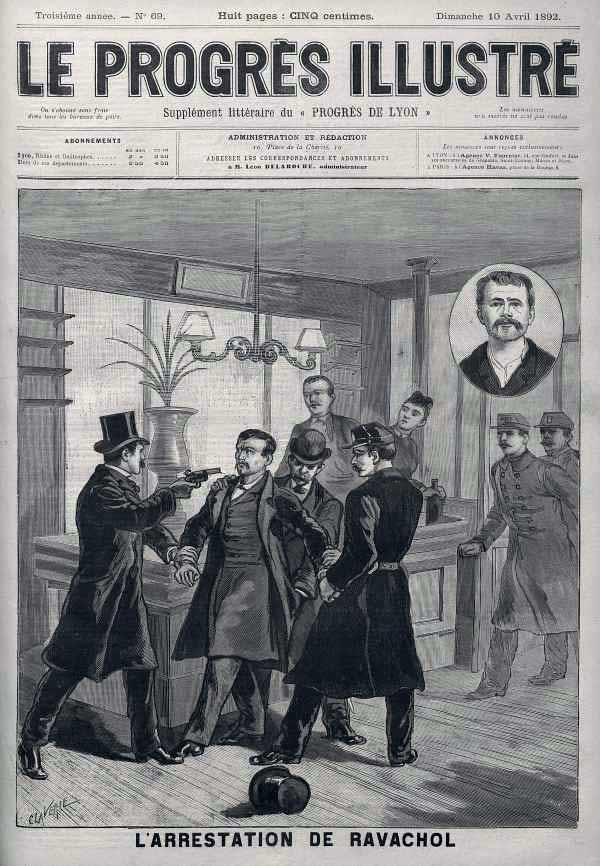
1892: Ravachol, anarchist terrorist

On this date in 1892, French anarchist François Claudius Koenigstein — better known as Ravachol — was guillotined at Montbrison for a series of bomb attacks on right-wing judges.

He took the name “Ravachol”, his mother’s, after his Dutch father ditched his mom, leaving the family in poverty.

Young Ravachol supported himself as best he could in proletarian labor and crime, as he attempted to observe* at his trial.

Ravachol, as painted by Charles Maurin.

There are many people who will feel sorry for the victims, but who’ll tell you they can’t do anything about it. Let everyone scrape by as he can! What can he who lacks the necessities when he’s working do when he loses his job? He has only to let himself die of hunger. Then they’ll throw a few pious words on his corpse. This is what I wanted to leave to others. I preferred to make of myself a trafficker in contraband, a counterfeiter, a murderer and assassin. I could have begged, but it’s degrading and cowardly and even punished by your laws, which make poverty a crime. If all those in need, instead of waiting took, wherever and by whatever means, the self-satisfied would understand perhaps a bit more quickly that it’s dangerous to want to consecrate the existing social state, where worry is permanent and life threatened at every moment.

Personal want segued into political conviction for Ravachol, whose crimes were justified by the principle of reprise individuelle.

And the political led him to reprisals of a less individual nature, when French state violence against radicals caused him to dynamite several magistrates’ homes.

He was caught in a restaurant,** brought to trial, and let off with penal servitude for life. Then another jury, intimidated by public outcry, reversed the decision and sent him to the guillotine.

The Banquet Years: The Origins of the Avant-Garde in France 1885 to World War I, which argues that anarchists “unsettle[d] the political smugness of the Third Republic … [and] challenge[d] any formulated aesthetic. The dynamism of prewar artistic activity ran a close parallel to anarchism; postwar Dada and surrealism look like its artistic parodies†.”

Anarchism, that revolutionary specter stalking fin-de-siecle Europe, burnt its fuse at both ends, but Ravachol’s falling head‡ left a legacy for his fellow-travelers. The next year, Auguste Vaillant tossed a bomb into the French Chamber of Deputies to avenge Ravachol. (Vaillant was himself guillotined, and himself avenged by Emile Henry and Sante Geronimo Caserio.)

Ravachol was also honored in a song, La Ravachole — set to the jauntily menacing tune of La Carmagnole, it cheers, “Long live the sound of the explosion!”

* This incendiary speech was cut off by the court.

** The table where the terrorist was nabbed got its own inscription: “Here ate Ravachol the day of his arrest.”

† e.g., Dadaist Marcel Janco‘s recollection:

We had lost confidence in our culture. Everything had to be demolished. We would begin again after the ‘tabula rasa’. At the Cabaret Voltaire we began by shocking common sense, public opinion, education, institutions, museums, good taste, in short, the whole prevailing order.

‡ Ravachol was guillotined midway through a parting exclamation, “Vive la Re-“. Initial newspaper reports implausibly rendered this as the patriotic classic “Vive la Republique!” rather than a much more in-character word like, oh, “Revolution”.

Weeks of controversy ensued over some witnesses’ claims that the head post-severing had actually completed the word “-publique”, a notion of a piece with the idea that the severed head survives decapitation by a few seconds. Scienticians countered that obviously excited witnesses were maybe hearing air escaping from the headless trunk and filling in the rest of the scene in their heads.

On this day..

1346: Simon Pouillet

From the Grandes Chroniques de France:

En celuy an, le samedi premier jour de juillet, fu fait à Paris une horrible justice, — né onques mais n’avoit esté faite semblable au royaume de France. Combien que nous lisons que l’empereur Henri en fist une autèle, et en Angleterre aussi, une autre fois en avint une autre semblable, toutes voies à Paris onques mais n’avoit esté telle , — d’un bourgois de Compiègne appellé Symon Pouilliet, assez riche, qui fu jugié à mort et mené aux halles de Paris; et fu estendu et lié sur un estal de bois, ainsi comme la char en la boucherie, et fu ylec copé et desmembré, premièrement les bras, puis les cuisses et après le chief ; et après pendu au gibet commun où l’en pent les larrons. Et tout pour ce qu’il avoit dit, si comme l’en luy imposoit, que le droit du royaume de France appartenoit mieux à Edouart, roy d’Angleterre, que à Phelippe de Valois. De laquelle mort tout honteuse, France pot bien dire la parole de Jhésucrist qui disoit : « Ci sont les commencemens des douleurs, » si comme il sera monstré par après.

The gist of the bolded bit:

a wealthy Compiègne bourgeois called Simon Pouilliet was broken and dismembered in Paris, and gibbeted on the common gallows. And all for saying that the right of the kingdom of France belonged more to Edward, king of England, that to Philippe of Valois.*

Come and see the violence inherent in the system!

There was cause, however, for the House of Valois to be oversensitive to Pouillet’s treasonable take on royal genealogy: it was at least plausibly true.

Edward’s interest in actualizing his nominal claim to the French throne had by this point precipitated the opening dynastic skirmishes of what would eventually (a hundred-plus years later) become remembered as the Hundred Years’ War.

And as the chronicle concludes on a note of melancholy, Simon Pouillet’s horrific butchery would be an omen of his realm’s coming sorrows.

Eight weeks later, the English sowed the battlefield of Crecy with the flower of French chivalry and established a foothold at Calais that would help sustain generations of bloodily inconclusive combat.

Then, from 1348, the Black Death ravaged Europe, bringing for its survivors the economic shock of a labor shortage, weird social movements like the flagellants, and a pervasive sense of fatalism that ate at humanity’s social bonds.

A few years after that, the French king, Philip’s successor John the Good, was actually captured by the English at the Battle of Poitiers, and ransomed as a hostage for a ruinous sum.

There’s no record whether the wind whistling through the remains of Simon Pouillet dangling on Montfaucon whispered “I told you so.”

* Pouillet had not acted on this notion — he’d merely been popping off, possibly while sauced. The absence of any actual intent on the speaker’s part, however, did not lessen the treason, as explained in The Law of Treason and Treason Trials in Later Medieval France:

The general royal position on treason by words was summed up in 1432 by Jean Barbin, king’s proctor in the Parlement of Poitiers, in the prosecution of the Fleming Hennequin Bize. ‘By word and by deed’, he began, ‘one commits the crime of lese-majesty: by deed when one makes an attempt on the person of the princeps; and by word when one speaks sinisterly of him or his acts.’ Barbin asserted furthermore that it was worse ‘to disparage by word than to injure by deed’, but he neglected to explain why.

On this day..

1669: Roux de Marsilly, employer of the Man in the Iron Mask?

On this date in 1669, a French Huguenot agent was publicly broken on the wheel in Paris.

On the dangerous political chessboard of 17th century Europe, the allegiance of Restoration England — governed once again by a dynasty with known Catholic sympathies — was a great prize for contending Catholic and Protestant powers on the mainland.*

While Charles II of England and the Catholic Louis XIV of France maneuvered towards a secret accord that would lead to devastating war against the Protestant Netherlands, Roux de Marsilly was busy in London trying to enlist England into a Protestant alliance against France.

Finding the avenues blocked, Marsilly retired to Switzerland and was there abducted by French spies who knew what he was up to.

A trumped-up rape charge served that country’s statecraft, and despite an offer by the prisoner to spill some beans in exchange for his life — and then a suicide attempt —

hee wounded himself … for he knew before hee should dye, butt he thought by dismembering himself that the losse of blood would carry him out of the world …

— Roux could not avoid his fate. In fact, out of fear that Marsilly could still succumb to his self-injury, they

sent word … which made his execution be hastened. Saturday about 1 of the clock he was brought on the skaffold before the Chastelet and tied to St. Andrew’s Crosse all which was while he acted the Dying man and scarce stirred, and seemed almost breathless and fainting …

they went to their worke and gave [Marsilly] eleven blows with a barre and laid him on the wheele. He was two houres dying.

(Both quotes above from this correspondence.)

For all those two agonizing hours, Roux de Marsilly really only merits a footnote in a different story.

The Man in the Iron Mask

The mysterious Man in the Iron Mask was first documented in French custody later in the summer of 1669, and he would remain a guest of the Bourbon dungeons until 1703.

The identify of this person — or maybe persons, since it’s been argued that there are multiple threads conflated into the one legend — has never been conclusively established, much to the profit of literature.

One of the stronger contenders for the crownmask, however, is a prisoner named “Eustace Dauger”, who may in fact have been Roux de Marsilly’s former valet, one “Martin”.

The case for Martin-as-Dauger-as-masked-man is made most comprehensively by Andrew Lang in The Valet’s Tragedy and Other Stories.

The hypothesis, roughly outlined, is that England and especially France were trying to tie up the loose ends of whatever plots Marsilly had authored, and got hands on his servant to interrogate him about the highly sensitive machinations he might have been privy to.

Possibly having established that Martin/Eustace had no actual information to betray, he still remained under lock and key out of some admixture of bureaucratic inertia and the remorseless paranoia of the security state. Crazy.

[T]he Man in the Iron Mask (if Dauger were he) may have been as great a mystery to himself as to historical inquirers. He may not have known WHAT he was imprisoned for doing! More important is the probable conclusion that the long and mysterious captivity of Eustache Dauger, and of another perfectly harmless valet and victim, was the mere automatic result of the ‘red tape’ of the old French absolute monarchy. These wretches were caught in the toils of the system, and suffered to no purpose, for no crime. The two men, at least Dauger, were apparently mere supernumeraries in the obscure intrigue of a conspirator known as Roux de Marsilly.

Marsilly was publicly tortured to death in Paris on June 22, 1669. By July 19 his ex-valet, Dauger, had entered on his mysterious term of captivity. How the French got possession of him, whether he yielded to cajolery, or was betrayed by Charles II., is uncertain. … By July 19, at all events, Louvois, the War Minister of Louis XIV., was bidding Saint-Mars, at Pignerol in Piedmont, expect from Dunkirk a prisoner of the very highest importance–a valet! This valet, now called ‘Eustache Dauger,’ can only have been Marsilly’s valet, Martin, who, by one means or another, had been brought from England to Dunkirk. It is hardly conceivable, at least, that when a valet, in England, is ‘wanted’ by the French police on July 1, for political reasons, and when by July 19 they have caught a valet of extreme political importance, the two valets should be two different men. Martin must be Dauger.

* And, of course, for the Catholics and Protestants in England. This struggle would come to a head in due time, to the grief of the Stuarts.

On this day..

1734: Marie-Joseph Angélique, for burning Montreal

On this date in 1734, a Portuguese-born slave known as Marie-Joseph Angélique was publicly hanged before the burned ruins of old Montreal on an accusation of having set the blaze.

Having recently been caught attempting to abscond with her lover, a white servant named Claude Thibault, Angelique was the instant consensus community suspect when Montreal caught fire on April 10. Forty-six buildings in the still-small frontier town burned; Angelique was arrested the very next morning.

(Thibault fled town, his fate unknown but presumptively no worse than what befell his paramour.)

Nobody died in the fire, but conflagrations were deadly serious back in the bucket brigade era.

The sentence

calls for the said Marie Joseph Angelique in reparation for the Fire caused by Her and other issues brought forward at the trial, to be condemned to make honourable amends Disrobed, a Rope around her Neck, holding in her hands a flaming torch weighing two Pounds before the door and main entrance of the parish Church of the said City of Montreal, where She will be led by the Executor of the high Court And there on her knees state and declare in a loud and intelligible voice that she maliciously and defiantly and wrongly set the Said fire for which She is repentant, [and] ask Forgiveness from God, the King and the Court; this done she is to be taken to the public square of the said City of Montreal to be Hanged until dead at the gallows erected for this Purpose at the said square, and then her dead Body is to be placed on a flaming pyre and burned and her Ashes Cast to the wind, her belongings taken and confiscated by the King; prior to this the said Marie Joseph Angelique is to be subjected to torture in the ordinary and extraordinary ways in order to have her reveal her accomplices …

And so she was.

Although the torture broke Angelique’s now-useless denial of her own guilt, she maintained her defense of Claude Thibault, insisting that she acted alone. It’s up for debate whether she did, in fact, act alone, or act at all — and if Angelique was guilty, what meaning or intent one can ascribe to her action.

There’s a fascinating exploration of this case, including the available primary documents, available in English or French.

On this day..