1940: Tirailleurs Senegalais, for France

On this date in 1940, German forces even then completing their rout of France — the humiliating capitulation was mere hours away — massacred a detachment of African soldiers who mounted a doomed resistance at Lentilly.

Tirailleurs Senegalais were recruited not only from Senegal but from throughout France’s domains in sub-Saharan Africa. (There were also Algerian, Tunisian, and Moroccan tirailleurs.)

Though these soldiers’ own lands were occupied, they were instrumental to defending the freedom of their occupier on European soil: over half a million African tirailleurs are thought to have served les couleurs in the two World Wars, and died in all the horrible ways those slaughterhouses could devise.

In 1940, black troops represented some 9% of the French army, a fact pilloried in German nationalist proaganda.

It’s hardly a surprise that the black man couldn’t catch a break from skull-measuring Aryan race warriors, but then, France too had its own less than comfortable relationship with these dark-hued citizens summoned from distant villages to bleed in the trenches of Europe. The military’s official guidelines emphasized (French link) the “Senegalese’s” special value as cannon fodder.

If a sacrificial mission is necessary, a defense to the death to provide cover for forces to regroup, appeal to the valor of the black fighter.

On the other hand, French authorities put up a monument to black soldiers in the aftermath of World War I. (The occupying Nazis vengefully dismantled it.) Such are the contradictions of colonialism.

Racial reservations notwithstanding, colonial troops were employed throughout the army if for no other reason than that they constituted nearly the tenth part of that army.

Their service record naturally included (French pdf) the over-before-it-started French defense against the Nazi blitz in 1940.

In this instance, knowing full well that the campaign was lost, French officers flipped open the “sacrificial mission” playbook and ordered their African charges to oppose a German march near Lyon “without thought of retreat.”

Since victory was equally out of the question, that left death. Wehrmacht troops duly prepared by Nazi racial typecasting to see their foes as savages were all too ready to wipe out African troops they greatly outclassed.


A monument to the Tirailleurs in Lentilly, France. Image (c) filoer and used with permission.

The Lentilly cemetery “Tata”, final resting place of 188 Senegalese riflemen who died under German artillery or were massacred after the battle by the 3rd SS Division Totenkopf June 19 and 20. Image (c) filoer and used with permission.

For more on the tirailleurs, there’s an extensive French-language blog.

On this day..

1939: Eugen Weidmann, the last public beheading in France

On this date in 1939, French murderer Eugen Weidmann dropped his head in the basket outside a prison in Versailles. France’s signal history of public beheadings died along with him.

The career criminal Weidmann knocked around prison in his twenties.

Further to the maxim that penitentiaries are the school of crime, Weidmann’s stint for robbery connected him right up with a couple of accomplices who started up a kidnapping-robbery-murder ring when they got out.

They left several bodies (and miles of newspaper copy) in their wake in late 1937 before the inevitable capture, confession, condemnation. (Weidmann’s accomplices all managed to avoid the chop.)

The beheading this day did not come off well; a massive crowd* jostled for a view, a scene belied by the tame crowd photo of the execution’s official witnesses.


Two photographs of Eugen Weidmann’s execution in Versailles 17 June 1939. (Click for larger images.)

The government immediately banned public executions. Although it wouldn’t be the government much longer, the change stuck.

But the crowd scene wasn’t the half of it.

Still photos of the guillotine had been snapped for years, but a delay putting justice into its heavy downward-crashing motion that morning meant the execution took place in plenty of light for an illicit moving picture.

Caution: Mature content. This is video of the guillotine in action.

From the time this film cut, France’s national razor would do its cutting only behind prison walls. It would be another 38 years yet before it trimmed its last client.

* According to his biography, British horror actor Christopher Lee — age 17 — was in the crowd.

On this day..

1797: Gracchus Babeuf, for the Conspiracy of Equals

If the “revolutionary extremist” exists at all as an identifiable type, he exists in purest incarnation in Gracchus Babeuf. No revolutionary better fits the description “narrowminded to the point of genius”; few have defined their heaven more clearly or crusaded so fanatically, ascetically, so religiously to bring it to earth.

Gracchus Babeuf: The First Revolutionary Communist

On this date in 1797, Francois-Noel Babeuf lost his head for the Conspiracy of Equals — the last Jacobin upheaval of the French Revolution, or the first Communist upheaval of post-Revolution modernity.

Francois-Noel — he styled himself “Gracchus” after the populist Roman tribunes — was a young man of Desmoulins‘ generation but from a considerably more hardscrabble background. Like the starry-eyed Dantonist scribbler, Babeuf discovered himself a brilliant journalist and pamphleteer with the onset of the Revolution; he did several prison stints during various revolutionary phases of the early 1790s for his too-radical-for-school opinions.

He did another in 1795 under the French Directory for his firebreathing rag Le Tribun du Peuple, which was particularly unfashionable stuff during the post-Robespierre Thermidorian regime.

Nothing daunted, Babeuf emerged from prison the leading apostle of the Parisian proletariat which had by then been decisively separated from power.

The order of the day was class consolidation with the spoils of the aristocracy apportioned among a new oligarchy of wealth. As France rushed headlong towards Bonaparte and Bourbon restoration, Babeuf was the man left to rally “the party which desires the reign of pure equality.”

The French Revolution was nothing but a precursor of another revolution, one that will be bigger, more solemn, and which will be the last.

The people marched over the bodies of kings and priests who were in league against it: it will do the same to the new tyrants, the new political Tartuffes seated in the place of the old.

Manifesto of the Equals, 1796

One can see why later revolutionaries — Marx included; Babeuf makes a cameo in the Communist Manifesto — would adopt this sort of thing as a harbinger of the next century’s revolutions.

And if the Directory had known who Nicholas II would be, it would have had no intention of going the way of his family.

Instead, it shut him down in February, 1796: Napoleon Bonaparte personally carried out the operation, just days before he wed Josephine.


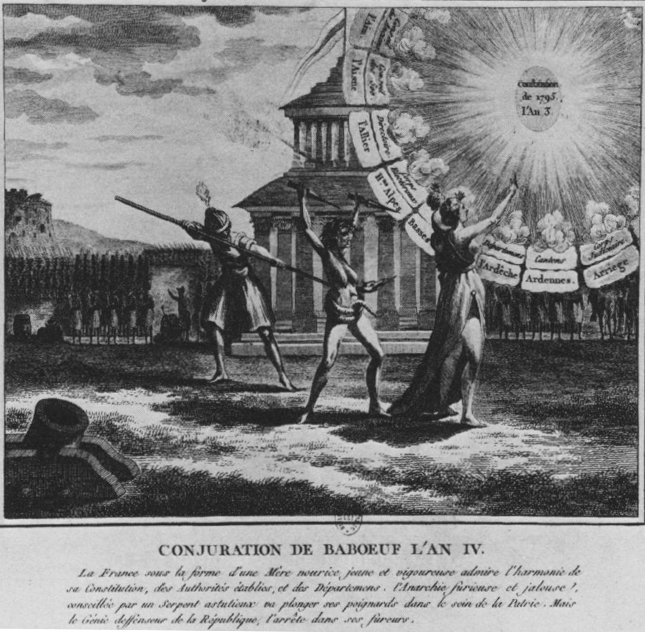
The Babeuf Conspiracy. Anonymous French print.

Babeuf’s party comes down to us as a “conspiracy,” under which word the state would charge him and which his follower Philippe Buonarroti would later rebrand the “Conspiracy of Equals”. It was not so much a grassy-knoll type of conspiracy as it was an underground organization.

When its adherents placarded Paris with the seditious “Analysis of the Doctrine of Babeuf” as the city endured a potentially dangerous economic crisis in April 1796, the government was put to a test of its strength.

It passed.

Having infiltrated Babeuf’s network, it arrested the principals on the eve of the Conspiracy’s intended insurrection. They were hailed out of Paris (a safeguard against sympathetic risings) to the commune of Vendome and there put on trial.* Babeuf and his associate Augustin Alexandre Darthe were condemned to death on May 26th and guillotined the very next day.

The last gasp of the French Revolution dropped with their heads into the basket.

Revolutionary Babeuvism, however, had scarcely just begun.

I don’t know what will become of the republicans, their families, and even the babies still at their mothers’ breasts, in the midst of the royalist fury that the counter-revolution will bring. O my friends! How heart-rending these thoughts are in my final moments! … To die for the fatherland, to leave a family, children, a beloved wife, all would be bearable if at the end of this I didn’t see liberty lost and all that belongs to sincere republicans wrapped in a horrible proscription.

-Babeuf’s last letter to his family

* The trial of Babeuf was itself a jurisprudential milestone: it was the first French trial to be transcribed verbatim.

What might look today like a nifty little advance for efficient judicature was bitterly controversial in 1797. The French Revolution had overturned an ancien regime practice of professional magistrates accepting legal testimony by written deposition and deciding matters behind closed doors. The liberte, egalite, fraternite way would instead demand that testimony be given live in the courtroom where citizen jurors could weigh its credibility.

Babeuf’s lawyer, Pierre-Francois Real, protested against the court stenographers, arguing that “The law insists that the system of written depositions not be restored in any way. That system will undoubtedly return if any means are used to save testimony given orally.”

There’s a fascinating disquisition on the curious and contradictory development of this issue and the way it “violates … common assumptions about the advance of textuality in the West” during the French Revolution in Laura Mason, “The ‘Bosom of Proof’: Criminal Justice and the Renewal of Oral Culture during the French Revolution” The Journal of Modern History, March 2004.

On this day..

1871: Hostages of the Paris Commune

The fall of the Paris Commune on May 28, 1871 launched many a leftist insurrectionary into the martyrs’ firmament.

But the last semaine sanglante that engulfed the Commune there was blood enough for many martyrdoms.

On this date in 1871, just days before the Commune gave way, it executed a clutch of hostages (French link) in desperate reprisal for the Versailles army’s cruelties. For the Commune, it was too little ruthlessness and much too late. For the 52 who stood up against the wall this date, they were just as dead.

These unfortunates were marched from La Roquette prison — whose inmates by dint of timely resistance only narrowly avoided a more extensive massacre — to Rue Haxo and slaughtered.

A number of them were men of the cloth. In 1938, the Catholic church of Notre Dame des Otages was erected on the site and dedicated to the victims’ memory.


A crucifix at Notre Dame des Otages. Copyrighted image used with permission.

(The markers on the spot have settled on 52 as the number of the victims, which might be the historically authoritative count; different sources, however, provide slightly different numbers.)

On this day..

1946: Marcel Petiot, Vichy serial killer

Paris, 1942.

On the run from the Gestapo — as a Jew or a Gypsy, a common criminal or a Resistance fighter whose cover is blown — you get wind of a man who can help.

“Dr. Eugène” will (for a fee) spirit you over the Pyrenees and thence to South America. In his house at rue le Sueur, you make the arrangements. One small matter: the tropics requires an inoculation, which le bon docteur will readily provide. One small prick of the needle and then …

The needle contained cyanide and the destination turned out to be a lime pit, and so “Dr. Eugène” — Marcel Petiot — was guillotined this date in 1946.

His opportunistic exploitation of the dangerous Vichy years is what he’s famous for, but Petiot had decades of crime behind him by the time he got his phony “underground railroad” up and running.

From youthful compulsive thieving, Petiot graduated into a shady medical practice in Villeneuve-sur-Yonne where he was the resident black market abortionist.

He’s thought to have killed a mistress there, and maybe a couple of others, but was able to segue into a political career by winning the mayoralty of Villaneuve when he sabotaged his opponent’s campaign appearances. The sticky-fingered Petiot naturally plundered the town treasury and was forced out of office in 1931.

By the time the war years had rolled around, Petiot had judiciously relocated to Paris where he retained his capacity for professional advancement in the face of profoundly disturbed behavior: he was institutionalized for kleptomania the same year he was appointed an official médecin d’état-civil.

So he had the requisite two-faced background for his whackadoodle wartime “escape route”, which he creepily code-named “Fly-Tox.”

Twists and turns elided — trutv.com and crimemagazine.com both have detailed biographies/case histories — Petiot’s enterprise was quasi-exposed early in 1944 when the stink of incinerating bodies prompted neighbors to summon the police and uncover his charnel house.

Amazingly, Petiot was able to beg off with the claim that he was a Resistance activist — these were French police — and that the victims were Nazis or collaborators who had been eliminated by his network on orders. The Gestapo had sniffed him out too late in the war to do anything about him, but its judgment that Petiot was a “dangerous lunatic” actually turned out to bolster the deranged doctor’s case that he was an anti-fascist.

The alibis fell apart as the war wrapped up, and Petiot was finally recognized in a Paris manhunt and brought to trial for 27 homicides. Police thought 60-plus was more like it — maybe even into the hundreds — but secured 26 of the 27 counts. That’s more than enough to do a man to death, especially since they were the for-fun-and-profit murders of desperate people already on the run from the late and hated occupying army. Bit of a touchy subject in France in ’46.

But there was good news.

This London Times (May 27, 1946) observed that Petiot’s beheading marked

the first time that the guillotine has been used since the war. Until now executions have been by firing squads. Although gruesome, it is one more indication of the return of this country to normal civil ways of life.

On this day..

1794: Antoine Laurent Lavoisier, father of modern chemistry

On this date in 1794, French scientist Antoine Laurent Lavoisier was guillotined in Paris for “adding water to the people’s tobacco.”

Portrait of Monsieur de Lavoisier and his Wife, chemist Marie-Anne Pierrette Paulze, by Jacques-Louis David (1788) Marie assisted Lavoisier in the laboratory; she also studied art under David the better to illustrate the resulting publications.

Tobacco-watering was the least of Lavoisier’s pastimes.

The man’s resume* of 50 busy years in chemical and biological experimentation included

  • Proving the law of conservation of mass
  • Naming oxygen and hydrogen
  • Demonstrating oxygen’s role in combustion and respiration
  • Writing the first chemistry textbook, with the first list of elements

Unfortunately, Lavoisier funded these eggheaded avocations with an investment in the Ferme générale, the hated tax-farming syndicate to which the crown outsourced its revenue-squeezing operations.

This is just the sort of operation one would expect to find in the crosshairs of the French Revolution’s Terror: hence, watering the people’s tobacco.

(Allegedly, Jean-Paul Marat also had it in for Lavoisier personally, on account of the latter’s having blown off Marat’s pre-Revolution scientific efforts.)

The company was shut down in 1790.

But at the height of the Terror, Lavoisier and 27 fellow tax-farmers of the Ferme were rounded up and quickly condemned.

Lavoisier’s appeal for a stay of execution to complete some experiments met a brusque refusal from the people’s tribunal: “The Republic has no need for scientists.”

Mathematician Joseph Louis Lagrange, whom Lavoisier had helped escape the Revolution’s proscription, left the chemist his epigrammatic epitaph:

It took only an instant to cut off that head, and a hundred years may not produce another like it.

* And yet,

[i]n spite of his great services it is impossible to overlook the sins of Lavoisier in appropriating to himself discoveries made by chemists who were his contemporaries or predecessors. Oxygen was first discovered by Hales in 1727, and had already been prepared from mercuric oxide by Priestley in 1774, by Bayen in the same year, and still earlier by Scheele in 1771. It was at a dinner at Lavoisier’s house that Priestley confidentially communicated his discovery to Lavoisier, in 1774; in 1778 Lavoisier then claimed for himself the discovery of the composition of water, whilst, as is now known, Blagden, a friend of Cavendish, when visiting Paris in 1781, told Lavoisier that Cavendish had discovered the composition of water in a very simple manner by burning inflammable air (hydrogen), as water alone was formed during this combustion.

Lavoisier and Laplace immediately repeated the experiment and then communicated the discovery to the French Academy in 1783.

These facts certainly do not obscure the fame of the great scientist when we remember his eminent services, but in the interests of historic accuracy and justice it is impossible to pass them over in silence.

On this day..

1314: Tour de Nesle Affair adulterers

Think you want to fall in love with a princess?

On this date in 1314, the French crown dissuaded the fantasy by butchering two Norman knights who had sheathed their swords where they oughtn’t.

In the Tour de Nesle affair (English Wikipedia page | French), French princess Isabella — then Queen of England, where she is known as Isabella of France or any number of less-flattering sobriquets — noticed that some purses she had once given her brothers’ wives as gifts were being sported by a couple of (evidently metrosexual) dudes in the court.

Let their fate be a warning against regifting.

In short order, the purse-toting knights Philippe and Gauthier d’Aunay or d’Aulnay (both links are in French) were arrested for tapping, respectively: Margaret of Burgundy (the wife of the king’s eldest son, Louis, soon to become Louis X); and, Blanche of Burgundy (the wife of the king’s third son, Charles, the future king Charles IV).*

“The pious confidence of the middle age, which did not mistrust the immuring of a great lady along with her knights in the precincts of a castle, of a narrow tower — the vassalage which imposed on young men as a feudal duty the sweetest cares, was a dangerous trial for human nature, when the ties of religion were weakened.”

Jules Michelet

Under torture, the knights copped to the cuckoldry, supposed to have been conducted in the Tour de Nesle, a since-destroyed guard tower on the Seine.**


Detail view (click to see larger image) of the dilapidated Tour de Nesle, as sketched in the 17th century by Jacques Callot. The tower was destroyed in 1665.

The knights suffered horrific deaths:

“deux jeunes et biaux chevaliers furents roués vifs, écorchés vifs , émasculés, épendus de plomb soufré en ébullition, puis décapités, traînés à travers rues, et pendus au gibet y pourrissant durant des semaines. Leurs sexes, instruments du crime, sont jetés aux chiens. Jamais corps n’auront autant souffert.”

In fine: flayed, broken on the wheel, burned with hot lead and sulfur, genitals thrown to the dogs, and then decapitated for ignominious gibbeting on Montfaucon.

The women fared only a little better. Neither faced execution, and in fact both would technically become Queens of France. But they “reigned” as such from prison.

Margaret of Burgundy was clapped in a tower in a room exposed to the elements while her estranged husband became king. She succumbed (or possibly was murdered outright to clear the way for a new wife) in 1315.

Blanche of Burgundy was still in wedlock and still locked up in Chateau-Gaillard when her husband ascended the throne early in 1322; the marriage was annulled a few months later, and Blanche lived out her last few years at a nunnery.

Isabella’s role in all of this as the goody-two-shoes informer upon the adulterers looks particularly ironic with benefit of hindsight. In another 12 years’ time, this Queen of England and an adulterous lover combined to overthrow the King of England.

But maybe not so ironic after all, if one takes her for a power-thirsty “she-wolf”.

This Tour de Nesle scandal also happened to cast doubt on the paternity of Margaret’s only daughter Joan, which mitigated against Joan (and potentially in favor of Isabella’s new son, Edward) for eventual claim to the throne of France. Since this potential succession was not evidently imminent, and Isabella had three brothers in the prime of life, this seems a farfetched motivation for tattling. But one is drawn to the question of inheritance since happenstance soon put the royal succession into dispute — a misfortune that helped lead to the Hundred Years’ War when that son, grown up to be Edward III of England, did indeed press his French claims at swordpoint.

(The Tour de Nesle scandal is generally thought now to have been legitimate, on the grounds that the ruling family would not have inflicted such an injury to its own legitimacy without very good cause. However, according to Alison Weir, at least one chronicle blamed the affair on a frame-up by hated royal advisor — and eventual Executed Today client — Enguerrand de Marigny.)

Neither Isabella nor Joan ever ruled France. Joan, however, was an ancestor of Henri IV.

* The wife of the middle son, Philip, was also accused of knowing about the affairs, but her strong defense and her husband’s backing got her off.

** Spectacular embroideries enhanced the legend in later generations, into tales of a royal succubus making her rendezvous in the tower by night, then having her lovers hurled off it at dawn. Alexandre Dumas spun a melodrama from this material, though Frederic Gaillardet accused him of plagiarism. (Dumas gives his side of the story at excrutiating length in his memoirs.) La Tour de Nesle was later made into a movie.

On this day..

1199: Pierre Basile, marksman

(Thanks to Jonathan Shipley of A Writer’s Desk for the guest post. -ed.)

If you kill a king, expect swift retribution.

Expect avengers.

Expect to not live long after you deal the final fatal blow to a royal personage.

A boy, Pierre Basile, was executed on this date in 1199 for shooting King Richard the Lionhearted* with an arrow expelled from his crossbow.

The wound wasn’t fatal to Richard I; the gangrene was. (French page) Although the king pardoned the boy for the shot before dying, Richard’s right hand man, French Provencal warrior Mercadier, would hear none of it. After the king’s death, Mercadier stormed Chateau de Chalus-Chabrol, defended weakly by Basile, then flayed him alive before hanging him.

Little is known of the boy defender. Also known as Bertran de Gurdun and John Sabroz (the various names suggest we’ll never know his real name), Basile was one of only two knights defending the castle against the king’s siege.

This castle protected the southern approach to Limoges and was betwixt routes from Paris and Spain and the Mediterranean Sea and the Atlantic Ocean. The English army openly mocked its defenses as the siege continued. The ramparts were cobbled together with makeshift armor. A shield was constructed out of a frying pan.

Knowing the castle would fall sooner than later, the English were lax in their siege, though eager for the riches inside. (Supposedly within the castle walls was a treasure trove of Roman gold.)

Richard I, as feudal overlord, claimed it for himself and no boy knights were going to get in his way. The king had been in the area suppressing a revolt by Viscount Aimar V of Limoges. The viscount’s forces had been decimated by the king’s army. The riches for the win lay in the castle and Basile stood atop it.

It was early evening, March 25, 1199, when Richard walked around the castle perimeter without his chainmail on. Arrows had been shot from the ramparts by Basile but were paid little attention. The king applauded when one arrow was aimed at him. The next arrow fired struck the king in the left shoulder near the neck.


Richard the Lionhearted, mortally wounded.

The king returned to the privacy of his tent to pull it out. He couldn’t. The surgeon Hoveden, Mercadier’s personal physician, was summoned. He removed the arrow, but not swiftly, or cleanly. Gangrene quickly set in. The king asked for the crossbowman. The boy, Basile, appeared before the stricken king, expecting to be executed on the spot. The boy spoke first, saying he had tried to kill Richard because the king had killed the boy’s father and two brothers.

“Live on,” the king replied, “and by my bounty behold the light of day.”

He ordered the boy set free and, further, sent him away with 100 shillings. Deliriously jubilant at the king’s decision, the boy quickly returned to the castle.

On April 6, in the arms of his mother, Richard I died. His remains were buried at the foot of the tower from which Basile shot the arrow.

And with the king died his chivalry towards Basile.

Mercadier, who had entered the king’s service in 1184 and fought in battles in Berry and Brittany, Flanders and Normandy, brought the castle’s defenders to a swift and punishing death.

Hanging the defenders, he took the boy and flayed him first — that is, he removed the boy’s skin while he was still alive. Then Pierre Basile was hung, and his body consigned in an unmarked grave.

* Last seen in these parts slaughtering Muslims on Crusade.

On this day..

1794: Jacques Hebert and his followers

On this date in 1794, firebrand revolutionary pamphleteer Jacques Hebert and his eponymous party of Convention radicals mounted the scaffold during the Paris Terror.

As a 32-year-old, Hebert started putting out his foul-mouthed blog radical newspaper Le Pere Duchesne in the Revolution’s early months.

In this increasingly vituperative rag, Hebert — incongruously writing in the voice of “Old Man Duchesne” — savaged first the royal couple, and then (after that pair lost their well-coiffed heads) whatever the retrograde element of the unfolding Revolution happened to be on any given day: the constitutional monarchist Lafayette; the bourgeois liberal Girondists. His paper valorized the Parisian working-class sans-culottes, and lustily demanded heads for the satisfaction of their various grievances.

Here, he literally channels Marat:

All of these thoughts trouble my brain, and the memory of Marat follows me without end. Last night I saw him in a dream: his wound was still bleeding, dammit. Upon seeing it I cried. Friend of the people, I shouted, is it you? Yes, good Père Duchesne, it’s Marat who comes from the dead to talk with you, because — dammit — the love of freedom pursues me even beyond the grave. Content to have lost my life for my republic, there only remains to me the regret of not having seen it delivered, before my death, from all the scoundrels who tear away at its breast. Père Duchesne, you must do what I couldn’t do. You closely followed me in the revolution; like me you consecrated you life to the defense of the rights of the people. You speak the language of the Sans Culottes, and your foul mouth, which makes little mistresses faint, sounds beautiful to free men, for free men shouldn’t be sought among the beautiful souls. Your joy and your anger have done more than all the dreams of statesmen. They know this well, the worthless fucks, and that’s why they’ve persecuted you like they did me. Courage, old man; don’t back off when you suffer the same trials as me, don’t be afraid: is there a more beautiful death than mine? But since you’re useful to your fellow citizens, try to avoid the daggers of statesmen. Live a while longer in order to denounce them and to complete, if you can, the task I’d undertaken.

Yes, Père Duchesne, you have to go after them hammer and tong, and not take it easy on anyone. When three months ago I proposed planting three hundred nooses on the terrace of the Tuileries in order to hang there the perfidious representatives of the people, some took me for a madman, and others as someone thirsty for blood. But nevertheless, if I’d been believed how much bloodshed would have been avoided! More than a million fewer men would have perished! So when I made that proposition I wasn’t speaking as a bloody monster, on the contrary I spoke as a friend of humanity. The moderates have buried more victims than those that fell before the steel of our enemies. Nothing is more harmful in a revolution than half measures. We have finally arrived at the era when we must pare things right down to the bone. … No more quarter for the defeated party, because, dammit, if the statesmen had the upper hand for one moment there wouldn’t exist a single patriot in six months.*

Late in his run, Hebert was on to venting dissatisfaction with the party of Danton, who had followed the monarchists and the liberals off the starboard of acceptable revolutionary opinion. Sensible centrist Maximilien Robespierre would indeed strike that faction down — just two weeks after he’d purged the radical Hebertist gaggle itself.**

Eleven days after Le Pere Duchesne last hit the streets, its author’s head hit the basket.

His printed editorials (like the one above) often assert a modish conviction in his own coming martyrdom, but as proof against a fatal political reversal, Hebert had trusted overmuch to his power base in the Paris commune. When he was carted out this morning, the mob whom his own paper once played to reveled in old Pere Duchesne’s fall just as readily as it had reveled in his enemies’.

some men carrying long sticks, at the end of which were suspended braziers of burning charcoal, symbolical of the “Charcoal-burners” of the “Pere Duchesne,” thrust them into the face of Hebert, insulting him with the same bitter railleries with which he tormented so many other victims (Alphonse de Lamartine)

Hebert was executed at the Place de la Revolution in a batch of 20 fellow-radicals, among whom we also find the eloquent “orator of mankind,” anticlerical† wordsmith Anacharsis Cloots. (Victor Hugo on his revolutionary leader in Les Miserables: “he had too much of Saint-Just about him, and not enough of Anacharsis Cloots.”)

The original La Pere Duchesne was dead, but just as the hot-selling mag had attracted ripoffs in its original run, the name lived on as a symbol of popular revolutionary menace — to be reclaimed by later generations in print and song.


La chanson du pere duchesne (live at RMZ)

* I know, right? Hebert was such a wild man, he thought ill of slavers.

Everywhere and at all times men of commerce have had neither heart nor soul: their cash-box is their God; they only know how to thieve and deceive; they would shave an egg, they would kidnap their own fathers; they traffic in all things, even human flesh; theirs are the ships which sail to the African coasts to capture negroes whom they then treat as worthless cattle.

** These rival factions linked as fellow-victims of Robespierre’s Terror are neatly symbolized by the spouses of their respective antipathetic scribblers: Jacques Hebert’s wife Marie, and Lucile Duplessis, wife of the Dantonist journalist Camille Desmoulins. Marie and Lucile were guillotined together that April, having forged a friendship while awaiting the chop.

† “The personal enemy of Jesus Christ,” Cloots called himself. He also remarked, “What is man’s chief enemy? Each man is his own.” A lot of enemies, this one had.

On this day..

1314: Jacques de Molay, last Templar Grand Master

On this date in 1314, the last Grand Master of the Knights Templar was burned in Paris.


Illustration of Jacques de Molay and Geoffroi de Charney burning on Paris’s Île de la Cité.

In a boring materialist history, Jacques de Molay was simply the head of an overrich military order whose crusading raison d’etre had become passe* with the Templars’ expulsion from the Holy Land.

Scores of trumped-up heresy charges did the work of ecclesiastical assassination for this renowned brotherhood originally founded to safeguard pilgrims in the Holy Land. (There’s a fine podcast episode on the Templars’ history here.)

This appears to be some sort of legitimate history. How droll!

Ruthless French King Philip the Fair, who owed the Templar banks a ton of cash, mounted in 1307 a, um, surprise nationalization — with the magnificently coordinated arrest of hundreds of members of the order on Friday, Oct. 13, 1307.**

This was, on the face of it, quite an infringement by the secular power upon the Church, but since Pope Clement V was Philip’s very own sock puppet — to the extent of relocating the papacy to Avignon the better to attend to his master — it was all good. Plus, of course, everyone made out with a big pile of loot.

As the interested parties jockeyed over those confiscated estates, there ensued for the once-powerful, now-proscribed order a years-long saga of torture, burnings (of lower-ranking Templars), salacious Baphomet-worship revelations, juridical maneuvering, and, finally, a compromise life-saving confession which Molay and his associate Geoffroi de Charney dramatically spurned.

The cardinals dallied with their duty until March 1314, when, on a scaffold in front of Notre Dame, Jacques de Molay, Templar Grand Master, Geoffroi de Charney, Master of Normandy, Ilugues de Peraud, Visitor of France, and Godefroi de Gonneville, Master of Aquitaine, were brought forth from the jail in which for nearly seven years they had lain, to receive the sentence agreed upon by the cardinals, in conjunction with the Archbishop of Sens and some other prelates whom they had called in. Considering the offences which the culprits had confessed and confirmed, the penance imposed was in accordance with rule—that of perpetual imprisonment. The affair was supposed to be concluded when, to the dismay of the prelates and wonderment of the assembled crowd, de Molay and Geoffroi de Charney arose. They had been guilty, they said, not of the crimes imputed to them, but of basely betraying their Order to save their own lives. It was pure and holy; the charges were fictitious and the confessions false. Hastily the cardinals delivered them to the Prevot of Paris, and retired to deliberate on this unexpected contingency, but they were saved all trouble. ‘When the news was carried to Philippe he was furious. A short consultation with his council only was required. The canons pronounced that a relapsed heretic was to be burned without a hearing; the facts were notorious and no formal judgment by the papal commission need be waited for. That same day, by sunset, a pile was erected on a small island in the Seine, the Isle des Juifs, near the palace garden. There de Molay and de Charney were slowly burned to death, refusing all offers of pardon for retraction, and bearing their torment with a composure which won for them the reputation of martyrs among the people, who reverently collected their ashes as relics.’

A History of the Inquisition of the Middle Ages, Vol III

Not bad, but the for a real plot twist, check the Templars’ turn — most famously in Dan Brown’s leaden bestseller The Da Vinci Code, but more entertainingly rendered as nonfiction “speculative history” in Holy Blood, Holy Grail — as mystic guardians of Christological secrets.†

Their most sensational secret: the Holy Grail.

In this reworking, the Cup of Christ is not the San Greal but the Sang Real, God’s own royal bloodline, by way (for some reason) of the French Merovingian dynasty.

The Templars and Jacques de Molay himself, this story goes, are just part of a centuries-long vanguard of Christianity’s mystical underground. Say, is that Jacques on the Shroud of Turin?

Thither this blog dares not venture, but those with the requisite inclination towards the occult will find limitless explorations of the theme for ready sale. All we ask, gentle reader, is that you kindly cut us in on the action by using our handy affiliate links.

In what may be yet another mystical just-so story, Molay is said to have foretold, as the flames consumed him, the deaths of his persecutors.

Pope Clement, Chevalier Guillaume de Nogaret [the prosecuting inquisitor], King Philip! I summon you to the Tribunal of Heaven before the year is out!

The curse worked: none of those gentlemen lived to see 1315. Someone, somewhere, has also attributed every bum turn for the French crown since then to Molay’s anathema. There’s a legend that an onlooker at Louis XVI‘s execution dipped his handkerchief in Citizen Capet’s Sang Real and cried out, “Jacques de Molay, tu es vengé!”

* Other expeditions called “Crusades” did continue after the Templars, but Christendom’s occupation of the Holy Land was toast until Lawrence of Arabia days.

** The date of this action is a possible origin of the whole paraskevidekatriaphobia superstition, but probably not really.

† It is a fact that these guys liked sweeping their crusading conquests for supposed holy relics, like this Roman nail recently unveiled from a Templar fort that was reverentially “handled by a lot of people over a long period of time.”

On this day..