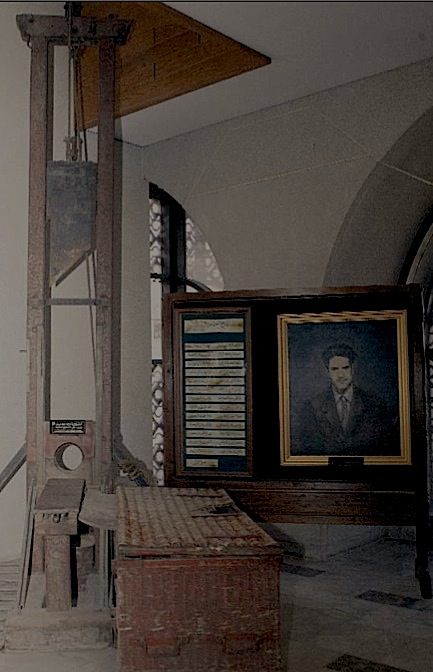
1888: Prado, before Gauguin

On this date in 1888, “Prado” — also known as “Count Linska de Castillon”; he never copped to his real identity — was beheaded as a thief and murderer at Paris.

The trial of this intrepid criminal promised, in the London Times‘ Nov. 6, 1888 preview, to be “one of the most extraordinary of our times”

He [Prado] is a Spaniard, and was brought up at Gijon, but he refused to say who he was. When 14 years of age he visited Mozambique, India, China, California, the West Indies, and North America. In 1872 he was a sub-lieutenant in the Carlist bands. He then lived by his wits. He once crossed the French frontier and stole 8,000f. At the battle of Somorrostro he was wounded by a shell, and removed to a hospital, from which he enticed the sister of the Order of Saint Vincent de Paul who nursed him. She belonged to one of the first families in England. He married her, and with her visited the Holy Land, but her health failed, and she died on their return to Italy. Prado says he married a second wife at Lima, with a dowry of 1,200,000f., and that after her death he committed many daring robberies.

He’s the most interesting man in the world.

This vagabond upon the overgrown lost highways of fortune eventually ditched wife #2 in penury in Spain and proceeded to France where he mooched off a local girl and her absentee American sugar daddy, until one night he slashed the throat a dame named Marie Aguetant, the lover of a late-working croupier, and plundered their domicile of chattels.

Prado eluded capture for some time, keeping his lover, taking another — both of whom ended up in the dock with their insolent Don Juan, along with various male intimates in various aspects of accesorizing. None of those others drew a death sentence, but as the interest of the London Times suggests — it fronted near-daily trial dispatches from Paris — all this stuff about cabals of swarthy men ravishing women of their virtue and their valuables made global news.

It also moved Third Republic bodice-ripping true crime like this zippy little volume, “Prado ou Le Tueur de Filles,” with a copyright notice as late as 1931.

A savage crime by a strange character, but now that it’s long departed all living memory, it scarcely stands out. Legion are the lotharios who have slain for the pedestrian motivation of gold.

In a post-bourgeois order, “we will no longer see men like Pranzini, Prado, Berland, Anastay and others who kill in order to have this metal,” the French terrorist Ravachol‘s suppressed address to the courtroom declared in 1892. “The cause of all crimes is always the same, and you have to be foolish not to see this.”

Yes, I repeat it: it is society that makes criminals and you, jury members, instead of striking you should use your intelligence and your strength to transform society. In one fell swoop you’ll suppress all crime. And your work, in attacking causes, will be greater and more fruitful than your justice, which belittles itself in punishing its effects.

-Ravachol


Just a few days before this headline-grabbing execution, impressionist painter Vincent van Gogh undertook the most famous thing he ever did off-canvas: after his latest dispute with roommate and fellow-artist Paul Gauguin, van Gogh sliced off his own left earlobe.*

It was in this abnormal circumstance that Gauguin, fresh to Paris fleeing from the scene of the self-mutilation in Arles, attended Prado’s beheading, even forcing his way through a line of gendarmes to obtain a closer view.

“[H]e may have had the counterphobic desire to reassure himself of his courage by taking an unflinching look at Prado’s execution,” writes Bradley Collins. “Gauguin may have identified with both the executioner and his victim. On the one hand, by watching the state kill a man, he could vicariously release some of his pent-up aggression toward Vincent. On the other, by identifying with Prado he could vicariously atone for the guilt he felt about precipitating Vincent’s breakdown and abandoning [Arles].”

Aptly for Gauguin’s personal demons, the guillotine managed to botch this job, too — giving Prado a non-fatal facial injury and requiring the now-wounded condemned to be repositioned for another chop.

All this pate-slashing sure seems to have found its way into Gauguin’s next creation:


Gauguin’s grotesque “Jug in the form of a Head, Self-Portrait”. “Within one work, he has become both the bloody, earless Vincent [Van Gogh] and the guillotined Prado.” –Collins

* Latter-day revisionist hypothesis: Gauguin actually cut off van Gogh’s ear in a fight, but both painters kept to a cover story to keep everyone out of trouble. That version would only thicken the psychological stew for Gauguin’s pilgrimage to the guillotine and subsequent “self-portrait”.

On this day..

1909: Valgrand in place of Fantomas

On this date* in 1909, in the first novel of the hit French Fantomas crime serial, the title character escapes the guillotine by having a duped actor beheaded in his place.

Fantomas’s Wikipedia entry calls the character “a transition from Gothic novel villains of the 19th century to modern-day serial killers“: he’s a swashbuckling anti-hero who’s a master of disguise and perfectly okay with getting his hands bloody.

His own personal Javert, an inspector by the name of Juve who has stalked him for years,** has finally managed to have Fantomas convicted of a murder and sent to await execution. (Here’s a synopsis of the book.)

The widow of that crime’s victim — also Fantomas’s lover — subsequently contrives to arrange a tete-a-tete with an actor then portraying Fantomas’s lurid crime spree on the Parisian stage. She wants him to come in costume, which excites the actor as a seriously macabre kink: little does this Valgrand suspect that his own tete will be swapped for the murderer’s by next light.

That following day finds a drugged Valgrand infiltrated into Fantomas’s cell, in a sort of travesty of the noble Sydney Carton‘s guillotine switcheroo. Still suffering the effects of the potion his supposed inamorata has plied him with only hours before, and still made up to resemble the condemned man, he’s incapable of objecting as he’s hustled to the scaffold.

Juve was watching the unhappy wretch, and could not restrain a word of admiration.

“That man is a brave man! He has not even turned pale! Generally condemned men are livid!”

The executioner’s assistants had bound the man upon the plank; it tilted upwards. Deibler grasped the head by the two ears and pulled it into the lunette, despite one last convulsive struggle of the victim.

There was a click of a spring, the flash of the falling knife, a spurt of blood, a dull groan from ten thousand breasts, and the head rolled into the basket!

But Juve … sprang towards the scaffold. He thrust the assistants away, and plunging his hands into the bran that was all soaked with blood, he seized the severed head by the hair and stared at it.

“Good God!” he cried in tones of anguish.

“It isn’t [Fantomas] who has just been put to death!” Juve panted brokenly. “This face has not gone white because it is painted! It is made up — like an actor’s! Oh, curses on him! Fantomas has escaped! Fantomas has got away! He has had some innocent man executed in his stead! I tell you Fantomas is alive!”

And so he was … to the tune of a staggering 32 books over three years. Eat your heart out, J.K. Rowling.

Fantomas on the silver screen

This series has enjoyed a number of adaptations to the screen, and indeed it’s a media milestone as well since the books were cranked out at record pace by a team of writers working simultaneously on modular chapters to meet publication deadlines that fed immediately into cinema deals. There were also comic and radio spinoffs, though they’re not known to have been forward-thinking enough to have had a website.

In the classic first silent adaptation of Fantomas in 1913 (the book was published in 1911), poor Valgrand catches a break: he’s recognized and spared beheading at the last moment. There’s a very thorough guide for viewing that film here.

* The book situates the action where Valgrand is seduced and tricked on December 18, and the narrative makes it clear that the execution itself is at dawn the next morning.

It can be placed in 1909 because a guard mentions the execution of Henri Duchemin, a real historical figure guillotined earlier in 1909. (That year marked a resumption of executions in France; a death penalty opponent serving as President of the Third Republic systematically blocked executions from 1905 through 1908.)

Lady Beltham, whose feminine wiles spring the master criminal, subsequently commits suicide in 1910, which leaves only the one possibility.

** Juve is a big fan of the then-trendy, now-discredited system of Bertillonage; Fantomas consistently runs circles around this “scientific” crime-fighting. Academics, if you please?

Through the incorporation of Alphonse Bertillon’s anthropometrics — the dominant mode of criminal investigation at the time –, as both the narratological and criminological impetus for its exponentially serialized representations of criminality, Fantomas articulates resistance to the representational strategies of the numerical classification of criminals as a means of social and “scientific” control, while compelling the ongoing modern capitalist cycle of mass literary production and consumption.

-Nanette Fornabai, “Criminal Factors: ‘Fantômas’, Anthropometrics, and the Numerical Fictions of Modern Criminal Identity,” Yale French Studies, No. 108 (2005)

On this day..

1674: The Chevalier de Rohan and Franciscus van den Enden

On this date in 1674, the former Grand Huntsman of France was beheaded in Paris for conspiring to betray Normandy during the Franco-Dutch War.

Your basic debt-mired noble and court cad, the Chevalier de Rohan (French Wikipedia link) through an accomplice “intimated that Normandy was very much dispos’d to a revolt, & that if hee would send a fleet with 6 thousand men, & armes for twenty thousand, with necessaries for sieges & two million of livres, that there was a greate man who would engage himself upon the assurance of thirty thousand crownes pension …”

The correspondence was discovered and Rohan arrested, but his role in the plot was sufficiently anonymized that even an absolutist state didn’t have the goods to convict him. Meanwhile, Rohan’s accomplice was hunted to ground and killed in Rouen during the attempt to arrest him.

This left the authorities in the position, common to every cop show and not a few real-life cases, of requiring a confession from the accused to proceed at all. Rohan’s friends realized this too, and tried desperately to warn him against self-incrimination.

Persons attached to the chevalier de Rohan went every evening round the Bastile, crying through a speaking trumpet, “La Tuanderie is dead, and has said nothing;” but the chevalier did not hear them. The commissioners, not being able to get any thing from him, told him, “that the king knew all, that they had proofs, but only wished for his own confession, and that they were authorized to promise him pardon if he would declare the truth.” The chevalier, too credulous, confessed the whole. Then the perfidious commissioners changed their language. They said, “that with respect to the pardon, they could not answer for it: but that they had hopes of obtaining it, and would go and solicit it.” This they troubled themselves very little about; and condemned the criminal to lose his head. He was conducted on a platform to the scaffold, by means of a gallery raised to the height of the window of the armoury in the arsenal, which looks towards the little square at the end of the Rue des Tournelles. He was beheaded on November 27, 1674.

It is hoped that, should the reader ever become a person of police interest, s/he will recall from Rohan’s example that inspectors do not have suspects’ best interests in mind.

A couple of other nobles also lost their heads along with our chevalier.

Hanged for his trouble was Franciscus van den Enden (English Wikipedia page | Dutch), the elderly Dutchman — and accused Dutch agent — who recruited these toffs for the purpose of seizing Le Havre.

Van den Enden is an interesting, perhaps underappreciated, radical intellectual of secular-democratic persuasion (he attracted the suspicion of atheism, and his Vrye Politijke Stellingen made an unabashed case for democratic government). He’s best known for being a schoolmaster of philosopher Baruch Spinoza; W.N.A. Klever, in an October 1991 paper in the Journal of the History of Philosophy (“A New Source of Spinozism: Franciscus Van den Enden”) traces the connections between the philosophy of the master and that of the pupil and rather dramatically argues that

Van den Enden must be considered as a kind of “Proto-Spinoza.” … He was the hidden agent behind Spinoza’s genius … [t]he origin of Spinoza’s anomalous philosophy.

A variety of (untranslated) references to the “Proto-Spinoza” from 17th century correspondence are available here.

Those inclined more towards geopolitics than philosophy might enjoy Victor Magagna’s podcast lecture on the great-power calculus driving France’s conflict with the Netherlands — which, as we have noticed in these pages, claimed the life of the longtime Dutch leader Johan de Witt.

On this day..

1793: Philippe Egalite, hoisted on his own petard

On this date in 1793, Philippe Egalite was hoisted on his own petard.

To hoist with one’s own petard actually has an older derivation, dating to siege warfare engineers whose primitive bombs, petards, were liable to detonate unexpectedly and gave their makers a “hoist.”

Still, the phrase sounds like something that ought to come right out of the French Revolution, redolent (as are petards themselves: the explosive word is from the French “to fart”) of angry mobs hoisting aristocrats, as was their wont, up on pikestaffs and lampposts and … petards. Whatever those are.

Philippe Egalite — the Duke of Orleans, as he was known for most of his life — was such an aristocrat: in fact he was royalty, the First Prince of the Blood and a cousin to Louis XVI.

And he was the member of the royal house who most vibed on the revolutionary spirit of the times, literally bankrolling the Jacobins before the Revolution. Hilary Mantel* notes that Orleans made the Palais Royal “into a sort of demagogue’s shopping centre — Paris’s most volatile public space, crammed with cafés and bookshops, a gathering place for the disaffected. In July 1789, three days of orchestrated violence began there, and culminated in the taking of the Bastille.”

Now that is a petard.

Philippe’s class-traitor politics obviously exposed him to the wrath of the monarchists — a particular irony since the man’s son Louis-Philippe, was France’s last king from 1830 to 1848 — but as usual in Paris during the Terror, it was the the Revolution devouring its children that did him in.

Despite taking up during the Revolution the very Republican name Egalite by which we know him, and despite Egalite‘s vote in the Convention in favor of guillotining Louis XVI (this is sometimes described with more melodrama than accuracy as the “decisive” vote), and despite his many years’ prior revolutionary sympathy, the Duke of Orleans was rounded up with the rest of the available Bourbons when the French General Dumouriez‘s spring 1793 defection prompted a panicky revolutionary purge in Paris. Philippe’s own son, the future king, had gone over with Dumouriez to the Austrians.

Rosebud

The Duc d’Orleans employed Choderlos de Laclos, author of the notoriously delicious Dangerous Liaisons.

As an individual citizen turned politician turned guillotinee, Egalite doesn’t much stand out in those perilous years: one more vulnerable Convention delegate outmaneuvered by Robespierre et al.

As the Daddy Warbucks of the Rights of Man, however, Egalite was a titanic figure for his contemporaries. Not many held him in high personal esteem, but movements need moneybags, and the Prince of the Blood bankrolled his from the bottomless revenues he earned on estates that would dwarf entire departements.

The Duke of Orleans and those around him, according to George Armstrong Kelly in “The Machine of the Duc D’Orléans and the New Politics” (The Journal of Modern History, Dec. 1979)

invented something novel in the history of French politics: the massive use of wealth, research, and propaganda** for the purpose of forming public opinion and swaying public policy. No doubt there are analogues among the Romans and the eighteenth-century English; but here we are almost reminded of the Rockefellers and Kennedys.

Orleans was accused of generating all this mayhem to make his own bid for the throne; those accusations may even hold a bit of truth. Such machinations remain for the conspiratorial among posterity a shadow-play upon the wall; one is left to guess at their potential dimensions from shreds of evidence and the vying vituperations of various contemporary revolutionary factions.

But if extant, such schemes were fatally compromised by the mediocrity of the figurehead who lost his head this day. Though a revolutionary in his philosophy, he was still a doughy Bourbon scion in his soul, and heir to the many shortcomings that characterized that dynasty in its decadence.

Dissolute in the enjoyment of privilege; irresolute in the conquest of power; blithely rearing wolves to his own destruction. That was some petard.


Philippe Egalite and his onetime lover Grace Elliott are the titular characters of the 2001 Eric Rohmer movie The Lady and the Duke.

* Hilary Mantel is the same author who penned the acclaimed historical novel Wolf Hall, about Thomas Cromwell.

** Kelly claims that Egalite funded Marat.

On this day..

1769: Nicolas de Lafreniere and four others for the Louisiana Rebellion

On this date in 1769, five French Creoles were shot in New Orleans for a revolt the previous year against a Spanish takeover.

This date’s story begins with the French King Louis XV getting his French clock cleaned in the French and Indian War. This conflict blew an ill wind all over Francophone North America, much of which was taken by the British. Result: a quarter-millennium later, this blog is in English.

Even what France kept, she did not keep. In a secret pact, France ceded to wartime ally Spain “the country known as Louisiana, as well as New Orleans and the island in which the city is situated.”

This projection onto New World colonists of Old World diplomatic horse-trading was rife with potential hostility among the traded horses. In this instance, Louisianans were widely dismayed when they were finally informed that they’d become Spaniards.

When they did get the memo — and Louis XV declined to reconsider — they launched the Louisiana Rebellion of 1768, expelling the new Spanish govenror Antonio de Ulloa.*

These weren’t mere rabble who showed Ulloa “insubordination … a sense of liberty and independence,” but elites of French New Orleans. Nicolas de Lafreniere was the attorney general.

“The name of Lafreniere deserves rank with those of foremost American patriots,” Americans later reckoned. O’Reilly’s reputation did not fare as well in the patriotic literature, but he perhaps had the best of the law.

Between a rock and a hard place, the leftover French adjutant Charles-Philippe Aubry refused to support the rebels, but also refused to fire on fellow Frenchmen. Meanwhile, Ulloa refused to provide his credentials to the uppity colonists. Louis XV refused to receive the delegations sent to implore him to keep Louisiana.

All these refuseniks found the matter adjudicated by immigrant Irish officer Alejandro O’Reilly, plucked out of Cuba to replace Ulloa and lay down the law. He spoke softly when he landed, but the amnesty he offered was followed a few months later by the surprise arrest of the chief rebels.

Lafreniere, Joseph Milhet, Jean-Baptiste Noyan, Pierre Caresse, and Pierre Marquis were ordered hanged on this date. Noyan, nephew of the city’s founder and a young man just married, was offered his pardon, but melodramatically refused.

It was found that there was no hangman in the colony, so the condemned prisoners were ordered to be shot. When the day of execution came, hundreds of people left the city. Those who could not leave went into their houses, closed the doors and windows and waited in an agony of sickening dread to hear the fatal shots. Only the tramping of soldiers broke the deathlike stillness which brooded over the crushed and helpless city. At three o’clock on a perfect October afternoon in 1769, the condemned men were led to the Spanish barracks. Lafreniere, it is said, gave the order to fire. A volley of muskets broke out on the still air, and five patriots went to their death, — the first Louisianians to give their blood for the cause of freedom.

A History of Louisiana

The details and historiography of this event are the subject of this 146-page master’s thesis. (pdf)

Whether or not all that stuff about Louisiana planters as freedom-loving patriots trod down by the barbarous Spanish has any real merit to it, that’s the way they’ve been memorialized.

Lafreniere Park in Metairie, La. — home of anti-death penalty VIP Sister Helen Prejean — is named for Nick Lafreniere.

When next visiting the Louisiana State House, keep an eye out for this day’s victims on the frieze to the right of the main entrance. And when next visiting New Orleans, keep an ear out for the ghost of the priest that buried them.

* Ulloa was also a scientist and gave his name to the Ulloa Halo, a “physical illusion consisting of a white luminous ring or arch that can sometimes be seen in mountainous regions, typically in foggy weather, while facing an area opposite the Sun.”

On this day..

1869: Charles Carpentier

On this date in 1869, an impressive crowd packed Arras’s Grande Place for the beheading of Charles Carpentier.*


Photo believed to have been taken shortly before Carpentier’s execution.

According to Bois de Justice, whose collection of guillotine arcana is second to none, this is one of the rare photographs extant of the guillotine in its more classically inspired public-scaffold setup.

Its construction is lovingly detailed in this New York Times report on the following year’s execution of Jean Baptiste Troppmann:

… a square-shaped scaffold, thirteen feet long by about twelve feet six inches wide, supported on four posts six feet in height, and reached by a flight of ten steps. This scaffold is railed in on all sides, with an open balustrade, and at two-thirds of its length are fixed two upright parallel posts, surmounted by a cross-beam which goes by the name of the “chapeau.” They are thirteen feet high, and have a space of about fifteen inches between them. The knife, which is attached to the chapeau, is composed of a triangular blade of steel, fixed by means of three iron pins into a leaden haft, called the “mouton,” which gives it great weight. This mouton is nearly fourteen inches broad and the blade at its greatest width hardly a foot … The criminal, having mounted the scaffold, finds himself in front of the vertical bascule, which extends from just above his ankles to the middle of his breat, and facing him also is the lunette, with its movable portion raised. The executioner pushes the bascule, which falls into the horizontal position, and then pushes it along the table; the head of the victim seems, as it were, to throw itself into the semi-circular opening of the lunette, and an assistant immediately seizes hold of the hair. Two things now remain to be done — one is to press the button which acts upon the mechanism of the upper portion of the lunette, causing it to fall and secure the head of the criminal — the other is to set loose the knife which is to cut the head off. On decapitation taking place the head is thrown into the basket while the executioner, by a single motion slides the body down the inclined plane. The rapidity of the motion is almost inconceivable …

With the best part of a century under its lunette, the guillotine at this point had been improved from the revolutionary original that Marie Antoinette or Robespierre died upon. But it had the same theatrical concept.

However, an assistant executioner and carpenter by the name of Leon Berger was even then in the process of designing a more compact, less monumental version of the device. This technical advance met evolving French social mores with the 1870 abolition of the scaffold and its towering thirteen-foot chapeau in favor of “the Algerian model.”

From then on, the business was to be conducted by a traveling executioner with a portable guillotine at ground level, meant to reduce the carnival atmosphere and centralize administration of justice.

This concession to an age’s liberalism might well have led to an abolition on public executions full stop, had the French state not simultaneously fallen apart.

The upshot was that the French public beheading — sans scaffold — would persist for seven more decades, long enough not only for photography but for film.

* For murder and robbery on the highway, as reported by the September 16, 1869 Le Figaro. Noting the contrast with some recent acquittals of other criminals, the paper remarked apropos its skeptical stand on the death penalty that “though Carpentier is very unattractive at least from what we know of his case, we confess sincerely that his conviction was not sufficient to convince us [of capital punishment], because it proves once again how juries in different places arrive at different verdicts for the same types of crimes.” Le Figaro anticipated that regional inconsistencies in sentencing would contribute to ending the death penalty.

On this day..

1565: Jean Ribault and the Huguenot colonists of Fort Caroline

On this date in 1565, the French Huguenot New World settlement plan was nipped in the bud when Spaniards executed en masse the inhabitants of Fort Caroline in present-day Jacksonville, Fla.

Jean Ribault.

During the late 16th century’s fractious French Wars of Religion, far-sighted Protestant admiral Gaspard de Coligny sponsored this like-minded colony in Florida — a sort of side bet on a satellite Protestant presence overseas, while the party in the mother country fought for its life.*

Jean Ribault (or Ribaut) was the loyal naval aide chosen to lead this colony. After an abortive attempt to plant a settlement in Charlestown, S.C., Ribault set up Fort Caroline and claimed greater Jacksonville for France.


Historical marker of Jean Ribaut/Ribault’s landing place, in Jacksonville, Fla. (cc) image from POsrUs.

French colonial projects further north enjoyed better success.

Down in Florida, both geopolitical and religious rivalry set Fort Caroline up for trouble. Ponce de Leon, questing for the Fountain of Youth, had planted the Spanish flag in Florida half a century before, and that country was none too pleased to find its continental rival jumping its claim. That it was Calvinist Frenchmen doing the usurping would prove downright intolerable to more-Catholic-than-the-Pope Spanish ruler Philip II.

The Spaniards attacked [Fort Caroline], hanged the colonists, and fastened above the heads of the corpses a placard on which was written, “Not because they were Frenchmen, but because they were heretics.” A French Catholic, de Gourgues, moved with righteous indignation, fitted out a ship and avenged this act by hanging their murderers, over whose bodies he put a similar placard, bearing the inscription, “Not because they were Spaniards, but because they were assassins.” But Coligny’s efforts failed, and he had to leave to the English race the realization of his dream of a great American Protestant state. (Source)

That great Protestant state, of course, eventually gobbled up Florida, and still owns it today.

There, it maintains Fort Matanzas National Monument, which takes its name for the Spanish term for what went down there on this date: matanzas, or slaughter.**

* It’s another country, another creed, and another century, but it reminds of the traffic between English New World settlements and England proper during the English Revolution.

** A different historical monument commemorates the failed South Carolina colony.

On this day..

Unspecified Year: The Last Day of a Condemned Man

On an unspecified date around this time in the late 1820s, the narrator of Victor Hugo’s Last Day of a Condemned Man leaves off his diary — bound for the guillotine.

An illustration from The Last Day of a Condemned Man.

The young Hugo‘s first major work of fiction, this 1829 story dramatizes the torment of an unnamed man doomed for an unstated crime. By abstracting its central character, Hugo generalizes its unabashed anti-death penalty message … but one of the few morsels of specificity places the man’s conviction on “a beautiful morning at the close of August,” with the action unfolding over the ensuing six weeks until his date with the guillotine.

If not exactly Hugo’s greatest work, this emotional rendering of a man’s anguish awaiting death well befits an artist deeply sensitive to the passion of the scaffold — and a period when many writers witnessed, critiqued, contested, and even faced the phenomenon of public execution.

They say that it is nothing,–that one does not suffer; that it is an easy death. Ah! then, what do they call this agony of six weeks,–this summing-up in one day? What, then, is the anguish of this irreparable day, which is passing so slowly and yet so fast? What is this ladder of tortures which terminates in the scaffold? Are they not the same convulsions whether life is taken away drop by drop, or intellect extinguished thought by thought?

Now I must fortify myself, and think firmly of the Executioner, the cart, the gendarmes, the crowd in the street and the windows.

I have still an hour to familiarize myself with these ideas. All the people will laugh and clap their hands, and applaud; yet among those men, now free, unknown to jailors, and who run with joy to an execution,–in that throng there is more than one man destined to follow me sooner or later, on the scaffold.

More than one who is here to-day on my account, will come hereafter on his own.


Hungarian painter Mihaly Munkacsy‘s The Last Day of a Condemned Man has no relationship to Hugo’s book, but deals in a similar mood. It won an award from the Paris salon in 1870.

The Last Day of a Condemned Man is available free online (English | French), or in throwback print form from Amazon.com.

* The prisoner finds in his cell the names of then-notable criminals who previously occupied it — a concession to period specificity. The last of these names is Castaing, meaning our man’s story takes place after that poisoner’s 1823 beheading. A subsequent reference to Louis-Auguste Papavoine, executed in 1825, would push the execution to the even narrower window of October 1825, 1826, 1827, or 1828.

On this day..

1772: The Marquis de Sade and his servant, in effigy

On this date in 1772, straw effigies of the (in)famous French libertine Marquis de Sade and his servant Latour were executed in Marseilles for sodomy.

“It is always by way of pain one arrives at pleasure.”

The aristocrat christened Donatien Alphonse François (even the name would become taboo for later use among his family) was at this point just 32 years old, but already cultivating the reputation that would make his name a byword for violent sex. He had in 1768 got the boot from Paris in view of the many courtesans who complained of his mistreatment.

Five more would do so for the incident that triggered his “execution”: de Sade took his baroque pleasure from these “very young girls” obtained by his manservant Latour (who also took part in the bisexual debauch). The whole scene was spiced with liberal dosage of the poison/aphrodisiac* spanish fly.

“Cruelty, very far from being a vice, is the first sentiment Nature injects in us all.”

One of these working girls seriously overindulged on the the love potion and spent the next week puking up “a black and fetid substance.” The authorities got interested, and de Sade and Latour bolted to Italy.**

Back in Marseilles, proceedings against the fugitives saw them sentenced for (non-fatal) poisoning and sodomy

for the said Sade to be decapitated … and the said Latour to be hanged by the neck and strangled … then the body of the said Sade and that of the said Latour to be burned and their ashes strewn to the wind.

This was duly carried out against straw effigies of de Sade and Latour on September 12, 1772.

“Lust is to the other passions what the nervous fluid is to life; it supports them all, lends strength to them all: ambition, cruelty, avarice, revenge, are all founded on lust.”

Although the Marquis eventually got this sentence overturned, it did in a sense mark an end to his life as it had been. Later in 1772, he’d be arrested in Italy; though he escaped and went back on the orgy circuit, most of the four-plus decades left to his life would be spent imprisoned or on the run — an ironic situation for the man Guillaume Apollinaire would celebrate as “the freest spirit that has yet existed.”

(Astonishingly, de Sade also avoided execution during the French Revolution: he was supposed to have been in the last batch guillotined before Robespierre fell; either through bureaucratic bungling or efficacious bribery, he avoided the tumbril.† De Sade also cheated death when a man whose daughter the marquis had outraged attempted to shoot him point-blank … only to have the gun misfire.)

“My manner of thinking, so you say, cannot be approved. Do you suppose I care? A poor fool indeed is he who adopts a manner of thinking for others!”

From this latter half of the infamous satyr’s life — when he often had time on his hands not available to dispose in more corporal pursuits — date the pornographic/philosophic writings that would stake de Sade’s disputed reputation for posterity.

* Alleged aphrodisiac.

** With another lover, his sister-in-law Anne … who was also a Benedictine canoness.

† It was on some firsthand authority, then, that de Sade took a dim view of capital punishment: “‘Til the infallibility of human judgements shall have been proved to me, I shall demand the abolition of the penalty of death.” This and other pithy de Sade quotes in this entry are from here.

Part of the Themed Set: Executions in Effigy.

On this day..

1764: The Sirven family, in effigy

On this date in 1764, Pierre-Paul Sirven and his wife — who lay beyond the reach of the law, in Switzerland — were burned in effigy at Mazamet, France, for murdering their daughter.

The Sirvens actually had three daughters; the purported victim, Elisabeth, was mentally unbalanced. The Protestant Pierre-Paul Sirven had had a recent run-in with the Catholic hierarchy in his native Castres, when Elisabeth was shanghaied to a convent for Catholic indoctrination under a lettre de cachet.

The Sirvens moved away to Saint Alby, near Mazamet, but when Elisabeth turned up dead in a well there early in 1762, the official presumption was that her schismatic parents had done her in to prevent her returning to the true church. It could have been that she just fell down the well accidentally, or went and committed suicide; as often in such cases, investigations commencing from a suspicion of foul play are liable to find that suspicion self-affirming.

To make matters worse, all this transpired during the dangerous run-up to the execution of Jean Calas in Toulouse, another instance where a doubtful criminal case was pursued against a Protestant.

Wisely, the Sirvens (parents and two remaining daughters) blew town.

They made it to Switzerland, where they holed up with Voltaire. Back in Mamazet, the parents were condemned to death and the other two children to exile for participating in the purported murder of Elisabeth. “This judgment was equally absurd and abominable,” Voltaire wrote.

If the father, in concert with his wife, had strangled his daughter, he ought to have been broken on the wheel, like Calas, and the mother to have been burned — at least, after having been strangled — because the practice of breaking women on the wheel is not yet the custom in the country of this judge. To limit the punishment to hanging in such a case, was an acknowledgment that the crime was not proved, and that in the doubt the halter was adopted to compromise for want of evidence.

The death sentences — further compromised by the absence of their objects — were nevertheless carried out in effigy on September 11, 1764.

Meanwhile, Voltaire turned his pen to the service of the Sirven cause; a French pamphlet he wrote vindicating both the Sirvens and Calas can be perused here. (Deadly religious persecution in France kept Voltaire quite preoccupied in the 1760s.)

After spending the decade trying to clear the family name from abroad, Pierre-Paul Sirven sensed an opening to return and gave himself up in 1769. The anti-Protestant hostility of the early 1760s had cooled by this time; the Calas execution was widely regretted.

Pierre-Paul Sirven was officially tried and exonerated in 1771, leading Voltaire to remark,

It only took two hours to sentence a virtuous family to death and it took us nine years to give them justice.

Part of the Themed Set: Executions in Effigy.

On this day..