1795: Unspecified Robespierrists

On this date in 1795, a Balzac story La Comedie humaine reaches its climax as the tumbrils of the Thermidorian Reaction wind their way to the scaffold.

In “An Episode Under the Terror”, a mysterious man appears to a priest in hiding and prevails upon him to say a secret mass for the recently executed Louis XVI.

It transpires in an exchange between the two that the stranger’s own conscience is somehow troubled.

“Remember, my son, [said the abbe] that it is not enough to have taken no active part in the great crime; that fact does not absolve you. The men who might have defended the King and left their swords in their scabbards, will have a very heavy account to render to the King of Heaven — Ah! yes,” he added, with an eloquent shake of the head, “heavy indeed! — for by doing nothing they became accomplices in the awful wickedness—-”

“But do you think that an indirect participation will be punished?” the stranger asked with a bewildered look. “There is the private soldier commanded to fall into line — is he actually responsible?”

We have no more answer in the text than we have in life.

Spoiler (That You Saw Coming) Alert

The stranger returns on the anniversary of the king’s martyrdom, but he remains enigmatic, until the abbe is caught up in a crowd watching the procession to the guillotine.

“What is the matter?” [the abbe] asked Madame Ragon.

“Nothing,” she said; “it is only the tumbril cart and the executioner going to the Place Louis XV. Ah! we used to see it often enough last year; but to-day, four days after the anniversary of the twenty-first of January, one does not feel sorry to see the ghastly procession.”

“Why not?” asked the abbe. “That is not said like a Christian.”

“Eh! but it is the execution of Robespierre‘s accomplices. They defended themselves as long as they could, but now it is their turn to go where they sent so many innocent people.”

The crowd poured by like a flood. The abbe, yielding to an impulse of curiosity, looked up above the heads, and there in the tumbril stood the man who had heard mass in the garret three days ago.

“Who is it?” he asked; “who is the man with—-”

“That is the headsman,” answered M. Ragon.

Meaning (though unnamed as such by Balzac), the phenomenally prolific Sanson.

On this day..

1758: Francois Macandal, forgotten black messiah

(Thanks to Mark Davis of macandal.org for the guest post on a remarkable historical parallel to today’s inauguration of Barack Obama. -ed.)

The world was astounded when Barack Obama was elected to the Presidency in 2008 knowing the cultural barriers minorities have faced for hundreds of years. The date of inauguration, January 20, also happens to be the anniversary of the burning at the stake of a virtually unknown man, Francois Macandal,* whose epic war against cultural barriers has been buried for centuries.

Read some of his story and judge if the historic election of Barack Obama could have occurred without the man they called “Macandal.”

The parallels with Barack Obama’s journey are numerous, but the life of Macandal was perhaps even more remarkable, reaching great heights and falling into the darkest chasms of despair, yet succeeding in spite of staggering odds. Macandal’s travails may be about finding one’s purpose and dreaming of victory even when condemned by a majority, as he was relentlessly pursued by soldiers and hounded by countless naysayers.

251 years ago on January 20, 1758, Macandal was chained to a post on a platform before thousands of slaves brought together to witness his brutal torture and execution. Because of his importance, the French gathered slaves from hundreds of plantations throughout the colony of St. Domingue (now Haiti and the Dominican Republic). They believed such a horrific spectacle would quash Macandal’s Revolution, which he began to end French rule and abolish slavery, 12 years before.

Around 1746 Macandal escaped his plantation, united thousands of escaped slaves along with many still enslaved, and proclaimed that he would lead them all to independence and freedom. This declaration, from someone who had only six years before been taken from his home in the Congo, was unprecedented, since no slave colony had ever defeated a European nation. Then Macandal mobilized tens of thousands and may have inspired millions to end slavery and defeat colonial hegemony in the Haitian Revolution consummated decades after his death.

But ironically even the famous, black Marxist writer C.L.R. James, attributed one of the greatest revolutions in history to something akin to ‘spontaneous rioting’ by 500,000 black slaves in 1791. Since 1791 almost every historian has reduced the “Haitian Revolution,” the only successful overthrow of a colonial power by black slaves, to a ‘collective rage,’ inspired by the whites of the “French Revolution.” Yet it may have been Macandal’s Revolution, not the starving peasants of France, that inspired their uprising in 1789.

The true story of Macandal represents obscure but recorded testimonies about his life and explains why the slave revolt of 1791 was in fact, “Macandal’s Revolution,” almost 50 years in the making. Macandal foretold the end of slavery, then planned it, plotted it and began it. His story shatters a myth that has gone unchallenged for over 200 years: that the Haitian Revolution of 1791 was a spontaneous slave uprising inspired by the French peasants who had charged the Bastille Prison in Paris two years earlier.

The Haitian Revolution ultimately ousted the French, defeating Napoleon and numerous French generals. It also succeeded against the vaunted British army and established a new government run by former slaves. It was the first domino in a series of colonial defeats and changes in law that led to the end of institutional slavery; and Macandal started it all.

Correcting the Historical Record

Macandal is rarely the focus of historians and when mentioned only his insignificance is noted. But the popular version of his story was immortalized by the original French writers themselves, in the interest of bolstering a self-image of innate superiority as a nation and a race. To have recognized Macandal’s brilliance would have acknowledged slavery’s illegitimacy, so Macandal’s real story had to be trivialized and buried.

This telling of Macandal’s journey from a free child in Africa to slavery and then revolution, relies less on popular writings and more on a review of all of the records in context. For example French writers claimed Macandal broke free because he was tied with ropes and the post was made of rotted wood that fell apart when he was set ablaze. Historians have repeated this without scrutiny. The French on St. Domingue regularly burned slaves to death at the town square of the capital, “Cap Francais.” At Macandal’s execution they gathered thousands of slaves as witnesses, to insure a humiliating defeat and halt his widely supported rebellion. Yet, despite this grandiose staging, we are supposed to believe Macandal was insignificant. And we must accept that the French military was so inept they forgot how to execute and did not know that ropes burn and untreated, rotted wood is flammable. Many such dubious “facts,” are still repeated blithely about Macandal and few Westerners grant him his bravery, genius or impact.

Interestingly, the U.S. Bill of Rights guaranteeing equality for all was also adopted in 1791, but it would be more than seven decades before slavery was outlawed in the U.S. and almost two centuries before equal opportunity laws were passed and enforced. For one tiny nation, Macandal enabled this to occur over 200 years ago.

Background

I began researching the life of Macandal 20 years ago, startled and inspired by one chapter in Wade Davis’ popular book The Serpent and the Rainbow, which focused on secret societies, Voodoo and Zombification. His version of Macandal’s story was dictated to him by Rachel Bouvoir-Dominique, a Haitian Anthropologist I interviewed in 1997, at her office in Cap Haitien. Working under the tutelage of well-known author and expert on Haitian history Michel Laguerre, a professor at U.C. Berkeley, I received grants for a field study and documentary on the subject of Macandal.

Anthropologists often allocate greater weight to oral history, informal observer accounts, burial remains, maps and gravures, re-evaluating more accepted published works historians rely on, and so this account reflects my perspective and research as an Anthropologist. I examined European gravures (illustrations) and colonial records cited commonly more skeptically, because they were clearly burdened by religious, sexist and racial paradigms of the day. For example illustrations portrayed slaves with happy smiles and sanguine facades, enjoying their lives in idyllic settings on the plantations. Yet slaves faced torture, rape, separation of family and death from over-work, every day. Blacks were often drawn with monkey features (toes, ears etc.) and other demeaning caricatures.

Western writers were fiercely loyal to provincial rhetoric, including the gender and racial bias then considered crucial foundations of Christian theology. Western scholars dehumanized natives and women to rationalize slavery, prejudice and justify the infamous “hierarchy of being,” which granted “white men” a closeness to God that no one else could approach. This endowed them with the right to use others as they saw fit.

There were many reasons colonial authorities destroyed or buried the noteworthy exploits of slaves. Few accounts of courageous acts from among the ranks of millions of Africans during 400 years of slavery were recorded and preserved, primarily to maintain the perception that slavery was justified, necessary and Nubian Africans were not truly human but beasts of burden. There are literally thousands of articles, books and films about individuals among the six million Jews who died during the holocaust but only a scant few from among the 100-200 million indigenous peoples killed during the colonial expansion; all the more reason to re-evaluate slaves like Macandal.

A Brief History of Macandal

During the early 18th century, around the age of 12, Macandal was taken from the west coast of Africa, probably the Loango Kingdom in the Congo. I claim the date of his birth was 1728 primarily because oral historians in Haiti I interviewed believed him to be 30 when he was fastened to a post before thousands and set on fire in 1758.

The French called him Macandal which may derive from a city in the Congo called “Makanda.” The town of Makanda no longer exists due to civil war but could have ancient roots and slaves were often named after the places they came from. His name may have been taken from the term makanda (plural form of “kanda”) referring to African societal groups. Some written accounts report that Macandal claimed to be descended from a ranking societal group and the son of a Chief or King.

Amazingly, Macandal could speak, read and write Arabic fluently. Some believe this is because he was raised Muslim, yet the Congo was Christianized long before Macandal was born. Portuguese mercenaries, missionaries and armies had combed every square inch of the Congo beginning in the late 1400’s, searching for gold, diamonds and slaves, forcing conversion to Christianity. However Macandal’s words and actions reveal a unique knowledge of both Christianity and Islam. His ancestors may have emigrated from the east coast where Muslims and Asians had allied with Swahilis to build beautiful cities and schools before the Portuguese invasion. His family may have then hidden themselves for centuries.

Conversion to Christianity was also a requirement for slaves on colony plantations but Macandal defied the French by learning the underpinnings of Christianity, to understand the roots of slavery and challenge newly acquired doctrines. Despite many influences the adult Macandal claimed no affiliation with Christianity, Islam, Voodoo or Animism.

As a child Macandal was educated and known to be accomplished in both music and art, including painting and sculpture. His dedication to learning was apparent throughout his life. He displayed a vast knowledge of plants, became a doctor on the plantation he was taken to and was sought by even the French themselves for treatment of diseases and ailments. Yet the vegetation on St. Domingue was completely different from that of the Congo; therefore, Macandal had to study his new environment and learn the properties of perhaps hundreds of plants. He secretly taught himself French and became so eloquent that the French aristocrats remarked that he could speak it better than they themselves, though education was strictly forbidden for slaves.

Based on historical records and interviews, it appears that Macandal was first sentenced to death on his plantation, around 1746 at the age of 18, for falling in love with the plantation owner’s favorite lover, a young and beautiful house slave. He underwent a scene of heinous torture intended to culminate in his death in front of many witnesses, but escaped mysteriously and fled into the hills. The French replaced this account with a tale about Macandal becoming handicapped from losing a hand in a sugar mill and then being left unguarded. His escapes were always attributed to poor guard oversight.

Though Macandal probably began his new life of freedom with the intention of bringing vengeance to his former owner Lenormand de Mezy and rescuing his true love, for some reason his objective evolved. Perhaps because of the totality of his traumatic experiences or because of the influence of Maroons (ex-slaves already living in the distant mountains) Macandal met after escaping, he began working for a new goal of freedom for all.

Macandal led a sweeping and unwavering revolution during the 12 years after his escape from the plantation. Unlike other escaped slaves, Macandal actually made the end of slavery his stated mission. He became the first to unite thousands of disparate Maroons who were living free but divided by tribal affiliation and known to be ardently dedicated to the destruction of each other. His uniting of these groups was an extraordinary accomplishment and he is the first known black leader and ex-slave to do so.

He began calling himself the “Black Messiah” and gave rousing speeches in secret locations to recruit slaves. He made dangerous and daring appearances on plantations during the night to urge loyalty and inspire hope. The name “Black Messiah” had great meaning to Macandal as evidenced by one of his famous speeches at a secret recruitment meeting. The words exposed Macandal’s understanding of Islam and Christianity and their link to institutional slavery. The term was a powerful catalyst he used to preempt religious and ethical indoctrination of blacks and free them from the ideological bonds of slavery. He had to usurp the authority of the Church and French government to convince slaves they deserved equality, freedom, family sanctity, education and self-government.

Macandal became a brilliant strategist and had a large, organized camp with lieutenants, captains and other ranks. He led countless attacks and escaped capture mysteriously many times. His tactics were unique and devastating. They were known to be carried on after his disappearance despite the brutal efforts of the French to extinguish illegal grassroots activity. During his reign as a Maroon leader he may have recruited half or more of the 100,000 slaves living on the plantations as secret agents of his revolution.

Maroons and slaves apparently employed his tactics for decades after his disappearance in 1758. During the decade before the final thrust for overthrow in 1791, and despite harsh measures to thwart rebellion, Maroon activity greatly increased. This activity was so secret that virtually nothing is known about this period and is one reason historians assume the war for independence was unplanned, even though the first massive attack was led by Boukman Dutty, formerly a cruel black overseer who was a contemporary of Macandal. His gathering, which launched the war, was convened at a hidden location where Macandal formerly gave his speeches, the symbolism of which cannot be denied.

Generals that followed Boukman used ingenuity and unique strategies to win the 13-year war and Toussaint L’Ouverture is given most of the credit for the victory. But Toussaint refused to support the war until after it had begun; its inevitability certain. He was 13 when Macandal was sentenced to death in 1758. A voracious reader and student of warfare he was well aware of Macandal but content as a slave under a liberal planter.

It is my thesis the “Macandal Revolution” continued through the three decades preceding the Haitian Revolution. No other slave is known to have prophesied and promised the end of slavery yet Macandal predicted that blacks would defeat the French, become free and independent of colonial rule and control the colony of St. Domingue. His rally cry and pronouncement repeatedly rang throughout the colony despite opposition and betrayal from many slaves who greatly feared the French and did not believe victory was possible.

The Haitian Revolution remains the only successful movement by black slaves to defeat a colonial power and achieve complete independence. It stands alone as a towering victory against incalculable odds. Though it is characterized as a ‘riot’ that generated its own momentum, 500,000 slaves and free blacks mysteriously rose up in unison, using sticks and stones, against over 50,000 heavily armed soldiers, landowners and henchmen.

The Fall of Colonialism

As Macandal’s victories mounted I propose that word of his revolution spread to Europe and bolstered many anti-colonial movements. For example one of his closest secret allies was a French Jesuit priest and the Jesuits along with other religious leaders in Europe began fomenting rebellion during this period. Before news of Macandal’s revolt spread, many in Europe believed the slave trade was not only profitable but philanthropic. It had long been heard in the churches that slaves were heathens being brought to Christ and treated well in the process. His uprising no doubt made many Europeans aware that slaves were not being treated well and were desperate. Macandal’s shocking victories may have provoked Europeans to finally condemn colonialism and slavery. His fearless attacks and disregard for colonial might may have also seeded the French Revolution.

What really happened on January 20, 1758? Macandal endured great agony during an intense and excruciating punishment. He did this so that slaves everywhere might become free. The French claim Macandal was burned alive at the town square in Cap Francais.** Admitting he broke free and leaped out of the fire, they wrote that soldiers reclaimed Macandal and threw him back in. However some observers claimed Macandal broke his chains and fled, never to be seen again. How he broke free during any of his escapes despite being surrounded by guards and soldiers, is not known. It is interesting to note that his remains were never found and there is no burial site. Given the French proclivity for making examples of slaves to increase fear and enforce discipline, a successful execution should have been commemorated by another French monument.

For most historians, January 20, 1758, came and went with barely a mention in official memorandums. Yet a detailed search of documents reveals a massive cover-up, confusion and consternation. Macandal’s Revolution was not quashed or even slowed; instead it was impelled and sent wildly rumbling down a path of manifest destiny. Plantation owners later discovered their most trusted slaves were working for the revolution. New restrictions were put on all blacks throughout the colony and 4-5 rebels were burned at the town square every month to strike fear into the rest. Intense interrogation and torture revealed ever more depth to the conspiracy. Macandal’s execution day inflamed slaves and intensified their commitment to him and they became more united and fervently bent on winning freedom. Jesuits were banned from St. Domingue five years later.

As the first U.S. President with African roots is inaugurated on January 20, no one will speak of Macandal or Macandal’s Revolution, which led to equal rights in 1804 for one small nation. January 20, 1758, the day the French sought to secure colonialism and slavery in perpetuity, became a day of victory for Macandal and a watershed event which brought colonialism down. Though Macandal has been denied his place, his actions may have ended slavery and paved the way for people like Barack Obama to make history.

Mark Davis received his Bachelor of Arts degree in Anthropology from U.C. Berkeley and a Master’s in Anthropology from the University of Hawaii. He is the foremost authority on Macandal and his one hour documentary The Black Messiah was broadcast on PBS in 1997. He publishes information through his website at www.macandal.org.

* The man’s true name is lost to us; the one he was given by the French can be alternately spelled “Mackandal” or “Makandal” or “Mackendal”.

** Renamed Cap Haitien after Haiti won its independence.

On this day..

1870: Jean-Baptiste Troppmann, mass murderer

Outside Paris’s La Roquette prison this morning in 1870, mass murderer Jean-Baptiste Troppmann was guillotined for the sensational butchery of a family of eight.

Katherine Taylor’s In the Theater of Criminal Justice conceptualizes Troppmann‘s crime and trial as a test case for the evolving public performance of justice.

The Alsatian-born Troppmann, or Traupmann (French Wikipedia page | German) was apprehended trying to catch a ship for America shortly after a murdered woman and her five murdered children were discovered on the Plaine de Pantin on the outskirts of Paris.

The horrific state of the bodies (caution: link displays grisly post-mortem photos) produced a public sensation with the curious phenomenon of mass citizen pilgrimmages to the “field of cadavers” such that the Parisian police chief would later remember that “[i]t was necessary to close the entrance gate of the train station on the crowd that could no longer go in or out, that screamed from every direction in explosions of terror and rage: ‘Yet another victim of Pantin!'”

Troppmann had last been seen accompanying family father Jean Kinck on a business trip from which the latter was destined never to return … and it soon came to light that Jean Kinck had been the first of Troppmann’s victims, followed by the eldest son, interspersed with letters written to Kinck’s unwitting widow requesting bank transfers in the name of his deceased business partner.

As a judicial matter, this case was open and shut; Troppmann was convicted three months after his arrest, and went under the blade three weeks after that.

But the immense public fascination he generated would be a milestone in the development of the French tabloid press, which did brisk business* stoking the lucrative hysteria.

Small wonder such a staggering throng assembled for the dawn beheading — assembled even from the previous evening, to catch a glimpse of the grim apparatus being assembled for the next day’s play.

Among the multitude were various intellectual worthies, including the liberal Russian author Ivan Turgenev. His subsequent “Kazn’ Tropmana” (“The Execution of Troppmann” — the link is in Russian; I haven’t found a full English version), which includes meeting the remorseless prisoner and witnessing his pre-execution “toilette,” reflects the writer’s discomfiture with Madame Guillotine. Too appalled to watch the beheading, he turns away and narrates its sound.

a light knocking of wood on wood — that was the sound made by the top part of the yoke with the slit for the passage of the knife as it fell round the murderer’s head and kept it immobile … Then something suddenly descended with a hollow growl and stopped with an abrupt thud … Just as though a huge animal had retched … I felt dizzy. Everything swam before my eyes. … None of us, absolutely none looked like a person who realized that he had been present at the implementation of an act of social justice; each one tried mentally to turn aside and, as it were, throw off any responsibility for this murder

“I will not forget that horrible night,” Turgenev later wrote to a friend (pdf link), “in the course of which ‘I have supp’d full of horrors’ and acquired a definite loathing for capital punishment in general, and in particular for the way it is carried out in France.”

Most others present are presumed to have experienced the opposite sensation, as made plain in this more democratic English-language account freely available from Google books. Nevertheless, Troppmann enjoyed a literary afterlife with a poetic name-check in Maurice Rollinat’s Les Nevroses (French link; “Soliloque de Troppmann” is about 75% of the way down the page); and as noted in Richard Burton’s Blood in the City, death-obsessed Georges Bataille used the infamous surname for both a pen name and the name of a main character in two separate works more than half a century later. (Update: Victor Hugo got in on the act, too. See the comments.)

Although Troppmann’s name appears on some lists of serial killers, his eight homicides do not fit the term’s usual definition of a compulsive pattern of murders spread over time. Troppmann’s blood offerings were meant for no other idol but Mammon.

* According to Thomas Cragin’s Murder in Parisian Streets: Manufacturing Crime and Justice in the Popular Press, 1830-1900, the circulation of everyman broadsheet Le Petit Journal surged by 50% overnight after the discovery of Troppmann’s victims — “But just as cases such as this one could boost sales, their absence temporarily reduced circulation … [and] its publishers tried to ensure a steady supply [of murder stories].”

On this day..

1914: Regiment Mixte de Tirailleurs decimated

On this date in 1914, the French army decimated a regiment of its Tunisian soldiers for retreating.

Seriously, decimation? In the 20th century?

Even the most jaded navigator of World War I’s extensive stock of horror may be gobsmacked to find that military executions in this conflict extended to the Roman-pioneered practice of imposing collective punishment on a unit by killing a random tenth of it. Little more is evidently available about this situation online, but the idea of the French military selecting randomly for salutary executions is used in Stanley Kubrick’s Paths of Glory where one officer, charged with providing an enlisted man for trial, simply has them all draw lots.

And according to Gilbert Meynier’s L’Algérie Révélée: La guerre de. 1914–1918 et le premier quart du XX sie`cle (French review), African soldiers’ experience in the Great War with incidents like this tended to underscore France’s colonial domination … and helped contribute to the national identity-forming that would break the French grip on North Africa as the century unfolded.

On this day..

1793: Madame du Barry, who hated to go

On this date in 1793, Madame du Barry — shrieking pitiably in terror — was guillotined in Paris.

Versaille costume dramas have made great hay with the courtesan who became the mistress of Louis XV, and her catty court rivalry with Marie Antoinette. (Madame Tussaud’s still-on-display Sleeping Beauty figure was also created way back in 1763 in her likeness.)

More portraits of Madame du Barry here.

The sovereign’s bed implied a station of wealth and extravagance, but the low birth that caused Marie to turn up her nose didn’t much help this day’s victim standing with the Jacobins.

Poor Madame du Barry, at 50 years of age, had not lost an ounce of her considerable zest for life … and her apparently ingenuous joie de vivre while the Revolution raged looks somewhere between innocent and daft.

While nobles were scrambling to get out of France, the Comtesse born Jeanne Bécu shuttled back and forth over the English Channel in 1792 to settle her jewelry accounts … and decided to stay in France, returning after the September Massacres no less. Later, she would detail to her gaolers where she had stashed her baubles around her estate, in the delusion that they could buy her life — or at least, “did not each word give her a second of time?”*

She’s remembered for the uncommon scene she made being hauled to the guillotine this date — in a time when the scaffold’s pageantry demanded a stoic public dignity from the guillotine’s victims, the Comtesse came apart, and begged the crowd for her life so frantically and heart-wrenchingly that the executioners felt hurried to dispatch her lest the scene turn against them.

Even to the last, hopeless second she implored Sanson,

Encore un moment, monsieur le bourreau, un petit moment.**

One could make the case that if more clients of the national razor had displayed such naked humanity to onlookers, the guillotine‘s technical and social capacity for mass butchery might have been lessened.

Whether true or not, she gives us a glimpse, oddly unusual in these pages, of unadulterated fright — of that visceral instinct to cling to life, even under the blade, even for one little moment more.

Dostoyevsky, who knew whereof he spoke would write in The Idiot,

After all this honour and glory, after having been almost a Queen, she was guillotined by that butcher, Samson. She was quite innocent, but it had to be done, for the satisfaction of the fishwives of Paris. She was so terrified, that she did not understand what was happening. But when Samson seized her head, and pushed her under the knife with his foot, she cried out: ‘Wait a moment! wait a moment, monsieur!’ Well, because of that moment of bitter suffering, perhaps the Saviour will pardon her other faults, for one cannot imagine a greater agony.

Spare a thought for that moment of bitter suffering, next time you … uh, dine on cauliflower?

* This line, obviously in the vein of her famous last request to the headsman, is from Memoirs of the Comtesse Du Barry, actually a 19th century work of historical fiction by Baron Etienne Leon Lamothe-Langon.

** “One moment more, executioner, one little moment!”

On this day..

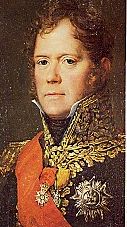
1815: Michel Ney, the bravest of the brave

On this date in 1815, Napoleonic Marshal Michel Ney faced a squad of French troops un-blindfolded and gave them the last order of his wild career:

Soldiers, when I give the command to fire, fire straight at my heart. Wait for the order. It will be my last to you. I protest against my condemnation. I have fought a hundred battles for France, and not one against her… Soldiers Fire!

The carrot-topped commander, just seven months Napoleon’s senior, had like the Corsican distinguished himself at arms during the French Revolution.

He shone thereafter as a ballsy* cavalry officer in the Napoleonic Wars — Bonaparte called him le Brave des Braves (“the bravest of the brave”).

Hitching your star to Napoleon’s was a good career move, for sure.

Until right about …


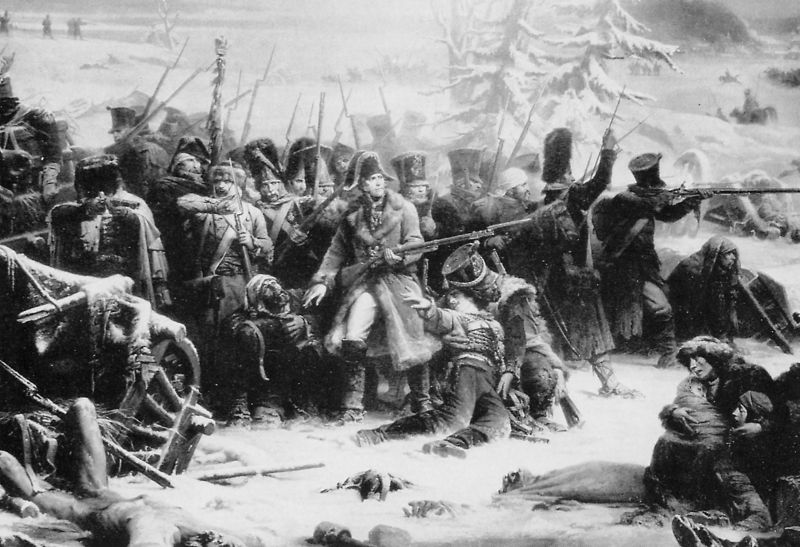
Michel Ney was named Prince de la Moskowa after the Battle of Borodino 1812. Things kind of went downhill from there.

“[W]e are told of the greatness of soul of the marshals, especially of Ney — a greatness of soul consisting in this: that he … escaped to Orsha abandoning standards, artillery, and nine-tenths of his men.” -Leo Tolstoy, War and Peace

Ney was able to keep things cool with Louis XVIII, but when Napoleon returned from Elba and Ney marched out to capture him, both Marshal and army deserted to the old emperor.

Ney often takes a rap for fouling up the reunion tour with a characteristically reckless cavalry charge during the Battle of Waterloo.

But his real problem was that he couldn’t make up his mind or stir his spirit or just plain read the writing on the wall well enough to get out while the getting was good. Though the Bourbons gave him every opportunity to blow town and spare the new-look ancien regime the embarrassment of having to try him, Ney didn’t do it — causing the king to fume,

By letting himself be caught, he has done us more harm than he did [defecting to Napoleon] on the 13th of March!

A vengeful Chamber of Peers, full of radical more-royalist-than-the-king types, gave him no quarter.

The near-unanimous conviction and death sentence were agreed by the Peers around midnight as December 6 became December 7, and the Bravest of the Brave led out near the Luxembourg Garden that very morning to suffer the sentence passed upon him.

The Bravest of the Brave, a 19th-century general history of the man, is available free on Google Books, as are two volumes of memoirs (1, 2) published posthumously by his family.

French speakers can find other free 19th century texts on Ney linked here.

* His reputation for unshakable courage notwithstanding, John Elting says Ney was also a deft hand at executing a cavalry retreat.

On this day..

1849: Sheikh Bouzian, defending Zaatcha

On this date in 1849, the French imposed a salutary example on Islamic resistance in Algeria.

Two decades into the colonization of Algeria, the blessings of French rule were not apparent to all. (Back in the homeland, the French populace had doubts of its own.)

Bouzian — or Bou Zian, Bou-Zian, or Abu Ziyan — led an uprising rooted half in resentment over confiscatory palm date taxes and half in a prophetic insurrectionary Islam that sure reads as foreshadowing from this distance.

Retiring to the defensible oasis village of Zaatcha, the rebels impressively repelled French zouaves sent to suppress them earlier in the year, sending them off to lick their wounds and regroup for several months in the nearby town of Biskra.

At last, a massive French force descended on redoubt.


Assaut de Zaatcha, 26 novembre 1849 by Jean-Adolphe Beauce

On the morning of this date, it commenced its assault, reducing the village to a ruin house by house against its desperate defenders. The savage immediacy of the fight is by this translation of a participant’s account, printed in this Google books freebie (which explores the siege in its tactical mechanics):

Bouzian holds out the longest. The 2nd battalion of Zouaves is on his track; two bags of powder placed against the house which shelters these energetic defenders produce no effect; only at the third does a mass of wall come down. Our soldiers of the different columns of assault rush in. They are received with musket-shots.

The efforts of our fine fellows triumph at last over that heroic resistance. Bouzian, his son by his side, fights desperately, but succumbs at last. He is put to death with his son, as rough a warrior as his father…

Every one of the close to 1,000 Arabs defending Zaatcha died — several dozen, at least, besides Bouzian summarily executed upon capture — and they took two hundred or so of the assailing force to the grave with them.

John Reynell Morell emits an non-partisan Orientalist tribute to everybody in this public-domain book about Algeria published shortly after the bloody affair.

What impartial pen shall chronicle the panting despair of those dauntless Saharians, fighting to the death for wives and home, and waving palms and liberty! what pen do justice to the gallatry of European discipline, establishing order amidst blazing temples and blood-stained gardens! The sweet South will continue to sigh its perfumes over that oasis; but its gardens are a wilderness, its homes a desolation, for the spirit of freedom has left it.

Those perfumed sighs, though, would not in the long run prove such an ephemeral matter for the Republic.

the outcome was intended [by the French] as a permanent lesson for the unruly inhabitants of the south. To the latter, the struggle that eventually centered upon the small oasis represented an Armageddon in miniature … [but] the determined resistance of Abu Ziyan and his forces created a heroic epic that remained in the popular collective memory long afterward. (Source)

General background on the Siege of Zaatcha is here (in English) and here (in French).

On this day..

1793: Olympe de Gouges, a head of her time

On this date in 1793, Olympe de Gouges’ forward thoughts were removed from her shoulders in the Place de la Revolution.

Most recognizable today for her Declaration of the Rights of Woman and the Citizen* — a proto-feminist call for equality of the sexes issued in response to the day’s revolutionary but guy-centric Declaration of the Rights of Man and of the Citizende Gouges was much more than a one-issue woman.

Fully engaged with the liberal intellectual currents of the Enlightenment, de Gouges spent the 1770’s and 1780’s in Parisian salon circles cranking out plays (over 40) and petitions, pamphlets and manifestos on animal welfare, poverty, the treatment of orphans, and ending slavery.

The latter issue, and not women’s rights, was the cause her contemporaries would have most associated with her.

But the natural-born gadfly didn’t pick her battles with injustice, and the Terror was a bad period to be indiscriminate. Like some of her Girondist associates, she risked the Paris mob’s wrath by openly opposing Louis XVI‘s execution — right in character, Olympe was down on the whole idea of the death penalty — and she carried principle into foolhardiness by printing broadsides savaging Robespierre.

Show trial time.

There can be no mistaking the perfidious intentions of this criminal woman, and her hidden motives … calumniating and spewing out bile in large doses against the warmest friends of the people, their most intrepid defender.

Misogynist condescension veined the prevailing interpretation of this misbehavior.

Olympe de Gouges, born with an exalted imagination, mistook her delirium for an inspiration of nature. She wanted to be a man of state. She took up the projects of the perfidious people who want to divide France. It seems the law has punished this conspirator for having forgotten the virtues that belong to her sex.

And strange to say, that condescension outlived Robespierre by centuries.

Only recently, as mainstream thought has (sort of) caught up with de Gouges, has the scope of her work (French link) attracted renewed appreciation, and Olympe been acknowledged an Olympian herself.

* Article 10: “Woman has the right to mount the scaffold; she must equally have the right to mount the rostrum.” The work was dedicated to Marie Antoinette.

On this day..

1793: The Girondists

On this date in 1793, in a revolutionary Paris where the machinery of the Terror was clattering to life, five tumbrils bore to the guillotine twenty former Girondist ministers to the National Convention — plus the corpse of their late colleague Dufriche de Valazé, who had cheated the executioner by killing himself.

Named for the region of Aquitaine from which their leading lights hailed, the Girondists (or Girondins) had in the compressed history of the Revolution ascended from fringe democratic party to governing party even as the political facts shifted under their feet. Finding themselves the conservative party in an assembly increasingly dominated by radical Montagnards and the Paris mob, the Girondists’ tactlessness and stubborn refusal to deal with Georges Danton after his (still historically murky) involvement in the riotous slaughter of prisoners during the September Massacre eroded their position.

As the terrible year of 1793 unfolded, the Girondins discovered themselves successively overthrown, expelled from the Convention, proscribed, and hunted. Though many more — Girondists and others — were to follow in their steps, the trial of these 21 before the Revolutionary Tribunal and subsequent guillotining, the first notable mass-execution of the Revolution, raised the curtain on the Terror.


L’ultime adieu des Girondins le 31 Octobre 1793, by Paul Delaroche

Decades later, the English historian Lord Acton remembered the faction’s doomed heroism.

[The Girondins] stood four months before their fall. During that memorable struggle, the question was whether France should be ruled by violence and blood, or by men who knew the passion for freedom. The Girondins at once raised the real issue by demanding inquiry into the massacres of September. It was a valid but a perilous weapon. There could be no doubt as to what those who had committed a thousand murders to obtain power would be capable of doing in their own defence.

Almost to the last moment Danton wished to avoid the conflict. Again and again they rejected his offers. Open war, said Vergniaud, is better than a hollow truce. Their rejection of the hand that bore the crimson stain is the cause of their ruin, but also of their renown. They were always impolitic, disunited, and undecided; but they rose, at times, to the level of honest men.

They were easily beaten and mercilessly destroyed, and no man stirred to save them. At their fall liberty perished; but it had become a feeble remnant in their hands, and a spark almost extinguished. Although they were not only weak but bad, no nation ever suffered a greater misfortune than that which befell France in their defeat and destruction.

That Pierre Vergniaud who scorned the hollow truce was the last to mount the scaffold this day — a shining orator of the Revolution who captured the calamity engulfing his nation in another well-remembered aphorism, “the Revolution devours its own children.”

On this day..

1839: Sebastien-Benoit Peytel, notwithstanding Balzac

On this date in 1839, Honore de Balzac’s crusade to save a condemned man got the chop.

Sebastien-Benoit Peytel was a notary and minor journalist death-sentenced that August for murdering his wife and their servant, one of those countless local outrages whose passing notice flies before the years.

Driven by sentimentality or opportunism or literary conceit — but with a genuine sense of aggrieved justice — the French writer Balzac, who had met Peytel, took up his pen on the condemned man’s behalf.

I am extremely agitated by a horrible case, the case of Peytel. I have seen this poor fellow three times. He is condemned; I start in two hours for Bourg.

Blowing through 10,000 francs of his own money on travel and investigation, Balzac could never make the case to the public as compellingly as it evidently appeared to him.

The English writer William Thackeray was then abroad in Paris, and if we are to credit his more measured defense of Peytel,* Balzac was counterproductive to his cause.

Perhaps Monsieur de Balzac helped to smother what little sparks of interest might still have remained for the murderous notary. Balzac put forward a letter in his favor, so very long, so very dull, so very pompous, promising so much, and performing so little, that the Parisian public gave up Peytel and his case altogether.

Thackeray’s own (yawn) account won’t bring the rhetoricians out of their seats. Conniving Frenchmen: fresh take.

I am not going to entertain you with any sentimental lamentations for this scoundrel’s fate, or to declare my belief in his innocence, as Monsieur de Balzac has done. As far as moral conviction can go, the man’s guilt is pretty clearly brought home to him. But … [i] t is a serious privilege, God knows, that society takes upon itself, at any time, to deprive one of God’s creatures of existence. But when the slightest doubt remains, what a tremendous risk does it incur! In England, thank heaven, the law is more wise and more merciful: an English jury would never have taken a man’s blood upon such testimony: an English judge and Crown advocate would never have acted as these Frenchmen have done; the latter inflaming the public mind by exaggerated appeals to their passions: the former seeking, in every way, to draw confessions from the prisoner, to perplex and confound him, to do away, by fierce cross-questioning and bitter remarks from the bench, with any effect that his testimony might have on the jury.

[Y]ou may see how easy a thing it is for a man’s life to be talked away in France, if ever he should happen to fall under the suspicion of a crime.

Eventually, he pivots from Peytel’s execution this date to state a more general argument against the death penalty, at least in its public form.

Down goes the axe; the poor wretch’s head rolls gasping into the basket; the spectators go home, pondering; and Mr. Executioner and his aides have, in half an hour, removed all traces of the august sacrifice, and of the altar on which it had been performed. Say, Mr. Briefless, do you think that any single person, meditating murder, would be deterred therefrom by beholding this — nay, a thousand more executions? It is not for moral improvement, as I take it, nor for opportunity to make appropriate remarks upon the punishment of crime, that people make a holiday of a killing-day, and leave their homes and occupations, to flock and witness the cutting off of a head. Do we crowd to see Mr. Macready in the new tragedy, or Mademoiselle Ellssler in her last new ballet and flesh-colored stockinnet pantaloons, out of a pure love of abstract poetry and beauty; or from a strong notion that we shall be excited, in different ways, by the actor and the dancer? And so, as we go to have a meal of fictitious terror at the tragedy, of something more questionable in the ballet, we go for a glut of blood to the execution. The lust is in every man’s nature, more or less. Did you ever witness a wrestling or boxing match? The first clatter of the kick on the shins, or the first drawing of blood, makes the stranger shudder a little; but soon the blood is his chief enjoyment, and he thirsts for it with a fierce delight. It is a fine grim pleasure that we have in seeing a man killed; and I make no doubt that the organs of destructiveness must begin to throb and swell as we witness the delightful savage spectacle.

Lost among literature’s towering oaks, our day’s humble shrub has a literary footnote of his own for authoring, in 1832, Physiologie de la Poire (“The Physiology of the Pear”), a protracted satire exploiting Louis-Philippe‘s reputation as “the Pear King.” (Contrary to some reports, Peytel does not appear to have invented this image.)

According to these antiquarians, the book contains the author’s “hilarious” predictions of the ways he will not die.

“Il ne sera pas guillotine‘ comme Bories, Raoulx …”

* Thackeray argued that the trial was badly done and the evidence insufficient for execution but expressly stopped well short of expressing confidence in Peytel’s innocence.

On this day..