On this date in 1978, a young Soviet girl’s desperate collaboration with the Wehrmacht caught up with a 55-year-old mother.
A village girl and the first in her family to go to school, young Antonina Parfenova was dubbed “Makarova” (after her father, Makar) by a teacher when the girl forgot or was too shy to say her surname. This childhood switcheroo would follow her into adulthood and ultimately buy her half a lifetime and a family to mourn her.
At 19, she had moved to Moscow when the German onslaught against the Soviet Union erupted, and like many young people in similar straits, she volunteered to help fight the Nazis. But as the front swept past her, she found herself in enemy territory, and was nabbed by the SS and persuaded to become the Germans’ executioner of Russians at Lokot, a village near the Ukrainian and Belarussian borders for which a short-lived Nazi-controlled “republic” was named.
A 2005 Pravda article (with a somewhat prurient concern over the young woman’s sexual incontinence) delves into her activities:
Usually Antonina Makarova was ordered to execute a group of 27 people, the number of partisans which a local prison could house. Death sentences were carried out on the edge of a pit half a kilometer from the prison. She never knew people whom she executed and they had no notion who the executioner was either. Antonina executed the first group of partisans being absolutely drunk and the girl could hardly realize what she was doing. She often kept clothes of those whom she killed if the things were good; she carefully washed them and heaped them in her room.
In the evenings after work Antonina loved to dress up and enjoy her time dancing with German officers together with other girls who came there as prostitutes. Antonina boasted she used to live in Moscow that is why other girls kept aloof from her.
At dawn, Antonina often came to the prison and peered into the faces of people whom she was to execute in the morning. The woman just did her job when executing people and believed that the war would write her crimes off.*
“Antonina Makarova” was implicated in some 1,500 executions, and formally charged in around 200 cases with identifiable victims. The KGB turned up scores of women of the right age with the right name, but none of them fit the bill: the real Makarova’s passport said “Parfenova.”
Not until 1976 did the case break, when a relative applying for a travel visa named her in a routine list of relatives. Now named Antonina Ginsburg — she had married a veteran and taken his name — she was living quietly in Belarus, but hardly in hiding: the pair attended parades and town functions in the honor accorded World War II survivors.
Viktor Ginsburg would be in for a bit of a shock.
Even 35 years after her spell with the Germans ended, the wounds of the Great Patriotic War were raw enough to spell her death in very quick order in Briansk, the capital of Lokot’s district. She was the last World War II traitor of any note executed in the Soviet Union, and according to this page, the only Soviet woman ever judicially executed by shooting. (I’d take that claim cautiously without more corroboration.)
The Pravda article cited above is about the only original English source readily available online; Russian speakers (or people prepared to grapple with an online translator’s inelegance) can read much more at her Russian Wikipedia page as well as here, here and here.
Update: Courtesy of Executed Today’s own Sonechka, a translation from this Russian story of Makarova’s daughter’s heartbreaking remembrance of a woman she only knew as a mother:
Pain, pain, pain … She spoiled the life of four generations … You would like to know whether I would take her back if she returned? I would. She is my mother after all… I really don’t know how to remember her — as if she’s alive or dead. According to the tacit law, women were not shot. Maybe she’s alive somewhere? And if not, tell me — I’ll finally light a candle for her soul.
(Candles in Orthodox churches are lit for “zdravie” — literally “good health, well being” — or “upokoi” — “peace of a soul.” The former is intended for living beings, the latter for dead ones.)
* This, at least, is what she told her interrogators.
On this date in 1944, Nazi Germany’s juridical vengeance against Hitler’s near-assassins commenced.
Barely two weeks after Col. Stauffenberg‘s bomb had barely missed slaying the Fuhrer, eight of his principal co-conspirators stood show trials at the Volksgerichtshof (People’s Court) before hectoring prig Roland Freisler.
The outcome, of course, was foreordained.
Apparently orders had come down from on high to make the deaths as degrading as possible; this batch, convicted August 7-8, was hanged naked this day at Berlin’s Plotzensee Prison on thin cord (piano wire, say some sources, although it’s not clear to me whether this is literally true) suspended from meathooks while cameras rolled. Video and stills from the ghastly scene were shipped back to Hitler’s bomb-damaged Polish outpost for the edification of the powers that be.
Many hundreds more would follow, both at Plotzensee and throughout the Reich where persons distantly connected to the plotters and various miscellaneous resistance figures were swept up in the purge.
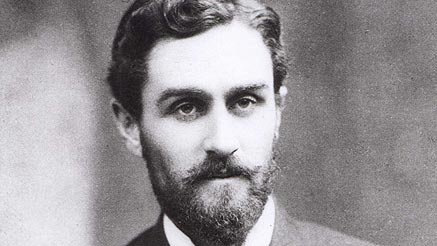
On this date in 1916, Roger Casement was hanged for treason by the British crown that had knighted him only a few years before.
Casement died for his part in the Easter Rising, but this Irish nationalist hero’s layered story has long made him a very different sort of cultural marker than, say, James Connolly.
Casement came to public prominence for his damning report on Belgium’s atrocious treatment of natives in its Congo colony, e.g.:
[T]he great decrease in population, the dirty and ill-kept towns, and the complete absence of goats, sheep, or fowls — once very plentiful in this country — were to be attributed above all else to the continued effort made during many years to compel the natives to work india-rubber. Large bodies of native troops had formerly been quartered in the district, and the punitive measures undertaken to his end had endured for a considerable period. During the course of these operations there had been much loss of life, accompanied, I fear, by a somewhat general mutilation of the dead, as proof that the soldiers had done their duty.
. . . Two cases (of mutilation) came to my actual notice while I was in the lake district. One, a young man, both of whose hands had been beaten off with the butt ends of rifles against a tree; the other a young lad of 11 or 12 years of age, whose right hand was cut off at the wrist. . . . I both these cases the Government soldiers had been accompanied by white officers whose names were given to me. Of six natives (one a girl, three little boys, one youth, and one old woman) who had been mutilated in this way during the rubber regime, all except one were dead at the date of my visit.
[A sentry in the employ of one of the concessionary private companies] said he had caught and was detaining as prisoners (eleven women) to compel their husbands to bring in the right amount of rubber required of them on the next market day. . . . When I asked what would become of these women if their husbands failed to bring in the right quantity of rubber . . , he said at once that then they would be kept there until their husbands had redeemed them.
Casement’s is an honorable name in the campaign for the Congo, an early human rights and anti-colonial struggle; in this 92-minute BBC documentary on the notorious depredations in the Congo, the Casement report’s creation and impact are treated from about 1:15:15 through the end:
A similar investigation undertaken in Peru — where the lens focused on British employers, rather than strictly the malfeasance of foreign states — earned him knighthood in 1911, but Casement’s personal evolution from loyal Protestant* imperial operative with a sympathy for the Irish cause to revolutionary nationalist was already underway. “This journey into the depths of the Congo has been useful in helping me discover my own country and understand her situation, her destiny, her reality,” he wrote his sister. “I’ve also found my true self: the incorrigible Irishman.”
He resigned from the consular service and began recruiting for the Irish Volunteers.
As World War I opened, Casement identified British aggression as its cause, an extension of the violent imperial hegemony he chronicled in The Crime Against Europe:
The British Empire was not founded in peace; how, then can it be kept by peace, or ensured by peace-treaties? It was born of pillage and blood-shed, and has been maintained by both; and it cannot now be secured by a common language any more than a common Bible. The lands called the British Empire belong to many races, and it is only by the sword and not by the Book of Peace or any pact of peace that those races can be kept from the ownership of their own countries.
While any Irish Republican would have agreed with that sentiment, the resulting moral and tactical calculus for the Irish cause to ally with the German was not universally embraced — and was certainly anathema to the British.
All that was beautiful and just,
All that was pure and sad
Went in one little, moving plot of dust
The world called bad.
Came like a highwayman, and went,
One who was bold and gay,
Left when his lightly loving mood was spent
Thy heart to pay.
By-word of little street and men,
Narrower theirs the shame,
Tread thou the lava loving leaves, and then
Turn whence it came.
Ætna, all wonderful, whose heart
Glows as thine throbbing glows,
Almond and citron bloom quivering at start,
Ends in pure snows.
Casement spent the first two years of the Great War in Germany itself, and arranged a shipment of guns that would have supported the Easter Rising, but thought the aid too little and too late. He had a German U-boat drop him at Ireland, trying to get word to the Republican leadership to postpone the revolt.** Instead, he was picked up three days before the doomed rising and hanged after a sensational trial.†
His “treason” — and of course, the very crime of which he was convicted imports a British legitimacy in Ireland that Casement explicitly rejected — shocked many old associates, but he still had friends in high places. To dampen the international clemency campaign, England circulated the notorious “Black Diaries,” photographs of supposed Casement diary pages detailing the author’s homosexuality.
This dirty (and successful) trick brings a personal-is-political quality to Casement’s legacy as well as an enduring debate over the diaries’ authenticity. Since Irish nationalism gained mainstream acceptance well before homosexuality, right-thinking folk long held the Black Diaries a forgery, and time was you solicited a black eye by saying otherwise in the wrong company.
The gay rights movement has seen a posthumous redefinition of Casement; although homosexuality was not on the indictment against him, one could argue that it was the reason he hanged. Given recent handwriting forensics that support the diaries’ authenticity, the general‡ consensus about the Black Diaries has inverted with the effect of only heightening sympathy for their alleged author, albeit at the expense of some tension over how to situate that characteristic within the whole of Casement’s life and thought.
And that is only one aspect of the shifting place of Casement in the firmament of Republican martyrs since his death. His hagiography waxed in the interwar years, with Yeats among those calling for the return of Casement’s remains in The Ghost of Roger Casement”.
But the humanitarian’s German ties were an inconvenience as World War II raged, and not until afterward was that cause renewed. When his body was finally returned in 1965, an Irish state funeral elided the matter of the diaries.
Even Casement himself, who would be the last to die for the Easter Rising, had a hand in the myth-making. His last mission’s purpose to avert the Easter Rising fit neither the government’s interest in maximizing his perfidy nor Casement’s own in identifying with the Irish cause; he himself therefore owned the Rising fully in his defense which made him fine fodder for Republican hymns like “Lonely Banna Strand”:
RTE radio’s What If? series recently explored Casement’s complex legacy:
As Casement put it in his voluminous personal writing, “It is a cruel thing to die with all men misunderstanding — misapprehending — and to be silent forever.”
* Casement’s father was Protestant and his mother was Catholic; he lived with a somewhat split identity between the two faiths, but formally converted to Catholicism while awaiting execution (which surely did not hurt his memory to the Irish cause) and his last meal was simply the Host.
** The guns themselves were interdicted by the British navy and ended up scuttled to the ocean floor.
† Since Casement’s incitements to rebellion had occurred on foreign soil, there was some fine legal parsing over whether he could be tried for “treason.” The dispute resolved to the placement of a comma in a medieval law — leading to the epigram/-taph that Casement was “hanged by a comma.” In the midst of war and before an English jury, however, punctuation was an even weaker defense than it sounds.
Minutes after midnight this date in 1944, four senior Wehrmacht officers who had come within an ace of murdering Adolf Hitler less than 12 hours earlier were summarily shot in Berlin — the first of thousands executed for the most famous assassination attempt on the Fuhrer.
One of those rare moments where historical epochs (arguably) turn on the minutest exigencies of chance, the so-called July 20 plot had seen Col. Claus Schenk Graf von Stauffenberg insinuate a bomb into Hitler’s conference room in modern-day eastern Poland, then fly back to Berlin to mount a coup d’etat.
Blam
Stauffenberg had every reason as he left Wolfsschanze to believe the devastating blast at 12:42 p.m. must have killed the Nazi dictator. Little did he know that another officer at the table where the high command was plotting strategy for the eastern front had, in the name of legroom, shifted the deadly satchel to the other side of a heavy oak table support — shielding Hitler from the brunt of the explosion.
Four men died. Hitler had hearing loss, an injury to his right arm, and one hell of a grudge.
Stauffenberg weaseled out of the confused bunker and flew back to Berlin, expecting that his confederates were even then launching Operation Valkyrie — a contingency plan for martial law in the case of civic disturbance that the conspirators intended to use to mount a coup.
Failure to Communicate
Control and distribution of information was not the least of the many threads in the tapestry of July 20, 1944. Hitler had risen to power on his artful grasp of propaganda; today, his headquarters’ mastery of communications would overpower the putschists’ rank amateurism.
While en route, Stauffenberg had no ability to communicate to the wider world. Landing in Berlin three hours after the not-quite-deadly-enough blast at Wolfsschanze, he must have been stunned to find that Valkyrie had not been launched. Apparently, fragmentary reports from the east were unclear as to whether Hitler had survived; everyone was reluctant about committing himself.
Frantically, Stauffenberg — already deeply committed — rallied his comrades and set the treasonable gears into motion. But by this time, communications with Hitler’s headquarters had been re-established and contradictory reports of the assassination attempt’s success were flying in Berlin. Stauffenberg’s sincere but incorrect eyewitness testimony of Hitler’s death became increasingly untenable. Compounded by the sluggish and ill-coordinated action of the conspirators, officers of a more opportunist bent soon began lining up with the bad guys.
Joseph Goebbels, the senior Nazi in Berlin and Hitler’s wizard of public relations, was inexplicably left unmolested for hours — long enough to phone the radio station (also never seized) an announcement of Hitler’s survival. “To think that these revolutionaries weren’t even smart enough to cut the telephone wires! My little daughter would have thought of that.”
Conspirators’ orders to military units around Berlin went out late, piecemeal, and far too often fell on ears already deaf to the appeals. In some cases, the proclamations that should have been queued up for inundating the airwaves instantaneously were with some other officer not on the scene, and consequently were haphazardly redrafted on the fly — for telex operators who had caught the day’s drift themselves and intentionally delayed or ignored them.
From the perspective of a radio editor it was tragic. Tragic because the way in which details were handled made it obvious that this revolt had had very lithe chance of succeeding. (Source)
The coup fell apart almost as soon as it began.
Fromm Here to Eternity
Most decisively of all, timely information had prevented any participation by Gen. Friedrich Fromm, Stauffenberg’s commanding officer and the head of the Reserve Army — it was that position that allowed his aide access to Hitler’s person, and it was under his authority that the putschists were issuing their Valkyrie orders.
Fromm fell in the “opportunist” camp, and would have been ready to strike had the Fuhrer been demonstrably killed. But a telephone connection straight from the scene of the crime assured him that Hitler had survived … and that his adjutant was a wanted man.
Fromm the potential collaborator quickly turned the tables on Stauffenberg and company late on the night of the 20th.
The Schwein Abides
Before advancing to our heroes’ foreordained fate, take a moment to appreciate this newsreel rushed into production to assure the German public that everything was under control. It’s an impressive advance on statist slick-talking from Germany’s World War I clunkers (like this):
Notice Hitler greeting Mussolini — the two had been scheduled to meet that day; it would be their last encounter in this world. His maimed right arm hanging concealed beneath a greatcoat, Hitler shakes left-handed.
Fromm … had quickly made up his mind to eliminate these men and not only to cover up the traces — for though he had refused to engage actively in the plot, he had known of it for months, sheltering the assassins and not reporting their plans — but to curry favor with Hitler as the man who put down the revolt. In the world of the Nazi gangsters it was much too late for this, but Fromm did not realize it.
He … announce[d] that “in the name of the Fuehrer” he had called a session of a “court-martial” (there is no evidence that he had) and that it had pronounced death sentences on four officers: “Colonel of the Genera Staff Mertz, General Olbricht, this colonel whose name I no longer know [Stauffenberg, his aide], and this lieutenant [Haeften].”
…
In the courtyard below in the dim rays of the blackout-hooded headlights of an Army car the four officers were quickly dispatched by a firing squad. Eyewitnesses say there was much tumult and shouting, mostly by the guards, who were in a hurry because of the danger of a bombing attack — British planes had been over Berlin almost every night that summer. Stauffenberg died crying, “Long live our sacred Germany!”
The courtyard of the Bendlerblock on modern-day Stauffenbergstrasse in Berlin, where Col. Stauffenberg and three compatriots were shot. Photo by Daniel Ullrich, licensed by CC-by-sa.
Minutes after they died, the SS arrived on the scene and forbade any further executions of potential witnesses.
Fromm’s gambit didn’t work any better than Stauffenberg’s had: he was arrested right away, and was himself later shot.
What If?
While the afternoon’s theatrics may have been doomed from the moment Hitler arose unkilled from the bomb’s debris, his miraculous escape from death — “confirmation of the task imposed upon me by Providence,” he told the nation in a radio address an hour after Stauffenberg’s execution — is an inexhaustible mine for historical hypothesizing.
That the bomb could have, and would have with the least change in the principle variables, slain the dictator is widely accepted; a 2005 reconstruction of the blast scene by the Discovery Channel supports that belief in the context of the cable-documentary-friendly format* of Adolf Hitler plus slow-mo explosives. (Parts 1, 2 and 3 of this series set up the episodes excerpted here with the plot’s historical background and the crew’s investigation into the precise dimensions of the blast space — a combination of file footage, modern recreation shots, talking heads, and tromping about the forest in the modern remains of Wolfsschanze.)
But that’s the easy what-if.
More problematic — and well into the realm of bar-stool dickering — are the questions of what would have happened if the explosive had hit its target.
Stauffenberg enjoys latter-day popularity in Germany — the street where he was shot bears his name — in no small measure because of the confessedly quixotic nature of the attempted murder. Indeed, he probably died at the height of his potential popularity for history.
But it’s not for nothing that this attempt (though it did have many botched antecedents) took place in the weeks when Germany’s military position went from desperate to disastrous. Over the preceding two months, Soviet offenses had pushed the front back to the prewar Polish border, and the Normandy landing had opened a rapidly expanding western front. The assassination had a healthy dose of self-interest … and therefore was at least potentially antithetical to other interests at play in the great conflagration.
The motivation of sparing the Fatherland the ravages of war on its own soil is not ignoble of itself, of course. But given this opposition circle’s years-long failure to take effective action against Hitler while he went from successful crime to successful crime, one might ask a little more than a late-breaking suicidal gambit for unreserved historical vindication.
The German military’s deal with the devil had seen Europe’s greatest armed forces squandered by its dumbest commander. The end result would bleed the Nazi state white at unspeakable human cost … but also, arguably, towards one of the better postwar outcomes imaginable.
And would the coup even have achieved the goal of leaving Germany unoccupied? It seems impossible to think that any outcome would have been worse than Hitler, and the last year of the war was also its bloodiest … but among the spectrum of counterfactual alternatives, the appealing possibilities mostly seem to work out in spite of the plotters, rather than because of them.
1. Civil War?
Countercoups, or even outright civil war, might very likely have erupted between rivals for succession. This might have worked out as the best-case situation — fragmenting German resistance and hastening the inevitable — but it might also have given Germany a leaner, meaner fascism with a path to enduring long-term. Predicting any particular arrangement of players to emerge from this black box is a just-so story, and any of them probably leads to one of the other three alternatives; certainly the plotters weren’t banking on their own subsequent overthrow.
2. Status Quo Ante?
The coup might have utterly failed to obtain peace. German was close to defeat; the Allies were demanding unconditional surrender, and the entire point of the plot was to surrender on better terms than that. Had no quarter been offered, the putschist government might then have fought on (either by choice, or by the compulsion of internal politics) to much the same end, although quite plausibly with much less gratuitous bloodletting in the camps. Accidentally abating the Holocaust would be a very significant plus, of course, but probably not what posterity has in mind when it goes naming streets for the man.
3. World War Against Russia?
The new government might have successfully made peace with the western Allies, which was its fervent hope. Under the circumstances of the summer of 1944, that practically implied the continuation of the global war with the capitalist and fascist powers aligning against the USSR. The horrors of the eastern front up to the summer of 1944 then would likely pale in comparison to what followed. You could tell the story so that it all works out in the end, but replacing the long Cold War with an immediate hot war, especially with the United States less than a year away from its first successful A-bomb test, isn’t exactly a presumptive improvement.
4. 1918 Redux?
In the all but unimaginable case that the post-Hitler government successfully sued for peace on both its fronts (or accepted unconditional surrender), it would have had to give up to a Soviet buffer zone much of what the Soviets ultimately conquered. Millions who died fighting for it, and millions more who died in concentration camps while the fighting played out, and millions of women raped by the conquering Red Army, would have considered that arrangement an improvement; still, the peace itself could have ensconced a less crazy and therefore more durable military dictatorship in central Europe, which wouldn’t necessarily seem like an altogether positive outcome vis-a-vis the actual postwar history. More worryingly, this might have horribly recapitulated the post-World War I scenario in which the liberal politicians who accepted defeat, and not the crazed reactionaries who caused it, were blamed for the loss, fueling the subsequent rise of some unattractive revanchist successor state. Precisely because that example would have been uppermost in the officers’ own minds, it’s hard to believe this least-bloodthirsty path would have been the actual consequence of the coup.
And so on …
Second-order effects from any of these possibilities generate a novelist’s trove of alternative histories. What would the map of eastern Europe have looked like? Whither European Jewry … and therefore the postwar state of Israel … and therefore the political chessboard in the Middle East? What would an early resolution in Europe have meant for the Pacific theater, or for the Chinese revolution? How would decolonization movements have been affected had the war concluded earlier, or had it transformed into a worldwide anti-Communist war?
Postscript
Somewhere in those alternate realities, staff at the re-education camp are bantering over happy hour about what would have happened if Stauffenberg had failed.
Who knows if “internally peacable European social democracies” are a bullet point for the pie-eyed optimists, or the incorrigible pessimists?
A few of the books about Stauffenberg and Operation Valkyrie
Poor Col. Stauffenberg is due to be played by a smirking Tom Cruise in the biopic Valkyrie, a role that has drawn some slightly overheated controversy in Germany over Cruise’s adherence to Scientology.
On this date in 1946, officials of Soviet-occupied Poland publicly hanged eleven convicted war criminals of the Stutthof concentration camp.
Set up immediately upon Germany’s September 1, 1939 invasion of Poland and not liberated until after official German capitulation in 1945, Stutthoff handled over 100,000 prisoners during its long service.
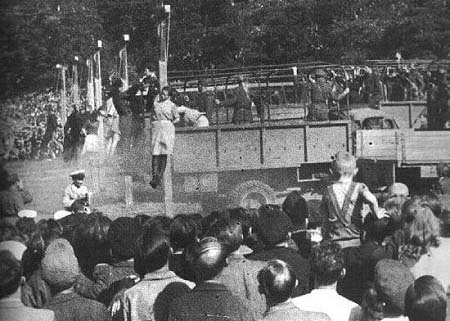
This day’s condemned — camp commandant Johann Pauls, five male kapos, and five female guards — were the product of the first of four Stutthof trials held in 1946-1947. At a hill in Gdansk known as Biskupia Gorka (Bishop Hill), upon a specially-erected row of four T-shaped double gallows centered around a pi-shaped triple gallows, and before a crowd of thousands, the doomed eleven were noosed on the back of military trucks which then drove away to leave them strangling to death with a “short drop” hanging.
The following gut-twisting images are among a number to be found here.
Above: on one end of the gallows row, the truck has just pulled away from Jenny Wanda Barkmann — a modish Hamburg lass in her mid-20’s known to Stutthof prisoners as “the Beautiful Specter” for her cruelty. Down the row, one can see that some of the prisoners are already swinging, while others have not yet been dropped.
Upon hearing her sentence, Jenny Barkmann retorted, “Life is indeed a pleasure, and pleasures are usually short.” (More about Barkmann, including trial photos, here.) In this closer view of her, just as in the first photo, she is still alive and struggling. Next to her, Ewa Paradies, another guard, is prepared for the same fate.
The central triple gallows. Commandant Johann Pauls hangs in the middle with Gerda Steinhoff — one of the senior female guards — in the foreground. The line of five male kapos recedes behind them into the enormous crowd of onlookers.
On this date in 1962, the architect of the Final Solution received such justice as could be meted to him on earth at Israel’s Ramla Prison.
Adolf Eichmann, the vacuum cleaner salesman turned SS Obersturnbannfuhrer, remains the only person judicially executed in the history of modern Israel, whose intelligence services kidnapped him from Argentina where he had settled after the war.
Other Nazis had used the “only following orders” defense with little success in the Nuremberg Trials shortly after World War II. On trial years later (and at the hands a Jewish state) Eichmann — a bookish, unmenacing man who invoked Kant — posed the questions of individual responsibility and human psychology in starker terms.
To be sure, he was no anonymous functionary. Neither, however, had he dirtied his nails at the stomach-churning business end of the Holocaust: rather, he had engineered the stupendous logistical project of deporting Eastern Europe’s Jews for extermination, an (impressive) accomplishment worth exponentially more lives than any Einsatzgruppe could ever account for, yet simultaneously abstract from the upshot.
Eichmann said he did it without ill-will towards its subjects — simply to obey and to achieve.
The Banality of Evil
[I]f it was of small legal relevance, it was of great political interest to know how long it takes for an average person to overcome his innate repugnance of crime, and what exactly happens to him once he has reached that point. To this question, the case of Adolf Eichmann supplied an answer that could not have been clearer or more precise.
-Hannah Arendt
Hannah Arendt took him at his word* and saw in Eichmann the abyss gazing back into us, into his judges — not a monster but a man unsettling in his normalcy, whose job was not TPS reports or quarterly sales results but turning humans into ash.
The company man. The career man. Every man, standing in for countless thousands more who pushed the papers that drove the trains to Auschwitz.
What for Eichmann was a job, with its daily routine, its ups and downs, was for the Jews quite literally the end of the world.
Not everyone accepts her conclusions, but Arendt’s characterization of “the banality of evil” has become the man’s epigraph. And Eichmann disturbs us precisely because we seem to be able to meet him on his terms, even sympathize with him when the horror of his crimes begs for a monster like Streicher or Goebbels we could safely consign to the Other.
Arendt’s turn of phrase has a certain breezy (hackneyed, even) life in the public discourse, but her analysis of Eichmann’s careerism remains a challenging and deeply relevant one for we heirs of the world that hanged him.
The complete transcript of Eichmann’s trial is available online here. Video of his trial has been posted online here (in English) and here (original languages).
* Albeit with some reservations; others have argued that Eichmann was considerably more personally invested in his mass-murder project than his demeanor at trial admitted. Certainly he had an interest in showing the mellower Eichmann when he was on trial for his life.
On this date in 1923, a German paramilitary was shot by a French firing squad near Dusseldorf for his anti-occupation sabotage efforts.
Albert Leo Schlageter, a World War I veteran and conservative Catholic who signed up with the right-wing Freikorps and tangled with communists after the war, joined the fledging Nazi party when it absorbed his Freikorps unit in 1922.
The next year, France occupied the Ruhr to secure war reparations payments then crippling Germany, which would do much to speed the rise of the Nazis in the years ahead.
Schlageter was nabbed sabotaging railroad lines in resistance, and Berlin’s protests didn’t help him much.
He became a Nazi martyr literally overnight, and as the nationalist right ascended, the place of his passion was marked with a 90-foot cross and used for party rallies. His name christened a naval vessel, a Luftwaffe fighter wing, two SA units, and several Nazi badges and decorations:
There was also a play about him, Schlageter, whose debut performance was for Hitler’s first birthday as Chancellor in 1933. The most famous work of Hanns Johst, it was notable for the line “Wenn ich ‘Kultur’ höre, entsichere ich meinen Browning!” — “When I hear the word ‘culture’, I reach for my gun!” — subsequently adopted by so many gun-reaching Nazi kulturkampfers that it is provenance is regularly misattributed.
Unsurprisingly, Schlageter’s cult has waned into obscurity since 1945. But one needs not endorse his philosophy or its horrifying posthumous expressions to appreciate the man’s struggle against foreign occupation and bravery in what he took to be the country’s interests.
For the Communist Karl Radek, this martyr of the right stood for many more whose sincere intentions had been bent against themselves — “those German Fascisti, who honestly thought to serve the German people.” Addressing the Communist International’s Executive Committee in the days after the officer’s execution, Radek anticipated Schlageter pointing the way to a future very different from that which came to pass:
Schlageter, a courageous soldier of the counter-revolution, deserves to be sincerely honoured by us, the soldiers of the revolution.
…
Schlageter went … to the Ruhr, not in the year 1923 but in the year 1920. Do you know what that meant? He took part in the attack of German capital upon the Ruhr workers; he fought in the ranks of the troops whose task it was to bring the miners of the Ruhr under the heel of the iron and coal kings. The troops of Waters, in whose ranks he fought, fired the same leaden bullets with which General Degoutte quelled the Ruhr workers. We have no reason to believe that it was from selfish motives that Schlageter helped to subdue the starving miners.
The way in which he risked his life speaks on his behalf, and proves that he was convinced he was serving the German people.
…
[The German Communist Party] believe[s] that the great majority of the nationalist-minded masses belong not to the camp of the capitalists but to the camp of the workers. We want to find, and we shall find, the path to these masses. We shall do all in our power to make men like Schlageter, who are prepared to go to their deaths for a common cause, not wanderers into the void, but wanderers into a better future for the whole of mankind; that they should not spill their hot, unselfish blood for the profit of the coal and iron barons, but in the cause of the great toiling German people, which is a member of the family of peoples fighting for their emancipation.
…
Schlageter himself cannot now hear this declaration, but we are convinced that there are hundreds of Schlageters who will hear it and understand it.
Alexandre Dumas recognized the name of Karl Ludwig Sand, who lost his head on this date in 1820 in Mannheim, Germany, for the murder of the dramatist and humorist August von Kotzebue.
The assassination of von Kotzebue* worried the Prussian monarchy — then headed by Friederich Wilhelm III — and precipitated a series of proclamations, reforms, and internal struggles that finally led to a full-scale rebellion 30 years later.
A print showing Sand stabbing August von Koetzebue. Sand is reported to have shouted, “Here, you traitor to the fatherland!”
Sand was a member of a Burschenschaft,** a liberal student fraternity organization which appealed to nationalist Germans seeking a unified German nation-state, and he and others in his group regarded von Kotzebue as a plague on their cause. Von Kotzebue was then Councillor of the Russian Legation, the culmination of over a decade in the Russian civil service, and a spinmeister for the Russian regime. In 1816, while Sand was in college, von Kotzebue was tasked with managing the flow of information into the Prussian state in an effort to increase the monarch’s popularity in Germany.
At the very least, then, von Kotzebue had no love for the Burschenshaft movement from the start, which originated in the university town of Jena, and he did not hold back his criticisms in his weekly literature newpaper Literatische Wochenblatt. He casually disparaged the Burschenschaften, as this stab in the review of a novel in one of the earlier editions evidences:
Longing and love in the work is described in a way which, in the judgment of the Jenaer Recensenten, resembles a light Spring rain that is at least refreshing. That is more than one can say of the Jenaer Literature-Zeitung, which roughly resembles an autumnal rain that simply makes one wet without refreshing at all.
But the student organizations were on the rise during Sand’s time at university as a theology student, and the turbulent events in France during his final days in school were having ripple effects across the German populace. It was in this climate that a young man who was “distinguished at once by the gifts of the mind and the faculties of the soul” (as his Gymnasium rector put it) and who sought to become a pastor was drawn to the nationalistic movement. Sand’s opposition to the imperial rule of Prussia became increasingly more urgent after his studies, and he was determined to make a statement through action, eschewing what he called “simply writing and talking.” On March 23, 1819, the 22-year old found von Kotzebue in his house and stabbed him in front of several witnesses. Sand was quickly arrested and sentenced to death.†
A print depicting the Wartburg Festival of 1817, Burschenschaft colors prominently displayed. (Click for larger image.)
As a result of von Kotzebue’s murder, Prince Klemens Wenzel von Metternich set down a series of decrees, known as the Karlsbad Decrees, which sought to quell any thoughts of rebellion before they could fully ferment. The decrees limited both university activity and press activity, constraining the actions of university employees and setting down harsh restrictions on anyone who might dare question the monarch’s authority.
Sand’s contemporaries outside of Germany were hardly pleased with the death of von Kotzebue, which they saw as the precursor to a greater turmoil, and two decades of removal from the event proved a powerful force. By the time Dumas visited the site of Sand’s beheading and penned his own biography of the man, a thorough rendering of Sand’s brief life — much of it reconstructed from Sand’s writings and the memories of those who knew him — the rebellion of the Burschenschaften was once again afoot, this time with permanent consequences for the German people.
In the end, nationalism and constitutionalism were not the panaceas Sand and other Burschenschaefter may have liked. While Sand would hardly have counted as a Nazi (his Puritanical theology would have fallen on deaf ears in that regime), he would have recognized that group’s near-religious fervor of the public book burnings anti pro-German sentiments as a distant echo of the Burschenschaft’s Wartburg Festival.†† Indeed, the so-called Third Reich could never have existed without the Second Reich, whose seeds Sand and his fellow nationalists were sowing a half century early when his fateful date with the axe arrived.
* The name is also spelled “Kozebue” by some sources.
** The Burschenschaften were roughly based on the Lützow Free Corps, an academic paramilitary group which fought during the Napoleonic Wars. During their height of popularity, the Burschenschaften adopted the black-red-gold flag that was reclaimed by the Frankfurt Parliament in 1949 to be the official German flag.
Early this morning in 1941, a Swiss theology student had his head cut off at Berlin’s Plotzensee Prison for plotting to kill Adolph Hitler.
Maurice Bavaud, 25 at his execution, cuts one of the more quixotic (the link is French) of the many figures who schemed Hitler’s death — and also one of the more affecting, for at this early date he might have spared Europe most of the great war’s horror.
But Bavaud was also, fundamentally, a poor assassin.
Apparently motivated by pique at Germany’s repression of Catholicism — he’s most commonly cast as a lone gunmen, although there are also theories that he was affiliated with a wider network of students — Bavaud slipped into Germany in 1938 and spent the ensuing weeks knocking around Bavaria looking for a chance to do the thing.
That November, the chancellor turned up for the 15th anniversary of the Beer Hall Putsch* … to which Bavaud secured VIP seating. The aspiring assassin had only a low-caliber pistol, but as the Fuhrer passed his vicinity, a copse of saluting arms from the spectators around him obstructed any chance to shoot. November 9, 1938 instead became famous for other reasons.
One can appreciate at this juncture the young man’s discouragement and desire to leave Germany. One can understand that, penniless, he felt obliged to sneak aboard a passenger train. But one will strain very hard to imagine why even the most desperate straits should impel a man to do either of these things while still carrying the incriminating pistol and notes revealing his plans. When he was nabbed for skipping the fare, his situation quickly became catastrophic, with the help of Gestapo torturers. (One can see, in Bavaud’s own hand, a 1940 letter to his family informing them of his sentence here.)
Switzerland essentially exerted no diplomatic effort on behalf of their subject, and this fact informed the Swiss courts which, years after the war, posthumously reduced Bavaud’s sentence. Germany eventually paid reparations to the family of the man who tried to off their head of state.
On this date in 1628, a prepubescent boy went to the stake at Würzburg, the victim of a witch-hunting spasm amid the confusion of the Thirty Years’ War.
Bernhard Reichardt, a magistrate and wealthy man of Markelsheim, had tried to give his young son, Johan Bernhard, a decent education by sending him to school at Neuen Münster in Würzburg. In December of 1627, however, the father became convinced that his son had been seduced into witchcraft there, and transferred Johan Bernhard to the Jesuit school at Dettelbach. By mid-March 1628 the authorities in Würzburg were aware that this nine-year-old boy had been involved in witchcraft and wrote politely to the Teutonic Order in Mergentheim to ask for assistance in extraditing the child to Würzburg for questioning. Johann Caspar, Administrator of the Teutonic Order, responded at once that the boy was to be delivered up formally to the authorities at the border. By the end of March he was under the jurisdiction of the Würzburg authorities. Far from merely questioning him, the Würzburg court got Johan Bernhard to sign a confession on April 8 that he had been seduced into witchcraft by a classmate. Among other horrors, he had denied God, Mary, and all the saints and angels. With his own blood he had written “Ich, Johannes Bernhardus Reichard, hab mich dem Teüfel vergeben.” He had flown to numerous dances and, although only nine years old, had had intercourse with the devil on numerous occasions. Like adults, Johan Bernhard always found the devil “hard as horn” and “of a cold nature.” Implicating his complices, the boy noted that he had seen three other persons known to him at the dances.
One month later, on May 9, 1628, the authorities at Würzburg burned Johan Bernhard Reichardt and four others. Johann Caspar in Mergentheim heard of the execution only after it had occurred, but agreed fully that it had been justified.
Little Johan was far from the only child prosecuted as a witch in Europe, and many very young children number among the casualties of the Würzburg witch trials. With Catholic and Protestant armies romping back and forth over German principalities, it was a ripe moment for feeling the presence of existential threats to the civilization … and for trying children as adults.
Midelfort, again:
[A] “New Treatise on the Seduced Child-Witches” thundered against the rapid increase in childhood witchcraft. The author asserted that the first reason for such conditions was the sins of the parents, for whom witch-children were a fitting punishment. But more important, such witchcraft was due to the sins of the children themselves. One should not think that they were innocent merely because they were young. Their cursing, coveting, and immoral words and games were proof enough that these children had fallen into mortal sin.
And why, after all, shouldn’t children be witches? Everybody else was. The chancellor of Würzburg’s Catholic Prince-Bishop wrote a comrade in the summer of 1629:
As to the affair of the witches, which Your Grace thinks brought to an end before this, it has started up afresh, and no words can do justice to it. Ah, the woe and the misery of it — there are still four hundred in the city, high and low, of every rank and sex, nay, even clerics, so strongly accused that they may be arrested at any hour … a third part of the city is surely involved … there are children of three and four years, to the number of three hundred, who are said to have had intercourse with the Devil. I have seen put to death children of seven, promising students of ten, twelve, fourteen, and fifteen.
In the version of this story preserved in Mackay’s Memoirs of Extraordinary Popular Delusions, desperate public demonic incantations repeated by “witches” who were either persuaded of their own guilt or hopeless of any source of aid save the infernal were absorbed by youngsters’ timeless instinct for that which is forbidden by their elders, further feeding the frenzy:
Many an unhappy urchin, who in a youthful frolic had repeated it, paid for his folly the penalty of his life. Three, whose ages varied from ten to fifteen, were burned alive at Wurzburg for no other offence. Of course every other boy in the city became still more convinced of the power of the charm. One boy confessed that he would willingly have sold himself to the devil, if he could have raised him, for a good dinner and cakes every day of his life, and a pony to ride upon. This luxurious youngster, instead of being horsewhipped for his folly, was hanged and burned.
However locally and temporarily overwhelming this current, it was never without resistance — everyday people willing to complain that charges were absurd, judges inclined to skepticism. An onset of acquittals was known to presage the end of a witch-hunting spasm.
A particular voice left to us is Friedrich von Spee, a Jesuit theologian whose tract Cautio Criminalis — Precautions for Prosecutors — accepted the existence of witches but argued forcefully against the legal apparatus of accusation and torture. To Spee’s mind, not two in fifty burned witches were truly in league with the devil, and his book quickly became influential to both Catholic and Protestant audiences. It remains in print down to the present day

 A village girl and the first in her family to go to school, young Antonina Parfenova was dubbed “Makarova” (after her father, Makar) by a teacher when the girl forgot or was too shy to say her surname. This childhood switcheroo would follow her into adulthood and ultimately buy her half a lifetime and a family to mourn her.
 While en route, Stauffenberg had no ability to communicate to the wider world. Landing in Berlin three hours after the not-quite-deadly-enough blast at Wolfsschanze, he must have been stunned to find that Valkyrie had not been launched. Apparently, fragmentary reports from the east were unclear as to whether Hitler had survived; everyone was reluctant about committing himself.