1619: Lucilio Vanini, aka Giulio Cesare

On this date* in 1619, Italian freethinker Lucilio Vanini was adorned with a placard reading ‘Ateiste et blasphemateur du nom de Dieu’ and taken to Toulouse’s Place du Salin where he had his blasphemous tongue cut out,** then was strangled and burned at the stake.

You can think of Vanini as a sort of Giordano Bruno mini-me — a bit less intellectually distinguished, a bit less famous, but doing the same peripatetic, pantheistic act before orthodoxy ran him down.

Ordained a priest (like Bruno), Vanini’s 34 years were spent perambulating (like Bruno): France, Switzerland, the Low Countries, even England, where he briefly auditioned Anglicanism.

Alas, (like Bruno) the libertine monk’s occult philosophy had no real home; he fled Paris for Toulouse (the place Bruno earned his doctorate), and was there charged with blasphemy.

Vanini veiled his dangerous speculations in nominally pietistic cant, but he probably could have done better misdirection than a title like De Admirandis Naturae Reginae Deaeque Mortalium Arcanis (Of the Marvelous Secrets of the Queen and Goddess Nature — available in Latin from Google books).

Vanini was bold enough to suggest an equivalency between human and animal souls, and reckon both mortal. Though his works purported to prove the existence of God, and he even made to his accusers a version of the “first cause” argument, they thought (probably rightly) he wasn’t being serious.

They also thought (again, probably rightly) Vanini and his aristocratic patrons were debauched; Vanini’s execution kicked off a dangerous crisis for hedonists in France and elsewhere in the 1620s.

There’s much more about Vanini in French here, and in English in this chapter of the public-domain The Skeptics of the Italian Renaissance.

* Some sources report Feb. 19. The source of this discrepancy isn’t clear to me; the then-10-day gap between the Julian and Gregorian calendars is an obvious suspect, but as this execution took place in Catholic France, the modern Gregorian calendar had been adopted decades before.

In any event, primary documentation appears to me to support the 9th.

” le samedi neuvième du mois de février … fut donné arrêt au rapport de M. de Catel, conseiller au parlement, par lequel il [Vanini] fut condamné à être traîné sur une claie, droit à l’Eglise Saint-Etienne, où il serait dépouillé en chemise, tenant un flambeau ardent en main, la hart [la corde avec laquelle on étranglait les criminels.] au col, et, tout à genoux devant la grande porte de la dite église, demanderait pardon à Dieu, au roi, à la justice, et de là … serait conduit à la place du Salin où, assis sur un poteau, la langue lui serait coupée, puis serait étranglé, son corps brûlé et réduit en cendres; ce qui fut exécuté le même jour.”

** “Before putting fire to the stake, Vanini was ordered to put forth his sacrilegious tongue for the knife. He refused; it was necessary to employ pincers to draw it forth, and when the executioner’s instrument seized and cut it off never was heard a more horrible cry. One might have thought that he heard the bellowing of an ox which was being slaughtered.” (Source) This account of the magistrate Gramont has to be considered in view of his interest in showing the condemned inadequate to his jaunty resolve, “Let us go, let us go joyfully to die, as becomes a philosopher.”

On this day..

1910: George Reynolds and John Williams

At 6:30 this morning a century ago, two black men were hanged in Kansas City, Mo., for raping a white violinist less than seven weeks before.

There was really only one way this case was going to end.

The assault was of such a nature that intense feeling was aroused. Threats of lynching frequently were heard …

Prisoners in the County Jail raised bedlam when the verdict became known. They had previously threatened to lynch the negroes in the exercise room of the jail.

That’s from the Los Angeles Times blog’s roundup of its A.P. coverage from the Show-Me state a century ago — which further reveals George Reynolds and John Williams enjoyed a five-minute jury deliberation, and this vituperative sentence from the judge:

“They don’t even deserve to be classed with the murderer who must pay the penalty for his crime with his life,” continued Judge Latshaw.* “It would be an insult to these men, who had at least a spark of manhood in their hardened souls, to have such brutes as these put in their class. I don’t care to desecrate the day by ordering these two brutes hanged on the legal hanging day.”

(The regular hanging day — Friday — was safely un-desecrated; Reynolds and Williams hanged on a Tuesday.)

Reynolds fainted at the gallows. “Cowardly Brute,” the LA Times headlined it, also mentioning that he’d been starving himself for a week in a desperate bid to cheat the hangman. He maintained his innocence at the last.

* Judge Latshaw presided over a number of high-profile Missouri trials … often acquittals.

On this day..

1852: Martin Merino, Jesuit assassin

On this date in 1852, a 63-year-old Jesuit priest was garroted outside Madrid’s Toledo Gate for attempting to assassinate Queen Isabella II.

Only five days before, Martin Merino y Gomez (Spanish Wikipedia link) had slipped into the palace wearing his clerical robes, and planted a dagger in the Queen’s side. (Non-fatally; her corset partly shielded the blow.)

Despite some speculation that he might have been connected to some more elaborate plot, investigation found him to be a lone nut, “crazed with Liberal doctrines, disordered vanity, and bilious disease.”

Neither a clear motive nor a real link to any other actor was ever established. Merino died as a lone nut, and then his parricidal remains were burned to ashes and scattered to the winds.

On this day..

1885: George Gibson and Wayne Powers

As of today, Scott County, Va., has gone 125 years since its last hanging — the execution in Estillville* of George Gibson and Wayne Powers for the drunken murder of a comrade.

Wayne Powers and Jonas Powers (brothers), and George Gibson and William Gibson (no relation), were on the road to West Virginia looking for opportunity and all that jazz, when the last-named William Gibson was slain by his traveling companions.

The crime was either one of minute pecuniary interest (the three survivors divided up the few dollars William had on him, and the clothes off his back), or just some inane drunken midnight quarrel between men who all happened to be well-armed.

At any rate, the inebriated killers “spent nearly the entire night trying to burn the body with a fire made of fence rails, and were thus discovered.”

Though all three were condemned, Jonas Powers was reprieved as not actually involved in the killing; both his brother and George Gibson used their scaffold time to insist upon his innocence. He was not ultimately executed.

His less fortunate companions did not neglect to blame Demon Rum for their woes, and took their leave of this earth doing their little bit to speed the day of a ruinous social policy.

O! may the cup of intoxicating drink never touch their lips, for it was this that has brought a fate so terrible upon their father. Society would do well to banish liquor forever from its midst. I, who have been decoyed to my ruin by it, might with some show of just reproach turn upon that people whose laws license this most deadly and dangerous of all agents, and say, ‘shake not thy glory locks at me.’”

The hanging itself was technically private, but the doomed men were trotted out on a stand outside the jail yard to address three thousand onlookers, and many of the public climbed trees to watch the gallows proceedings over the walls.

* Estillville is today known as Gate City. If the name rings a bell, it might be for its recent foray into the electoral fraud headlines.

On this day..

1945: Denise Bloch, Lilian Rolfe and Violette Szabo

On or about this date in 1945, three women who had been caught behind German lines working for the British Special Operations Executive were shot at Ravensbruck.

Left to right: Denise Bloch, Lilian Rolfe, Violette Szabo.

Denise Bloch, Lilian Rolfe, and Violette Szabo were all fluent young Francophones who volunteered their services for Britain’s dangerous spying-and-sabotage operations in support of the French Resistance.

Bloch and Rolfe were wireless operators; Szabo, the most famous of the three, got her hands dirtier with explosives and sabotage.

One evening towards 1900 hours they were called out [of the punishment block] and taken to the courtyard by the crematorium. Camp Commandant Suhren [German Wikipedia link] made these arrangements. He read out the order for their shooting in the presence of the chief camp doctor, Dr. Trommer, SS Sergeant Zappe, SS Lance Corporal Schult, SS Corporal Schenk, and the dentist Dr. Hellinger

All three were very brave, and I was deeply moved. Suhren was also impressed by the bearing of these women. He was annoyed that the Gestapo did not themselves carry out these shootings.

Extensive and illustrated biographies on all three, as well as other SOE agents, can be found at 64 Baker Street: Bloch; Rolfe; Szabo.

Violette Szabo in particular was much written-of after the war (long out of print, the classic Carve Her Name With Pride was recently republished), and was posthumously awarded a variety of decorations by both England and France.

Szabo has what looks to be a charming museum in Herefordshire (phone ahead to Miss Rigby before visiting!); for a younger generation, she’s the inspiration behind “Violette Summers”, the protagonist of the video game Velvet Assassin.

On this day..

1529: Ludwig Haetzer, Anabaptist

On this date in 1529, Biblical translator Ludwig Hätzer (or Haetzer, or Hetzer) had his head lopped off with a sword in the town square Konstanz (Constance) where he had first been ordained a priest. The charge against him was adultery … but his real crime was his Protestant radicalism.

Haetzer, a Hebrew scholar, was of that first generation of church reformers who pushed dangerously beyond the reforms intended by more respectable types like Luther and Zwingli.

The latter actually took Haetzer under his wing in 1523 for his erudite denunciation of religious imagery, and tapped him to help translate the Old Testament.

But Haetzer started rolling with wilder-eyed types like Michael Sattler and getting thrown out of cities and the like. The young priest’s own thinking evolved over the 1520s towards a rejection of infant baptism, and sacraments, and marriage.

There was also a sect among them the members of which wished, together with all things else, to have their wives in common; but they were soon suppressed by the other Brethren of the community, and driven out. Many inculpated Hut and Hätzer as leaders of this sect. If this be true, these men at all events atoned for their sin.

According to Alcohol: A Social and Cultural History, Haetzer was even the first divine to publicly denounce boozing — in a German treatise available free online, On Evangelical Drinking.

He wasn’t opposed to all corporal diversions, however.

Protestant authorities in Constance arrested him for living in sin with Anna Regel.

After his execution for sexual impropriety, anti-Trinitarian writings were discovered and judiciously destroyed; this biography claims that some Unitarians view him as their proto-martyr.

On this day..

1967: Ronald Ryan, the last hanged in Australia

At 8 a.m. in Melbourne this date in 1967, as a moment of silence was observed across Australia, Ronald Ryan was hanged in Pentridge Prison for killing a guard during a prison break. He would be the last man put to death Down Under.

Ryan, a small-time thief, broke out of that selfsame Pentridge Prison’s lower-security districts with fellow-prisoner Peter John Walker late in 1965, prompting a high-profile holiday season manhunt.

Still, with capital punishment fading in Australia — and especially in Victoria, where nobody had hanged since 1951 — even the jury that doomed Ryan thought its sentence was strictly pro forma. Eleven of them later joined nationwide petitions for clemency when Liberal Premier Henry Bolte made plain his intention to let the hanging go forward.

Though Bolte did in fact gain seats at the next polls, the anti-hanging campaign had a breadth hard to comprehend forty-plus years later.

A media witness recalled that he “came away from Pentridge Prison in 1967 firmly opposed to capital punishment,” and some form of that sentiment seemed to take throughout Australia. Its state and federal governments abolished their various death penalties over the ensuing generation.

Ryan’s hanging “ensured that no government anywhere in the country would politically risk imposing the death penalty again,” the criminal’s biographer said.

It also gave the man a lasting foothold in Aussie popular culture. Clips from a couple of subsequent films made about him can be seen online here and here.

Ryan’s attorney, Philip Opas, has continued to maintain his man’s innocence. (pdf)

On this day..

1461: Owen Tudor, sire of sires

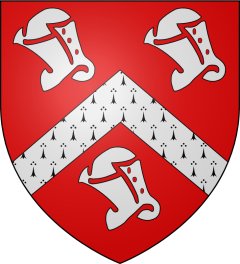
A Welsh courtier with the boldness to bed the queen lost his head this date in 1461 … but his career in usurpation was just getting started.

Owen Tudor’s coat of arms.

The House of Tudor that would come to rule England counted Owen its sire; the four-year-old grandson he left at his death grew up to become the first Tudor monarch, Henry VII.

Owen produced the root of this august line with Dowager Queen Catherine of Valois, the French princess Henry V had extracted as part of the price of peace after Agincourt.

That union was supposed to join the two great realms, but Henry V unexpectedly kicked the bucket in 1422, leaving an infant son who was not only unable to hold the French throne … he was too unstable to hold the English throne, either.

Unless he was a seer, suave Owen must not have been thinking dynasties when he took the Queen as his lover (and eventually his wife via a secret marriage in the early 1430s).

They produced six children, but it wasn’t the bedroom politics that did our prolific father in, at least not directly. Only decades later, when ownership of the crown was up for grabs in the War of the Roses and Owen loyally led Lancastrian forces at a battle he was unwise enough to lose, did he give up his head for the pedestrian crime of backing the wrong horse.

Owen reportedly thought he had stature enough to expect a reprieve until the very last moment, when the executioner’s ripping his collar caused him to sigh,

The head which used to lie in Queen Catherine’s lap, would now lie in the executioner’s basket.

In time, Owen’s descendants would get to pull the same trick, because the doomed cause in whose service Owen Tudor lost his life swept clear England’s political chessboard and made possible his own line’s accession.

Elizabethan poet Michael Drayton later versified Owen’s prodigious conquest in “Owen Tudor to Queen Catherine”.

When first mine eyes beheld your princely name,
And found from whence this friendly letter came;
Is in excess of joy, I bad forgot.
Whether I saw it, or I saw it not:

My panting heart doth bid mine eyes proceed,
My dazzled eyes invite my tongue to read,
Which wanting their direction, dully mist it:
My lips, which should have spoke, were dumb, and kist it,

And left the paper in my trembling hand,
When all my senses did amazed stand :
Even as a mother coming to her child,
Which from her presence hath been long exil’d,

With gentle arms his tender neck doth strain,
Now kissing it, now clipping it again;
And yet excessive joy deludes her so,
As still she doubts, if this be hers, or no.

At length, awaken’d from this pleasing dream,
When passion somewhat left to be extreme,
My longing eyes with their fair object meet,
Where ev’ry letter’s pleasing, each word sweet.

It was not Henry’s conquests, nor his court,
That had the power to win me by report;
Nor was his dreadful terrour-striking name,
The cause that I from Wales to England came:

For Christian Rhodes, and our religion’s truth,
To great achievement first had won my youth:
Th’ brave adventure did my valour prove,
Before I e’er knew what it was to love.

Nor came I hither by some poor event,
But by th’ eternal destinies’ consent;
Whose uncomprised wisdom did foresee,
That you in marriage should be link’d to me.

By our great Merlin was it not foretold,
(Amongst his holy prophesies enroll’d)
When first he did of Tndor’s name divine,
That kings and queens should follow in our line?

And that the helm (the Tudors ancient crest)
Should with the golden flow’r-de-luce be drest ?
As that the leek (our country’s! chief renown!)
Should grow with roses in the English crown –

As Charles his daughter, you the lilly wear;
As Henry’s queen, the blushing rose you bear;
By France’s conquest, and by England’s oath,
You are the true-made dowager of both :

Both in your crown, both in your cheek together,
Join Tether’s love to yours, and yours to Tether.
Then cast no future doubts, nor fear no hate,
When it so long hath been fore-told by fate ;

And by the all-disposing doom of Heav’n,
Before our births, we to one bed were giv’n.
No Pallas here, nor Juno is at all,
When I to Venus yield the golden ball:

Nor when the Grecians wonder I enjoy,
None in revenge to kindle fire in Troy.
And have not strange events divin’d to us,
That in our love we should be prosperous ?

When in your presence I was call’d to dance,
In lofty tricks whilst I myself advance,
And in a turn my footing fail’d by hap,
Was’t not my chance to light into your lap ?

Who would not judge it fortune’s greatest grace,
Sith he must fall, to fall in such a place ?
His birth from Heav’n, your Tudor not derives,
Nor stands on tip-toes in superlatives,

Although the envious English do devise
A thousand jests of our hyperbolies;
Nor do I claim that plot by ancient deeds,
Where Phoebus pasture his fire-breathing steeds:

Nor do I boast my god-made grandsire’s scars,
Nor giants trophies in the Titans wars:
Nor feign my birth (your princely ears to please)
By three nights getting, as was Hercules:

Nor do I forge my long descent to rim
From aged Neptune, or the glorious Sun:
And yet in Wales, with them that famous be,
Our learned bards do sing my pedigree

And boast my birth from great Cadwallader,
From old Caer-Septon, in mount Palador:
And from Eneon’s line, the South-Wales king,
By Theodor, the Tudors’ name do bring.

My royal mother’s princely stock began
From her great grandame, fair Gwenellian,
By true descent from Leolin the great,
As well from North-Wales, as fair Powsland’s seal.

Though for our princely genealogy
I do not stand to make apology:
Yet who with judgment’s true impartial eyes,
Shall look from whence our name at did first rise,

Shall find, that fortune is to us in debt
And why not Tudor, as Plantagenet?

Nor that term Croggen, nick name of disgrace
Us’d as a by-word now in ev’ry place,
Shall blot our blood, or wrong a Welshman’s name,
Which was at first begot with England’s shame.

Our valiant swords our right did still maintain,
Against that cruel, proud, usurping Dane,
Buckling besides in many dang’rous fights,
With Norway, Swethens, and with Muscovites;

And kept our native language now thus long,
And to this day yet never chang’d our tungue:
When they which now our nation fain would tame,
Subdu’d, have lost their country and their name.

Nor ever could the Saxons’ swords provoke
Our British necks to hear their servile yoke:
Where Cambria’s pleasant countries bounded be
With swelling Severn, and the holy Dee:

And since great Brutus first arrived, have stood
The only remnant of the Trojan blood.
To every man is not allotted chance,
To boast with Henry, to have conquer’d France:

Yet if my fortune be thus rais’d by thee,
This may presage a further good to me;
And our Saint David, in the Britons’ right,
May join with George, the sainted English knight:

And old Caer-merdin, Merlin’s famous town,
Not scorn’d by London, though of such renown.

Ah, would to God that hour my hopes attend,
Were with my wish brought to desired end !
Blame me not, madam, though I thus desire,
Many there be, that after you inquire;

Till now your beauty in night’s bosom slept,
What eye durst stir, where awful Henry kept ?
Who durst attempt to sail but near the bay,
Where that all-conqu’ring great, Alcides lay ?

Your beauty now is set a royal prize,
And kings repair to cheapen merchandise.
If you but walk to take the breathing air,
Orithia makes me that I Boreas fear:

If to the fire, Jove once in light’ning came.
And fair Egina makes me fear the flame:
If in the Sun, then sad suspicion dreams
Phoebus should spread Lucothoe in his beams:

If in a fountain you do cool your blood,
Neptune, I fear, which once came in a flood:
If with your maids, I dread Apollo’s rape,
Who cous’ned Chion in an old wife’s shape :

If you do banquet, Bacchus makes me dread,
Who in a grape Erigone did feed :
And if myself your chamber-door should keep,
Yet fear I Hermes coming in a sleep.

Pardon (sweet queen) if I offend in this,
In these delays love most impatient is:
And youth wants pow’r his hot spleen to suppress,
When hope already banquets in excess.

Though Henry’d fame in me you shall not find,
Yet that which better shall content your mind;
But only in the title of a king
Was his advantage, in no other thing:

If in his love more pleasure you did take,
Never let queen trust Briton for my sake.
Yet judge me not from modesty exempt,
That I another Phaeton’s charge attempt;

My mind, that thus your favours dare aspire,
Shows, that ’tis touch’d with a celestial fire:
If I do fault, the more is beauty’s blame,
When she herself is author of the same;

“All men to some one quality incline,”
Only to love is naturally mine.

Thou art by beauty famous, as by birth,
Ordain’d by Heav’n to cheer the drooping Earth :
Add faithful love unto your greater state,
And be alike in all things fortunate.

A king might promise more, I not deny,
But yet (by Heav’n) he lov’d not more than I.
And thus I leave, till time my faith approve,
I cease to write, but never cease to love.

Aficionados of old tyme history novelizations can also kick back with Owen Tudor: An Historical Romance.

On this day..

1924: Alikomiak and Tatimagana, Inuit

On this date in 1924, the Canadian government made an example of two Inuit murderers on the Arctic Sea’s Herschel Island.

Alikomiak.

Alikomiak and Tatimagana (there are many alternate transliterations of each name) had been arrested in 1921 for killing four in a wife-stealing affair, then killed two more while in custody.

Canada, in the midst of a decades-long process of projecting its sovereignty in the Arctic, had let lenient treatment of some Inuit “criminals” in a few notable cases during the preceding years, and there was sentiment that an example of the majesty of the law was in order. “Make these tribes understand that the stern but at the same time just hand of British justice extends also to these northern shores,” the prosecutor implored the jury. (pdf, a great resource on this case)

To say nothing of whites’ sense that Inuits were savages.

Mr. Rasmussen states that 75% of the male population are murderers in fact it is the exception, where a man is a weakling or has something wrong with him, that a man has not at least one killing to his credit. These people are always on the offensive. This is particularly the case among the Netsilik band. While at Pelly Bay he offered a reward to his native Greenland Boy if he could find one man who was not a murderer. These people hold life very cheaply and as Mr. Rasmussen says it is a very easy matter to get killed. An attempt was made on his life at the H.B.C. post at Kent Peninsula. Now that these people know that the Police from Chesterfield Inlet and Kent Peninsula Detachments have arrested and taken out natives for committing murder, they immediately prepare for a fight on observing the approach of a strange sled or outfit. They are prepared to die fighting and have absolutely no fear of death yet they have the greatest fear of being taken away from their own country. Here I would like to say that this latter is the reason Alicomiak gave for killing Cpl. Doak and O. Binder at Tree River and lends truth to Mr. Rasmussen’s statement also judging from the absolute fearlessness with which Alicomiak and Tatamigans met their death here on the scaffold in February last would further corroborate it. In his travels from Pelly Bay through to Ellice River, Rasmussen says that on approaching a native camp of a number of natives, they, on noticing his strange outfit, at once made preparations for a fight thinking he was a policeman and on such occasions the first thing he had to do was to inform them that he was not a policeman, where upon they were most friendly and hospitable and would talk openly of murders they had committed when questioned about it.

That Dr. Knud Rasmussen cited at second-handed in the RCMP brief above was a great chronicler of the Inuit, and would record of this day’s hanging how “heavy and cumbersome machinery was required to get the two murderers sentenced. Judges, jury and witnesses had to be summoned from long distances.” The legal personnel were sent especially for this trial, along with the timber to build a gallows. You could say the verdict was foreordained.

Rasmussen’s work on the Inuit was recently put to celluloid by the director of Atanarjuat: The Fast Runner … another dimension, like the hanging this date, in the complex collision of cultures.

There was only one more hanging in the Yukon before Canada abolished the death penalty, though Canada was hardly finished using Inuit as instruments of its northern policy.

On this day..

1955: Moshe Marzouk and Shmuel Azar

On this date in 1955, two Egyptian Jews enrolled by Israeli intelligence as saboteurs were hanged in Cairo.

Marzouk (left) and Azar, from this page.

The strange and disturbing “Lavon affair” — or “Esek habish,” the “shameful affair” — has never had a completely satisfying explanation.

It broke in 1954, when Egypt arrested a ring comprised of Egyptian Jews who had bombed locations in Alexandria and Cairo, including an American diplomatic post, in an apparent false flag operation meant to be attributed to the radical Muslim Brotherhood. (The apparent operation had a recent precedent.)

The germ and the goal of this project have been fodder for speculation ever since; the most commonly accepted theory is that it was intended to trigger western intervention or pressure on Egypt that would prevent Nasser from nationalizing the Suez Canal.

Initially blamed on the Defense Minister Pinhas Lavon, unrelated court testimony in 1960 would reveal that he was a fall guy.

But in any guise, the hangings this day in Cairo prompted national mourning in Israel and an immediate political shakeup whose dimensions might as well have sprung from this morning’s paper:

The dovish government of Moshe Sharett fell; hawkish founding Prime Minister David Ben-Gurion was recalled from retirement in a Negev kibbutz; and Israel launched a reprisal raid at Gaza. Little more than two years later, Israel and Egypt would contest control of the Suez on the battlefield.

On this day..