1645: William Laud, given to the devil

On this date in 1645, Archbishop William Laud was beheaded on Tower Hill for treason.


Portrait of William Laud by Anthony Van Dyck. For this image’s subsequent life in popular circulation (and its contribution to its subject’s beheading) see Mercurius Politicus.

This diminutive “martinet” made himself odious to the rising Puritan party through his rigorous (some would say narrow-minded) enforcement of so-called “High Church” dogma and decor. It was a time when believers were prepared to rend the fabric of the church over a literal fabric, the surplice worn by the clergy — among other innumerable points of doctrinal rectitude.

Laud’s run as Archbishop of Canterbury also happened to coincide with Charles I‘s 11-year personal rule, sans parliament. The overweening divine’s influence on secular as well as religious policy would do his sovereign no favors in the public mind.

Roughly enforcing an unpopular minority position, Laud got the woodblock blogosphere in a tizzy with heavy-handed stunts like having dissenters’ ears cut off.

That’s the sort of thing that’ll give a guy an image problem. The king’s fool, Archibald Armstrong, is supposed to have tweaked our high and mighty subject (and warned the king against his influence*) with the punny aphorism,

Give great praise to the Lord, and little laud to the devil.

Funny because it’s true.

So when Charles ran out of money and finally had to call parliament in 1640, that august representative of the nation had some business with Laud. Ironically — since the prelate was always sensitive about his height — it would involve shortening him.

Laud was impeached as early as December 1640 and soon tossed in the Tower, where his neck awaited the unfolding radicalization of the pent-up Puritans and the onset of armed hostilities in their contest with the obdurate king. (While his hands blessed the allies who preceded him to the block.)


Wenceslas Hollar’s etching of William Laud’s trial.

For more about Laud’s life and work, check out the detailed Britannica entry or this Google books freebie.

* If a warning, it apparently was not heard. This 19th-century publication of Armstrong’s jests cites a 1637 royal order to the effect that

the King’s Fool, for certain scandalous words of a high nature, spoken by him against the Lord Arch-Bishop of Canterbury his Grace … shall have his coat pulled over his head, and be discharged of the King’s service, and banished the Court.

On this day..

1953: Marguerite Pitre, the last woman hanged in Canada

Thirty-five minutes past midnight this date in 1953, the 13th and last woman executed in Canada, Marguerite Pitre, was hanged in Montreal’s Bourdeaux gaol.

Pitre was condemned an accomplice to Albert Guay in the latter’s 1949 airline bombing, which killed 23 people just to get rid of Mrs. Guay.

The “dark and buxom go-between in Guay’s affair”* with a teenage waitress had rented Guay a room to install the nymphet when the girl’s father got wise to the frolicking and kicked her out of the house.

Pitre actually testified against Albert Guay in his trial, describing how she bought dynamite at his instruction and delivered a “mystery parcel” to the air freight on the doomed plane.

In fact, she helped blow open the case at the outset by attempting suicide 10 days after the crime and blabbing in the hospital how Albert had made her do it. Pitre insisted, though, that her own involvement was unintentional, and that she thought the box held a statue even though it was her own brother who had fashioned the explosives into a time bomb.

But after Guay’s conviction, both Pitre and her brother were arrested and separately tried for the plot themselves — both of them to follow Guay to the gallows for the audacious crime.

* Chicago Tribune, Jan. 9, 1953.

On this day..

1603: Not Tommaso Campanella

The wise were forced to live as the mad were accustomed, in order to shun death, such that the greatest lunatic now possesses the royal burdens. The wise now lived alone with their wisdom, behind closed doors, applauding only in public the others’ mad and twisted caprices.

-Tommaso Campanella

On this date in 1603, freaky-deaky Dominican philosopher Tommaso Campanella drew a life sentence — avoiding execution by dint of a painfully convincing performance of insanity.

Campanella had some problematically heterodox notions about the sun (namely, that it was going to consume the earth) and everything under it, and had had a recent scrape with the Inquisition.

What really got him in trouble was trucking with a Calabrian conspiracy to overthrow Spanish domination, apparently a product of the monk’s millenarian anticipation of a sort of proto-communist revolution.

Campanella was a strange guy, but this was quite a far-out plot.

As Joan Kelly-Gadol writes in this fine tome,

This took place, let it be noted, after he had written two works advocating a Papal monarchy for Italy and the world and two works promoting the interests of the Spanish Empire also in Italy and throughout the world.

Past performance is no guarantee of future returns. Once the conspiracy was betrayed,

Campanella was imprisoned … in the Castel Nuovo, one of the principal fortresses in which the Spaniards maintained a military garrison. He was arraigned before the civil tribunal for rebellion and before the ecclesiastical tribunal for heresy. His “examination” which began in January 1600 was gruesome. He claimed innocence in his first interrogation before the civil tribunal, was thrown into a dungeon, actually a cleft in the bedrock of the Castle, to remain there for seven days. Then followed torture. He “confessed,” admitting that he preached about the coming political upheaval but denying that he was part of a conspiracy to bring it about …

His desperation at this point can be gauged by the fact that by April of 1600 he began to feign madness. The ecclesiastical action against him began now, and he persisted in this attitude of insanity through three interrogations, including an hour of torture … On the fourth and fifth of June 1601, he was subjected to the cruel torture of “the vigil” to test whether his insanity was genuine. This was the usual torture of the rope, suspending the body of the victim by his tied hands over a blade which cut into his flesh whenever he yielded to the strain of holding himself in the air; but the vigil refined this cruelty by continuing it for forty hours. Campanella endured the ordeal without breaking.

And it wasn’t just a feat of toughness to beat the torturer at his own game, impressive as it is on those terms alone: Campanella pulled off a genius gambit exploiting the Inquisition’s own legal machinery to duck the separate capital charges he faced in civil and ecclesiastical court.

Joseph Scalzo’s “Campanella, Foucault, and Madness in Late-Sixteenth Century Italy”,* an academic paper that reads like a thriller, narrates Campanella’s “dangerous competition” with his persecutors.

In fine: on Easter Sunday 1600,** as he was approaching conviction and condemnation in his state trial for treason, Campanella began his insanity ploy, successfully forcing a delay in that case and initiating his separate church trial for heresy.

Then, by remaining stubbornly committed to what most of his examiners believed was a charade, Campanella won … by forcing them to inflict that juridically determinative 40-hour “vigil” torture.

the jurisprudence of the time accorded torture so much force, such as to annul all other proofs and “to purge circumstantial evidence”; if the torture had been vigorous and unusual. The accused came, all the more to avail himself of the result obtained, according to the scholarship of the criminologists most in vogue. Thus, Campanella had judicially to be regarded as insane, although everyone was persuaded that he probably simulated insanity. The consequence, in the tribunal of the Holy Office, was not indifferent: He was a “relapsed heretic,” and even if repentant, he would have been disgraced and consigned to the secular court of justice, which would have executed him; being mad, he could no longer suffer condemnation, and in the circumstance in which he might already have been condemned, he would have been spared the death penalty, to reason and repent.

(this is Scalzo’s quotation of Luigi Amabile, an Italian who wrote the book on Campanella; I have been unable to find the Amabile original online.)

Home free.

Having reached this judicial safe haven, Campanella soon — in fact, according to the man who tortured him, literally on the walk from the vigil back to his cell — resumed a recognizable rationality.

He’d languish in prison until 1626 (a few years after he got out, he had to flee to France), but he made the most of it. Campanella wrote his magnum opus, the utopian City of the Sun, while awaiting his sentence in 1602. A number of other works on a wide array of subjects — science, philosophy, theology, political governance (he returned to giving the Spanish empire supportive advice), a vigorous defense of Galileo — were also composed during his 27 years under lock and key.

Campanella’s visionary anticipation of radical egalitarianism would, like Thomas More‘s, help shape the utopian literary genre. But Campanella’s take, while still a theocratic one, lent itself to distinctly more subversive interpretation.†

For example, this Brezhnev-era Soviet essay‡ (unearthed and translated by Executed Today friend and sometime guest-blogger Sonechka) decants the Dominican’s heretical notions into Marxist orthodoxy.

How many times were the communists denounced by their enemies for this “commonality of wives”! Scientific communism, certainly, is not responsible for the figments of a monk like Campanella. But it is instructive to penetrate his logic. It is not commodification or dehumanization that hides behind Campanella’s “commonality of wives”. The women of the “City of Sun” have the same rights as men … The “commonality of women” is equivalent to the “commonality of men” on the basis of mutual equality. That is why, though [we are] decisively rejecting this type of family-free communism, it is necessary to consider who stands on the higher moral grounds — Campanella’s woman, alien to deceit and pretense, or a false bourgeois woman, whose lot in life is adultery and legalized prostitution.

Ultimately, this wild man not only got the high moral ground: he got to die in bed. Once in a while, we get a happy(ish) ending.

So although it actually has nothing to do with Tommaso, “La Campanella”“Little Bell”, a Paganini violin concerto — allows us here at this blog (in common with our day’s hero) an atypically soothing* denouement.

* Joseph Scalzo, “Campanella, Foucault, and Madness in Late-Sixteenth Century Italy”, The Sixteenth Century Journal, Vol. 21, No. 3 (Autumn, 1990)

** Campanella’s Easter 1600 madness was initiated only a few weeks after fellow intellectual omnivore Giordano Bruno was burned for heresy up the road in Rome. Strictly coincidence.

† Since so much of Campanella’s work was produced while the author was under duress — fighting capital charges, applying for clemency and release — it remains disputable just which parts of it can be taken to represent his real beliefs.

‡ L. Vorob’ev. “Utopija i dejstvitelnost”. (“Utopia and Reality”) in Utopicheskij roman XVI-XVII vekov (Utopian Novel of XVI-XVII century); Series “Biblioteka vsemirnoj literatury”, Khudozhestevnnaja literature, Moscow, 1971, p. 19.

On this day..

2009: Haidar Ghanem, human rights activist

On this date last year, in the midst of Israel’s bloody incursion, Gaza’s Hamas government executed Palestinian journalist and human rights activist Haidar Ghanem as an Israeli spy.

Ghanem was the best-publicized of a number of Israeli collaborators to suffer that fate during the one-sided, three-week war.

“He was taken to an abandoned building in southern Gaza and shot to death,” a Palestinian source said. “Others were executed the same way.”

The Rafah resident had actually been a minor cause celebre back in 2002, when the Palestinian Authority condemned him to death for pinpointing Fatah activists for assassination by Israeli security, for which assignment he was supposedly recruited in the 1990’s while working as a field researcher for the Israeli human rights organization B’Tselem. International pressure got him released.

The Jerusalem Post reported that Ghanem confessed (as he had in the 2002 case) to the charges.

On this day..

1794: Maurice Joseph Louis Gigost d’Elbee, Vendean general

On this date in 1794, one of the great royalist generals of the Vendee revolt was shot by the French Revolution’s Republican forces at Nourmoutier.

The 1793 counterrevolutionary uprising in the Vendee had roused retired cavalryman Maurice Joseph Louis Gigost d’Elbee (English Wikipedia link | French), and he became the second commander of the Royal and Catholic Army upon the death of Jacques Cathelineau.

Unfortunately for d’Elbee, even with English support, the balance of force rather tipped in favor of Paris, and the Revolutionary government was obviously not shy about sealing its victories in blood.

D’Elbee suffered a grievous wound at the Battle of Cholet in October 1793, and for a couple of months was spirited one step ahead of the advancing Republicans.

As Charles MacFarlane writes in The French Revolution, Vol. 3, he ran out of room to run at the island of Noirmoutier.

D’Elbee was lying in bed between life and death; his wife might have escaped, but would not leave him: they were both taken. As Turreau’s soldiers entered their chamber the wounded royalist exclaimed, “Yes, here I am! Here is d’Elbee, your greatest enemy! If I had been strong enough to fight or stand upon my feet, you would not have taken me in my bed!” They kept him for five days, treating him with execrable barbarity, and then carried him in an arm-chair to the place appointed for fusilading the prisoners, and there shot him. His wife was fusiladed the next day, and her brother and brother-in-law perished in the same manner.


Mort du General d’Elbee, by Julien Le Blant, depicts the general shot with three other royalist officers. Not pictured: Hundreds of other Vendean prisoners massacred in the aftermath of the Battle of Savenay.

On this day..

1993: Westley Allan Dodd, child molester

Just after midnight this date in 1993, Washington state carried out the first legal hanging in the U.S. since 1965.

Pornstached child molester Westley Allan Dodd is the textbook “incorrigible sex offender” case study. That’s certainly how Dodd himself asked us to interpret him.

“I have said all along the system does not work,” he wrote of his long career in pedophilia, notoriously unrehabilitated by the criminal justice system. “I knew what I was doing, I knew it was wrong. I knew I could get the death penalty if caught.”

From the usual humble beginnings in teenage child-groping, and despite several arrests over the years, Dodd devolved into abducting young boys to actualize horrific fantasies he did not scruple to jot in his journal.

Incident 3 will die maybe this way: He’ll be tied down as Lee was in Incident 2. Instead of placing a bag over his head as had previously planned, I’ll tape his mouth shut with duct tape. Then, when ready, I’ll use a clothespin or something to plug his nose. That way I can sit back, take pictures and watch him die instead of concentrating on my hands or the rope tight around his neck — that would also eliminate the rope burns on the neck . . . I can clearly see his face and eyes now…

He suspects nothing now. Will probably wait until morning to kill him. That way his body will be fairly fresh for experiments after work. I’ll suffocate him in his sleep when I wake up for work (if I sleep).

In short: not the nicest guy, though also a monster as much pathetic as diabolic.

Dodd pleaded guilty to his three sex murders, and fought for his own execution. The state of Washington obliged him in a speedy three years.

Although the Evergreen State had lethal injection on the books, Dodd also availed his right to select its holdover alternative method, hanging.

Those kids didn’t get a nice, neat painless easy death. Why should I?

Which justification’s nobility (such as it is) is considerably more socially gratifying than, say, a hankering for the gallows’ post-mortem priapism.

(He didn’t get everything, though: they turned down his request to televise the hanging.)

Not content with his headline-grabbing mode of departing the world, Dodd had a hand in a statutory milestone, too. His stranger-danger nightmare case surfacing in the fall of 1989 was part of the background that drove Washington to pass the nation’s first sexually violent predator law, the Community Protection Act of 1990.*

Trutv.com’s Crime Library has a good deal more about the mind of this particular maniac.

* It was really Earl Shriner’s crimes more than Dodd’s that led most directly to the new law, which licensed indefinite “civil commitment” of sexually violent predators after the completion of their criminal sentences.

On this day..

1943: Jerzy Iwanow (Georgios Ivanof)

On this date in 1943, Polish-born Greek resistance hero Jerzy Iwanow-Szajnowicz was shot (or shot attempting to escape the Kaisariani execution ground, which amounts to pretty much the same thing) for a dramatic career fighting the occupation of Greece.

Iwanow (Polish) — or Georgios Ivanof — was the son of a Russian officer, but his parents divorced in his childhood, and mom married a Greek.

Jerzy was on his way to a cosmopolitan upbringing, mastering half a dozen languages and apparently just as many sports.

His athletic and linguistic prowess would both come in handy for derring-do missions (more Polish) in the Greek waters that saw him sink a German submarine and a destroyer with magnetic bombs. He even escaped the first two times he was captured.

Third time was a charm for the Nazis.

Sounds like celluloid material. As a matter of fact, a 1972 Polish film valorized Iwanow as Agent Nr. 1.

You can see the full movie on Veoh, if you’re prepared to install their viewing software.

On this day..

1645: John Hotham the Elder

On this date in 1645 — one day after the same fate befell his son — Sir John Hotham was beheaded by the English Parliamentarians for attempting to betray Hull to the Cavaliers in the English Civil War.

Part of the Daily Double: John Hothams.

On this day..

1645: John Hotham the Younger

On this date in 1645, John Hotham the Younger — former M.P., and (too) briefly an adherent of Parliament in the English Civil War, was beheaded as a traitor.

Part of the Daily Double: John Hothams.

On this day..

104 B.C.E.: Jugurtha

(Thanks to Daily Kos diarist “emperorhadrian” for licensing this guest post, originally published on that site June 24, 2007. -ed.)

The Jugurthine War was a key war in the final century of the Roman Republic.

Like the Americans in Iraq, Rome assumed that their war against Jugurtha, King of Numidia (a nation in north Africa), would be a cakewalk. They believed that Numidia was a nation of savages with a bizarre religion. They assumed that their own “shock and awe” attacks by the superior legions would decapitate and destroy the “evil doer” Jugurtha. They believed that in order to liberate the Numidians of their primitive ways, they had to impose the civilized will of the Roman state on this backward nation. Rome never expected that the Numidians would wage an insurgent war against their Roman occupiers. This war ended up dragging on for almost a decade. And in the end, it showed the depravity of the ruling party (the ultra-conservative republican Optimate party), which was sending the Roman Republic on its way to tyranny, empire and ruin.

In 148 BC, the King of Numidia, Masinissa, died. The Roman proconsul, Publius Cornelius Scipio Aemilianus, had been given authority by Masinissa to divide Masinissa’s estate. He divided it between Masinissa’s three sons, Micipsa, Gulussa, and Mastarnable. Soon after, Gulussa and Mastarnable died, leaving Micipsa as the sole King of Numidia. Around the year 134 BC, Micipsa sent Jugurtha (who was Masinissa’s grandson, but the son of another Numidian) to Spain with Scipio Aemilianius. Scipio was fighting the Celtiberians, who lived in a part of what is now Spain. Jugurtha was able to raise an army to help Scipio. Because of the valor of Jugurtha and his army at the Siege of Numantia, Scipio was able to win his war against the Celtiberians.

While fighting for Rome, Jugurtha worked alongside his future enemy, Gaius Marius. Jugurtha not only learned the superior Roman style of fighting, but he also learned of Rome’s weakness for money and thus bribery. Jugurtha described Rome as “urbem venalem et mature perituram, si emptorem invenerit” (“a city for sale and doomed to quick destruction, if it should ever find a buyer”). When Jugurtha returned to Numidia, Micipsa adopted Jugurtha, and decided to include Jugurtha in his will.

After the fall of Numantia, Jugurtha returned home with a letter from Scipio addressed to his uncle; in it, the commander praised Jugurtha’s exploits and congratulated Micipsa for having “a kinsman worthy of yourself, and of his grandfather Masinissa” (Sallust Iug. 9). On this recommendation the king formally adopted Jugurtha and made him co-heir with his own children

In 118, Micipsa died. He left his kingdom to Jugurtha and his two natural sons, Hiempsal and Adherbal. Shortly after Micipsa’s death, Jugurtha had Hiempsal killed. Adherbal fled to Rome. The Roman Senate sent a commission to Numidia to make peace. Jugurtha bribed the Romans on the commission, and thus the commission gave the better regions of the kingdom to Jugurtha.

In 113 BC, Jugurtha took his army and cornered Adherbal in his capital city of Citra. According to Sallust, Adherbal had the support of the people, but Jugurtha had the support of the best soldiers. A Roman Commission was sent to Numidia to forge a new peace. Jugurtha then bribed the Romans on this commission. The Romans thus allowed Jugurtha to storm Citra, and slaughter Adherbal and his supporters. Because Jugurtha slaughtered a number of Italian business people (including Roman Equites, or “Knights“), the Roman senate declared war on Jugurtha.

The Roman Senate sent an army under the command of the consul Lucius Calpurnius Bestia to fight Jugurtha. Bestia decisively defeated Jugurtha. But Jugurtha bribed Bestia, and thus was given unusually favorable terms. The Roman Senate viewed the favorable terms with suspicion, so it summoned Jugurtha to Rome. When Jugurtha arrived in Rome, he bribed two Tribunes, who thus prevented him from testifying. While in Rome, Jugurtha attempted to have his cousin and rival Massiva assassinated. Because of this, he was expelled from the city and returned to Numidia.

In 110 BC, the Roman Senate sent the praetor Aulus Postumus Albinus (who was the cousin of a consul for that year) to defeat Jugurtha. Because Jugurtha bribed key Romans involved in Albinus’ army (who then betrayed Albinus), Albinus was defeated.

The Roman Senate then sent the consul Quintus Caecilius Metellus to fight Jugurtha. At the Battle of the Muthul, a young Roman officer named Gaius Marius helped to reorganize Metellus’ legions, which then defeated Jugurtha. But Jugurtha was defeated because he forced his army to retreat before it could suffer heavy losses. The Romans did suffer their own heavy losses. Jugurtha disbanded his army, and had his soliders mount an insurgency to fight the Roman occupiers.

Marius returned to Rome. Dissatisfied with the slow pace of the war under Metellus, the Roman Military Assembly (one of the two Roman legislative assemblies, similar to the US Senate) appointed Marius consul (the Military Assembly, not the senate, appointed consuls). The Roman consuls had similar powers as the US President. The consulship was the highest constitutional office, and the consuls had imperium powers, which allowed them to command armies and conduct wars. The senate didn’t want Marius to be consul, because at this time it was dominated by an ultra-conservative republican party of aristocratic elites known as the Optimates. Marius belonged to the party that opposed the Optimates, the Populares. Partly because the senate didn’t like Marius, and partly because of the increasing difficulty Rome was having in recruiting armies, Marius was forced to raise his own army.

The capture of Jugurtha, from this French history of the Jugurthine War.

Marius took his army to Numidia to fight Jugurtha. But while Marius had been raising his army, Jugurtha allied with his father-in-law, Bocchus, the King of Mauretania. Marius defeated Jugurtha and Bocchus in several key battles. But much like with the American occupation in Iraq, Jugurtha’s strategy of insurgency warfare against the occupiers rendered all conventional victories irrelevant. Marius was playing a game of whack-a-mole. No matter how many times the Numidians were defeated, Jugurtha’s insurgents would regroup and keep fighting. It became clear that because of this, Rome could not defeat Jugurtha.

Marius sent his young Quaestor, Lucius Cornelius Sulla, to Bocchus. Sulla bribed Bocchus, and told him that Bocchus would be given a part of Numidia if he would betray Jugurtha. Bocchus then decided to give Jugurtha to Sulla. Sulla took Jugurtha to Rome, where Jugurtha was strangled in the Tullianum in Rome after marching in Marius’ January 1, 104 B.C. Triumph.


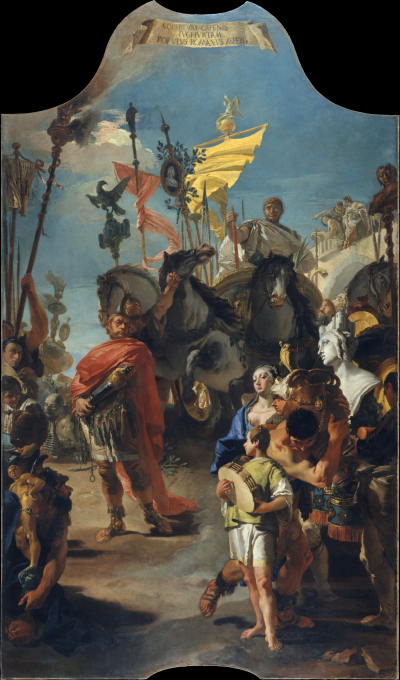
The Triumph of Marius (1729) by Giovanni Battista Tiepolo. The inscription in Latin reads “The Roman people behold Jugurtha laden with chains”.

The Jugurthine War was over. But in the process, several problems were exposed that would cause Rome serious pain in the future. Republicans in this country love to tell us that money in politics is harmless free speech. But as we saw in the Roman Republic during the Jugurthine War, money can be very corrupting. Rome almost lost the war because of money in politics, and the susceptibility of public officials to bribery.

In addition, this war saw the rise of two Romans who would play a key role in the events that directly preceded the fall of the Roman Republic. The first Roman made famous through this war was Gaius Marius. Gaius Marius would later hold the Roman Consulship an unconstitutional 7 times in 21 years (constitutionally, a Roman had to wait 10 years before being reelected consul).

The second Roman made famous through this war was Lucius Cornelius Sulla. Sulla and Marius would fight an unconstitutional civil war with each other several years after this war had ended. Sulla would illegally march his troops on Rome, and unconstitutionally legalize the mass killing of Marius’ supporters. Marius’ supporters in the senate would unconstitutionally prevent Sulla from fighting a war during one of Sulla’s consulships. Sulla would eventually seize absolute power for himself. Sulla would be the first Roman to be Dictator in almost 150 years. He would also be the first Roman in history to hold the dictatorship without the traditional six month term limit.

As dictator, Sulla would illegally change the Roman constitution to make himself and his party (the ultra-conservative republican Optimates) even more powerful. And most importantly, Sulla would set the example (of civil war on Romans, and then the seizing of absolute power) that the future tyrant Gaius Julius Caesar would follow.

In the end, the actions taken by key players in the war against Jugurtha would be repeated in the final destruction of the Roman Republic. The future triumvir Pompey would unconstitutionally hold multiple consulships in a short period of time. Crassus, another future triumvir, would illegally bribe politicians to get his way. And the future tyrant Julius Caesar would bribe, unconstitutionally hold the consulship, and become dictator for life (as Sulla had done). It was Caesar’s actions in this regard, as well as the similar actions of his adopted son and heir, Gaius Octavius (later Gaius Julius Caesar Octavianus, the Emperor Augustus) that would once and for all destroy the Roman Republic, and create the Roman Empire.

1. When when, and whenever death closes our eyelids,
2. Moving naked over Acheron
3. Upon the one raft, victor and conquered together,
4. Marius and Jugurtha together,
5. one tangle of shadows.

6. Caesar plots against India,
7. Tigris and Euphrates shall, from now on, flow at his bidding,
8. Tibet shall be full of Roman policemen,
9. And the Parthians shall get used to our statuary
10. and acquire a Roman religion;

11. One raft on the veiled flood of Acheron,
12. Marius and Jagurtha together.
13. Nor at my funeral either will there be any long trail,
14. bearing ancestral lares and images;
15. No trumpets filled with my emptiness,
16. Nor shall it be on an Atalic bed;
17. The perfumed cloths shall be absent.
18. A small plebeian procession.
19. Enough, enough and in plenty
20. There will be three books at my obsequies
21. Which I take, my not unworthy gift, to Persephone.

From Homage to Sextus Propertius, Canto VI by Ezra Pound

On this day..