1924: Daisuke Namba, for the Toranomon Incident

On this date in 1924, just two days after his sentencing, Japanese student Namba Daisuke was hanged for attempting to assassinate the the future emperor Hirohito.

Namba (or Nanba) was a 24-year-old Communist and son of a Japanese parliamentarian.* Inflamed by reports of Japanese atrocities in Korea and by the execution years earlier of leftist agitator Shusui Kotoku, Namba fired a pistol at the 22-year-old Prince Regent in a Tokyo intersection.**

It was a pretty simple case: no doubt he’d done it, and no sympathy for the assailant. The act shook Japan so deeply that Namba’s prosecutors stuck to the story that the offender must be deranged — even though he clearly was not. Under the circumstances, that wouldn’t cut enough ice to mitigate the sentence anyway.

In the words of the judge who sentenced him:

Daisuke has made a blot upon Japanese history. He believed in violence and had determined to kill the Prince Regent. He committed a great crime in attempting to injure the imperial family, which has never oppressed the poor.

To which Daisuke had a direct reply:

Long live the Communist Party of Japan!

As is often the case, the gesture of violence against the established order provoked a still more repressive crackdown. The Prime Minister resigned for the security lapse, to be replaced a more conservative government that pushed through the radical-hunting measures of the Peace Preservation Law.

And the award goes to …

Simple enough as far as the assassin goes.

Let’s take a sideways turn into a digression from the blog’s macabre daily fare to ponder a strangely pleasant ripple effect of this young man’s shot.

According to Ben-Ami Shillony’s Politics and Culture in Wartime Japan, the incident forced the resignation of a senior police official charged with keeping an eye on subversives.

You’re welcome, Ichiro. (The Major League superstar won the Matsutaro Shoriki Award twice during his Japanese professional career, in 1994 and 1995.)

This gentleman, Matsutaro Shoriki, transitioned into a career as a media mogul, building up one of the country’s most prominent papers. In that capacity, he took to promoting baseball in Japan.

Though this imported sport had an existing — and growing — popularity from the first decades of the century, Shoriki became the father of Japanese baseball by sponsoring American all-star teams to play on Japanese tours and creating the country’s first professional baseball team.

Shoriki even survived an assassination attempt of his own, at the hands of a nationalist who thought bringing Babe Ruth to the Land of the Rising Sun was treasonable.

Today, he’s remembered generously and his name adorns one of Japanese baseball’s major awards. But if not for Daisuke Namba’s shot, he might have served those years moving paper in the tokko, trying to ferret out dangerous elements.

* The father had to resign his seat in the Diet, of course; not only his immediate family but his former schoolmasters and his whole hometown were put under the pall. According to Time, Namba’s relatives were formally released from their debt of shame by Hirohito in 1926, and took the unblemished name Kurokawa.

** Hirohito did not become Emperor until his father’s death in 1926.

On this day..

1817: Policarpa Salavarrieta, Colombian independence heroine

This morning in 1817, a Colombian seamstress was shot in Bogota for spying on the Spanish forces fighting to quell South America’s Bolivarian independence movements.

Policarpa Salavarrieta — it was the name her brother used for her; her legal given name and origin are romantically lost — was infiltrated into Bogota during the reconquista, when a Spain recovering from Napoleon’s intrusion deployed in force to quash the separatist aspirations of its New World colonies.

It was the day of Simon Bolivar, but Spain had completed its apparent pacification of New Granada* in 1816, and established a stronghold in Bogota. Subversives had to mind their P’s and Q’s.

Although she was a known agitator in the city of Guadas, “La Pola” could slip into Bogota without drawing attention.

There, she used her skills as a domestic to hang around royalist households, sewing up clothes while snooping around, and helping revolutionaries recruit soldiers.

She was arrested when the Spanish busted the network, (the link is in Spanish) and shot publicly with her lover, Alejo Sabarain, and a number** of others — all men, none of them half so well-remembered or beloved as Salavarrieta. She was supposed to have ignored the priests murmuring te deums in her ear on the scaffold in order to exhort the onlookers to resistance.

Over the years to come, she would become an emblematic martyr of independence; just see how many times her theme is visited in this history of Colombian painting (Spanish again). She’s also the only historical (not mythological/allegorical) woman ever used on Colombian currency.

As will be readily surmised, of course, she merits her tribute because the movement in whose service she died soon rallied and carried the day.

* The Spanish territory of New Granada encompassed most of the ice cream of the South American cone.

** Various numbers are given for the day’s total execution count. This site (Spanish) says a total of nine — Policarpa Salavarrieta and eight men, including Alejo Sabarain — and persuasively names all of them.

On this day..

1849: Frederick and Marie Manning, a Dickensian scene

On this date in 1849, husband-and-wife murderers Frederick and Marie Manning (or Maria Manning) were publicly hanged together outside Horsemonger Lane Gaol in London.

An image of Marie Manning (nee Marie de Roux) from the Victorian popular press — from this romantic biography of Tolstoyan length available free from Google books.

The felonious pair — she a Swiss-born domestic; he a shifty laborer with a penchant for the inside job — lured to dinner in their Bermondsey home a wealthy friend who had designs on the redheaded knockout, then murdered him for his loot and stuffed the limed body under the floorboards. They were apprehended separately on the lam.

As is typical when a heartthrob femme fatale stands in the dock, a sensational trial of the “here today, gone tomorrow” variety ensued. The crime, nicknamed “the Bermondsey Horror” (here (pdf) is a book chapter-scale recounting), had each accusing the other, with the outcome usual for this site.

A massive, jeering throng turned out to see the two off (Mrs. Manning’s choice of black satin for the occasion is said to have caused the look to go out of fashion).

Among that crowd was Charles Dickens,* who took a break from working on David Copperfield to write The Times a letter published Nov. 14 demanding that executions be removed within prison walls on account of the unedifying conduct of the spectators.

Sir — I was a witness of the execution at Horsemonger-lane this morning. I went there with the intention of observing the crowd gathered to behold it, and I had excellent opportunities of doing so, at intervals all through the night, and continuously from daybreak until after the spectacle was over.

I believe that a sight so inconceivably awful as the wickedness and levity of the immense crowd collected at that execution this morning could be imagined by no man, and could be presented in no heathen land under the sun. The horrors of the gibbet and of the crime which brought the wretched murderers to it, faded in my mind before the atrocious bearing, looks and language, of the assembled spectators. When I came upon the scene at midnight, the shrillness of the cries and howls that were raised from time to time, denoting that they came from a concourse of boys and girls already assembled in the best places, made my blood run cold. As the night went on, screeching, and laughing, and yelling in strong chorus of parodies on Negro melodies, with substitutions of “Mrs. Manning” for “Susannah,” and the like, were added to these. When the day dawned, thieves, low prostitutes, ruffians and vagabonds of every kind, flocked on to the ground, with every variety of offensive and foul behaviour. Fightings, faintings, whistlings, imitations of Punch, brutal jokes, tumultuous demonstrations of indecent delight when swooning women were dragged out of the crowd by the police with their dresses disordered, gave a new zest to the general entertainment. When the sun rose brightly — as it did — it gilded thousands upon thousands of upturned faces, so inexpressibly odious in their brutal mirth or callousness, that a man had cause to feel ashamed of the shape he wore, and to shrink from himself, as fashioned in the image of the Devil. When the two miserable creatures who attracted all this ghastly sight about them were turned quivering into the air, there was no more emotion, no more pity, no more thought that two immortal souls had gone to judgment, no more restraint in any of the previous obscenities, than if the name of Christ had never been heard in this world, and there were no belief among men but that they perished like the beasts.

… I am solemnly convinced that nothing that ingenuity could devise to be done in this city, in the same compass of time, could work such ruin as one public execution, and I stand astounded and appalled by the wickedness it exhibits. I do not believe that any community can prosper where such a scene of horror and demoralization as was enacted this morning outside Horsemonger-lane Gaol is presented at the very doors of good citizens, and is passed by, unknown or forgotten.

Dickens would base a French maid named Mademoiselle Hortense in his next novel, Bleak House on Marie Manning.

This question of public as opposed to private hangings was a lively debate at the time, and Dickens’s view was hardly uncontested. A letter in response from one F.B. Head of Oxenton countered thus:

The merciful object of every punishment which the law inflicts is not so much to revenge the past crime as to prevent its recurrence. Now, Mrs. Manning’s last moments clearly explain, or rather indisputably prove, the benefit which society practically derives from a public execution. … as for a few fleeting moments she stood, with bandaged eyes, beneath the gibbet, how unanswerably did the picture mutely expound the terror which the wicked very naturally have of being publicly hanged before the scum and refuse of society! “The whistlings — the imitations of Punch — the brutal jokes and indecent delight of the thieves, low prostitutes, ruffians and vagabonds,” so graphically described by Mr. Charles Dickens were — by her own showing — not only the most fearful portion of her sentence but, under Providence, these coarse ingredients may possibly have effected that momentary repentance which the mild but fervent exhortations of the chaplain had failed to produce.

But, besides the impolicy of divesting the death by law of a murderer of the most effective portion of its terrors, there are, Sir, I submit, higher and infinitely more important reasons, which make it our bounden duty to require that every criminal who suffers death should be executed in public.

So long as it shall be deemed advisable by us, by laws divine as well as human, to deprive the murderer of his life, the whole process of his trial, ending in an act of such awful responsiblity, ought to be performed in open day, in order that the community may at all events clearly see what it is they are doing — what it is they have done. The purple hands of the wretched sufferer sufficiently explain what the white nightcap hypocritically conceals, namely, the dreadful act that has been performed; and, although thieves and prostitutes may ridicule the convulsions they witness, there will, it is to be hoped, in a free country and with a free press, always be found among an English crowd some one fellow-creature possessing the kindly feelings of Mr. Charles Dickens, who, should he see sufficient reasons for doing so, will not only call upon the country most seriously to consider whether the punishment he delineates has not exceeded the offence, but, as an honest witness, will condemn and expose any unnecessary harshness or cruelty that may have accompanied it.”

Even the legendary British humor magazine Punch weighed in, with a famous cartoon skewering the mob who turned up for public hangings.**


“The Great Moral Lesson at Horsemonger Lane Gaol”, Punch magazine’s rendition of the Mannings’ execution — turning its gaze not on the scaffold but on the unruly crowd beneath it. It comes with a poem.

Public executions would continue in England until 1868.

* Not the only literary big wheel in the crowd: Herman Melville also checked it out. No indication they bumped into each other, and no surprise: the crowd was so huge that at least one spectator was crushed to death against a police barricade. (As reported by Hanging in the Balance: A History of the Abolition of Capital Punishment in Britain, which numbers the onlookers at 30,000 and claims 2.5 million execution broadsheets were sold.)

** According to Dickens and Crime, Dickens actually observed the hanging with the Punch cartoonist who sketched “The Great Moral Lesson” (the two went in together to rent out a well-placed roof “for the extremely moderate sum of Ten Guineas”). That artist, John Leech, had illustrated Dickens’ A Christmas Carol a few years before.

On this day..

1874: William Udderzook, because a picture is worth a thousand words

On this date in 1874, William Udderzook was hanged in West Chester, Pennsylvania for an insurance scam gone horribly macabre — accidentally making judicial history in the process.

Udderzook and his brother-in-law Winfield Scott Goss had contrived to pick up some easy scratch by insuring Goss’s life and having him “burned to death” in a laboratory fire; Udderzook procured a medical cadaver for the purpose, and duly identified its charred remains the late lamented Goss, who was in fact laying low in Newark under an assumed name.

An amateurish stunt by today’s standards, but forensic science was still in its infancy. During the Civil War just a decade before, the majority of the dead had been buried unidentified. Personal recognition was still the best way available in most cases to tell who was who.

Udderzook and Goss’s wife therefore collected on their say-so, but insurance adjusters smelled fraud. It was through their pressure that the “Goss-Udderzook tragedy” unfolded, and became an object lesson and test case in the science of establishing identity.

Goss was the first hoisted on his own petard, for his faked death meant that Udderzook could not afford to have investigators find him alive. So Udderzook murdered Goss, this time for real — real gruesome, that is. When the body was discovered, it had been dismembered, disemboweled, and repeatedly stabbed.

When Udderzook faced trial, Goss’s identity with “Wilson” (his assumed name) was the central question, and it was established using photography. (The same way they identified the body, actually, per a contemporary New York Times account here. (pdf))

Udderzook fought the photographic identification all the way to the Pennsylvania Supreme Court — which turned aside the appeal with a landmark ruling whose embrace of the photographic science would unlock its forensic potential:

That a portrait or a miniature painting from life and proved to resemble the person may be used to identify him cannot be doubted, though, like all other evidences of identity, it is open to disproof or doubt, and must be determined by the jury. There seems to be no reason why a photograph, proved to be taken from life and to resemble the person photographed, should not fill the same measure of evidence. It is true that the photographs we see are not the original likenesses; their lines are not traced by the hand of the artist nor can the artist be called to testify that he faithfully limned [sic] the portrait. They are but paper copies taken from the original plate, called the negative, made sensitive by chemicals, and printed by the sunlight through the camera. It is the result of art, guided by certain principles of science. . . .

It is evident that the competency of the evidence in such a case depends on the reliability of the photograph of a work of art, and this, in the case before us, in which no proof was made by experts of this reliability, must depend upon the judicial cognizance we make of photographs as an established means of producing a correct likeness. The Daguerrean process was first given to the world in 1839. It was soon followed by photography, of which we have nearly a generation’s experience. . . . We know that its principles are derived from science; that the images on the plate, made by the rays of light through the camera, are dependent on the same general laws which produce the images of outward forms upon the retina through the lenses of the eye. The process has become one in general use, so common that we cannot refuse to take judicial cognisance of it as a proper means of producing correct likeness.

On this day..

1887: Parsons, Spies, Fischer and Engel, the Haymarket Martyrs

On this date in 1887, the Chicago political machine hanged four at Cook County Jail to defend civilization from the eight-hour day.

The Haymarket martyrs, as they would be remembered ere the hysterical atmosphere of their sentencing had passed, were four from a group of eight anarchist agitators rounded up when a never-identified person threw a bomb at Chicago police breaking up a peaceful rally. The bomb killed one cop; the indiscriminate police shooting that followed killed several more in friendly fire, plus an uncertain number of civilians.

The incident occurred just days after nationwide strikes began on May 1, 1886, in support of the eight-hour day. Nowhere were the tensions greater than Chicago, an epicenter of militant organizing. When tens of thousands poured into the streets on May 1, the Chicago Mail darkly said of high-profile radicals Albert Parsons and August Spies,

Mark them for today. Hold them responsible for any trouble that occurs. Make an example of them if trouble does occur.

Sure enough …

Most of the eight hadn’t even been present at the time the bomb was thrown, but the state put anarchism itself on trial under the capacious umbrella of “conspiracy,” in a proceeding so absurdly rigged that a relative of a slain cop was on the jury. Quoth the prosecutor,

Law is upon trial. Anarchy is on trial. These men have been selected, picked out by the grand jury and indicted because they were leaders. They are no more guilty than the thousand who follow them. Gentlemen of the jury; convict these men, make examples of them, hang them and save our institutions, our society.

That was the argument for hanging them. And right-thinking burghers applauded it.

Seven of the eight were condemned to die; two had their sentences commuted, but the other five refused to ask for clemency on the grounds that, innocent, they would “demand either liberty or death.” One of those five, Louis Lingg, painfully cheated the hangman by setting off a blasting cap in his mouth the night before his execution. (Lingg might have made, though seemingly not thrown, the mysterious bomb.)

The others — Parsons and Spies, along with Adolph Fischer and George Engel — hanged together, with their epitaphs upon their lips — literally so for Parsons, whose parting remark is at the base of the Haymarket Martyrs Monument*

“The time will come when our silence will be more powerful than the voices you are throttling today.”

“Throttle” was right, as the Chicago Tribune reported the next day, taking up when the trap was sprung:

Then begins a scene of horror that freezes the blood. The loosely-adjusted nooses remain behind the left ear and do not slip to the back of the neck. Not a single neck is broken, and the horrors of a death by strangulation begin.

Six years later, Illinois Gov. John Altgeld granted the free pardon the hanged men had demanded to the three surviving Haymarket anarchists. There is no institutional mechanism to determine erroneous executions in American jurisprudence — a fact that occasionally leads to smugly circular avowals that nobody recently executed has ever been “proven” innocent — and death penalty researchers Michael Radelet and Hugo Bedau believed as of this 1998 paper (pdf) that Altgeld’s executive statement flatly asserting the injustice of the Haymarket convictions was the most recent official acknowledgment of a wrongful execution in U.S. history. If true, its uniqueness would be understandable: the gesture cost Altgeld his political career.

Long gone as all these principals are, the legacy of Haymarket remains very much with us, and not just as a magnet for digital archives like this, this and this (don’t miss the brass gallows pin).

May 1, now rich with the symbolism of the Haymarket Passion, was soon selected by the international labor movement as the date to resume the eight-hour-day push — thus becoming the global workers’ holiday it remains to this day.

* Opposing interpretations of the Haymarket affair — which can be the “Haymarket riot” or the “Haymarket massacre,” depending on where you line up — were marked by opposing memorials. The police memorial was itself eventually bombed by the Weather Underground, and subsequently squirreled away from easy public view. Paradoxically, the Haymarket Martyrs Monument has been federally dignified as a National Historic Landmark.

On this day..

1954: Hossein Fatemi, before the blowback

At dawn this date in 1954, the last Foreign Minister of democratic Iran was shot in Tehran.

It was a year since the dramatic events of 1953, when a CIA-backed coup d’etat overthrew Iranian Prime Minister Mohammed Mossadegh (or Mosaddegh, or Mossadeq, or Mosaddeq) for contemplating oil nationalization.

Over several chaotic days of “Operation Ajax” (or TPAJAX), the Mossadegh government repulsed a first coup attempt, then succumbed to another.

After Mossadegh initially appeared to have maintained his hold on power, the autocratic Shah Mohammad Reza Pahlavi fled for his life to Iraq and thence to Rome. Fatemi, Mossadegh’s forceful young foreign minister, excoriated the Shah in words that themselves raised the specter of execution.

A traitor is afraid. The day when you, O traitor, heard by the voice of Teheran that your foreign plot had been defeated you made your way to the nearest country where Britain has an embassy. (Quoted in the New York Times.)

Either way, it was high stakes for all concerned in oil country. There’s been contentious debate over the extent to which the affair was also a Cold War proxy conflict — or whether the involvement of the country’s Communist party was incidental, a smokescreen, or an outright stalking-horse for the west.

The coup against Mossadegh has emerged as a major historical turning point — and after the Shah was himself dramatically overthrown in the 1979 Iranian Revolution, not necessarily so successful for American foreign policy goals as it seemed at the time.

Appropriately — in fact, with eerie prescience given the events that then lay a generation in the future — a recently declassified 1954 CIA report on the coup made the first known use of a neologism that has since grown increasingly familiar: blowback.

Possibilities of blowback against the United States should always be in the back of the minds of all CIA officers involved in this type of operation. Few, if any, operations are as explosive as this type.

Maybe those possibilities should be in the front of the mind.

Today, there’s a street named for Fatemi in Tehran, and — strange to say — still some number of Americans who anticipate the greeting due liberators should they ever manage to roll a tank down it.

On this day..

2008: The Bali Bombers

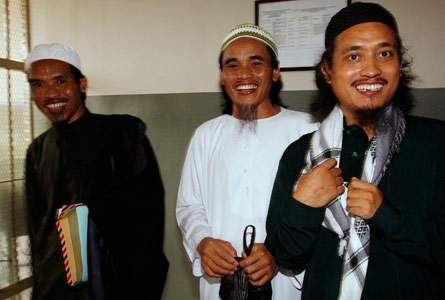
On this date — mere hours ago as of this writing — three of the most infamous terrorists in two nation’s histories were shot in a jungle clearing on Indonesia’s Nusa Kambangan Island.

“At around 00:15 am (1715 GMT Saturday) the three convicted men on death row, Amrozi, Mukhlas and Imam Samudra, were executed by firing squad,” said attorney general’s office spokesman Jasman Panjaitan.

“The autopsy results show that all three are dead. The family members are now bathing the bodies.” (Source.)

The men were taken from prison and tied to wooden crosses in the Indonesian prison island’s forest, where they were shot simultaneously by three separate firing squads for the October 12, 2002 bomb attack on the island of Bali that claimed 202 lives.

Though taking place in Indonesia, the strike was aimed at westerners vacationing at a tourist hot spot. Eighty-eight Australians were slain, along with 76 other (predominantly European) foreigners. The only shred of regret the late executees ever betrayed was that the infidel body count wasn’t higher.


The mediagenic murderers display a range from insouciant to jocular in most of their photos. The ever-grinning Amrozi — in the middle — was known as the “smiling assassin.”

The three facing death today* have occupied most of the intervening six years endeavoring to transmute their criminal celebrity into the dearer coinage of martyrdom through the doubtful influence of the Philosopher’s Stone mass media.

Despite their body count, burial disturbances, and even the prospect of some follow-up strike by at-large members of Jemaah Islamiyah, a base metal the late bombers will remain. Picture the most fanatical devotee of any cause you care to conjure drawing any enduring inspiration from this juvenile twaddle.

Indonesia has appeared to sidle towards this execution, ginger at inflaming Islamic radicals; Australia, which has no death penalty itself, has been controversially mum and bombing victims and their families conflicted.

It remains to be seen whether the high-profile case has legs among militants. But its undertones of race, religion and national sovereignty are being very closely watched by one group of Australians in particular: the Bali Nine, Australian nationals in Indonesian custody for drug smuggling.

Three of the nine are currently on death row, reportedly “somber” at this day’s shootings — no doubt aware that they could be next.

Update: True to the publicity-savvy rep, Imam Samudra reportedly knocked out a nasheed or nasyid just before his execution that’s now a hot ringtone download.

[audio:Imam_Samudra.mp3]

* A fourth man was also death-sentenced, but that sentence was vacated on appeal.

On this day..

1892: Jens Nielsen, the last in Denmark

On this date in 1892, serial arsonist Jens Nielsen was beheaded with an axe in the courtyard of Horsens prison — the last civil execution ever conducted in Denmark.

According to this Danish biography, Nielsen had incurred a long prison sentence for burning several farms in July 1883.

(He’d just returned from a fruitless stint in the New World, torching a warehouse in England on the return voyage.)

Apprehended immediately and sentenced to a long prison term, Jens confronted an age-old dilemma which was evidently noticeably acute among melancholy Danes: effecting state-assisted suicide on the scaffold.

These cases must have once been fairly frequent because Denmark, by an ordinance of December 18, 1767, deliberately abandoned the death penalty in cases where “melancholy and other dismal persons [committed murder] for the exclusive purpose of losing their lives.” The background for the provision was, in the words of Orste, “the thinking that was then current among the unenlightened that by murdering another person and thereby being sentenced to death, one might still attain salvation, whereas if one were to take one’s own life, one would be plunged into eternal damnation.”

The ordinance was ineffective in one case, at least, that of Jens Nielsen, who was born in 1862 and spent a most unhappy and unfortunate childhood. In 1884 he was sentenced to 16 years of hard labor for theft and arson. The following year he tried to kill a prison guard. He was tried, sentenced to death and received a commutation to life. He was then placed in solitary confinement. A year later he tried again to kill a guard, “realizing that he could not stand solitary confinement, did not have the nerve to commit suicide and wanted to force his execution.” He was again tried, sentenced to death and the sentence commuted. In 1892, having remained in solitary confinement all that time, he tried again to kill a guard. This time he got his wish, was sentenced to death and executed. (Source.)

He even managed to crack wise, “Thank you!” to the mayor who wished him God’s help on the way to the scaffold — envoy of the powers both temporal and ethereal that would finally loose his shackles.

Denmark’s death penalty law lingered into the 1930’s, but even the occasional death sentences were no longer carried out. Apart from a brief revival after World War II to punish war crimes committed during the Nazi occupation, nobody has been put to death in Denmark in — as of today — 116 years.

On this day..

1944: Hannah Szenes, who gambled on what mattered most

On this date in 1944, Hannah Szenes was shot by the Nazis in her native city of Budapest — a city she had left five years before, and to which she had returned as a British special operative.

Hannah Szenes (alternatively, “Chana Senesh” or “Hannah Senesh”) grew up in interwar Hungary.

Reaching adulthood in a period of rising anti-semitism in the late 1930’s, she became a Zionist and emigrated to British-controlled Palestine.

But with the onset of war, she signed up with the British Special Operations Executive and was parachuted behind German lines in March 1944.

Her brief: to save both Jews and downed Allied pilots. It is often described as the only military expedition to relieve European Jewry during World War II.

And it was as dangerous as it sounds.

[flv:http://www.blessedisthematch.com/BITMclip4.flv 425 344]

Hannah was nabbed crossing into Hungary on a mission that her colleagues (rightly, it seems) deemed too perilous to attempt, and withstood months of torture without divulging her codes.

By the time she went in the dock for treason, Nazi control of Hungary was collapsing and judicial administration itself was breaking down to the timpani of falling shells. Her sentencing November 4 was postponed; on November 7, an officer peremptorily informed her that she had been condemned to death. It’s believed that she was actually never formally sentenced, merely mopped up ahead of the unstoppable Red Army, which on this very day first entered Budapest’s suburbs.

A writer as well as a fighter, Szenes’ poetry survived as her monument to life — like the present-day Israeli standard “Blessed is the Match”, also the title of the documentary excerpted above; and, her “Halikha LeKesariya” (“A Walk to Caesarea”), also known as “Eli, Eli” (“My God, My God”). Here it is sung by Regina Spektor.

These lines were reportedly her last-known verses from prison:

One – two – three … eight feet long
Two strides across, the rest is dark …
Life is a fleeting question mark
One – two – three … maybe another week.
Or the next month may still find me here,
But death, I feel is very near.
I could have been 23 next July
I gambled on what mattered most, the dice were cast. I lost.

On this day..

1730: Hans Hermann von Katte, Frederick the Great’s lover

On this date in 1730, Prussia’s greatest king watched his boyhood lover put to death at his father’s order.

Happy families are all alike; every unhappy family is unhappy in its own way. Most of those ways were explored at some point by a Hohenzollern.

The 18-year-old prince Frederick had a thoroughly frosty relationship with the old man. Surly Frederick William I — “the soldier king” — didn’t have much use for his sensitive, music-loving son. An “effeminate fool,” dad thought the boy, and did not scruple to beat him publicly as he forcibly molded the unwilling heir into a military man.

Now, blue bloods have often had rocky relationships with their sires, but running away is not the usual option for a prince of the realm.

But Frederick contrived to hit the bricks, and 26-year-old officer Hans Hermann von Katte had the bad luck to be his best friend (and presumed homosexual lover). When Frederick turned to him for help, they started plotting flight.

Both were apprehended and imprisoned, and Frederick was himself in some danger of being executed by command of his own father. Dad softened up enough to keep his son’s head attached to his shoulders.

Von Katte wasn’t so lucky: sentenced only to imprisonment, the verdict was upgraded by the vindictive monarch — and as part of Frederick William’s ongoing project to break his son, he made the kid watch his friend’s beheading from close enough proximity to beg (and receive) von Katte’s forgiveness.

Here’s a melodramatic interpretation from a short film called Der Tod des Hans Hermann von Katte:

Frederick spent the next decade under the father’s thumb, chafing but bending himself to the austere demands of Prussian statecraft.

Well did he absorb them, for upon succeeding in 1740, he far surpassed his father in the martial pursuits, and for the half-century span of his reign was Europe’s acknowledged battlefield master. Known to posterity as Frederich the Great — and more familiarly as der alte Fritz, “old Fritz” — his augmentation of the empire vaulted Prussia into Europe’s great powers club and set the stage for German unification.

[flv:http://play-mcvideos.howstuffworks.com/2008-07/31/12211.flv 425 344]

Frederick scarcely ever spoke again of von Katte, but neither did he lose his native intelligence, and he kept up a long-running correspondence with Voltaire.

It gives an achingly tragic cast to the boy who suffered the horrible loss of his intimate this day — who dutifully delivered to his country genius as a commander and statesman, at the uncomplaining sacrifice of the life he yearned to lead.

UC-Berkeley professor Margaret Anderson’s wonderful “Rise and Fall of the Second Reich” course podcast situates Frederick in the arc of Prussia’s development out of the Middle Ages —

[audio:http://webcast.berkeley.edu/media/f2007/hist167b/hist167b_20070904.mp3]

— and treats his adroit foreign policy and active mind in the age of the Enlightenment.

[audio:http://webcast.berkeley.edu/media/f2007/hist167b/hist167b_20070906.mp3]

On this day..