1780: David Dawson and Ralph Morden, Quaker “traitors”

On this date in 1780, two unconnected Quakers were hanged for two unconnected treason convictions in two different cities in Pennsylvania.

The public executions of Ralph Morden in Easton, Pa., and David Dawson in Philadelphia (in a double hanging along with counterfeiter Richard Chamberlain) had the unusual distinction of being treason convictions against the state of Pennsylvania during the Revolutionary War, rather than against any sort of federal entity.

According to the Espy File of American executions, there were only 15 people put to death for treason* during the Revolutionary War. It’s a remarkably low figure under the circumstances — separatist colonial conflict that often pitted revolutionary neighbor against loyalist neighbor.

Morden, a Quaker who kept his head down during the war, agreed to guide one Robert Land, a Tory who needed to slip past Continental sentries, and of course didn’t make it. His case is summarized here, here and here.**

Less is readily available about Dawson, but a fellow-prisoner (and fellow-Quaker) left an account remembering that he and the counterfeiter Chamberlain

were taken out amidst a crowd of spectators — they walked after a cart in which were two coffins and a ladder, etc., each had a rope about his neck and their arms tied behin [sic] them … they were both hanged in the commons of this city abt. 1 o’clock.

This prisoner, Samuel Rowland Fisher, kept a two-year journal (pdf) of his imprisonment in Philadelphia for Tory sympathies, and as one might imagine paints an unflattering picture of the revolutionary “State as they call it.” In his view, Dawson’s hanging was a

greater act of Cruelty in the present Rulers than anything they have heretofore done, for they never gave him even a shadow of a tryal in their own fashion & they have executed him merely as what they call a proscribed person because he came into the City while the Brittish Army lay here, the circumstances of which was, that he was coming from his abode with his Waggon, that being in danger of his life from some of Washington’s Men he fled into the City & left & lost his Wagon, Horses, provisions &c — He never acted in any manner under Brittish, nor had he taken the Test to the present Usurpers, he did not go with the Brittish Army to New York, but had secreted himself in various places till he was betrayed by Jamed Reed last Spring & taken prisoner

Quaker Notes

Quakers who stuck by the sect’s pacifist teachings had a tough go of the American Revolution, often lumped in as Tories by patriots and subject to spasms of popular abuse, official writs confiscating their property, and other indignities from those who considered them “the unfriendly Quakers … notoriously disaffected to the cause of American Liberty.”† That same prejudice occasionally exposed Quakers to the severest punishments for perceived crimes.

Thus Morden, who presumably helped the British agent as a personal gesture of assistance, an everyday “crime” for which hanging was an extreme stricture: one hundred Continental dollars from Chamberlain’s press to the reader who can demonstrate that this was one of the 15 most treasonable acts committed behind American lines. But confronted with the request in a time of war, what was the neutral, pacifist choice?

“A man was hanged this morning,” one British officer’s diary recorded, “for piloting some people through the back woods, to the Indians. He was very old and left a wife and 9 children. His death was chiefly owing to his being a noted friend of Government.” (Cited by John Coleman in “The Treason of Ralph Morden and Robert Land,” The Pennsylvania Magazine of History and Biography, Oct. 1955)

Dawson, meanwhile, had worked for the British during the city’s recent occupation by General William Howe and was one of many so-called Loyalists “attainted of High Treason” and stripped of property by the state. Still, the British had been gone more than two years by the time he hanged.

Egged by Benedict

What might have upgraded Dawson’s sentence to a capital one was having the bad sense to be apprehended around the same time news arrived that Benedict Arnold had betrayed the Revolutionary cause two months before this date.

Arnold had recently been stationed in Philadelphia, and there controversially married into a Tory family. The betrayal he wrought thereafter was keenly felt in the cradle of liberty, and Arnold’s

effigy was paraded through the streets and hanged, his wife was ordered to leave the city within fourteen days, and his estate was confiscated. Still more rigorous proceedings were instituted against the tories and Quakers, one of whom [Dawson -ed.] was convicted of high treason and hanged. (Source.)

Discipline and Punish

Since we are students of the morbid here, let us also pause to notice the strikingly throwback nature of the punishment — not merely the fact that the Dawson-Chamberlain hanging was public, but that they were so theatrically marched to it, with ropes drawn about necks like the false Martin Guerre.

Not only did the treason conviction belong to a pre-American jurisprudence — against the state, yes, but also of a broader British conception of treason that the still-to-come U.S. Constitution would sharply curtail — but the resulting sentence is sharply at odds with Pennsylvania’s historical image as a a haven of penal reform.

Before the decade was out, the Keystone State would establish itself as an international epicenter of the movement away from harsh and (to us) primitive-sounding judicial sanctions, reconceptualizing punishment into the ordered prison system still familiar today. Pennsylvania abolished the death penalty for all crimes but murder by the turn of the century (it had made liberal use of the rope to punish crimes like burglary before that), and even murder hangings were not frequent.

Quakers, and Quaker philosophy, were instrumental in the shift.

If the thought that led to that sea change came from a deeper place, it may yet have been informed by the episodic recent history of the revolution: according to Gail Stuart Rowe’s Embattled Bench, there were around 700 indictments and attainders for treason or misprision of treason in Pennsylvania throughout the American Revolution, and these resulted in only four hangings.

All four of the hanged were Quakers.

* The Espy file is an outstanding resource, with the intent to document every execution that took place in what is now the United States since its colonial antecedents. However, it is not necessarily reliable that it actually does this, so the precise figure of 15 should not be depended upon too greatly.

** Land himself managed to escape from the ambush, leaving only Morden to face the music. The interest in his fate seems to come from genealogists; according to this site, Charles Lindbergh numbered among his descendants — bringing us to another century’s death penalty.

† That was George Washington, cited in George Washington and Slavery. However, according to this listing of famous Quakers, other notable patriots like revolutionary Gen. Nathanael Greene, flag-stitcher Betsy Ross and polemicist Thomas Paine were Quakers, too.

On this day..

1922: Robert Erskine Childers, for carrying the gun of Michael Collins

On this date in 1922, Robert Erskine Childers was shot by the Irish Free State for carrying a gun its founding colossus had gifted him.

Many Irishmen were executed on either side in this terrible time, but Childers cuts a unique figure among them.

To begin with, he wasn’t all that Irish — “that damned Englishman,” fellow Republican turned Civil War enemy Arthur Griffith called him. The London-born son of a British scholar and an Irish mother, Childers was a lifelong Protestant, itself an anomaly since Irish nationalism mapped (and still maps) strongly to Catholicism.

You’d think he’d be a loyal man of the empire. Early on, that’s just what he was.

In his twenties, Childers volunteered for the Boer War, and he would later say the rank savagery and underlying injustice of England’s war “changed the whole current of my life and made me a Liberal and a Nationalist.” (Source.)

Laying down the sword, Childers took up the pen and wrote several books of military history. (Long since into the public domain, at least two can be read free online: War and the Arme Blanche, German Influence on British Cavalry.) He also wrote a novel, The Riddle of the Sands, that has a (debatable) claim as the first spy novel. Riddle has never gone out of print since it was published in 1903, though it is also available free online.

Both in fiction and nonfiction, Childers’ warnings against the German challenge to British hegemony were prophetic, but he was himself becoming a man divided. 1914 saw him running German guns to Irish nationalists aboard his yacht Asgard … and then signing up for the royal navy when World War I erupted.

The British crackdown on the Easter Rising during the war completed his radicalization; he moved to Dublin and turned his eloquence against the British.

Here, Childers was swept into the tragedy of the Irish War of Independence, and the civil war that followed it; though both were in the delegation that produced the contentious Anglo-Irish Treaty, Childers broke with Michael Collins over it and backed the IRA nationalists who fought the Irish Free State.

After Collins’s assassination, emergency laws promulgated the death sentence for anyone caught armed without authorization. Childers was a writer, not a partisan, but he was arrested in early November with a small sidearm — a gift Michael Collins had given him, back when they were on the same side. It was a time of bloody justice, and they threw the book at him.

Childers knew as well as Collins had that the internecine conflict would have to end. He checked out with awe-inspiring forgiveness; summoning his 16-year-old son to prison the night before his execution, Childers extracted a promise that the boy would find everyone who signed his death warrant … and shake their hands. (Young Erskine Hamilton Childers eventually became President of Ireland.)

Childers himself likewise shook the hands of his own firing squad, one by one. His last words (reported in a number of slightly different variations) were lightheartedly addressed to them:

Take a step or two forwards, lads. It will be easier that way.

On this day..

1927: Father Miguel Pro, “Viva Cristo Rey!”

On this date in 1927, the anti-clerical Mexican government made the emblematic martyr of the Cristero War.

This video is in Spanish, but the storyline is pretty easy to follow — young man finds faith, lives faith, dies faith.

Miguel Pro‘s dying cry, “Viva Cristo Rey!” — “Long live Christ the King!” — was a refrain of Cristeros, anti-government guerrillas who in the late 1920’s fought the revolutionary Mexican government’s attempts to forcibly restrict the power of the Catholic Church.

That conflict had been brewing for years, an outgrowth of Mexico’s own complex history of colonization and development — measures to restrict the church’s size, wealth, and social reach had been mooted and sometimes implemented well back to the middle of the 19th century.

Early in the 20th, the confrontation was merely a twist on its classic form: liberal state-builders and the Catholic hierarchy were (or increasingly saw themselves as) diametrically opposed in their vision for Mexico.

That conflict came to a head under president Plutarco Elias Calles, an irreligious northerner with a project of national capital development for whom the church’s intransigence from its agrarian strongholds was most unwelcome … and who seemed to delight in provoking Rome with sport like mandatory physicals for priests, not neglecting to publicize the incidence of venereal disease thereby revealed.

Liberals had already brought about drastically reduced clerical privileges in the Mexican Constitution of 1917; its somewhat draconian measures were neither fully enforced nor fully resisted, but initiated a period where the two hostile institutions rudely grappled for their respective spheres of influence on the ground.

Calles was the rudest grappler of all, and his 1926 Calles Law pushed for anti-clericalism stricter than the letter of the constitution … and sparked armed resistance.

It was an exceptionally dirty war with routine summary executions on both sides and thousands of Catholic refugees — a dangerous environment for any priest with legal sanctions against basically every practice of the vocation. (Photos of Cristeros, some in heroic resistance and others in grisly martyrdom, can be eyeballed here.)

Pro, a Jesuit who like many was forced underground, was under state surveillance and got picked up in the aftermath of an assassination attempt against a prominent politician. He was chosen to make an example of — without an actual trial, possibly because there’s no actual reason to think he was involved in the bombing.

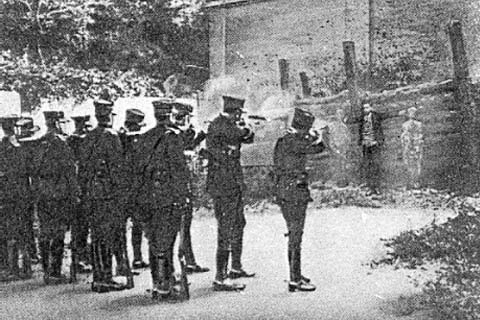
Looking at these pictures of Pro’s last moments, it’s hard to believe that they were taken and circulated at government direction to cow the Cristero movement. Fail.


Led out to execution in a police courtyard. The place of his death today is (bizarrely) Calle Loteria Nacional.


Calmly at prayer before his death, under the eye of the firing squad commander.


Pro himself refused a blindfold. But why state authorities carrying out the execution with an eye towards public relations would allow him to die in this pose is anyone’s guess.


He blessed and forgave the firing squad, of course.


Just beginning to topple at the moment the bullets struck him.


Like many firing squad executions, this one failed to kill its victim with the ceremonial volley. Pro was finished off with a coup de grace.

Calles was simultaneously — the key measures were also enacted in 1926 — involved in a confrontation with the United States over oil rights, a situation that came to the brink of war, with Washington saber-rattling about “Soviet Mexico”. It’s tempting to wonder whether the two situations weren’t related, especially since the new American ambassador* who had arrived only the month before Pro’s execution would ultimately negotiate both situations’ resolutions.

While the natural resource politics went their separate way, the Mexican Revolution’s anti-clerical strain didn’t so much disappear by negotiation as fade away over decades, with regular new outbreaks.

One thinks of Mexico today as such so staunch a Catholic country that it’s hard to imagine that some of these provisions were only officially repealed in 1998.

As for Pro, he’s welcome in Mexico by now — celebrated by Pope John Paul II who ultimately beatified him, and the inspirational source of this hymn whose refrain is his famous last cry.

There’s a faithful site in his honor here, and apparently a shrine to him in Houston, Texas run by a group pushing for his canonization.

* The American ambassador in question, Dwight Morrow, invited Charles Lindbergh on a goodwill tour to Mexico, where the aviator would meet the diplomat’s daughter not long after Miguel Pro’s martyrdom. Little could Lindbergh and Anne Morrow suspect that their love match would set them on the path to their own famous encounter with capital punishment.

On this day..

1538: John Lambert, “none but Christ”

On this date 470 years ago, John Lambert was burned to death at London’s Smithfield market for heresy.

One possible way to read the early progress of the English Reformation is as an initial flowering of Protestantism followed — after the execution of Anne Boleyn — by a reactionary crackdown by the monarch.

In this telling, John Lambert (born John Nicolson or Nicholson) marks the turning point, the man in whose blood Henry VIII etched his warning against doctrinal liberality.

John Lambert cooked his goose by picking a theological dispute with a pastor in London. He didn’t buy into transubstantiation, the Catholic doctrine (still extant today) that the bread blessed on the altar became the literal body of Christ.

Though the Anglican church would ditch this belief soon thereafter, it came down hard on Lambert in a show trial attended by Thomas Cromwell, Thomas Cranmer, and all the Tudor big wheels whose heads were at that point attached to their shoulders.

The king himself — who here reminds one of the the stout defense of the sacraments that in his early Catholic period had earned him the papal honorific “defender of the faith” — debated theology with the accused, though mostly he left it to his august councilors.


John Lambert disputing before Henry VIII. Early 19th c. illustration.

But the crowned head made his doctrine as plain to the audience as the consequences of crossing it.

The pro-Lambert account from which this extract is drawn is available free on Google books:

At length [Lambert] was worn out with fatigue, having been kept five hours standing …

Night coming on, the King being desirous to break up this pretended disputation, said to Lambert, “What sayest thou now, after all this pains taken with thee, and all the reasons and instructions of these learned men? Art thou not yet satisfied? Wilt thou live or die? What sayest thou? Thou has yet free choice.” Lambert answered, “I yield and submit myself wholly unto the will of your Majesty.” Then said the King, “Commit thyself into the hands of God, and not unto mine.” Lambert replied, “I commend my soul unto the hands of God, but my body I wholly yield and submit unto your clemency.” Then said the King, “If you do commit yourself unto my judgment, you must die, for I will not be a Patron unto heretics.” And then turning to Lord Cromwell he said, “Cromwell, read the sentence of condemnation against him:” which was accordingly done.

A few months later, Henry induced Parliament to pass the Act of the Six Articles, essentially establishing Catholic doctrine — sans Pope, obviously — as the basis for the Church of England and criminalizing dissent.

What to make of this trial and the policy it represented is open to dispute. In a simple telling, Henry realizes his Reformation is running away from him, or becomes wise to discomfiting reforms that Cranmer or Cromwell are pushing. Too, the ebb and flow of Henry’s “Reformation” has sometimes been seen as a product of the shifting balance between reformers and conservatives advising the crown; Protestant martyrologist John Foxe favored this approach since it enabled him to celebrate a John Lambert without indicting the monarch by blaming advisors.

Lambert’s death is also sometimes interpreted in light of the international situation, as the Catholic powers of France and the Holy Roman Empire had made peace, potentially (along with Scotland) encircling England with Popish foes who might conceivably be less belligerent with a move towards traditional doctrine.*

But maybe that’s all a good deal more explanation than is needed for the old defender of the faith. G.W. Bernard’s consideration of The King’s Reformation argues that Lambert isn’t so pivotal after all:

[H]istorians who see … the trial of Lambert as some sort of turning point are greatly mistaken. There was absolutely nothing new in Henry’s policy in November 1538. Ever since radical — Zwinglian — notions on the mass had come to influence some within England, Henry had reacted firmly and boldly. This was not something that only came late in the 1530s, when he supposedly woke up to what Cromwell and Cranmer had been doing in his name but without his knowledge. It was there from the start. As early as March 1535 a proclamation fiercely denounced strangers who had presumptuously rebaptised themselves and who denied that the blessed and most holy sacrament of the altar was really the body of Christ. If there was a novelty in autumn 1538, it was the perception that such heresies were spreading through the realm and that heretics with a high profile, such as Lambert, needed to be dealt with publicly so that others might learn from their unhappy example. … Henry surely blasted against sacramentarians for the straightforward reason that he sincerely believed them to be wicked.

As for Lambert himself, he met an especially cruel version of the none-too-pleasant sentence of burning alive, allegedly being lifted by pikestaffs from the flame when his legs were burned off to prolong his suffering. He is said to have continued to call out the inspirational last words, “None but Christ! None but Christ!”

* It was against this alliance that Cromwell would arrange the king’s ill-fated marriage to German princess Anne of Cleves, a debacle that helped Cromwell lose his own head.

On this day..

1942: Partisans by the Sonderbataillon Dirlewanger

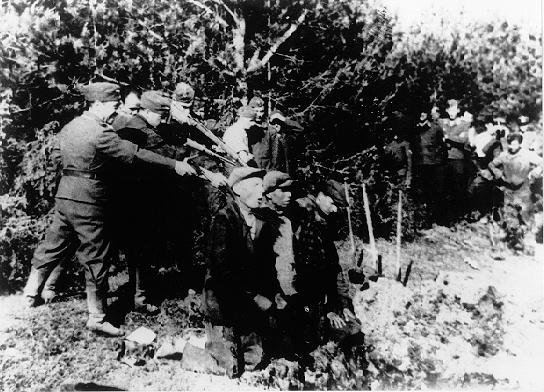
On an uncertain date in November 1942, this photograph of an SS unit executing anti-Nazi partisans in Belarus was taken.

Behind this striking but all too typical image of brutal field executions on the eastern front lies the sordid story of one of the strangest military formations in the Nazi service.

The Dirlewanger brigade was formed under a man whose fortuitous early enrollment in the NSDAP had enabled him to pull strings to get himself out of Dachau, where he had been sent after his second molestation conviction, and where unfolding events could have easily seen him on the other end of the firing squad.

Instead, Oskar Dirlewanger formed a unit of criminals and reprobates: poachers at first, and eventually, as it grew into the SS-Sonderbatallion Dirlewanger, men culled from the camps or soldiers condemned by the army, some literally trading the likelihood of execution themselves for service under one of the most disreputable commanders in the field.

Oh, and, just incidentally — it stuck them into a lawless environment where they could probably practice and refine their pathologies unchecked. Some “rehabilitation.”

As of this relatively early date, the convict floodgates weren’t yet entirely open, and the existing German volunteers were supplemented by a goodly portion of Soviet citizens recruited in the occupied territories. From 1942 to 1944, they hung around Belarus hunting guerrillas and doing to them — well, you know. (The original notion of using poachers was to exploit their ranger-like woodsman talents for anti-partisan warfare.)

Oh, and civilians. Tens of thousands of civilians. That almost goes without saying.

Sadly for Dr. Dirlewanger, events further south were undoing all his bloody work, for it was also in the November 1942 that the Red Army decisively turned the tide of the war with its counterattack at Stalingrad — in fact, it was this very date in 1942 that it completed its encirclement, stranding a quarter-million freezing Wehrmacht regulars on the banks of the Volga, only a handful ever to see Germany again.

The Dirlewanger brigade would have its own turn being minced by the Soviet war machine, though not before it had a notorious hand in drowning the Warsaw Uprising in blood.

Dirlewanger himself was tortured to death by Polish guards a few weeks after the war ended.

Part of the Themed Set: The “Ex” Stands For “Extrajudicial”.

On this day..

284: Aper, by Diocletian

On this date* in 284, one of Rome’s greatest emperors claimed the purple by summarily executing his rival before the approving army in Anatolia.

The Emperor Diocletian christened his reign with a bit of scaffold theatricality, but he might have been the real perp.

For half a century, the Roman Empire had waded through crisis. In its political manifestation, a parade of forgettable emperors had marched through the throne room, each to be assassinated, overthrown, or otherwise disposed of by some equally forgettable aspirant en route to a similarly unenviable end.

At length, out of this unpropitious bunch, rose one Diocles, a low-born Dalmatian of classical education whose martial gifts saw him rise through the legions. His opportunity came when the emperor Carus, barely a year on from succeeding his assassinated predecessor, died on campaign against Persia allegedly struck by lightning (quite possibly a euphemism for something more dagger-like), leaving his son Numerian in charge.

As the army meandered back to the friendly confines, Numerian secluded himself in his litter. And after a while, the litter started to stink.

Sometime on the journey, he’d been secretly killed — but by whom?

The principals this day are our leading suspects. (And it’s a little mystifying in either case just what was gained by leaving the body hidden so long.) We turn to Gibbon to narrate what must have been a riveting — not to mention definitive — proceeding adjudicating between them a few kilometers past Nicomedia (moder Izmit, Turkey) towards Chalcedon (now the Kadikoy district of Istanbul).

A general assembly of the army was appointed to be held at Chalcedon, whither Aper was transported in chains, as a prisoner and a criminal. A vacant tribunal was erected in the midst of the camp, and the generals and tribunes formed a great military council. They soon announced to the multitude that their choice had fallen on Diocletian, commander of the domestics or body-guards, as the person the most capable of revenging and succeeding their beloved emperor. The future fortunes of the candidate depended on the chance or conduct of the present hour. Conscious that the station which he had filled exposed him to some suspicions, Diocletian ascended the tribunal, and raising his eyes towards the Sun, made a solemn profession of his own innocence, in the presence of that all-seeing Deity. Then, assuming the tone of a sovereign and a judge, he commanded that Aper should be brought in chains to the foot of the tribunal. “This man,” said he, “is the murderer of Numerian;” and without giving him time to enter on a dangerous justification, drew his sword, and buried it in the breast of the unfortunate praefect.** A charge supported by such decisive proof was admitted without contradiction, and the legions, with repeated acclamations, acknowledged the justice and authority of the emperor Diocletian.

Though there isn’t any direct evidence of it, posterity is entitled to suspect on grounds of means, motive and opportunity, that the eventual beneficiary of Numerian’s demise — the emperor henceforth known as Diocletian — was its true author.

Whether obtained by fair means or foul, Diocletian put the laurels of state to good use, stabilizing government by introducing the “Tetrarchy” — the rule of the empire’s eastern and western halves by two emperors (“Augusti”) each aided by a “Caesar” who was also the heir apparent.

Diocletian’s two decades in power before his anomalous voluntary retirement constitute a watershed in the late history of Rome, and not only because the cycle of imperial assassinations and civil war took a welcome generation-long hiatus.

Although he’s also remembered for initiating the last major persecution of Christians, his administration set the stage for the rise of Constantine the Great, the Galilean’s first imperial champion. Constantine’s father was one of the original tetrarchs, the Caesar of the west.

And in the longer term, Diocletian’s division of the empire between east and west would sow the seed of the later separation of Byzantium and Rome, and the corresponding division in the Christian world. No surprise, then, that the first ruler profiled in Lars Brownworth’s 12 Byzantine Rulers podcast is this date’s executioner:

[audio:http://www.12byzantinerulers.com/audio/02-Diocletian.mp3]

More audiophilia about Diocletian and the tetrarchs in this lecture from Isabelle Pafford’s UC-Berkeley course on Roman history. (The first 6:45 or so consists of class business and carryover from previous lectures.)

[audio:http://webcast.berkeley.edu/media/s2008/hist106b/hist106b_20080425.mp3]

* As with much in the ancient world, sourcing is tenuous, and there is some scholarly debate over whether the events in this post should be ascribed to November 20, or to November 17, or to September 17, or to some other date. Since this blog, notwithstanding its title, embraces the occasional execution whose date is uncertain, I am prepared to wave aside textual uncertainty in the interest of a ripping good story.

** According to the Historia Augusta, Diocletian had a superstitious reason to carry out this bloodthirsty act personally.

This story my grandfather related to me, having heard it from Diocletian himself. “When Diocletian,” he said, “while still serving in a minor post, was stopping at a certain tavern in the land of the Tungri in Gaul, and was making up his daily reckoning with a woman, who was a Druidess, she said to him, ‘Diocletian, you are far too greedy and far too stingy,’ to which Diocletian replied, it is said, not in earnest, but only in jest, ‘I shall be generous enough when I become emperor.’ At this the Druidess said, so he related, ‘Do not jest, Diocletian, for you will become emperor when you have slain a Boar (Latin: Aper).’ ” … It is now well known and a common story that when he had killed Aper, the prefect of the guard, he declared, it is said, “At last I have killed my fated Boar.” My grandfather also used to say that Diocletian himself declared that he had no other reason for killing him with his own hand than to fulfill the Druidess’ prophecy and to ensure his own rule. For he would not have wished to become known for such cruelty, especially in the first few days of his power, if Fate had not impelled him to this brutal act of murder.

Part of the Themed Set: The “Ex” Stands For “Extrajudicial”.

On this day..

1928: Marshall Ratliff lynched for the Santa Claus Bank Robbery

On this date in 1928, the man whose disguise christened one of the most bizarre crimes in Texas’s colorful history was lynched behind a theater … producing “The Noose”.

The Santa Claus Bank Robbery was, in the words of one columnist present for the affair,

the most spectacular crime in the history of the Southwest … surpassing any in which Billy the Kid or the James boys had ever figured.

The story begins on December 23, 1927, in the town of Cisco, where a genial man dressed as Saint Nick strolled down the main drag dandling playful children en route to the First National Bank.

Santa — Marshall Ratliff — and three accomplices then conducted one of the most inept bank robberies in that craft’s ample stock of ineptitude.

A general gun battle erupted during the robbery, owing to the general citizenry being armed, and a standing reward available from the bank association for shooting a bank robber in the act. When the quartet finally fought their way to the getaway car — killing two cops in the process — they realized it was almost out of gas.

After a few days’ dodging a manhunt, everyone was rounded up, one of them in corpse form. Two of the surviving three drew death sentences, and Henry Helms sat in the Lonestar State’s electric chair on September 6, 1929.

But Kris Kringle — er, Ratliff — had his execution delayed by a sanity hearing that brought him back to Eastland County, where he feigned illness and killed a guard in an abortive escape attempt. The good folk decided they’d had about enough of due process.

Quoth a newspaper report of the day (reproduced in A.C. Greene’s book on the case):

All yesterday afternoon they gathered in little groups about the town and muttered about [the guard] Jones’ shooting which physicians said probably would prove fatal. Last night a crowd in front of the jail swelled to nearly a thousand at 8:30 o’clock.

At about 9 o’clock, some 200 men slipped into a side door of the jail and asked for the man. Jailer Gilborn refused to give him up. They overpowered Gilborn, took his keys and got Ratliff.

… He was dragged in the direction of the public square, but the crowd would not wait to go those few blocks.

At 200 yards from the jail a strong telephone cable was pointed out, a rope flung across it. A noose was put around Ratliff’s neck, a dozen men on the other end of the rope bent their weight, and Ratliff was jerked from the ground.

The rope broke. Messengers were sent for another, and again the mob set to its task. Then someone remembered that men about to die are usually given a chance to say a last word. For another moment he was lowered to the ground, but, displeased at his mumbling, the crowd yelled, “String him up!”

Part of the Themed Set: The “Ex” Stands For “Extrajudicial”.

On this day..

2005: Elias Syriani, a family affair

On this date in 2005, North Carolina executed 67-year-old immigrant Elias Syriani at Raleigh’s Central Prison for the murder of his wife — despite the emotional clemency intervention of the couple’s children.

Syriani, an ethnic Assyrian driven from his native Jerusalem by al nakba who moved to the U.S. from Jordan through marriage to a Jordanian immigrant, had a stormy marriage hit the rocks in 1990. Teresa filed for divorce after a few years facing Elias’s violent objections to her westernized behavior.

Syriani responded by jumping her when she drove home one night, and stabbed her to death with a screwdriver in front of their 10-year-old child.

This case meandered forgettably through the bowels of the criminal justice system; the traumatized children moved on (.pdf).

Until the year before Syriani met his fate, when the mysteries of the human heart flipped the script.

The four children visited Syriani and found themselves forgiving their mother’s murderer … and forging an unexpected bond with the father they hadn’t known for a decade. They called it a miracle, a gift from their late mother to go from “hate, absolute hate, to love in a split second.”

The children — by then grown — became Syriani’s advocates for executive clemency, posing an unusual challenge for Gov. Mike Easley: in an environment that (rhetorically, at least) often counts on survivors’ rage and grief as arbiters of punishment, would he spare a father for killing a mother when the children said execution would redouble the family’s injury?

But commutations rarely happen — there’s just no percentage in them for politicians.

“After careful review of the facts and circumstances of this crime and conviction, I find no convincing reason to grant clemency and overturn the unanimous jury verdict affirmed by the state and federal courts.” (Easley)

This startling story became the subject of a 2007 documentary, Love Lived on Death Row

[flv:https://www.executedtoday.com/video/Love_Lived_on_Death_Row_trailer.flv 440 330]

The following are excerpts from an interview with the film’s Producer/Director Linda Booker originally conducted by Sean O’Connell of The Charlotte Weekly.

When did you first hear about/become interested in this story?

Back in July 2005, I was checking the weather on a local news website and scanning the headlines when the article about the Syriani siblings forgiving their father caught my eye. I think at first it interested me because I have been involved with our local domestic violence agency as a volunteer and fundraiser, but as I read the article something about their reconciling with and forgiving their father really touched me. At this point they had begun to share their story with the public and had just appeared at a domestic violence conference in Charlotte called “Hope to Heal.”

At what point did you get the idea to film the story in documentary form? How long did it take to complete the film?

It was an immediate reaction for me upon reading the article that their story might make a compelling documentary film. I printed it out and carried it around with me. But I was still finishing up interviews and editing my first documentary project “Millworker: the Documentary” so I didn’t act on it right away. Then several months later I learned that they would be speaking in Chapel Hill, close to where I live, and I thought, “okay, if I feel this strongly about this, here’s my chance to meet them and film their discussion.” So there I was, a relatively new filmmaker and very nervous about that first step, but I received permission to film that night. That’s also when I first heard about and met Meg Eggleston, who had been writing letters and visiting Elias Syriani on death row for four years and the Syriani sibling’s attorney Russell Sizemore, who was helping them through their father’s clemency appeal pro-bono. I came to learn that Meg’s friendship with Elias was an essential part of their father’s transformation and was such an interesting story in itself.

I started filming in October 2005, edited in the fall of ’06 and started doing preview screenings in early ’07. Since then the film has screened at film festivals and many grassroots screenings with various non-profits and faith groups as sponsors in the U.S. especially in North Carolina.

The Syriani children are open and honest in the film. Did you have trouble accessing them? Were they open to the idea of participating in the film, even though at this point it could not help their father?

I started filming interviews with Meg Eggleston and Russell Sizemore first who trusted that I was not trying to do a sensationalized story, but that I recognized the Syriani’s story of forgiveness was inspirational, regardless of the outcome of the clemency appeal. The Syrianis knew that I was working with Meg & Russ, but out of respect for all they were going through, I did not push the issue of their participation. About six months after the appeal, I wrote them about participating and subsequently we went to California and Chicago in the summer of ’06 to film interviews with them. While they know that a part of the discussion around the film will be capital punishment, the Syriani siblings have expressed that they want their story to live on in hope that their experience of surviving a domestic violence tragedy and the healing that came from forgiveness will touch people’s hearts and help others.

I think it’s because this case is so unique, but I found the film’s stance on the death penalty unclear. Can you, as the filmmaker, clarify your thoughts on the death penalty?

Well, I’ll take that as a compliment, because the documentaries I admire aren’t pounding you over the head with the filmmaker’s opinion. I can tell you that making this film made me face how I felt about the death penalty and I spent a lot of time researching and doing some deep thinking about the issue.

Needless to say it’s very complex, and it is completely understandable that feelings of anger and retribution can occur when you have lost a loved one to violence. We need to do more for those dealing with the aftermath of murder with as much support, assistance and counseling services as possible, especially children. But as I went to restorative justice forums and have met many people who belong to organizations such as Murder Victims Families for Reconciliation, I kept hearing stories about how the death penalty was causing more grief, stress and division in families that had experienced murder. Between making the documentary and doing the research, I came to the conclusion that I couldn’t support a system of justice that can possibly create more pain and victims in its wake and that was also irreversible and arbitrary.

On this day..

1939: Nine Czech students

Today is International Students’ Day and a public holiday in the Czech Republic and in Slovakia thanks to the martyrdom of nine at the hands of the Nazi occupation forces this day in 1939.

The previous fall, Hitler had cowed the allied powers into ceding the mountainous Czechoslovakian Sudetenland to the Third Reich in order to avert war — leading to Neville Chamberlain‘s famously mistaken “peace in our time” speech.

In March 1939, Germany reneged its part of the bargain and gobbled up Bohemia and Moravia, essentially the modern Czech Republic.

That this would collapse Chamberlain’s vision of peace and set Europe’s powers on the road to war with Berlin was cold comfort to the occupied Czechs. They had their own problems.

On October 28, youth demonstrations in Prague against the occupation resulted in the shooting of Charles University medical student Jan Opletal

Two weeks later he succumbed to the injury, and his funeral turned into an anti-occupation riot forcibly quashed by German arms. According to the London Times account:

On November 17 at 3 a.m., the Gestapo entered all students’ colleges, men’s and women’s, without allowing them to dress, tied the students in groups of three, and dragged them away … Between 3 o’clock and 8 o’clock in the morning the Gestapo visited students’ homes and lodgings. Those opposing arrests and parents who withheld information were immediately shot at, and the wounded were refused attention. The Gestapo broke into high schools as well as into the university …

The prisoners were taken to the Ruzyn barracks and to the Sparta football stadium, where cold water was flung over them and were made to wait until the evening. Then, in the barrack yard, 124 students and teachers* were shot before their fellow-students, the first nine being presidents of students’ associations, including the brilliant young sociologist Dr. Matoushek [English Wikipedia entry | Czech], son of a former Minister of Commerce.

Universities in the cities were declared closed for three years; they would not in fact re-open until after the war.

The day, subsequently memorialized as den boje studentu za svobodu a demokracii (Day of the Students’ Fight for Freedom and Democracy), entered Czech history a second time a half-century later. A student protest at Opletal’s grave on this date in 1989 helped catalyze the Velvet Revolution that toppled Czechoslovakia’s Communist government.

* The larger figure was circulated in the days following by Czech sources. It is not clear to me whether that number proved unfounded, or whether subsequent memorials simply came to focus on the leading nine — whose executions are certain, and were even announced by German communique.

On this day..

1869: Hamiora Pere, Maori “traitor” to the Queen

On this date in 1869, Hamiora Pere became the only New Zealander ever executed for treason.

Maurice Shadbolt’s Season of the Jew is a historical novel of the conflict that doomed Hamiora Pere. It’s told from the standpoint of Te Kooti, who liked to compare the Maori cause to that of the Israelites resisting Egypt, and founded a religious sect that still persists today.

Pere* came by the distinction quite accidentally — even setting aside the queer circumstance of his “betraying” a state on the opposite side of the globe by resisting its claim to his ancestral homeland.

Hamiora Pere was one of five Maori prisoners from the Siege of Ngatapa during Te Kooti’s War — an indigenous resistance against British colonization — to face the fatal charge.

The crown handled these cases carefully.

Though all five men drew death sentences (mandatory for treason), the government was evidently trying to stay out of the martyr-making business — as revealed by a judge’s comment during official deliberations.

I believe the result is the very best that could have been arrived at. I am glad to know that Mr McLean thinks that one execution will be useful as more would have been by way of example and caution.

Unfortunately for Hamiora Pere, the one of those five who was most likely set up to be the “example,” Wi Tamararo, committed suicide in prison shortly after his sentence.

Pere seemingly became the next in line for hanging because he was associated with murders in a noteworthy massacre at Matawhero that slew 33 Europeans and 37 of their Maori allies. Notably, however, the charge of murder actually filed against him was dropped prior to trial since he could be placed at the scene of the attack, but not directly shown to have killed anyone. Even off the indictment, it may have been the thing that doomed him.

Whatever the nature of the deliberations — and this report (pdf) of New Zealand’s Waitangi Tribunal inconclusively attempts to unpack the story with the patchy evidence available — the remaining convicts got clemency. Four years later, they were pardoned outright.

Pere got the noose at Wellington, and the accidental historical footnote. He would seem destined to maintain his unusual distinction indefinitely, since New Zealand has abolished the death penalty altogether.

Fear of Death

It is the circumstantial distinction of his case that earns Pere his place in this blog out of the numberless thousands to meet his same fate.

But in the end, he faced the gallows in that existential nakedness common to all us mortal wretches beholding death. Many in these pages meet their ceremonial end with with bravado; Hamiora Pere, by contrast, suffered all the pitiably human torments of fear, according to the report of the Daily Southern Cross:

He received the notice of his approaching death with calmness, and it was not until the morning before the execution that he gave any outward sign that he realised his terrible position. … [after his last farewell with his family he] became terribly distressed. He evidently fully recognised his position; he knew that he had looked for the last time on those from whom only he had any right to expect sympathy; every incident was reminding him how rapidly his term of life was decreasing, and it was not until his spiritual adviser … had been with him some time, that he became more composed.

[on the morning of the execution, Pere’s] responses [to his spiritual advisor] were accompanied by a peculiar moaning, and by convulsive sobbing. … the prisoner, quite a young man, and with nothing in his general appearance worthy of special remark, was sobbing bitterly, and was evidently suffering from intense mental agony; he looked anxiously around, yet stood firm and erect while he was being pinioned, repeating, as well as his trembling voice would allow, the prayers that were being offered on his behalf. … At the foot of the steps [to the gallows] the prisoner halted a moment, but, being led up, was quickly placed in the centre of the platform, under the noose, which was immediately fixed round his neck. From the time the prisoner left his room, until the rope was adjusted, he continued praying in a low moaning tone, interrupted frequently by violent sobbing …

* Also spelled “Peri” and, occasionally, “Pera”.

On this day..