1895: A day in death penalty around the U.S. (McTeague edition)


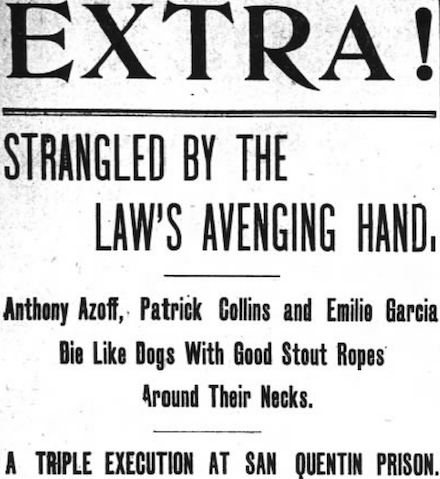
Headline from the Tacoma (Wash.) Daily News, June 7, 1895.

On this date in 1895, the hangman noosed for the cycle with single, double, and triple executions in three different U.S. states.

Arkansas

In Morrilltown, William Downs or Downes for criminally assaulting a woman called Pauline Bridlebaugh.

“On the scaffold Downs declared that he was guilty of part but not all he was charged with,” according to multiple newspaper reports. The eight-foot fall failed to snap his neck, and Downs strangled to death over 15 agonizing minutes.

Alabama

“Lee Harris and Abe Mitchell, colored murderers, highwaymen and thieves, were hanged here [Birmingham] today before 2000 people for the murder of Grocerymen Merriweather and Thornton. Both bodies were turned over to the undertakers, who purchased them several weeks ago for $18 from the men themselves.”


From the Oakland Tribune, June 7, 1895.

California

Three Californians hanged, sequentially, at San Quentin prison on the morning of June 7 in an affair timed to ensue the arrival of the 7:40 train from San Francisco, carrying about 100 official witnesses.

Emilio Garcia stabbed and slashed to death a San Bernardino old timer whom he believed to possess a hoard of gold.

Anthony Azoff fatally shot a Southern Pacific detective in the course of a botched robbery of that railroad firm’s offices; he was balked of a suicide attempt in the hours before his execution.

And Patrick Collins acquired more lasting infamy than any of his scaffold brethren by sensationally stabbing to death his estranged wife at the kindergarten where she worked when she refused his demand to hand over her wages.

Collins’s guilt was very apparent, so his trial gave the horrified public ample rein to sketch the brute in terms of the era’s crackpot racist typologies. In one Examiner article tellingly titled “He Was Born for the Rope,” it was postulated that “if a good many of Patrick Collins’ ancestors did not die on the scaffold then either they escaped their desert or there is nothing in heredity … Seeing him you can understand that murder is as natural to such a man when his temper is up as hot speech is to the anger of the civilized.”


Various newspaper images of Patrick Collins, from The Construction of Irish Identity in American Literature.

Be they ever so headline-conquering in their time, such crimes are like to fade speedily from the public memory. Collins, the man who slaughtered his tightfisted wife, and Collins, the savage ethnic archetype, have improbably survived his moment of notoriety, by imparting to literature the inspiration for San Francisco novelist Frank Norris‘s 1899 offering McTeague.

In McTeague, a vicious husband murders the wife he has abandoned when she refuses him money. The murderer here presents as an overpowering ancestral beast within — attributable, says Christopher Dowd, to Norris’s “study of criminal anthropology, particularly the school of thinking developed by Cesare Lombroso regarding atavism, hereditary criminality, degeneration, and criminal physiognomy. According to Donald Pizer, by the time Norris wrote McTeague, he had developed a ‘preoccupation’ with the themes of atavism and reversion, and ‘particularly with the role of heredity in causing either an obvious physical or mental devolution or a return to an earlier family condition’. Suddenly, Norris had a way to explain the behavior of his murderous protagonist — he was born a criminal, having inherited the degenerate traits and predilections of his Irish ancestors. Combined with the newspaper reports of the Collins murder, criminal anthropology gave Norris all the tools he needed to write, what Pizer calls, ‘that mythical creature of literature, a naturalistic tragedy'”. For example, Norris zooms through the disordered mind of McTeague as he struggles to control himself on one occasion.

He was disturbed, still trembling, still vibrating with the throes of the crisis, but he was the master; the animal was downed, was cowed for this time, at least.

But for all that, the brute was there. Long dormant, it was now at last alive, awake. From now on he would feel its presence continually; would feel it tugging at its chain, watching its opportunity. Ah, the pity of it! Why could he not always love her purely, cleanly? What was this perverse, vicious thing that lived within him, knitted to his flesh?

Below the fine fabric of all that was good in him ran the foul stream of hereditary evil, like a sewer. The vices and sins of his father and of his father’s father, to the third and fourth and five hundredth generation, tainted him. The evil of an entire race flowed in his veins. Why should it be? He did not desire it. Was he to blame?

McTeague does not exit upon the gallows as did his real-life inspiration; instead, having murdered and robbed his wife, the fugitive flees to the scorching desert of Death Valley where he faces a fight to the finish with a friend/rival who has pursued him. McTeague overpowers this foe, but the man’s dying act is to handcuff himself to McTeague — condemning the latter to sure death.

McTeague has long been in the public domain; it can be perused here; a Librivox audio reading of the book is available here. It’s also been adapted to at least two films in the silent era — including one of the genre’s greats — plus a more recent PBS radio drama, an opera, and miscellaneous other media.

On this day..

1806: Dominic Daley and James Halligan, hated foreigners

On this date in 1806, immigrants Dominic Daley and James Halligan were hanged at Northampton, Massachusetts. In the words of one widely reproduced report, “They persisted in their innocence to the last moment, although there were perhaps not a single one of the numerous spectators present, which was presumed to amount to nearly 15,000, who entertained a doubt of their guilt.”

Today, nearly everyone thinks them innocent.

The case began, as many wrongful convictions do, with a particularly outrageous crime — a young farmer, Marcus Lyon, found dead in a Massachusetts creek en route to his home in Connecticut. He’d been shot through the chest and his brains battered out of his skull. The motive: robbery.

In the absence of substantive evidence, some witnesses with vague reports of strangers on the fatal turnpike furnished tissue for an entire theory of the case, and through the misapprehended focus of tunnel vision the strangers became Irishmen, and the Irishmen became Dominic Haley and James Halligan.

In the close aftermath of American independence, New England was still overwhelmingly Anglo-Saxon and Protestant. Most of the Irish people about at this moment were also Protestants: large-scale Irish Catholic immigration into the region only began in the 1820s and it panicked the normies when it came, with preachers and politicians railing against the insidious incursions of idolatrous papists.

So in 1805, when the hunt for strangers settled on two Irish-born Catholic immigrants … well, what was left to know? Just days later, a North Wilbraham Congregationalist minister thundered from the pulpit,

We see the evil attending a continued influx of vicious and polluted foreigners in this country. Many of the outrages we suffer proceed from this source. Who break open our homes in the unsuspecting hours of sleep? Who set fire to our large cities and towns for the sake of plunder? And who rob and commit murder on our highways? We are far from exculpating all of our own native citizens; we regret, indeed, that so many of them disgrace themselves and injure society by evil deeds. But these things notwithstanding, we are doubtless justified in saying, that a great proportion of the crimes above mentioned, together with many others which might be named, are committed by foreigners. And that atrocious deed which has so recently congealed all our blood with horror, in this place, is supposed to have been perpetrated by foreigners. Look at the annual reports of the overseers of the prisons and you will find them be principally occupied by foreigners

The first planters of this country were, generally speaking, men of pure lives and good morals and they were induced to come here for the sake of religion. And, for a long time, they maintained a wholesome and orderly state of society. But since the rapid increase of our commerce with other nations, and the great ingress of foreigners, many of whom are said to come here for the sake of escaping the retribution of justice in their own country; we have ripened apace in all the arts of vice and depravity. Some, who come among us from abroad, we readily acknowledge to be worthy and good men, and we cordially welcome their approach. But the number of these is comparatively small. The best and most useful citizens are cautiously retained, while the worst are readily parted with. Hence the rapid influx upon us, of late, of the most violent and abandoned of the human race. The late and present disturbances in foreign countries have greatly increased the calamity. The prisons of Europe and the West Indies are now disgorging themselves upon our shores; and this country is thus becoming the general asylum of convicts. This is a sore evil, and will furnish an increasing number of inhabitants for our prisons and victims for the halter.

The case in court would comprise 24 witnesses not one of whom had witnessed the crime; at most they could suggest that two strangers had taken the same well-trafficked public road on the same day as the victim, who was also a stranger in these parts. Even this much was not certain among the witnesses; their renderings were vague, tentative, contradictory — but witness recollections and prejudicial readings of circumstance soon shaped themselves around the shared understanding of events, and from so much smoke they wove the hemp.

The friendless immigrants’ court-appointed attorney, Francis Blake, who had been tasked with this first capital case of his life a bare 48 hours before the trial opened, made a vehement, eloquent, and futile address to the jury against “this illiberal, this inhuman prejudice” closing around the throats of his clients.

That the prisoners have, however, been tried, convicted, and condemned, in almost every bar-room, and barber’s-shop, and in every other place of public resort in the county, is a fact which will not be contested. That the sentence of the law has not been anticipated, and that they have not already suffered the penalty of death, may be ascribed rather to defect of power, than to lenity of disposition, in many of their accusers …

There is yet another species of prejudice, against the influence of which it is my duty to warn you. I allude to the inveterate hostility against the people of that wretched country, from which the Prisoners have emigrated, for which the people of New-England are peculiarly distinguished …

Pronounce then a verdict against them! Condemn them to the gibbet! Hold out an awful warning to the wretched fugitives from that oppressed and persecuted nation! Tell them that although they are driven into the ocean, by the tempest which sweeps over their land, which lays waste their dwellings, and deluges their fields with blood; — though they float on its billows upon the broken fragments, of their liberty and independence; — yet our inhospitable coast presents no Ararat upon which they can rest in safety; that although we are not cannibals, and do not feast upon human flesh, yet with all our boasted philanthropy, which embraces every circle on the habitable globe, we have yet no mercy for a wandering and expatriated fugitive from Ireland. That the name of an Irishman is, among us, but another name, for a robber and an assassin; that every man’s hand is lifted against him; that when a crime of unexampled atrocity is perpetrated among us, we look around for an Irishman; that because he is an outlaw, with him the benevolent maxim of our law is reversed, and that the moment he is accused, he is presumed to be guilty, until his innocence appears! …

The lives of the prisoners are now consigned to your disposal. Before you proceed to the performance of this awful duty, let me borrow the language of one of their countrymen, not degraded by the ignominious reproaches against his nation, but elevated to the highest rank among the orators of the elder world by the most splendid talents, the purest patriotism, and the most unsullied integrity. Let me beseech you to “remember that there is another than a human tribunal, where the best of us, will, on one day, have occasion to look back on the little good we may have done. In that solemn trial may your verdict on this day give assurance to your bones and afford you strength and consolation in the awful presence of an adjudging God!”

The words fell on deaf ears.

Daley and Halligan maintained their innocence from arrest to execution, but in the end they would require the offices of another foreign refugee, Father Jean-Louis de Cheverus, a French-born priest in Boston, who had fled the anti-clerical paroxysms of his own homeland. (Later, he would become the first Catholic Bishop of Boston.) It’s said that he stayed in jail with his charges, as no one in Northampton would suffer the papist priest to sleep under their own roof — and that his ministrations to them included the first Catholic mass said in that city.

Folklore cropped up around the 1830s to the effect that a local man had given a deathbed confession exonerating the hanged Irishmen … and that this murderer was the kinsman of one of the witnesses against Daley and Halligan. I cannot establish that this is any more than a just-so story, a fable, but even so it speaks to the continuing injury done by this execution to the now-growing Irish Catholic community. In time that demographic’s maturing numbers and political muscle flipped the story of Daley and Halligan from one of foreigners ripened in depravity to a sobering caution against bigotry and rush to judgment.

We have no real way, now, to access a definitive assessment of guilt or innocence; we can certainly say with confidence that the evidence was appallingly flimsy to hang a man even for the time. Both Daley and Halligan were posthumously exonerated by a writ of Massachusetts Gov. Michael Dukakis in 1984. Dukakis discussed that action, and history’s view of the Daley-Halligan railroading, in a 2011 panel available in podcast form here.

For additional resources, check this Historic Northampton page (already linked several times within this post). Below, you can read the entirety of an 1806 publication reporting the trial, from which the defense lawyer’s remarks have been drawn.

On this day..

Feast Day of St. Baudilus

January 20 is the feast date of Christian martyr Saint Baudilus, patron of Nîmes, France — also known as Baudilio or Baudelio in Spain, where his cult is also quite widespread.

Baudilus supposedly dropped into a festival of the Roman god Vejovis in the late third century and paid his respects by desecrating the pagan shrine, with predictable consequences for Baudilus.

Baudilus was neither a native of that place nor the first to carry the religion of the Galilean there, but his spectacular and confrontational martyrdom granted Baudilus pride of place locally as Christianity rose.

The location of his tomb, called Valsainte, became a pilgrimage destination and eventually the place of a church and monastery; three springs of water were by legend attributed to the holy bounces of the saint’s decapitated head, and an oratory built for them dedicated to Baudilus.

His cult spread widely in southern France and especially in Spain where you can call him Baudilio, Baudelio, or even Boal. There are over 400 churches named for him, notably San Baudelio de Berlanga in central Spain, a hermitage nearing its thousandth year and renowned for its ancient friezes.

On this day..

1835: Four slaves, for the Malê Rebellion

On this date in 1835, four African slave rebels were shot at Salvador.

The Malê Revolt acquired its name from the local designation for Muslims … which was the predominant religion of the slaves harvested from West Africa* who were pouring into Brazil. (It’s also known as the Muslim Revolt, or simply the Great Revolt.) Ethnically, these were mostly Yoruba peoples, known in Brazil as Nagôs; Nagôs constituted the bulk of the slave sector whom the Portuguese had nicknamed “Minas” — Gold Coast imports who had embarked their slave ships at the notorious Elmina Castle.

Under whichever designation, this population was particularly thick in the agrarian Atlantic province of Bahia; there, “slaves constituted the majority of Bahia’s population in the 1820s and 1830s, [and] the maority of slaves were African-born.” And African-born slaves proved over the years to share a vigorous spirit of resistance. Slave risings and plots had emerged in Bahia in 1807, 1809, 1814, 1816, 1822, 1824, 1826 1827, 1828, 1830, and 1831, spanning the periods of Portuguese colonialism and Brazilian independence. Scottish botanist George Gardner, recalling his travels in Brazil in the late 1830s, opined that

The slaves of Bahia are more difficult to manage than those of any other part of Brazil, and more frequent attempts at revolt have taken place there than elsewhere. The cause of this is obvious. Nearly the whole of the slave population of that place is from the Gold coast. Both the men and the women are not only taller and more handsomely formed than those from Mozambique, Benguela, and the other parts of Africa, but have a much greater share of mental energy, arising, perhaps, from their near relationship to the Moor and the Arab. Among them there are many who both read and write Arabic. They are more united among themselves than the other nations, and hence are less liable to have their secrets divulged when they aim at a revolt.

Here, in secret madrassas and an underground tongue, these people cultivated a shared religion that naturally fused with the religious to the political and eventually germinated a revolutionary conspiracy. Two elderly, enslaved Muslim teachers seems to have been particular nodes in this community of resistance.**

On the night of January 24-25 of 1835, some 300 of these African-born slaves (with a few African-born freedmen) rebelled and attacked the city of Salvador. The fighting spanned only a few midnight hours; rumors of a rising had reached white ears on the 24th and as a result the masters stood halfway prepared and rallied quickly enough to crush the revolt — killing around 80 rebels in the process.

Nevertheless, it was perhaps the largest and most frightening servile rebellion in Brazil’s history. And although not all participants were Muslim, they very distinctively were all African-born: second-generation, Brazil-born blacks (whether slave or free) as well as mulattoes, who occupied a higher caste rank more in simpatico with whites, were deeply distrusted by African natives as liable to betray the plot — and rightly so. This turned out to be the very channel by which advance warning of the imminent rebellion reached white ears on the night of January 24. It was a great, if last-minute, victory for white Brazilians’ intentional stratification of the servile labor force: “The division among Africans is the strongest guarantee of peace in Brazil’s large cities,” the governor of Bahia had written in 1814.

Surprisingly, only four juridical executions are known to have resulted from this rising, although flogging sentences inflicted on others were so brutal that at least one person also died under the lash. Records, however, are patchy, and as João José Reis notes in his essential text on the Malê revolt (Slave Rebellion in Brazil: The Muslim Uprising of 1835 in Bahia) it is scarcely apparent why these particular men came in line for the law’s final extremity:

The president of the province, under pressure from influential members of Bahian society, felt that it was important to put on a public spectacle and hang prisoners as soon as possible so as to intimidate would-be rebels. With this in mind, on 6 March 1835 Francisco de Souza Martins wrote to the minister of justice:

It seems fitting, as has been suggested to me by many Citizens of this Capital, that the Government of His Majesty the Emperor, so as not to diminish the healthy effect of an execution as soon as possible after the crime, should have the sentences carried out on the two or three main leaders, at the same time declaring that these individuals should not have any recourse or appeal; that is, such a measure is thought to be both efficacious and necessary to the present circumstances.

In a decree dated 18 March 1835 the central government accepted this suggestion and ordered that the death sentences be “immediately carried out without being allowed to go before a Court of Appeal, after the remaining legal steps had been taken.” A month later, on 14 May, one day after the publication of the law on deportations, and without having taken “the remaining legal steps,” the government put four Africans to death.

There was only one freedman among those executed: Jorge da Cruz Barbosa, a hod carrier (carregador de cal) whose African name was Ajahi. Ajahi had been arrested on the day after the uprising, in the house of some fellow Nagô acquaintances, Faustina and Tito. Tito was also involved in the rebellion and had left home some days before the twenty-fifth, never to return. On the morning of the twenty-fifth, Ajahi showed up wounded and hid under a bedframe (estrado). Faustina turned him in to inspectors Leonardo Joaquim dos Reis Velloso and Manoel Eustaquio de Figueiredo, who arrested him. Under questioning Ajahi declared that he lived on Rua de Oracao and was a neighbor of Belchior and Gaspar da Cunha, whom he used to visit regularly. Concerning the meetings they had there, he claimed: “Everybody prattled on and on or just stopped in to say hello.” He denied being a Malê and having participated in the revolt. He tried to convince the judge and jury that the bayonet wound in his right leg “had been inflicted by soldiers … while he was at the window, [and] not because he was outside fighting with anybody.” Ajahi was apparently just an ordinary rebel. Indeed none of the Africans questioned in 1835 suggested he had played an important part in the Malê organization. Even so, on 2 March 1835 he was sentenced to death, along with other important prisoners. His sentence had been set by Francisco Goncalves Martins, the chief of police, now presiding over the jury as a judge: “In light of the previous declaration … on behalf of the Sentencing Jury I sentence prisoners: Belchior da Silva Cunha, Gaspar da Silva Cunha, and Jorge da Cruz Barbosa (all freedmen), as well as Luis Sanim, a slave of Pedro Ricardo da Silva, to natural death on the gallows.” With the exception of Jorge Barbosa (Ajahi), all those listed by Martins had their sentences commuted. Ajahi appears to have escaped from prison, but he was quickly recaptured. Perhaps the maintenance of his sentence comes from his being considered an incorrigible rebel.

Little is known about the others sentences to death. They were all Nago slaves. One of them was Pedro, a slave of Joseph Mellors Russell, the English merchant. It seems that all of this man’s slavees took part either in the rebellion or, at least, in the Malê conspiracy. On his own Russell had turned over to the justice of the peace a crate containing a great number of Malê objects belonging to his slaves — Necio, Joao, Joaozinho “the urchin,” Tome, Miguel, and Pedro. Of all these men Joao was the most militant, and his final sentence is not known. No one knows why Pedro was singled out for the death penalty. I could not find the records for his particular trial.

The other two slaves executed were Goncalo, whose owner appears in the records as Lourenco so-and-so, and Joaquim, who belonged to Pedro Luis Mefre. About them all that is known is that they were among the thirteen rebels wounded and taken prisoner during the confrontation at Agua de Meninos. It may be that they were both abandoned by their masters, since nothing suggests that they might have been leaders and none of the other eleven taken prisoner in the same circumstances received similar punishment.

These were, then, the four Africans put to death in 1835. Rodrigues began a tradition claiming that five Africans were executed, but there is no evidence for it. He names a freedman by the name of Jose Francisco Goncalves as the fifth victim. This African actually existed. He was a Hausa and lived in the Maciel de Baixo neighborhood. According to his testimony, he earned his living “bringing out samples of sugar from the warehouses for Merchants.” His name appears on the Roll of the Guilty with this observation: “sentenced and acquitted on 4 June 1835.” On that same roll the names of Jorge da Cruz Barbosa, Joaquim, Pedro, and Goncalo appear, with the following observation after each one: “sentenced to death and executed on 14 May 1835.”

Like all public executions, this one had its share of pomp and ceremony. The victims were paraded through the streets of Salvador in handcuffs. At Campo da Polvora new gallows had been constructed to replace the old ones, which had rotted from lack of use. At the head of the cortege marched the council “doorman,” Jose joaquim de Mendonca, who cried the sentence out to the ringing of bells. After him came Joao Pinto Barreto, the execution scribe, and Caetano Vicente de Almeida, a municipal judge. On both sides of the prisoners marched a column of armed Municipal Guardsmen. The Santa Casa da Misericordia was also presente, since the bylaws of that important philanthropic institution obliged its members, who were recruited from the local elite, to march along with people condemned to death as an act of Christian piety. The execution itself was to be witnessed by the interim chief of police (Martins had already gone to Rio de Janeiro as a congressional deputy), Judge Antonio Simoes da Silva, and by the commandant of the Municipal Guard, Manoel Coelho de Almeida Tander.

Much to the authorities’ disappointment, the new gallows could not be used to hang the prisoners. No one would act as executioner. On 13 May, one day before the execution, the vice-president of the province, Manoel Antonio Galvao, in response to a request from the chief of police, offered 20-30 milreis to any ordinary prisoner in Bahia’s many jails to act as executioner. Even though that was four months’ earnings for the average urban slave, no one came forward. The chief warden, Antonio Pereira de Almeida, expressed his disappointment in a communique to the chief of police that afternoon: “I have offered the job to the inmates, and no one will take it. I did the same thing today at the Barbalho and Ribeira dos Gales jails, and no one will take it for any amount of money; not even the other blacks will take it — in spite of the measures and promises I have offered in addition to the money.” Either because of prisoners’ solidarity or out of fear of retaliation from the African Muslims, an executioner could not be found. For this reason, still on 13 May, the president of the province had a firing squad formed to carry out the sentences. Then, on the fourteenth at Campo da Polvora, the four men were executed by a squad of policemen and immediately buried in a common grave in a cemetery run by the Santa Casa, next to the gallows. Without the hangings, the didactic value Bahian leaders envisaged in the spectacle was lost.

Less pomp surrounded floggings, although they too were public. Here, as well, the chief of police insisted (20 March 1835) that the “punishment should immediately follow the crime.” He argued that haste was necessary “so that the prisoners would not overflow,” a practical more than a political reason. The scenes of torture oculd not have been more degrading. The victims were undressed, tied, and whipped on their backs and buttocks. Floggings were held at two different sites: the Campo da Polvora and the cavalry garrison at Agua de Meninos, where the last battle of the uprising had been fought. At times the authorities worried that these public spectacles would themselves disturb the peace. Alufa Licutan’s sentence to one thousand lashes would be carried out in public, “but not on the street of the city.”


Illustration of a slave being publicly flogged in Brazil, by Johann Moritz Rugendas.

Prisoners received fifty lashes per day, “for as many days as it took to undergo the entire sentence … provided there was no risk to a prisoner’s life.” The victims’ suffering was closely watched by armed guards and carefully supervised by officers of the law, as well as by a court scribe who on a daily basis recorded the date, names, and numbers of lashes. From time to time, doctors visited the victims to check on their health and to advise whether the whipping should be continued or suspended for a while. These doctors’ reports are shocking testimony to the physical state of the tortured individuals. On 2 May 1835 Dr. Jose Souza Brito Cotegipe told Caetano Vicente de Almeida, the municipal criminal judge: “I have only found two who are well enough to continue serving their sentences. The rest cannot because of the enormous open wounds on their buttocks.” In a report on 19 September he said: “Having proceeded in the examination … of the Africans being flogged, I can inform Your Grace that the blacks [named] Carlos, Belchior, Cornelio, Joaquim, Carlos, Thomas, Lino, and Luiz (at the Relacao Jail) are in such a state that if they continue to be flogged, they may die.”

On that very day Luiz was admitted to the Santa Casa da Misericordia Hospital, where he stayed for two months. On 3 November he went back to the stocks, and two weeks later he completed his sentence of eight hundred lashes. Narciso, another slave, was less fortunate. He was caught red-handed during the uprising and did not survive the twelve hundred lashes of his sentence. He is the only African known to have died from that terrible punishment, but there may have been more.

After the Malê Rebellion, the signs and practices of Islam came under harsher surveillance than ever before. Brazil did not abolish slavery until May 13, 1888 — the very last nation in the western hemisphere to do so.

* Prisoners taken by all sides during the wars accompanying the formation and growth of the Sokoto Caliphate were a key source for the early 19th century slave trade.

** Neither teacher was directly involved in the rebellion: one, Ahuna, had alredy been exiled to another locale and the other, Bilal, languished in prison for debts. We have particularly poignant word of the latter’s devastation upon hearing word of what had transpired.

After the rebellion, Bilal, still in jail, received news of the fate of the rebellion. One of his cell companions said in a gripping testimony that Bilal lowered his head to weep and that he never saw him raise it again. Bilal wept as many of his cherished students were brought into the jail. When one of the surviving rebels, who was being incarcerated, passed Bilal a piece of paper with a message written on it, he read it and swiftly began to weep. The devastating fate of his students had brought Bilal to a perpetual trail of tears. His fate, however, was to be amongst the most devastating. Although he could not be charged with participation in the physical uprising that took place, it was clear to authorities that he had participated in the spiritual cultivation of the uprising. Bilal “was sentenced to 1,200 lashes of the whip, to be carried out in public, though not in the streets where everyone could see. The sentence was divided up into 50 lashes a day until completed.” We can imagine that this is how Bilal died.

On this day..

1974: Leyla Qasim, Bride of Kurdistan

On this date in 1974, Kurdish activist Leyla Qasim was hanged by the Ba’ath regime in Baghdad.

A middle daughter among four brothers from the heavily Kurdish Khanaqin district, Qasim joined the Kurdish Student Union as a student at Baghdad University in the early 1970s.

The Iraqi government had fought a running war against Kurdish rebels throughout the 1960s, resolved only by a tenuous truce; by the spring of 1974 armed conflict began again.

Visible Kurdish activists living right in the capital became a natural target.

Qasim and four male companions were arrested in late April, accused of plotting against Iraq (various accounts have this down to a hijacking scheme or cogitating the murder of Saddam Hussein). They were tortured, condemned in a televised trial, and executed together.

She purportedly gave her family the last words of a proper martyr: “I am going to be [the] Bride of Kurdistan and embrace it.”

She’s still regarded as a Kurdish heroine and many families confer her name on their daughters.

On this day..

Feast Day of Saint Leonides of Alexandria

April 22 is the Christian feast date of Saint Leonides of Alexandria, the patron saint of being surpassed by your children.*

The Christian historian Eusebius recorded of our man in his Ecclesiastical History that

when Severus raised a persecution against the churches, there were illustrious testimonies given by the combatants of religion in all the churches every where. They particularly abounded in Alexandria, whilst the heroic wrestlers from Egypt and Thebais were escorted thither as to a mighty theatre of God, where, by their invincible patience under various tortures and modes of death, they were adorned with crowns from heaven. Among these was Leonides, said to be the father of Origen, who was beheaded, and left his son behind yet very young.

We don’t have much more on Leonides but that son, Origen, was said to have attempted to turn himself in with dad to face missionary martyrdom together; he was only a teenager at the time. His mother forbade the willful boy throwing his life away and it’s a good job she did: Origen went on to become one of Christianity’s seminal** theologians.

(Sadly, a sizable corpus of Origen’s work is lost to history because for a period in later antiquity his thought was denounced as heresy; the Byzantine emperor Justinian had Origen’s writings burned.)

* According to Wikipedia, Leonides is actually the patron saint of “large families” (he had at least six other children besides Origen), which we assume must surely include large sons.

** That’s a little etymological pun, as the reader will discover with an image search on “Origen castration.”

On this day..

1806: Francisco Dos Santos


New-York Weekly Journal, April 20, 1741

On this day..

1844: Samuel Mohawk


Philadelphia Sun, March 26, 1884.

On this date in 1844, Samuel Mohawk, an indigenous Seneca Indian, was hanged for slaughtering Mary McQuiston Wigton and her five children in Slippery Rock, Penn.

Many witnesses noticed Mohawk in a violent rage as he traveled by stage from New York, and his mood grew fouler with drink and with the repeated refusal of hospitality by white establishments. It’s unclear what specific trigger turned his evil temper to murder at the Wigton residence — if there was any real trigger at all — but in his fury, he pounded the brains of his victims out of their skulls with rocks. The case remains locally notorious to this day, in part for being the first execution in Butler County.

I’d tell you all about it but the (inert but very interesting) blog YesterYear Once More has already got it covered.

On this day..

1841: The Jewboy’s Gang

On this date in 1841, Australian bushranger Edward “Teddy the Jewboy” Davis was hanged in Sydney along with five others of his gang. The reader may guess the chief’s distinguishing demographic characteristic, and some lists mark him the only Jewish bushranger.

He’d been transported from England in 1833 at the age of about 16, for a trifling theft. “Obsessed by the idea that he had been wronged when he was transported and governed by an indomitable desire for freedom,” Davis began repeatedly escaping from his penal assignments only to be repeatedly captured.

Indefatigable as Monty Python’s Swamp Castle King, he just kept trying until he got it right.

By 1839 the young Hebrew had formed a seven-strong outlaw gang plundering New South Wales’s future wine country, the Hunter Valley. Their captain seems to have brought along from the old country the romantic conception of a cavalier-thief, as this charming account of one of their raids suggests, wherein the victim “says he was treated in the most gentlemanly manner by them, and that he never spent a happier night in his life.” The stylish marauders, we find, dressed themselves “rather gaudy, as they wore broad-rimmed Manilla hats, turned up in front with abundance of broad pink ribbons, satin neck-cloths, splendid brooches, [and] all of them had rings and watches.”

They kept by a sage policy of Davis’s to eschew deadly violence for fear of bringing down the authorities’ wrath, but they didn’t quite keep to it well enough. One of their number, John Shea, slew a man in December 1840, and a posse hunted them down the very next day, and interviewed in jail, “Davies said that he would always oppose the shedding of blood, for he knew if they once committed a murder they would not reign a week; whilst saying so he looked at the other four men,* and said, you now see we have not reigned a day.”

Edward Davis, 26, Robert Chitty, 37, James Everett, 25, John Marshall, 27, Richard Glanville, 31, and the 27-year-old Shea were hanged behind Sydney Gaol on the 16th of the following March.

The notoriety which the crimes of these men has attained drew together a large concourse of spectators to witness their execution. The entrance to the Gaol, in George-street, was besieged for admission long before the arrival, at nine o’clock, of a strong military guard from the barracks, and so great was the pressure of the crowd, that it required the unremitting exertions of Captain Innes to preserve order. At ten minutes past nine, the culprits were strongly pinioned, and conducted from the cells to the area in front of the drop, where they knelt down. Chitty, Everett, Marshall, and Glanville, were attended by the Rev. William Cowper and the Rev. John Elder. The Rev. Mr. Murphy, Catholic Priest, accompanied Shea; and Davis (being of the Jewish persuasion), was attended by Mr. Isaacs, Minister of the Jewish congregation in New South Wales. All the culprits (if we except Everett), deeply lamented their having committed the crimes for which they were about to die, and acknowledged the justice of their sentences. Everett ascended the scaffold hurriedly, and in an evident state of excitement. He was followed by Chitty, Marshall, and Glanville, all three of whom, on reaching the scaffold sung the first verse of the Morning Hymn, to be found in many editions of the book of Common Prayer, commencing “Awake my soul, and with the sun.”

This act of devotion, we have since heard was entirely spontaneous, not having been suggested, or even expected by either of the reverend gentlemen, who attended to administer the consolations of religion according to the rites of the Protestant Church. The ropes were speedily adjusted, and the white caps drawn over the faces of the wretched criminals; in the short interval which elapsed before the withdrawal of the fatal bolt, Marshall and Glanville were engaged in loud and apparently fervent prayer, and we observed the culprit Davis (who was attired in a suit of mourning), thank the Jewish Minister for the attention paid him in his last moments. The struggles of all the men were of short duration; the immense crowd dispersed peaceably. It will be remembered that these men were apprehended, chiefly through the active exertions of Mr. Day, Police Magistrate, Maitland.

* A fifth accomplice was captured a short time afterwards and joined his mates on the gallows.

On this day..

1964: Jack Ruby condemned

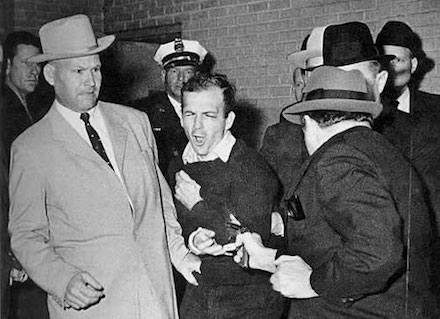
On this date in 1964, Dallas nightclub owner Jacob Rubenstein — notorious to history as Jack Ruby — was condemned to the electric chair for the dramatic live-televised murder of accused John F. Kennedy assassin Lee Harvey Oswald, captured by snapping shutters in one of the 20th century’s indelible images.

Ruby would never sit on that mercy seat.

For one thing, his punishment arrived as the American death penalty lulled into hibernation. Had he lived his sentence eventually would have been vacated by the 1972 Furman v. Georgia ruling. But instead of seeing that juridical landmark, the enigmatic Ruby died in prison inside of three years, awaiting retrial after an appeal.

On this day..