222: Elagabalus

March 11, 222 marked the downfall of the Roman emperor Elagabalus (or Heliogabalus, in the Greek rendering).*

Notorious to posterity for lapping the field in outrageous sensuality, he was the 14-year-old cousin of the deposed brute Caracalla and stepped into the purple because his crafty grandma won the civil war that ensued Caracalla’s assassination.

By family heredity he was by that time already the high priest of the Syrian sun-god Elagabalus,** in the city of Emesa (present-day Homs, Syria). History has flattered the youth with the name of his novel god, although in life the former was simply Marcus Aurelius Antoninus. By any name, his eastern affectations would smell as foul to the Romans.

We’re forever constrained by the partiality of our few sources when it comes to antiquity and the possibility cannot be dismissed that the bizarre and alien portrait remaining us is mostly the outlandish caricature of his foes. However, such sources as we have unanimously characterize Elagabalus as — per Gibbon’s summary — “corrupted by his youth, his country, and his fortune” and it is this that has made his name a western metonym for for the sybaritic Oriental despot. (“I quote in elegiacs all the crimes of Heliogabalus,” patters the Modern Major-General of Gilbert & Sullivan canon.)

But in this they are not faithless to their sources. The ancient chroniclers practically compete for outlandish anecdotes of hedonism (the very dubious Historia Augusta) …

He would have perfumes from India burned without any coals in order that the fumes might fill his apartments. Even while a commoner he never made a journey with fewer than sixty wagons, though his grandmother Varia used to protest that he would squander all his substance; but after he became emperor he would take with him, it is said, as many as six hundred, asserting that the king of the Persians travelled with ten thousand camels and Nero with five hundred carriages. The reason for all these vehicles was the vast number of his procurers and bawds, harlots, catamites and lusty partners in depravity. In the public baths he always bathed with the women, and he even treated them himself with a depilatory ointment, which he applied also to his own beard, and shameful though it be to say it, in the same place where the women were treated and at the same hour. He shaved his minions’ groins, using the razor with his own hand — with which he would then shave his beard. He would strew gold and silver dust about a portico and then lament that he could not strew the dust of amber also; and he did this often when he proceeded on foot to his horse or his carriage, as they do today with golden sand.

… and tyranny (Cassius Dio)

Silius Messalla and Pomponius Bassus were condemned to death by the senate, on the charge of being displeased at what the emperor was doing. For he did not hesitate to write this charge against them even to the senate, calling them investigators of his life and censors of what went on in the palace. “The proofs of their plots I have not sent you,” he wrote, “because it would be useless to read them, as the men are already dead.”


Detail view (click for the full image) of The Roses of Heliogabalus, by Sir Lawrence Alma-Tadema (1888). The work alludes to one of the boy-emperor’s crimes of decadence recounted in the Historia Augusta: “In a banqueting-room with a reversible ceiling he once overwhelmed his parasites with violets and other flowers, so that some were actually smothered to death, being unable to crawl out to the top.”

Most scandalous to Romans, or at least most expedient for his foes’ vituperations, were the adolescent’s outrageous transgressions of masculinity — again, we must underscore, “alleged”. They’re clearly deployed by his enemies to magnify Elagabalus’s cultural easternness, and we might suspect them to also hint at the emasculating power of the teenager’s mother and grandmother who were the true chiefs of state (and who were outrageously admitted to the Senate). Yet if we are to believe the half of what we read of Elagabalus then this effeminate priest-king constitutes one of history’s most notable transgender or genderfluid figures.

Let’s hear at some length from the tittering Cassius Dio, calling the emperor “Sardanapalus” to exoticize him by connection to Assyria.†

When trying someone in court he really had more or less the appearance of a man, but everywhere else he showed affectations in his actions and in the quality of his voice. For instance, he used to dance, not only in the orchestra, but also, in a way, even while walking, performing sacrifices, receiving salutations, or delivering a speech. And finally, — to go back now to the story which I began, — he was bestowed in marriage and was termed wife, mistress, and queen. He worked with wool, sometimes wore a hair-net, and painted his eyes, daubing them with white lead and alkanet. Once, indeed, he shaved his chin and held a festival to mark the event; but after that he had the hairs plucked out, so as to look more like a woman. And he often reclined while receiving the salutations of the senators. The husband of this “woman” was Hierocles, a Carian slave, once the favourite of Gordius, from whom he had learned to drive a chariot. It was in this connexion that he won the emperor’s favour by a most remarkable chance. It seems that in a certain race Hierocles fell out of his chariot just opposite the seat of Sardanapalus, losing his helmet in his fall, and being still beardless and adorned with a crown of yellow hair, he attracted the attention of the emperor and was immediately rushed to the palace; and there by his nocturnal feats he captivated Sardanapalus more than ever and became exceedingly powerful. Indeed, he even had greater influence than the emperor himself, and it was thought a small thing that his mother, while still a slave, should be brought to Rome by soldiers and be numbered among the wives of ex-consuls. Certain other men, too, were frequently honoured by the emperor and became powerful, some because they had joined in his uprising and others because they committed adultery with him. For he wished to have the reputation of committing adultery, so that in this respect, too, he might imitate the most lewd women; and he would often allow himself to be caught in the very act, in consequence of which he used to be violently upbraided by his “husband” and beaten, so that he had black eyes. His affection for this “husband” was no light inclination, but an ardent and firmly fixed passion, so much so that he not only did not become vexed at any such harsh treatment, but on the contrary loved him the more for it and wished to make him Caesar in very fact; and he even threatened his grandmother when she opposed him in this matter, and he became at odds with the soldiers largely on this man’s account. This was one of the things that was destined to lead to his destruction.

Aurelius Zoticus, a native of Smyrna, whom they also called “Cook,” after his father’s trade, incurred the emperor’s thorough love and thorough hatred, and for the latter reason his life was saved. This Aurelius not only had a body that was beautiful all over, seeing that he was an athlete, but in particular he greatly surpassed all others in the size of his private parts. This fact was reported to the emperor by those who were on the look-out for such things, and the man was suddenly whisked away from the games and brought to Rome, accompanied by an immense escort, larger than Abgarus had had in the reign of Severus or Tiridates in that of Nero. He was appointed cubicularius before he had even been seen by the emperor, was honoured by the name of the latter’s grandfather, Avitus, was adorned with garlands as at a festival, and entered the palace lighted by the glare of many torches. Sardanapalus, on seeing him, sprang up with rhythmic movements, and then, when Aurelius addressed him with the usual salutation, “My Lord Emperor, Hail!” he bent his neck so as to assume a ravishing feminine pose, and turning his eyes upon him with a melting gaze, answered without any hesitation: “Call me not Lord, for I am a Lady.” Then Sardanapalus immediately joined him in the bath, and finding him when stripped to be equal to his reputation, burned with even greater lust, reclined on his breast, and took dinner, like some loved mistress, in his bosom. But Hierocles fearing that Zoticus would captivate the emperor more completely than he himself could, and that he might therefore suffer some terrible fate at his hands, as often happens in the case of rival lovers, caused the cup-bearers, who were well disposed toward him, to administer a drug that abated the other’s manly prowess. And so Zoticus, after a whole night of embarrassment, being unable to secure an erection, was deprived of all the honours that he had received, and was driven out of the palace, out of Rome, and later out of the rest of Italy; and this saved his life.

He carried his lewdness to such a point that he asked the physicians to contrive a woman’s vagina in his body by means of an incision, promising them large sums for doing so.

Some books about Elagabalus

The essential problem for Elagabalus was that regardless the precise reality of the behavior his sure cultural distance from Roman manners was also a cultural distance from Roman soldiers — the men whose power to arbitrate succession had placed him in the purple to begin with. The reader may hypothesize the direction of causality but Elagabalus’s historical reputation proves that he failed to bridge that distance.

The fickle Praetorian Guard soon harbored an accelerating preference for Elagabalus’s cousin and heir Severus Alexander, a moderate and respectable Roman youth. Elagabalus triggered his own downfall, and summary deaths meted out to his associates and hangers-on like the hated charioteer/lover Hierocles, with an ill-considered attempt to disinherit this emerging rival. For this narrative we turn to Herodian, a contemporary of events who has disdain for the emperor’s weird god and his “dancing and prancing” but is not nearly so colorful on the subject of his purported sexual depravity. (For Herodian, Elagabalus’s “mockery of human marriage” consists in taking and discarding several different wives, including a Vestal Virgin.)

the emperor undertook to strip Alexander of the honor of caesar, and the youth was no longer to be seen at public addresses or in public processions.

[11 or 12 March 222] But the soldiers called for Alexander and were angry because he had been removed from his imperial post. Heliogabalus circulated a rumor that Alexander was dying, to see how the praetorians would react to the news. When they did not see the youth, the praetorians were deeply grieved and enraged by the report; they refused to send the regular contingent of guards to the emperor and remained in the camp, demanding to see Alexander in the temple there.

Thoroughly frightened, Heliogabalus placed Alexander in the imperial litter, which was richly decorated with gold and precious gems, and set out with him for the praetorian camp. The guards opened the gates and, receiving them inside, brought the two youths to the temple in the camp.

They welcomed Alexander with enthusiastic cheers, but ignored the emperor. Fuming at this treatment, although he spent the night in the camp, Heliogabalus unleashed the fury of his wrath against the praetorians. He ordered the arrest and punishment of the guards who had cheered Alexander openly and enthusiastically, pretending that these were responsible for the revolt and uproar.

The praetorians were enraged by this order; since they had other reasons, also, for hating Heliogabalus, they wished now to rid themselves of so disgraceful an emperor, and believed, too, that they should rescue the praetorians under arrest. Considering the occasion ideal and the provocation just, they killed Heliogabalus and his mother [Julia] Soaemias (for she was in the camp as Augusta and as his mother), together with all his attendants who were seized in the camp and who seemed to be his associates and companions in evil.

They gave the bodies of Heliogabalus and Soaemias to those who wanted to drag them about and abuse them; when the bodies had been dragged throughout the city, the mutilated corpses were thrown into the public sewer which flows into the Tiber.

More detail on reprisals — not exactly dated — comes from Cassius Dio:

His mother, who embraced him and clung tightly to him, perished with him; their heads were cut off and their bodies, after being stripped naked, were first dragged all over the city, and then the mother’s body was cast aside somewhere or other, while his was thrown into the river.

With him perished, among others, Hierocles and the prefects; also Aurelius Eubulus, who was an Emesene by birth and had gone so far in lewdness and debauchery that his surrender had been demanded even by the populace before this. He had been in charge of the fiscus, and there was nothing that he did not confiscate. So now he was torn to pieces by the populace and the soldiers; and Fulvius, the city prefect, perished at the same time with him.

The History of Rome podcast covers Elagabalus in episode 104.

* As pertains the mandate of this here site Elagabalus’s death is far more a murder than an execution, while the actual and threatened executions surrounding this murder are not necessarily dated, and verge towards lynchings. But between them we have a patina of somewhat orchestrated state violence with a somewhat dependable calendar peg that will suffice for a worthy cheat.

** The deity Elagabalus was among several pagan forerunners of the later sun god Sol Invictus, whose cult in turn became eventually conflated with another strange Asian religion, Christianity. There is a reading (distinctly a minority one) of Elagabalus as Rome’s Akhenaten, an unsuccessful proto-monotheist traduced by the incumbent priests who defeated his before-his-time religious revolution.

† Cassius Dio was a senatorial historian which both positioned him to know the scandalous things he reported and problematically incentivized him to concoct scandalous things to report. In particular we should note that Elagabalus’s successor Severus Alexander was personally and politically tight with Cassius Dio and, the historian boasts, “honoured me in various ways, especially by appointing me to be consul for the second time, as his colleague, and taking upon himself personally the responsibility of meeting the expenditures of my office.” In reading Cassius Dio we read the party line of the post-Elagabalus regime.

On this day..

1291: Sa’ad al-Dawla, grand vizier

On this date in 1291, Sa’ad al-Dawla, a Jewish physician become grand vizier, was put to summary death as his patron and protector Arghun Khan lay expiring on his deathbed.

The story has it that Sa’ad won the khan’s confidence by a successful medical consult, and then told the big guy all about the corruption of his courtiers.

This descendant of Genghis Khan* knew an able servant when he saw one and Sa’ad soon had charge of the empire’s finances — the latter not failing to exercise the patronage prerogatives of his office on behalf of his own kith and kin. For the khan, a Buddhist heir to steppe conquerors, he was an able man to make the caravans run on time and the treasuries burst with gold. The Muslim populace saw it a bit differently, as one Baghdad poet gibed:

The Jews of this our time a rank attain
To which the heavens might aspire in vain.
Their is dominion, wealth to them does cling,
To them belong both councillor and king.
O people, hear my words of counsel true
Turn Jew, for Heaven itself has turned a Jew!

(Source)

We have seen many times in these pages that upstart administrators elevated by the caprice of the sovereign — Jews or otherwise — often risk an extremely perilous situation should their master predecease them. Sa’ad had resentment in proportion to his power … and when the khan fell ill, the former redoubled while the latter vanished.

Expediently accused of poisoning the dying Arghun Khan, Sa’ad was seized in the royal camp and given over to summary execution/murder. (Less exalted Jews in Baghdad faced a less exalted riot.)

* Arghun Khan’s grandfather Hulagu Khan was Genghis Khan’s grandson. Hulagu Khan has been seen in these pages, for he conquered Baghdad and executed the last Abbasid caliph in 1258.

On this day..

1882: Dead Shot, Dandy Jim and Skippy, mutinous Apache scouts

On this date in 1882,* the U.S. Army hanged three White Mountain Apache scouts as mutineers.

This small tragedy in the long-running Apache Wars of the American Southwest had its seeds in the 1870s, when the Army forced onto the San Carlos reservation several bands of Apache peoples, including the Chiricahua, Yavapai, and the Western Apache nations of Tonto, White Mountain, and Cibecue.

The concentration proved potent, unexpectedly so since the tribes in question were not all on friendly terms with one another.

Noch-ay-del-klinne (many other transliterations are possible), an influential White Mountain medicine man of 36 summers or so — and a man who had been to Washington DC with a peace delegation and laid his own eyes on the encroaching industrial civilization — began cultivating something very like a ghost dance for the San Carlos Indians.

Though the ghost dance is most closely associated with the Lakota Sioux, several years and several hundred kilometers’ distance from the Apache of Arizona, the movement actually originated among the much nearer Nevada Paiute. Incarnations of ghost dancing throughout the American West gave a millenial expression to indigenes’ shared trauma of defeat, displacement, and death.

Noch-ay-del-klinne’s rituals were called Na’Ilde’, meaning raising from the dead,** and his prophesy that lost comrades would rise from their graves and the white man would vanish from Apache lands when the corn was ripe, spoke to that trauma for the denizens of the San Carlos reservation — and alarmed the U.S. Army troops stationed at nearby Fort Apache. Especially troubling was the “fraternizing that went on between tribes and elements of tribes which had always held for each other the most deadly aversion,” in the words of the later memoir of Thomas Cruse, who commanded the army’s company of native Apache scouts. He had granted leave for some of his scouts to attend these dances and didn’t like what he saw when they returned.

After the medicine dances began around the post I noticed a change. Generally they [the scouts] are very ready to communicate anything they know or may have seen, but after these dances they became very uncommunicative and would not tell anything that was going on among the other Indians or among themselves … when they came back they were not only exhausted and unfit for duty, but they showed surliness and insubordination. They grumbled constantly and made vague remarks about the country being theirs, not ours. Dozens of small incidents showed that something, or someone, was giving them new thoughts.

Cruse gave a grim — and as events soon proved, sound — assessment of his men’s unreliability: “he entirely distrusted his scouts in event of the rising of the White Mountains and believed all or nearly all would go with the enemy.” But the affirmative reply to Cruse’s plea to discharge the unit was delayed due to telegraph problems by the time that unit set out with Col. Eugene Asa Carr on an August 1881 mission to arrest Noch-ay-del-klinne.†

This incursion, which will set in motion dozens of untimely deaths, was entirely aggressive, justified by no act of overt hostility by the Apache. Although Cruse was writing many years after the fact, his complaints about his subalterns’ “surliness” and “new thoughts” have the ring of the boss’s know-your-placeism, as directed in this same period at social insubordination elsewhere in the American experiment — at organized labor, for example; or at Black men and women.

The army found the medicine man and took him into custody on August 30. That evening, as the troop bivouaced down for the night, Apaches began gathering ominously beyond their fringes. They were visibly armed, and unhappy about the unprovoked seizure of Noch-ay-del-klinne; according to an oral history relayed by Tom Friday, the orphaned son of one of the men destined for the gallows in this post, “All Cibecue Indian people know that the soldiers were coming. They were ready for them. They were ready to fight. They sent word to all Indians, ‘Come, clean your guns; get ready.’ … The Indians were very angry: they had done no wrong and could not understand why the soldiers would come.”‡

Whether upon an arranged signal or merely the alert of the sort of random confrontation this situation invited, those Apaches started firing at the army camp — and as Cruse had anticipated, his scouts in the breach adhered to their people, not the flag.

The Battle of Cibecue Creek could easily have wiped out the expedition, for as one of their number named William Carter later wrote, there were at the outset of “more than 100 Indians besides the scouts in camp, and less than forty dismounted men engaged in a hand-to-hand conflict.”

In averting catastrophe, Carr was one of four U.S. soldiers to earn the Medal of Honor for gallantry in the battle, repulsing the hostiles from the camp and scrambling his surprised men to hold off any further attacks until night dispelled the combatants. He also had Noch-ay-del-klinne summarily shot during the fight. Carter again:

Before leaving the field Colonel Carr sent Lieutenant Carter to examine the body of the Medicine Man and determine if life was extinct. Strange to say, notwithstanding his wounds [he’d been shot in the head -ed.], he was still alive. The recovery of this Indian, if left in the hands of his friends, would have given him a commanding influence over these superstitious people, which would have resulted in endless war. Colonel Carr then repeated the order for his death, specifying that no more shots should be fired. Guide Burns was directed to carry out the order with the understanding that a knife was to be used. Burns, fearing failure, took an ax and crushed the forehead of the deluded fanatic, and from this time forward every person murdered by these Apaches was treated in a similar manner.

Carr’s bloodied expedition proceeded that night upon a forced march for the safety of Fort Apache, reaching it the following afternoon — although “many of the Indians had preceded the command, and all night they were haranguing in the vicinity. They covered the roads and trails, and killed a number of citizens.” The fort came under a brief siege in the ensuing days, and hostilities in the resulting regional uprising dragged on for two years, concluding with the outcome customary for the Apache Wars.

Four of the absconded scouts were arrested in the months ahead and tried at court-martial. (Other captured Apache who were not enlisted in the army were not prosecuted for the firefight.) A Private Mucheco was sentenced to hard labor at Alcatraz. The other three, sergeants jauntily known to the whites as Dead Shot, Dandy Jim, and Skippy,

On the appointed day, per a detailed report in the New York Herald (March 4, 1882),

Wagons of all descriptions loaded with men anxious to see the execution of the Indian scouts, Dead Shot, Dandy Jim and Skippy, came pouring into this place from Wilcox, Thomas, Safford and all points from very early this morning. The time not being known at which the event would take place, there was a state of suspense until the moment arrived for the execution. The gallows was erected in front of the guard house and was fourteen feet high, with a platform six feet four inches from the ground and a distance of seven feet four inches from the floor to the gallows pole. The whole measured twelve feet in length by eight feet wide. The rope used was three-quarters of an inch thick and the drop was four feet six inches.

Dandy Jim, from this forum thread.

[On the scaffold] Dead Shot said he had nothing to say. What was being done was correct. He would probably meet his people. He had suffered much in this world and now he was through and would see his people. Since he first saw white men he had been well treated. He had plenty to eat and plenty of clothes, but this day paid for all he got from the white men. He also said Dandy Jim was a nephew and Eskiticha, or “Skippy,” a cousin of his. He had seen a good many of his people die and did not know where they went, but he was going to follow. He thought there was no use in dressing an Indian up as he was and then hanging him. When he came into San Carlos, if he had done anything wrong, he would not have given himself up, yet he gave up his rifle and the twenty rounds of ammunition that were furnished him at Camp Apache.

Dandy Jim said he had to be hanged, as such were the orders. He could not talk much. It was no use to beg for his life, as people would only laugh at him for his trouble. Eskiticha said: — “The sun is going down, and God is looking after me.” He did not think they were doing right, as he had never done anything to warrant being hanged.

The chaplain, Rev. A.D. Mitchell, then repeated a short prayer, which was interpreted by Merijilda, when all retired from the scaffold, except the hangman, a military prisoner. The black caps were then placed over the heads of the men, and at one o’clock the drop fell. Death was instantaneous in the case of Dead Shot and Eskiticha; Dandy Jim quivered once or twice. After being allowed to hang about twenty minutes they were cut down and pronounced dead by the doctors.

* The same date as an unrelated Mississippi double hanging, previously covered in these pages.

** According to John R. Welch, Chip Colwell-Chanthaphonh and Mark Altaha in “Retracing the Battle of Cibecue: Western Apache, Documentary, and Archaeological Interpretations,” Kiva, Winter 2005. Noch-ay-del-klinne had some exposure to Christian doctrine, which seems present in his own movement’s interest in resurrection.

† Also in the scouting party for this mission was famed frontiersman and eventual Executed Today client Tom Horn.

‡ Thomas Friday’s full account of this affair — which is a second-hand version, since Friday himself was a small child at this time — comes courtesy of William B. Kessel in “The Battle of Cibecue and Its Aftermath: A White Mountain Apache’s Account,” Ethnohistory, Spring 1974.

On this day..

1896: Ivan Kovalev, Russian meddler

On this date in 1896, Russian refugee Ivan Kovalev was hanged for a Sacramento double murder.

Kovalev and nine other Russian convicts had in 1893 fled from the most remote and dreaded of Russia’s Far East penal colonies, Sakhalin Island.

They might have met Anton Chekhov when he visited in Sakhalin in 1890 to compose the investigative articles that would become his book Sakhalin Island, one of the great pieces of journalism of his time. “Utter hell,” the great playwright mused of that brutal and befogged colony. “I feel that if I were a convict, I would escape immediately, whatever the consequences.”

Kovalev and nine mates felt exactly the same and they did it in the form of a downright suicidal flight from Sakhalin’s abyss in an open launch ventured into the Pacific in hopes of reaching Japan. They were on the brink of succumbing to their privations when they were miraculously picked up by a San Francisco-based whaler, the Charles W. Morgan.**

The convicts claimed that they were escaped political prisoners, a demographic that enjoyed western sympathy; there’s every chance that they were actually violent criminals but their tale of woe in the bowels of tsardom was persuasive and times being what they were a background check with the nearest consulate was not an option. The Sakhalin escapees were allowed to stay in California.

On December 30, 1894, about sixteen months after they drew their last moldy Sakhalin rations, Kovalev with two accomplices† bashed the brains out of the aged grocer F.H.L. Weber and his wife with an axe so that they could rob his store. Chekhov? Make that Dostoyevsky.

It took several months to zero in on the perpetrator but once the conviction was secured, indignant Sacramentans applied in record numbers for passes to attend the hanging, such “a spirit of enmity and hatred toward this son of far-away Russia” having been aroused by the horrid circumstances of the butchery that “it is evident that a spirit of satisfaction is abroad in the community at the thought that … Ivan Kovalev will expiate that crime with his life.”

* The New York Public Library hosts a digital collection of photos of the Sakhalin penal colony, here. Others can be browsed at the Sakhalin Regional Museum site.

** The Charles W. Morgan had an 80-year service history; it’s been restored and can be visited in Mystic, Connecticut.


1971 U.S. postage stamp commemorating the Charles W. Morgan‘s preservation.

† The accomplices don’t figure in the execution story: one was mortally wounded in an unrelated subsequent robbery, prior to Kovalev’s arrest; the other wound up serving time for burglary.

On this day..

1917: The only triple hanging in Montana

Anaconda Standard, Jan. 11, 1917:

The story of the crime was that seven negroes boarded an eastbound freight train on the Great Northern railway at Nihil on Oct. 5 with the intention of beating their way. They found the car they boarded, a gondola loaded with lumber, already occupied by three white men. The deceased [Michael Freeman] and two companions, Earl Fretwell and Claud C. Campbell. The negroes first went through the white men, obtaining a small sum of money and some trinkets, and then directed them to get off the train, which was going at the rate of 30 miles an hour. The men begged to be allowed to remain on the train until it stopped or slowed down. Fretwell started to comply, being urged by blows, and was struck on the head with a revolver and fell from the car. Campbell jumped from the train, followed by a fusillade of shots. Freeman was shot from behind, the bullet entering his back, and his body thrown from the train, being found alongside the track the next morning.

National Public Radio, July 2, 2014 (associated audio story):

“I was curiosity with a ‘C.’ I just started to pepper him with questions — ‘Oh, Grandpa, what was it like? Did they lose their heads? Did their eyes bug out? Did everybody cheer? Did everybody cry?'” Zachary says.

“And he raised a hand, which told me to shut up. And he said three words: ‘It was awful.'”

On this day..

1584: Five Catholic priests

John Hungerford Pollen collected and translated this document in Unpublished Documents Relating to the English Martyrs. It comprises the testimony of a friendly Catholic witness to the martyrdom of five priests at Tyburn on this date in 1584, as conveyed to another priest, the future martyr Robert Southwell. The historical moment for these martyrdoms was the weeks following the exposure of the Catholic Throckmorton Plot; most of the priests had been in prison many months, but appear to have their martyrdoms catalyzed by a seemingly perilous security situation.

The Martyrdome of Mr Haddock, Emerford, Fenn, Mutter, priests.

The 6 day of February Mr Heywood and five other priests were brought to the Kings-bench barre, indited of high treason for conspiring at Rhemes and Rome, as it was surmised against F. Campian. They all pleaded not guilty and so were conveyed to the Tower. F. Haywood was in Jesuit’s weed, so grave a man as ever I sett my eyes upon, he wore a coate of black very low and upon the same a cloke of black, downe almost to the grownde. He had in his hand a black staff and upon his head a velvet coyfe and there upon a broade seemly black felt.

The 9 [sic] of February the five priests were brought againe to the barre, and arrained upon the former endightment: they pleaded and protested innocency. Their old friend [Charles] Sledd [an informer noted, like George Eliot, for turning in Catholic priests -ed.] gave in evidence against them: The Jury found them out of hand Guilty, and the Judge gave sentence of death. Whereupon the priests soung Te Deum and such like godly verses.

Upon Wednesday being the last day of the Terme, these five priests were drawen from the Tower to Tyborne upon hurdles; the first that was brought into the cart under the gibbet was Mr Haddock, a man in complexion fayre, of countenance milde, and in professing of his faith passing stoute. One of the Sherifs called Spencer much incensed against them, together with certaine ministers bad Mr Haddock confesse the fact and ask the Queen forgivenesse. Whereupon Mr Haddock calling God to witnesse, protested upon his soule that he was not guilty of the treason, and therfore would not aske the Queen forgivenesse: and further sayd, ‘I take her for my lawfull Queen, I have seyd this morning these many paternosters for her, and I pray God she may raigne long Queene. If I had her in the wildernesse I would not for all the world putt a pinn towards her with intent to hurt her.’

Then seyd the Sherif Spenser, ‘There is since thy arrainment worse matter found against thee [by Munday the spye]’: Whereunto answered Mr Haddock, ‘You have found nothing since; and soe belyke I was wrongfully arrained.’

Then Antony Munday was brought in, who uttered these speeches, ‘Upon a time you and I, with another whose name I have forgotten, walking together at Rome, the other wished the harts [Munday actually said ‘heads’ -ed.] of 3 of the nobility being of her counsell. Whereupon you sayd, M. Haddock, To make up a masse, I would we had the hart [head] of the Queen.’

Then sayd Spenser and other of his officers, ‘Away with the villaine traytor.’

But Mr Haddock, moved with these foresaid talke and speeches sayd as followeth. ‘I am presently to give an account [of all that I have done during life before the tribunal of God]; and as before God I shal answer, I never spake nor intended any such thing. And Munday, if thou didst heare me speak any such thing, how chanced it thou camest not to the barre to give this in against me upon thy othe.’ ‘Why,’ sayd Munday, ‘I never heard of your arraingement.’

Then said Spencer, ‘Didst not thou call the Queen heretick?’ ‘I confesse,’ sayd Haddock, ‘I did.’ Whereupon Spencer together with the ministers and other of his officers used the aforesaid speeches of treason, traytor, and villaine.

Mr Haddock sayd secretly a hymne in latin and that within my hearing, for I stood under the gibbet. A minister being on the cart with him, requested him to pray in English that the people might pray with him. Where upon Mr Haddock put the minister away with his hand, saying, ‘Away, away, I wil have nothing to doe with thee.’ But he requested all Catholics to pray with him and for his country. Where upon sayd one of the standers-by, ‘Here be noe Catholicks’: ‘Yes,’ sayd another, ‘we be all Catholics.’ Then sayd Mr Haddock, ‘I meane Catholicks of the Catholick Roman Church, and I pray God that my bloud may encrease the Catholick faith in England’: whereunto sayd Spenser: ‘The Catholic faith, the devel’s faith. Away with the traytor Drive away the cartel’ And so Mr Haddock ended his life, as constantly as could be required.

When the cart was dryven away, this Spenser presently commanded the rope to be cut, but notwithstanding the officer strock at the rope sundry times before he fell downe; and the reporte of them that stood by the block was that at what time the tormenter was in pulling out of his bowells, Mr Haddock was in life. By his own confession he was 28 yeares of age.

After Mr Haddock was taken to the block Mr Hemerford was brought unto the cart; he was very milde, and sometime a scholler of St John’s College in Oxford. Spenser bad him confesse and aske forgivenesse as before: but he protested innocency as Mr Haddock had done; yet sayd, ‘Where in I have offended her, I ask her forgivenesse, but in this fact of treason alleaged against me, I never offended.’

Then sayd a minister, master of art of St John’s College of Oxford, ‘You and I ware of old acquaintance in Oxford, by which I request you to pray openly and in English, that the people may pray with you.’ Then said M Hemerford, ‘I understand latin well enough, and am not to be taught of you. I request only Catholicks to pray with me.’ Where upon answered the minister, ‘I acknowledge that in Oxford you were alwaies by farre my better. Yet many times it pleaseth God, that the learned should be taught by the simple.’ One Risse termed a Doctor of Divinity, asked Mr Hemerford whither he would hold with the Pope or the Queen, in case the Pope should send an army into England. Whereunto Mr Hemerford answered, That in case they were sent in respect of the Pope’s own person, then he would holde with the Queen; but if it were sent to suppresse heresy or to restore the land to the catholick faith, then he would holde with the Pope. His speech was short being not permitted to speak much, and in substance the rest of his speech, not here sett down verbatim, was to the same effect that Mr [Haddock’s] was. He was cutt downe half dead: when the tormentor did cutt off his membres, he did cry ‘Oh! A!’ I heard my self standing under the gibbet.

Mr Fenn was the third that suffred, being bidd to doe as before, answered as his fellows did & sayd. ‘I am condemned for that I with Ms Haddock at Rome did conspire, & at which time Mr Haddock was a student at Rome and I a prisoner in the Marshalsea, or at the lest I am sure that I was in England, but to my remembrance, I was a prisoner in the Marshalsea. Therefore good people judge you whether I am guilty of this fact or noe.’

A minister called Hene avouched a place of St Paul whereunto Mr Fenn said: ‘I am not to be taught my duty by you.’

The rest of his speeches were to the same effect his fellows were. Before the cart was driven away, he was stripped of all his apparell saving his shirt only and presently after the cart was driven away his shirt was pulled of his back, so that he hung stark naked, where at the people muttered greatly, and the other sherif, called Massam, sayd to the officers, ‘You play the knaves. They be men. Let them be used like men,’ and alwaies commanded that they should hang until they were dead. Notwithstanding the other sherif commanded that they should be cut downe presently, and soe was Mo Fenn, but his companions following him were permitted to hang longer.

Mr Nutter was the 4th man, sometime schollar of St John’s College in Cambridge, and Mr Munden was the fifth & last: they denyed the fact, acknowledged the Queen Majesty to be their Queene and prayed for her, as the former had done, and soe in most milde and constant manner ended their life. Many a one in my hearing sayd, ‘God be with their sweet soules.’

What I have putt downe I hard myself, and therefore I may boldly speake it. If you please, you may shew it to your friends, provyded alwaies you tell not my name.


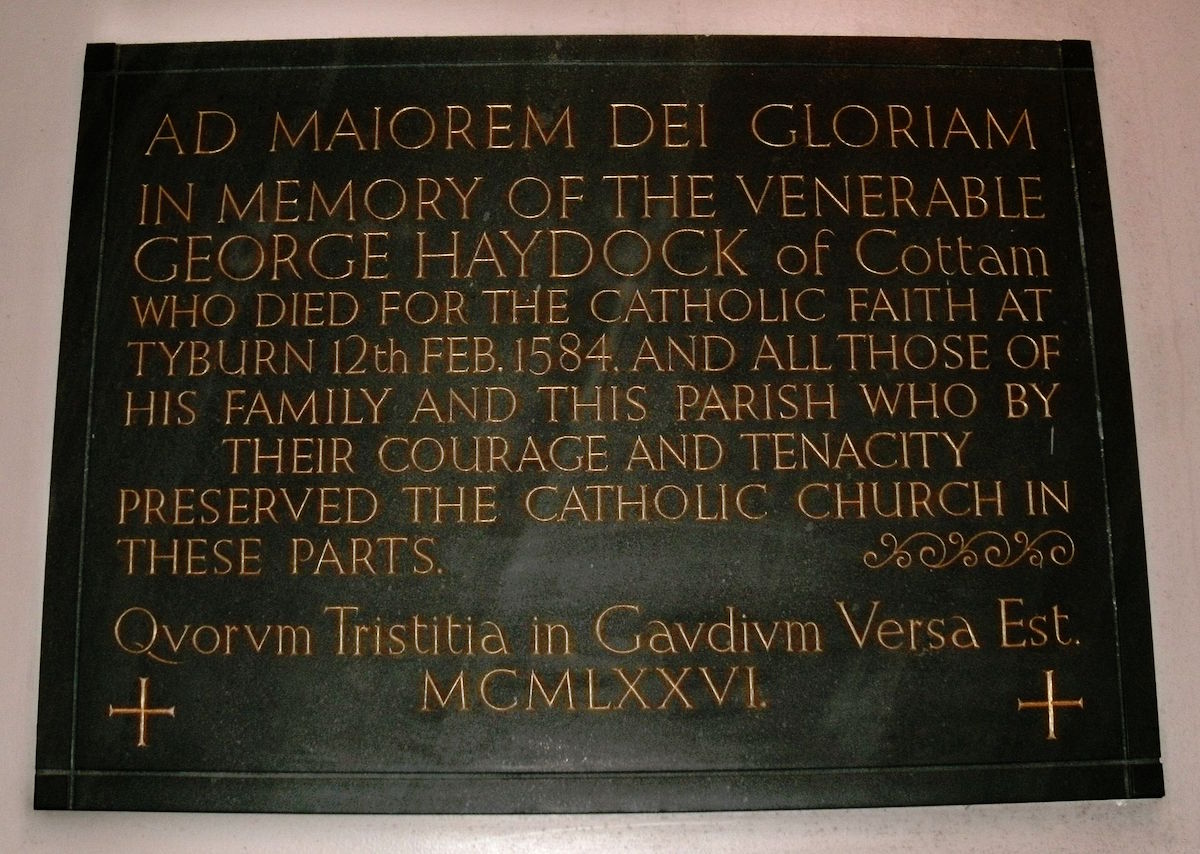
Plaque honoring George Haddock/Haydock at St. Andrew’s & Blessed George Haydock’s Catholic Church, Cottam, Lancashire. (cc) image by Skodoway.

On this day..

1886: Henry Jackson, religiously inclined

From the New York Times, Jan. 23, 1886:

NEW-ORLEANS, La., Jan. 22. — Last July Henry Britton, of Minden Junction, was found murdered in his store. He had been shot through an open window with a shotgun and his brains blown out. The murderer, it was subsequently shown, deliberately crawled into the store window over the dead body, took down some sardines from the shelf, opened them, and made a meal. After eating he rifled the cash drawers and the dead man’s pockets, securing about $130 in money and two watches. He then went out the front door, taking the key which had been left sticking into the lock on the inside. He closed the door and carried away the key. The next morning, which was Sunday, a negro named Henry Jackson appeared at the negro church at Arcadia, 10 miles away, took a prominent part in the services, and contributed liberally to the church. On Monday morning, as soon as the business houses were opened, Jackson commenced purchasing goods freely, which led to a suspicion of his being the man who committed the murder.

Jackson was arrested, and when searched the money and watches — one of them with the murdered man’s initials on it — and the store key were found on him. He stoutly asserted his innocence until he was returned to Minden and jailed. He then confessed. He said that he knew Britton had money, and he murdered him for it. Jackson was tried by a jury composed of his own color, who found him guilty of murder in the first degree, without leaving their seats. He was sentenced to be hanged on such day as the Governor might name. He experienced religion a week after he was jailed, and he said that the Lord had forgiven him, and he was going straight to heaven.

The murderer was hanged to-day, and the event is notable in consequence of his being the first person ever legally hanged in Webster Parish. He came down the stairs to the gallows singing a negro revival hymn at 12:50 in the presence of the Sheriff, his deputy, and the witnesses allowed by law. The rope holding the trap on which the prisoner stood was cut, and in 15 minutes the doctor declared the man dead. His neck was instantly broken, and there was every indication of an instantaneous death. Jackson was singing a hymn when the trap fell.

On this day..

1890: Three hangings in Louisiana

From the New Orleans Times-Picayune, Jan. 18, 1890:

CLINTON, La., Jan. 17. — [Special.] — At 1:15 this afternoon the witnesses summoned by the sheriff proceeded to the jailyard where the scaffold had been erected. A few minutes later Charles and Isaiah Dent were led from their cells and up the steps to the platform, which overlooked a space where quite a large crowd had gathered outside the inclosure around the jail.

Both men walked firmly, Isaiah showing throughout wonderful nerve, and Charles, though a little shaky, apparently ready to meet his fate without quailing.

When they first reached the platform they seemed to be praying half audibly. While Sheriff Woodward read the death warrant both men looked about them, seemingly not more concerned than if they were only disinterested spectators of the scene. Charles Dent nodded his head assentingly each time the officer paused in his reading.

At the end of a sentence Sheriff Woodward asked them if they wished to say anything. Isaiah said, “I want to speak to them people,” indicating the crowd on the outside. “Friends and foes,” he said in a clear voice, “let this be a warning to all; don’t do like Isaiah.” After a pause he continued, “My home will be in heaven.”

When he had ceased Charles said, “Charles Dent, the same. If I hadn’t went down the road this wouldn’t have happened, but I didn’t do no shooting.”

The black caps were drawn over the heads of the doomed men. The rope that supported the trap was cut and the two fell together a distance of about 8 feet. Their necks were both broken and their agony was soon over, the pulse of Isaiah ceasing to beat within 3 minutes and all signs of life being extinct in Charles in 12 minutes.

Everything connected with the execution was skillfully arranged and quickly and smoothly carried out by the sheriff and his efficient deputies.

THE CIRCUMSTANCES OF THE CRIME

for which Isaiah and Charles Dent were executed were as follows:

Herman Praetorius, a German merchant and farmer living at Ethel, on the Louisville, New Orleans and Texas Railroad, had been furnishing supplies to the Dent brothers. Along in the summer some cause of disagreement arose and ill-feeling between the merchant and his customers became intense and the relationship between them, as such, came to an end.

Late in the afternoon on Monday, July 1, of last year, while Praetorius was returning from a visit to a plantation several miles from home, he had occasion to pass near where the Dent brothers live. Evidence on the trial showed that as he came into the public road by a bypath Charles and Isaiah Dent, two brothers, and a brother-in-law of theirs were standing a short distance up the road, in an opposite direction from that in which he was going, and that they called to him and he turned and rode back to where they were standing. Some loud words were heard and Praetorius was seen to turn to ride away from the party of negroes, who were armed and making angry demonstrations. Just as he was riding away Charles and Isaiah Dent were seen to raise their shotguns, the reports of which were heard, and Praetorius fell from his horse, shot to death. His murderers fled, Charles and Isaiah escaping to Pointe Coupee parish, the other three participants, David and Clark Dent and Frank Cooper, being subsequently arrested and placed in jail in Clinton.

After some time Charles and Isaiah Dent were

APPREHENDED IN POINTE COUPEE

and likewise lodged in jail in Clinton. Public indignation was at a fever heat and an ineffectual effort was made to hang the two principal murderers by the processes of Judge Lynch’s court. For greater security the two prisoners were taken to New Orleans and confined in the parish prison until the next term of court, which met in September.

The grand jury promptly indicted the five men for murder.

The attorneys for the Dents, Messrs. E.T. Merrick, Jr., of New Orleans, and Judge J.G. Kilbourne of Clinton, filed a motion for a change of venue, which was overruled by the court.

THE TRIAL

excited a great deal of interest and occupied several days. The result was a verdict of guilty, without qualification, as to Charles and Isaiah Dent, which consigned them to the gallows.

Frank Cooper went to the penitentiary for life and Clark and David Dent for lesser terms.

The condemned men have since their arrest steadfastly maintained that the killing of Praetorius was done in self-defense, though the testimony of eye-witnesses to the contrary was irrefutable. Isaiah has taken his fate philosophically, and seemed resigned from the time he learned the decision of the district court had been affirmed by the supreme court, to which an appeal had been taken, but his brother Charles has taken the matter much harder.

James Holcombe’s Crime.

BONNET CARRE P.O., St. John the Baptist Parish, La., Jan. 17. — [Special.] — At dusk of day, Nov. 12, 1888, as James Holcombe and Emile Ambroise were returning from Waguespack’s plantation, where they were employed, they met Madeleine Will, a pretty colored girl, on the railroad track back of Angelina plantation in this parish. Holcombe on seeing her whispered a few words to Ambroise and advancing toward Madeleine began a conversation with her. A few minutes after Ambroise, who was a short distance away, heard a shot fired, and thinking it was intended for him ran off. In his flight he was met by young Brignac, to whom he related the story, and as Brignac came to the spot he found Madeleine Will gasping her life away, whilst Holcombe was reclining over her body.

Brignac ran to the neighbors and related what he had seen, but when they came to the spot Madeleine Will was dead and James Holcombe had disappeared.

The next day the coroner held an inquest over the body and the jury found that

MADELEINE WILL CAME TO HER DEATH

from a gunshot wound inflicted by James Holcombe and Emile Ambroise.

On the 14th of November, 1888, the accused were arrested and committed to jail without the benefit of bail.

Seven months after, on the 5th of June 1889, the grand jury then in session found a true bill of murder against both Holcombe and Ambroise. On motion of District Attorney Leche their case was then fixed for June 14, 1889.

In the meanwhile the dastardly deed had created so much excitement that two of our most prominent citizens took steps towards raising a fund to aid in the prosecution of the case.

On the day fixed for the trial the case was continued to the 15th of June, 1889, when it was regularly taken up and proceeded with.

THE STATE

was represented by Judge Gervais Leche of St. John and Chas. A. Baquie of St. Charles. Ambroise was represented by H.N. Gantier of Jefferson, and James Holcombe having no means to employ counsel, the court appointed P.E. Edrington to take charge of his case.

After a little trouble the following jury, composed of four white and eight colored men, were impaneled: Paul Webre, Jefferson Coleman, Valery Barre, Felicien Landeche, Firmin Clement, Theo. Haydel, Felix Martin, Joseph Sandez, Francois Mathieu, Alfred Vicksnair, Gustave Delonde and Bernard Orbien.

After the state had heard from four of its witnesses it was evident that it would fail in its case, as the evidence was circumstantial and not of a nature to convict, so District Attorney Leche abandoned the state’s case against Emile Ambroise and placed him on the witness stand.

THE GUILT OF JAMES HOLCOMBE

was then clearly proven.

The case was submitted without argument, and after hearing the judge’s charge the jury retired to their room, when in fifteen minutes they returned a verdict of guilty against James Holcombe as charged and not guilty as to Emile Ambroise.

On the 20th of June, 1889, counsel for Holcombe made a motion for a new trial, which was heard on the day following and the motion denied by the court. On the same day a suspensive appeal to the supreme court was granted, and that ribunal on the 13th of December, 1889, affirmed the judgment of the lower court.

On Jan. 6, 1890, the governor fixed the day of execution to be on Friday, Jan. 17, 1890.

James Holcombe was a thick set negro of the true African type, 5 feet 4 inches tall, weight 155 pounds, and 21 years old. He had taken everything philosophically so far, and it was only to-day that he evinced some uneasiness. Charitably disposed persons frequently sent him delicacies, such as champagne, fruits and cakes, all of which he seemed to relish, but his favorite dish was ham and rice, cooked together.

THE EXECUTION

took place yesterday at the courthouse. James Holcombe spent his last night on earth in an apparently comfortable manner, although he would accept of no nourishment, on this, the last day of his existence.

To questions propounded by your correspondent, his answers were that he was reconciled to his God, and willing to meet his fate.

When dressed for the scaffold the greatest coolness was shown, helping his minister to dress him. His march on the scaffold was firm and in his farewell address to the fifteen witnesses present he reiterated his innocence, saying that the God who was to receive his soul this day would in the close hereafter receive the soul of the party who committed the crime.

At 12:17 p.m. the black cap was adjusted and after prayers offered by the Rev. Baily Lee the trap was sprung, his neck was broken and death was instantaneous.

The rope was cut down at 12:49 p.m. and his body delivered into the hands of the parents of the condemned at his own request.

Credit is due to our efficient sheriff and his able deputies for the manner in which the execution was performed.

On this day..

1772: Bryan Sheehen, cuck

Colonial Massachusetts sailor Bryan Sheehen culminated a life of warped relations with the opposite sex at his hanging on this date in 1772.

According to the pamphlet An Account of the Life of Bryan Sheehen, as a child in Ireland, Sheehen‘s family split up by gender with the Catholic father taking the boys and the Anglican mother taking the girls. While the legacy of this childhood trauma can only be guessed at, it looks suggestive in hindsight

Sheehen migrated to Newfoundland and then to Massachusetts where he eventually indentured himself as a household servant to colonial shipwright Benjamin Hallowell, a “father” from whom the young adult Sheehen again fled, this time to fight in the Seven Years’ War.

Unfortunately upon his return from only six years away he found that his wife had impatiently [re]married herself to a Frenchman, a humiliating risk and fear of the seagoing set. Sheehen forced the woman to choose between the rivals but when she chose Sheehen, the latter found that he was still so disgusted with her that he preferred to abandon the wife, and the child she had borne him, and the child she had borne the Frenchman. Psychologists have a lot to unpack here already.

Relocating to Marblehead, Mass. our reborn swinging single now developed “the character of a wicked, profligate person” and eventually began stalking a woman named Abial Hollowell … her surname eerily echoing that of Sheehen’s own former master. In fact, Abial’s husband was also named Benjamin Hollowell. His advances rebuffed, Sheehen

went up, in the middle of the night, to the room where Mrs. Hollowell lay, found her asleep, awaked her, and swore, if she made the least noise, he would kill her; and then stopping her mouth, perpetrated the atrocious crime. After which (to prevent, it seems, a pregnancy) he abused her with his hand, in an unheard-of, cruel and shocking manner: Insomuch that her life was for some time almost despaired of; and she was not able for ten days after to get off her bed without help.

That’s as per a case summary appended to “A Sermon Preached at Salem, January 16, 1772” by the Salem Rev. James Diman. The good preacher was so chagrined that Sheehen’s persistent denials had led some citizens to murmur against Mrs. Hollowell that for “justice to the woman’s character” he devotes about a page and a half to traducing Sheehen’s. Sheehen, Diman charged, was just the sort of vicious wretch who would imperil his soul by going to the gallows with a lie upon his lips, perhaps because, as a Catholic, “he might swear falsely, he might doubtless speak falsely to Hereticks, as they call all whose religious principles differ from theirs.”

Last and most important, Diman claimed to have it on good authority from “two credible persons”

that there was a young woman, daughter of one Williams, of Goldsborough, in the Eastern part of this province, abased in the same manner Mrs. Hollowell was. That she was way-layed in the the evening, between her father’s house and a neighbour’s; was seized, forced, and wounded to such a degree, that her friends were obliged to carry her home, she being unable to walk, and that the next morning early she died. That the villain, who perpetrated this crime, returned after he had done it, to his companions, who, it seems, were before, or then, made acquainted with his enterprize; for such wretches declare their sin as Sodom: And that one of them told him he would probably have a child to maintain: He answered so, that he had taken care to prevent that, and that she would never have a child by him, nor by any other man.

This guy, his informants said, was an Irishman named something like Bryan Sheehen — and he had escaped town after the incident.

* The Hallowells were notable British loyalists during the American Revolution, and returned to England when their estates were sacked by Patriots. The grandson of Bryan Sheehen’s employer, Admiral Sir Benjamin Hallowell Carew, was one of Lord Nelson‘s Band of Brothers. During the Battle of the Nile, Admiral Hallowell’s supplied the literal fireworks by defeating the French battleship Orient — whose spectacularly exploding magazines highlighted all the artistic commemorations of that victory. He later presented to Nelson as a gift a coffin fashioned from the Orient‘s mast, “that when you have finished your military career in this world you may be buried in one of your trophies.” Nelson was indeed laid to rest in Hallowell’s trophy in 1805.


The flaming Orient illuminates Thomas Luny’s Battle of the Nile, August 1st 1798 at 10 pm.

On this day..

1811: The slaves of the German Coast Uprising

Villainous blacks, and MORE VILLAINOUS WHITES who have reduced to the level of the beasts of the field these unhappy Africans — and are now obliged to sacrifice them like wild beasts in self preservation! The day of vengeance is coming!

-Marietta, Ohio Western Spectator, March 5, 1811

On this date in 1811, Louisiana planters commenced their executions of rebel slaves involved in the German Coast Uprising.

Also known as the Deslondes rebellion after the surname of its mulatto commander, this was a larger insurrection than the better-known Nat Turner rebellion: in fact, it was the largest slave rebellion in U.S. history. Louisiana at this point was still new to the Union courtesy of the 1803 Louisiana Purchase; Congress in 1811 would take up the question of statehood for the former French colony and its liability to slave rebellions stoked by Gallic sugar magnates offered no small store of vehemence for the Republic’s orators. (Louisiana was admitted as a state in 1812.)

On January 8 of that same year of 1811, some 60 to 125 black men and women — slaves of Louisiana’s brutal sugarcane economy, as well as runaways and maroons lurking in nearby river swamps — rebelled at Col. Manuel Andry’s plantation 36 miles from New Orleans. Andry was wounded but miraculously escaped, leaving behind a son whom his slaves were energetically stabbing and axing past death.

Under the improbable leadership of Charles Deslondes, who had enjoyed so much trust as to be a Andry’s slave overseer, the slaves stripped the plantation of gunpowder, weapons, horses, liquor, and the like, and began following the Mississippi along River Road — drumming, chanting, exulting with cries of “On to Orleans!”

American Uprising Book CoverWhether they knew it or not, they had selected an auspicious moment for their uprising: New Orleans lay practically defenseless, its regular garrison off augmenting the realm via the conquest of adjacent West Florida.* The rebels multiplied several times over as they marched, swelling to perhaps 500 strong over two days as they rolled through plantations — each one a sea of servile labor vastly outnumbering its white household. Yet only one more white man besides Col. Andry’s son died during the German Coast Uprising as, forewarned, planters’ families were able to flee ahead of the Jacquerie.

The Louisiana territory skirted the volcano’s mouth in this moment and everyone realized it: New Orleans, the slaves’ avowed target, was itself two-thirds black. Had the rebels reached it, something cataclysmic might have begun.† “Had not the most prompt and energetic measures been taken, the whole coast would have exhibited one general scene of devastation,” Navy Commodore John Shaw wrote to Washington, having dispatched a company of marines to shore up New Orleans’s defenses. “Every description of property would have been consumed, and the country laid waste by the Revolters.”

Instead, and as was always eventually the case, the volcano swallowed the slaves instead. Sixteen miles from the Big Easy, a scrambled militia of New Orleans volunteers and some federal dragoons and infantry pulled from Baton Rouge managed

to meet the brigands, who were in the neighbourhood of the plantation of Mr. Bernoudi [present-day Norco -ed.], colors displayed and full of arrogance. As soon as we perceived them we rushed upon their troops, of whom we made considerable slaughter.

Not a single white person lost his life in the fray but scores of slaves were either killed in fighting, were summarily executed upon capture, or, fleeing from the carnage, were hunted to their deaths in the following days. The exact butcher’s bill is unknown; Louisiana officials counted 66 dead slaves in the immediate aftermath of action, including those executed, but this certainly understates the figure.

Where principal rebels were known, the revenge was exemplary. Pierre Griffe and Hans Wenprender, who were said to have personally imbrued their hands with the blood of the two dead white planters at the outset of the rebellion, were killed on the spot, mutilated, and their heads cut off as trophies for Colonel Andry.

Decapitation and worse was also the fate awaiting captives, at least 21 of whom were ordered for immediate death on January 15 by a tribunal of planters hastily assembled for the task. “By the end of January, around 100 dismembered bodies decorated the levee from the Place d’Armes [Jackson Square -ed.] in the center of New Orleans forty miles along the River Road into the heart of the plantation district,” in the words of a recent book about the affair. Such decor cost the territory $300 per piked head in compensation to the dead slaves’ former owners.

We excerpt the sentence from the tribunal’s own hand, as published in Louisiana History: The Journal of the Louisiana Historical Association, Autumn 1977.

The Tribunal assembled on the 14th and called before it the Negroes: Jean and Thomas, belonging to Mr. Arnauld; Hypolite, belonging to Mr. Etienne Trepagnier; Koock, belonging to Mr. James Brown; Eugene and Charles, belonging to the Labranche brothers; Quamana and Robaine, belonging to Mr. James Brown; Etienne, belonging to Mr. Strax; Louis and Joseph, belonging to Mr. Etienne Trepagnier; the mulatto Guiau, belonging to Messrs. Kenner and Henderson; Acara, belonging to Mr. Delhomme; Nede, belonging to Mr. Strax; and Amar, belonging to Widow Charbonnet; all of whom confessed and declared that they took a major part in the insurrection which burst upon the scene on the 9th of this month.

These rebels testified against one another, charging one another with capital crimes such as rebellion, assassination, arson, pillaging, etc., etc., etc. Upon which the Tribunal, acting in accordance with the authority conferred upon it by the law, and acting upon a desire to satisfy the wishes of the citizenry, does CONDEMN TO DEATH, without qualifications, the 18 individuals named above. This judgment is sustained today, the 15th of January, and shall be executed as soon as possible by a detachment of militia which shall take the condemned to the plantation of their owners and there the condemned shall be shot to death. The tribunal decrees that the sentence of death shall be carried out without any preceding torture.

It further decrees that the heads of the executed shall be cut off and placed atop a pole on the spot where all can see the punishment meted out for such crimes, also as a terrible example to all who would disturb the public tranquility in the future.

Done at the County of the Germans, St. Charles Parish, Mr. Destrehan’s plantation, January 15, 1811, at 10 o’clock in the morning.

Signed,
Cabaret
Destrehan
Edmond Fortier
Aud. Fortier
A. Labranche
P.B. St. Martin

We know for sure that the militia effected these grisly sentences with dispatch because this same body condemned three more slaves to the same fate later that same day, ordering that “their heads shall be placed on the ends of poles, as those of their infamous accomplices, who have already been executed.” Yet even this was better due process than a number of other prisoners enjoyed at the hands of angry white men; the Maryland-born naval officer Samuel Hambleton recorded the “characteristic barbarity” of the French oligarchy with disgust:

Several [slaves] were wrested from the Guards & butchered on the spot. Charles [Deslondes] had his Hands chopped off then shot in one thigh & then the other until they were both broken — then shot in the Body and before he had expired was put in a bundle of straw and roasted!”‡

The shock prompted an immediate tightening of security, and not only in Louisiana — where militia conscription became enforced more rigorously, both slaves and free blacks were encumbered with new restrictions on their movements, and a larger federal military presence was deployed at Louisiana’s own request. The legislatures of Kentucky, Tennessee, and the Mississippi territory — Mississippi wasn’t admitted to statehood until 1817 — all likewise buffed up their militias in the wake of German Coast.§

* Latterly Spanish, West Florida is no part of the present-day U.S. state of Florida; rather, Florida’s former littoral extrusion towards the Mississippi was annexed by Louisiana itself.

** When the U.S. went to war with Great Britain in 1812, Louisiana’s huge servile population made it an obvious vulnerability if the British were to land and arm the slaves. Summoning him from his Alabama stomping-grounds to his date with American folklore, Edward Livingston wrote to Andrew Jackson on behalf of the New Orleans Committee of Safety on September 18, 1814, imploring him to aid the outnumbered sugar planters:

This Country is strong by Nature, but extremely weak from the nature of its population, from the La Fourche downwards on both sides the River, that population consists (with inconsiderable exceptions) of Sugar Planters on whose large Estates there are on an average 25 slave to one White Inhabitant the maintenance of domestic tranquility in this part of the state obviously forbids a call on any of the White Inhabitants to the defense of the frontier, and even requires a strong additional force, attempts have already it is said been detected, to excite insurrection, and the character of our Enemy leaves us no doubt that this flagitious mode of warfare will be resorted to, at any rate the evil is so great that no precautions against it can be deem’d superfluous.

† The rising’s Spartacus, Charles Deslondes, was himself an import from the insurrectionary Caribbean Santo Domingo colony, which suggests a probable link by inspiration to the Haitian Revolution. Santo Domingo slaves were thought so seditious that their importation was periodically banned. However, and perhaps this is no accident, no documentation survives to elucidate the rebel slaves’ ideology, or what triggered them to rise at this particular moment.

‡ Letter to David Porter, January 25, 1811 as quoted by Robert L. Paquette in “‘A Horde of Brigands?’ The Great Louisiana Slave Revolt of 1811 Reconsidered,” Historical Reflections / Réflexions Historiques, Spring 2009. Deslondes was captured on January 11th but as far as I can ascertain, we don’t have a precise date on record for his savage extrajudicial execution/murder. It obviously falls within this same short mid-January span.

§ See Thomas Marshall Thompson, “National Newspaper and Legislative Reactions to Louisiana’s Deslondes Slave Revolt of 1811,” Louisiana History: The Journal of the Louisiana Historical Association, Winter, 1992. Thompson notices that “the Tennessee law specified, as had the one in the Orleans Territory, that blacks, mulattoes, and Indians could not be members of the militia.”

On this day..