1949: Margaret “Bill” Allen, transgender

(Thanks to Meaghan Good of the Charley Project for the guest post. -ed.)

On January 12, 1949, Margaret Allen was executed by Albert Pierrepoint at Strangeways Gaol. She was the first woman hanged there since Charlotte Bryant in 1936.

41-year-old Margaret had beaten to death an elderly neighbor, Nancy Ellen Chadwick, on August 21, 1948, after Nancy stopped by Margaret’s cottage at 137 Bacup Road, Rawtenstall, Lancashire. Several hours later, she dragged the body outside and left it in the road, almost literally right on her doorstep.

The following facts can be gleaned about Margaret Allen’s life:

  1. Since her early twenties, she had habitually worn men’s clothing and said she wanted to be a man.
  2. She wanted everyone to call her “Bill.”
  3. She wore her hair in a short, slicked-back cut, a common style for men at the time.
  4. She once went on holiday to Blackpool with her best (and perhaps only) friend, Annie Cook, and they checked into a boarding house under the names “Mr. Allen” and “Mrs. Allen.”
  5. In 1935, after a stay in St. Mary’s Hospital, Manchester, Margaret told people she’d had a sex change operation and was now a man.*

All of it adds up to this: although few even knew it was a thing in the 1940s, it seems highly likely that if Margaret was alive today, she would have identified as a transgender man and pursued treatment, such as hormonal therapy, to change her sex.

But in 1948, such options weren’t available to Margaret. She felt like a man, dressed like one and cut her hair like one, and even adopted a man’s name. But in spite of all her efforts she didn’t really look like a man, and the local townspeople didn’t think of her as one. “Bill” Allen must have been the subject of curiosity and gossip in the small town of Rawtenstall.

As with most transgender individuals even today, Margaret’s life was difficult. She had an elementary education, had never married, and worked grueling jobs her entire life, such as in the mills and in the postal service.

Alan Hayhurst, in his book More Lancashire Murders, suggests that the four years she was a bus conductor may have been the happiest period in her life, since female employees wore slacks as part of their uniform. She was ultimately dismissed from that job for being “rude and aggressive” towards passengers.

By 1948, Margaret’s parents were dead, and she was estranged from all twenty-one of her siblings. It’s likely they were put off by her inclination to be a man.

Due to ill health, Margaret hadn’t worked since January 1948. She was living on 11 shillings a week in welfare and 26 shillings a week in National Health sick pay.

She was behind in her rent to the tune of £15, and her landlord had been threatening eviction. She hadn’t paid the electricity or coal bills in almost two years, and she had several court judgments pending against her besides. All told, she was £46 in debt and had no realistic hope of ever paying it off.

On top of everything else, Margaret was going through menopause — often a difficult time in any woman’s life, never mind a transgender one’s — and suffered frequent headaches, dizzy spells and depression as a result. Her friend Annie Cook was worried about her; she smoked too much and didn’t eat properly. She begged Margaret to pull herself together.

Enter Nancy Ellen Chadwick.

Nancy was housekeeper to a Mr. Whitaker, and lived on Hardman Avenue, about half a mile from Margaret’s home. She and Margaret first met at a mutual acquaintance’s house, then a week later on the street in the center of town. Nancy mentioned that she was out of sugar, and Margaret offered to lend her a cupful. This was generous: Britain was still laboring under postwar rationing, and sugar was rare and precious.

Margaret visited Nancy’s home a few times after that, although she did not bring the sugar. She visited her again at 8:30 a.m. on Saturday, August 21, and said she would have sugar on Monday.

“Nancy Chadwick,” Hayhurst says in his book, “was getting more and more curious about the little woman in men’s clothing.”

At about 9:30 that same morning, by accident or design, Nancy appeared on Bacup Road, saw Margaret and asked to be invited inside her home. Hayhurst describes their fatal encounter:

‘I’m afraid I haven’t got time, Nancy,’ she said, ‘you can see inside another time.’ But she found herself being pushed back into the scullery as Nancy Chadwick made a determined effort to gain entrance. Margaret still protested, but Nancy now had the bit between her teeth and was shutting the front door behind her and making for the living room.

At around 4:00 a.m. the next day, a bus driver traveling along Bacup Road stopped when he saw, illuminated in his headlights, what looked like a bundle of rags lying in the road. When he got out to take a closer look he realized it was a woman’s body.

When the doctor arrived, he determined the woman had been dead at least ten hours. There was a deep gash in her head and blood on her arms and hands, but her injuries were not consistent with a hit-and-run accident.

Two witnesses who had been walking home later told the police they’d walked past that spot at 3:45 a.m. and there was nothing there, indicating the body had been dumped sometime between 3:45 and 4:00.

Nancy Chadwick’s nephew identified the body. At the postmortem, Hayhurst records,

Dr. Bailey found that the vault of the skull was fractured in several directions over almost the whole of the skull, and there were seven incised wounds to the head, each just over 1 inch long. The cause of death was shock, produced by multiple fractures to the skull and hemorrhaging of the scalp wounds. It was apparent that Nancy Chadwick had suffered a frenzied attack with a heavy implement.

An obvious motive for the murder was robbery, for “it was common gossip in the town that Mrs. Chadwick had lots of money and was suspected of carrying it round with her.”

The police searched the nearby River Irwell for evidence. They didn’t find the murder weapon, but did find Nancy Chadwick’s handbag. Inside were some sewing materials, scissors, and a pack of playing cards, but no money at all.

Authorities also began a house-to-house search of Bacup Road, interviewing all the residents. Because there was a large drag mark leading from No. 137 to where the body lay, they paid particular attention to Margaret Allen. A look into her background would have revealed her financial problems.

At first they could find nothing suspicious inside No. 137. Margaret was taken to the police station and gave a statement, admitting she knew Nancy. Nancy had been to see her on the day she died, Margaret said, but she had refused to let her in. The old woman had left, and this was the last time Margaret had seen her alive.

The police smelled a rat. They reappeared the next day and took Margaret back to the station, where she issued a second statement, which did not differ significantly from her first. A second search of Margaret’s home, however, turned up large bloodstains in the coalhouse.

In the living room she said quietly, “I’ll tell you all about it. The other statements I gave you were wrong.” Back at the police station she made her confession:

As I was saying, I was coming out of the house on Saturday last about twenty past nine in the morning, when Mrs. Chadwick came around the corner. She asked if this was where I lived and could she come in. I told her I was going out. I was in a funny mood and she seemed to get on my nerves, although she hadn’t said anything. I said I would have to go, as I was going out and could she see me sometime else, but she seemed somehow to insist on coming in.

I just looked round and saw a hammer in the kitchen. This time we were talking just inside the kitchen with the front door closed. On the spur of the moment, I hit her with the hammer. She gave a shout that seemed to start me off more. I hit her a few times but I don’t know how many. I then pulled the body into my coalhouse. I’ve told you where I was all day, that part is true and true that I went to bed at ten to eleven. When I awoke, the thought of what was downstairs made me keep awake. I went downstairs but couldn’t tell the time as all the clocks are broke. There were no lights in the road and I couldn’t hear any footsteps. My intention was to pull her into the river and dispose of the body but she was too heavy and I just put the body in the road. Later, I heard the noise outside and knew they had found her. I looked out of the window and saw the bus. Then I went back to sleep. Just before I put the body out, I went round the corner and threw the bag into the river. The bag I sort of dropped in, the hammer head I hit her with I threw some distance up the river and the handle I used for the fire. I looked in the bag but there was no money in it. I didn’t actually kill her for that. I had one of my funny turns … I had no reason to do it at all. It seemed to come over me. The noise after the first hit seemed to set me off.

She made her first court appearance on September 2, her forty-second birthday. The Bacup Times website notes she was wearing her preferred masculine outfit of navy blue pants, a checkered shirt, a grayish-blue pullover sweater and a fawn overcoat.

At Margaret’s trial, the defense didn’t bother to pretend she was innocent. How could they, when the evidence was so overwhelming? Her legal aid attorney merely pointed out that she had not committed the murder for financial gain and asked for a verdict of “guilty but insane.”

You can’t just go around beating old ladies in the head with a hammer, of course. But given the stress Margaret was dealing with, and her considerable need for privacy, it would be perhaps understandable if she had panicked and lashed out violently when a near-stranger tried to push her way into her home.

Had the murder happened today, Margaret might have chosen the partial defense of diminished responsibility, which would have given the jury the option of convicting her of manslaughter rather than murder. This defense would have fit the case much better than an insanity plea, but it was not available to her in the 1940s.

Annie Cook, Margaret’s friend (lover?), testified as to Margaret’s “funny turns” and headaches, as well as one prior suicide attempt, but the prison medical officer said he could find no signs of physical or mental disease.

In his summing-up the judge said there was no medical evidence to support an insanity verdict. The outcome was clear, and the jury deliberated only fifteen minutes before convicting her.

Annie visited her until the end, and sent around a petition for a reprieve, but it got a hostile reception and only 112 people signed.

In spite of everything, Margaret remained calm and cheerful. The prison chaplain would later write,

She was a woman with plenty of grit and she faced it as a man would and I felt the whole thing was bestial and brutal. She was well prepared and behaved like a man. In fact she had more guts then most men I have seen.

Margaret wanted to dress in men’s clothing at her hanging, but the prison authorities said no and gave her a blue smock and a frock to wear instead.

Annie inherited her ring and cigarette lighter, as per her wishes.

* Whatever procedure Margaret may have had, it seems unlikely that it was a sex-change operation. That type of surgery was in its infancy in the 1930s, and female-to-male sex reassignment surgery is rare and difficult to perform even today.

On this day..

1999: Dobie Gillis Williams

Dobie Gillis Williams was executed by Louisiana on this date in 1999.

Sister Helen Prejean, the Louisiana nun of Dead Man Walking fame, ministered to Williams on death row and became convinced of his innocence — a perspective she argues forcefully in another book, The Death of Innocents: An Eyewitness Account of Wrongful Executions.*

Sister Helen has been accused of overstating her argument here; certainly the state was able to develop a number of incriminating circumstances, like Williams’s observed absence from his home just a half-mile from the murder and abrasions that speculatively could have been incurred shimmying out the small bathroom window. The best forensic evidence was blood at the scene matched by type to Dobie Williams, although blood was oddly absent from the purported murder weapon dropped outside of Sonja Knippers’s Sabine Parish home one summer night in 1984.

Home on a prison furlough, Williams profiled as a central casting suspect and his un-recorded confession late that night would cinch the case. Williams’s attorneys throughout his 14-plus-year legal odyssey suggested that the borderline developmentally disabled Williams might have been manipulated into a false confession, a factor that today is today increasingly understood as a frequent contributor to wrongful convictions. What Helen Prejean wrote about back in 2005 of the possible dynamic could certainly be read as special pleading but her understanding of the interrogation as an event of collaborative storytelling full of subtle back-and-forth cues ran well ahead of the general public’s.

Dobie’s defense attorney, Michael Bonnette, in his cross-examination of the officers, pressed them on the way the confession had been obtained, taking Dobie in the middle of the night and questioning him over and over, feeding him information. Bonnette did get the officers to acknowledge two crucial pieces of information about the crime they had relayed to Dobie — that the victim had been stabbed and that the crime had taken place in the bathroom. Perhaps they had also pieced things together for him: If there was a stabbing, there had to be a knife — so where was the knife? And how did he enter and leave the apartment? Didn’t he leave through the bathroom window? Didn’t it have to be the bathroom window, since that was what Mr. Knippers reported his dying wife had said?

Coming up on two decades gone, Dobie Gillis Williams’s case isn’t widely remembered these days; the Death Penalty Information Center doesn’t even name him on its “Executed but Possibly Innocent” page.

The likely reason is that Williams had a November 1998 execution date stayed so that DNA tests could be attempted on the bathroom curtains, the ones that had yielded the blood type match at the time of the trial — and the tested sample reportedly matched Williams. Helen Prejean is sticking to her guns; she explains why she doubts the lab’s conclusions here.

On this day..

1528: Augustin and Christoph Perwanger

On this date in 1528, brothers Augustin and Christoph Perwanger were beheaded as heretical Anabaptists — “a third baptism, with blood,” in the record of the humanist chronicler Kilian Leib. (A German link, as are most in this entry.)

The noble Hofmarkherr at the Bavarian town of Günzlhofen, Augustin beefed with the district’s pastor over Augustin’s asserted right to appoint the vicar of his choosing to a vacant township. The lord lost that fight and vented about it in that novel medium of movable type.

In 1526 he and his younger brother Christoph joined the Anabaptist movement that was burgeoning in Upper Bavaria. There’s no direct indication of precisely who converted them and how, but Günzlhofen, small though it was, seems to have been a stronghold … just not nearly so strong as to withstand the general persecution of early adult baptism adherents.

Chronicles indicate that an unnamed miller suffered martyrdom with them.

On this day..

1857: Dedea Redanies, immigrant soldier

On New Year’s Day of 1857, Serbian Dedea Redanies was hanged in front of the Maidstone gaol for the shocking, out-of-nowhere murder of two English sisters he was close with.

Hailing from Belgrade, capital to the autonomous Serbian proto-state at the fraying fringes of Ottoman Europe, Redanies numbered among the thousands of subjects of central and southern European polities recruited by England as Crimean War cannon fodder. Relocated to England for training, a great many of these Germans, Italians, and Swiss were never deployed before the war ended in March 1856.

Though empires seek young men for their trigger-fingers they obtain also their passions and dreams so it is no surprise that a number of these import soldiers made time with the women near their posts. Our man Dedea Redanies was one of these; he became intimate with a Dover family near his garrison at Shorncliffe Camp and began to pay court to its eldest daughter, Caroline Back. Caroline liked Dedea too. Some of the young soldier’s letters to his inamorata, in touchingly fractured English, were published. (This is from Jackson’s Oxford Journal, Aug. 23, 1856)

My dear Caroline, —

I receive your portress and letter. I am glad and happy unto death. I am glad that you me not forgotten, and I beg you rit me every week one letters.

I have since that time than I from you to depart must, no happy hour to live to see can, and I thanks you for yours truth love.

I hoppe next month to see you. I do wish God spead you well. Me complaments on all familie 6000 tousend kisses.

Good bie mi dear Caroline, you truth,

Mi not forgotten.

Dedea Redanies

That letter was dated the 28th of June.

Barely a month later a passerby would find Caroline and her sister Maria (ages 18 and 16, respectively) stabbed to death on the road to Folkstone. They’d been last seen by their family gaily conversing with Dedea as he escorted them on the nine-mile walk; some others would describe noticing them on their way that morning, all of them in apparent high spirits.

Dedea Redanies said little after his arrest other than to embrace his (already obvious) responsibility for the murders but as could be best understood from a German letter* that he posted to the victims’ mother shortly before his capture, he had perceived a slip in Caroline’s affections and decided to do the whole tragic murder-suicide thing rather than live another day without her. Attaining a secluded glen facing the sea, he effected his plan in the most mawkish fashion imaginable. (This is from Jackson’s Oxford Journal, Aug. 23, 1857)

To Mother Back, —

On the first lines I pray to forgive the awful accident to the unlucky Dedea Redanies, which I committed on my very dear Caroline and Maria Back yesterday morning at five o’clock. Scarcely I am able to write; my heart break for my ever memorable Caroline and Maria. The cause of my deed is — 1, As I heard that Caroline is not in the family way, as I first believed; 2, because Caroline intends to go to Woolwich; 3, as I cannot stay with my very dear Caroline it made my heart so scattered that I put into my mind at last that Caroline rather may die from my hands than to allow Caroline’s love being bestowed upon others. However, I did not intend to murder also Maria, her sister, but, not having other opportunity, and as she was in my way, I could not do otherwise. I must stab her, too.

Dear Mother, — Saturday evening, when I came, I had not at least any intention to commit this awful act; but as I learned that my dear Caroline gave me back my likeness, and as she told me she would leave, I did not know any other way than that leading to the cutler, where I bought a poignard which divided the hearty lovers.

Sketch of Dedea Redanies committing murder by … Dedea Redanies. (Some stories indicate this was a repeated hobby of his as he awaited hanging.)

Arm by arm I brought my dearest souls in the world over to the unlucky place, neear the road before Folkestone, and requested them to sit down. But the grass being wet, they refused to do so, and I directed then Caroline to go forward, and I went behind Maria, into whose breast I ran the dagger. With a dull cry she sank down. With a most broken heart I rushed then after Caroline, lifting the poignard in my hand towards her. ‘Dear Dedea,’ cried she, with a half-dead voice, and fell down with weeping eyes. Then I rushed over her, and gave her the last kisses as an everlasting remembrance.

I could not live a more dreadful hour in my life than that was, and my broken heart could not feel when my senses were gone. And I took both the black capes of Maria and dear Caroline, as a mourning suit for me, leaving the awful spot with weeping eyes and a broken heart. Never I shall forget my dear Caroline and Maria, and the poignard will be covered with blood until it will be put in my own breast, and I shall see again my dear Maria and Caroline in the eternal life.

Farewell, and be not unhappy about the blissful deceased; they are angels of God, and forget the unhappy ever-weeping

Dedea Redanies

Wandering onward toward Canterbury, Redanies self-inflicted three stab wounds (one of them tearing into his left lung) that would have been fatal but for the timely arrival of a party of laborers and a surgeon they were able to summon. That enabled the crown to do the inflicting for him. Impassive in the face of his approaching death, he kept on roleplaying the romance in his head to the very end — “In a few moments I shall be in the arms of my dear Caroline; I care not for death” — “Now I write no more — I prepare myself to go meet my dear Caroline” — etc.

There’s more detail about this case as well as a hanging ballad to be found at PlanetSlade.com; the crime also inspired a folk tune, “The Folkestone Murder”

One final senseless death remained to the tragedy: according to the London Morning Chronicle (Jan. 2, 1857), one of the workmen disassembling the scaffold after it had served its turn “fell from a considerable height upon his head, and was killed upon the spot.”

* The quoted text is the English as it was originally published; I’m not positive whether to attribute its clunky prose more to the writer or the translator.

On this day..

1066: Joseph ibn Naghrela

On this date in 1066, the Jewish vizier of Granada Joseph ibn Naghrela was lynched during a notorious pogrom.

His (more illustrious) father, the scholar, courtier, and battlefield commander Samuel ibn Naghrela (or Naghrilla, or Ha Nagid), had become the trusted vizier to the Berber emirs of the taifa of Granada in Islamic Spain. Samuel helped to manage the transition to the (present-day, for purposes of this post) emir Badis or Badus when the latter was a whelp of 18.

This was the golden age of Jewish culture in Spain, thriving in an atmosphere of relative tolerance. Needless to say, the nature and extent of this religious harmony and the weight of contrary but uncommon events like that of today’s post are fodder for lively contemporary debate that gores oxes both historiographical and geopolitical.


A Jew and a Muslim play a nice game of chess in this 13th century illustration commissioned by the Christian King Alfonso X. It’s an exemplar of the late Middle Ages era of interreligious “Convivencia”.

After his father’s passing, Joseph became a powerful vizier for Badis: maybe too powerful, or at any rate so indiscreet about his influence that the Jewish Encyclopedia knocked him as “haughty”. A poem by an enemy named Abu Ishaq, whom Joseph had balked of a sinecure, has been credited with triggering the riot and it certainly plays a few timeless leitmotifs. (The translated poem is as published in Medieval Iberia: Readings from Christian, Muslim, and Jewish Sources)

Go, tell all the Sanhaja
 the full moons of our time, the lions in their lair
The words of one who bears them love, and is concerned
 and counts it a religious duty to give advice.
Your chief has made a mistake
 which delights malicious gloaters
He has chosen an infidel as his secretary
 when he could, had he wished, have chosen a Believer.
Through him, the Jews have become great and proud
 and arrogant — they, who were among the most abject
And have gained their desires and attained the utmost
 and this happened suddenly, before they even realized it.
And how many a worthy Muslim humbly obeys
 the vilest ape among these miscreants.
And this did not happen through their own efforts
 but through one of our own people who rose as their accomplice.
Oh why did he not deal with them, following
 the example set by worthy and pious leaders?
Put them back where they belong
 and reduce them to the lowest of the low,
Roaming among us, with their little bags,
 with contempt, degradation and scorn as their lot,
Scrabbling in the dunghills for colored rags
 to shroud their dead for burial.
They did not make light of our great ones
 or presume against the righteous,
Those low-born people would not be seated in society
 or paraded along with the intimates of the ruler.
Badis! You are a clever man
 and your judgment is sure and accurate.
How can their misdeeds be hidden from you
 when they are trumpeted all over the land?
How can you love this bastard brood
 when they have made you hateful to all the world?
How can you complete your ascent to greatness
 when they destroy as you build?
How have you been lulled to trust a villain [Joseph]
 and made him your companion — though he is evil company?
God has vouchsafed in His revelations
 a warning against the society of the wicked.
Do not choose a servant from among them
 but leave them to the curse of the accursed!
For the earth cries out against their wickedness
 and is about to heave and swallow us all.
Turn your eyes to other countries
 and you will find the Jews are outcast dogs.
Why should you alone be different and bring them near
 when in all the land they are kept afar?
–You, who are a well-beloved king,
 scion of glorious kings,
And are the first among men
 as your forebears were first in their time.
I came to live in Granada
 and I saw them frolicking there.
They divided up the city and the provinces
 with one of their accursed men everywhere.
They collect all the revenues,
 they munch and they crunch.
They dress in the finest clothes
 while you wear the meanest.
They are the trustees of your secrets
 –yet how can traitors be trusted?
Others eat a dirham’s worth, afar,
 while they are near, and dine well.
They challenge you to your God
 and they are not stopped or reproved.
They envelop you with their prayers
 and you neither see nor hear.
They slaughter beasts in our markets
 and you eat their trefa
Their chief ape [Joseph again] has marbled his house
 and led the finest spring water to it.
Our affairs are now in his hands
 and we stand at his door.
He laughs at us and at our religion
 and we return to our God.
If I said that his wealth is as great
 as yours, I would speak the truth.
Hasten to slaughter him as an offering,
 sacrifice him, for he is a fat ram
And do not spare his people
 for they have amassed every precious thing.
Break loose their grip and take their money
 for you have a better right to what they collect.
Do not consider it a breach of faith to kill them
 –the breach of faith would be to let them carry on.
They have violated our covenant with them
 so how can you be held guilty against violators?
How can they have any pact
 when we are obscure and they are prominent?
Now we are humble, beside them,
 as if we had done wrong, and they right!
Do not tolerate their misdeeds against us
 for you are surety for what they do.
God watches His own people
 and the people of God will prevail.

The enraged mob stormed the palace where Joseph vainly hid himself in a coal pit — murdering the hated counselor and displaying his corpse on a cross. A general pogrom has been credited with killing some three thousand Jews around Granada.

On this day..

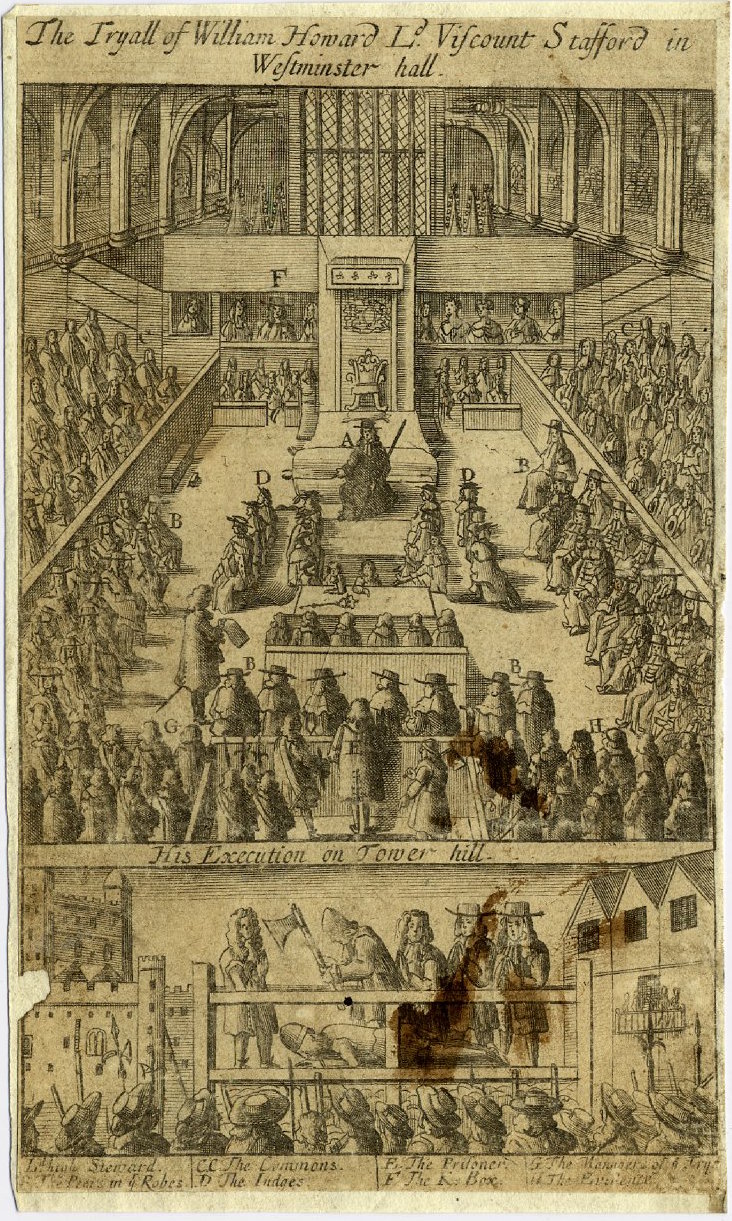
1680: William Howard, Viscount Stafford

(Thanks to Scottish Enlightenment titan David Hume for the guest post on William Howard, 1st Viscount Stafford — a Catholic peer who fell victim to the hysteria of Titus Oates‘s “Popish Plot”. It takes some time to build into the execution itself, since Hume in his History of England narratively locates it in the proto-Whig party’s frustrated parliamentary efforts to exclude from the succession the king’s Roman Catholic brother, the eventual King James II who at this time was the Duke of York. -ed.)

Besides friendship for his brother, and a regard to the right of succession, there were many strong reasons which had determined Charles to persevere in opposing the exclusion. All the royalists and the devotees to the church, that party by which alone monarchy was supported, regarded the right of succession as inviolable; and if abandoned by the king in so capital an article, it was to be feared that they would, in their turn, desert his cause, and deliver him over to the pretensions and usurpations of the country party. The country party, or the whigs, as they were called, if they did not still retain some propensity towards a republic, were at least affected with a violent jealousy of regal power; and it was equally to be dreaded that, being enraged with past opposition, and animated by present success, they would, if they prevailed in this pretension, be willing, as well as able, to reduce the prerogative within very narrow limits.

All menaces, therefore, all promises were again employed against the king’s resolution: he never would be prevailed on to desert his friends, and put himself into the hands of his enemies. And having voluntarily made such important concessions, and tendered, over and over again, such strong limitations, he was well pleased to find them rejected by the obstinacy of the Commons; and hoped that, after the spirit of opposition had spent itself in fruitless violence, the time would come, when he might safely appeal against his Parliament to his people.

So much were the popular leaders determined to carry matters to extremities, that in less than a week after the commencement of the session, a motion was made for bringing in an exclusion bill, and a committee was appointed for that purpose. This bill differed in nothing from the former, but in two articles, which showed still an increase of zeal in the Commons: the bill was to be read to the people twice a year in all the churches of the kingdom, and every one who should support the duke’s title was rendered incapable of receiving a pardon but by act of Parliament.

The debates were carried on with great violence on both sides. The bill was defended by Sir William Jones, who had now resigned his office of attorney-general, by Lord Russel, by Sir Francis Winnington, Sir Harry Capel, Sir William Pulteney, by Colonel Titus, Treby, Hambden, Montague. It was opposed by Sir Leoline Jenkins, secretary of state, Sir John Ernley, chancellor of the exchequer, by Hyde, Seymour, Temple. The arguments transmitted to us may be reduced to the following topics.

In every government, said the exclusionists, there is somewhere an authority absolute and supreme; nor can any determination, how unusual soever, which receives the sanction of the legislature, admit afterwards of dispute or control. The liberty of a constitution, so far from diminishing this absolute power, seems rather to add force to it, and to give it greater influence over the people. The more members of the state concur in any legislative decision, and the more free their voice, the less likelihood is there that any opposition will be made to those measures which receive the final sanction of their authority. In England, the legislative power is lodged in King, Lords, and Commons, which comprehend every order of the community: and there is no pretext for exempting any circumstance of government, not even the succession of the crown, from so full and decisive a jurisdiction. Even express declarations have, in this particular, been made of parliamentary authority: instances have occurred where it has been exerted: and though prudential reasons may justly be alleged why such innovations should not be attempted but on extraordinary occasions, the power and right are for ever vested in the community. But if any occasion can be deemed extraordinary, if any emergence can require unusual expedients, it is the present; when the heir to the crown has renounced the religion of the state, and has zealously embraced a faith totally hostile and incompatible. A prince of that communion can never put trust in a people so prejudiced against him: the people must be equally diffident of such a prince: foreign and destructive alliances will seem to one the only protection of his throne: perpetual jealousy, opposition, faction, even insurrections will be employed by the other as the sole securities for their liberty and religion. Though theological principles, when set in opposition to passions, have often small influence on mankind in general, still less on princes; yet when they become symbols of faction, and marks of party distinctions, they concur with one of the strongest passions in the human frame, and are then capable of carrying men to the greatest extremities. Notwithstanding the better judgment and milder disposition of the king, how much has the influence of the duke already disturbed the tenor of government? how often engaged the nation into meaures totally destructive of their foreign interests and honour, of their domestic repose and tranquillity? The more the absurdity and incredibility of the popish plot are insisted on, the stronger reason it affords for the exclusion of the duke; since the universal belief of it discovers the extreme antipathy of the nation to his religion, and the utter impossibility of ever bringing them to acquiesce peaceably under the dominion of such a sovereign. The prince, finding himself in so perilous a situation, must seek for security by desperate remedies, and by totally subduing the privileges of a nation which had betrayed such hostile dispositions towards himself, and towards every thing which he deems the most sacred. It is in vain to propose limitations and expedients. Whatever share of authority is left in the duke’s hands, will be employed to the destruction of the nation; and even the additional restraints, by discovering the public diffidence and aversion, will serve him as incitements to put himself in a condition entirely superior and independent. And as the laws of England still make resistance treason, and neither do nor can admit of any positive exceptions; what folly to leave the kingdom in so perilous and absurd a situation, where the greatest virtue will be exposed to the most severe proscription, and where the laws can only be saved by expedients, which these same laws have declared the highest crime and enormity.

The court party reasoned in an opposite manner. An authority, they said, wholly absolute and uncontrollable is a mere chimera, and is nowhere to be found in any human institutions. All government is founded on opinion and a sense of duty; and wherever the supreme magistrate, by any law or positive prescription, shocks an opinion regarded as fundamental, and established with a firmness equal to that of his own authority, he subverts the principle by which he himself is established, and can no longer hope for obedience. In European monarchies, the right of succession is justly esteemed a fundamental; and even though the whole legislature be vested in a single person, it would never be permitted him, by an edict, to disinherit his lawful heir, and call a stranger or more distant relation to the throne. Abuses in other parts of government are capable of redress, from more dispassionate inquiry or better information of the sovereign, and till then ought patiently to be endured: but violations of the right of succession draw such terrible consequences after them as are not to be paralleled by any other grievance or inconvenience. Vainly is it pleaded that England is a mixed monarchy; and that a law assented to by King, Lords, and Commons, is enacted by the concurrence of every part of the state: it is plain that there remains a very powerful party, who may indeed be outvoted, but who never will deem a law, subversive of hereditary right, any wise valid or obligatory. Limitations, such as are proposed by the king, give no shock to the constitution, which, in many particulars, is already limited; and they may be so calculated as to serve every purpose sought for by an exclusion. If the ancient barriers against regal authority have been able, during so many ages, to remain impregnable; how much more those additional ones, which, by depriving the monarch of power, tend so far to their own security? The same jealousy too of religion, which has engaged the people to lay these restraints upon the successor, will extremely lessen the number of his partisans, and make it utterly impracticable for him, either by force or artifice, to break the fetters imposed upon him. The king’s age and vigorous state of health promise him a long life: and can it be prudent to tear in pieces the whole state, in order to provide against a contingency which, it is very likely, may never happen? No human schemes can secure the public in all possible imaginable events; and the bill of exclusion itself, however accurately framed, leaves room for obvious and natural suppositions, to which it pretends not to provide any remedy. Should the duke have a son, after the king’s death, must that son, without any default of his own, forfeit his title? or must the Princess of Orange descend from the throne, in order to give place to the lawful successor? But were all these reasons false, it still remains to be considered that, in public deliberations, we seek not the expedient which is best in itself, but the best of such as are practicable. The king willingly consents to limitations, and has already offered some which are of the utmost importance: but he is determined to endure any extremity rather than allow the right of succession to be invaded. Let us beware of that factious violence, which leads to demand more than will be granted; lest we lose the advantage of those beneficial concessions, and leave the nation, on the king’s demise, at the mercy of a zealous prince, irritated with the ill usage which he imagines he has already met with.

In the House of Commons, the reasoning of the exclusionists appeared the more convincing; and the bill passed by a great majority. It was in the House of Peers that the king expected to oppose it with success. The court party was there so prevalent, that it was carried only by a majority of two, to pay so much regard to the bill as even to commit it. When it came to be debated the contest was violent. Shaftesbury, Sunderland, and Essex argued for it; Halifax chiefly conducted the debate against it, and displayed an extent of capacity, and a force of eloquence, which had never been surpassed in that assembly. He was animated, as well by the greatness of the occasion, as by a rivalship with his uncle Shaftesbury; whom, during that day’s debate, he seemed in the judgment of all to have totally eclipsed. The king was present during the whole debate, which was prolonged till eleven at night. The bill was thrown out by a considerable majority. All the bishops, except three, voted against it. Besides the influence of the court over them; the church of England, they imagined, or pretended, was in greater danger from the prevalence of presbyterianism than of popery, which, though favoured by the duke, and even by the king, was extremely repugnant to the genius of the nation.

The Commons discovered much ill humour upon this disappointment. They immediately voted an address for the removal of Halifax from the king’s councils and presence for ever. Though the pretended cause was his advising the late frequent prorogations of Parliament, the real reason was apparently his vigorous opposition to the exclusion bill. When the king applied for money to enable him to maintain Tangiers, which he declared his present revenues totally unable to defend; instead of complying, they voted such an address as was in reality a remonstrance, and one little less violent than that famous remonstrance, which ushered in the civil wars.

All the abuses of government, from the beginning almost of the reign, are there insisted on; the Dutch war, the alliance with France, the prorogations and dissolutions of Parliament; and as all these measures, as well as the damnable and hellish plot, are there ascribed to the machinations of Papists, it was plainly insinuated that the king had, all along, lain under the influence of that party, and was in reality the chief conspirator against the religion and liberties of his people.

Portait of William Howard as a young man by Anthony van Dyck, ~1638-1640. Howard was born in 1614, and beheaded at the age of 66.

The Commons, though they conducted the great business of the exclusion with extreme violence and even imprudence, had yet much reason for the jealousy which gave rise to it: but their vehement prosecution of the popish plot, even after so long an interval, discovers such a spirit, either of credulity or injustice, as admits of no apology. The impeachment of the Catholic lords in the Tower was revived; and as Viscount Stafford, from his age, infirmities, and narrow capacity, was deemed the least capable of defending himself, it was determined to make him the first victim, that his condemnation might pave the way for a sentence against the rest. The chancellor, now created Earl of Nottingham, was appointed high steward for conducting the trial.

Three witnesses were produced against the prisoner; [Titus] Oates [conjurer of the Popish Plot panic -ed.], [Stephen] Dugdale, and [Edward] Turberville.* Oates swore, that he saw Fenwick, the Jesuit, deliver to Stafford a commission signed by De Oliva, general of the Jesuits, appointing him paymaster to the papal army, which was to be levied for the subduing of England: for this ridiculous imposture still maintained its credit with the Commons. Dugdale gave testimony, that the prisoner at Tixal, a seat of Lord Aston‘s, had endeavoured to engage him in the design of murdering the king; and had promised him, besides the honour of being sainted by the church, a reward of five hundred pounds for that service. Turberville deposed, that the prisoner, in his own house at Paris, had made him a like proposal. To offer money for murdering a king, without laying down any scheme by which the assassin may ensure some probability or possibility of escape, is so incredible in itself, and may so easily be maintained by any prostitute evidence, that an accusation of that nature, not accompanied with circumstances, ought very little to be attended to by any court of judicature. But notwithstanding the small hold which the witnesses afforded, the prisoner was able, in many material particulars, to discredit their testimony. It was sworn by Dugdale, that Stafford had assisted in a great consult of the Catholics held at Tixal; but Stafford proved, by undoubted testimony, that at the time assigned he was in Bath, and in that neighbourhood. Turberville had served a noviciate among the Dominicans; but, having deserted the convent, he had enlisted as a trooper in the French army; and being dismissed that service, he now lived in London, abandoned by all his relations, and exposed to great poverty. Stafford proved, by the evidence of his gentleman and his page, that Turberville had never, either at Paris or at London, been seen in his company; and it might justly appear strange that a person, who had so important a secret in his keeping, was so long entirely neglected by him.

The clamour and outrage of the populace during the trial were extreme: great abilities and eloquence were displayed by the managers, Sir William Jones, Sir Francis Winnington, and Serjeant Maynard. Yet did the prisoner, under all these disadvantages, make a better defence than was expected, either by his friends or his enemies: the unequal contest in which he was engaged was a plentiful source of compassion to every mind seasoned with humanity. He represented, that during a course of forty years, from the very commencement of the civil wars, he had, through many dangers, difficulties, and losses, still maintained his loyalty: and was it credible that now, in his old age, easy in his circumstances, but dispirited by infirmities, he would belie the whole course of his life, and engage against his royal master, from whom he had ever received kind treatment, in the most desperate and most bloody of all conspiracies: He remarked the infamy of the witnesses; the contradictions and absurdities of their testimony; the extreme indigence in which they had lived, though engaged, as they pretended, in a conspiracy with kings, princes, and nobles; the credit and opulence to which they were at present raised. With a simplicity and tenderness more persuasive than the greatest oratory, he still made protestations of his innocence, and could not forbear, every moment, expressing the most lively surprise and indignation at the audacious impudence of the witnesses.

It will appear astonishing to us, as it did to Stafford himself, that the Peers, after a solemn trial of six days, should, by a majority of twenty-four voices, give sentence against him. He received, however, with resignation the fatal verdict. God’s holy name be praised! was the only exclamation which he uttered. When the high steward told him, that the Peers would intercede with the king for remitting the more cruel and ignominious parts of the sentence, hanging and quartering, he burst into tears: but he told the Lords that he was moved to this weakness by a sense of their goodness, not by any terror of that fate which he was doomed to suffer.

It is remarkable that, after Charles, as is usual in such cases, had remitted to Stafford the hanging and quartering, the two sheriffs, Bethel and Cornish, indulging their own republican humour, and complying with the prevalent spirit of their party, ever jealous of monarchy, started a doubt with regard to the king’s power of exercising even this small degree of lenity. “Since he cannot pardon the whole,” said they, “how can he have power to remit any part of the sentence?” They proposed the doubt to both Houses: the Peers pronounced it superfluous; and even the Commons, apprehensive lest a question of this nature might make way for Stafford’s escape, gave this singular answer: “This House is content that the sheriffs do execute William, late Viscount Stafford, by severing his head from his body only.” Nothing can be a stronger proof of the fury of the times than that Lord Russel, notwithstanding the virtue and humanity of his character, seconded in the House this barbarous scruple of the sheriffs.

In the interval between the sentence and execution, many efforts were made to shake the resolution of the infirm and aged prisoner, and to bring him to some confession of the treason for which he was condemned. It was even rumoured that he had confessed; and the zealous party-men, who, no doubt, had secretly, notwithstanding their credulity, entertained some doubts with regard to the reality of the popish conspiracy, expressed great triumph on the occasion. But Stafford, when again called before the House of Peers, discovered many schemes, which had been laid by himself and others for procuring a toleration to the Catholics, at least a mitigation of the penal laws enacted against them: and he protested that this was the sole treason of which he had ever been guilty.

Stafford now prepared himself for death with the intrepidity which became his birth and station, and which was the natural result of the innocence and integrity which, during the course of a long life, he had ever maintained: his mind seemed even to collect new force from the violence and oppression under which he laboured.

When going to execution, he called for a cloak to defend him against the rigour of the season: “Perhaps,” said he, “I may shake with cold; but I trust in God, not for fear.” On the scaffold he continued, with reiterated and earnest asseverations, to make protestations of his innocence: all his fervour was exercised on that point: when he mentioned the witnesses, whose perjuries had bereaved him of life, his expressions were full of mildness and of charity. He solemnly disavowed all those immoral principles, which over-zealous Protestants had ascribed, without distinction, to the church of Rome: and he hoped, he said, that the time was now approaching, when the present delusion would be dissipated; and when the force of truth, though late, would engage the whole world to make reparation to his injured honour.

The populace, who had exulted at Stafford’s trial and condemnation, were now melted into tears at the sight of that tender fortitude which shone forth in each feature, and motion, and accent of this aged noble. Their profound silence was only interrupted by sighs and groans. With difficulty they found speech to assent to those protestations of innocence which he frequently repeated: “We believe you, my lord! God bless you, my lord!” These expressions, with a faltering accent, flowed from them. The executioner himself was touched with sympathy. Twice he lifted up the axe, with an intent to strike the fatal blow; and as often felt his resolution to fail him. A deep sigh was heard to accompany his last effort, which laid Stafford for ever at rest. All the spectators seemed to feel the blow. And when the head was held up to them with the usual cry, This is the head of a traitor! no clamour of assent was uttered. Pity, remorse, and astonishment, had taken possession of every heart, and displayed itself in every countenance.


Detail view (click for the full image) of an engraving of the trial and execution of Viscount Stafford. (via the British Museum).

This is the last blood which was shed on account of the popish plot: an incident which, for the credit of the nation, it were better to bury in eternal oblivion; but which it is necessary to perpetuate, as well to maintain the truth of history, as to warn, if possible, their posterity and all mankind ever again to fall into so shameful, so barbarous a delusion.

The execution of Stafford gratified the prejudices of the country party; but it contributed nothing to their power and security: on the contrary, by exciting commiseration, it tended still farther to increase that disbelief of the whole plot, which began now to prevail.

* Channeling Jacques de Molay, Stafford prophesied that Turberville, the perjured witness against him, would not outlive him by so much as a year. Turberville obligingly dropped dead of smallpox late in 1681, after falling out with his former Popish Plot conspirator Titus Oates.

On this day..

1856: Three Italian seamen in Hampshire

On this date in 1856, Neapolitan sailors Giuseppe Lagava, Giovanni Barbaolo and Matteo Pettrici* were hanged at Hampshire for a murderous mutiny aboard the British barque Globe.

In an incident to thrill the Euroskeptic, the Alloa-based barley hauler had become a Bosphorus donnybrook one Monday in July when five Italian soldiers (our Neapolitans, along with a Venetian and a Triestine) turned against the English half of the crew (comprising the master, the mate, two sailors, and a ship’s boy). Alerted by the sound of the Italians murdering the two sailors, the boy and the two senior officers were able to barricade themselves in the master’s cabin.

After a tense negotiation, the sailors contented themselves with the two lives they had already taken as well as all the valuables they could load into a skiff, and lowered into the sea intending to disappear into the Turkish coast. But the Globe was able to limp into harbor with her surviving crew, and a quick scrambling of British and Turkish pursuit forces captured three of the five rebels.**

Hauled to England and condemned on foreign soil, the Italians kept mum about the event until hours before the execution when Lagava broke down and confessed, claiming to have dragooned his confederates into the task “trascinarsi per i capelli” (by the hair of their heads).

We tap the hanging report from the London Reynolds’s Newspaper of Dec. 28, 1856.

The drop had been erected over the entrance gateway of the gaol on the previous day, and all the preparations having been completed at five minutes to eight o’clock, Mr. Hasfield, under sheriff, acting for Mr. E. R. Bradshaw, of Fairoak-park, high sheriff of the county of Hants, formally demanded the bodies of the culprits for execution. They were then brought out of the cells in which they had been separately confined, and marshalled in the procession appointed to convey them to the gallows. The governor led the way, followed by the Rev. Mr. Rogers, and then came Peetrisi [sic], resting one arm upon Signor Ferretti and another upon the officer of the gaol. Lagava came next — supported by two officers and accompanied by Dr. Faa and Mr. Stone; and was in turn followed by Barbaolo, who was led by two turnkeys and attended by Bishop Grant and Dr. Baldassoni. A more painful sight than was presented by this procession as it crossed the court-yard lying between the prison and the entrance gateway cannot possibly be imagined. There was nothing of bravado in the manner of any of the culprits — though all of them walked without assistance.

Arrived at the entrance-gateway, the culprits were conducted by a narrow stone staircase to an apartment about forty feet above the basement floor, where the process of pinioning was gone through. Previously to this the unhappy men were permitted to embrace each other, which they did with great apparent affection, and also bade farewell to the chaplain and governor, and the priests, Lagava and Barbaalo, requesting the latter to accompany them to the scaffold. Resigning themselves into the hands of Calcraft they were now severally pinioned. During the whole time this was going on, Lagava and Barbaalo repeated aloud the “Kyrie Eleison,” and other prayers.

At one period Lagava directed the attention of Pietrici to the priest, but the latter replied, “The priest did not die for me; Christ died for me.” Pietrici was the first to be led on to the scaffold. As soon as Calcraft had placed him under the fatal beam, the most painful excitement was occasioned among the crowd assembled in front of the gaol by the culprits exclaiming in a loud shrill voice, which resounded across the valley overlooked by the prison, “Gesu Cristo, piglia l’anima mia!” (Christ have mercy upon my soul!) and other phrases of a similar character, which, not being understood by the multitude, were believed to be cries of distress and protestations of innocence. Lagava was brought up next, and no sooner had he been placed near his fellow-culprit than his voice was raised in protestations to the Virgin Mary, and all the saints of the calendar. Terrible as was the scene up to this point, it was infinitely more painful where Barbaalo appeared on the drop. This wretched youth was greatly excited, and could not be induced to submit himself quietly to the executioner. He appealed to the priests, and these reverend men, in their anxiety to give the dying man consolation, placed themselves in positions which obliged Calcraft to call upon them to remove, or it would be impossible for him to perform his office. This as done in a tone loud enough to be heard by the crowd below, from whom a murmur of “Shame” arose, probably as much from the length of time already occupied in affixing the nooses and splicing the ropes round the cross-beam — a clumsy operation, which, with the improved example of the metropolitan prison in Newgate open to them, is a disgrace to all the country justices who tolerate it — as from any other cause. At length, after thirteen minutes had elapsed from the period of Pietrici appearing on the scaffold, during the whole of which time the culprits were exclaiming in Italian at the top of their voices, and in tones which created the most painful excitement among all who heard them, the drop fell, and in a few moments the bodies of the wretched men were hanging lifeless.

There were very few spectators present; probably at no period more than a thousand, and as soon as the drop fell most of them dispersed.

The bodies were cut down after hanging an hour, and before noon they were buried in one of the court-yards of the gaol.

The visiting justices, with Lord Henry Cholmondely in the chair, had a meeting at ten o’clock on Tuesday morning. It is understood that one of the subjects under discussion was the great inhumanity of requesting a culprit about to be executed to descend between seventy and eighty steps, which is the number from the basement of the entrance gateway to the drop at Winchester.

It may be interesting to add that Pietrici was a Dalmatian, and has been in England before, having sailed in a vessel which traded between the Levant and Liverpool. Lagava and Barbaalo were both Sicilians. The former sailed in both French and English transports during the late war, and was flogged while in the English service. Lagava it should be stated, is an assumed name; his real name is Francisco Libresti, but having deserted from the Sicilian service, he changed his name to avoid detection. Barbaalo was of better birth than his comrades, being the son of a law agent; he was brought up in the Marine School of Naples, and carried certificates of good seamanship.

* Also given in various reports as Pietrici or Pettrich. Barbaolo is also alternately given as Barbalalo or Barbalano.

** Summary via Lloyd’s Illustrated Newspaper, July 27, 1856.

On this day..

1950: Shooting on Seoul’s Execution Hill

On this date in 1950, South Korean police shot more than 100 alleged Communists on a hill outside Seoul. It was just one day amid a weeklong bloodbath that claimed a reported 800 or more, although December 15 was the one that helped to thrust the horrors into public consciousness in the West.

These mass executions occurred in the paroxysm after the North Korean capital of Pyongyang — briefly captured by the United Nations offensive earlier in 1950 — was retaken by Chinese-supported Communist forces in early December.

These were themselves only the most recent installment of numerous indiscriminate mass murders that had scarred the South Korean rear once Chinese intervention in the summer of 1950 turned the tide of the war. A South Korean Truth and Reconciliation Commission investigation from the 2000s estimated that the collective death toll of countless such executions could “conservatively” run to 100,000-plus: “the worst tragedy of 20th century South Korea,” as one commission member provocatively characterized it.

In a Kafkaesque bureaucratic twist, many of those rounded up for execution were culled from the rolls of the “National Guidance League”, an organ set up by the Seoul government to re-educate former leftists. Enlistment to the League was incentivized by extra rations pushed by local officials with signup quotas to make, and that was just great for everyone until that same state decided to turn it into an expedient roster of fifth columnists.

“The authorities pressed us to join the league,” one aged survivor said at a 2009 news conference. “We had no idea that we were joining a death row.”

American officials directing the South Korean army downplayed all this as it was occurring. Even when the Korean War ended in 1953, South Korea remained under the dictatorial administration of its wartime president Syngman Rhee, whose commitment to strangling leftist dissent extended so far as hanging the presidential candidate of the Progressive Party. For many years the wartime massacres could be no more than murmured at.

The chaos of war helped bring the executions to momentary prominence in December 1950, however, when western conscripts bivouacked down adjacent to the capital’s “execution hill” and were aghast to witness what was happening there.

“A wave of disgust and anger swept through American and British troops who either have witnessed or heard the firing squads in action in the Seoul area during the last two days,” reported the United Press on December 17, 1950. (via the Trenton (N.J.) Evening Times of the same date) On Friday, December 15, those soldiers “were horrified upon seeing truckloads of old men, women, youths and several children lined up before open graves and shot down by South Korean military police with rifles and machineguns.

“One American captain George Graff reported he kicked aside the dirt lightly covering one of the bodies and found it still twitching.”

Deeply shocked, one British soldier wrote to the government “wondering which side was right in Korea.”

Revulsion among these forces and their newspaper-reading publics threatened to badly erode support for the mission — a point made forcefully by the Archbishop of York in a letter to the London Times (December 20, 1950):

Sir, —

I hope that our Government will convey to the South Korean Government the horror and detestation with which the people of this country have read the accounts of the wholesale execution of suspected Communist sympathizers. Your Correspondent says it is reported that some of the murdered women “carried babies on their backs.” If these barbarous executions continue, all sympathy with South Korea will vanish, and instead there will be a general demand that the forces of the United Nations should no longer be used to protect a Government responsible for these atrocities. I am glad to see that British soldiers on the spot already have shown their anger at these killings.

Yours faithfully,
Cyril Ebor
Bishopthorpe, York, Dec. 18

Christian ministers in Korea likewise raised alarm over these atrocities with both United Nations and South Korean authorities. Due regard for humanity and/or public opinion led the United Nations on December 17th to exhume the execution grounds looking for evidence of child executions. But the very same day, according to the U.P. (via the Cleveland Plain Delaer, Dec. 18, 1950),

South Koreans hauled another batch of prisoners to snow-covered “Execution Hill” this afternoon and shot them.

Evidently to escape the eyes of angry American G.I.s and British Tommies, the prisoners apparently were forced to lie down in trenches where they were killed.

The new executions occurred only two hours after U.N. observers had supervised an exhumation of bodies lying in four trench-like graves on the hill and after 29th Brigade Commander Tom Brodie had told his officers he was not prepared to tolerate further executions in his area.

As layer after layer of bodies were disinterred from the mountain graveyard, Fusillier Capt. Bill Ellery, tall, moustached British officer, said coldly and precisely what all watching British and American troops were thinking.

“We don’t do this sort of thing in my country.”

A South Korean apologized. The prisons were so crowded with Communists sentenced to death that Execution Hill was the only solution.

“There are so many to execute,” he said.

An abatement of visible-to-western-press executions and the cosmetic expedient of a small Christmas amnesty appears to have stanched the immediate threat to homefront support for the war — which would continue for another two and a half years.

On this day..

1591: Edmund Geninges

Catholic priest Edmund Geninges (also Gennings, or Jennings) was executed on this date in 1592, along with the layman Swithburne Welles, whose home played host to Geninges’s final Mass. At least, that’s according to The life and death of Mr. Edmund Geninges priest, crowned with martyrdome at London, the 10. day of November, in the yeare M.D.XCI., by .

Despite the title, the text within that volume correctly places events on “fryday the 10 day of December” — per the Julian calendar still in use in England at that time. The book was even by the priest’s brother, John Gennings: m must have just been a typeset-o on the frontispiece.

As merchants of the grim we excerpt the portion of that tract focusing on Geninges’ death. A fuller summary of the hagiography can be enjoyed on Early Modern Whale.

When the happy houre of his passion was come being 8 of the clocke on fryday the 10 day of December, M. Plasden, M. White, and the rest were carryed to Tyborne, & there executed. Mistresse Welles to her great grief was reprived, and died in prison. M. Edmund Geninges, and M. Swythune Welles, as is aforesayd, were condemned to be executed in Grayes Inne fieldes on the North side of Holborne, over agaynst his owne dore: When they were brought thither, after a few speaches of a Minister or two that were there present, M. Geninges was taken of the sledd, whereon he lay. In the meane time he cryed out with holy S. Andrew: O bona Crux diu desiderata, & iam concupiscenti animo preparata, securus & gaudens venio ad te; ita & tu exultans suspicias me discipulum eius qui pependit in te! O good gibbet long desired, and now prepared for my hart much desiring thee, being secure and ioyfull I come unto thee, so thou also with ioy, I beseech thee receyue me the disciple of him that suffered on the Crosse.

Being put upon the ladder naked to his shirte, many questions were asked him by some standers by, wherto he answered still directly. At length M. Topliffe being present cryed out with a loud voyce, Geninges, Geninges, confesse thy fault, thy Popish treason, and the Queene by submission (no doubt) will grant thee pardon. To which he mildly answered, I knowe not M. Topliffe in what I have offended my deare annoynted Princesse, for if I had offended her, or any other in any thing, I would willingly aske her, and all the world forgivenesse. If she bee offended with me without a cause, for professing my fayth and religion, because I am a Priest, or because I will not turne Minister agaynst my conscience, I shalbe I trust excused and innocent before God: Obedire (sayth S. Peter) oportet Deo magis quam hominibus, I must obey God rather than men, and must not in this case acknowledge a fault where none is. If to returne into England Priest, or to say Masse be Popish treason, I heere confesse I am a traytour; but I thinke not so. And therefore I acknowledge my selfe guilty of these thinges, not with repentance or sorrow of hart, but with an open protestation of inward ioy, that I have done so good deedes, which if they were to do agayne, I would by the permission and assistance of Almighty God accomplish the same, although with the hazard of a thousand lives.

Which wordes M. Topliffe hearing, being much troubled therwith, scarce giving him leave to say a Pater noster, bad the Hangman turne the ladder, which in an instant being done, presently he caused him to be cut downe, the Blessed martyr in the sight of all the beholders, being yet able to stand on his feete, & casting his eyes towardes heaven, his senses were very little astonished, in so much that the Hangman was forced to trippe up his heeles from under him to make him fall on the blocke. And being dismembred, through very payne, in the hearing of many, with a lowde voyce he uttered these wordes, Oh it smartes, which M. Welles hearing, replyed thus: Alas sweete soule thy payne is great indeed, but almost past, pray for me now most holy Saynt, that mine may come. He being ripped up, & his bowelles cast into the fire, if credit may be given to hundreds of People standing by, and to the Hangman himselfe, the blessed Martyr uttered (his hart being in the executioners hand) these words, Sancte Gregori ora pro me, which the Hangman hearing, with open mouth swore this damnable oath, Gods woundes, See his hart is in my hand, and yet Gregory in his mouth, o egregious Papist! Thus the afflicted Martyr even to the last of his torments cryed for the ayde & succour of Saynts, and especially of S. Gregory his devoted patron, and our countries Apostle that by his intercession he might passe the sharpnes of that torment.

And thus with barbarons [sic] cruelty our thirce [sic] happy Martyr finished the course of his mortall life, and purchased no doubt a crowne of immortality in the glorious Court of heaven. Wherfore now he triumpheth with all unspeakeable ioy, and [b]eatitude amongst the number of those blessed martyrs who have in this world suffered all torments of persecution, and have withstood Princes and Potentates, lawes and lawmakers, for the honour and glory of theyr Lord and Saviour, and therfore have found true the confortable saying of holy David, Qui seminant in lachrymis, in exultatione metent: They who sow in teares, shall reape in ioy. Now so much the more is our Saynt glorifyed, by how much the more he was tormented, according to that saying of S. Cyprian: Quo longior vestra pugna hic, corona sublimior, presens tamen confessio quanto in passione fortior, tanto clarior & maior in honore. By how much your combat is the longer, by so much your crowne shall be the higher, so that by how much stronger the present confession is in suffering, so much more glorious and greater it shall be in honour.

On this day..

1889: Two Apaches in Arizona

Two of eight Apaches — Nacod Qui Say and Rah Dos La, among other possible transliterations — who murdered an Arizona sheriff and deputy while escaping from a transport to the penitentiary were hanged on this date in 1889.

According to White Justice in Arizona: Apache Murder Trials in the Nineteenth Century, the documentary trail for this remarkable case is surprisingly thin, with “no indictments, subpoenas, jury lists, witnesses, trial notes, or prosecutor’s notes extant.”

The vituperation of many surviving news accounts, however, gives us an essential fact that the judiciary’s papers surely wouldn’t. After decades of war with the Apaches in the Southwest, white settlers were set on edge by a native revolt against settler authority and from the first reports of the incident began ruminating about “the treacherous red man.” (Tucson Daily Citizen, Nov. 4, 1889)

When five were condemned to hang in this affair — three would cheat the executioner by committing suicide two days before the hanging — a newspaper in Florence where the gallows went up remarked that “should a few bands of Apaches be taken from the war path and suspended by the necks, where the other Indians on the reservation could get a good, fair look at them, there would be no more Apache outbreaks.”

This sort of rhetoric would rate as positively liberal beside the cruder commentary. For example, a few days before the execution, U.S. President Benjamin Harrison had said in an address to Congress that as the white man “can no longer push the Indian back into the wilderness,” it had become essential “to push him upward into the estate of a self-supporting and responsible citizen.” The Tombstone Prospector found some Khruschchevian merriment mulling its preferred form of “support.” Harrison must not have been too put off, since he denied clemency.*


Tombstone Prospector, Dec. 6, 1889.

Meanwhile, in the spirit of the old saw that “the only good Indian is a dead Indian,” a wag at the following week’s San Diego Weekly Union did Tombstone one better in the racist headline department.


San Diego Weekly Union, Dec. 12, 1889

* Arizona didn’t attain statehood until 1912; prior to that it was federally administered and the last word on clemencies and commutations belonged to the U.S. President.

On this day..