1944: Not Sim Kessel, Jewish boxer

(Thanks to Meaghan Good of the Charley Project for the guest post. -ed.)

“In December 1944,” begins Sim Kessel’s Holocaust memoir, “I was hanged at Auschwitz.”

He was twenty-five years old and had been caught attempting to escape.

Sim Kessel (called “Sam” in some accounts), a French Jew who boxed professionally, had been at Auschwitz for two years — a staggering period of time where the normal lifespan of a prisoner was at most three months — and had already escaped the gas chambers on two occasions.

The first time, he was in the infirmary recuperating from a severe beating and torture at the hands of the SS (one of his fingers had been cut off), and a Nazi doctor judged him incapable of recovery and took his number down. Then, a miracle: somehow, his chart was misplaced.

Four days later Kessel was selected again and this time actually marched to the gas chamber with other hopeless cases. As they were lined up, naked and shivering, waiting their turn to die, an SS man happened to pass on a motorcycle and stopped to have a look at them. Kessel recognized something in him:

Unmistakable. The stigmata of the ring. He also had muscular shoulders and a springy way of walking. I hesitated for a second and then thought, oh, what the hell!

Naked and shivering I walked up to him. I don’t know if it was a dim hope behind my overture, or some irrational kinship felt by boxers the world over, across all boundaries. I simply blurted out in German:

“Boxer?”

“Boxer? Ja!”

He didn’t wait for an explanation, he understood. […] “Get on!” he bellowed.

Kessel’s savior, whose name he never knew, took him back to camp and to the infirmary, where he made a full recovery from his injuries and rejoined the working prisoners. The two men never saw each other again. Kessel had no illusions about the character of the man who had saved his life:

This act of mercy which he had performed in the name of boxing meant something totally different to each of us. Obviously to me it was everything; for him, nothing at all. I was like a worm that one doesn’t step on at the last minute.

In December 1944, Kessel and four Polish prisoners tried to escape. He reflected later on that “the strategy could have succeeded despite its apparent idiocy.”

The idiotic strategy will be familiar to high school delinquents the world over: they casually walked out of camp together, in broad daylight, acting as if they had a legitimate destination in mind, and no one tried to stop them.

Unfortunately, they were caught the next day and sent back to Auschwitz. A public execution was the only punishment for escapees, and so the five were lined up on the scaffold in front of a crowd of some 25,000 prisoners. They each had to take their turn to die and Kessel was the last.

And then the rope broke.

Not that I knew it; I didn’t realize a thing, having lost consciousness from shock. I didn’t even know they had hanged me. […]

I came to. Or partly came to. It was as if I were in a dream, still unable to realize what was going on around me, aware mainly of the excruciating pain in my neck and back.

In some countries, if a person survives an execution they’re granted a reprieve and allowed to keep their lives. Not so in Auschwitz: you were simply hauled away and shot, this time without ceremony.

Kessel was left to the tender mercies of Jacob, described as “the camp’s official killer.” He knew his executioner’s reputation in camp and also out of it, for Jacob was also a professional boxer and had helped train the famous German champion Max Schmeling. Having nothing to lose, and remembering what had happened before, Kessel argued with him:

So I appealed to him, half in German, half in French. I argued that one boxer could not kill another boxer. That he, a former champion, a sparring partner of Schmeling’s, could not degrade himself by simply slaughtering me in cold blood.

Jacob listened and then walked away without a word. When he returned he carried a new camp uniform. Kessel was to put it on and simply rejoin the mass of prisoners outside.

Officially, Kessel was dead, and someone else’s body would be put in the crematorium ovens in place of his own. Certainly there were many bodies to choose from.

It probably wouldn’t have worked were it not for the fact that the Third Reich was in its death throes. The Wehrmacht was on the run, besieged by the Russians on one side and the Americans on the other, and within days Auschwitz would be evacuated.

Kessel survived two death marches and other dangers before he was liberated on May 7, 1945, five months after the rope broke.

On this day..

1946: A triple execution in Washington, DC

“Death, administered in the law’s deliberate way, exacted a three-fold toll in the District [of Columbia]’s electric chair” on this date in 1946, announced the next day’s Washington Post.*

It was as many people as the nation’s capital had put to death in the previous four years combined. The clientele: three unconnected men, condemned for unconnected murders.

“Joseph Dunbar Medley, suave slayer of a Washington divorcee,” was the most (in)famous of the three. “The debonair man who blazed a trail of crime from the Middle West” had that April made a daring escape from District Jail — which was rather renowned for its escapability, but still, this was a guy on death row, and who was only a few weeks from his then-scheduled electrocution.

Medley and another condemned man, Earl McFarland, charmed their way into their guards’ confidence. During a card game played in one of the guards’ rooms, they imprisoned their jailers, nicked their clothes, and cut their way into a ventilation shaft and out to the roof.

Medley himself was captured hours later hiding in a sewer pipe on the Anacostia River, pithily remarking to reporters, “You can’t blame a guy for trying, and I’m going to try again.” (Chicago Tribune, April 4, 1946) If he did try again, he didn’t make it.

But the bloodhounds couldn’t pick up McFarland, whose manhunt made nationwide headlines for more than a week until he was finally tracked down in Knoxville, Tenn. (He was executed solo in July.)

While [Medley] waited [for three hours of last-second appeals to clear], the chair claimed two other slayers, both Negroes.

William Copeland, 38-year-old slayer of his sister-in-law, Mrs. Dora Johnson, walked into the chamber, jauntily smoking a cigar which he clenched in his teeth while he smiled. He helped guards adjust the straps and the leather face mask smothered his last smile …

Second to die was Julius Fisher, 32, convicted of beating to death Miss Catherine Reardon, librarian at the Washington Cathedral … bludgeoned to death with a piece of firewood and her body hidden in a sub-basement crypt. He strangled and struck her after she had complained about the way he had cleaned under her desk.

* Charles J. Yarbrough, “Death Hour Delayed by Futile Court Maneuver,” The Washington Post, Dec 21, 1946.

On this day..

1965: Joseph Bamina, former Burundi Premier

On this date in 1965, 24 Burundians were shot following mass trials in the stormy aftermath of an attempted coup.

Burundi met post-colonial independence deprived by an assassin’s bullet of the popular, unifying figure who might have kept ethnic conflict under control, and many years of living dangerously ensued as Hutu and Tutsi grappled for power.

On October 18, 1965, a group of Hutu officers attempted a coup d’etat against Burundi’s monarchy — and failed.

the events of October 1965 carried momentous consequences. The mutineers took a huge gamble and lost … power became the exclusive monopoly of Tutsi elements.

… In the capital, virtually every Hutu leader was apprehended.

-Rene Lamarchand, Burundi: Ethnic Conflict and Genocide

While the putschists were unsurprisingly executed, the Tutsi-authored backlash cast a much wider net, ultimately claiming up to 5,000 lives. (It was only a dress rehearsal for a similar scenario — Hutu rebellion triggering massive Tutsi crackdown — that resulted in a full-on genocide in 1972.)

Various executions peppered the weeks after the intended coup; this date’s was one of the last of the particularly noteworthy. The New York Times (Dec. 21, 1965) described those “executed in the Central African kingdom Wednesday after mass trials” as “Joseph Bamina,* a former Burundi Premier … [and] 23 others included two prominent political leaders.”

Burundi did not live happily ever after.

* Lamarchand calls Bamina one of the “hard-core Hutu opposition.”

On this day..

1603: The men of the Bye Plot, but not those of the Main Plot

On this date in 1603, priests William Watson and William Clark were executed for a dramatic (that is, harebrained) plot “to take away ‘the KINGE and all his cubbes.'”

The year was 1603, the first in the reign of James I. (However, he’d been James VI of Scotland since the tender age of 13 months, when his mother Mary, Queen of Scots had been forced to abdicate. He made himself quite a reputation for witch-hunting.)

With the death of the Protestant Queen Elizabeth and all her schismatic Anne Boleyn mojo, hard-pressed English Catholics greeted Jamie’s ascension hopeful of relief from official persecution. Although raised Protestant, both his parents had been Catholic.

Watson was one of these hopeful adherents, and hastened himself to Scotland as Queen Elizabeth lay ailing to extract from the future English monarch the soothing blandishments of good favor that future monarchs make.

When toleration was not extended to Catholics upon the new king’s elevation in late March 1603, the disenchanted Watson almost immediately embarked on a preposterous scheme to

assemble force and strengthe, and on Midsommer-day last, in the night, to come to the Parke pale at Grenewich, to enter in by the gardein with a key, that should be borowed; and when the numbers were come in, there should be a watche set at the dores of principall persons, and at the passages; and then to goe up to the KING’S loding. And when they cam to the KING, they should surprise his person, and carry him to the Tower, and they would move him for 3 things: — 1, for there pardon; 2, for tolleration of relligion; 3, for assuraunce thereof, to preferre Catholiques to places of credit, as WATZON the priest to be Lord Keper; GREY, Erle Marshall; GEORGE BROOKE, Lord Treasorer; and MARCAM, Secretary. They concluded to cutt of many of the Privy Councill, and to have made a Proclamation, purporting howe the KING had bene misled, and to have had many things reformed. They determined to have possessed the principall ports of the realme, and to have kept the KING in the Towre a quarter of a yeare.

The Bye Plot was ironically busted by other Catholics — Jesuits, as distinct from “secular clergy” (clergy not affiliated with an order) like Watson. Jesuits and secular clergy were at loggerheads in this period over tactics, church structure … more or less everything. The need to steal the thunder of whatever restore-the-Church scheme the Jesuits might be cooking up might have helped precipitate Watson into such immediate and desperate disaffection.

At any rate, these other more respectable fathers of the church blew the whistle on the Bye Plot lest it provoke anti-Catholic pogroms, and you’d have to concur with their estimate that taking the king hostage is the sort of thing that would have prompted some blowback.

In the course of rolling up the now-exposed Bye Plot, investigators also caught wind of the parallel Main Plot, courtesy of one conspirator who was involved in both and unable to hold his tongue under torture.

The Main Plot was a sketchier affair to a similar end, allegedly among Catholic-sympathizing nobles to depose James for his cousin. As befits its title, the Main Plot implicated much bluer blood than Watson’s: Lord Cobham,* Baron Grey, and the knighted soldier Griffin Markham.

Oh, and a guy you might have heard of by the name of Walter Raleigh.

All these Main Plot gentlemen were likewise condemned to death. December 9, 1603 was the date appointed for Watson and Clark to expiate the Bye Plot in the grisly manner that commoner priests were wont to suffer in that age — they as the undercard to the beheadings of Cobham, Grey, and Markham. (Raleigh was on deck for a later date.)

The drama that unfolded on the Winchester scaffold that day was wonderfully narrated in the correspondence of Sir Dudley Carleton and well worth extracting at length.

The two priests that led the way to the execution were very bloodily handled; for they were both cut down alive; and Clarke, to whom more favour was intended, had the worse luck; for he both strove to help himself, and spake after he was cut down. They died boldly both … Their quarters were set on Winchester gates, and their heads on the first Tower of the castle.

Warrants were signed, and sent to Sir Benjamin Tichborne, on Wednesday last at night, for Markham, Grey, and Cobham, woh in this order were to take their turns … A fouler day could hardly have been picked out, or fitter for such a tragedy. Markham being brought to the scaffold, was much dismayed, and complained much of his hard hap, to be deluded with hopes and brought to that place unprepared. One might see in his face the very picture of sorrow; but he seemed not to want resolution … [and] prepared himself to the block. The sheriff, in the mean time, was secretly withdrawn … whereupon the execution was stayed, and Markham left upon the scaffold to entertain his own thoughts, which, no doubt, were as melancholy as his countenance, sad and heavy. The sheriff, at his return, told him, that since he was so ill prepared, he should yet have two hours respite, so led him from the scaffold, without giving him any more comfort, and locked him into the great hall … The lord Grey, whose turn was next, was led to the scaffold by a troop of the young courtiers … and thereupon entered into a long prayer for the king’s good estate, which held us in the rain more than half an hour; but being come to a full point, the sheriff stayed him, and said, he had received orders from the king, to change the order of the execution, and that the lord Cobham was to go before him … he had no more hope given him, than of an hour’s respite; neither could any man yet dive into the mystery of this strange proceeding.

The lord Cobham, who was now to play his part, and by his former actions promised nothing but matiere pour rire, did much cozen the world; for he came to the scaffold with good assurance, and contempt of death. … [he] would have taken a short farewel of the world, with that constancy and boldness, that we might see by him, it is an easier matter to die well than live well.

He was stayed by the sheriff, and told, that there resteth yet somewhat else to be done; for that he was to be confronted with some other of the prisoners, but named none. So as Grey and Markham being brought back to the scaffold, as they then were, but nothing acquainted with what had passed, no more than the lookers-on with what should follow, looked strange one upon the other like men beheaded, and met again in the other world. Now all the actors being together on the stage (as use is at the end of a play,) the sheriff made a short speech unto them, by way of the interrogatory of the heinousness of their offences, the justness of their trials, their lawful condemnation, and due execution there to be performed; to all which they assented; then, saith the sheriff, see the mercy of your prince, who, of himself, hath sent hither to countermand, and given you your lives. There was then no need to beg a plaudite of the audience, for it was given with such hues and cries, that it went from the castle into the town, and there began afresh, as if there had been some such like accident. And this experience was made of the difference of examples of justice and mercy; that in this last, no man could cry loud enough, ‘God save the King;’ and at the holding up of [the previously executed] Brookes’s head, when the executioner began the same cry, he was not seconded by the voice of any one man, but the sheriff. You must think, if the spectators were so glad, the actors were not sorry; for even those that went best resolved to death, were glad of life … Raleigh, you must think (who had a window opened that way), had hammers working in his head, to beat out the meaning of this strategem. His turn was to come on Monday next; but the king has pardoned him with the rest, and confined him with the two lords to the Tower of London, there to remain during pleasure.

Turns out that James wanted to do only the minimum amount of butchery necessary to establish his bona fides, and it sure seems like the mercy play proved a public relations triumph.** Raleigh was left by this reprieve languishing in the Tower for years, before his own final adventure saw him to the block after all in 1618.

Would you like some bootless speculation that Raleigh’s being caught up in this mess led him to nurture during his imprisonment a decade-long grudge against William Shakespeare and eventually murder the playwright? Of course you would.

In the world of more demonstrable historical consequences, the failure of these plots and continuing frustration with Catholics’ lot under a new boss who seemed a lot like the old led two years later to the ne plus ultra of English sectarian terrorism, Guy Fawkes‘s Gunpowder Plot to blow King James and his court straight to kingdom come.

* Cobham was a descendant of John Oldcastle and is supposed to have forced Shakespeare to redact the family name in his Henry V plays — giving us, instead, the character of Falstaff.

** One is obliged to notice Carleton’s disquieting footnote indicating that the entire affair was staged so well that someone almost actually lost his head:

… there was another cross adventure; for John Gib could not get so near the scaffold, that he could speak to the sheriff, but was thrust out amongst the boys, and was fain to call out to sir James Hayes, or else Markham might have lost his neck.


Topical sourcing: Mark Nicholls, “Treason’s Reward: The Punishment of Conspirators in the Bye Plot of 1603” The Historical Journal, Vol. 38, No. 4 (Dec., 1995).

On this day..

1640: Bishop John Atherton, buggerer

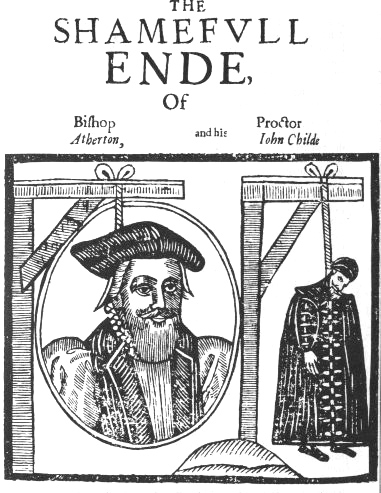
On this date in 1640, John Atherton achieved the unenviable distinction of being the only Anglican bishop hanged for buggery.* (His proctor, and alleged lover, John Childe, got the same treatment a few months later.)


Suppose a Devill from th’infernall Pit,
More Monsterlike, then ere was Devill yet,
Contrary to course, taking a male fiend
To Sodomize with him, such was the mind
Of this Lord Bishop, he did take a Childe
By name, not years, acting a sinne so vilde
-From the text of the pamphlet this image decorates

The Oxford-educated Englishman was appointed Lord Bishop of Waterford and Lismore by King Charles‘s hated governor Thomas Wentworth.

It may well have been the internecine politics of the day that claimed Atherton’s life, just as the civil wars they engendered in the ensuing decades claimed the original trial records.

While posterity is left to speculation, Atherton was defended in print in those years as well. (Defended as no homo, that is — not defended on principle against ubiquitous anti-gay laws.) If it wasn’t really a voracious sexual appetite (not exclusively same-sex**), goes this argument, it was intra-Protestant infighting, with Atherton’s successful clawback of land for the weak Irish Anglican church stepping on the toes of the local land barons who had recently expropriated it.

This politics outside the boudoir argument gets compelling treatment in Mother Leakey and the Bishop, a historical investigative thriller that links Atherton to a weird ghost story† in his native Somerset — that of “Old Mother Leakey,” the Minehead ghost.

Mother Leakey was Atherton’s mother-in-law, and Somerset family members claimed she haunted them — including with a message for the bishop that one of his sisters-in-law actually went to deliver in Ireland. The message isn’t known; in legend, this was a warning from beyond against the prelate’s ungodly behavior; in reality, it was more probably a family shakedown.‡

Despite the skepticism of the Leakey family’s own contemporaries, the facts, allegations, suppositions, and pure flights of fancy somehow managed to blend and recombine into a lasting tale of the paranormal that Minehead still retails to this day.

And it goes right back to the public opprobrium Bishop Atherton endured — as described in that 1641 hanging pamphlet:

“demonstrates the link between the stories of Mother Leakey and Bishop John Atherton … in a highly readable and often entertaining fashion”

… through pride, high fare, and lustfull life,
Incest committed with the Sister of his wife,
For which he sued his pardon, and then fled
To Ireland, where a worser life he led

He surely warned was to mend his life,
By his own Sister Master Leakies wife,
Which Master Leakies Mother being dead,
And in her life-time conscious how he led
His lustfull life, her Ghoast in gastful wise
Did oft appeare before her Sisters Eyes,
But she feare-strucken durst not speak unto it,
Till oft appearing forced her to doe it:
Then thus she spake, Mother in Law what cause
You from your rest, to my unrest thus drawes?
Who answered, daughter tis the wicked life
Your Brother leads, warne him to mend his life;
If not, then plainely tell him tis decreed,
He shall be hangd, bid him repent with speede:
Then shall my restless spirit be at rest,
And not till then; Thus vanisht. She addrest
Herselfe for travaile, Into Ireland went
With this sad message unto him was sent:
Which how he tooke to heart may plaine appeare
By the slight answer he returned her,
What must be, shalbe: If I must, I must dye,
Mariage, and hanging, come by destiny.
Thus scoft her counsell, sent her back, and when
Shee was returnd, he grew farre viler then
He was before, if Viler man may be,
For one bad Act before, committed three.

* According to Who’s Who in Gay and Lesbian History, Atherton and Childe were the second pair of alleged homosexual lovers executed in the British Isles. The first was the Earl of Castlehaven in 1631, along with his manservants.

** “[O]ne should note the compound sexual nature of the ‘sodomy’ charge in this context, a portmanteau omnibus of non-procreative sex, which is what ’sodomy’ was widely held to be.”

† Walter Scott footnotes this legend in Rokeby: “Mrs Leakey … dispatched her [daughter-in-law] to an Irish prelate, famous for his crimes and misfortunes, to exhort him to repentance, and to apprize him that otherwise he would be hanged; and how the bishop was satisfied with replying, that if he was born to be hanged, he should not be drowned.”

‡ Archbishop William Laud dispatched a team of ghost-whisperers to investigate the Leakey story well before the ectoplasm hit the fan for Atherton, and they weren’t buying: “certainly it is a fiction and a practice … it may be some money business.” Bishop Atherton had left home under a cloud with the suspicion that he’d had an affair with his wife’s sister, and this was part of the eventual Irish complaint against the horny goat.

On this day..

1977: Larry Tacklyn and Erskine Burrows, for the murder of Richard Sharples

On this date in 1977, Black Berets Larry Tacklyn and Erskine “Buck” Burrows were hanged in Bermuda for assassinating the islands’ police chief and governor.

“During the 1970s, a black power organization in Bermuda conspired to bring about social change ‘by any means necessary,’ including assassination. This is the first full account of the murders and the Black Beret Cadre, the revolutionary group whose activities resulted in mayhem throughout the island.”
Book’s advance publicity

A revolutionary black nationalist organization, the Black Beret cadre took its name from that Che Guevara photograph and its model from the Black Panthers.

The cadres’ agenda for early-1970s Bermuda

was ‘freedom by any means necessary’ which included assassination. Taking their cue from the Black Panthers, whose primary aim was to bait the ‘racist cops’, the Black Berets exhorted its members and all Bermudian youth to confront the ‘English racist police’ as frequently as possible and prepare for the coming conflict between blacks and whites …

Its purpose was to indoctrinate young black Bermudians in communist revolution and the ideology of Black Power.

Cadres Tacklyn and Burrows were one part liberators of their oppressed brothers, one part common criminals.

In 1972, they gunned down white police commissioner (a veteran of Britain’s colonies) George Duckett; in 1973, they ambushed governor (and former Tory M.P.) Richard Sharples and slew him, along with his aide-de-camp.

Neither perp was apprehended, which meant they went on to kill a couple of supermarket executives before someone I.D.’d Tacklyn. Burrows stayed on the lam long enough to rob a bank of $28,000.

The trials were a sensation — apt for the involvement of sensational Bermudian lawyer and politician Julian Hall — with Burrows convicted all around. He openly avowed the political murders.

Erskine Burrows

The motive for killing the Governor (his ADC was not our objective, he was shot only because he happened to be with the Governor at the time) was to seek to make the people, black people in particular, become aware of the evilness and wickedness of the colonialist system in the Island of Bermuda.

Secondly, the motive was to show that these colonialists were just ordinary people like ourselves who eat, sleep and die just like anybody else and that we need not stand in fear or awe of them.

Finally, the motive was to reveal to black people unto themselves.

This refers to the revealed reactions of many black people during the Governor’s funeral, when black people were seen to be standing with tears in their eyes, crying for a man who when he was alive didn’t care if they lived or died and here they were crying for a white Governor and yet when many of their own people pass away there is sometimes hardly a tear shed for them.

This shows clearly the evil effects that the colonialist propaganda has had over the long years they have ruled over this little Island.

Tacklyn managed to win acquittals over Duckett and Sharples but was condemned for killing the grocers. With “only” the two murder raps, Tacklyn’s appeals against execution might have stood a chance in other circumstances. But his affiliation with Burrows, who so openly avowed the other crimes and declined to mitigate them in court, “hung like an albatross around Tacklyn’s neck.”

That wasn’t the only thing that was hanging.

Massive riots rocked Bermuda after it became known that eleventh-hour clemency bids were rejected; “Fires erupted across Bermuda,” Reuters report, “causing millions of dollars in damage as a dusk-to-dawn curfew failed to halt the racial violence.” (Per Chicago Tribune, Dec. 3, 1977) British troops were deployed to help quell the riots.

Tacklyn and Burrows were the first people executed in Bermuda in 34 years, and remain the last executed there to this date.

Because all Britain’s overseas territories in the Caribbean subsequently abolished the death penalty (Bermuda in a contentious 1999 parliamentary dispute decided by a single tiebreaking vote), Tacklyn and Burrows also hold the distinction of being the last people put to death anywhere under British law. (As distinct from the last executed in Britain.)

On this day..

1327: Adso’s lover in The Name of the Rose

On an unspecified date presumably around early December of 1327 — the timeframe is approximated by action’s story’s commencing on “a beautiful morning at the end of November” — the Inquisition burns the nameless peasant lover of the narrator in Umberto Eco’s novel The Name of the Rose.

Adso of Melk is apprenticed to the scientific-minded William of Baskerville — a deliberate allusion to Sherlock Holmes — when the monk is dispatched to an Italian monastery to sniff about for heresy.

The Name of the Rose unfolds a labyrinthine murder mystery around a literal labyrinth (a maze-like library) as William and Adso fight crime and the superstitious dogmatism of the Church. Well … William fights these things. Young Adso mostly comes along for the ride and keeps the action signposted for the reader with his cluelessness.

As a teenage boy, Adso has his own demons to confront.

During their short stay at the monastery, Adso has a chance, and scorching, sexual encounter with a peasant girl from the lands owned by the monks. This subplot intersects with a relentless Inquisitor — the real-life historical figure Bernard Gui* — in pursuit of refugee Dolcinians and other heretical types who were actually running around northern Italy at this time.

The long and short of it is that the girl is condemned to the stake as a sorceress on ridiculous circumstantial evidence that the reason-favoring duo is in no position to repel, and that Gui is eager to trump up further to politically muscling Dolcinian-friendly monks.

The very watchable 1986 cinematic adaptation of the novel, starring Sean Connery as Brother William and Christian Slater as Adso, takes some liberties with Eco’s text on the matter of the girl.

In the novel, her execution happens “off-camera” but with a numbing certitude; it’s an evil in the world that no protagonist can prevent, and Adso just has to get used to the idea.

I was tempted to follow her … William, grim, restrained me. “Be still, fool,” he said. “The girl is lost; she is burnt flesh.”

Directly after convicting the girl for witchcraft, and nabbing two heretical monks in the process, Gui departs the convent towards the papacy’s then-residence at Avignon for a gratifying show trial. The monks are the real prize; Brother William prophesies that the girl

will be burned beforehand, along the way, to the edification of some Catharist village along the coast. I have heard it said that Bernard is to meet his colleague Jacques Fournier (remember that name: for the present he is burning Albigensians, but he has higher ambitions), and a beautiful witch to throw on the fire will increase the prestige and the fame of both.

The smitten Adso is heartbroken over this cruelty.

“So the cellarer was right: the simple folk always pay for all, even for those who speak in their favor … who with their words of penance have driven the simple to rebel!”

The only sure thing was that the girl would be burned. And I felt responsible, because it was as if she would also expiate on the pyre the sin I had committed with her.

I burst shamefully into sobs and fled to my cell, where all through the night I chewed my pallet and moaned helplessly, for I was not even allowed — as they did in the romances of chivalry I had read with my companions at Melk — to lament and call out the beloved’s name.

This was the only earthly love of my life, and I could not, then or ever after, call that love by name.

The film indulges a happier and very implausible fate for Adso’s hot little number: in this version, the executions take place on-site at the monastery, and other peasants riot, murder the Inquisitor, and free our oblate’s muse. Hey, in a work that’s all about faith, why not a little deus ex machina?

Warning: Spoilers The Name of the Rose is a detective story, and the clips below intercut the execution scene with the mystery’s big reveal. Don’t watch them if you want to approach the film or the book without knowing how it all plays out.

The movie’s softhearted approach has the benefit of allowing a more cinematic and literal presentation of Adso’s choice between the life of the mind/soul and the life of the flesh. The clip below is spoiler-safe, since you already know which one he chooses.

To geek out on this book’s complex tapestry of allusions, you could do worse than this archived study guide.

* Played by F. Murray Abraham in the film. Gui wrote a notable tract on examining heretics; dust off your Latin to read it on Google books here, or get the gist with this English-translated excerpt.

On this day..

1957: Adolfas Ramanauskas-Vanagas

On this date in 1957, Lithuanian anti-Soviet partisan Adolfas Ramanauskas-Vanagas (Lithuanian link) was shot in Vilnius.

Ramanauskas-Vargas himself was born in the U.S., but his Lithuanian family soon returned to the motherland, where Adolfas grew up and supposedly just taught seminary during the war years. (Code for, he collaborated in the Holocaust.)

When the USSR finally broke the Siege of Leningrad and sent the Wehrmacht running west in 1944, it (re-)occupied the Baltic nations of Lithuania, Latvia, and Estonia. And the Soviets didn’t plan to leave.

Bands of anti-Soviet partisans formed in these anti-Soviet states, as elsewhere in Eastern Europe — the evocatively named Forest Brothers. Ramanauskas-Vanagas joined up.

Absent western support which was not forthcoming, these nationalist guerrillas were overmatched against the Red Army — but the movements held out in their secret wilderness fastnesses for years, and in the case of at least a few intransigent individuals, decades.

The Soviets answered with ruthless suppression to quell resistance, coupled (after Stalin’s death in 1953) with an amnesty offer that largely emptied the forests.

Ramanauskas-Vanagas, the South Lithuania commander, wasn’t captured until late in 1956. He enjoyed the customary favors of his KGB captors, and after torture, the Lithuanian SSR Supreme Court sentenced him to execution. (His wife got a trip to the gulag.)

There’s a Lithuanian biography of him here, and a few good photos in this forum thread.

A few topical books

On this day..

1838: Tsali, Cherokee

The decade following establishment of the “permanent Indian frontier” was a bad time for the eastern tribes. The great Cherokee nation had survived more than a hundred years of the white man’s wars, diseases, and whiskey, but now it was to be blotted out. Because the Cherokees numbered several thousands, their removal to the West was planned to be in gradual stages, but discovery of Appalachian gold within their territory brought on a clamor for their immediate wholesale exodus. During the autumn of 1838, General Winfield Scott‘s soldiers rounded them up and concentrated them into camps. (A few hundred escaped to the Smoky Mountains and many years later were given a small reservation in North Carolina.) From the prison camps they were started westward to Indian Territory. On the long winter trek, one of every four Cherokees died from cold, hunger, or disease. They called the march their “trail of tears.”

-Dee Brown, Bury My Heart at Wounded Knee

This date in 2010 happens to be Thanksgiving in the United States.

Dating to the Civil War in its modern incarnation, its ancestral event is the “first thanksgiving” wherein European colonists* chowed down with the Wampanoags who had saved them from starvation in New England.

This moment of apparent amity obviously also presages the near-annihilation of native peoples by those European colonists over the succeeding centuries; even in 1621, the seeds of future conflict were at hand. By the very next year, Wampanoag chief Massasoit would demand the execution of legendary Pilgrim-befriender Tisquantum (Squanto).

So it’s also fitting to remember that this day in 1838** was the execution of Tsali, the hero of those escaped North Carolina Cherokee whom Brown mentions — a man tied to a tree and shot this date by the U.S. Army for resisting “Indian removal”.

While assimilated Cherokees like Chief John Ross were themselves right in the thick of the debate about deportation, Tsali was a traditionalist farmer in North Carolina who had little contact with such sketchy political machinations.

When Washington’s ethnic cleansing policy shed its diplomatic cover for naked force, Tsali and his family killed some of the soldiers sent to capture them for removal.** General Scott was not amused.

The individuals guilty of this unprovoked outrage must be shot down; & there is another object demanding equal & immediate attention, viz: –the protection of the white families, residing in that region, who are, doubtless, much alarmed (& may be in great danger) at the most unexpected spirit of hostility evinced by the fugitive Indians about them by the murders in question.†

And, of course, they were. Tsali is said to die in that fearlessness of the noble savage, a fitting aspect for any martyr at the last.

I have a little boy…If he is not dead, tell him the last words of his father were that he must never go beyond the Father of Waters, but die in the land of his birth. It is sweet to die in one’s native land and be buried by the margins of one’s native stream.

-Tsali’s recorded last words

It’s one of those ironies of empire (not unlike Thanksgiving Day itself) that Tsali’s dying wish was made possible by the very fact that other Cherokees collaborated in his death. Or at least, that’s how Tsali came to be remembered.

Other Cherokee with farms outside the boundaries of the formal Cherokee nation were then maneuvering to avoid the effects of the removal treaty — which by its own letter ought not apply to other Cherokee. William Holland Thomas, the remarkable Caucasian-born orphan adopted by the chief of these Cherokee, Dancing Bear, cut a deal with General Scott:

if [Dancing Bear’s Cherokee] would seize Charley [Tsali] and the others who had been concerned in the attack upon the soldiers and surrender them for punishment, the pursuit [for other Cherokee in the Great Smokies] would be called off and the fugitives allowed to stay unmolested … he could secure respite for his sorely pressed followers, with the ultimate hope that they might be allowed to remain in their own country …

It was known that Charley and his party were in hiding in a cave of the Great Smokies, at the head of Deep creek, but it was not thought likely that he could be taken without bloodshed and a further delay which might prejudice the whole undertaking. Thomas determined to go to him and try to persuade him to come in and surrender. Declining Scott’s offer of an escort, he went alone to the cave, and, getting between the Indians and their guns as they were sitting around the fire near the entrance, he walked up to Charley and announced his message. The old man listened in silence and then said simply, “I will come in. I don’t want to be hunted down by my own people.” They came in voluntarily and were shot … one only, a mere boy, being spared on account of his youth.†

Scott honored the deal, goes the story, and those un-removed Cherokee indeed persisted in North Carolina. Whether due to Tsali’s sacrifice or not, they remain there to this day: the Eastern Band of Cherokee Indians, headquartered in Cherokee, N.C.

On November 25, 1838, Tsali was executed … They were ordered to kill him so they could stay in North Carolina. Tsali was killed. We are still here. Tsali is a Cherokee hero.

-Resolution of the Cherokee Tribal Council (Source)


Bilingual English/Cherokee street sign in Cherokee, N.C. (cc) image from Chuck “Caveman” Coker.

Nearby, you can hike, bike, or ride horses in the Tsali recreation area.

* Including the first man hanged at Plymouth Colony.

** Or at least, the most widely reported date. The sourcing is slightly inconsistent and ambiguous as to whether all the family turned itself in and was shot together, or whether Tsali’s three kinsmen were executed on a previous date with Tsali shot on this date.

† As cited by Paul Kutsche, “The Tsali Legend: Culture Heroes and Historiography,” Ethnohistory, Vol. 10, No. 4 (Autumn, 1963)

‡ These Cherokee would form a legion in the Confederate army which actually had the distinction — under then-Colonel William Thomas — of firing the last shots in the Civil War east of the Mississippi.

§ John Finger’s sacred cow-slaying take on the evolution of the Tsali legend in The Eastern Band of Cherokees: 1819-1900 is that only the family turned in voluntarily, but the army left Tsali alone once the younger men were killed, and the old man was mopped up (involuntarily) by the Cherokee themselves: “there was no noble sacrifice … [and] the capture and execution of Tsali little affected the right of the Qualla Cherokees to remain in North Carolina.”

That version would also resolve the apparent discrepancy in the date and number executed, with Tsali captured on the 24th and shot on the 25th.

On this day..

Feast Day of St. Cecilia, patron of music

This is the feast day of the early Christian saint Cecilia.

There’s more than serendipity in that name’s pop culture connection: Cecilia is the patron saint of music for the rather slight reason that her heart sung only for God even when she was forced to marry the pagan Valerian. Seriously, Christianity didn’t have any early martyr with a stronger biographical context for a portfolio as significant as music?*

Being the go-to divine intermediary for something this big made Cece a popular saint centuries after her martyrdom, supposed to be either later in the 2nd century or early in the 3rd. (As with many other martyrs’ legends, Cecilia survives several executions before the Romans finally manage to cut her head off.)

Musician and songwriter Paul Simon knew enough St. Cecilia lore to explicitly use her in her musical-patronage role in a different song, “The Coast” (lyrics). The song “Cecilia” deepens immensely if it’s understood as mixed frustration and exaltation with the minstrel’s inconstant artistic muse.

Nor would that be the only 20th century musical homage for this accessible saint. In a more traditional vein, Benjamin Britten set to music a W.H. Auden poem about Cecilia, creating the Hymn to St. Cecilia.

Blessed Cecilia, appear in visions
To all musicians, appear and inspire:
Translated Daughter, come down and startle
Composing mortals with immortal fire.

Fans of classical music should hit YouTube for Handel’s Ode for St. Cecilia’s Day, which appropriately premiered on this date in 1739. Here’s a nibble:

* So far as we know, blogging remains a niche of divine patronage as-yet unfilled. We propose to accept the protection of the patron saint of lost causes.

On this day..