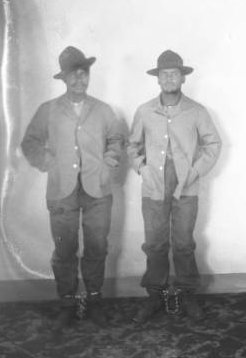
1996: Ebbisaa Addunyaa, extrajudicially executed

On this date in 1996, Oromo singer Ebbissaa Addunyaa was slain in his Addis Ababa home.

He “appeared to have been extrajudicially executed on suspicion of supporting the OLF,” according to Amnesty International. “No investigations were known to have taken place into allegations of torture, ”disappearance” or extrajudicial execution.”

“Extrajudicial execution” is a category challenge for these pages; Ebbisaa Addunyaa was not tried for anything, never mind convicted. His “execution” was a close cousin to simple murder … but a murder carried out by state security forces, targeting him specifically, and acting, if not under color of law, at least with legal impunity.

Ebbisaa and his friend Tana Wayessa

were at Ebbisaa’s home … north of the American Embassy in Addis Ababa, when gunmen burst in. Eyewitnesses claim the bodies were dragged from the house and put in a Land Rover with a government license plate. The security men, who carried out the murders, first cleared the street. Residents who looked out of their houses after the gunfire were told to get back indoors. The bodies were recovered [the] next day from the morgue at the Menelik II hospital.

All this took place in the turbulent 1990s wake of the collapsed Derg dictatorship. An initial multiparty post-Derg coalition government had included the Oromo Liberation Front — an organization upholding the rights of Ethiopia’s largest ethnic group — but the OLF soon withdrew from the coalition.

Ebbisaa was an OLF cadre who used his musical gifts for advocacy, and became a target when the outlawed OLF was forced underground.

A United Nations “Special Rapporteur” monitors “Extrajudicial, Summary or Arbitrary Executions” for the Economic and Social Council (ECOSOC).

Many of the Special Rapporteur’s reports dating back to the 1990s are available on the website of NYU’s Project on Extrajudicial Executions, and the 1997 country report (pdf) for Ethiopia reveals that Ebbisaa’s execution/assassination/murder was only one in a pattern.

The Special Rapporteur transmitted the following allegations of violations of the right to life concerning 16 identified persons and 13 unidentified persons: Ahmed Good Abdi, Ahmed Sanay Farah, Ahmed Sangaab and Hassan Ahmed Sagal, reportedly arrested and killed on 8 August 1996 in Toon-Ceeley by members of the Ethiopian armed forces; Ebissa Addunya, a singer and musician, and Tana Wayessa, reportedly shot and killed on 30 August 1996 by members of the Ethiopian security forces in the former’s house in Addis Ababa; 4 unidentified persons reportedly killed on 8 August 1996 in Gabababo; Awal Idire, aged 16, Awal Sani, aged 13, Badiri Shaza, aged 12, and Usen Kalu, aged 12, reportedly killed on 20 July 1996 by members of the Ethiopian armed forces because they had the initials of the Oromo Liberation Front tattooed on their hands; Mohamed Arabi Hirsi, Abdi Mohamed Yare, Gahnug Yusuf Aare, Mohamed Aw Farah Ga’iye, Haye Hirad, alleged to be tribal chiefs and clan elders, reportedly killed on 18 July 1996 by members of the Ethiopian armed forces; Sarecya Seerar Mohamed, her newborn child and eight other unidentified individuals, reportedly killed in mid-August 1996 by members of the Ethiopian armed forces in Qabridaharre (30 September 1996).

On this day..

1927: Sacco and Vanzetti (and Celestino Madeiros)

America Sacco & Vanzetti must not die

-Allen Ginsberg, “America” (mp3)

We have now reached a stage of the case the details of which shake one’s confidence in the whole course of the proceedings and reveal a situation which undermines the respect usually to be accorded to a jury’s verdict.

-Felix Frankfurter in The Atlantic

America our nation has been beaten by strangers who have turned our language inside out who have taken the clean words our fathers spoke and made them slimy and foul

their hired men sit on the judge`s bench they sit back with their feet on the tables under the dome of the State House they are ignorant of our beliefs they have the dollars the guns the armed forces the powerplants

they have built the electricchair and hired the executioner to throw the switch

all right we are two nations

. . .

but do they know the old words of the immigrants are being renewed in blood and agony tonight do they know the old American speech of the haters of oppression is new tonight in the mouth of an old woman from Pittsburgh of a husky boilermaker from Frisco who hopped freights clear from the Coast to come here …

the men in the deathhouse made the old words new before they died.

John Dos Passos, The Big Money (part of the U.S.A. trilogy)

Let us abandon then our gardens and go home
And sit in the sitting room.
Shall the larkspur blossom or the corn grow under this cloud?
Sour to the fruitful seed
Is the cold earth under this cloud,
Fostering quack and weed, we have marched upon but cannot conquer;
We have bent the blades of our hoes against the stalks of them.

Let us go home, and sit in the sitting room.
Not in our day
Shall the cloud go over and the sun rise as before,
Beneficent upon us
Out of the glittering bay,
And the warm winds be blown inward from the sea
Moving the blades of corn
With a peaceful sound.
Forlorn, forlorn,
Stands the blue hay-rack by the empty mow.
And the petals drop to the ground,
Leaving the tree unfruited.
The sun that warmed our stooping backs and withered the weed uprooted
We shall not feel it again.
We shall die in darkness, and be buried in the rain.

What from the splendid dead
We have inherited —
Furrows sweet to the grain, and the weed subdued —
See now the slug and the mildew plunder.
Evil does overwhelm
The larkspur and the corn;
We have seen them go under.

Let us sit here, sit still,
Here is the sitting-room until we die;
At the step of Death on the walk, rise and go;
Leaving to our children`s children this beautiful doorway,
And this elm,
And a blighted earth to till
With a broken hoe.

-Edna St. Vincent Millay, “Justice Denied in Massachusetts”

If it had not been for these things, I might have lived out my life talking at street corners to scorning men. I might have died, unmarked, unknown, a failure. Now we are not a failure. This is our career and our triumph. Never in our full life could we hope to do such work for tolerance, for justice, for man’s understanding of man as now we do by accident. Our words — our lives — our pains — nothing! The taking of our lives — lives of a good shoemaker and a poor fish-peddler — all! That last moment belongs to us — that agony is our triumph.

-Bartolomeo Vanzetti


Ben Shahn, The Passion of Sacco and Vanzetti

A recently discovered letter indicates that Upton Sinclair was convinced of his subjects’ guilt.

“Alone in a hotel room with Fred [Moore], I begged him to tell me the full truth … He then told me that the men were guilty, and he told me in every detail how he had framed a set of alibis for them … I faced the most difficult ethical problem of my life at that point … I had come to Boston with the announcement that I was going to write the truth about the case.”

But Sinclair had reasons beyond the “ethical” to tell what he saw as the larger truth. From a different letter:

“My wife is absolutely certain that if I tell what I believe, I will be called a traitor to the movement and may not live to finish the book … Of course, the next big case may be a frame-up, and my telling the truth about the Sacco-Vanzetti case will make things harder for the victims … It is much better copy as a naïve defense of Sacco and Vanzetti because this is what all my foreign readers expect, and they are 90% of my public.”

Well, the dying time came, the legal midnight hour,
The moment set by law for the Chair to be at work,
To substantiate the majesty of the State of Massachusetts
That hour was at hand, had arrived, was struck by the clocks,
The time for two men to be carried cool on a cooling board
Beyond the immeasurably thin walls between day and night,
Beyond the reach of airmail, telegrams, radiophones,
Beyond the brotherhoods of blood into the fraternities
Of mist and foggy dew, of stars and ice.
 The time was on for two men
 To march beyond blood into dust —
 A time that comes to all men,
 Some with a few loved ones at a bedside,
 Some alone in the wilderness or the wide sea,
 Some before a vast audience of all manking.

 Now Sacco saw the witnesses
 As the straps were fitted on
 Tying him down in the Chair —
 And seeing the witnesses were
Respectable men and responsible citizens
And even though there had been no introductions,
 Sacco said, “Good-evening, gentlemen.”
And before the last of the straps was fastened so to hold
Sacco murmured, “Farewell, mother.”

Then came Vanzetti.
He wished the vast audience of all mankind
To know something he carried in his breast.
This was the time to tell it.
He had to speak now or hold his peace forever.
The headgear was being clamped on.
The straps muffling his mouth were going on.
He shouted, “I wish to forgive some people
  for what they are now doing.”
 And so now
 the dead are dead????

-Carl Sandburg, “Legal Midnight Hour”


(The executions took place just after midnight Aug. 22-23)

THE names of the “good shoe-maker and poor fish-peddler” have ceased to represent merely two Italian workingmen. Throughout the civilised world Sacco and Vanzetti have become a symbol, the shibboleth of Justice crushed by Might. That is the great historic significance of this twentieth century crucifixion, and truly prophetic, were the words of Vanzetti when he declared, “The last moment belongs to us–that agony is our triumph.”

Vanzetti was right when he declared that his execution was his greatest triumph, for all through history it has been the martyrs of progress that have ultimately triumphed. Where are the Caesars and Torquemadas of yesterday? Who remembers the names of the judges who condemned Giordano Bruno and John Brown? The Parsons and the Ferrers, the Saccos and Vanzettis live eternal and their spirits still march on.

-Alexander Berkman and Emma Goldman, “Sacco and Vanzetti”

Starting points for the many Sacco and Vanzetti resources online: Famous American Trials | Wikipedia | Massachusetts Supreme Court virtual tour | American Writers and the Sacco-Vanzetti Case

On this day..

1775: Thomas Jeremiah, Charleston’s wealthiest free black

(Thanks to Meaghan Good of the Charley Project for the guest post. -ed.)

On this day in 1775, Thomas Jeremiah, a free black man in the then-colony of South Carolina, was hung after being convicted of attempting to a slave insurrection.

The case against him was extremely weak, but he was tried/framed under the Negro Act of 1740 (in a slave court, although he was not a slave), wherein the defendant was considered guilty until proven innocent. South Carolina’s own royal governor, William Campbell, called it a case of “judicial murder.”

Very little is known about Jeremiah. He left no diary or letters behind, and most of his trial records have been lost. We know he was married but we know nothing about his wife, whether she was a slave or a free black like himself, or whether they had any children. We don’t know how he became free or how he learned his trade. He is, in fact, so obscure that he doesn’t even have his own Wikipedia entry.

What little we do know, however, suggests that he was a most extraordinary man: a fisherman and ship’s pilot, one of less than 500 free blacks in the city of Charles Town (now called Charleston), Jeremiah had somehow managed to claw his way up and amassed a net worth of £1,000, or about $200,000 in today’s money. He was one of the wealthiest free black men in North America, and certainly the wealthiest self-made one.

Himself a slaveowner, he had no reason to start a slave rebellion, but this didn’t matter to those who convicted him. Jeremiah’s life, trial and death are discussed in detail in J. William Harris’s 2009 book, The Hanging of Thomas Jeremiah: A Free Black Man’s Encounter with Liberty. (This book review provides a good summary.)

2010 saw the publication of a second book, The World of Thomas Jeremiah: Charles Town on the Eve of the American Revolution.

Jeremiah was basically a victim of his own success. He had risen too high; he made the local white elites uncomfortable. As Harris noted, Jeremiah “did not need to gather arms or preach revolution to undermine slavery, because his whole life was a refutation of whites’ basic justification for slavery.”

Henry Laurens, a wealthy businessman, future Continental Congressman, slaveowner, and contemporary of Jeremiah’s, stated he was “a forward fellow, puffed up by prosperity, ruined by Luxury & debauchery & grown to amazing pitch of vanity & ambition.” He needed to be smacked down and he was, most severely.

In the spring and summer of 1775, revolution was fomenting everywhere. White “Patriots” wanted an opportunity to get out from under England, but they feared their slaves would use the conflict to try and get out from under them.

Nat Turner and Charleston’s own Denmark Vesey — these immortal rebels lay years into the future, but their very prospect made slave rebellions an omnipresent fear among the white populace. It was jumpy. And when two slaves accused Jeremiah of trying to persuade them to rebel, it jumped.

Only a few months passed between Jeremiah’s arrest and his execution. By that time he was a broken man, welcoming death. After he was hung, his body was cut down and burned to ashes.

Books about Thomas Jeremiah

On this day..

1951: Antonio Riva and Ruichi Yamaguchi

On this date in 1951, the first two foreigners — Italian merchant Antonio Riva and Japanese bookseller Ruichi Yamaguchi — were convicted and immediately executed in Beijing for a supposed plot to assassinate Mao Zedong.

According to Time magazine’s coverage of the affair, Radio Peking said that

“the streets they passed through [en route to execution] were thronged with people who expressed their feelings .. . with shouts of ‘Down with imperialism! Suppress counterrevolutionaries! Long live Chairman Mao!'”


No relation.

Riva (English Wikipedia entry | Italian) was a World War I fighter ace who had relocated to Beijing/Peking in the 1920s to peddle aircraft and training the Chinese Koumintang.

(In 1936, Riva married Catherine Lum, the daughter of American wood block artist Bertha Lum and sister of Eleanor Peter Lum, who took after mom.)

When the guys those planes were being used against won the Chinese Civil War, Riva mulled an expedient departure, but reportedly declared (Spanish link) that he could do business under any regime type.

The Communist government decided he had a different sort of business in mind. Citing Chinese state media, the London Times (Aug. 18, 1951) described the plot thus:

the conspirators planned to fire mortar shells at a reviewing stand outside the Tien An gate of the forbidden city in Peking during a procession to celebrate China’s national day on October 1 last year.

Several others, both Chinese and foreigners, drew long prison sentences as part of the “conspiracy” uncovered in a one-hour trial. The most illustrious of those was the Italian bishop Tarcisio Martina.*

Though Riva and Yamaguchi were the first foreigners officially executed by the new Chinese government, they were far from the last. All the more remarkable, then, that in a country that carries out thousands of executions per annum, Antonio Riva is thought to have been the last European citizen put to death there until Akmal Shaikh in 2009.

The Shaikh case helped rekindle interest in Riva’s execution — a timely confluence, since a recent book, L’ uomo che doveva uccidere Mao, critiqued the case against the Italian aviator.

* American diplomat Col. David Barrett, safely beyond the reach of the Maoists at Formosa, was a supposed ringleader.

On this day..

1776: Neptune, as witnessed by John Gabriel Stedman

On or around this date in 1776,* a couple of blacks in Suriname (both slave and free) were executed for unrelated crimes … notably a free man named Neptune whose coolness under horrific torture is related by John Gabriel Stedman in The Narrative of a Five Years Expedition against the Revolted Negroes of Surinam.

Dutch-born and of Scottish descent, Stedman was a soldier who volunteered to serve in the West Indies and found himself in Suriname fighting those “revolted negroes” — Maroons fled from slavery who had established independent communities and episodically (most of the 1770s were one such episode) fought the white colonies.

Maroon settlements in Suriname still pesist to this day.

Though that was Stedman’s business on the Caribbean coast of South America, the culprits whose deaths he witnessed today were not among the “revolted”, but more prosaic criminal fare. Prosaic, that is, until Neptune’s insouciantly comedic discourse in the midst of the most appalling torture.

Stedman sets the scene for us with the more everyday depravities prevailing in the colonial capital, Paramaribo

If, as I have just mentioned, cruelties were become less common in the rivers by the rebels, barbarities still continued in a shocking degree in the metropolis; where my ears were deafened with the clang of the whip, and the shrieks of the negroes. Among the most eminent of these tyrants was a Miss Sp—n,who lived next door to Mr. de Graav, and who I saw with horror from my window give orders that a young black woman should be flogged principally across the breasts, at which she seemed to enjoy peculiar satisfaction. To dissipate the impression this scene had left on my mind, I got into a whiskey, and rode out; when the first thing I saw was a negro girl fall naked from a garret window on a heap of broken bottles: this was indeed an accident, but she was so mangled, though not dead, that she exhibited a spectacle nearly as wretched as the other.—Cursing my unlucky fate, I turned the horses, and drove to the beach, as the only place to avoid every scene of cruelty and misery; but here I had the mortification to see two Philadelphia sailors (while they were fighting on the forecastle of their vessel) both fall over the ship’s bow into the stream, where they sunk, and were no more seen. On board another American brig, I discovered a little tar defending himself from the cross-trees with a hatchet, against a serjeant and four armed men, for a considerable time; till they threatening to shoot him out of the rigging, he at last surrendered, and being brought ashore, was dragged to Fort Zelandia, in company with two others, by a file of musketeers, where, for having been drunk on duty, they received a fire-cant each, at the captain’s request; that is, they were bastinadoed or beaten on the shoulders by two corporals with bamboo canes, till their backs were black, and swelled like a cushion. However arbitrary this mode of correction, the captain endeavoured to explain the necessity of it; the private American sailors being of a turbulent spirit indeed when drunk, although when sober they may be fairly classed among the best seamen in the world.

But the narrator is just getting warmed up, and after a good night’s sleep …

Early the next morning, while musing on all the different dangers and chastisements to which the lower class of people are exposed, I heard a crowd pass under my window. Curiosity made me start up, dress in a hurry, and follow them: when I discovered three negroes in chains, surrounded by a guard, going to be executed in the savannah. Their undaunted look, however averse I may be to the sight of cruelties, so attracted my attention, as to determine me to see the result, which was thus:— The sentence being read in Low Dutch (which they did not understand) one was condemned to be flogged below the gallows, and his accomplice to have his head struck off with an axe, for having shot a slave who had come to steal plantains on the estate of his mistress. The truth however was, that this had been done by that lady’s absolute command; but the murder being discovered, she, in the hopes of saving her character, besides the expence of paying the penalties, gave up her valuable slave, and permitted the unhappy man to be thus sacrificed. He laid his head upon the block with great indifference, stretching out his neck; when, with one blow of the axe, it was severed from his body.

The third negro, whose name was Neptune, was no slave, but his own master, and a carpenter by trade; he was young and handsome, but having killed the overseer of the estate Altona, in the Para Creek, in consequence of some dispute, he justly forfeited his life. The particulars, however, are worth relating: This man having stolen a sheep, to entertain a favourite young woman, the overseer, who burnt with jealousy, had determined to see him hanged; to prevent which, the negro shot him dead among the sugar canes; for these offences of course he was sentenced to be broken alive upon the rack, without the benefit of the coup de grace or mercy-stroke. Informed of the dreadful sentence, he composedly laid himself down on his back on a strong cross, on which, with arms and legs expanded, he was fastened by ropes: the executioner, also a black man, having now with a hatchet chopped off his left hand, next took up a heavy iron bar, with which, by repeated blows, he broke his bones to shivers, till the marrow, blood, and splinters flew about the field; but the prisoner never uttered a groan nor a sigh. The ropes being next unlashed, I imagined him dead, and felt happy; till the magistrates stirring to depart, he writhed himself from the cross, when he fell on the grass, and damned them all, as a set of barbarous rascals; at the same time removing his right hand by the help of his” teeth, he rested his head on part of the timber, and asked the by-standers for a pipe of tobacco, which was infamously answered by kicking and spitting on him; till I, with some American seamen, thought proper to prevent it. He then begged that his head might be chopped off; but to no purpose. At last, seeing no end to his misery, he declared, “that though he had deserved death, he had “not expected to die so many deaths: however, (said he) you christians have missed your aim at last, and I now care not, were I to remain thus one month longer.” After which he sung two extempore songs (with a clear voice) the subjects of which were, to bid adieu to his living friends, and to acquaint his deceased relations that in a very little time he should be with them, to enjoy their company for ever in a better place. This done, he calmly entered into conversation with some gentlemen concerning his trial; relating every particular with uncommon tranquillity—”But,” said he abruptly, “by the sun it must be eight o’clock; and by any longer discourse I should be sorry to be the cause of your losing your breakfast.” Then, casting his eyes on a Jew, whose name was De Vries, “A-propos, sir,” said he, “won’t you please to pay me the ten shillings you owe me ?” — “For what to do ?” — “To buy meat and drink, to be sure—don’t you perceive I am to be kept alive?” Which speech, on seeing the Jew stare like a fool, this mangled wretch accompanied with a loud and hearty laugh. Next, observing the soldier that stood sentinel over him biting occasionally on a piece of dry bread, he asked him ” how it came to pass, that he, a white man, should have no meat to eat along with it ?” — ” Because I am not so rich,” answered the soldier. — “Then I will make you a present, sir,” said the negro; “first, pick my hand that was chopped off clean to the bones, next begin to devour my body, till you are glutted; when you will have both bread and meat, as best becomes you;” which piece of humour was followed by a second laugh; and thus he continued, until I left him, which was about three hours after the dreadful execution.

Wonderful it is indeed, that human nature should be able to endure so much torture, which assuredly could only be supported by a mixture of rage, contempt, pride, and the glory of braving his tormentors, from whom he was so soon to escape. [ here a footnote is marked in the original text, whose content is: “At Demerary, so late as October, 1789, thirty-two wretches were executed in three days, sixteen of whom suffered in the manner just described, with no less fortitude, and without uttering one single complaint.” -ed. ]

Though I never recal to my remembrance, without the most painful sensation, this horrid scene, which must revolt the feelings of all who have one spark of humanity, I cannot forbear exhibiting to the public the dreadful spectacle in the annexed drawing.


Detail view of William Blake‘s illustration of Neptune’s breaking on the rack. (Click for full image.)

If the reader, however, should be offended with this shocking exhibition, and my dwelling so long on this unpleasant subject, let it be some relief to his reflection, to consider this punishment not inflicted as a wanton and unprovoked act of cruelty, but as the extreme severity of the Surinam laws, on a desperate wretch, suffering as an example to others for complicated crimes; while at the same time it cannot but give me, and I hope many others, some consolation to reflect that the above barbarous mode of punishment was hitherto never put in practice in the British colonies.

I must now relate an incident, which, as it had a momentary effect on my imagination, might have had a lasting one on some who had not investigated the real cause of it, and which it gave me no small satisfaction to discover. About three in the afternoon, walking towards the place of execution, with my thoughts full of the affecting scene, and the image of the sufferer fresh in my mind, the first object I saw was his head at some distance, placed on a stake, nodding to me backwards and forwards, as if he had really been alive. I instantly stopped short, and seeing no person in the savannah, nor a breath of wind sufficient to move a leaf or a feather, I acknowledge that I was rivetted to the ground, where I stood without having the resolution of advancing one step for some time; till reflecting that I must be weak indeed not to approach this dead skull, and find out the wonderful phenomenon, if possible, I boldly walked up, and instantly discovered the natural cause, by the return of a vulture to the gallows, who perched upon it, as if he meant to dispute with me for this feast of carrion ; which bird, having already picked out one of the eyes, had fled at my first approach, and striking the skull with his talons, as he took his sudden flight, occasioned the motion already described. I shall now only add, that this poor wretch, after living near six hours, had been knocked on the head by the commiserating sentinel, the marks of whose musket were perfectly visible by a large open fracture in the skull.

Stedman’s work details a number of other atrocities against Suriname’s African (primarily slave) population, many of them powerfully illustrated by William Blake with near pornographic effect. These sorts of things were of ancient vintage in the realm.

The Narrative itself became both an important anti-slavery text, and an invaluable historical reference. (Where I have clipped the text, Stedman is about to segue into a discourse on the local vulture population, just the sort of detail that present-day researchers might have a hard time sourcing for 18th century Suriname.)

But even though contemporary abolitionists made use of the Narrative, Stedman’s 18th century publisher actually played down the author’s tone on the subject. A version much more overtly critical of slavery and the savage corporal punishments that upheld it has recently been published from the original manuscripts. (An abridged version of that original is also available.)

* Stedman’s narrative mingles chronological journal-style entries with general observations about his environs. The text is slightly ambiguous as to the date, but the chapter in question begins by situating the action on Aug. 12, digresses into a description of the regional landscape, then returns to the narrative where this blog entry picks it up. It’s not completely explicit that the metropolitan atrocities he witnesses also occur on the 12th, but the text invites that inference — with the execution taking place the next morning after.

The next date explicitly named is Aug. 24, the birthday of the Prince of Orange, so if Neptune did not die on Aug. 13, it was within only a very few days after.

On this day..

1795: Pomp, a Negro

On this date in 1795, an African-American near-slave (slavery’s official 1783 abolition in the state seems not to have constituted a completely bright line) was hanged in Ipswich, Mass. for murdering his master-slash-employer.

Thanks to Laura James at CLEWS, we are drawn to this story reproduced here at the University of North Carolina-Chapel Hill’s Documenting the American South site. Pomp was perhaps mentally “touched”; he was certainly physically “touched” for any perceived inadequacy at his labors, and eventually chopped off his master’s head while the latter slept beside his wife. (The wife summoned the police, without molestation from Pomp.)

The victim, Captain Charles Furbush, was a minuteman who fought at Lexington, one of the opening skirmishes of the Revolutionary War.

Reprinted in full below (complete with breaks in the text where the original document is damaged) is the “Dying Confession of Pomp,” a broadsheet produced by a local merchant — who does not scruple to append some classified ads to the end of the text.*


I POMP now under sentence of death in Ipswich Jail, was born in [illegible], and brought from that place, so soon after I began my existence, that together with my Parents, I arrived at Boston when I was about three months old. My Father died soon after and my Mother has since had two husbands, and is now a widow. I have three sisters and three brothers now living in Boston, for whom a well as for my Mother I have a great regard.

My Mother soon after our arrival in this Country gave me away to Mr. Abbot of Andover. With this Gentleman I lived till I was sixteen years of age, but he being then on the point of moving back into the country some distance, told me if I chose it that I might then live with one of his sons, who was still to reside in Andover. I took up with his offer: choosing rather to continue in Andover, than to accompany my old master, to his new abode.

With young Mr. Abbot I lived not long, before I grew uneasy with the place. I told him that I meant to leave him soon, but he informed me that I was not free. About this time I was seized with convulsion fits which continued to oppress me at times ever after, to the fatal night that I murdered Capt. Furbush. Continuing still unreconciled to the new place, I went to the Select men of Andover to know whether I had not a right to leave it, and by their advice continued there a considerable time longer. But after a while it came to pass that Capt. Furbush took a notion to have a black man; and applying to the Select men, obtained their consent that I should be his servant. In compliance with the wishes [illegible] him; but soon found that I did not like him any better than the man with whom I had last lived. Furbush had a considerable farm and when I first began to live with him did some work himself, but I did not like the way he carried on his business, and after a while he left off work entirely, and by my desire left the whole management of the farm to me. I performed nearly all the work that was done on the place, cut all the hay, and with a trifle of help from the boy, whom my master desired to asist me a few days in a season, raised an hundred and seventy bushels of corn in a year. But my master still continued unkind to me, never letting me go to meeting on Sundays, and forcing me to clear out the cattle on those sacred days. When I asked him for money, he commonly gave me no more than four pence half peny, at a time: and even on Election day he gave me no more, nor would he suffer me on those days to go to frolicing till after one o’clock in the afternoon.

Though I did the best that I was able to do on the farm, my master was so far from seconding my endeavors, that he often brought whole droves of horses home with him in the night, and turned them in among the standing corn, that I had taken so much pains to plant, and hoe, and on the succeeding mornings he would charge me with the guilt of turning these horses into the corn field. In this way he often caused corn enough to be broken down in one night to fat a hog, and keep him fat a whole winter. I thought I found that he was a bad man, and a cheating horse jockey, and finally being unable to like him, I ran away from him, but was pursued, found, brought back, and severely flogged, by him for my pains. I afterwards ran off again but again met with the same fate. In this manner I went on ten or a dozen years, not liking my place, and not able to get away from it. I was frequently troubled with convulsion fits and sometimes crazy in such a degree, that I was generally bolted in to a chamber every night, in order to hinder me from getting into the chamber where my masters daughters slept. I worked very hard all the time. My master had one weakle son who was unable to work, and who often shed tears while he saw me labor and told me that he wished he was able to help me. I told him that perhaps I should contrive something after a while but did not explain myself. Continuing still uneasy I thought I would try once more the benefit of my legs. I accordingly ran off, but after a weeks absence, I was again brought back by my master, stripped naked, tied up by both hands, and unmercifully flogged. This was in the evening, and though it was late in the fall, and cold, frosty, icy weather, my master left me thus naked, and tied up, till the morning. My sufferings during the tedious hours of this lengthy night, by reason of cold and nakedness, a sore back and wounded spirits, were extremely great, and while under this torture, I thought it likely that my master would sometime or other feell the effect of his cruelty. My conjectures were so far right that it was the last time, that Furbush ever struck me.

My master used to tell me I might stay as long as I pleased at his house, adding that he should not stay in the world forever. From this I entertained an idea that Mrs. Furbush and the farm would be mine, after the death of my master. The hopes of being master, husband and owner, on one hand, and the cruel treatment I had received from Furbush on the other, prompted me to wish for his death and produced an idea of hastening [illegible] by [illegible] him myself.

In this state of mind the morning of the fatal day arrived. I arose considerably disordered having a great singing noise in the ears, and something whispering strange things to me I however went about my work as usual, cut up bushes all the day, near where there was another man to work but revealed nothing concerning my designs to him, at night went home, eat a beef steak for supper, and went to bed. Soon after I was seized with a fit, bit my tongue almost through, and after coming out of the fit, was delirious. I continued not long after this in bed, being impressed with an idea that I must get up and kill Capt. Furbush. The Lord a massy! said I to myself what is a going to take place now! The door of my chamber not being bolted as usual, I left my apartment and went down to the fire place. I was struck with horror by my reflections; but something still kept whispering in my ear, that now is your time! kill him now! now or never! now! now! I took an axe and went softly into the bed room of my master, and the moon shining bright, distinguished him from my mistress, I raised the ax before he awaked and at two blows, I so effectually did the job for him, that he never after even stretched himself.

My mistress being roused from sleep by the sound of the blows, said are you dead you? But receiving no answer she immediately left the bed, and called in a near neighbor. I did not try to escape not knowing that there was any necessity of it. I was told that I had but to go up to my chamber, I went there and perceived that somebody had bolted the door after me. Company soon began to croud into the house, and I was soon told that I should certainly be hanged. I was now very much frighted, nnd expected to be hung immediately, but my grief wore off considerably w [illegible] found that I was not to be hung there. I [illegible] soon brought to this Jail, and here enjoy mys [illegible] considerable well, though at Court time I [illegible] ry unhappy, and now some times, the idea [illegible] I have no friends, makes me dull.

The Ministers have been kind to me here, and I believe they are clever people: Mr. Stanniford too the Ja [illegible] keeper is kind and humane, and his wife and daughters clever people and pretty women. ([illegible] ndantly amiable ladies he ought to have said [illegible] whole family are clever folks.) The Ministers have told me to pray to God, and to the blood of Christ, for a new heart. I approve of [illegible] advice, and spend great part of my time in prayer, even ten or twenty times in a day I pray though I find it hard work, I do not however find fault with the hardness of the task, for [illegible] ieve it has been attended with great success. I have good hopes that I have got a new hear [illegible] the one that I used to have, used to ache [illegible] d, but the one I now have feels easy. I never [illegible] so well and hearty in my life as I now am, [illegible] fits and lunacy have left me entirely [illegible] hope to behave cleverly and graciously in this world.

I have prayed so much, that I have got all the minister’s [illegible] of praying and am not afraid to pray with [illegible] black coated man on the Continent. I [illegible] d make a very extraordinary priest, and inde [illegible] am turning very fast into one. When I [illegible] here, I was as black as any negro in the country, but now I have scarcely a drop of negro blood left in me, my blood having so far [illegible] ed into the blood of a Minister, that I am a [illegible] y nearly as white as a Mulatto. Minist [illegible] people and they can turn [illegible]

Some acc [illegible] the hapless POMP with some reflections [illegible] fate by J. PLUMMER, Jun.

Illustration of Pomp's hanging from the broadsheet

POOR POMP was a well made, considerable large, likely looking Negro. [illegible] e was very capable of contriving business on a farm, and such was his strength and industry, that besides the [illegible] which he received for his labour, Capt. Furbush could very well have afforded him 50 dollars per year–With such wages, or even with half that salary he might soon have acquired money enough to purchase 50 acres of excellent [illegible] land, and to have enabled him to clear and improve the same–In that situation some unfortunate white woman might possibly have sought [illegible] assylum in his arms, or at least the likelie [illegible] to girl that fell within the line of his ac [illegible] nce would have sprung like nimble doe [illegible] his marriage bed–The animating sweets of freedom, and of domestic life, had then been all his own–He would neither have sullied his hands with innocent blood, nor have been forced with unutterable woe, to breathe his last in a h [illegible] . But alas! instead of running this happy course, for want of understanding, and skill [illegible] him, to wife and laudable pursuits, we have seen him experience the sad reverse.

I ha [illegible] endeavored to preserve the ideas of poor Pomp, in the above speech, though I have taken the liberty to arrange the matter in my own way, [illegible] to word his thoughts more elegantly and [illegible] than he was able to express them. As to [illegible] said of something telling him to kill his [illegible] er, I believe it to be a falsehood of his ow [illegible] hing contrived by him to excuse his conduct, but as to the rest of his speech, I fancy that he believed it himself; though in several particulars he was pretty much mistaken. His [illegible] capacity was below the common pitch, and his understanding was undoubtedly considerably injured by convulsion fits, though his parts were vastly superior to those of an ideot. But for a rational being his mental improvements were extremely small; though when we consider the situation that he has lived in, this is not so very strange as we at first should think it. He lived either alone in the field, in bed, or in the kitchen of some people, who were too much above him to be his associates: and probably was never learned to read–There were few Negroes in Andover or any where near him, and all there was were unlearned people. From whom then or in what manner was it in his power to gain knowledge? ‘Tis true that he had some intercourse with his white neighbours, but very little that was profitable for instruction;– the discourse generally turning on domestic business, the raising country produce, the age, and strength, of oxen, and horses, the bulling of cows, or the lambing of sheep.– Of knowledge like this Pomp had a large stock. He knew all his master’s cattle, sheep, and hogs, and pretty exactly the age of each creature: and likewise the horses and oxen of many of his neighbours: could tell when such a particular cow of a certain neighbour had been bulled, and when his sow had pigged; but no man thought it worth his while to talk much upon other matters with him, nor would he have been much pleased with the discourse had it been otherwise. He knew not the names of the Seven Sciences, nor even that there were such things or names–knew nothing of ancient or modern history, nor even the late revolution in France, or the consequences of it so often rung through the universe–So little [illegible] ears–Of philosophy [illegible] , geography, good breeding, honor, politics, [illegible] he never heard, or heard with little attention, and less improvement– To crown his ignorance he lost his life by not knowing that murder was a sin: he expecting that he should immediately rise to a good estate and great felicity whenever he should be fortunate enough to kill his master. He knew nothing of the Laws of the United States or of this Commonwealth; and after the murder when he was told that he would be hung, he dreamed nothing of any previous imprisonment or trial: when he heard the sentence of death in Court, he expected to be hung the same hour but finding he was not to be executed that day, he conceived hopes that he never should be. He had seen others and been himself corrected in anger. He had observed that whenever his master was angry with him he either flogged immediately, or he for that time escaped correction, and that after the wrath of his master had subsided there was no danger. He thought the People of Andover and the Court at Ipswich would hang him in the same angry frame of mind, that his master used to flog him in, or that they would not hang him at all: he having no idea of the calm, but irrefutable ire, the deliberate, but vindictive, vengeance of the offended Justice, and of Heaven.

N. B. The reader will take notice that I do not attest to the truth of Pomp’s dying speech, but I affirm that he related to me as matters of fact the particulars [illegible] ted in this speech– Unfortunately for me [illegible] Jail keeper was absent when I visited the prisoner, [illegible] on his name does not appear a [illegible] tness: his lady was present, but perceiving that she was rather timorous, I did not trouble her with a request to be a witness; though I believe she will readly, orally attest to the truth of it.

Printed for and sold by JONATHAN PLUMMER, JUN. price 6d, who still continues to [illegible] various branches of trifling business–Underbeds filled with straw and wheeled to the ladies doors — Any person wanting a few dollars at any time may be supplied by leaving a proper adequate in pawn–Wanted 1000 junk bottles.

A certain secret disorder cured privately and expeditiously– Love-letters in prose and verse furnished on the shortest notice–The art of gaining the object beloved reasonably taught–

Nymphs and swains bow’d down with care
By cupid wounded to the heart,
Quick, O quick to me repair
For soon I ease the dreadful smart.


To Tell a Free Story: The First Century of Afro-American Autobiography, 1760-1865 characterizes the dueling interpretations of Pomp and his white interlocutor as “[pitting] two explanations of black criminal behavior against each other for the first time in Afro-American autobiography. Plummer’s argument is based on the notion of the Negro as absence. His lack of remorse for murder shows that he has no moral sense, and in justifying his crime with the “whispering” voices, he proves that he lacks truthfulness. Pomp’s narrative, on the other hand, insists that there was something at work in the black man’s psyche, a dynamic whose manifestations in the actions and language of Pomp resisted Furbush’s methods of control and Plummer’s system of reference.”

* By the way, click on my sidebar ads, why don’t you?

On this day..

1903: Hilario Hidalgo and Francisco Renteria

Border-related violence and crime due to illegal immigration are critically important issues to the people of our state, to my Administration and to me, as your Governor and as a citizen.

Statement (pdf) by Arizona Gov. Jan Brewer on signing the anti-immigration law, which went into effect July 29, 2010

Some stories are just plain classics.

In February 1903, two Mexicans shot up Goddard Station stagecoach stop, for motivations that were never plain. (There was no robbery, but it might have been revenge.)

The shooters got away, but law enforcement soon enough decided that a couple of railroad workers on the Mexican side of the border matched their description, and contrived to lure them into Arizona where they could be arrested.

Hilario Hidalgo and Francisco Renteria, were put on trial for their lives in Prescott, Ariz., in June 1903, where they were doomed to hang on the strength of eyewitness testimony and thirty minutes of the jurymen’s time. Appeals forbidden, the sentence was executed on this date — not six months after the crime.

With feelings of profound regret and sorrow, I hereby invite you to attend and witness the private and decent and humane execution of two human beings, namely: Richard Roe and John Doe. Crime — Murder.

Said men will be executed on July 31, 1903 at 12 noon. You are expected to deport yourself in a respectful manner and any flippant or unseemly language or conduct on your part will not be allowed. Conduct on anyone’s part bordering on ribaldry and tending to mar the solemnity of the occasion will not be tolerated.

-Sheriff’s invitation to the hanging, quoted in Frontier Justice in the Wild West: Bungled, Bizarre, and Fascinating Executions

The men cracked wise at the reading of their death warrant — “I have heard that repeated so often that if it was a song I would sing it to you,” reported the Los Angeles Times (Aug. 1, 1903) — and with “perfect nerve” checked out, calling only “Adios! Adios!” from the scaffold.

It was the last hanging in Prescott, Ariz.

On this day..

1885: James Arcene, the youngest juvenile offender hanged in the US?

(Thanks to Caitlin at Vast Public Indifference for the guest post -ed.)

On June 26, 1885, two Cherokee men — James Arcene and William Parchmeal — were hanged at Fort Smith, Arkansas. Moments before their deaths, both men made statements, though it is unlikely that their last words were intelligible to many witnesses at the military outpost, owing to the heavy rain and the fact that Parchmeal spoke little English.* Under the eye of Federal Judge Isaac Parker, the notorious “Hanging Judge” of the old Southwest, Arcene and Parchmeal had their limbs bound and their faces covered before being “launched into eternity.”**

In February, Arcene and Parchmeal had been convicted of a murder committed 13 years previously. On November 25, 1872, someone had killed a Swedish immigrant named Henry Feigel on the road near Fort Gibson in Indian Territory (now Oklahoma). The case remained unsolved for over a decade.

In 1884, 12 years after Feigel’s death, a U.S. Deputy Marshall named Andrews arrested Arcene and Parchmeal in connection with the murder. Though documents describing the evidence used to obtain the arrest warrant are not readily available, Andrews was able to convince a judge (probably the same Judge Parker who presided over the trial) that the trail had not gone cold after so many years. Arcene “denied having knowledge of the killing,” but Parchmeal made a statement through an interpreter “admitting being present, but said that he was there under duress and that Arcine did the killing.”†

After both men were convicted, Arcene made a confession stating that he had “shot [Feigel] six times, then both took rocks and mashed the man’s head” before dragging him off the road and robbing him of his boots and 25 cents. Judge Parker sentenced both men to hang.

At first glance, there is little to distinguish this case from the 77 other executions presided over by Judge Parker during his tenure at Fort Smith.‡ Parker had been appointed to the bench in the hope that he would make Indian Territory feel the full might of the federal government, and he did not disappoint. According to one chronicler of the Fort Smith court under Judge Parker,

“Tried, found guilty as charged, sentenced,” was the tale repeated until the mere fact of arrest meant almost certain conviction. The sentence “To die on the gallows” was passed upon more men here than anywhere in history. So numerous were the executions [Parker] ordered and so commonplace the thunderous crash of the gallows trap that street urchins playing outside the old walls would gleefully shout: “There goes another man to hell with his boots on!”

Glenn Shirley, Law West of Fort Smith: A History of Frontier Justice In The Indian Territory, 1834-1896 (1957), 79.

But this execution was peculiar in one significant detail: James Arcene claimed to have been “only a boy [about] 10 or 12 years old” at the time of the murder.† If true, he was one of the youngest criminals in American history to have his crime punished by a federally-sanctioned execution.

It is difficult to verify James Arcene’s age with any degree of certainty. Census records for Indian Territory in the 1870s and 1880s are spotty at best, and few other vital records survive. It is possible that Arcene may have hoped to obtain a pardon by falsely pleading youth, but he did not revise his statement, even when it became apparent that it would do him no good. We may never know how old James Arcene really was — all we can know is that he claimed to have been a child in 1872 and that Judge Parker ignored this information and sentenced the adult who stood before him.§

If James Arcene was a juvenile offender, he looked very much like the other children and adolescents executed in the United States since the era of the American Revolution. Those offenders executed for crimes committed before the age of 18 have disproportionately been African American, Native American, or Hispanic teenagers who have committed crimes against white victims. This is true of the 20th century as well as the 19th: of the 22 juvenile offenders executed for murder in the US between 1976 and 2004, 77% had killed a white victim, though only 50% of homicides perpetrated by juvenile offenders involved a white victim. As of 2004, 9 of the last 10 juvenile offenders executed in Texas, the state responsible for 59% of all juvenile executions, were black or Hispanic. (Figures from the Death Penalty Information Center.)

In March of 2005, the Supreme Court handed down a 5-4 ruling in Roper v. Simmons declaring that states could no longer execute criminals who had committed their crimes while under the age of 18.

* See “Murder for Money,” Daily Arkansas Gazette, 27 June 1885 on rain, and “Hanged on the Gallows,” New York Times, 27 June 1885 on Parchmeal’s need for an interpreter.

** “Murder for Money,” Daily Arkansas Gazette, 27 June 1885.

† “Hanged on the Gallows,” New York Times, 27 June 1885.

‡ Judge Parker sentenced 156 men and 4 women to death. Of these, 79 were actually executed, the rest having died in prison, had their sentences commuted, or were pardoned.

§ It should be noted that many books make the erroneous claim that Arcene was 10 at the time of his execution. This is not the case — all available primary documents agree that he was an adult in 1885. I made this same mistake in my earlier guest post on the case of Hannah Ocuish, having relied on Dean J. Champion’s The American Dictionary of Criminal Justice: Key Terms and Major Court Cases (2005).

On this day..

1734: Marie-Joseph Angélique, for burning Montreal

On this date in 1734, a Portuguese-born slave known as Marie-Joseph Angélique was publicly hanged before the burned ruins of old Montreal on an accusation of having set the blaze.

Having recently been caught attempting to abscond with her lover, a white servant named Claude Thibault, Angelique was the instant consensus community suspect when Montreal caught fire on April 10. Forty-six buildings in the still-small frontier town burned; Angelique was arrested the very next morning.

(Thibault fled town, his fate unknown but presumptively no worse than what befell his paramour.)

Nobody died in the fire, but conflagrations were deadly serious back in the bucket brigade era.

The sentence

calls for the said Marie Joseph Angelique in reparation for the Fire caused by Her and other issues brought forward at the trial, to be condemned to make honourable amends Disrobed, a Rope around her Neck, holding in her hands a flaming torch weighing two Pounds before the door and main entrance of the parish Church of the said City of Montreal, where She will be led by the Executor of the high Court And there on her knees state and declare in a loud and intelligible voice that she maliciously and defiantly and wrongly set the Said fire for which She is repentant, [and] ask Forgiveness from God, the King and the Court; this done she is to be taken to the public square of the said City of Montreal to be Hanged until dead at the gallows erected for this Purpose at the said square, and then her dead Body is to be placed on a flaming pyre and burned and her Ashes Cast to the wind, her belongings taken and confiscated by the King; prior to this the said Marie Joseph Angelique is to be subjected to torture in the ordinary and extraordinary ways in order to have her reveal her accomplices …

And so she was.

Although the torture broke Angelique’s now-useless denial of her own guilt, she maintained her defense of Claude Thibault, insisting that she acted alone. It’s up for debate whether she did, in fact, act alone, or act at all — and if Angelique was guilty, what meaning or intent one can ascribe to her action.

There’s a fascinating exploration of this case, including the available primary documents, available in English or French.

On this day..

1940: Tirailleurs Senegalais, for France

On this date in 1940, German forces even then completing their rout of France — the humiliating capitulation was mere hours away — massacred a detachment of African soldiers who mounted a doomed resistance at Lentilly.

Tirailleurs Senegalais were recruited not only from Senegal but from throughout France’s domains in sub-Saharan Africa. (There were also Algerian, Tunisian, and Moroccan tirailleurs.)

Though these soldiers’ own lands were occupied, they were instrumental to defending the freedom of their occupier on European soil: over half a million African tirailleurs are thought to have served les couleurs in the two World Wars, and died in all the horrible ways those slaughterhouses could devise.

In 1940, black troops represented some 9% of the French army, a fact pilloried in German nationalist proaganda.

It’s hardly a surprise that the black man couldn’t catch a break from skull-measuring Aryan race warriors, but then, France too had its own less than comfortable relationship with these dark-hued citizens summoned from distant villages to bleed in the trenches of Europe. The military’s official guidelines emphasized (French link) the “Senegalese’s” special value as cannon fodder.

If a sacrificial mission is necessary, a defense to the death to provide cover for forces to regroup, appeal to the valor of the black fighter.

On the other hand, French authorities put up a monument to black soldiers in the aftermath of World War I. (The occupying Nazis vengefully dismantled it.) Such are the contradictions of colonialism.

Racial reservations notwithstanding, colonial troops were employed throughout the army if for no other reason than that they constituted nearly the tenth part of that army.

Their service record naturally included (French pdf) the over-before-it-started French defense against the Nazi blitz in 1940.

In this instance, knowing full well that the campaign was lost, French officers flipped open the “sacrificial mission” playbook and ordered their African charges to oppose a German march near Lyon “without thought of retreat.”

Since victory was equally out of the question, that left death. Wehrmacht troops duly prepared by Nazi racial typecasting to see their foes as savages were all too ready to wipe out African troops they greatly outclassed.


A monument to the Tirailleurs in Lentilly, France. Image (c) filoer and used with permission.

The Lentilly cemetery “Tata”, final resting place of 188 Senegalese riflemen who died under German artillery or were massacred after the battle by the 3rd SS Division Totenkopf June 19 and 20. Image (c) filoer and used with permission.

For more on the tirailleurs, there’s an extensive French-language blog.

On this day..