1871: The Paris Commune falls

On this date in 1871, the last barricade of the Paris Commune fell to the onslaught of the army — and a legion of Parisians fell to the army’s firing squads.

On the evening of that bright Sunday when the insurrection finally collapsed, a Sunday when the streets of central Paris were crowded with returning bourgeois, all expressing their satisfaction that the struggle was at last over, the city’s walls were placarded with a proclamation emanating from MacMahon. “Inhabitants of Paris,” said he, “the Army of France has come to save you. Paris is delivered. At four o’clock our soldiers carried the last position occupied by the insurgents. Today the struggle is over, order, work and security will now revive.

I read that announcement in the Rue de Rivoli, not far from the Hotel-de-Ville. A moment later, however, I heard a discharge of musketry … Several insurgents who had been taken fighting were being shot. (My Adventures in the Commune, Paris, 1871, an anti-Commune source)

The day was climax and curtains for the first working-class seizure of power in industrial Europe, but in truth indiscriminate reprisal executions had been underway since troops of the conservative Versailles government first breached rebellious Paris on May 21.

What followed was semaine sanglante, the “bloody week” — each barricade’s surviving defenders executed summarily, and anyone in the city liable to a similar fate if the nearest French officer disliked the cut of his or her jib. Rumors swept the city that women of the Commune were torching buildings, for instance, and suddenly any woman in the street could be killed as an arsonist; some firefighters were shot as saboteurs when the “water” they threw on such flames failed to speedily quench them,* and was consequently adjudged to be kerosone.

And heaven help he who should chance to resemble one of the wanted Communard leaders!

Any passer-by calling a man by a revolutionary name caused him to be shot by soldiers eager to get the premium … Members and functionaries of the Commune were thus shot, and often several times over, in the persons of individuals who resembled them more or less.


Un rue de Paris en 1871, by Maximilien Luce.

The total body counts are guesswork: the killing ran far ahead of the record-keeping. Twenty thousand, or thirty, or more are thought to perished by summary execution. Even the press of the bourgeoisie, whose sword arm the Versailles men comprised, was aghast. London’s Times filled its broadsheets with calumnies upon the Commune, but noted on May 29:

“The Revolution is crushed;” but at what a cost, and amid what horrors! … the Communists seem not very much worse than their antagonists. It sounds like trifling for M. Thiers to be denouncing the Insurgents for having shot a captive officer “without respect for the laws of war.” The laws of war! They are mild and Christian compared with the inhuman laws of revenge under which the Versailles troops have been shooting, bayoneting, ripping up prisoners, women and children, during the last six days.

Whatever the true death toll, it massively surpassed that of the much more eagerly commemorated Revolutionary Terror.

Not for Executed Today to number what the butchers themselves could not. In a city turned charnel house in the midst of a Week of Blood, a few scenes of mortality from the day the Commune fell. (Heavily sourced to the very pro-Commune — hence potentially sensational — History of the Commune of 1871)

This people, heroes in the face of the foreigner, must therefore by called assassins, criminals, wretches, because they died for the Universal Republic, because in defense of their beliefs, their conscience, their idea, they preferred, in their fierce enthusiasm, to bury themselves in the ruins of Paris rather than abandon it to the coalition of despots a thousand times more cruel and more lasting than any foreigner.

-Lissagaray

The 147 Fédérés at Communards’ Wall

At a wall still consecrated to leftists in the Pere Lachaise cemetery of Belleville, 147 were summarily shot.

The 147 are acclaimed as the last defenders of the Commune.

the Commune is in its death throes. Like the dragon of fairy lore, it dies, vomiting flames … What must these men feel who are killing and being killed in the cemetery! To die among the dead seems horrible. But they never give it a thought; the bloody thirst for destruction which possesses them allows them only to think of one thing, of killing! Some of them are gay, they are brave, these men. That makes it only the more dreadful; these wretches are heroic! Behind the barricades there have been instances of the most splendid valour. A man at the Porte Saint-Martin, holding a red flag in his hand, was standing, heedless of danger, on a pile of stones. The balls showered around him, while he leant carelessly against an empty barrel which stood behind. — “Lazy fellow,” cried a comrade. ‘”No,” said he, “I am only leaning that I may not fall when I die.”

Paris Under the Commune, an anti-Commune source

Communard Eugene Varlin

Varlin, alas! was not to escape. On Sunday the 28th May he was recognized in the Rue Lafayette, and led, or rather dragged, to the foot of the Buttes Montmartre before the commanding general. The Versaillese sent him to be shot in the Rue des Rosiers. For an hour, a mortal hour, Varlin was dragged through the streets of Montmartre, his hands tied behind his back, under a shower of blows and insults. His young, thoughtful head, that had never harboured other thoughts than of fraternity, slashed open by the sabres, was soon but one mass of blood, of mangled flesh, the eye protruding from the orbit. On reaching the Rue des Rosiers, he no longer walked; he was carried. They set him down to shoot him. The wretches dismembered his corpse with blows of the butt-ends of their muskets.

Varlin was shot along with a nameless batch of others to whom the March 18 execution of Generals Lecomte and Thomas had been hastily imputed (they were held at the generals’ execution site, to contemplate their sin). A pro-government paper allowed that Varlin “died game.”
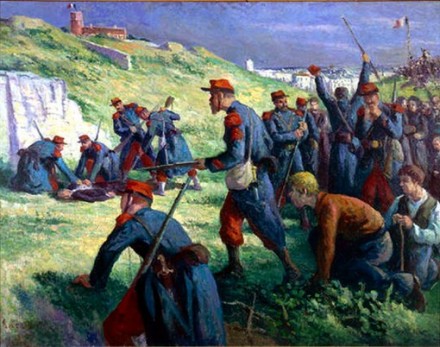

L’execution de Varlin, another Maximilien Luce scene.

Many at the stock exchange

According to the Paris Francais as quoted by this Marxist review of the events

It is at the Bourse that there was to-day the largest number of executions. The doomed men who attempted to resist were bound to the iron railing.

The stock exchange is “a fit place, to be sure, for this sort of business,” observes our interlocutor.

Eighty-plus defenders of Belleville, at the Arc de Triomphe

The London Times editorialized on May 31 upon this incident when the Marquis de Gallifet plucked from the mass of Belleville’s May 28 captives “eighty prisoners, principally soldiers of every arm, linesmen, artillerymen, and Zouaves, [who] were set apart and afterwards led to the right of the rampart to be shot.”

The French are filling up the darkest page in the book of their own or the world’s history. The charge of ruthless cruelty is no longer limited to one party or to one class of persons. The Versailles troops seem inclined to outdo the Communists in their lavishness of human blood. The Marquis de Gallifet is escorting a column of prisoners to Versailles or Satory. He “picks out eighty-two of them, and shoots them at the Arc de Triomphe.” Next came a lot of 20 firemen, then a dozen women, one aged 70. On another spot our Correspondent came upon “80 corpses, piled upon each other, a mass of arms and legs and distorted faces, while the roads and gutter literally flowed with blood.” About 1,000 are said to have thus suffered. By this wholesale and summary execution of prisoners in batches of 50 and 100, not only must the innocent perish with the guilty, but many must bear the penalty of imaginary guilt.

An utterly disconnected Englishman, according to the paper’s correspondent, was accidentally among the four score at the Arc, and only saved by the fortuitous intervention of a Belgian attache.

an English officer somehow got mixed up in the procession, and was forced to keep in it by the escort, who, out of 5,000 prisoners, could not, of course, be expected to recognize one innocent man … it so happened that some of the prisoners tried to escape, and to make an example the leader of the cavalry escort, the Marquis de Gallifet, a man who is not prone to err on the side of mercy, had then and there 81 shot, and the English officer was all but one of them, his explanations being at first refused the slightest attention. Human life has, in fact, become so cheap that a man is shot more readily than a dog.

Socialist physician Tony Moilin

One single fact was Tony Moilin reproached with: that of having on the 18th March taken possession of the mairie of his arrondissement, and having thus had a share in giving the signal for the insurrection …

The court-martial condescended to tell him that the fact of the mairie, the only one he could be reproached with, had in itself not much importance, and did not merit death, but that he was one of the chiefs of the Socialist party, dangerous through his talents, his character, and his influence over the masses; one of those men, in short, of whom a prudent and wise Government must rid itself when it finds a legitimate occasion to do so

[A] respite of twelve hours was granted him in order that he might make his testament, write a few words of farewell to his father, and finally [marry his pregnant lover] … on the 28th May, in the morning, Tony Moilin was led into the garden a few steps from the palace and shot. His body, which his widow claimed, the surrender of which had been at first promised, was refused her. (History of the Commune of 1871)

The unnumbered dead of Lobau Barracks

Since morning a strong cordon is being formed round the theatre (Châtelet); where a court-martial is permanently established. From time to time one sees a band of fifteen to twenty individuals coming out, composed of National Guards, civilians, women and children fifteen to sixteen years old.

These individuals are condemned to death. They march two by two, escorted by a platoon of chasseurs, who lead and bring up the rear. This cortege goes up the Quai de Gevres and enters the Republican Barracks in the Place Lobau. A minute after one hears from within the fire of platoons and successive musketry discharges; it is the sentence of the court-martial which has just been executed.

The detachment of chasseurs returns to the Chatelet to fetch other prisoners. The crowd seems deeply impressed on hearing the noise of the shootings.

This is another publication’s story cited in the History of the Commune of 1871, which itself also details the court-martial procedures of this drumhead tribunal:

Thousands of prisoners who were led there were first of all penned in upon the stage and in the auditorium, under the guns of the soldiers placed in the boxes; then, little by little, like sheep driven to the door of the slaughter-house, from wing to wing they were pushed to the saloon, where, round a large table, officers of the army and the honest National Guard were seated, their sabres between their legs, cigars in their mouths. The examination lasted a quarter of a minute. ‘Did you take arms? Did you serve the Commune? Show your hands.’ If the resolute attitude of a prisoner betrayed a combatant, if his face was unpleasant, without asking for his name, his profession, without entering any note upon any register, he was classed. ‘You?’ was said to the next one, and so on to the end of the file, without excepting the women, children, and old men. When by a caprice a prisoner was spared, he was said to be ordinary, and reserved for Versailles. No one was liberated.

The classed ones were at once delivered to the executioners, who led them into the nearest garden or court. From the Châtelet, for instance, they were taken to the Lebau Barracks. There the doors were no sooner closed than the gendarmes fired, without even grouping their victims before a platoon. Some, only wounded, ran along by the walls, the gendarmes chasing and shooting at them till they fell dead. … There were so many victims, that the soldiers, tired out, were obliged to rest their guns actually against the sufferers. The wall of the terrace was covered with brains; the executioners waded through pools of blood.


Summary executions — death squads — continued for days or weeks afterwards in Paris; martial law throttled left organizing in the city; and those “fortunate” enough to have been captured alive were processed in a steady stream of judicial executions over the months yet to come.

The Commune, a palpably subversive example even in the present day, was destroyed in every way possible for the Versailles government. But its example could hardly be forgotten.

Marx would write The Civil War in France of the only proletarian revolution he would actually witness in his lifetime.

The next generation’s subversives also took inspiration from the Parisian example … and lessons from its mistakes. Lenin — a fond student of the Commune, who was eventually buried wrapped in a Communard banner — said that

two mistakes destroyed the fruits of the splendid victory. The proletariat stopped half-way: instead of setting about “expropriating the expropriators”, it allowed itself to be led astray by dreams of establishing a higher justice in the country united by a common national task; such institutions as the banks, for example, were not taken over … The second mistake was excessive magnanimity on the part of the proletariat: instead of destroying its enemies it sought to exert moral influence on them; it underestimated the significance of direct military operations in civil war, and instead of launching a resolute offensive against Versailles that would have crowned its victory in Paris, it tarried and gave the Versailles government time to gather the dark forces and prepare for the blood-soaked week of May.

“The lesson learnt by the proletariat will not be forgotten,” Lenin vowed, and his own revolution gained a vital object lesson in the Bloody Week of Paris, and an anthem besides: Communard Eugene Pottier, fleeing the Versailles army’s slaughter, wrote the verses that have been sung ever since by millions dreaming of a better world — the Internationale.

* Water can accelerate a fire, under the right circumstances.

On this day..

1525: Thomas Müntzer, prophet of the Peasants’ War

On this date in 1525, radical religious reformer and Peasants’ War leader Thomas Müntzer lost his head in the town of Mühlhausen.

Müntzer, a university-educated theologian, caught the whiff of Lutheranism in the Zeitgeist; following Luther’s call to study the Biblical text directly without the intervention of the doctors of Rome, Müntzer swiftly discerned a heavenly admonition to set to rights the many wrongs of an unjust world.

Luther had not had in mind dispossessing the haves, particularly not when imperial electors defended him from the Pope’s inquisitors.

When in 1517 opposition against the dogmas and the organisation of the Catholic church was first raised by Luther, it still had no definite character. Not exceeding the demands of the earlier middle-class heresy, it did not exclude any trend of opinion which went further. It could not do so because the first moment of the struggle demanded that all opposing elements be united, … Luther’s sturdy peasant nature asserted itself in the stormiest fashion in the first period of his activities. “If the raging madness [of the Roman churchmen] were to continue, it seems to me no better counsel and remedy could be found against it than that kings and princes apply force, arm themselves, attack those evil people who have poisoned the entire world, and once and for all make an end to this game, with arms, not with words. If thieves are being punished with swords, murderers with ropes, and heretics with fire, why do we not seize, with arms in hand, all those evil teachers of perdition, those popes, bishops, cardinals, and the entire crew of Roman Sodom? Why do we not wash our hands in their blood?”

This revolutionary ardour did not last long. The lightning thrust by Luther caused a conflagration. A movement started among the entire German people. In his appeals against the clergy, in his preaching of Christian freedom, peasants and plebeians perceived the signal for insurrection. Likewise, the moderate middle-class and a large section of the lower nobility joined him, and even princes were drawn into the torrent. While the former believed the day had come in which to wreak vengeance upon all their oppressors, the latter only wished to break the power of the clergy, the dependence upon Rome, the Catholic hierarchy, and to enrich themselves through the confiscation of church property. The parties became separated from each other, and each found a different spokesman. Luther had to choose between the two. Luther, the protégé of the Elector of Saxony, the respected professor of Wittenberg who had become powerful and famous overnight, the great man who was surrounded by a coterie of servile creatures and flatterers, did not hesitate a moment. He dropped the popular elements of the movement, and joined the train of the middle-class, the nobility and the princes. Appeals to war of extermination against Rome were heard no more. Luther was now preaching peaceful progress and passive resistance.

Muntzer became adopted into the Marxist pantheon sufficiently to grace East Germany’s five-mark bill.

That’s Engels in The Peasant War in Germany, revisiting the theological conflicts at the birth of the Protestant Reformation from the perspective of 19th century Marxism.

Projecting backwards, Engels saw in Müntzer a distant forerunner of their own day’s class conflicts — the man whose language was Biblical and apocalyptic but whose subject matter was the peasantry’s demand for material justice.

[Luther] says in his booklet on commerce that the princes should make common cause with thieves and robbers. But in this same writing he is silent about the source of all theft … Behold, the basic source of usury, theft, and robbery is our lords and princes, who take all creatures for their private property. The fish in the water, the birds in the air, the animals of the arth must all be their property, Isaiah 5[:8]. And then they let God’s commandment go forth among the poor and they say, “God has commanded, ‘Thou shalt not steal’.” But this commandment does not apply to them since they oppress all men — the poor peasant, the artisan, and all who live are flayed and sheared, Micah 3[:2f]. But, as soon as anyone steals the smallest thing, he must hang. And to this Doctor Liar says, “Amen.” The lords themselves are responsible for making the poor people their enemy. They do not want to remove the cause of insurrection, so how, in the long run, can things improve? I say this openly, so Luther asserts I must be rebellious. So be it!*

In this detail view of East German artist Werner Tübke’s weird panorama of the Battle of Frankenhausen, a crestfallen Müntzer realizes divine aid is not forthcoming.

Müntzer embraced the cause of a massive peasant revolt in central Europe in 1524-25. Luther said God wanted them “knocked to pieces, strangled and stabbed, secretly and openly, by everybody who can do it, just as one must kill a mad dog!”

So it was with Müntzer, who was captured in the decisive Battle of Frankenhausen, tortured into recanting his heretical doctrines,** and beheaded.

Whether one thinks of politics leading Müntzer’s theology or theology leading his politics† or some sort of dialectic between them, we see Müntzer latterly through a glass darkly — the wasted root of a lost Reformation.

* From a 1524 pamphlet vituperatively entitled “Highly provoked defense and answer to the spiritless, soft-living flesh at Wittenberg, who has most lamentably befouled pitiable Christianity in a perverted way by his theft of holy Scripture,” reprinted in Revelation and Revolution.

** Müntzer’s theology included rejection of infant baptism, which ranks him as an early anabaptist.

† “I have done nothing but say that a Christian should not so wretchedly sacrifice someone else on the butcher’s table. And if the political bigwigs do not cease to do so, the government should be taken from them. Whenever I have seriously proclaimed this to Christendom, it either refused to act or was too scared to do so. What more shall I do? Should I perhaps be silent, like a dumb dog? Why should I then make a living off the altar?”

On this day..

1832: Samuel Sharpe, “I would rather die upon yonder gallows than live in slavery”

On this date in 1832, Jamaican national hero Samuel Sharpe died upon the gallows for instigating the slave revolt that would (help to) end slavery.

Samuel Sharpe, an educated slave who was also a Baptist deacon, was the moving spirit behind the attempted general strike that became the Christmas Rebellion.

That time of year was less than festive for Jamaica’s enormous slave population, for Saint Nick opened the short window for harvesting the island’s sugar cane.

Samuel Sharpe and collaborators had the wit to realize that being depended upon to bring in the cash crop that made life comfortable for their owners put the slaves’ hands upon a potent economic lever. In the last few days of 1831, they pressed it.

The “passive resistance” thing didn’t last long, however, and the “strike” transmuted into a rebellion — the cause swiftly taken up by thousands of slaves around the island who torched crops. Given the small (less than 20) white body count,* the “violence” appears to have been directed against the instruments, rather than the perpetrators, of their enslavement.

Not so the reprisals.

The rebellion was suppressed within days, and over 300 put to death for it (in addition to 200 slave casualties during the pacification itself). There’s an absorbing BBC Witness episode about this affair available as a podcast here.

Sharpe was the last of those executed.

But his revolt is widely thought to have given impetus to the British parliament’s deliberations over the ensuing months that ultimately led to the Slavery Abolition Act (1833).

What [abolitionist MP William] Wilberforce was endeavoring to win from the British senate by his magic eloquence the slaves themselves were endeavoring to gain by outbreaks and violence. The combined action of one and the other wrought out the final result. While one showed that slavery was wrong, the other showed that it was dangerous as well as wrong. Mr. Wilberforce, peace man though he was, and a model of piety, availed himself of this element to strengthen his case before the British Parliament, and warned the British government of the danger of continuing slavery in the West Indies. There is no doubt that the fear of the consequences, acting with a sense of the moral evil of slavery, led to its abolition. The spirit of freedom was abroad in the Islands. Insurrection for freedom kept the planters in a constant state of alarm and trepidation. A standing army was necessary to keep the slaves in their chains. This state of facts could not be without weight in deciding the question of freedom in these countries … I am aware that the insurrectionary movements of the slaves were held by many to be prejudicial to their cause. This is said now of such movements at the South. The answer is that abolition followed close on the heels of insurrection in the West Indies, and Virginia was never nearer emancipation than when General Turner kindled the fires of insurrection at Southampton.

Frederick Douglass

Sharpe, today, is an official national hero of Jamaica. The place in Montego Bay that he hanged is known as Sam Sharpe Square, and his face adorns the currency.

* Contrast with the much smaller, much bloodier rebellion of Nat Turner in the U.S., which preceded the Christmas Rebellion by a few months.

On this day..

1894: Emile Henry, because there are no innocent bourgeois

On this date in 1894, Emile Henry was guillotined in Paris for bombing the Cafe Terminus three months before.

Yale history professor John Merriman (see him lecturing on the Paris Commune) explores how Henry’s bombing “ignited the age of modern terror.” (Review.) (Another.)

A bourgeois youth who, disgusted at the gross economic exploitation of the Gilded Age, had turned against his class with the fury only the apostate can command, Émile Henry had chucked a bomb into the chic cafe of the Parisian Gare Saint-Lazare a week after the execution of Auguste Vaillant.

Henry’s act killed only one, but electrified the country.

The Terminus bombing stood out in an era of violent anarchist ferment for its target selection: not a prince or president or parliamentarian, but the faceless multitudes of the bourgeoisie (formerly) secure in their metropolitan repose — who, in their indifference to the misery of workers assented to and profited from the more infamous repressions wrought by their plenipotentiaries.

Henry was completely explicit about his intent: “there are no innocent bourgeois.”

Recognizing the hopelessness of his legal position, he proudly admitted the charges against him and mounted an eloquent defense for the wider world of his version of anarchist terror.

I had returned to Paris at the time of the Vaillant affair, and I witnessed the frightful repression that followed the explosion at the Palais Bourbon. I saw the draconian measures which the government decided to take against the anarchists. Everywhere there were spies, and searches, and arrests. A crowd of individuals were indiscriminately rounded up, torn from their families, and thrown into prison. Nobody was concerned about what happened to the wives and children of these comrades while they remained in jail.

The anarchist was no longer regarded as a man, but as a wild beast to be hunted everywhere while the bourgeois Press, which is the vile slave of authority, loudly demands his extermination.

But, gentlemen of the bourgeoisie, you have reckoned a little too much without your host. You arrested hundreds of men and women, you violated scores of homes, but still outside the prison walls there were men unknown to you who watched from the shadows as you hunted the anarchists, and waited only for the moment that would be favourable for them in their turn to hunt the hunters.

… The bomb in the Cafe Terminus is the answer to all your violations of freedom, to your arrests, to your searches, to your laws against the Press, to your mass transportations, to your guillotinings. But why, you ask, attack these peaceful cafe guests, who sat listening to music and who, no doubt, were neither judges nor deputies nor bureaucrats? Why? It is very simple. The bourgeoisie did not distinguish among the anarchists. Vaillant, a man on his own, threw a bomb; nine-tenths of the comrades did not even know him. But that meant nothing; the persecution was a mass one, and anyone with the slightest anarchist links was hunted down. And since you hold a whole party responsible for the actions of a single man, and strike indiscriminately, we also strike indiscriminately.

Perhaps we should attack only the deputies who make laws against us, the judges who apply those laws, the police who arrest us? I do not agree. These men are only instruments. They do not act in their own name. Their functions were instituted by the bourgeoisie for its own defence. They are no more guilty than the rest of you. Those good bourgeois who hold no office but who reap their dividends and live idly on the profits of the workers’ toil, they also must take their share in the reprisals. And not only they, but all those who are satisfied with the existing order, who applaud the acts of the government and so become its accomplices, those clerks earning three or five hundred francs a month who hate the people even more violently than the rich, that stupid and pretentious mass of folk who always choose the strongest side — in other words, the daily clientele of Terminus and the other great cafés.

That is why I struck at random and did not choose my victims! The bourgeoisie must be brought to understand that those who have suffered are tired at last of their sufferings; they are showing their teeth and they will strike all the more brutally if you are brutal with them. …

We will not spare the women and children of the bourgeois, for the women and children of those we love have not been spared. Must we not count among the innocent victims those children who die slowly of anaemia in the slums because bread is scarce in their houses; those women who grow pale in your workshops, working to earn forty sous a day and fortunate when poverty does not force them into prostitution; those old men whom you have made production machines all their lives and whom you cast on to the waste heap or into the workhouse when their strength has worn away?

At least have the courage of your crimes, gentlemen of the bourgeoisie, and grant that our reprisals are completely legitimate.

In that pitiless war which we have declared on the bourgeoisie, we ask for no pity. We give death, and we know how to endure it. So it is with indifference that I await your verdict. I know that my head is not the last you will cut off; yet others will fall, for the starving are beginning to know the way to your great cafes and restaurants, to the Terminus and Foyot. You will add other names to the bloody list of our dead.

You have hanged in Chicago, decapitated in Germany, garotted in Jerez, shot in Barcelona, guillotined in Montbrison and Paris, but what you will never destroy is anarchy. Its roots are too deep. It is born in the heart of a society that is rotting and falling apart. It is a violent reaction against the established order. It represents all the egalitarian and libertarian aspirations that strike out against authority. It is everywhere, which makes it impossible to contain. It will end by killing you.

Clemenceau, who witnessed the beheading at the Place de la Roquette, saw in the ghastly white 21-year-old crying “long live anarchy!” in the predawn gloom this morning in 1894 “the face of a tormented Christ, terribly pale, implacable in expression, trying to impose his intellectual pride upon his child’s body … let those for the death penalty go, if they dare, to smell the blood of La Roquette.”

Five weeks later, the French president who had refused to spare Henry was himself assassinated by another anarchist.

The clip above uses an actual 1893 anarchist hymn to dynamite, that fruit of the chemical science whose pyrotechnics were held to catalyze social change. Henry, who probably hummed the song a few times in his life, must have approved the songwriter’s philosophy.

Tant mieux s’il éclate parfois en faisant beaucoup de victimes
Chez nos ennemis les bourgeois cela nous venge de leurs crimes

For more on Henry’s place in the era’s revolutionary ferment, enjoy this lecture by Dynamite Club author John Merriman as part of his course European Civilization, 1648-1945.

[audio:http://openmedia.yale.edu/projects/courses/fall08/hist202/mp3/hist202_14_102208.mp3]

On this day..

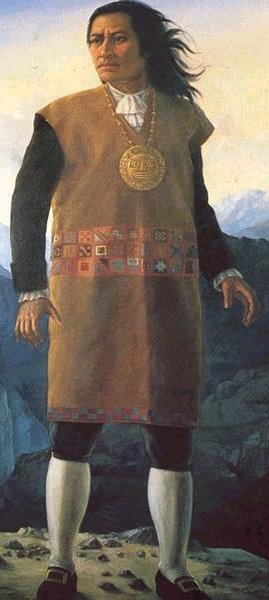
1781: Tupac Amaru II, Incan insurgent

On this date in 1781, the last name in Incan rebellion met a horrible end in the ancient Incan capital of Cusco.

José Gabriel Condorcanqui — rechristened Tupac Amaru II, as he was a distant descendant of the last Incan king — was a member of the privileged indigenous population depended upon by the Spanish to administer the forced and extorted labor that made its New World empire worth having.

Condorcanqui evidently had an epiphany.

In November 1780, he launched a well-planned rebellion by engineering the public execution of a hated corregidor Antonio de Arriaga at the hands of his own servant.

“From this day, no longer shall the Spanish feast on your poverty!”

This attention-grabbing entry onto the political chessboard was followed with an exemplary victory over Spanish forces. His revolt rapidly metastasized into an ethno-religious crusade, with all the accumulated bitterness of the Indians’ two-plus centuries maltreatment ferociously visited upon the Spanish.

It was a heady moment — but only a moment; within a few months, the Spanish had rallied and Tupac Amaru was betrayed into their hands.

The rebel had seized Incan symbology for his own purposes — speaking at ancient shrines, for instance — and the Spanish sentence against him included not only the inevitably horrific execution (of both Tupac Amaru and his wife and family) but a comprehensive and explicit programme of cultural annihilation to consign the Incan identity to the past. This lengthy sentence is well worth the read. (Sourced here, a pdf file; the bolded sections are my highlights.)

I must and do condemn José G. Túpac Amaru to be taken out to the main public square of [Cuzco], dragged out to the place of execution, where he shall witness the execution of the sentences imposed on his wife, Micaela Bastidas [Spanish link]; his two sons, Hipólito and Fernando Túpac Amaru; his uncle, Francisco Túpac Amaru; and his brother-in-law, Antonio Bastidas, as well as some of the principal captains and aides in his iniquitous and perverse intent or project, all of whom must die on the same day.

And once these sentences have been carried out, the executioner will cut out his tongue, and he will then be tied or bound by strong cords on each one of his arms and feet in such a way that each rope can be easily tied or fastened to others hanging from t he saddle straps of four horses, so that, in this position, each one of these horses, facing opposite corners of the square, will pull toward his own direction; and let the horses be urged or jolted into motion at the same time so that his body be divided into as many parts and then, once it is done, the parts should be carried to the hill or high ground known as “Picchu,” which is where he came to intimidate, lay siege to, and demand the surrender of this city; and let there be lit a fire which shall be prepared in advance and then let ashes be thrown into the air and a stone tablet placed there detailing his main crimes and manner of his death as the only record and statement of his loathsome action.

His head will be sent to the town of Tinta where, after being three days on the gallows, it shall be placed on a stake at the most public entrance to the town, one of his arms will go to the town of Tungasuca, where he was chief, where it will be treated in like manner, and the other in the capital of the province of Carabaya; one of the legs shall likewise be sent for the same kind of demonstration to the town of Libitaca in the province of Chumbilcas, while the remaining one shall go to Santa Rosa in the province of Lampa along with the affidavit and order to the respective chief magistrates, or territorial judges that this sentence be proclaimed publicly with the greatest solemnity as soon as it arrives in their hands, and on the same day every year thereafter; and they will give notice in writing of this to their superiors in government who are familiar with the said territories.

Since this traitor managed to arm himself and form an army and forces against the royal arms by making use of or seducing and leading with his falsehood the chiefs who are the second in command in the villages, since these villages, being of Indians, are not governed by such chiefs but rather by mayors who are elected annually by the vote or nomination of the chiefs: let these same electoral communities and the chief magistrates that care to give preference to candidates who know Spanish, and who are of the best behavior, reputation, and customs so that they will treat their subjects well and lovingly, honoring only those who have demonstrated honestly their inclination and faithfulness, eagerness, respect, obedience, submission, and gratitude to the greater glory of our great Monarch through the sacrificed of their lives, properties, or ranches in deference of their country or religion, receiving with brave disdain the threats and offers of the aforesaid reel leader and his military chiefs, yet taking care that these elected leaders are the only ones with the right to the title of chief or governor of their ayllus [communities] or towns, and that they cannot transmit their position to their children or other family members.

To this same end, it is prohibited that the Indians wear heathen clothes, especially those who belong to the nobility, since it only serves to symbolize those worn by their Inca ancestors, reminding them of memories which serve no other end than to increase their hatred toward the dominant nation; not to mention that their appear is ridiculous and very little in accordance with the purity of our relics, since they place in different parts images of the sun, which was their primary deity; and this prohibition is to be extended to all the provinces of this southern America, in order to completely eliminate such clothing, especially those items which represent the bestialities of their heathen kings through emblems such and the unco, which is a kind of vest; yacollas, which are very rich blankets or shawls of black velvet or taffeta; the macapaycha, which is a circle in the shape of a crown from which they hand a certain emblem of ancient nobility signified by a tuft or tassel of red-colored alpaca wool, as well as many other things of this kind and symbolism. All of this shall be proclaimed in writing in each province, that they dispose of or surrender to the magistrates whatever clothing of this kind exists in the province, as well as all the paintings or likenesses of their Incas which are extremely abundant in the houses of the Indians who consider themselves to be nobles and who use them to prove their claim or boast of their lineage.

These latter shall be erased without fail since they do not merit the dignity of being painted in such places, and with the same end in mind there shall also be erased, so that no sign remains, any portraits that might be found on walls or other solid objects; in churches, monasteries, hospitals, holy places or private homes, such duties fall under the jurisdiction of the reverend archbishops or bishops of both viceroyalties in those areas pertaining to the churches; and in their place it would be best to replace such adornments with images of the King and our other Catholic sovereigns should that be necessary. Also, the ministers and chief magistrates should ensure that in no town of their respective provinces be performed plays or other public functions of the kind that the Indians are accustomed to put on to commemorate their former Incas; and having carried out the order, these ministers shall give a certified account to the secretaries of the respective governments. In like manner shall be prohibited and confiscated the trumpets or bugles that the Indians use for their ceremonies and which they call pututos, being seashells with a strange and mournful sound that celebrate the mourning and pitiful memorial they make for their antiquity; and there shall also be prohibited the custom of using or wearing black clothing as a sign of mourning, a custom that drags on in some provinces in memory of their deceased monarchs and also of the day or time of the conquest which they consider disastrous and we consider fortunate since it brought them into the company of the Catholic Church and the very loving and gentle domination of our Kings.

With the same goal it is absolutely forbidden that the Indians sign themselves as “Incas,” since it is a title that anyone can assume but which makes a lasting impression on those of their class; and it is ordered, as is required of all those who have genealogical trees or documents that prove in some way their descent, that they produce them or send them certified and without cost by mail to the respective secretaries of both viceroyalties so that the formalities may be observed by those persons responsible to their excellencies the viceroys, consulting His Majesty where necessary according to each case; and the chief magistrates are charged to oversee the fulfillment of such requirements, to seek out and discover anyone who does not observe them correctly, in order to have it done to collect the documents with the aim of sending them to the proper authorities after giving their owners a receipt.

And so that these Indians renounce the hatred that they have conceived against the Spaniards, and that they adhere to the dress which the laws indicate, adopting our Spanish customs and speaking Castilian [Spanish], we shall introduce more vigorously than we have done up to now the use of schools, imposing the most rigorous and fair penalties on those who do not attend once enough time has passed for them to have learned the language; the duties and responsibilities involved in this plan going to the very reverend ecclesiastical prelates so that, in the opposition between parishes and doctrinas, they take care that those candidates bring affidavits from the provincial judges as to the numbers of people who speak the Said Castilian in those provinces … it being left up to the sovereign discretion of His Majesty to reward and honor those towns whose inhabitants have rendered, under the present circumstances, their due loyalty and faithfulness.

Finally, the manufacture of cannons of all kinds shall be prohibited under the penalty that any noble found manufacturing such items will be sentenced to ten years of prison in one of the presidios in Africa and any commoner will receive two hundred lashes as well as the same penalty for the same time period; reserving for a future time a similar resolution with regards to the manufacture of powder. And since there cannons of almost every caliber in the many ore-crushing mills and timber yards in these provinces, they will be gathered up by the magistrates once of the pacification of this uprising has been completely terminated in order to give account of them to the respective captaincy general so that he may determine whatever use he deems proper for them. Thus have I visualized, ordered, and signed: this is my final judgment.

José Antonio de Areche.

Tupac Lives.

The Spanish campaign to eradicate his name and identity didn’t exactly have legs.

The savagery of the crackdown helped generate Incan support for the rebellions that would shake off Spanish authority in the generations to come. He entered the official iconography of the post-colonial state, and can be found on Peruvian currency.

The very name Tupac Amaru became pregnant with the spirit of resistance — both in Peru, where it was adopted by a 1990’s revolutionary movement, and abroad, where a New York City Black Panther activist (pdf) gave the name to a son: Tupac Amaru Shakur.

On this day..

1795: Antoine Quentin Fouquier-Tinville, Robespierre’s prosecutor

On this date in 1795, the attorney who had engineered the Terror was guillotined for engineering the Terror.

Antoine Quentin Fouquier de Tinville (English Wikipedia page | French), or just plain Fouquier-Tinville, had emerged during the Revolution from penurious obscurity to wrangle a jury foreman’s position courtesy of his connection to Camille Desmoulins. When Desmoulins ally Georges Danton spearheaded creation of a Revolutionary Tribunal (French link), Fouquier-Tinville drew the choice gig of Public Prosecutor.

From that perch, he would supply the arbitrary exercises of the Committee of Public Safety their (increasingly scanty) scaffolding of formal legality in Paris’s greatest show trials.

Charlotte Corday.

The Girondists.

Marie Antoinette.

Fouquier-Tinville’s own onetime benefactors, Danton and Desmoulins. (He struggled to contain Danton’s rhetorical fireworks, as depicted in the 1983 film Danton — we see him plying his trade from about 3:29 of this clip.)

Heck … when the Terror ended, our good state’s attorney even signed off on the execution of Robespierre, with what must have been a lump in his throat. He was himself denounced within days, and narrowly preserved from the summary justice of his fellow-prisoners upon incarceration.

Naturally, like every criminal barrister since, Fouquier-Tinville’s defense was, hey, don’t blame me: the law made me do it. “I had only acted in the spirit of the laws passed by a Convention invested with all powers. Through the absence of its members [on trial], I find myself the head of a conspiracy I have never been aware of.”

Pity the lawyers.

This varietal of the only-following-orders defense did not impress in Fouquier-Tinville’s case; the Public Prosecutor had made the role too much his own.

I have been told by a gentleman who was at school with Fouquier, and has had frequent occasions of observing him at different periods since, that he always appeared to him to be a man of mild manners, and by no means likely to become the instrument of these atrocities; but a strong addiction to gaming having involved him in embarrassments, he was induced to accept the office of Public Accuser to the Tribunal, and was progressively led on from administering to the iniquity of his employers, to find a gratification in it himself.

And, indeed, he was condemned by his own hand. His lawyerly letter to the Convention during Danton’s trial — “the accused are behaving like madmen and demand the summoning of their witnesses … our judicial powers do not furnish us with any means of refusing” — duly elicited those heretofore absent powers, which the prosecutor immediately deployed to gag the defense.

Antoine Quentin Fouquier de Tinville, the sinister mediocrity who gave villainy the cover of law, was guillotined this morning in 1795 to the delight of the Paris mob: the last head to roll in a batch of 16.

On this day..

1649: John Poyer, the lucky winner

On this date* in 1649, John Poyer, late the mayor of Pembroke, was shot at London’s Covent Gardens for switching sides in the English Civil War.

John Pembroke had earned his Round head by taking Carew Castle from King Charles‘ forces in the First English Civil War.

But the silly hats in Parliament wanted much of the potentially dangerous army to demobilize, and do so without settling the small matter of its back pay. Poyer refused to hand over his command and Pembroke Castle to a Parliamentary agent, and sought a better deal from monarchists.**

Only with a painstaking siege was the imposing medieval fortress of Pembroke reduced. Poyer, his superior Rowland Laugharne, and Rice Powell were hauled to London and condemned to death.†

In an interesting twist, it was decided that one example would prove the point as well as three, and to allot the clemencies by chance. When the three refused to draw their own lots, a child was given the job instead, and distributed three slips of paper. Laugharne and Powell read “Life given by God.” Poyer’s was deathly blank.

Mark Twain latched onto the singular role of a child in this deadly lottery, and wrung it for every drop of pathos in a short story, “The Death Disk”.

Unlike the proposed victim of that story, Poyer did not benefit from any last-second Cromwellian pity. His death is related in the zippily titled “The Declaration and Speech of Colonell John Poyer Immediately Before his Execution in Covent-Garden neer Westminster, on Wednesday, being the 25 of this instant April, 1649. With the manner of his deportment, and his Proposals to the people of England.”‡

Having ended his speech, he went to prayers, and immediately rising up again, called the men designed for his execution to him, which were six in number, and giving them the sign when they should give fire, which was by holding up both his hands, they observed his motion, who after some few expressions to his friends about him, prepared an embracement for death, and casting his eyes to Heaven, with both hands lifted up, the Executioners (with their fire locks) did their Office, who at one voley bereav’d him of his life, his corps being taken up, was carryed away in a Coach, and the Souldiery remanded back again to White-Hall.

* A few sources say April 21, but the overwhelming majority concur on the 25th — as do the primary citations available in 17th-century comments on his death (e.g., “he was upon the 25 of this instant Aprill being Wednesday, guarded from White-Hall in a Coach, to the place of execution” in “The Declaration and speech of Colonell John Poyer before his execution…”)

** D.E. Kennedy observes that the divide between Parliament and Royalist was not so bright as might be imagined — and that Cromwell himself was at this time negotiating with the future Charles II as an expedient to get around Charles I.

† The rank and file of Welsh insubordination basically skated, a display of clemency from the Lord Protector that Ireland would not enjoy.

‡ The title promises much more scaffold drama than two and a half forgettable pages deliver — basically, that Poyer died (a) penitent; (b) Anglican; and (c) wishing for peace.

On this day..

1521: The Comuneros of Castile

On this date in 1521, the day after winning the decisive battle in the Castilian War of the Communities, royalist forces beheaded its three principal leaders in Villalar.

Even while the Spanish Empire was burgeoning in the New World, its home peninsula remained a house divided.

The Iberian Kingdoms of Aragon and Castile had joined in a personal union with the marriage of Ferdinand and Isabella in the late 15th century.

When the couple passed, it was not a given that their conjoined territory would become, as it did, the germ of a unified Spain.

Instead, the royal power couple’s crazy daughter was kept under lock and key while her infant son grew into the redoubtable Emperor Charles V. To exacerbate the local annoyance, Chas had continent-spanning territories, and ambitions; Spain was not his base, merely one of his provinces. (He’d grown up in Flanders. Ah, dynastic politics.)

The Emperor was only a teenager when his Castilian subjects rose against his levies, and against the paradoxical perception that the first true King of Spain was a foreign ruler.

A riot in Toledo mushroomed into a revolt, and everyone started drawing up sides. (Spanish link) Things went south when the commoner rebels started adopting an unwelcome radicalism (beyond rebelling against the king, that is), enabling the imperial rep (and future pope) Adrian of Utrecht to pull back into the royalist camp rebellious nobles increasingly fearful of expropriation at the hands of the firebrands.

After the balance of forces decided in Charles V’s favor, all that remained was to give the chop to the primary troublemakers. Juan Lopez de Padilla, Juan Bravo and Francisco Maldonado were obligingly captured after the Battle of Villalar.


The Execution of the Comuneros of Castile, by Antonio Gisbert. Segovian Juan Bravo allegedly asked to die first, so as not to witness the death of so good a knight as Padilla.

The demise of the “Caballeros Comuneros” pretty much squelched the revolt — although Padilla’s widow Maria Pacheco defended the rebel ground zero of Toledo for several months more.

The comuneros have lived on ever since as a symbol in literature and propaganda, among monarchists (for whom they are a symbol of perfidy), liberals (rather the reverse) and Castilian nationalists. Though “comuneros” was for a period an all-purpose smear against agitators in the Spanish dominions, April 23 (the date of the fateful battle) has been Castile and Leon Day, a public observance, since 1986.


This monolith in the Villalar town plaza commemorates the Comuneros. Image (c) Julio Alvarez, and used with permission.

On this day..

1997: Hostage-takers in Lima

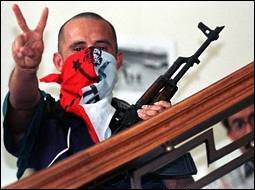
On this date in 1997, Peruvian paramilitaries stormed the Japanese ambassador’s residence held hostage for 126 days by leftist rebels.

Peace out.

All 14 of the Tupac Amaru Revolutionary Movement (MRTA) were slain in the raid,* along with two of the commandos and one hostage. Officially, there were no “executions” at all.

Unofficially?

It’s pretty well-documented that some — perhaps most — of the terrorists were taken alive, and thereafter summarily executed. (pdf of Defense Intelligence Agency cable hosted by the National Security Archive)

However untoward the outcome and however unimpressive the foe, the operation was a master stroke for then-President Alberto Fujimori. Peru’s neoliberal taskmaster had introduced the world to the auto-golpe, the “self-coup”, a Cromwellian maneuver of shuttering parliament in order to rule as dictator, and he thereafter made ruthless suppression of Peru’s ruinous internal conflict the calling card of his presidency.

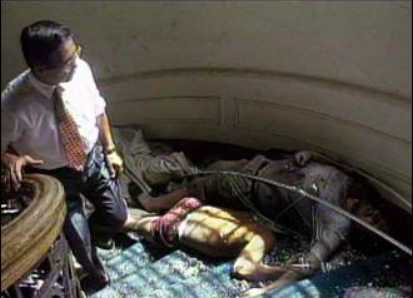
The DIA cable linked above claims Fujimori himself ordered the commandos to take no prisoners. He did not scruple to show himself in the middle of the bloodbath.


Alberto Fujimori made sure to get himself snapped standing over the bodies of the guerrillas, including MRTA leader Nestor Cerpa Cartolini.

El Presidente banked the political capital from having restored civic order, but it wasn’t the only capital he was banking. Three and a half years later, with a corruption scandal darkening his door, Fujimori absconded to Japan, faxed in his resignation, and became a fugitive.

Even there, he continued to justify his authoritarian governance.

Many Peruvians have always agreed with Fujimori’s self-assessment, even many who regret his well-publicized disregard for human rights.

But human rights researcher Michael Baney calls this day’s executions “pointless.”

“The MRTA was a spent force by the time of the embassy takeover,” said Baney. “The takeover was an act of total desperation, which is evidenced by the fact that the leader of the movement, Nestor Cerpa Cartolini, personally participated in it.”

After spending the best part of a decade in exile, Fujimori returned to the headlines by boldly returning to the hemisphere — to Chile, specifically, which arrested him and extradited him on a Peruvian warrant.

Just days ago as of this writing, Fujimori was convicted in his own former courts of authorizing death squads,** and sentenced to 25 years in prison. (Here’s some legal analysis.)

In the court of public opinion, it’s a different matter.

Fujimori’s daughter Keiko, a Peruvian congresswoman, figures to be a leading contender for the presidency in 2011, and has said she would pardon her father if given the opportunity.

“A majority of Peruvians think that Fujimori was guilty of serious human rights violations, but a majority also believe that he was a good president,” Baney observed. “And Fujimori really does believe that he single-handedly saved his country from economic and political collapse, and that Peru needs him around.”

* “Operation Chavin de Huantar”, profiled in several Spanish-language documentary videos available online. (Such as this one.)

** Not specifically related to this day’s MRTA killings, although these could be prosecuted in the future.

On this day..

1881: The assassins of Tsar Alexander II

On this date* in 1881, five members of the Russian terrorist organization Narodnaya Volya were publicly hanged in St. Petersburg, where they had slain the tsar Alexander II a few weeks before.

“The People’s Will” etched in blood its place in the dangerous late 19th century ferment of Russian revolutionaries. In time they would read as the politically immature forerunners of the Bolsheviks, whose turn into terrorism was a political dead end.

But as of this date, they were at the top of their arc.

Every St. Petersburg tourist sees the place Alexander II died: the spot received a picturesque church that is now one of the city’s principal attractions.

On March 13, 1881, Narodnaya Volya assassinated the former tsar with a suicide bombing on the streets of St. Petersburg. With the death of the monarch who had emancipated the serfs, and was on the very day of his murder tinkering with plans to introduce an Assembly, liberalism arguably lost its weak purchase on Russia’s future.

The Nihilists** — who immediately sent an open letter to the new tsar demanding amnesty and a representative political body† — did not prevail in any direct sense.

Their dramatic gesture failed to ignite a social revolution or topple the autocracy, and they would find in Alexander III an implacable foe.

But while this spelled the end for the old man’s five assassins,‡ and even the end of Narodnaya Volya as an effective organization as the 1880’s unfolded, Alexander III’s efficacious repression was a Pyrrhic victory for the Romanov dynasty.

By depending on police operations rather than political reforms, Alexander III bequeathed his doomed successor a hopelessly backward political structure … and a considerably more dangerous revolutionary foe.


Refusal of Confession (Before Execution), by Ilya Repin, 1879-1885. (Via)

Alexander II’s death in the context of the times and its effect for Russia’s fate receive diverting treatment in a BBC In Our Times broadcast

* April 15 was the date on the Gregorian calendar; per the Julian calendar still in use in Russia at the time, the date was April 3.

** A quick summary of the strains of Russian revolutionary thought of the time here.

† Despite their dramatic tyrannicide, the Nihilists’ letter was angled for the consumption of mainstream post-Enlightenment Europeans. Karl Marx noted its “cunning moderation,” and its call for freedom and civil rights commonplace in more developed countries drew considerable support in the west. The Nihilists even took care to underscore their reasonableness a couple months later by condemning the senseless assassination of American President James Garfield. (See Inside Terrorist Organizations.)

Andrei Zhelyabov, Sophia Perovskaya, Nikolai Kibalchich, Nikolai Rysakov and — though he had backed out of the plot — Timofei Mikhailov, whose noose broke twice in the attempt to hang him. A sixth condemned assassin, Gesya Gelfman, escaped hanging due to pregnancy … but she and her child both died shortly after the birth.

Perovskaya gets adulatory treatment in this 1910 New York Times retrospective (pdf) on Russian political violence and repression.

On this day..