1814: Six slaves in Guyana

An alarming rumour, meanwhile, … spread throughout the Colonies; a rumour which, whatever of truth or fact, little or none, might be at the foundation, gathering, as it went, size and gloom, and dust of slander, was calculated to make them all feel very unhappy. The report was that a slave insurrection had been discovered, having its centre on the Berbice West Coast, but extending right and left so as to include all the shore from the Corentyne Coast to Mahaica, about eighty miles; that the negroes had chosen a governor and other officers; that it was their intention to murder all the white men, and take possession of all the rest; that some of the Demerara East Coast negroes were leaders in the rebellion, especially Philip, a member of the church on Le Resouvenir; and that instruction of the negroes was to blame.

the account which the negroes gave of the matter was, that there had been formed a society in imitation of the Freemasons, they wishing to have, as well as their buckras or masters, a society of that nature; and that the money collected was to support the poor and defray the expense of their dances, &c.; just as it had been formerly very common for them to assume the names of their masters, or of the Governor or Fiscal, and send invitations to friends to supper or a dance, and appoint a captain of their own as president of the feast; sometimes to put feathers in their hats at holiday time and parade the streets. “No one,” as far as Mr. Wray could learn, “had been injured by them, neither was any property destroyed,” yet on 12th April six of the unhappy people apprehended on the West Coast were executed in New Amsterdam as ringleaders, their heads cut off and fixed upon poles on the different estates to which they belonged; one of them white with age, whose master, Mr. Rader, told Mr. Wray that he denied to the last having any bad intentions. Several others were flogged under the gallows, and some were transported.

A proclamation was subsequently issued to the effect that as “the privilege allowed the slaves of the Colony, of publicly or privately dancing on estates and other places at stated periods, had been perverted by them to purposes of the most dangerous nature, all dancing was forbidden until next year, 1815, or the further pleasure of the Court;” … This was followed, late in the year, by another calling upon the colonists to pay their quota of the expenses incurred in crushing the plot and indemnifying the proprietors of the slaves capitally punished … Better still, the law concerning Sunday labour was amended in favour of the slave, forbidding field-work on that day, except in sudden emergencies; and further enactments were issued limiting and regulating the excessive use of the whip, and forbidding the burial of any slave dying suddenly or by suicide, or in consequence of punishment or hurt, without previously acquainting the authorities …

From The Life and Labours of John Wray, Pioneer Missionary in British Guiana.

On this day..

1836: Goliad Massacre

On this date in 1836 — Palm Sunday, as it happened — over 300 Anglo POWs fighting to separate Texas from Mexico were executed en masse outside Goliad’s fortress

Less widely celebrated than the Battle of the Alamo preceding it by a fortnight, the Battle of Coleto on March 19-20 had seen Mexican troops surround and capture another force of Texians at Goliad.

Unaware of a Mexican order issued the previous December to execute foreign prisoners,* the men under Col. J.W. Fannin — a dithering commander whose military competence didn’t quite equal his romantic aspirations — expected to be released in a matter of weeks. They were marched out this morning on some innocuous pretext and had bare moments to apprehend their impending fate before their guards mowed them down. (Fannin was individually shot apart from his troops.)

Nineteenth-century musketry was a mediocre tool for mass slaughter, especially when the targets were nearly as many as their executioners. A number of prisoners survived the volley and managed to escape the subsequent cavalry charge and bayoneting by leaping into a nearby river. A fortunate few others were intentionally preserved. This thorough site on the massacre** preserves several survivor accounts.

These memoirs also detail life in the unit and troop maneuvers that are certainly of interest; in these pages, of course, we are most drawn to the accounts of those who stared death in the face — like this (understandably melodramatic) description by Herman Ehrenberg:

Either life or death! Behind were the bayonets of the murderers, and before me was the sword of a coward that crossed my way to the saving stream. Determinedly I rushed upon him. Forward I must go, and — the coward took flight in characteristic Mexican gallantry. Now the path was open, near was the point of my escape.

Arriving at the other bank of the river, I looked around once more to where my comrades were dying, while the bullets of the still firing enemies whistled about me. The hellish exaltations of the enemy mixed with the cries of pain of my dying brothers sounded over to me. What feelings took possession of me here! I cast another look and a farewell greeting to my dead companions and turned to flee. I had to hasten if I did not wish to fall into the hands of the lancers who were now on this side of the river less than a half a mile below me.

Which makes an interesting stylistic contrast with the story of John C. Duval, similar in its events but strikingly low-key, even ironic:

Some one near me exclaimed “Boys! they are going to shoot us!” and at the same instant I heard the clicking of a musket locks all along the Mexican line. I turned to look, and as I did so, the Mexicans fired upon us, killing probably one hundred out of the one hundred and fifty men in the division. We were in the double file and I was in the rear rank. The man in front of me was shot dead, and in falling he knocked me down. I didn’t get up for a minute, and when I rose to my feet, I found that the whole Mexican line had charged over me, and were in hot pursuit of those who had not been shot and who were fleeing towards the river about five hundred yards distant. I followed on after them, for I knew that escape in any direction (all open prairie) would be impossible, and I had nearly reached the river before it became necessary to make my way through the Mexican line ahead. As I did so, one of the soldiers charged upon me with his bayonet (his gun I suppose being empty). As he drew his musket back to make a lunge at me, one of our men coming from another direction, ran between us, and the bayonet was driven through his body. The blow was given with such force, that in falling, the man probably wrenched or twisted the bayonet in such a way as to prevent the Mexican from withdrawing it immediately. I saw him put his foot upon the man, and make an ineffectual attempt to extricate the bayonet from his body, but one look satisfied me, as I was somewhat in a hurry just then, and I hastened to the bank of the river and plunged in. The river at that point was deep and swift, but not wide, and being a good swimmer, I soon gained the opposite bank, untouched by any of the bullets that were pattering in the water around my head.


The Texas state flower — the bluebonnet — blooms in front of the monument put up to the Goliad Massacre on its centennial. Creative Commons image from Matthew Lee High.

History buffs in the Goliad environs this weekend can catch the annual re-enactment of the Goliad Massacre this weekend at Presidio La Bahia.

* The order came from the top, but the general who captured Goliad had no stomach to carry it out. He asked for leniency … but received an emphatic confirmation of the execution order.

** Also see its unit rosters tracking the particular fates of most of Fannin’s men, and these biographies of the unit.

On this day..

1858: Felice Orsini, Italian revolutionary

On this date in 1858, Italian revolutionary Felice Orsini calmly lost his head for the nation.

Something of a celebrity revolutionary, Orsini joined the independence movement of Giuseppe Mazzini and embarked on a generation’s worth of conspiracy, covert operations and prison spells and prison breaks which he himself voluptuously recounted in hot-selling autobiographical tomes.

Orsini became convinced that French ruler Louis Napoleon* was the chief obstacle to Italian unification, and accordingly chucked a bomb at the dictator’s carriage on January 14, 1858.

Ever theatrical, the condemned Orsini addressed a letter to Louis Napoleon while awaiting execution. In it, he urged the emperor to take up the Italian cause.

Whether mindful of the prospect of another Orsini waiting for his carriage, remembering his own youthful plotting with the Italian carbonari, or simply for reasons of French statecraft, Napoleon did just that. His alliance with the Piedmont state in northwest Italy (for which France received Savoy and the French Riviera in exchange) helped it absorb most of what now constitutes the Italian state.

Within three years of Orsini’s death, only a reduced papal enclave around Rome and the Austrian holdings around Venice separated the peninsula from unification.

In life, Orsini had been a prominent advocate of the Italian cause and played to packed houses in England. In death, he was felt further afield than that.

Tacking to a moderate stance on slavery abolition ahead of his presidential campaign, Abraham Lincoln condemned the late radical abolitionist John Brown as another Orsini — “an enthusiast [who] broods over the oppression of a people till he fancies himself commissioned by Heaven to liberate them. He ventures the attempt, which ends in little else than his own execution.”

Among Lincoln’s officers in the coming Civil War would be Charles DeRudio, the anglicized name of Orsini co-conspirator Carlo di Rudio.

Di Rudio had drawn a death sentence himself for the Orsini plot but was spared (pdf) by the clemency of his intended victim. He would go on to fight in the Battle of the Little Bighorn where he once again managed to cheat death.

* aka Napoleon III. He was the grandson of Josephine’s guillotined first husband.

On this day..

1960: Hoang Le Kha, NVA cadre

On this date in 1960, the former French colony of Vietnam made its last use of that most characteristically Gallic killing-machine: the guillotine.

Communist cadre Hoang Le Kha of the Vietnam People’s Army — the insurgent force also known at different times, in different manifestations, and through different eyes as the Viet Minh, the North Vietnamese Army (NVA) and the Vietcong* — earned the unpleasant distinction. According to a disappointingly truncated article (.pdf) from the Texas Tech University Vietnam Archive, the beheading took place notwithstanding an appeal pending before the International Control Commission, the multinational body charged with overseeing the supposedly temporary partition of Vietnam.

So, six years after Dien Bien Phu, what was independent Vietnam using this hated machine for?

Why, the same thing the French used it for: Terror.

The demonstrative device was redeployed in 1959 by Ngo Dinh Diem — a man whose obliviousness to blowback would soon land him in these pages — for exacting frightful, visible justice on subversive types.

According to that troubled former Secretary of Defense Robert McNamara,

On May 6, 1959, Diem signed Law 10/59, which, in an ironic bow to the former French colonial masters, inaugurated the era of death by beheading, as Diem’s lieutenants traveled the countryside with mobile guillotines and platforms, looking for “communists.” Article 1 of Law 10/59 called for “sentence of death, and confiscation of the whole or part of his property” for anyone convicted of crimes ranging from murder to stealing farm implements and water buffalo. Article 3 proclaimed that anyone belonging to “an organization designed to help to prepare or to perpetrate” such crimes “will be subjected to the sentences provided for” — that is, they will also be beheaded. … Article 16 announced: “The decisions of the special military court are not subject to appeal, and no appeal is allowed to the High Court.”

He then cites Hanoi historian Tran Van Giau’s recollection of the period.

“In 1959, the most difficult period of the revolution in South Vietnam, the Ngo Dinh Diem puppet regime dragged the guillotine everywhere and carried out a bloody fascist repression.”

Though officially downplayed overseas, all-but-summary beheadings were intentionally publicized in Vietnam in an effort to cow rebels.

The Diem government had many public executions. A lot of people in the West denied that it happened but Diem made no bones about it. They advertised the executions and there were pictures in the paper of people getting their heads chopped off by a guillotine. … In 1959, when I went around with the map teams there were many military outposts where they summarily chopped off the heads of people they thought were Communists. They put the heads on stakes right in front of their outposts, sometimes with two cigarettes up the nostrils. They even invited people to take pictures of it. They were very proud of themselves.

It didn’t work.

As a result, the guillotine itself, an archaic French model, can be seen among other dreadful mementos of that horrific war at Ho Chi Minh City’s War Remnants Museum.

Right alongside it is a picture of Hoang Le Kha.

(Many images — some of them graphic or disturbing — available at this Vietnamese page.)

* This is a very hasty lumping-together; the terms are not synonymous.

On this day..

1836: The defenders of the Alamo, much remembered

On this date in 1836, Mexican forces commanded by President Antonio Lopez de Santa Anna overran the Alamo — and executed those few of its defenders who survived the day’s battle.

“Remember the Alamo!”

This most memorable battle of the Texas Revolution has since retained its place in the founding mythology of Texas and its draw as a tourist destination in San Antonio, no matter the complexities on the ground. (You can watch the earliest surviving film treatment, The Martyrs of the Alamo, free online. D.W. Griffith made it the same year he made Birth of a Nation.)

That Alamo of blood and legend, and the countervailing interpretations it eclipses, are much beyond our scope here, but we are attracted to notice the reputed summary execution of five to seven defenders who had surrendered or otherwise been captured during the fight. (A few dozen mostly civilian noncombatants in the former mission also survived, and were not executed.)

According to Robert Scott, Santa Anna was empowered by a Mexican resolution holding (not without cause) that

“foreigners landing on the coast of the Republic or invading its territory by land, armed, and with the intent of attacking our country, will be deemed pirates.”

Who counted, at this moment, as “foreigners” among the Anglo settlers trying to break away from Mexico and their supporters among from the United States to which Texas would eventually attach poses a historiographical riddle. But then, Santa Anna wasn’t there to write a dissertation, but to win a war — and he was said to be sorely annoyed at the defenders having tied him down for a week and a half.

King of the Wild Frontier

Covered by most any definition of “foreigner” would have been the Alamo’s most famous defender, Tennessee frontiersman and former U.S. Congressman Davy Crockett. He had arrived in Texas just a few months before, on a rendezvous with destiny.*

It’s a matter of dispute whether Crockett was among those last few executed; in an event this emotionally remembered, every version of the Crockett death scene — from “found dead of injuries amid a heap of Mexican casualties” to “cravenly bargained for his life” — gores someone’s ox.

Even if the account of Crockett’s presence among the executed derives from a disputed source — well, this blog has not scrupled to highlight the fictional and the mythological, those executions whose resonance transcends factual accuracy.

And even if Davy Crockett was not among those anonymous souls put to death this day, it is by his name that they have their tribute, as in the 2004 film** The Alamo:

* Destiny by way of Walt Disney.

** This Disney film diddles with the Crockett legend that Disney helped to inflate in the 1950’s — to the annoyance, of course, of traditional-minded Alamo partisans.

On this day..

1573: Matija Gubec, peasant revolt leader

On February 15, 1573, the brief but scintillating career of insurrectionary Matija Gubec came to a brutal end when he was publicly tortured to death in Zagreb.


You know what they say about the size of a man’s feet: Matija Gubec about to be crowned with a red-hot iron ringlet and quartered.

Gubec emerged from (to us, at least) obscurity to leadership of a short-lived peasant uprising in Croatia against Franjo Tahi (Croatian Wikipedia link), your basic feudal tyrant.

Although put down inside of two weeks, this revolt and its personification in Gubec have endured as potent national symbols in Croatia.

In the revolutionary 20th century, both left and right claimed Gubec’s standard as their own: a multiethnic company of Yugoslav volunteers fought under his name in the Spanish Civil War, as did multiple partisan units during World War II who took inspiration in his peasant class uprising. By contrast, the Ustasha conceived Gubec as

one man, who was not the exponent of any class, but … a reflection of an entire nation’s beliefs.*

Fascist and communist alike can jam to the rock opera Gubec Beg.**

* See Pavlakovic, Vjeran (2004) ‘Matija Gubec Goes to Spain: Symbols and Ideology in Croatia, 1936-1939’, The Journal of Slavic Military Studies, 17:4, 727 — 755.

** According to Pavlakovic, Gubec’s real given name is unknown and birth records suggest it might have been “Ambroz”. He was known as “Gubec called Beg,” using the Turkish term for a lord.

On this day..

1968: Nguyen Van Lem

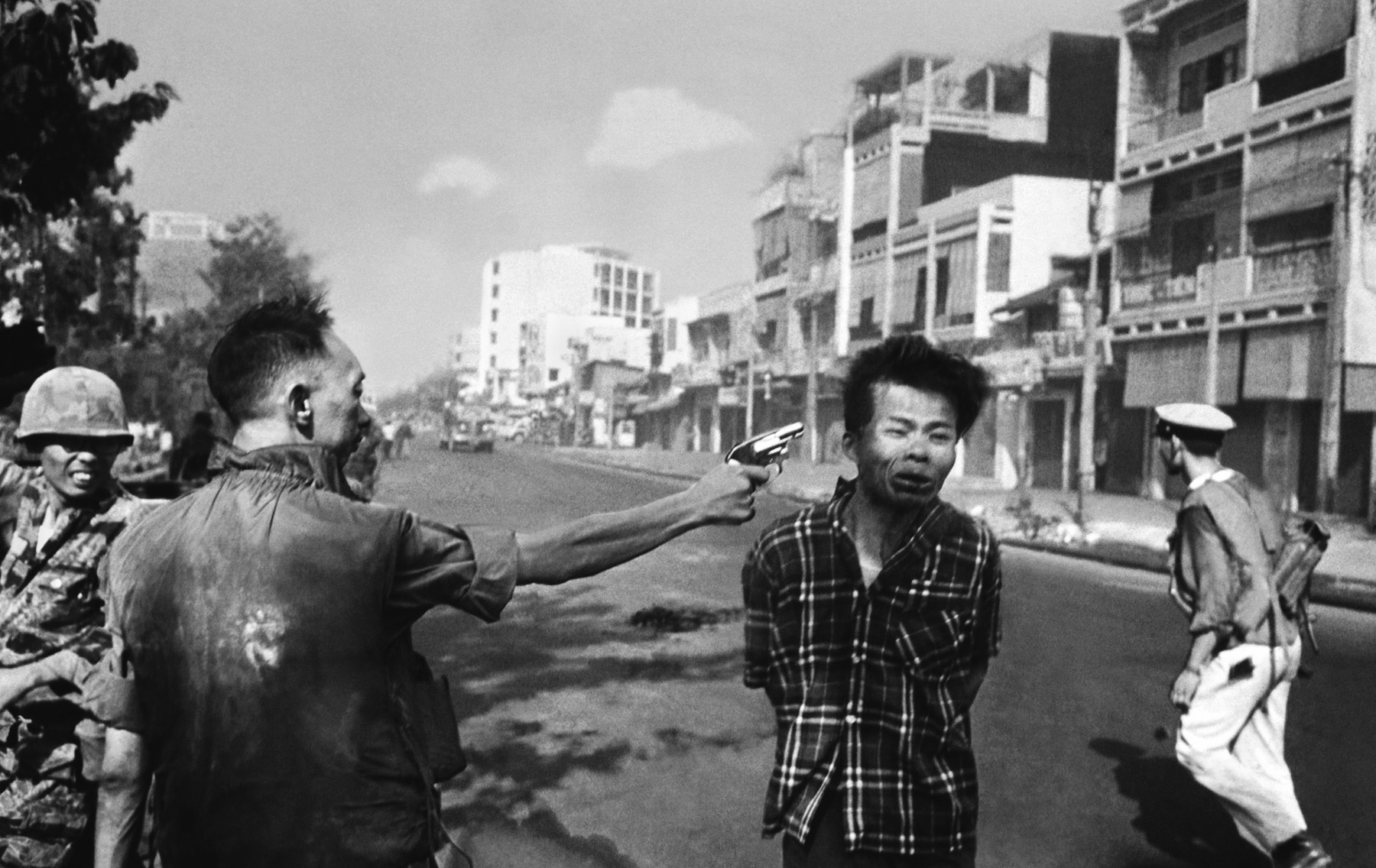
Around noon of February 1, 1968, in the opening days of the communist Tet Offensive, South Vietnamese General Nguyen Ngoc Loan summarily executed a Viet Cong prisoner on the streets of Saigon — and photographer Eddie Adams captured perhaps the war’s most unforgettable image.

An American cameraman also captured it in on celluloid. Caution: This clip shows … well, a man being shot in the head at point-blank range.

Though the image brought Adams the Pulitzer Prize, he would express discomfort with it later in life, and eulogized General Loan in Time magazine when he died in the U.S. in 1998.

The general killed the Viet Cong; I killed the general with my camera … photographs do lie, even without manipulation.

For Adams, the lie was the omission of context — that the plainclothes Lem had allegedly just been caught having murdered not only South Vietnamese police but their civilian family members; that Loan was a good officer and not a cold-blooded killer.

Adams’ editor has said that many such summary executions were taking place during the Battle of Saigon — a broader context to the image no matter its specific fairness to the executioner.

But of course, the shot gained its deeper resonance from the growing disgust with the Vietnam War … and from its concise tableau of a century’s brutality. Here is a frozen image of Orwell’s boot stamping on a human face, forever.

Like any great work of art, Adams’ serendipitous photograph took on a life of its own … and a tapestry of meanings richer than its creator could ever have intended.

On this day..

1661: Oliver Cromwell, posthumously

On this anniversary date of King Charles I’s beheading, the two-years-dead corpse of the late Lord Protector Oliver Cromwell was hung in chains at Tyburn and then beheaded, along with the bodies of John Bradshaw and Henry Ireton.

The great-great-grandnephew of ruthless Tudor pol Thomas Cromwell rose higher than any English commoner, high enough to be offered the very crown he had struck off at Whitehall. Oliver Cromwell declined it in sweeping Puritan rhetoric just as if he hadn’t spent weeks agonizing over whether to take it.

“I would not seek to set up that which Providence hath destroyed and laid in the dust, and I would not build Jericho again.”

The House of Stuart never could rebuild its Jericho while the Lord Protector ran the realm* — thirteen years, writes Macaulay, “during which England was, under various names and forms, really governed by the sword. Never, before that time, or since that time, was the civil power in our country subjected to military dictation.”

“Cromwell lifting the Coffin-lid and looking at the body of Charles I”, by Hippolyte (Paul) Delaroche — a French painter with an affinity for English execution scenes. The painting is based on an apocryphal but irresistible legend, also used by Nathaniel Hawthorne in a tedious short story.

And not only England. Cromwell’s prodigious depredations in Ireland — justifiably or not — remain a source of bad blood.

The English Commonwealth foundered after Cromwell’s death, however, and restoration of the monarchy — a rock, as it turned out, on which the Puritans’ bourgeois revolution could erect its colossus — came with the price of a few examples being made.

Of course, “executing” dead guys displays about as much strength as it does sanitation, and for all Charles II‘s demonstrative vengeance, the politically circumscribed throne he resumed was very far from his father’s dream of absolutism. Between the late dictator and the new king, the future belonged to the corpse clanking around on the gibbet.

When the able Charles II followed Cromwell into the great hereafter, his brother James II promptly fumbled away the crown with his anachronistic insistence on royal authority and his impolitic adherence to Catholicism.**

In the emerging England of the century to come, the divine right would depart the Stuarts for another dynasty more amenable to the rising authority of the parliament whose sword Oliver Cromwell once wielded.

* Resources on the particulars of Cromwell’s career, the English Civil War, et al, are in plentiful supply online. This BBC documentary is a very watchable overview: part I; part II; part III; part IV.

** James II remains England’s last Catholic monarch.

On this day..

1781: Mutinous ringleaders of the New Jersey line

On this date in 1781, George Washington quelled a dangerous mutiny in his starving Continental Army with a couple of salutary summary executions.

Weeks before, the Pennsylvania Line had mutinied for better pay — successfully. (When approached by British agents offering hard currency should they turn coat, the mutinous troops patriotically arrested the agents.)

General Washington had cause to fear widespread discontent in his chronically undersupplied army, however. He circulated to Congress and to several state governors an urgent appeal (.pdf) for more aid to hold up morale.

The aggravated calamities and distresses that have resulted from the total want of pay for nearly twelve months, the want of clothing at a severe season, and not unfrequently the want of provisions, are beyond description … it is vain to think an army can be kept together much longer under such a variety of sufferings as ours has experienced … unless some immediate and spirited measures are adopted to furnish at least three months’ pay to the troops in money, which will be of some value to them, and at the same time ways and means are devised to clothe and feed them better … the worst that can befall us may be expected.

Washington vowed in the meantime to “continue to exert every means I am possessed of to prevent an extension of the mischief.”

The mischief, however, extended.

The New Jersey line at Pompton imitated — and the imitation was reportedly explicit — the Pennsylvania line. They had legitimate grievances, like nearly everyone in the Continental Army, and that was precisely the problem: if mutiny became the means to resolve grievances, Washington wouldn’t have a Continental Army much longer.

Washington detailed Gen. Robert Howe to make an example.

Sir: You are to take the command of the detachment, which has been ordered to march from this post against the mutineers of the Jersey line. You will rendezvous the whole of your command at Ringwood or Pompton as you find best from circumstances. The object of your detachment is to compel the mutineers to unconditional submission, and I am to desire you will grant no terms while they are with arms in their hands in a state of resistance. The manner of executing this I leave to your discretion according to circumstances. If you succeed in compelling the revolted troops to a surrender you will instantly execute a few of the most active and most incendiary leaders.

And as Washington reported this afternoon to New Jersey Governor William Livingstonsuccess.

Dr. Sir: I have the pleasure to inform your Excellency, that the measures concerted for quelling the mutiny in the Jersey line were this morning carried into full execution. The mutineers were unexpectedly surrounded and awed into an unconditional surrender with little hesitation and no resistance. Two of the principal actors were executed on the spot, the rest pardonned. The spirit of mutiny seems now to have completely subsided and to have given place to a genuine repentance. This was very far from being the case previous to this step, notwithstanding the apparent submission which the assurances of redress had produced; they still continued insolent and refractory and disobedient to the commands of their officers.

A general pardon was promised by Colonel Dayton, on condition of an immediate and full return to duty. This condition was not performed on the part of the mutineers and of course they were not entitled to the benefit of the promise; besides which the existence of the Army called for an example. I have the honor etc.

That second paragraph of the letter hints at a bit of ass-covering from Washington. The officer on the scene, Elias Dayton, had, according to Charles Patrick Neimeyer, already smoothed the disturbance by promising that a state commission would adjudicate discharge claims.

The placated “mutineers” were therefore surprised to be roused from their beds at Ringwood, N.J., by Howe’s forces and forced to form a firing squad to execute their own sergeants. (Neimeyer also claims that the first six-man squad intentionally missed.)

This in-the-field execution to enforce military discipline was a precedent later cited by Alexander Mackenzie to justify hanging Philip Spencer, Samuel Cromwell and Elisha Small at sea for mutiny.

On this day..

1795: Unspecified Robespierrists

On this date in 1795, a Balzac story La Comedie humaine reaches its climax as the tumbrils of the Thermidorian Reaction wind their way to the scaffold.

In “An Episode Under the Terror”, a mysterious man appears to a priest in hiding and prevails upon him to say a secret mass for the recently executed Louis XVI.

It transpires in an exchange between the two that the stranger’s own conscience is somehow troubled.

“Remember, my son, [said the abbe] that it is not enough to have taken no active part in the great crime; that fact does not absolve you. The men who might have defended the King and left their swords in their scabbards, will have a very heavy account to render to the King of Heaven — Ah! yes,” he added, with an eloquent shake of the head, “heavy indeed! — for by doing nothing they became accomplices in the awful wickedness—-”

“But do you think that an indirect participation will be punished?” the stranger asked with a bewildered look. “There is the private soldier commanded to fall into line — is he actually responsible?”

We have no more answer in the text than we have in life.

Spoiler (That You Saw Coming) Alert

The stranger returns on the anniversary of the king’s martyrdom, but he remains enigmatic, until the abbe is caught up in a crowd watching the procession to the guillotine.

“What is the matter?” [the abbe] asked Madame Ragon.

“Nothing,” she said; “it is only the tumbril cart and the executioner going to the Place Louis XV. Ah! we used to see it often enough last year; but to-day, four days after the anniversary of the twenty-first of January, one does not feel sorry to see the ghastly procession.”

“Why not?” asked the abbe. “That is not said like a Christian.”

“Eh! but it is the execution of Robespierre‘s accomplices. They defended themselves as long as they could, but now it is their turn to go where they sent so many innocent people.”

The crowd poured by like a flood. The abbe, yielding to an impulse of curiosity, looked up above the heads, and there in the tumbril stood the man who had heard mass in the garret three days ago.

“Who is it?” he asked; “who is the man with—-”

“That is the headsman,” answered M. Ragon.

Meaning (though unnamed as such by Balzac), the phenomenally prolific Sanson.

On this day..