1944: Ernst Thälmann, German Communist

On this date in 1944, German Communist Ernst Thälmann was shot at the Buchenwald concentration camp.

A true proletarian turned proletarian leader (and reliable adherent to Moscow’s line), Thalmann stood for election to the German presidency no the Communist Party ticket against Hindenburg and Hitler in 1932 (he’d also run in 1925).

Hitler wasn’t a very good winner.*

The Gestapo nabbed Thalmann in its sweep for leftists following the Reichstag Fire. Eleven years he waited in prison — being tortured, naturally — for his turn on the stage of a show trial. Or any trial at all.

It never took place.

Instead, the Weimar Communist leader languished in detention as the horror of Naziism swallowed Germany, with nothing to give the anti-fascist cause but his name — here adopted by a Spanish Civil War battalion.

We have such cinematic treatment of the man because after the war, the legitimately proletarian, demonstrably antifascist, ideologically unsullied, and conveniently dead Thalmann made ideal material for the Communist East German state’s national pantheon.

The myth employed all of the media available to a modern industrialized state. In addition to the scholarship produced by professional historians, popular works with a similar agenda also appeared. Irma, the slain party leader’s daughter, wrote a biography of her father intended for children. Max Zimmering wrote one of several children’s novels about Thalmann, and East German poets lionized the martyred communist leader. … Thalmann memorials were built, and membership in the SED’s youth organization, the Free German Youth (FDJ), began with the Thalmann Pioneers. Finally, Thalmann’s life was the topic of several films and television movies, the most important being the two features, Ernst Thalmann – Sohn seiner Klasse (Ernst Thalmann – Son of His Class, 1954) and Ernst Thalmann – Fuhrer seiner Klasse (Ernst Thalmann – Leader of His Class, 1955).

And something else, too: a barely-there Caribbean island ceremonially gifted to East Germany by Cuba in 1972. Is it the last outpost of the German Democratic Republic?

* Yes, this is glib; Hindenburg, not Hitler, won the 1932 election. However, the Nazis’ plurality victory in that year’s Reichstag election also gave Hitler the juice to demand the Chancellorship and set himself up to wield total power in Germany. Whatever the ballot boxes on any particular day had to say, Hitler obviously won the early 1930’s.

On this day..

1909: Madanlal Dhingra, Indian revolutionary

A century ago today, the first Indian revolutionary martyr to be hanged in England was put to death at Pentonville Prison.

Madanlal Dhingra (or Madan Lal Dhingra) was a bright young scion of a loyalist Indian family that disowned him when he took to radical politics.

As an engineering student in London, Dhingra quaffed the martyr’s cup by assassinating Sir William Curzon Wyllie, a career imperial official spending his golden years keeping tabs on nationalist types among England’s Indian students. (Evidently, he could have been doing his job better.)

Dhingra rejected the legitimacy of the British court, disdained a defense, and was sentenced to death on the first day of trial. His martyrdom being the shared object of both the prosecutors and the offender, he was not long for the world — supposedly checking out with the well-turned last words,

My only prayer to God is that I may be re-born of the same mother and I may re-die in the same sacred cause till the cause is successful.

Dhingra is a noteworthy martyr to the cause of Indian independence now, but like anything else things weren’t so black and white at the time. Gandhi was not down with Dhingra — Gandhi’s own differences with Hindu extremists would eventually cost him his life — and plenty of Indian liberal types shared his abhorrence.

On the other hand, a subversive Brit like poet Wilfrid Scawen Blunt filled his blog-like diary with admiration for the assassin during the weeks of his celebrity — writing of this date, for instance:

They have done me the honour of choosing [my birthday] for Dingra’s execution, thus making of it an anniversary which will be regarded as one of martyrdom in India for generations.

And reflecting later, after the hanging:

People talk about political assassination as defeating its own end, but that is nonsense; it is just the shock needed to convince selfish rulers that selfishness has its limits of imprudence.

Other subjects of the Empire were inclined to agree.


From the Aug. 19, 1909 London Times.

On this day..

1952: Night of the Murdered Poets

As night fell this evening in Moscow, 13 prominent Soviet Jews were shot in Lubyanka Prison on trumped-up charges of treason and espionage.

“The Night of the Murdered Poets”, as it’s come to be remembered, wasn’t so much about the poetry; “only” five of the victims fit that description.

But as Joshua Rubenstein put it, “only the martyred Yiddish writers are mentioned at August 12 commemorations; the other defendants who lost their lives, as well as the sole survivor Lina Shtern, are rarely if ever remembered, perhaps because their careers as loyal Soviet citizens do not fit comfortably into an easy category for Westerners to honor … Stalin repaid their loyalty by destroying them.”

Falling victim to Stalin was such a particularly tragic fate because they were, in the main, good Communists:* good enough to have been part of the Jewish Anti-Fascist Committee, a World War II organ dedicated to rallying support for the Soviet Union against Nazi Germany.

Such national particularism — any port in a storm! — was all well and good when Moscow had the Wehrmacht at its gates and a short supply of friends, but it increasingly ran dangerously afoul Soviet officialdom as the 1940’s progressed. It was a bastion of sectarian identity rather than socialist universalism; its celebration of the Jewish soldier and of Jewish wartime travails cut against the narrative of Soviet sacrifice and heroism; its overseas links to the United States (where it toured in wartime) and the new state of Israel made it suspect, or at least vulnerable.

Thin excuse for mass execution, to be sure, but in a structure of generalized antisemitism run by a trigger-happy dictator …

In 1948-49, fifteen JAC members were arrested. One would die in prison; the aforementioned Lina Stern, a scientist, would receive a term of exile and return to Moscow when this purge’s victims were rehabilitated after Stalin’s death.

The thirteen others were tortured and condemned by a rigged (but secret, since many of the accused wouldn’t cop to public self-denunciations) trial

Years before his arrest, Markish would write words to make a eulogy for many a disillusioned Soviet citizen … and literally so in his case, since the verse was cited at his trial as evidence of his “pessimism”:

Now, when my vision turns in on itself,
My shocked eyes open, all their members see
My heart has fallen like a mirror on
A stone and shatters, ringing, into splinters.

Piece by piece I’ll try to gather them
To make them whole with stabbed and bleeding fingers.
And yet, however skillfully they’re glued,
My crippled, broken image will be seen.

* Naturally, being a good Communist did not keep one safe from Uncle Joe.

On this day..

1922: Joseph O’Sullivan and Reginald Dunne, helping spark the Irish Civil War

(Thanks to Rob at Another Nickel In The Machine, a delectable blog about 20th century London, for this post. It originally ran on Another Nickel October 4, 2008.)

“I do not approve, but I must not pretend to misunderstand” – Eamon de Valera

The arrest of Reginald Dunne and “James Connolly” (Joseph O’Sullivan) in 1922

On December 1921 at 22 Hans Place in Knightsbridge, a treaty was signed between a provisional Irish Government and the British to create what was called the Irish Free State. However only six months later, a few hundred yards away in Eaton Place, an assassination occurred, the reverberations of which could be said to have helped start the Irish Civil War in 1922.

Sir Henry Hughes Wilson in 1918

Sir Henry Hughes Wilson in 1921

At around midday of 22 June 1922, Field-Marshall Sir Henry Wilson unveiled a war memorial at Liverpool Street Station. He made a speech, quoted some relevant Kipling poetry and soon after returned by taxi to his home at 15 Eaton Place in Knightsbridge. Two 24 year old men, Reginald Dunne and Joseph O’Sullivan, were surreptitiously waiting for his arrival. They watched while Wilson paid for his taxi before running up to him and killing him in cold blood on the footsteps leading up to his front door. In Dunne’s words:

I fired three shots rapidly, the last one from the hip, as I took a step forward. Wilson was now uttering short cries and in a doubled up position staggered towards the edge of the pavement. At this point Joe fired once again and the last I saw of him he (Wilson) had collapsed.

Joseph O’Sullivan

Reginald Dunne

The Field Marshall had half withdrawn his sword in a futile effort to protect himself but after being shot seven times he fell face first on to the pavement with blood running profusely from his body and mouth. Dunne and O’Sullivan started to run but O’Sullivan had been seriously wounded at Ypres during WW1 (both men had fought for the British) and his wooden leg severely hindered their escape. Dunne and O’Sullivan both attempted to shoot their way out of trouble and shot and injured two policemen and a civilian in the process but were soon surrounded by an angry and hostile crowd and the two men were quickly arrested. They actually had to be protected by the police from a mob who wanted instant revenge for Wilson’s death.

The steps of 36 Eaton Place where the Field Marshall fell fatally wounded.

The killing of Field-Marshall Wilson in Eaton Place turned out to be pivotal in an extraordinarily complex political period of Ireland’s history when a national liberation struggle turned into a civil war. However much of Britain was outraged with the murder and The Times wrote:

Field-Marshall Sir Henry Wilson, the famous and gallant soldier, was murdered yesterday upon the threshold of his London home. The murderers were Irishmen. Their deed must rank among the foulest in the foul category of Irish political crimes.

Six months earlier at 2.20 am 6th December 1921 the Anglo-Irish Treaty was signed between an Irish delegation, led by Michael Collins, and the British Government at 22 Hans Place. Incidentally, there is nothing on the outside of the building commemorating the historical event and today, in what is probably one of the most expensive property areas of London, seems to be unused and empty with security boards up in the windows.

22 Hans Place in Knightsbridge and where the Anglo-Irish Treaty was negotiated

Signing the Anglo-Irish treaty in 1922

Michael Collins in London October 1921

11th October 1921

Collins outside Downing Street 1921

The treaty envisaged an independent Ireland that would be known as the Irish Free State but the agreement was hugely controversial, especially back in Ireland. For a start, de Valera, the President of the Irish Republic and who had a difficult relationship with Collins at the best of times, was angry that the treaty was signed without his authorisation (although it was at his insistence that Collins went, with de Valera considering it wrong to be involved in the negotiations if Britain’s King George V wasn’t either). Also controversial was both the British insistence that they continued to control a number of ports, known as the Treaty Ports, for the Royal Navy and that Northern Ireland (which had been created in the Government of Ireland Act 1920) was able to leave the Irish Free State within one month, which of course it duly did.

In April 1922 a group of 200 anti-treaty IRA men had occupied the Four Courts in Dublin in defiance of their Government. Collins, wanting to avoid Civil War at all costs, decided to leave them alone. However after the Field Marshall’s assassination and the subsequent Fleet Street outrage this all changed. It was assumed by the British that Dunne and O’Sullivan were anti-treaty IRA men and after the shock of the Field Marshall’s murder Winston Churchill wrote to Collins threatening that unless he moved against the Four Courts anti-treaty garrison he (Churchill) would use British troops to do so for him. After a final attempt to persuade the men to leave the Courts, Collins borrowed two 18 pounder Artillery guns from the British and bombarded the Four Courts until it’s garrison surrendered. A surrender which almost immediately led to the Irish Civil War with fighting breaking out over Dublin and subsequently the rest of the country.

The Four Courts siege, Dublin 1922

Sackville Street, Dublin 1922

Meanwhile back in London at the Old Bailey, and before Mr Justice Shearman, Dunne and O’Sullivan were both tried together for the murder of Sir Henry Wilson on 2 July 1922. Dunne stood with his arms folded while the charge was being read while O’Sullivan stood stiffly at attention. When Dunne was asked, “Are you guilty or not guilty?” he replied “I admit shooting Sir Henry Wilson.” “Are you guilty or not guilty of the murder?” the Clerk of Arraigns repeated. “That is the only statement I can make,” was the response. O’Sullivan made a similar reply and after some discussion the plea was treated as one of “Not guilty.”

Towards the end of the trial, which lasted just three hours, the defence Counsel handed the judge a double sheet of blue official paper given to him by Dunne. After perusing the contents Mr Justice Shearman said – “I cannot allow this to be read. It is not a defence to the jury at all. It is a political manifesto…I say clearly, openly, and manifestly it is a justification of the right to kill.”*

Dunne’s hand written statement

Dunne and O’Sullivan were sentenced to death by hanging and sent to Wandsworth gaol where they were both hanged together by the executioner John Ellis on the 10th August 1922.

Less than two weeks later Michael Collins was ambushed and shot dead in his home county of Cork by anti-treaty IRA members.
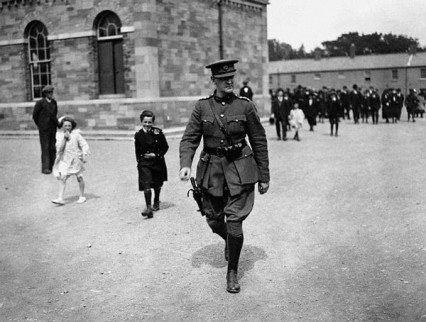
Commander in Chief Michael Collins in July 1922, two or three weeks before he was assassinated in Cork.

Michael Collins' funeral, O'Connell Street August 1922
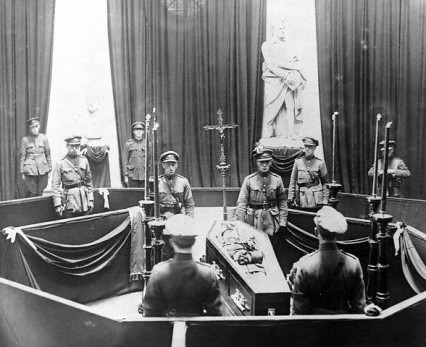
The coffin bearing the body of Michael Collins lying in state in the City Hall, Dublin. September 2, 1922 Dublin, Ireland

Michael’s brother Sean Collins

It was never really established whether Dunne and O’Sullivan acted on their own (the assassination seemed pretty badly organised for an official assassination so this was likely) or with the approval and help of Michael Collins. Collins had been a friend of Dunne’s while Sir Henry Wilson was responsible for establishing the Cairo Gang (a group of experienced British Intelligence agents who met frequently at Dublin’s Cairo Cafe) twelve of whom were murdered by the IRA acting under Collins command in 1920. The Cairo Gang killings provoked the British Auxiliaries in Dublin to shoot trapped innocent civilians at Croke Park in not the bloodiest but perhaps the nastiest of the various historical Bloody Sundays.

The infamous Cairo gang

Perhaps the ironic aspect to the story of the murder of Sir Henry Hughes Wilson was that Reginald Dunne and Joseph O’Sullivan were both born and bred in London, whereas Field-Marshall Wilson was born smack bang in the middle of Ireland at Ballinalee in County Longford.

A letter sent to O'Sullivan while waiting for his execution

Sinéad O’Connor – She Moves Through The Fair

* The text of Dunne’s intended last statement, as transcribed from the images in this post.

Lord and Members of the Jury. My friend and I stand here before you today charged with the offense of murder; and I have no doubt that, from the evidence placed before you by the prosecution, you will find us both guilty. With respect to the charges of attempted murder, we merely tried, as everyone must know, to try and escape arrest.

The offence of murder is a very serious matter; so much so, that any act which results in loss of human life requires very grave and substantial reason. We have never until now been charged with any crime. As you have heard from the Police Officer, who gave evidence as to our character and our previous records, we have both been in the British Army. We both joined voluntarily, for the purpose of [making Europe safe?] in order that the principles for which this country stood, should be upheld and preserved. These principles, we were told, were Self-Determination and Freedom for Small Nations. We both, as I have said, fought for these principles, and were commended for doing so; and I imagine that several of you gentlemen of this jury did likewise. We came back from France to find that Self-Determination had been given to some Nations we had never heard of, but that it had been denied to Ireland, We found, on the contrary that our Country was being divided into two Countries; that a Government had been set up for the Belfast district, and that under that Government outrages were being perpetrated, that are a disgrace to civilization — many of the outrages being committed by men in uniform and in the pay of the Belfast Government. We took our part in supporting the aspiration of our fellow Countrymen, in the same way as we took part in supporting the nations of the world who fought for the right of small nationalities.

Who was Sir Henry Wilson? What was his policy? And what did he stand for? You have all read in the newspapers lately, and been told, that he was a great British Field Marshal; but his activities in other fields are unknown to the men of the British public. The nation to which we have the honour to belong, the Irish nation, knows him, not so much as the British Field Marshal, but as the man behind what is known in Ireland as the Orange Terror. He was at the time of his death the Military Advisor to what is colloquially called the Ulster Government, and as Military Advisor he raised and organized a body of men known as the Ulster Special Constabulary, who are the principle agents in his campaign of terrorism.

My Lord and Members of the Jury, I do not propose to go into details of the horrible outrages committed on men, women and children of my race in Belfast and other places under the jurisdiction of the Ulster Government. Among Irishment it is well known that about 500 men, women and children have been killed within the past few months, nearly two thousand wounded, and not one offender brought to justice. More than 9000 persons have been expelled from their employment; and 23,000 men, women, and children driven from their homes. All the big cities of this country and even those of Northern France are now receiving these refugees. Sir Henry Wilson was the representative figure and the organiser of the system that made these things possible.

At his suggestion and advice the Ulster Parliament passed an Act authorising the [purging?] of political opponents and this power is now exercised and enforced by the Courts in Ulster.

There is and can be no political liberty in a country where one political party outrages, oppresses, and intimidates not only its political opponents, but persons whose religious opinion differ from those of the party in power. The same principle for which we shed our blood on the Battle Field of Europe led us to commit the act we are charged with.

My Lord and Members of the Jury, you can condemn us to death today, but you cannot deprive us of the belief that what we have done was necessary to preserve the lives, the homes, and the happiness of our countrymen in Ireland. You may by your verdict find us guilty, but we will go [to] the scaffold justified by the verdict of our own Conscience.

Dunne truncated his statement to “cut out the patriotic adjectives I feel inclined to use under the present circumstances” (as well as his specific delineation of the atrocities of Henry Wilson and the Ulster government). -ed.

On this day..

1864: Romuald Traugutt and the January Uprising leaders

On this date in 1864, the leadership of Poland-Lithuania’s abortive January Uprising against the Russian tsar was hanged before 30,000 at Warsaw Citadel.


Romuald Traugutt depicted (somewhat ironically) on the 20-zloty note of Soviet bloc Poland.

Romuald Traugutt (English Wikipedia link | Polish) had been a decorated Lieutenant Colonel in the Tsarist army, and a heretofore apolitical man — but he resigned shortly after the outbreak of the doomed national uprising to take up sides against Russia.

This installment of the venerable Russians vs. Poles series was characteristically nasty.

In 1863 – Polonia by Jan Matejko, an allegory for the Polish nation is manacled by the Russians.

And it ended the way these affairs have ended these last 400 years or so: Russian victory.

The fallout was severe.

In addition to this day’s batch — Traugutt along with (all Polish Wikipedia links) Rafal Krajewski, Jozef Toczyski, Roman Zulinski and Jan Jezioranski — a further 391 were put to death after the war; tens of thousands were deported to Siberia or otherwise scattered in the vast Romanov empire; a war indemnity tax was imposed; and over three thousand estates in Poland and Lithuania were confiscated.

Traugutt has gained some latter-day support in the Catholic Church for beatification.

On this day..

1826: The Decembrists

On this date* in 1826, five leaders of the Decembrist revolt were hanged at St. Petersburg’s Peter and Paul fortress for their abortive eponymous uprising eight months before.

The most renowned and romantic of Russia’s hapless liberals, the Decembrists were a secret clique of idealistic young officers, many of whom had cut their teeth chasing Napoleon’s grande armee out of Russia in 1812.

In Russia’s complex interaction with the West — its ideas, its political institutions, its ways of life — these were the westernizers, who saw constitutionalism as the way of the future.

Upon the mysteriously sudden death of Tsar Alexander I, an irregular succession to the second-oldest surviving brother, Nicholas I, gave our day’s doomed and gallant youth cause to occupy St. Petersburg’s Senatskaya Square to uphold the rights of the first brother — and more to the point, to uphold the constitution to the extent of constraining the monarchy.


Decembrists at Senate Square, as depicted by Karl Kolman.

Uh … Now What?

This badly organized affair failed in its aim to attract the mass of soldiery and, constitutionalists as its organizers were, did not even aim at mobilizing the general populace.

After the initial heady rush of marching into the square in the name of liberty, the Decembrists were left in a standoff against a much larger force of loyalists. When the latter started shooting, that was that.

Those that survived faced trial, with five — Peter Kakhovsky, Kondraty Ryleyev, Sergei Muravyov-Apostol, Mikhail Bestuzhev-Ryumin and Pavel Pestel — initially sentenced to drawing and quartering.

“Mere” hanging was deemed sufficient for the purpose. That would be about the maximum embrace of liberalism by the Russian autocracy, whose lesson from the uprising was to crack down against any hint of forward-thinking politics — ultimately an unsuccessful strategy for the Romanov dynasty.

St. Petersburg’s Senate Square — renamed Decembrist Square by the Soviet government — where the action happened. The iconic equestrian statue of Peter the Great, commissioned by Catherine the Great and unveiled in 1782, witnessed it all; the statue acquired its enduring moniker, “The Bronze Horseman”, from a poem of the same title penned in 1833 by Alexander Pushkin, a friend of several Decembrists.

One of the greatest works of Russian literature, Pushkin’s “Bronze Horseman” weaves an ambiguous Decembrist-tinged critique of cruel imperial power and overreach into a complex narrative of St. Petersburg whose upshot is still up for lively literary debate. “The Bronze Horseman’s crag rose up before the poet on an empty square,” wrote one historian, “washed with the blood of those who rebelled on December 14, 1825”

Appalling there
He sat, begirt with mist and air.
What thoughts engrave His brow! what hidden
Power and authority He claims!
What fire in yonder charger flames!
Proud charger, whither art thou ridden,
Where leapest thou? and where, on whom,
Wilt plant thy hoof?

“They don’t even know how to hang you …”

When the hangings were carried out, Kakhovsky, Muravyov-Apostol and Ryleyev all had their ropes break; while some in the crowd anticipated the old prerogative of mercy for any prisoner who survives an execution, they just got re-hung instead. “Unhappy country,” quipped Ryleyev as the fresh nooses were fixed up, “where they don’t even know how to hang you.”**

Other Decembrists not condemned to the unreliable craftmanship of the Russian gallows were shipped to Siberia, where they invigorated the cultural life of the Lake Baikal city of Irkutsk — many of them famously followed by their “Decembrists’ wives,” an iconic type that continues to denote heroically sacrificial loyalty since the women had to renounce their own right to return to European Russia.

These, at least, had a place to call their own, however distant. But the class of Russian elites to which they belonged would be thrust into a trackless wilderness by their failure (in the Decembrist rising and otherwise) to carve out some distinct place for themselves. Russia’s long reckoning with modernity still had many years to run.


A worn postcard of a 19th century Russian painting depicting (perhaps) a political prisoner in the Peter and Paul Fortress.

* July 25 was the date on the Gregorian calendar; per the Julian calendar still in use in Russia at the time, the date was July 13.

** Ryleyev was quite the saucy one, having fought a “mysterious” duel with Pushkin in 1823, and instigated (and served as second at) a famous St. Petersburg jilted-love duel in 1825 that cost the lives of both antagonists.

A poet himself and a romantic to the point of fanaticism, Ryleyev wrote odes extolling executed national heroes like Artemy Volynsky and Severyn Nalyvaiko, seemingly alluding (as in this excerpt from the latter work) to his anticipation of joining them.

I know full well the dire fate
Which must upon the patriot wait
Who first dare rise against the foe
And at the tyrant aim the blow.
This is my destined fate

On this day..

1976: Lt. Col. Abu Taher

At 4 a.m. this date in Dhaka Central Prison, Lt. Col. Abu Taher was hanged for treason.

A series of coups in the mirrored-sunglasses era of military governance shook the young state of Bangladesh:

  • The autocratic Sheikh Mujibur Rahman was toppled by a revolt of junior officers on August 15, 1975;
  • Senior brass in turn felled the ruling junta on November 3, 1975, jailing powerful officer Ziaur Rahman;
  • A quick counter-coup of junior officers — also remembered as the “sepoy mutiny”* — mounted by leftist war hero Abu Taher on November 7 put Ziaur Rahman’s hand back on the helm of state.

While November 7 is still marked in Bangladesh as National Revolution and Solidarity Day, its author got short shrift from its beneficiary.**

Abu Taher, a retired officer and a hero of the 1971 Bangladesh Liberation War that had detached the former East Pakistan from Islamabad, had visions of social revolution. But three coups in as many months is the sort of thing to rattle the new big man, and Zia consolidated his own power by eliminating threats to both left and right political flanks.

A mere 17 days after doing that National Revolution and Solidarity thing, the guy with the mass movement (pdf) of armed men was arrested for treason. He faced a military tribunal the following year.

Taher scorned the charges against him, but of course the fix was in.

* An allusion to colonial history.

** However, Taher’s own date of martyrdom is also still marked by his posthumous partisans.

On this day..

1537: Robert Aske, for the Pilgrimage of Grace

On this date in 1537, Robert Aske was hanged for leading the Pilgrimage of Grace.

The year preceding had been among the most wrenching in British history, and when Henry VIII began shuttering Catholic monasteries, many an egg that would comprise the English Reformation‘s omelette would be shattered.

In the conservative and Catholic-leaning north, Thomas Cromwell‘s reforms (combined with various political and economic grievances) triggered an uprising that soon controlled York.

This fraught situation ended much easier for the English crown than it might have, with a royal negotiating strategy of nominally accepting the Pilgrimage’s terms inducing the massive rebel force to disband, allowing its leaders to be seized thereafter on the first pretext of renewed trouble.

[flv:https://www.executedtoday.com/video/Pilgrimage_of_Grace.flv 440 330]

Robert Aske, the barrister who had come to the fore of the Pilgrimage movement and had personally negotiated terms with Henry, was among about 200 to suffer death for their part in the affair. In Aske’s case, it was against the will of Jane Seymour, Henry’s demure third queen and also a Catholic-inclined traditionalist; she made an uncharacteristic foray into state policy by ask(e)ing for Aske’s life, summarily vetoed by the king’s reminding her the fate of her politically-minded predecessor.*

Here’s Aske hanged at York Castle in The Tudors:

And here’s an inscription on a Yorkshire church reminding one of Aske’s surviving brothers of the events of those pivotal months.

* In other wives-of-the-king developments, Henry’s future (sixth, and final) wife Katherine Parr was taken a hostage by the rebels during the Pilgrimage.

On this day..

2008: Anandrao Sainu Koram, Naxalite informer

Last year on this date, India’s Maoist “Naxalites” publicly beheaded a former comrade who had surrendered and collaborated with police.

Naxalites.

The incident that occurred in village Murgaon of Dhanora sub district has the entire Maoist-affected region in the grip of tension because of the manner in which the reprisal has been carried out.

A group of 40 to 50 Maoists went to the village Saturday night, called out Anandrao Sainu Koram from his house, tied him to a tree and beheaded him in full view of the villagers who had gathered at the spot, deputy superintendent of police Anant Rokde said Sunday.

“They also warned Anandrao’s colleague Shantaram Gawde, who too had surrendered to the police in April this year along with three others, that he would meet the same fate if he did not desist from acting as an informer,” Rokde told IANS on the basis of the complaint lodged by Anandrao’s wife.

The 23-year-old Koram was reportedly the fourth surrendered Naxalite slain by insurgents in as many months of the long-running and escalating conflict … which, needless to say, has been dire for civilians.

On this day..

1962: Gheorghe Arsenescu, Romanian partisan

On this date in 1962, partisan Gheorghe Arsenescu was put to death at Bucharest’s Jilava Prison.

Arsenescu was a leader and co-founder of one of Romania’s several bands of anti-communist resistance units. Arsenescu’s Haiducii Muscelului — the Muscel Outlaws — were a band of 30 to 40 in the Carpathian fooothills who scarcely posed a serious threat to the Romanian state, but who nevertheless managed to elude capture for nine solid years in the 1950’s.

(More about the Haiducii in this Romanian pdf.)

Arsenescu was finally nabbed in 1960, a few months after his former comrades Toma and Petre Arnautoiu had themselves been executed. According to Revolution and Resistance in Eastern Europe, Arsenescu’s wife and father were also given long prison sentences for aiding him.

This band was perhaps most especially notable for one of its members who not only survived capture, but outlived the Communist regime: Elisabeta Rizea.

Crippled by torture, Rizea became a potent symbol in post-Communist Romania of the resistance of Arsenescu and others.

On this day..