On this date in 1919, the commandante of the “Red Army” of the short-lived Bavarian Soviet Republic was shot by the German soldiers and Freikorps that had just overrun the revolutionary republic.
The son of a pauper basketweaver, Rudolf Egelhofer enlisted in the navy in World War I and was involved in a naval revolt in the war’s closing days. Transplanting to Munich in the chaotic postwar environment, Egelhofer joined the Communist Party and became a fixture of the revolutionary movement; the socialist writer Oskar Maria Graf would record of Egelhofer’s stature at a parade that he stood “determined and sincere, in a sailor’s uniform, sometimes raising his fist. Those who heard him, had to believe in him.”
After a left-wing coup claimed Bavaria in early April, Egelhofer’s steel and magnetism received the impossible mandate of organizing a Red Army before Munich went the way of the Paris Commune. But the Bavarian Soviet was overwhelmed in less than a month.
In the first days of May, Egelhofer’s fate was shared by something like 700 supporters of the defeated Soviet.
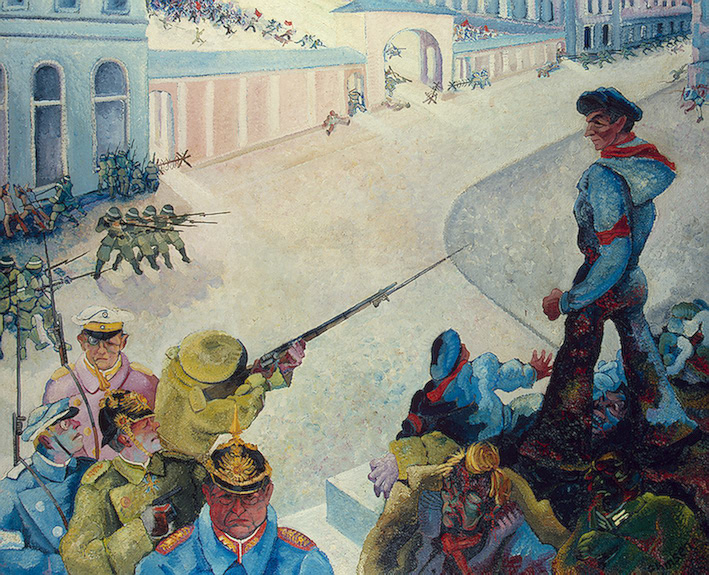
The fierce “victim” dominates his executioner in Execution by Firing Squad of the Sailor Egelhofer, by Heinrich Ehmsen (1931). This is only the central panel of a triptych depicting the White storming of Red Munich; the piece is described in this post.
Ehmsen has a similar idea about relative stature at work in Execution by Firing Squad (Red Jacket) (1919).
Though little memorialized at the place of his glory and martyrdom — which fell on the western side of the Iron Curtain — numerous East Germany streets, public buildings, and naval vessels bore Egelhofer’s name in tribute during the Cold War.
Lieutenant General Hisao Tani was shot on this date in 1947 for his part in the Rape of Nanking.
Tani commanded a division that took part in the conquest and occupation of that Chinese city in 1937, and it was outside its gates — following a Chinese war crimes trial — that he took his leave of this world.
On this date in 1947, U.S. Army Private Garlon Mickles was hanged at a place called “execution gulch” in Honolulu’s Schofield Barracks.
Mickles had enlisted three years before, the 16-year-old son of a St. Louis laundress. (“Tell my mother I died like a man,” were his reported words to the chaplain.)
According to Associated Press reports, army engineers frustrated peeping eyes by “put[ting] up a smoke screen to shield the gallows from the view of the curious.”
He was convicted of raping and robbing a female War Department employee on Guam, where he was stationed with the Twentieth Air Force — from which staging-point the unit conducted bombing raids on mainland Japan. (The Enola Gay, which dropped the atomic bomb on Hiroshima, was part of the 20th.)
Mickles appears to be the last person ever executed on the Hawaiian islands, and also an unusual overlook by the Espy File of U.S. executions, from which he’s totally absent.
This Jemadar of the 34th Regiment N.I. was brought to trial on the following charges: —
1st. For having at Barrackpore on the 29th March 1857, he being then in command of the quarter-guard of his regiment, not used his utmost or any endeavours to suppress a mutiny begun by Mungul Pandy, the said sepoy having on the afternoon of the day above mentioned, gone out into the parade ground in front of and near to the quarter-guard of the regiment armed with a sword and musket; and then and there used words to excite the men of the reigment to come forth and join him in resistance to lawful authority; and having then and there on the parade ground, and near to the quarter-guard of the regiment, discharged his loaded musket at Serjeant Major James Thornton Hewson, and Lieutenant Bempole Henry Baugh, of the 34th Regiment N.I., and then and there with a sword struck, and severely wounded, the said Lieutenant Baugh and Serjeant Major Hewson, and the said Jemadar not having taken any measures to arrest and confine the said sepoy throughout the aforesaid occurrences, nor to assist the said Lieutenant Baugh and Serjenat Major Hewson, and he [sic] the said Jemadar having, moreover, then and there discouraged and interfered to prevent any sepoys of his guard from going to their assistance.
2nd. For disobedience to the lawful command of his superior officers in not having advanced with his guard to rescue the Serjeant and capture the aforesaid sepoy, Mungul Pandy, when shortly after the occurrences, set forth in the first charge, he was ordered to do so by Brevet Colonel S.G. Wheler, commanding the 34th Regiment N.I.
The Court found the prisoner, Jemadar Issurree Pandy, guilty of both charges preferred against him, and sentenced him to suffer death. On the 21st April 1857 Major General Hearsey reported as follows: —
Jemadar Issuree Pandy was duly hanged by the neck this afternoon at 6 o’clock in presence of all the troops at the station; the crimes, finding, and sentence of the General Court Martial before which he was arraigned, approved and confirmed by His Excellency the Commander-in-Chief, having been first carefully explained to all the native corps.
It may be perhaps satisfactory to the Government to know that when on the scaffold the Jemadar made a voluntary confession of his guilt, and admitted the justice of the sentence which had been passed on him, at the same time imploring all his fellow soldiers who were present to take warning by his untimely fate.
Alonso formed a popular militia and continued a short-lived resistance against the French but was captured early in 1864, and although this was still some months before the dirty war’s notorious “Black Decree” the French determined to make an example of him.
Alonso aside, the Mexican adventure proved a right catastrophe for France and its adherents.
You’ll never guess it: CCFAN also took Galopin hostage.**
CCFAN tried to leverage its new captive into an arms trade. When France dragged its feet, the Chadians terminated the negotiation by having Galopin condemned by a “revolutionary tribunal” and hanged to a roadside tree.
Habre would eventually take power as President of Chad in 1982, and was subsequently welcomed on state visits to the former mother country — much to the disgust of those who remembered the Frenchman sacrificed to his ambitions. Galopin was hardly the last man to be so distinguished: as of this writing, Habre is serving an eternal prison sentence in neighboring Senegal for crimes against humanity committed during his eight years ruling Chad.
* Archaeologist Françoise Claustre and development worker Marc Combe. (A third hostage, West German doctor Christoph Staewen, had also been taken, but had quickly been ransomed by his government.) Combe escaped in 1975. Claustre was not released until 1977.
** CCFAN was also riven by a major internal division that by 1976 would split the movement into two rival organs. It has long been murky (French-language pdf here) just whose interest within CCFAN was best served by the hostile course of events.
Retreating from the Philippines in early 1942, U.S. Gen. Douglas MacArthur famously vowed, “I shall return.” To Homma’s grief, he did just that.
While MacArthur cogitated his revenge, Homma was finishing off the remnants of his last great stand in the Battle of Bataan. Bataan was a victory for Japan, but a bloody and protracted one; it cost the lives of some 7,000 Japanese, and the three-month battle has sometimes been credited with slowing the Japanese advance sufficiently to safeguard Australia; it also left the occupiers with an unexpectedly huge complement of POWs.
On April 9, 1942, the very day fighting ended at Bataan, transfers began for these prisoners, who would be driven by train and then marched overland some 60+ miles to Camp O’Donnell. More than 60,000 Filipinos and about 15,000 Americans endured this harrowing five- or six-day slog — the Bataan Death March.
A few books about the Bataah Death March
Early reports of the death march made grist for this wartime propaganda poster in the U.S.
This crucible of endurance, both physical and spiritual, came by its evil repute honestly; in the age of the Internet, numerous appalling testimonials are within easy reach of a web search. They recount battle-wearied men enervated by hunger and thirst, liable to be summarily shot or bayoneted for making themselves the least bit conspicuous to captors who already disdained them for having the weakness to surrender in the first place.
Some were murdered at the outset: having any Japanese “trophies” on one’s person when captured was liable to be worth a summary bullet, or a quick flash of an officer’s katana. An even more certain death sentence was falling behind on the march, and wounded prisoners could expect no quarter: they had to keep up with their compatriots or the Japanese “buzzard squad” trailing a few score meters behind every marching peloton would finish them off with any other stragglers. In different groups POWs might be thrashed or killed over any trifling annoyance; meanwhile, those suffered to live trudged under a wasting sun, nearly unnourished but for fetid handfuls scooped from mud puddles, dying on their feet hour by hour. Dehydrated to the point of madness, some snapped and ran suicidally for the tantalizing nearby village wells that marchers were prohibited from accessing.
Something like a quarter, and maybe nearer to a third, of the souls who set out on the Bataan Death March never reached Camp O’Donnell. Those who did entered new portals of torment: rent by dysentery and crowded cheek to sunken jowl, prisoners died off daily by the dozens until they were finally dispatched — often crammed like sardines into the bowels of “hell ships” — to different Japanese work camps.
The Bataan Death March was a no-question basket of war crimes, egregiously flouting existing POW treatment accords.* It’s far more questionable whether our man Gen. Homma was the right person to answer for it.
Homma had segued directly from the Battle of Bataan to the succeeding Battle of Corregidor after which he had been cashiered for a homeland desk job.
Ironically, it was an excess of leniency that helped earn Homma his enemies among the brass — the opposite of the thing that hanged him. For many who observed the postwar trial slating him with 48 war crimes violations related to the Death March, Homma was a figure more tragic than wicked, prey to returning victor MacArthur’s pique at the defeat Homma had once inflicted upon him.
Little reliable evidence could show that Homma blessed or even knew of the atrocities committed in the march, but he himself allowed during trial that “I am morally responsible for whatever happened in anything under my command.” According to Homma’s American defense attorney Robert Pelz — a biased source to be sure — the general slipped into genuine disgust and remorse during the trial as a parade of witnesses remembered their ordeals. “I am horrified to learn these things happened under my command,” Homma wrote in a note passed to Pelz at one point. “I am ashamed of our troops.”
The hanging verdict was controversial then and remains so now. “If the defendant does not deserve his judicial fate, none in jurisdictional history ever did,” MacArthur complained. He honored the mercy application of Homma’s wife Fujiko only insofar as to permit the general a more honorable execution by musketry, instead of hanging.
The bulk of the U.S. Supreme Court okayed the procedure by which the U.S. military brought that fate about, although Justice Frank Murphy issued a scorching dissent urging that in the haste and partiality of the proceedings against both Homma and General Tomoyuki Yamashita “we abandon all pretense to justice, let the ages slip away and descend to the level of revengeful blood purges.”
One who would share that sentiment was an 18-year-old Navy man who observed the trial, Bob Perske. Perske would remember this his experiences on the Philippines at the end of World War II “sharpened his sensitivies toward vulnerable persons” and influenced a subsequent career advocating for people with disabilities as well as those caught in the toils of the criminal justice system. Executed Today formerly interviewed Mr. Perske in connection with the wrongful execution of a mentally disabled man in Colorado, Joe Arridy.
On this date in 1718,* the vengeful tsar Peter the Great staged a horrible execution on Moscow’s Red Square.
Stepan Glebov was the collateral damage of Peter’s ferocious conflict with his ill-favored crown prince Tsarevich Alexei — the whelp who had only recently been repatriated to his glowering father after fleeing Russia altogether, to cap a lifetime of letting dad down. Alexei was back in Peter’s clutches, and a few months from the events in this post would be shockingly knouted to death at Peter’s orders.
This Freudian clash also mapped sharply onto Russia’s political schisms (and many of the links in this post are to Russian pages). Alexei was the son of Peter’s first wife, Eudoxia [or Evdokia] Feodorovna Lopukhina, a princess whom the teenage Peter had been required to wed as part of the political logrolling involved in overcoming the 1680s regency of his sister Sofia.
Peter had achieved that victory, definitively, and once it was secured it didn’t take him long to tire of both Eudoxia and of the stagnant boyar class she represented. Peter was all about westernizing the motherland; what better way to start than by immuring his Russian bride in a monastery** and grabbing a German merchant’s daughter for a mistress?
The blows were borne together by Eudoxia, by her devout son Alexei, and by that part of traditional and Orthodox Russia horrified by Peter’s innovations. Resentments ran along the familiar channels, here to an immoderate fantasy of deliverance come Peter’s death and there to dangerous plans to immanentize same.
When exposed by to Peter’s hostile gaze little distance would there seem between these varietals.
When Alexei returned to face Peter’s investigation, the old man turned his harsh scrutiny on the ex, knowing her to be a locus of opposition. She was found living outside the monastery in secular garb, having taken an officer named Stepan Glebov as her lover. Their correspondence was ransacked by persecutors determined to discover indicia of treasonable scheming therein. Dozens of associates and monastery monks and nuns would be caught up in the affair, damned for anything from failing to prevent the former queen’s dalliance to plotting against the life of Tsar Peter. Most were stripped of rank and sent to exile with various forms of corporal punishment — whipping, severed nostrils, tongues sliced out — but several would be tortured to death or executed on the breaking-wheel including Dositheus, Bishop of Rostov, a confidante of Eudoxia who had allegedly prophesied Alexei’s triumph over his father, and Alexander Kikin, a mentor of Alexei’s who had helped to arrange his escape from Russia.
But upon Glebov, miserable man, Peter would give free rein to his amazing talent for cruelty: the lover to be impaled alive on a stake artfully inserted to miss all vital organs so as to maximize his suffering; some accounts even give it out that the naked Glebov was bundled in furs for the freezing winter’s execution, that he might endure his pains the longer.
Glebov survived impalement for over 14 hours, only dying after 7 a.m. on the morning of March 16. Folklore (it’s probably just that) has it that, importuned on that stake by the tsar to admit to the treasonable conspiracy, Glebov justifiably retorted that he had refused such a confession under unspeakable torment in Peter’s dungeons, so why would he break now? “Depart, and let me die in peace so that you may live without peace.”
Eudoxia’s brother Avram was also put to death in December 1718. She herself was shut up in Shlisselburg fortress for the balance of Peter’s life, but she would survive to see her grandson (Alexei’s son) take the throne in 1727 as Peter II.
* Julian date: it was March 26 on the Gregorian calendar.
On this date in 1984, the Islamic Republic of Iran completed its destruction of the Tudeh party with ten executions.
In the 1940s, the Tudeh was Iran’s largest mass party and a fair bet to take power in the near future but state repression after Mossadegh was overthrown in 1953 had largely driven the Communist movement to the skulking margins.
Its fragments hung on underground, preparing and organizing for the proletarian revolution — an orientation that would leave the Tudeh entirely unprepared for the Iranian Revolution that really occurred. In fairness, few from Tehran to Moscow to Washington could read those tea leaves: who in the winter of the Cold War anticipated a great regional prize like Iran being captured by … the mullahs?
The Revolution released the once-banned party onto terra incognita as a minor outlet for leftward sentiment and perhaps a show of democratic good faith. But from the start it awkwardly existed on sufferance of an entirely incompatible regime. The venerable English journalist Robert Fisk, who covered the Iranian Revolution, filed a wry dispatch for the Times (Nov. 26, 1979) from the Tehran offices of Tudeh leader Nouredin Kianouri — unconvincingly trying to position his own movement within the events sweeping everyone along.
Tudeh is involved in “the radical struggle against imperialism”, and “the struggle for the reorganization of social life, especially for the oppressed strata of society” … and in so far as it is possible, Tudeh — Iran’s oldest political party — stands for the same things as Ayatollah Khomeini.
That, at least, is the theory: and Mr Kianouri holds to it bravely.
…
Tudeh demands a “popular front” government in Iran and Mr Kianouri professes to see little difference between this and Ayatollah Khomeini’s desire for national unity. “Popular Front”, however, is not an expression that has ever crossed the Imam’s lips and it is difficult to see how Iran’s new fundamentalist religious administration could form any cohesion with the materialist aims of Mr Kianouri’s scientific Marxism.
The article’s headline was “Ayatollah tolerates Communists until they become too popular,” but Tudeh never fulfilled its clause: it was blown out in the 1980 election, failing to win even a single seat, and maneuvered ineffectually for two years until a crackdown shattered its remnants with over 1,000 arrests early in 1983,* heavily targeting Tudeh-sympathizing army officers.** (The aforesaid Mr. Kianouri was forced to make a humiliating televised self-denunciation in 1983, although he surprisingly avoided execution.)
Those arrests culminated in a large show trial of 101 Tudeh principals in December 1983-January 1984, followed by smaller trials of lesser Tudeh figures in several cities over the months to come.
Eighty-seven Tudeh officials caught prison sentences ranging from eight months to life; these “lucky” ones, along with hundreds of other Tudeh adherents arrested in the years to come, would later be well-represented among the victims of Iran’s 1988 slaughter of political prisoners.
That left ten† reserved for execution on February 25 on charges compassing espionage, treason, and the weapons they had once naively stockpiled to fight against a monarchist coup. Notable among them were four high-ranking military officers: Col. Houshang Attarian, Col. Bezhan Kabiri, Col. Hassan Azarfar, and the chief catch, former Navy Commander Admiral Bahram Afzali.
* The U.S., officially abhorred of Iran, was in this period covertly aiding Tehran to raise funds to illegally bankroll Central American death squads — the Iran-Contra scandal. According to the American Tower Commission investigation of those events, the Tudeh were one of the lesser casualties this foreign policy misadventure when U.S. intelligence about the Tudeh network, largely obtained via a KGB defector, was passed to Tehran as a pot-sweetener: “In 1983, the United States helped bring to the attention of Tehran the threat inherent in the extensive infiltration of the government by the communist Tudeh Party and Soviet or pro-Soviet cadres in the country. Using this information, the Khomeini government took measures, including mass executions, that virtually eliminated the pro-Soviet infrastructure in Iran.” (See Appendix B here.)
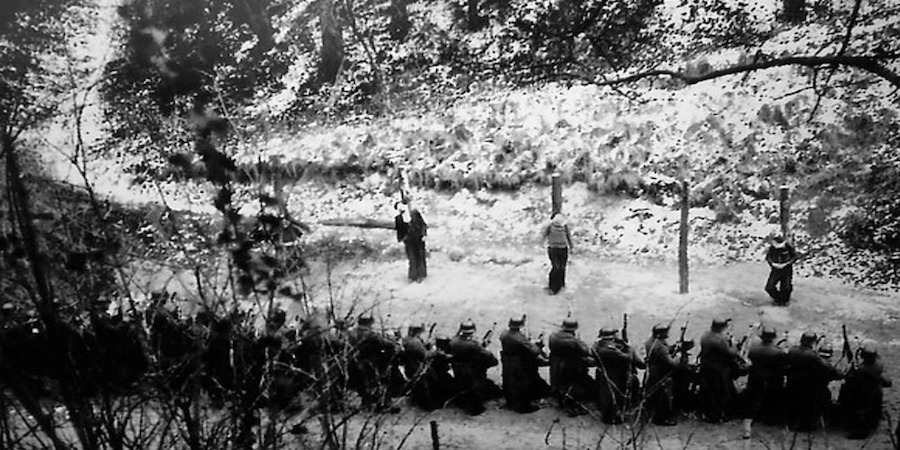
On this date in 1944, 22 members of the anti-Nazi French Resistance’s “immigrant movement” Francs-tireurs et partisans – main-d’œuvre immigrée (FTP-MOI) were executed by firing squad on the outskirts of Paris.
Comprised of foreign communists whose backgrounds amply motivated them to desperate resistance, FTP-MOI was a notably aggressive partisan unit; a few months before this date’s executions, it had stunningly assassinated SS Col. Julius Ritter on the streets of Paris. Risky tactics, including larger-scale operations like the one that claimed Ritter (these required more partisans to know each other) entailed greater risk of penetration, and the November 1943 arrest of the Armenian commander Missak Manouchian and his group devastated FTP-MOI. After the customary interlude of torture, these were subjected to a show trial with 23 condemned to execution.*
As a gaggle of foreign terrorists, heavily Semitic, this clique looked to the occupation like a marvelous tar with which to blacken the Resistance. To that end the Germans produced a scarlet poster denouncing the Resistance as an “Army of Crime,” its soldiery labeled with strange names and alien nationalities converging on the swarthy Manouchian.**
Soon known as l’Affiche Rouge, the poster instead apotheosized its subjects. In the postwar period it became an emblem of the best of the Resistance — its multinational unity, France as an idea powerful enough that men and women of distant birth would give their lives for her. (Not to mention the postwar French Communists’ claim on le parti des fusillés.)
To this day in France, the backfiring propaganda sheet is one of the best-recognized artifacts of the Resistance.
The executions were naturally conducted quietly; the Germans strictly forbade public access to or photography of Resistance heroes in their martyrdoms for obvious reasons.
That made it especially surprising when a few pictures of this execution surfaced recently, surreptitiously snapped from an overlooking vantage by German motorbike officer Clemens Rüter, who kept them hidden for decades. They are to date the only known World War II photos of French Resistance members being executed.
* The 23rd, and the only woman in the group, was Romanian Olga Bancic, also known by the nom de guerre Pierrette; she was not shot on this date but deported to Stuttgart and beheaded there on May 10, 1944. There was also a 24th, a man named Migatulski, who was initially part of the same trial; he was instead remanded to French custody. (See coverage in the collaborationist La Matin from Feb. 19, 1944 and Feb. 22, 1944.)
** We’ve noted before that a Polish Jew named Joseph Epstein who was part of the same cell (and a prime candidate for racist demagoguing) avoided a place on l’Affiche Rouge thanks to his preternatural talent for remaining mum under interrogation.



 Elected to the post during early months of the unfolding
  Galopin (
 Homma commanded the