1858: Henry Fife and Charlotte Jones, exonerating Monroe Stewart

On this date in 1858, Charlotte Jones and Henry Fife hanged side by side in Pittsburgh for murdering Jones’s elderly aunt and uncle the year before. But their dying confessions insistently exonerating their death-sentenced co-accused led the governor to pardon Monroe Stewart ahead of the latter’s scheduled hanging later that February.

Fife, Jones, and Stewart had been tried and convicted together in the so-called “McKeesport Murder” or “Wilson Tragedy”. The reader will infer that it entailed the murder of a man named Wilson in the city of McKeesport.

George Wilson, an elderly farmer, was Charlotte’s uncle: resident in a McKeepsort log cabin with his sister Elizabeth McMasters. He had a tightfisted reputation and a consequent stash of gold and silver coins and paper bills, amounting altogether to several hundred dollars.*

“Maddened by a thirst for gold and stimulated by drink I gave them the fatal blow that robbed them of life and sent their souls, without warning, to the bar of God,” Fife lamented in his scaffold confession. George Wilson had been stabbed to death; Elizabeth McMasters bludgeoned with a poker until her brains spattered the room.

Their 27-year-old niece, our Charlotte Jones, was the one who reported the murder but it would soon become painfully apparent that she had lacked the poise for this high-stakes bluff. She had already the reputation of a woman of low morals, and her suspicious eagerness to leave the vicinity brought her in for close questioning. It was not long before Jones served up a confession.

In her initial iterations of this statement, Jones implicated not only her lover, 22-year-old Irish shoemaker Henry Fife, but Fife’s friend Monroe Stewart. It seems that this was a bit of panicked vindictiveness on the part of Mrs. Jones, for Stewart had often counseled his friend to kick Jones to the curb.

This denunciation was enough to see all three condemned in an 11-day trial in July of 1857. Post-conviction, Fife would join Jones in admitting guilt, but both exculpated Stewart of any part in the crime. And in the subsequent odyssey of appeals and clemency petitions, it was really only Stewart’s fate that remained at issue.

When Pennsylvania’s high court squelched the trio’s last legal avenue, reported the Baltimore sun (Nov. 26, 1857), Stewart, “who had always displayed the most astonishing self-possession and calmness, appeared overwhelmed by the news, and betrayed a degree of emotion that he never before manifested.”

His whole hope centered on the Supreme Court. He believed firmly that there would be a reversal of the judgment of the court below in his case, and when he found the hope which had buoyed him up suddenly destroyed, his self-possession deserted him, and he gave himself up to a degree of anguish that surprised while it pained his fellow-prisoners. He still proclaims his innocence, and maintains that, though a thousand courts held otherwise, he is guiltless of the blood of the Wilson family.

Fortunately for him, Stewart did not hang with Fife and Jones but was slated to die a fortnight later.

By execution day, Jones was in a state of near-collapse — “utterly broken down and bewildered,” according to the Pittsburgh Gazette‘s report (as reprinted in the Harrisburg Patriot and Union, Feb. 17, 1858). “She cried bitterly, and every now and then uttered incoherent sentences — now stating that she desired to die, and again declaring that she was afraid of death and wished to live.” The lengthy execution prelude on the scaffold, as she multiplied over and over the terrors of her imminent death while Fife tried to console her through interminable prayers, statements, and other ceremonial niceties, must have been agony.

Jones’s statement (read by a spiritual counselor) and Fife’s (which he delivered himself) both owned the murder while insisting that Monroe Stewart had no part in it. Outgoing Gov. James Pollock* had had no time for this ploy in issuing Stewart’s death warrant, and even in the hours after the hanging newsmen speculated that this exculpation carried little credibility. But a new man, William Packer, had taken office between the death warrant and the executions, and Packer thought better than his predecessor of Stewart’s protestations. He pardoned Monroe Stewart days before his February 26 execution.

* In the hours after the crime, Fife buried sacks of $20 gold coins and silver half-dollars and dollars along the bank of the Youghiogheny River. He only had one chance to recover the money later and couldn’t find the hole; neither could the authorities when he later described the hiding place from his condemned cell.

Finally, in 1880, two boys accidentally ran across the cache … only to have a passing stranger with “a heavy red beard and red hair” immediately relieve them of the treasure and hurry off into the mists of history.

** Pollock later directed the Philadelphia mint and helped spearhead the first introduction of the “In God We Trust” motto on U.S. currency.

On this day..

1943: The last five Young Guards shot in Krasnodon

On this date in 1943, days before their city was liberated, five members of the anti-occupation resistance were shot in Krasnodon in the Donbass.

That eastern Ukrainian city* had fallen under German-Italian-Romanan occupation in July 1942.

In response, some 100 local teens banded together into an anti-fascist underground — the Molodaya Gvardiya, or Young Guard. (English Wikipedia entry | Russian) Most of their number would give their lives in resistance.

During the few months of occupation, the Young Guards managed an impressive record of sabotage operations and propaganda coups. It busted 90 people out of the Germans’ concentration camp, and got the hammer and sickle hung up on government buildings to mark the silver anniversary of Red October. In December, the Young Guards managed to destroy the labor bureau (and its list of intended conscripts) on the eve of a planned deportation, sparing 2,000 people that dreadful fate.

The Germans finally got their hooks into the Young Guards and started mass arrests at the start of January. They brought in most of the Young Guards for torture and execution — smashing up the organization in their very last weeks in town.

The five put to death this date were the last of those martyrs, and the more tragic in that the occupiers were even then gearing up to evacuate as the Red Army closed in. (The Soviets took the city on February 15.) They were:


Oleg Koshevoy’s interrogation. Image from MolodGuard.ru’s stupendous images collection.

In September 1943, three Soviet citizens were publicly executed in the liberated city on charges of having aided the Germans in suppressing the Young Guards.

The Young Guards’ youth and intrepidity made them extremely congenial to the Soviets’ wartime demand for martyrs. At the urging of his Ukrainian deputy Nikita Khrushchev — who himself hailed from the Donbass — Stalin approved a number of the Young Guards (including this date’s Koshevoy and Shevtsova) as Heroes of the Soviet Union.

The Guards valorized in a 1945 novel, and then a 1948 film based on that novel. (Russian links, both.)

They’ve featured in postage stamps, public artwork, and every manner of patriotic commemoration ever since. They’ve even come in for a bit of post-Soviet “ownership” conflict (over the Guards’ degree of Communist Party affiliation) between Ukraine’s Russian- and Soviet-leaning east and the nationalist-sympathizing west.

Today the “Molodaya Gvardiya” brand might be most immediately recognizable as a youth organ of Vladimir Putin’s party — no connection to the young partisans, of course.

* Not to be confused with the Russian city of Krasnodar.

On this day..

2015: Sajida al-Rishawi and Ziyad Karboli, Jordan’s revenge on ISIS

This morning at Swaqa prison south of Amman, Jordan executed two operatives of al-Qaida in Iraq in retaliation against ISIS for the murder of a captured Jordanian pilot.

ISIS yesterday posted a video showing a caged and gasoline-drenched Lt. Muath al-Kaseasbeh shrieking as flames devour him. The slickly produced 22-minute piece with the stomach-turning climax can be found online here, but don’t say we didn’t warn you. It’s nightmarish.

The unfortunate pilot had been used as a prop in ISIS’s provocative hostage diplomacy along with the Japanese captive Kenji Goto, who were both offered in exchange for Sajida al-Rishawi, a terrorist already on Jordan’s death row Jordan’s death row who had been widely forgotten. Video of Goto’s beheading came out several days ago.

Jordan last week agreed to trade al-Rishawi, if ISIS could prove that al-Kaseasbeh was still alive. Jordanian television has reported that the almost jeering video reply was actually filmed on January 3, indicating that the “hostage” negotiations had been a sham all along. (And/or deflecting some of the public anger away from the government; initial reports today had some crowds chanting against Jordan’s King Abdullah, who hastened home from meetings in Washington, D.C. after news of Lt. al-Kaseasbeh’s fate surfaced.)

Al-Rishawi, an Iraqi woman condemned to death in 2005 for taking part in a suicide bombing,* was promptly hanged in revenge by an enraged Jordan. Her crime predated ISIS, of course, but here’s guessing it was a public relations maneuver for the Islamist quasi-state to involve the al-Rishawi gratuitously and invite Jordan to martyr a female prisoner who turned terrorist after she lost a husband and three brothers killed fighting American troops.


Sajida al-Rishawi

Jordan has vowed an “earth-shaking response” extending far beyond hanging al-Rishawi and Ziyad Karboli, another al-Qaida in Iraq prisoner who was also executed.

“While the military forces mourn the martyr, they emphasize his blood will not be shed in vain. Our punishment and revenge will be as huge as the loss of the Jordanians,” a spokesman said in a prepared statement today.

“My son’s blood is worth more than those two,” Lt. al-Kaseasbeh’s father agreed — adding that Jordan’s true revenge must be “to destroy this terrorist group.”

* Her explosive vest failed to detonate, but the attack killed 57. Despite the notoriety of the bombing, al-Rishawi was understood as a small-timer by Jordanians who widely favored setting her free if that could actually secure the release of the lieutenant.

On this day..

1905: Elisabeth Wiese, the angel-maker of St. Pauli

On this date in 1905, “baby farmer” Elisabeth Wiese was beheaded in Hamburg.

In a luridly reported case “revolting in the extreme, proving the woman to be a monster of iniquity” Wiese stepped into a quintessential fin de siecle moral panic as a former convict whose larcenous past had forced her trade away from the legitimate field of midwifery towards the more shady precincts of mercenary fostering.

From scandal-averse single mothers in England as well as Germany, she collected children with maintenance fees running to US $1,000 plus a hush-money surcharge tacked on. For this donative, she represented a capacity to distribute these whelps to willing adoptive families: in reality, most of them she disposed of with morphine. (As an added inflammation to public opinion, she had also forced her own illegitimate daughter into prostitution; Paula, whose own infant was among Wiese’s victims, repaid that ill turn by appearing as a witness against her mother.)

When Wiese fell under suspicion, the neighbors’ reports of her kitchen glowing like hellfire and belching revolting stenches led police to the remains of these little ones burnt up in her stove.

Condemned for five murders — it’s thought that the true count must have run much higher — Wiese is known as the “angel-maker of St. Pauli” after the suburb where she plied her trade.

On this day..

1745: Eve, her smoke visible throughout the country

On this date in 1745, Orange County, Virginia was darkened by the smoke from a stake where a slave named Eve died for poisoning her master, Peter Montague.

As accused, Eve, “not having God before her eyes nor considering the obedience to the said Peter Montague, her master, but led and seduced by the instigation of the Devil … with force of arms and her malice forethought, feloniously and traitorously did mingle and poison milk … did give it to the said Peter Montague, which he did taste, eat, drink and swallow down … and did languish until the 27th day of December. Eve falsely, traitorously and feloniously of her malice forethought with the poison … did kill, poison and murder.” (Quoted here.)

Eve asserted her innocence to no avail at her trial on January 23. The court condemned her to “be drawn upon a hurdle to the place of execution and there to be burnt.”

Upon the execution of that sentence — “the smoke of the burning of Eve was visible over a large extent of the country” — the Montague estate was compensated £50 by the Commonwealth of Virginia for the destruction of its human property.

On this day..

1538: Anna Jansz, Anabaptist

Dutch Anabaptist Anneke Esaiasdochter (better known as Anna Jansz; this was the surname of her husband*) was executed in Rotterdam on this date in 1538.

Anna (English Wikipedia entry | German) is a key martyr of the fragmented Anabaptist movement following the destruction of Anabaptis’s “New Jerusalem” in Münster.

This catastrophe hurled Anabaptism into the desert, where rival leaders pointed the way to different horizons. Would it double down on revolutionary political aspirations, along the lines of Münster? Would it become a pacificist, spiritual movement without secular aspirations?

Anna Jansz, at least as she appears in the readings others have given her, somewhat personifies these conflicting directions — and not incidentally, the also-open question of women’s role in the Anabaptist movement.

Though she appears in the Martyrs’ Mirror as a model feminine sufferer, the “Trumpet Song” she composed has in at least some versions a distinctly apocalyptic tone. One historian called it the Marseillaise of Anabaptist hymns:

Wash your feet in the godless blood

This is shocking imagery, but it’s also far from clear that it’s actually what Anna herself wrote — or if its surface interpretation is what the author intended to convey. Anabaptism’s fast-evolving strains published different versions of the “Trumpet Song” in the 16th century, whose slight alterations dramatically shade its meaning — especially so in view of the possible scriptural allusions. Here’s a version of the same line in which the verb wash (wascht) is replaced with watch, or mind (wacht), and it now advises the true Christian to leave punishment of the persecutors to God:

You true Christians be of good cheer
Mind dipping your feet in blood
Because this is the reward which those who
robbed us will receive

As Timothy Nyhof details in this paper (pdf), her image is ultimately quite elusive to us,** and filtered through the texts of interlocutors like the great Anabaptist fugitive David Joris, rumored to have been Anna’s onetime lover. Joris published the version of the “Trumpet Song” excerpted just above — the cautious one.†

In the end, a fixed conclusion as to whether Anna was a firebrand later softened for public consumption, or the reverse, or a more nuanced character entirely, is beyond the reach of posterity. In any guise, she was an exponent of the call to spiritual purity and anticipation of the Lord that fortified a proscribed faith in its wilderness sojourn.


Detail view (click for the full image) of Anna Jansz en route to her January 24, 1538 execution from the Martyrs’ Mirror.

* Anna’s husband Arendt Jansz fled to England to escape the persecution of Anabaptists, which is why he doesn’t figure in this story.

** Nyhof ultimately situates Anna Jansz among the Melchiorites. Although that philosophy’s namesake had gone down backing the Anabaptist commune, his post-Münster followers turned Melchior Hoffman’s eschatology towards personal redemption instead of political violence. (Source)

† I’m certain it must exist out there, but I have not been able to find online a complete version of any of the “original” versions of Anna’s famous song, either in Dutch or in translation. Profiles of Anabaptist Women: Sixteenth-Century Reforming Pioneers gives the last three of its 13 stanzas thus:

At Borsa and Edom, so the author has read
The Lord is preparing a feast
From the flesh of kings and princes.
Come all you birds,
Gather quickly
I will feed you the flesh of princes.
As they have done, so shall be done to them.
You servants of the Lord, be of good cheer.
Wash your feet in the blood of the godless.
This shall be the reward for those who robbed us.

Be pleased therefore, rejoice and be glad.
Play a new song on your harps;
Delight in our God
All you who foresee vengeance.
The Lord comes to pay
And to revenge all our blood.
His wrath is beginning to descend.
We are awaiting the last bowl.

Oh bride, go to meet your Lord and King.
Arise, Jerusalem, prepare yourself.
Receive all your children alike.
You shall spread out your tents.
Receive your corwn, receive your kingdom.
Your King comes to deliver.
He brings his reward before him.
You shall rejoice in it.
We shall see his glory in these times.
Rejoice, Zion, with pure Jerusalem.

On this day..

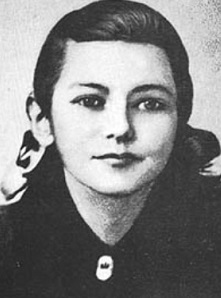
1944: Zinaida Portnova, Komsomol hero

On this date in 1944, Soviet partisan Zinaida Portnova was executed by the Germans occupying Belarus.

The youngest-ever female Hero of the Soviet Union (she was posthumously decorated in 1958), the Leningrad-born Portnova had a rude start in insurgency when the German blitz swept past her summer camp in Belarus and trapped her behind lines.

Said to have been radicalized when occupying soldiers struck her grandmother, the girl joined the youth arm of the local resistance, dubbed the “Young Avengers”.

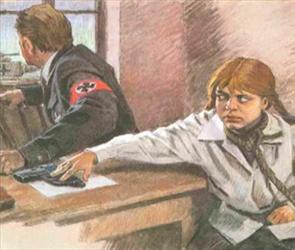
From surveilling enemy troop deployments and assembling weapons caches, Zinaida Portnova graduated to sabotage and ambushes … and capture. Even then she pulled off an action hero escape by snatching a gun and shooting her way out of custody, only to be re-arrested shortly thereafter.

She was shot a month shy of her 18th birthday.

A large number of Pioneer youth groups were subsequently dedicated to Zinaida Portnova, as was a museum of the Komsomol underground and a public monument in Minsk. She remains to this day an honored martyr of the Great Patriotic War.

On this day..

1874: Three for misshapen love

On this date in 1874, two men and a woman hanged at H.M. Prison Gloucester for unsatisfactory affairs of the heart.

Charles Edward Butt

On August 17 of the previous year, Charles Edward Butt had besought the company of a Miss Amelia Phipps for an excursion to the next day’s Gloucester Cheese Fair.

Miss Phipps, long the object of the young farmer’s amorous suit, had unfortunately pledged her company to another gentleman, which disappointment Butt remedied by shooting the young lady to death.

Mary Anne Barry and Edwin Bailey

On that very same August 17, a Bristol teen mother named Mary Susan Jenkins attempted to relieve her baby’s colic by reaching for a packet of Steedman’s Soothing Powders.

Plumped for use by teething children, these packets had been helpfully delivered by the local Dorcas Society, a charitable network set up to provide essentials to the poor. And Miss Jenkins was quite poor indeed, after having been dismissed from her domestic service by a prosperous cobbler named Edwin Bailey after the latter impregnated her, and then refused to pay for the upbringing of his whelp.

Minutes after the treatment with Steedman’s, however, the whelp had breathed his last.

Investigation soon determined that the packages had been laced with lethal quantities of strychnine, and the package from the “Dorcas Society” in fact appeared to have been addressed by the hand of Edwin Bailey himself — whose maintenance payments of five shillings per week had now been mandated by a court.

Bailey’s motivation in the affair is obvious; much less so is that of Mary Anne Barry. Barry was another of Bailey’s servants, and she had taken to visiting the Jenkins family over the preceding months under the name only of “Anne” — representing herself as an emissary of the Dorcas Society.

Barry claimed that she had simply been dispatched by Bailey to attempt to ferret out the bastard child’s real paternity which he still violently denied. But a few days before the rat poison was administered it was she who had recommended Steedman’s powders and suggested that they could probably be procured of the Dorcas Society. Though this surely convinced her jury, that panel strongly recommended her to mercy, perhaps not entirely certain on the judge’s charge to them “whether there was not a view of her case consistent with her innocence.” Considering that she was informing Edwin Bailey of the conversations in what she perhaps thought was merely the capacity of a detective, there is indeed such a view.

Robert Anderson Evans

Aging executioner-relic William Calcraft, who would be forced into retirement later this year, was too sick to officiate, so the honors were done by Welsh hanging-hobbyist Robert Anderson Evans instead. Evans only rates a faint and distant blot on the British executioners’ star chart; this date’s trio was probably his piece de resistance. At Evans’s suggestion, the gallows was constructed not as a rising stage, but as a platform level with the ground, and built over a pit.

Evans was a doctor by training, but despite this he gave these patients an increasingly outdated physic: the short drop hanging, soon to be rendered entirely obsolete by William Marwood‘s variable-drop tables.

While the fall Anderson allowed on this occasion was sufficient for the men, the lightly-built Mary Anne Barry — for whom Marwood’s calculations would have called for a longer fall — choked to death for several minutes. Anderson even had to resort to pressing down on her dangling body to speed her death, possibly reflecting as he did on the advantage the elevated stage had for effecting this sort of extremity. (It was a regular occurrence at Calcraft executions.)* Ms. Barry, who confided on the platform that her dreams had long foretold this fate for her, turned out to have the distinction of being the last Englishwoman to die with a short-drop hanging.

* Anderson’s undistinguished hanging career might have been lengthened had he taken to heart the idea that the separation is in the preparation. Anderson didn’t even bring three ropes with him because he assumed that the woman in the group would be reprieved (and that he wouldn’t break a rope and have need for a handy backup). Mary Anne Barry’s noose was made up at short notice in the prison by a former navy man.

On this day..

1945: Karolina Juszczykowska, who couldn’t say no

(Thanks to Meaghan Good of the Charley Project for the guest post. -ed.)

On this date in 1945, Polish Gentile Karolina Juszczykowska was executed at the prison in Frankfurt am Main for her attempt to save two Jewish men in Tomaschow, Poland, the previous year. She was 46 years old.

The people she tried to rescue have never been identified; only their first names, Paul and Janek, are known. According to Karolina, she met them on the street and they offered her 300 zloty a week to hide them. She kept them in her home and locked them inside when she went off to work during the day; they slept on the floor at night.

The arrangement lasted only about six weeks before they were betrayed.

The Gestapo raided Karolina’s home on July 23, 1944 and found Janek and Paul hiding in the cellar. Karolina was arrested and the two men were summarily executed.

Karolina emphasized that she only took them in because she needed the money to support herself. The judges who presided over her case seemed to believe her and, although they issued the mandatory death sentence, recommended clemency, writing, “The accused is in a difficult financial situation and succumbed to the temptation to improve her life.”

Karolina was indeed poor. “I have no assets,” she said in her statement to the police, “and don’t expect to have any in the future.” She’d worked menial jobs her whole life: farm work, construction, domestic service, and most recently in the kitchens of Organization Todt, the Third Reich’s civil and military engineering division. She had never been to school and was completely illiterate; she signed her police statement with three crosses.

But, as Yad Vashem points out when writing of her case, no matter what she said, it’s highly unlikely that Karolina Juszczykowska’s reasons for hiding Jews were primarily mercenary.

The wartime Polish economy had shattered, inflation had soared, and 300 zlotys wouldn’t have even been enough to cover the costs of feeding two extra people. No rational person would risk her life for that — the sentence for a Pole caught helping Jews was nearly always death.

What, then, motivated our Gentile rescuer?

Psychologist and filmmaker Eva Fogelman wrote a book called Conscience and Courage: Rescuers of Jews During the Holocaust, wherein she examines the many and various motivations of rescuers. “Many rescuers,” she writes,

found it impossible to explain to anyone who did not live through those times why they acted as they did. In war, there were no rules. The familiar seemed strange, and the bizarre seemed normal. In retrospect, rescuers’ behavior, in some instances, was not understandable even to them. How could they have endangered their families? How could they have done what they did or said what they said?

In Fogelman’s estimation, many rescuers were motivated by simple morality, either of a religious or purely personal kind.

Moral rescuers had a strong sense of who they were and what they were about. Their values were self-sustaining, not dependent on the approval of others. To them, what mattered most was behaving in a way that maintained their integrity. The bystanders who ultimately became rescuers knew that unless they took action, people would die …moral rescuers typically launched their rescuing activity only after being asked to help or after an encounter with suffering and death that awakened their consciences. Scenes of Nazi brutality touched their inner core and activated their moral values … For the most part, when asked for help, moral rescuers could not say no.

We will never know for sure, but it could have happened like this: In 1943, Karolina, while working for Todt, either witnessed or heard about the liquidation of the Tomaschow Ghetto and the accompanying violence and brutality. Most of the ghetto’s Jews were sent to Treblinka in January 1943; the last few hundred were taken away in May. Janek and Paul went into hiding and managed to stay off the radar for a year or so, but by the time they met Karolina they’d been run to ground and were desperate. They asked for her help. She couldn’t say no.

Although Karolina’s judges recommended she be pardoned, the death sentence was carried out anyway. There were no survivors and all we know about this case comes from court documents. But her sacrifice did not go unnoticed.

On May 17, 2011, over 65 years after her death, Israel recognized Karolina Juszczykowska as Righteous Among the Nations, its official honorific for Gentiles who aided Jews during the Holocaust.

On this day..

1945: An unfortunate woman, name and nationality unknown


AP caption: “The expression on the face of this Hun posing for the camera standing by the gallows from which a woman is hanging, Jan. 3, 1945 shows a lack of concern. The name and nationality of the unfortunate woman is unknown. One of the many victims of Nazi terror. The German soldiers seem to be quite used to this kind of sights for them a picture like this is just a souvenir.” (Via)

On this day..