1554: A cat dressed as a prelate

Whatever might be said, from a state’s perspective, for the virtues of making a public spectacle of capital punishment, the scaffold could also double as a subversive rostrum.

Religious martyrs, vaunting outlaws, courageous dissidents — all these sometimes sought to speak their own dangerous voices through the sermon of their deaths. If most such displays are usually better remembered by rhetoricians than historians, it is still true that public executions carried the potential to whipsaw against the authorities conducting them. In these pages, we have seen the commoners who are supposed to be the spectacle’s audience force their way into proceedings by rescuing a woman at the block (murdering the executioner), tearing down the breaking-wheel and carrying away its prospective victim in triumph, rampaging through Edinburgh and lynching a brutal gendarme in the hanging party, and eerily refusing to attend a Italian execution in a show of silent menace.

And apart from high drama when the place of execution is put to its usual function, the site itself has underappreciated potential for popular expropriation.

That brings us to this date’s subject, courtesy of the Anne Boleyn Files: a grisly and caustic comment left on the gallows by some unknown Protestant in the first year of Queen Mary‘s Catholic reign. To situate this event in time and context, the Protestant rebellion of Thomas Wyatt had been crushed just two months before, leading to the precautionary beheading of potential Protestant rival Lady Jane Grey. Three days after the events here, on April 11, 1554, Wyatt himself went to the block.

The same 8. of April, being then Sunday, a cat with hir head shorn and the likenes of a vestment cast ouer hir, with hir fore feet tied togither, and a round peece of paper like a singing cake [communion wafer] betwirt them, was hanged on a gallowes in Cheape, neere to the crosse, in the parish of S. Mathew, which cat being taken downe, was caried to the Bish. of London, and he caused the same to be shewed at Pauls crosse, by the preacher D. Pendleton.

There’s no no record that the heretical “executioner” was ever outed, despite publication of a reward.

The xiij day of Aprell was a proclamasyon was made that what so mever he where that could bryng forth hym that dyd hang the catt on the galaus, he shuld have XX marke for y labur.

On this day..

1558: Cuthbert Simson

On this date in 1558, Protestant Cuthbert Simson or Simpson was burned at Smithfield — having withstood harrowing torture in the Tower of London.

As deacon of a secret congregation during the reign of the Catholic Queen Mary, Simson bore the dangerous responsibility of keeping membership rolls. When he was arrested as a heretic and a traitor, he was subjected to “enhanced interrogation” in an effort to obtain the identities of the whole coterie.

He resisted.

Protestant hagiographer John Foxe recorded an alleged last letter that Simson sent to his friends from captivity (updated to present-day English from the glorious original), describing what happened after he, Simson, refused interrogators’ demand that he begin naming names.

I was set in an engine of iron, for the space of three hours as I judged. After that, they asked me if I would tell them. I answered as before. Then I was loosed, and carried to my lodging again. On the Sunday after, I was brought into the same place again before the lieutenant, being also constable, and the recorder of London, and they examined me. As before I had said I answered. Then the lieutenant sware by God, I should tell. Then did they bind my two forefingers together, and put a small arrow betwixt them, and drew it through so fast that the blood followed, and the arrow brake.


1563 woodcut of Cuthbert Simson’s torture. (Source)

Then they racked me twice. After that was I carried to my lodging again; and ten days after, the lieutenant asked me if I would not confess that which before they had asked me. I said I had said as much as I would. Then five weeks after, he sent me unto the high priest, where I was greatly assaulted; and at whose hand I received the pope’s curse, for bearing witness of the resurrection of Jesus Christ.

And thus I commend you unto God, and to the word of His grace with all them that unfeignedly call upon the name of Jesus; desiring God, or His endless mercy, through the merits of His dear Son Jesus Christ, to bring us all to His everylasting kingdom. Amen. I praise God for His great mercy shewed upon us. Sing Hosanna unto the Highest, with me Cuthbert Simson. God forgive me my sins. I ask all the world forgiveness, and I do forgive all the world; and thus I leave this world, in hope of a joyful resurrection.

Two associates, Hugh Fox and John Davenish, suffered at Smithfield with Simson.

On this day..

1524: Klaus Hottinger, sausage radical

On this date in 1524, the first Reformation martyr of Switzerland was beheaded in Lucerne.

Klaus Hottinger (English Wikipedia entry | German), a cobbler by trade, was among Zurich’s early radical reformers — the folks impatient enough for ecclesiastical change to go looking for provocative transgressions.

On March 9, 1522 — two years to the day before his martyrdom — Hottinger was among several Zurich denizens who calculatedly broke the Lenten fast by gobbling sausages at a printer‘s home. History charmingly designates this event “the Affair of the Sausages”. It was scandalous precisely because Zwingli, a pastor, made no attempt to enforce the Church’s fasting edict on his fellows, and then defended the carnivores.

This sort of behavior marked an important cleavage with Luther, both tactically and theologically. Luther certainly agreed with Zwingli that meat was not forbidden Christians, and even that believers ought to assert this right forcefully when bullied:

you must in no wise allow yourself to be drawn away from the liberty in which God has placed you, but do just the contrary to spite him, and say: Because you forbid me to eat meat, and presume to turn my liberty into law, I will eat meat in spite of you. (Fourth Invocavit sermon)

But still, Luther — strenuously at work in this period to dissociate his own cause from rebellion — would have his followers pick their battles. Does going out of your way to beef over the meat thing help or hinder the cause?

There are some who are still weak in faith, who ought to be instructed, and who would gladly believe as we do. But their ignorance prevents them, and if this were faithfully preached to them, as it was to us, they would be one with us. Toward such well-meaning people we must assume an entirely different attitude from that which we assume toward the stubborn. We must bear patiently with them and not use our liberty, since it brings no peril or harm to body or soul, nay, rather is salutary, and we are doing our brothers and sisters a great service besides. But if we use our liberty without need, and deliberately cause offense to our neighbor, we drive away the very one who in time would come to our faith.

Hottinger wasn’t the bearing patiently type. As if the sausages weren’t enough, our enragee ratcheted up the deliberate offense in 1523 with an iconoclastic strike against a roadside crucifix.

This stunt got him exiled from Zurich and put his sacrilege show on the road. As it transpired, not every canton was as easygoing as Zurich.

On this day..

845: The 42 Martyrs of Amorium

March 6 is the feast date of the 42 Martyrs of Amorium, the day in the year 845 when they submitted to the caliphate’s executioners in preference to conversion.

Though they were people of rank in their lifetimes, most of them are not known to posterity by name or even position. Devotionally, they govern no special sphere of intercession; iconographically, they have no special device. When depicted (itself unusual) it is simply as a gaggle of generic courtiers.*

It seems a fitting fate for mere individuals ground up between states and faiths; even so, their weedy tombs mark a fork on the path trod by Byzantium.

The 42 earned their martyrs’ crowns at the end of seven years’ imprisonment, so it is to the Byzantine war with the Abbasid Caliphate in 837-838 that we must return to unravel their story. This war was itself merely the resumption of a conflict that had been ongoing between the civilizations for two centuries since Arab conquerors emerged from the desert to found an empire.

With the connivance, encouragement, or cajoling of anti-caliphate rebel Babak Khorramdin, the young Byzantine emperor Theophilos broke four years of tense peace with destructive effect in 837, ravaging the Upper Euphrates.

“He captured and burned the fortress of Zapetra, putting to death the male population and carrying off the women and children,” John Bury wrote in A History of the Eastern Empire from the fall of Irene to the Accession of Basil I. Upon his return to the mandatory official Triumph, “[t]roops of children with garlands of flowers went out to meet the Emperor as he entered the capital. In the Hippodrome he competed himself in the first race, driving a white chariot and in the costume of a Blue charioteer;** and when he was crowned as winner, the spectators greeted him with the allusive cry, ‘Welcome, incomparable champion!'” Because the one thing 200 years of engaging the Arabs in back-and-forth raids, counterattacks, and suits for peace had taught Byzantium was that victories would surely prove durable.

In truth this war was also politics by other means — domestic politics, that is.

Theophilos really did aspire to incomparable championhood of something far more important than the position of the frontier: in matters religious, he was a stringent iconoclast and he meant to win Christendom firmly over to this philosophy.

The century-old schism within the communion — pitting iconoclasts, like Theophilos, who condemned as idolatrous the veneration of religious imagery against iconophiles or iconodules who embraced it — itself likely owed much to the stunning march of Arab arms and the wound Caliphate success had inflicted on a state and faith that had formerly presumed itself hegemonic. It was certainly the case that Roman superstition† perceived in the battlefield results of imperial adherents to the rival icon’isms a going divine referendum. God says go with whichever icon policy starts beating Islam!

Well might the triumphant Theophilos preen, then — right before the fall, like the Good Book says. Gibbon charged that Theophilos “was rash and fruitless” and “from his military toils he derived only the surname of the Unfortunate.”

The caliph al-Mu’tasim counterattacked the Unfortunate ruthlessly in 838, invading Anatolia in two huge columns that converged on a major city, Amorium.‡ There, they penetrated the city’s walls and put her to the sack — slaughtering unnumbered thousands and carrying away most survivors as slaves, outrageously unmolested by the chastisement of any Byzantine army.


12th century illustration from the Madrid Skylitzes, an edition of the chronicle written by 11th century Greek historian John Skylitzes. The volume was produced in Sicily; it’s got “Madrid” in the name because that’s where the sole surviving copy of it resides today.

Byzantium might have been fortunate on this occasion that, before he could extend his conquest, al-Mu’tasim’s domestic politics promptly recalled him to the caliphate to deal with plots against his own throne. But the raid devastated the martial credibility of Theophilos the incomparable champion, and with it the credibility of iconoclasm. Nor can there have been much fortune reckoned by the thousands of prisoners marched out of the smouldering ruins of Amorium to the new Arab capital Samarra — among whom we find this post’s titular 42 martyrs.

They were, or at least seemed, the crown jewels among the captives, meaning the ones with cash value. Constantinople and Samarra would engage in periodic negotiations over the next several years to exchange them; the Caliphate’s insistence on obtaining for their return a treasure equal to the cost it had incurred to attack Amorium in the first place put an unbridgeable gap between the sides.

The nameless and rankless commoners among them went to their nameless destinies; undoubtedly their experience was cruel and many died or were killed, but for those who endured the tribulations there was a return to hearth and home in a prisoner exchange in 841.

For the VIPs, deliverance sank into the Mesopotamian mud.

Both Theophilos and al-Mu’tasim died in 842 and sometime around there the respective empires seem to have given up trying to resolve the impasse about the Amorium ransom. A few more years on with no apparent relief forthcoming from the annoyance of maintaining these now-useless prisoners of war, someone in Samarra decided to dispose of them with the ultimatum.

Their martyrs’ glory assured their afterlife in Byzantine religious propaganda. Yes, these two Christian sects had made martyrs of one another within the empire. But iconoclasm really hinged on one crucial argument fatally undone by the 42 martyrs: victory. The pro-icon emperors from 797 to 813 had been associated with retreat and humiliation;§ one had even been killed on campaign in the Balkans leaving the Bulgar king Krum to fashion the imperial skull into a ceremonial goblet. That the iconoclast rulers of the succeeding generation had at least stabilized the situation was their ultimate scoreboard taunt. Amorium dispelled that glow of providential favor, especially when followed by the years-long abandonment of that razed city’s noble hostages to the heathen dungeon.

Little could the monk Euodios know that his iconoclasm-tweaking hagiography of these martyrs would prove a redundant step.

The late Theophilos had only an infant son, so governance after his death fell to a regency led by the empress Theodora. Despite her dead husband’s scruples, Theodora didn’t mind an icon one bit, and restored icon veneration to a favor it would never again lose for the six centuries remaining to Byzantium.

* See for example the leftmost group on the second row in this image. (Located here)

** One of the principal charioteering teams/factions that had, centuries before, nearly overthrown Justinian and Theodora.

† Among the Romans themselves for whom supernatural causation was an assumed fact on the ground, superstitio had a more attenuated meaning, contrasting with religio. That is far afield for this post; I use the term here advisedly from a post-Enlightenment cosmology.

‡ Amorium is no more today: just a ruin buried under a village. But not because of this siege.

§ Charlemagne being crowned “Holy Roman Emperor” in 800 was also a gesture of disregard for a weakened (and at that moment, female-ruled) Byzantium, which dignified itself the Roman Empire despite having long since abandoned Rome itself.

On this day..

1562: The Massacre of Vassy

March 1 was the date in 1562 of the Massacre of Vassy.

This horror supplies to historical periodization the opening date of the Wars of Religion that would ravage France for the balance of the century.

After the shock jousting death of Henri II, sectarian tensions spun out of control under the unsteady succession of sons still in their minority — and the power behind the oft-transferred throne, Catherine de’ Medici.

But Catherine was a foreigner and the royal authority rested uncertainly on her children’s wee heads. Tense as matters already stood between Catholics and Huguenots, the realm’s shaky sovereignty disinhibited both confessions when it came to ever more irksome provocations.

Seeking to steer past the looming civil war, Catherine promulgated a decree of limited toleration for Huguenots, who were now to be permitted to worship publicly outside of towns. This is called the Edict of Saint-German or the Edict of January — as in, January of 1562, two months before our massacre. It is not taught in politics classes as a triumph of governance.

Whether this right even had force of law at the moment of our story is unclear, inasmuch as Catholic parlements whose ratification was required dragged their feet when it came to reading the edict into the statutes. But some incident like this was looming no matter where things stood from a scriptorium proceduralist’s standpoint.

At Vassy (or Wassy) on our date arrived the retinue of Francis, Duke of Guise. The Guises were a proverbial more-Catholic-than-the-Pope house, and Francis was not the sort of man to pass with equanimity the spectacle of Vassy’s Huguenots openly holding heretical services in a barn. His retainers tried to barge in. High words were exchanged. Scuffles gave way to brickbats and when something struck the duke’s own person a vengeful slaughter of the Calvinists ensued.

Warfare followed fast upon the publication of this atrocity. The chief Protestant lord, the Prince of Conde, openly mobilized for hostilities, seizing and fortifying Protestant towns — and the Catholic faction likewise. Inside of a year, Guise himself would be slain during a siege: one of the first wave of casualties amid 36 years of civil war.

On this day..

1688: James Renwick, to end the Killing Time

Though none of the crowd that thronged Edinburgh’s Grassmarket this day in 1688 could know it, that date’s execution of minister James Renwick would make an end to the Killing Time, the great 1680s persecutions that scattered martyrs’ bones across Highland and Lowland.

Renwick, at any rate, was the last of many Covenanters who submitted to the public executioner; only a few months yet remained when officers in the field were empowered to force an oath of abjuration upon suspected dissidents, on pain of summary death in the field. By year’s end, the absolutist Catholic King James II — with whose brother and predecessor the movement had such a tortured history — fled to exile as the Glorious Revolution brought the Protestant William of Orange to power: royal recognition of Scottish Presbyterianism ensued.*


Monument to Renwick at his native Moniaive. (cc) image by Scott Hill.

The son of a village weaver, Renwick manifested a martyr’s uncommon zeal for the faith early in life and matriculated at the University of Edinburgh. There in 1681 he witnessed the hanging of Covenanter preacher Donald Cargill. Here, muses the hagiography, “the mantle of Elijah fell upon young Elisha.”

After studying — and ordination — abroad in the Netherlands Renwick returned to his native soil in 1683. He managed some five years of secret ministering in hidden homes and conventicles, and all the while the law sought him ever closer. By the time it finally hunted him to ground in 1688, so many of the faith’s august champions had already taken their martyrs’ crowns that at age 25** Renwick was among the biggest game remaining.

How often cowled on ghostly moors by torchlight had the young reverend rehearsed the steadfast refusal he might one day deliver to his persecutors? Had he prayed that the weakness of flesh would not betray his spirit with an unbecoming attachment to his own life? “I cannot own this usurper as the lawful king, seeing both by the word of God such an one is incapable to bear rule, and likewise by the ancient laws of the kingdom which admit none to the crown of Scotland until he swear to defend the Protestant religion, which a man of his profession cannot do,” he declared to his captors when pressed for the formula of abjuration.

Renwick passed this test but little could even he have imagined how speedily would be fulfilled his gallows prayer:

Lord, I die in the faith that Thou wilt not leave Scotland, but that Thou wilt make the blood of Thy witnesses the seed of Thy church, and return again and be glorious in our land. And now, Lord, I am ready.


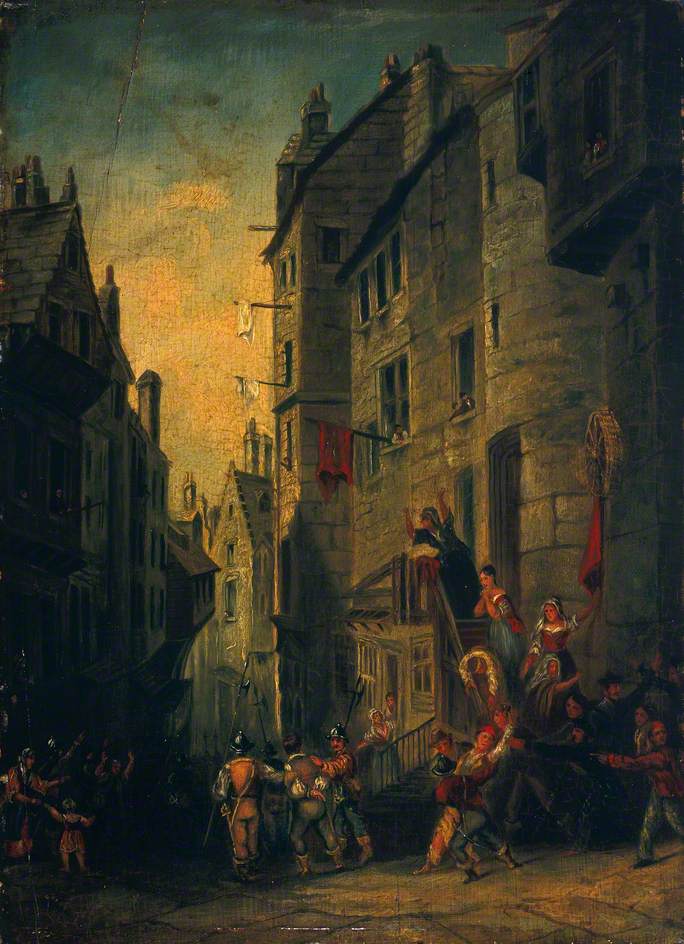
Condemned Covenanters on Their Way to Execution in the West Bow, Edinburgh. Artist unknown. (Source)

James Renwick has enjoyed tender biographical treatment from posterity; see here and here for some longer-form examples.

* While good news for the Presbyterians, this put many an Episcopal and Catholic in a tight spot of their own, setting up decades of bloody tragedy for Jacobite loyalists … but this is a subject for other posts.

** The captain who finally caught Renwick is supposed to have exclaimed at seeing his youth, “Is this the boy Renwick that the nation has been so much troubled with?” The outlaw minister turned 26 two days before his execution.

On this day..

1557: Martin Bucer and Paulus Phagius, already in their coffins

On this date in 1557,* the long-dead bones of the Protestant theologians Martin Bucer and Paulus Phagius (Fagius) were sent to the stake during the Tudor era’s brief Catholic recrudescence under Mary I.


18th century engraving (via the British Museum) shows a procession through the streets of Cambridge, with a separate scene depicting men burning both books and the two scholars in their coffins.

Both were Rhenish eminences of the reform movement, such early adopters that they embarked on their heresies from personally attending one of Luther’s earliest disputations, before his doctrines were officially excommunicate.

Bucer was a leading figure in the 1530s and 1540s struggle to keep unity among the competing strains of German Protestantism, and maintained an active correspondence with both Luther and Zwingli. The price of disunity was starkly underscored by the military rollback the Church achieved in the Schmalkaldic War of the late 1540s — and under growing pressure, both men accepted the invitations of Thomas Cranmer to cross the sea and reform the English liturgy.

Their labors there were but brief.** Each appointed to the Cambridge faculty, Phagius promptly died of the plague in 1549; Bucer outlived him, but he was in his late fifties and his health was failing. Before he too died in February of 1551, he produced a treatise to the young king Edward VI on government both ecclesiastical and secular, as well as recommended liturgical revisions that helped shape Cranmer’s 1552 version of the Book of Common Prayer.

If Bucer was fortunate to predecease Edward VI, his bones and Phagius’s would not be spared the Catholics’ wrath. In 1556, heresy proceedings (recounted at admiring length in Foxe’s Book of Martyrs) were opened against them by a deputation sent to cleanse Cambridge of its theological novelties. The Bishop of Chester conceived it a merciful example to be made:

If we had desired revengement, we might have showed cruelty upon them that are alive: of the which (alas! more the pity,) there are too many that embrace this doctrine. If we thirsted for blood, it was not so to be sought in withered carcases and dry bones. Therefore ye may well perceive, it was no part of our wills that we now came hither … but especially for the care and regard we have of your health and salvation, which we covet by all means to preserve. For you yourselves are the cause of this business; you gave occasion of this confession, among whom this day ought to be a notable example, to remain as a memorial to them that shall come after …

[I]f God, as he is slow to wrath and vengeance, will wink at it for a time, yet notwithstanding if we, upon whom the charge of the Lord’s flock leaneth, should permit so execrable crimes to escape unpunished, we should not live in quiet one hour.

Their condemnation was reversed a few years later, when Mary’s Protestant half-sister Elizabeth I succeeded the throne.

* 1557 by our present reckoning; England at the time recognized the new year in March, so it was 1556 to contemporaries.

** Though they hardly had time to make the impact on the English Reformation that they might have aspired to, Bucer had already influenced it in an important way: tracts of Bucer’s from years prior supporting more liberal divorce options, which had made Luther think the man a sybarite, had been fixed upon in the young Cranmer’s effort to construct a respectable theological framework for Henry VIII’s pursuit of Anne Boleyn.

On this day..

1550: Four Anabaptist martyrs at Lier

The Martyrs Mirror hagiography of Reformation martyrs offers us these four stalwart subjects of the Habsburgs’ Low Countries patrimony:

On the last of January, 1550, there were offered up for the faith, at Lier, in Brabant, four pious Christians, named Govert, Gillis, Mariken and Anneken, who, as sheep for the slaughter, had been apprehended without violence. When they were brought before the council, and questioned concerning their faith, they made a frank and unfeigned confession of it. The bailiff then said, “You stand here to defend yourselves?”

Govert replied, “As regards my faith, I have freely confessed it, and shall turn to no other; though it cost my life, I will adhere to it.”

Forthwith the imperial edict* was read to them, and the bailiff asked them whether they understood its contents.

Govert said, “God has commanded us through Christ, as is recorded in the sixteenth chapter of Mark, that all who believe and are baptized shall be saved, and that those who do not believe shall be damned; but the emperor, in his blind judgment, has commanded that whoever is baptized upon his faith, shall be put to death without mercy. These two commands militate against each other; one of the two we must forsake; but everyone ought to know that we must keep the command of God; for though Satan teaches that we are heretics, yet we do not act contrary to the Word of God.”

When they were led to the tribunal, Govert said to the priests, “Take off your long robes, put on sack cloth, put ashes on your heads, and repent, like those of Nineveh.”

In the court the bailiff asked him whether he desired no favor.

He replied, “I will not ask for your favor; for what I cannot do without, the most high God will give me.”

The bailiff said also to Anneken, “Do you not desire a favor, before sentence is passed upon you?

She answered, “I shall ask favor of God, my refuge.”

Mariken, an old woman of seventy-five years, was asked whether she would confess her sins to the priest.

She replied, “I am sorry that I ever confessed my sins to the mortal ears of the priests.”

Seeing some brethren, Govert turned his face and joyfully comforted them, saying among other things, “I pray God, that you may be thus imprisoned for His glory, as I now am.”

The bailiff very fiercely said, “Be still, for your preaching is of no account here.”, “My lord bailiff,” said he,”I speak only five or six words, which God has given me to speak, does this give you so much pain?” And when the people murmured on this account, he said, “This has been witnessed from the time of righteous Abel, that the righteous have suffered reproach; hence be not astonished.” The two servants that stood by him said, “You must not speak; the bailiff will not have it; hence be still.”

Immediately God closed his mouth, which grieved many. Gillis was not questioned, and he said nothing at all; but they were led back to prison, where they rejoiced together, and sang: Saligh is den man, en goet geheeten; and also the forty-first psalm. The bailiff then came into prison, and asked Govert, whether he had considered the matter; to which be replied, “Unless you repent, the punishment of God shall come upon you.” The bailiff looked out of the window, and said, “Will God damn all this multitude of people?”

Govert replied, “I have spoken the Word of God to you; but I hope there are still people here who fear God?”

The bailiff then turned to Anneken, and asked her what she had to say to it.

She replied, “Lord bailiff, twice I have been greatly honored in this city, namely, when I was married, and when my husband became emperor; but I never had a joy that did not perish, as I now have.”

On his way to death, Govert delivered an excellent admonition, reproving the wicked railing, and said, “Be it known to you, that we do not die for theft, murder or heresy, but because we seek an inheritance with God, and live according to His Word.”

The executioner commanded him silence, but he said, “Leave God be with me for a little while; repent, for your life is short.”

A brother then said, “God will strengthen you.” “Oh, yes,” said he, “the power of His Spirit is not weakening in me.”

The monk attempted to speak to Mariken, but Govert said, “Get you hence, deceiver, to your own people; for we have no need of you.”

Entering the ring, Govert said to the gild-brothers, “How you stand here with sticks and staves? Thus stood the Jews when they brought Christ to death; if we had been afraid of this, we would have fled in time.”

They then knelt down together, and prayed; whereupon they kissed each other. Anneken immediately commenced to sing, “In thee, O Lord; do I put my trust.” The servants told her to be still; but Govert said, “No, sister, sing on,” and helped her sing. Enraged at this, the bailiff called to him a servant, and whispered something in his ear. The latter went to the assistant of the executioner, who, upon receiving the order, immediately put a gag on Govert; but the latter held his teeth so firmly closed, that the gag did not hinder him much, and he laughingly said, “I could easily sing with the gag on; but Paul says: “Sing in your heart to God.”

The executioner, in order to put her to shame, made Anneken stand in her bare chemise. A servant asked Gillis whether he did not see some of his people. Gillis said, “Do you know of nothing else to torment us with?” “What does he say?” asked Govert. “He inquires for our fellow brethren,” replied Gillis. Govert said, “Though I could count twenty, I would not mention a single one. You think that by killing us you can suppress the Word of God; but of those that hear and see this, hundreds shall yet come forth.” Standing at the stake, he said, “Amend your ways and repent; for after this there will be no more time for repentance.” A servant who had a bottle of wine, asked them whether they wished to drink. Govert said, “We have no desire for your insipid wine; for our Father shall give us new wine in His eternal kingdom.” When it was thought that the old woman had been strangled at the stake, she began to sing a hymn in honor of her Bridegroom, which when Anneken heard it, she, from ardent love, sang with her. When they all stood at their stakes, each with a strap around the neck, they smiled at and nodded to one another, thus affectionately saluting and comforting each other, and commending their souls into the hands of God, they fell asleep in the Lord, and were burned.

* A 1535 edict against Anabaptists, issued in the aftermath of the Muenster rebellion.

On this day..

1678: James Mitchell, Covenanter assassin

On this date in 1678, Covenanter radical James Mitchell was hanged at Edinburgh for attempting to murder the Archbishop of St. Andrews.

Mitchell’s intended victim, James Sharp by name, is one of Scottish history’s great villains — tasked as he was to cheat Presbyterians of the religious reform they had spent a generation seeking. After Cromwell had King Charles I beheaded, his heir Charles II was nothing but an exile pretending to the throne his father had been deposed from.

Desperate for allies, he made a reluctant pact with Scottish allies to promulgate Presbyterianism throughout the realm should he regain the kingdom: this meant, in practice, bottom-up church governance as against the top-down authority of bishops characterizing Episcopacy. For a king, this would entail ceding considerable power over religious matters.

Such a promise was more readily given than honored. When Charles II regained the English throne in 1660, he instead restored Episcopacy in the north and everywhere else — selecting our man James Sharp, up until then a Presbyterian minister of the moderate faction, to boss Scotland’s most exalted ecclesiastical post. “The great stain will always remain, that Sharp deserted and probably betrayed a cause which his brethren intrusted to him,” Walter Scott wrote.

From this position, whose very existence was obnoxious to his former friends, our Judas* was Charles’s point man for reintroducing and enforcing all those ecclesiastical prerogatives of the monarchy that the Presbyterians had been so desperate to abolish.

He drove from the church irreconcilable Covenanter ministers — so named for their adherence to the objectives of those discarded covenants. That faction despised Sharp, and he returned the sentiment. On one occasion, he had to call for the militia to disperse an angry mob, only to be told that the militia’s members had joined the mob too. After a Covenanter rising was put down at the Battle of Rullion Green, Sharp okayed the withdrawal of quarter for surrendered foes with the taunt “You were pardoned as soldiers, but you are not acquitted as subjects” — putting his episcopal imprimatur on numerous ensuing hangings.

It was only a matter of time before someone tried to murder him.

On the 11th of July in 1668, James Mitchell — a zealous but unordained freelance preacher and dyed-in-the-wool Covenanter — stepped to a carriage the archbishop was embarking and took a shot at him. Mitchell missed, and pinged one of the prelate’s companions in the wrist, crippling the hand.

Mitchell managed to escape and live for several years with sizable sum on his head and nobody interested in claiming it** before Sharp’s own brother finally captured him in 1674. The proceedings against him are surprisingly protracted considering the famous vindictiveness of his target, and resolved by (as Mitchell said at his hanging) “an extrajudicial confession, and the promise of life given to me thereupon by the chancellor, upon his own and the public faith of the kingdom.” Given his party, he ought not have been surprised that the promise was not kept; as an added bonus, his retraction of the confession — which was the only evidence against him — resulted in his torture by the boot.

In 1679, a different bunch of Covenanters finally succeeded in assassinating the hated Archbishop Sharp.


The Murder of Archbishop Sharpe on Magus Muir near St. Andrews, 1679, by William Allen (c. 1840).

There’s a public domain biography friendly to Sharp (and perforce extremely hostile to the Covenanters) here.

* Cromwell met Sharp — still a Presbyterian minister at that time — in a negotiation during the Protectorate and allegedly rated him “ane Atheist, and of noe principles at all.”

** At one point Mitchell resided in Edinburgh with another man bound for the scaffold, Major Weir

On this day..

1528: Leonhard Schiemer, Anabaptist pacifist

Forasmuch then as Christ hath suffered for us in the flesh, arm yourselves likewise with the same mind: for he that hath suffered in the flesh hath ceased from sin.

–1 Peter 4:1, a verse very dear to this date’s principal*

Anabaptist Leonhard Schiemer was beheaded on this date in 1528 at Rattenberg.

Schiemer abandoned a Franciscan monastery, preferring to set his table with honest labor as a tailor, and to succor his soul with that that new heresy minting martyrs in northern Europe.

In 1527, Schiemer was both a vigorous missionary and an eloquent proponent of the pacificism for which the sect would eventually become known. In Schiemer’s time, before the catastrophe of Münster’s Anabaptist theocracy, this was quite naturally a hot dispute among the persecuted adherents trying to determine how to make their way in a world where they were considered heretical even by the other heretics: turn the other cheek, or come like Christ with a sword?

Schiemer’s answer was for the true Christian to give himself to the ordeal of Christ’s cross.

[The Holy Spirit] teaches no one, however, unless he despaired of all human comforting and wisdom first. He does not comfort or strengthen anyone unless he feels a horror and turns away from all comforting and power of man. This is why the Lord says, “Do not be called masters.” But this master, Christ, does not accept anyone as His pupil or disciple, unless he renounces and hates everything that he has, and follows Him and carries his cross daily. In doing this, one has to trust in the Lord’s comforting and keep still, as the Scriptures say in many passages, particularly in the Psalms, the Prophets, most of all in Isaiah and the Lamentations of Jeremiah.

The strength of all Christians consists in keeping still, by not forsaking the words of the Lord so quickly, by not losing courage so soon, but by being patient, waiting for the comfort of the Holy Spirit, in the midst of the greatest desolation and misery. This is true weakness of which the Scriptures speak, in particular Paul when he says, “For when I am weak I am strong.”

He also says, “For as we share abundantly in Christ’s suffering, so through Christ we share abundantly in comfort too.” That is what Christ means when He says, “A little while and you will see me no more, again a little while and you will see me.” And when the apostles asked Him what He meant by this, He answered, “Truly, truly, I say to you, you will weep and lament, but the world will rejoice; you will be sorrowful, but your sorrow will turn in to joy … Indeed the hour is coming when whoever kills you will think he is offering service to God.

–The Threefold Grace

It is often suspected that Schiemer’s execution on January 14 might have inspired the Rattenberg grandee Pilgram Marpeck to convert — for he was dismissed from a post as a mining magistrate on January 28, and thereafter became an influential, itinerant Anabaptist “wandering citizen of heaven” crisscrossing southern Germany.

* According to an essay on Schiemer in The Anabaptists and Contemporary Baptists: Restoring New Testament Christianity.

On this day..