Feast Day of St. Gordius

January 3 is the feast date of Saint Gordius, a centurion said to have abandoned his spatha and scutum in favor of a pious hermit’s desert solitaire.

While we have many examples of martyrs attributed to Diocletian‘s persecution, Gordius belongs to the subsequent, transitional era. His purported death in 320 would have been a mere five years before the Council of Nicaea convened by the empire’s Christian ruler Constantine.

But in Gordius’s time, Constantine only ruled half the Roman world — the western half. The eastern half, where Gordius munched his insects, was in the hands of the empire’s last pagan baddie,* Licinius.

Gordius is said to have tied a knot in some games being staged in the Anatolian city of Caesarea to honor “a war-loving deity” (presumably Mars). “The whole people were collected above the hippodrome, and not a Gentile or a Jew was absent. No small portion of the Christians was mingled with them, who guarded not their lives from sin, but sat in the assemblies of vanity.”

We are quoting here from one of our primary sources on the life of Gordius, or at least of how it was understood just a few generations distant: it is a homily on the martyr delivered by St. Basil in the late fourth century — a native son of Caesarea, and then its bishop, who says of Gordius that “we are the more attached to him, inasmuch as he is our peculiar ornament … having grown up in our native soil, and attained the very height of glory.”

Per Basil, his late countryman, “mighty in soul, sublime in resolution, descended from the mountains upon the theatre” to harangue the impious spectators — and to solicit his own martyrdom.

The eyes of the whole theatre were instantaneously fixed on the unwonted prodigy. They beheld a man of aspect wild, and savage, through his long abiding in the mountains: his hair was matted, his beard bushy, his garments squallid, his whole body parched and shrivelled: he bore in his hand a staff; a wallet was suspended by his side; and beaming around him from an unknown source, a certain grace ineffable threw a charm upon the whole.

As soon as he was recognized, a loud and commingled shout was raised by all; those who were allied to him in faith, crying out for joy; and those who were enemies to the truth, exciting the judge to murder him, and before his trial, condemning him to death …

Being immediately apprehended, he was dragged before the governour, who sat in the theatre, and directed the contention of the chariots. At first, he addressed the prisoner in a gentle, and benignant tone … [Gordius] said, I am present here, by deeds to attest at once, my disregard of thine imperial mandate, and my faith in that God upon whom my hopes repose. Having heard that thou art eminent in harshness and severity, I have chosen this, as the fittest season for accomplishing my desire.

When he thus spake, his words lighted up the fury of the ruler, and drew upon himself his accumulated rage. Call the Lichtors hither. Where are the leaden weights? Where are the scourges? Let him be stretched on the wheel; let his limbs be racked: let all modes of punishment be prepared: the wild beasts; the fire; the sword; the cross; the pit …

While the tyrant thus felt, and purposed, the saint, looking unto God, was weaving round his heart, the enchantment of a holy psalm. “The Lord,” he exclaimed, “is my helper. I will not be affrighted at what man shall do unto me. I will not e affrighted at evil things, for thou art with me.” Other passages akin to these, and inspiring courage, he repeated; such as ye may imagine him to have been deeply imbued with; him, who was so far from trembling at the threatened evils, that he even provoked and challenged them. Wherefore do ye linger? he exclaimed. Wherefore do ye stand inactive? Let my body be torn: let my limbs be racked: torture them as much as ye desire: do not envy me the blessed hope I cherish; for in proportion as ye extend my sufferings, ye acquire for me a brighter retribution.

…

He spake: he signed himself with the symbol of the cross, and went forward to receive the blow. No fear blanched the hue of his complexion, or dimned the glory of his countenance. He seemed, not as if he were delivering himself to the Lictors, but as if consigning himself to the hands of angels; those angels, who in the moment of his liberation, wafted him to the blessed life, as once they wafted Lazarus. — But oh! who can describe the terrific shout, which arose from the assembled multitude? What thunder, pealing from the clouds, ever transmitted such a sound to earth, as then thundred from earth to heaven? This is the very stadidum in which he was enwreathed. This very day beheld that wonrous spectacle; whose impression, no time can obliterate; no familiarity can weaken; no future achievements can surpass. For as we ever behold the sun, and ever admire his brightness; even so, will the memory of the Martyr be ever blooming and efflorescent. “The just man is for an everlasting memorial;” a memorial with the inhabitants of earth, as long as the earth endureth; a memorial with the Saints in Heaven; a memorial with the all-righteous Judge; unto whom be ascribed glory, and dominion, through eternity.

Amen.

* Bar Julian the Apostate‘s short-lived attempt to revive the ancient rites.

On this day..

1539: St. John Stone

Though it is not certain, it is thought that December 27, 1539 might have been the execution date of Catholic martyr St. John Stone in England.

An Augustinian whose friary was closed in 1538 during the Dissolution of the Monasteries, Stone at his expulsion “rudely and traitorously” refused to endorse Henry VIII’s authority over the church. He maintained his obstinacy even under the personal interrogation of Thomas Cromwell.

Somehow a year passed before Stone was brought to trial at Canterbury as a traitor. The execution of the inevitable sentence might then have been held up to coincide with the arrival to Canterbury of Anne of Cleves, the German Protestant princess who was (ever so briefly) Henry VIII’s fourth wife. Welcome to England, honey! It’s a great scene to imagine, but obviously the story — and hence this date — smacks of propaganda.

Whatever the true date of execution was, what we do have for certain is the butcher’s bill — itemizing the operation of tearing apart a religious dissident into rigorous accounting straight from your corporate expense report.

Paid for half a ton of timber to make a pair of gallows to hang Friar Stone, 2s. 6d.; to a labourer that digged the holes, 3d.; to four men that helped set up the gallows for drink to them, for carriage of the timber from Stablegate to Dongeon, 1s.; for a hurdle, 6d.; for a load of wood and for a horse to draw him to the Dongeon, 2s. 3d.; paid two men that set the kettle and parboiled him, 1s.; to two men that carried his quarters to the gates and set them up, 1s.; for halters to hang him and Sandwich cord and for straw, 1s.; to a woman that scoured the kettle, 2d.; to him that did the execution, 3s. 8d.

The Vatican rates John Stone as one of the Forty Martyrs of England and Wales, and canonized him in 1970.

On this day..

1736: Ana de Castro and two Jesuit effigies in a Lima auto de fe

The auto de fe — those great spectacles of Spanish ecclesiastical power, enacted on the bodies of heretics and apostasizers — were scarcely limited to the Iberian peninsula.

Autos were also enacted for benefit of the subjects in the hinterlands of Spain’s global empire — especially since lapsed Jewish conversos, who were one of the principal interests of the Spanish Inquisition, were known to seek safety in the periphery.

December 23, 1736 marked perhaps the best-remembered public auto held in Lima, the capital of the Viceroyalty of Peru. Its victims were the effigies of two deceased Jesuit priests plus one living woman: Dona Ana de Castro.

All three were the playthings of Inquisitor Cristóval Sánchez Calderón — whose prosecutor’s office, then as now, enjoyed a wide scope for mischief.

According to the public domain The Inquisition in the Spanish Dependencies, one distant predecessor in the post had “aroused indignation” with his “arbitrary and scandalous conduct”: planting spies in the palace, and brazenly taking concubines. According to a report submitted to Toledo, this bygone inquisitor

was in the habit of walking the streets at night dressed as a cavalier, brawling and fighting, and on one Holy Thursday he supped with a number of strumpets … He was involved in perpetual contests with the [viceregal] judges and royal officials, whom he treated without ceremony or justice, interfering with their functions, of which a number of cases were given which, if not exaggerated, show that the land was at the mercy of the inquisitorial officials, who murdered, robbed and took women at their pleasure, and any who complained were fined or kept chained in prison.

But Inquisitors liked to keep busy with the pleasures of destroying the flesh, too.

Francisco de Ulloa, a Jesuit mystic “of little education but of high spiritual gifts,” had gained a small following who revered him as a saint by the time he died in 1709. For the Inquisition he looked like a possible exponent of heretical quietism, whose founder had been forcibly shushed by the Inquisition in the late 17th century. A half-mad expelled Jesuit named Juan Francisco Velazco was caught up in the same charge, and although he died in prison in 1719 the legal machinery proceeded against both he and Ulloa just the same — albeit without any great hurry.

Meanwhile, in 1726, a beautiful (multiple sources of the time dwell on this characteristic) noblewoman named Ana de Castro was turned in by a lover as a possible Judaizer. Her case along with those of the late Jesuit heretics languished for a decade for unclear reasons,* but when Calderon (who only became Inquisitor in 1730) turned his attention to her, she was tortured on three different occasions — treatment that her sex ought to have exempted her from.

Apparently (pdf) one basis of the case against her was her continued recourse to Jewish rituals learned in her childhood, whose observance she thought was immaterial to Christianity — things like Jewish mourning practices. But if the subsequent reports of the skeptical chief Peruvian inquisitor Mateo de Amusquibar are to be believed, Calderon was determined to send her to the stake in order to gratify his auto with a live human sacrifice. (Absent Castro, the auto’s apex sentences would have been mere floggings of various misbelievers and polygamists.)

In doing so, Calderon ignored an explicit directive straight from the mother country not to execute her; he may even have ignored Castro’s own attempt to claim the sanctuary of penitence — something her situation should have allowed her.

Amusquibar reported that the day before the auto she sought two audiences; no record was made of what occurred, but there could be no doubt that she confessed more than enough to entitle her to reconciliation; even if she did not entirely satisfy the evidence, what more could be expected of a poor woman in such agitation of mind…?

Amusquiar … states that there was no record that she was notified of the sentence; that the book of votes id not contain such a sentence and that, even if there was one, it was invalid in consequence of the absence of the Ordinary; moreover that, in spite of her confessions, no new consulta de fe was summoned to consider them. Altogether, if Amusquibar is to be believed, it was a cold-blooded judicial murder contrived, like the burning of Ulloa in effigy, for the purpose of rendering more impressive the spectacle of the auto de fe.

* Perhaps everyone was distracted through the 1720s by the Jose de Antequera case.

On this day..

Feast Day of St. Lucy

Today is the feast of Saint Lucy, a Diocletian martyr and one of Christendom’s best beloved saints.

As her Wikipedia page observes, “all the details of her life are the conventional ones associated with female martyrs of the early 4th century.” Like St. Barbara she had secretly become a Christian; like St. Cecilia, she was betrothed to a mean old pagan; like St. Catherine her sacred body defied the tortures ordered by the Governor of Syracuse, until the Romans just gave up and beheaded her. (Her husband is supposed to have denounced her when he found out that the pious Lucy, with the help of an apparition of the martyred St. Agatha, had convinced her mother to give away the daughter’s ample dowry; this embrace of lonely penury probably explains how she came to be the patron saint of writers.)


Lucy Before the Judge by Lorenzo Lotto, 1523-32.

Iconography often depicts St. Lucy brandishing her own eyeballs, like a Guillermo del Toro monster: this, too, is an allusion to the torments of the Romans, and the story is either the cause or the consequence of her patronage of the blind.

Lucy’s name derives from the Latin root for “light”, and her December 13 feast formerly coincided with the winter solstice; as a result, St. Lucy’s Day became a major holiday some locales — including Italy, Scandinavia, the Philippines, and Omaha, Nebraska. The English poet John Donne meditates upon the occasion in a 1627 noctural, by which time December 13 was not technically the solstice by either Julian or Gregorian calendars.

Since she enjoys her long night’s festival,
Let me prepare towards her, and let me call
This hour her vigil, and her eve, since this
Both the year’s, and the day’s deep midnight is.


Detail view (click for the full image) of Burial of St. Lucy — which was painted for the church in Syracuse that stands on the spot of her purported martyrdom by the fugitive genius Caravaggio.

On this day..

764: St. Stephen the Younger, iconodule martyr

This is the supposed martyrdom date, in the year 764 or perhaps 765, of St. Stephen the Younger in Constantinople at the hands of an iconoclastic emperor.

Ancient and “dark ages” history characteristically comes with all kinds of problems arising from the paucity and prejudice of primary sources. Byzantium’s century of Iconoclastic controversy is a fine example.

In this period from approximately 726 to 842, the empire was rent by a conflict between iconophiles or iconodules — proponents of the use and adoration of religious imagery in Christian worship — and iconoclasts — who abhorred same as a form of sacrilegious idolatry.

This was deadly serious stuff in the way that only Byzantine sectarian conflict could be, but the controversy was not strictly about defining the Biblical injunction on graven images. As the excellent History of Byzantium podcast explains in its iconoclasm episode,* it likely manifests “an empire-wide reaction to the trauma of defeat” — battlefield defeat by the rising armies of Islam, and with it a shaken confidence in the favor of God. (Islam’s hard line against idolatry surely can’t be coincidental.)

But in posterity we are reduced to these muddy qualifiers because as the winning party in the dispute, iconodules wrote the history. That’s no moralistic stab: iconoclasts, too, burned the enemy’s tracts when they had the opportunity; had they prevailed in the end, they would have blurred out the background, motivations, and achievements of their rivals as readily as the iconodules did and leave those who followed to read between the lines of a partisan history. Indeed, Bissera Pentcheva’s recent Icons and Power: The Mother of God in Byzantium even contends that the legendary centrality of icons to Byzantine religiosity was an invention of the post-iconoclastic era, with events like the Marian icon’s saving Constantinople during the Avar siege of 626 backfilled to replace the original story about Marian relics working the divine intervention.


Iconoclasts plastering over an icon.

The iconoclastic era opens in the late 720s; according to the (iconodule, naturally) saint and historian Nicephorous, its immediate trigger was the devastating 726 eruption of the Greek island Thera (Santorini) — and affrighted by the apparent divine wrath, “the impious emperor Leo [III] started making pronouncements about the removal of the holy and venerable icons.” He’s alleged to have taken down a particularly revered icon of Christ on Constantinople’s Chalke Gate.

Nevertheless, it is difficult to get a firm fix on what specific anti-icon policies Leo promulgated, if indeed there were any at all. (The Greek term for “pronouncements” could be understood simply as “comments” instead of “edicts”.) It is Leo’s son Constantine V, succeeding the purple in 741, who clearly brings an overt imperial turn against icons, for “He cannot be depicted. For what is depicted in one person, and he who circumscribes that person has plainly circumscribed the divine nature which is incapable of being circumscribed.” Constantine convened an ecumenical council that ruled for his anti-icon position and set about removing images from churches.

Against this campaign was ranged the bulk of the clergy — church vs. state is another possible and difficult-to-measure dimension of the whole dispute, although Constantine’s ability to win the acquiescence of hundreds of bishops must complicate this interpretation.

The great champion of and martyr for the iconodule position in this time was St. Stephen the Younger. That’s “younger” vis-a-vis the original St. Stephen, Christianity’s protomartyr.

As befits that exalted company, this monk and hermit was credited by his adherents with a supernatural power in the iconoclasm debate.

A man blind from his birth visits the saint with suppliant outcry for relief. “If you hast faith in God,” he replies, “if thou art a worshipper of His image, thou shalt behold the light and the beauty of hidden things.” Scarcely had the words gone forth, when the blind man rejoiced in beholding light. A woman brings to him her son “grievously vexed with a devil,” and a distressing scene is described. Stephen bids a disciple to apply the sign of the Cross to the whole afflicted body. The saint calls upon God with many tears. Finally he delivers the boy safe to his mother, when the image of Christ has been adored. An infirm soldier comes with entreaty for relief. The saint bids him adore the images of Christ and His Mother, and immediately he is restored. The soldier afterwards repudiates image-worship before the Emperor, who at once promotes him to the rank of centurion. Leaving the imperial presence he would mount his horse; the horse rears, throws him to the ground, and tramples him to death. Such is the life of the younger Stephen as related with awe-struck delight in Greek and Roman martyrologies. (Source)

And so forth.

The emperor is alleged by the hagiographies to have sought Stephen’s destruction for many years, being continually frustrated even to the point where Stephen’s torturers in prison seemed unable to finish him off. “Will no one rid me of this monk?” Constantine cries, anticipating Thomas a Becket by a good four centuries. His soldiers finally clubbed to death the obdurate cleric on November 28, 764. (For a critique of Stephen’s hagiography, including a death date that proves questionable (no surprise), see this pdf.)

But not for the first time, an imperial innovation in theology failed to outlast the patronage of its sovereign. After Constantine’s death, Empress Irene** restored the iconodules to favor† — and set the stage (after some hiccups) for a great flowering of Orthodox icons in the centuries to come.

* Also see Episode 75, delving into Constantine’s iconoclasm.

** The fact that the extant remnant of the Roman Empire had no emperor — merely a woman ruler — formed part of the rationale for the western church crowning Charlemagne “Holy Roman Emperor”. This slap in the face to Constantinople could occur because a papacy long deferential to Byzantium had at last broken with the East in the mid-8th century … in part, over iconoclasm.

† Emperor Leo V restored official iconoclasm in 813 for another 29-year run as imperial policy before the movement’s final defeat.

On this day..

1546: The Fourteen of Meaux

If the execution of the “Fourteen of Meaux” falls far short of the massacre of the Vaudois as regards the number of its victims, its strictly judicial character makes it more instructive as an example of the treatment of heretics.

In the year 1546 the Reformers of Meaux organised themselves into a Church after the pattern of that set up by the French refugees at Strassburg eight years before. They chose as their first pastor, a wool-carder, named Pierre Leclerc, a brother of the man who was burnt at Metz.

Their number increased under his ministry, and the matter soon came to the ear of the authorities. On September 8 a sudden descent was made on the congregation, and sixty persons were arrested and sent to Paris to be tried by the Parliament. Their greatest crime was that they had celebrated the Holy Communion.

On October 4 sentence was pronounced. Fourteen were sentenced to be tortured and burned, five to be flogged and banished; ten, all women, were set free, while the remainder were to undergo graduated forms of penance. The sentences were carried out at Meaux on October 7.*

Etienne Mangin, in whose house the services had always been held, and Leclerc, were carried to the stake on hurdles, the rest on tumbrils. They had all previously undergone what was known as “extraordinary” torture, and all had refused to reveal the names of other Reformers at Meaux. At the stake six yielded so far as to confess to a priest, thereby escaping the penalty of having their tongues cut out; the others who remained firm suffered this additional barbarity, which it was the custom to inflict on those who died impenitent. The congregation at Meaux was thus broken up, but the survivors carried the evangelical seeds to other towns in France.

The “Fourteen of Meaux” were not the only victims of the year 1546. Five others had already been burned at Paris, including the scholar and printer Etienne Dolet. Others were burned in the provinces. The next year, 1547, opened with fresh executions; and on January 14 the mutilation of a statue of the Virgin was expiated by a solemn procession at Paris.

Such was the policy which Francis I began definitely to adopt towards Protestantism after the affair of the placards, and which he put into active execution during the last seven years of his life. How far was it successful? As we have seen, it drove a large number of persons into exile; and these consisted chiefly of the better-born and better-educated among the Reformers.

It intimidated many into outward conformity with the Church. It prevented all public exercise of the Reformed religion, and all open propaganda. Religious meetings were held by night or in cellars; doctrines were spread by secret house-to-house teaching, or by treatises concealed amongst the wares of pretended pedlars.

On the other hand the frequent executions helped to spread the evil they were meant to repress. The firm courage with which the victims faced death did as much as the purity of their lives to convert others to their faith. Moreover, the influence of the exiles reacted on their old homes. From Geneva to the other Swiss centres of Protestantism missionaries came to evangelise France.

–The Cambridge Modern History, vol. 2

* There are some sources that aver Oct. 6, and it appears that the primary documents are not explicit on the exact date of execution. This Proceedings of the Huguenot Society collects a great deal of information about the Fourteen of Meaux and settles on Thursday, Oct. 7 (see fn 54, page 101 and fn 64, page 103) — in part because the Parlement also demanded that the heretical house be razed, with Catholic services to be held there every Thursday.

On this day..

1573: Maeykens Wens, Antwerp Anabaptist

On this date in 1573, Antwerp burned a clutch of Anabaptists, including the martr Maeykens Wens.

Thereupon on the next day, which was the 6th of October, this pious and God-fearing heroine of Jesus Christ, as also her other fellow believers, who in like manner had been condemned, were with their tongues screwed fast, like innocent sheep brought forward, and after each was tied to a stake in the market place, were robbed of life and body by a dreadful and horrible fire, and in a short time were burned to ashes. The oldest son of this aforementioned martyr, called Adrian Wens, about fifteen yars old, upon the day on which his dear mother was sacrificed, could not stay away from the place of execution, so he took his youngest brother, called Hans Matthias Wens, about three years old, on his arm, and stood on a bench not far from the burning-stake to witness his mother’s death. But when she was brought to the stake he fainted, fell down, and lay unconscious until his mother and the others were burned. Afterward, when the people had gone away and he came to himself, he went to the place where his mother was burnt, and hunted in the ashes until he found the screw with which her tongue had been screwed fast, and he kept it for a memento. There are now, 1659, still many descendants of this pious martyr living well known to us, who, after her name, are called Maeyken Wens.

On this day..

1567: The Michelade of Nimes

On this date in 1567, Huguenots in revolt in Nimes put to death dozens of Catholics in a courtyard butchery to climax a massacre remembered as La Michelade (English Wikipedia entry | the much more detailed French)

This name of sinister memory derives from one of the church calendar’s great autumnal feast, Michaelmas — and the sword-arm of its titular archangel would have been required to keep the peace between the rival religionists in the Languedoc.

Nimes went heavily for the Protestants, with the region’s royal governors unable to restrain the conquest of Catholic neighborhoods and churches by the predominant Huguenots through the 1560s: “the very wind which blew upon Nimes breathed heresy,” in the words of Dumas.

The years running up to our events of 1567 feature one of the numerous rancorous truces pocking France’s intractable Wars of Religion: this one is known as the “Armed Peace”, which gives you an idea where everyone’s heads were at. And in Nimes, the heresy in the wind was not such as to prevent the restoration of Catholic authorities to control of the civic institutions — to the undoubted irritation of the Huguenot grandees who endured the indignity of displacement alongside the sure knowledge of the popular weight that supported them.

This ripening conflict appropriately came to fruition via a vegetable market at a city fair on Michaelmas — September 29, 1567 — where an altercation turned into a sectarian riot and soon transformed into a municipal Protestant insurrection.

Huguenots still maintaining the preponderance of force in Nimes, they perpetrated the expected outrages during the excitement: sacking the cathedral, murdering some particularly hated Catholics. But the overall organization of the Huguenots and the organized participation of the city’s Huguenot elites suggests a good deal of advance orchestration, and perhaps coordination with the Huguenot attempt to kidnap the king just days before.

In the disturbance, Nimes’s first consul Guy Rochette — Catholic, naturally — sought refuge in the palace of Bishop Bernard d’Elbene; a Huguenot captain forced the door and arrested them, confiscating from Rochette the keys to the city. Though the bishop managed to escape, other prominent Catholics were systematically detained, too. According to Allan Tulchin’s That Men Would Praise the Lord: The Triumph of Protestantism in Nimes, 1530-1570, “[i]t seems clear that the Protestant leadership intended to conduct a general roundup of Catholic lay and clerical leadership. Protestant forces targeted at least half of the sixteen men who had served as consul between 1564 and 1567 … of the nine Catholic members of the presidial, only two did not appear among the victims.”

Captive Catholics were detained in several buildings around the city, notably in the city hall. It is not known to what extent the kill lists to cull from these unfortunates were preordained and to what extent they were improvised in the moment, but on the night of September 30, summons for specific victims went out, and Protestant squads complied by dragging them out of the city hall basement or wherever else they were held to the courtyard of the bishop’s palace. This would be the makeshift abattoir.

In the narration of Dumas,

when night came the large number of prisoners so imprudently taken began to be felt as an encumbrance by the insurgent chiefs, who therefore resolved to take advantage of the darkness to get rid of them without causing too much excitement in the city. They were therefore gathered together from the various houses in which they had been confined, and were brought to a large hall in the Hotel de Ville, capable of containing from four to five hundred persons, and which was soon full. An irregular tribunal arrogating to itself powers of life and death was formed, and a clerk was appointed to register its decrees. A list of all the prisoners was given him, a cross placed before a name indicating that its bearer was condemned to death, and, list in hand, he went from group to group calling out the names distinguished by the fatal sign. Those thus sorted out were then conducted to a spot which had been chosen beforehand as the place of execution.

This was the palace courtyard in the middle of which yawned a well twenty-four feet in circumference and fifty deep. The fanatics thus found a grave ready-digged as it were to their hand, and to save time, made use of it.

The unfortunate Catholics, led thither in groups, were either stabbed with daggers or mutilated with axes, and the bodies thrown down the well. Guy-Rochette was one of the first to be dragged up. For himself he asked neither mercy nor favour, but he begged that the life of his young brother might be spared, whose only crime was the bond of blood which united them; but the assassins, paying no heed to his prayers, struck down both man and boy and flung them into the well. The corpse of the vicar-general, who had been killed the day before, was in its turn dragged thither by a rope and added to the others. All night the massacre went on, the crimsoned water rising in the well as corpse after corpse was thrown in, till, at break of day, it overflowed, one hundred and twenty bodies being then hidden in its depths.

Dumas is indulging poetic exaggeration of the scene, and later estimations of the number of victims range well below 120 — but Tulchin quotes a leather worker who saw the courtyard on the following day and described it as “all covered with blood and the water of the well all red.” Even “merely” twenty or thirty victims slashed to death would have been a gory work.

In the days following, Huguenots would cement their control of Nimes with the systematic pillage of churches and (after a six-week siege) the capture of the city’s royal garrison. There was no general massacre after the Michelade; in the main, Catholics were forced into submission or exile instead of the grave.

But the effusion, combined with Huguenot attacks further north, helped to trigger the (very brief) “Second War” within the Wars of Religion which gave way after a short truce to the much bloodier “Third War” of 1568-1570 … whose peace would be broken by a Catholic sectarian massacre much better remembered to history than the Michelade.

On this day..

Feast Day of Saints Cosmas and Damian


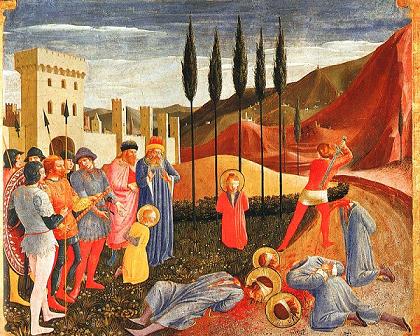
The Martyrdom of Saints Cosmas and Damian, by Fra Angelico.

September 27 is the traditional* feast date of early Christian saints Cosmas and Damian.

Martyred in Syria during the Diocletian persecution, these Arabian brothers were reputedly physicians who did not charge their patients, even for premium services like transplanting an entire leg.


Cosmas and Damian graft an Ethiopian’s leg onto a white patient.

This has made them patron saints to doctors, surgeons, pharmacists, and dentists but decidedly not to insurers.

They were once much more widely known and revered than today, back when the mysteries of medicine and of faith intertwined with one another. The two are named in the Canon of the Mass, and multiple churches in Europe dubiously claim the honor the ancient doctors’ relics; their skulls alone reside simultaneously in Bremen, Vienna, and Madrid, while a church in Venice allegedly holds their non-cranial remains. Visitors to the Roman Forum will behold the beautifully preserved pagan Temple of Romulus, which was rededicated in 527 as the basilica of Santi Cosma de Damiano and still hosts weddings beneath its impressive Cosmas and Damian mosaic.

The saints’ day is observed in Brazil, where children on September 27 receive candies (Cosmas and Damian also count confectioners and children among their devotees). St. Anthony’s Church in Utica, New York, also hosts an annual Cosmas and Damian pilgrimage attracting thousands of people from across North America.

As two men intimate with one another who traveled and ministered together, they are sometimes speculatively ventured as early gay exemplars. (They’re traditionally accounted as brothers.)

* The Vatican’s 1969 calendar revision moved the feast to September 26, leaving September 27 to St. Vincent de Paul.

On this day..

258: St. Cyprian, Bishop of Carthage

The Christian bishop of Carthage, Cyprian, was condemned by Roman authorities on this date and immediately beheaded.

Not one of your dubious ancient martyrs fogged with legend, Cyprian was a major public figure in his own time; dozens of epistles and treatises of his survive. An epidemic that ravaged the Roman Empire in the 250s and 260s is known from his description of it; hence it is remembered as the Plague of Cyprian.

The real-life Cyprian had different plagues to fight.

The essential challenge of Cyprian’s day — and the one that would see him to martyrdom — was the onset of anti-Christian persecution after the relative tolerance of the 240s. Cranky senator turned general Decius claimed the purple in 249 on a programme of traditional values that included a demand that all* obtain a magistrate’s certificate confirming that they had performed public sacrifice to the pagan gods. We don’t want anyone tempting divine vengeance here.

The Christian community had grown, little molested of late, to encompass many peaceable adherents who were not necessarily prepared to sell their lives over a stick of incense. Now, it fragmented under the Decian persecution — which was applied by different governors with varying levels of severity. Some Christians made the requisite sacrifices; others paid bribes to get the paperwork. Some fled to hiding: Cyprian himself did so, and some Christian ultras criticized him for failing to embrace martyrdom.

Decius died in 251, leaving the Christian minority with a controversy over how to handle the so-called lapsi who had made some concession to the idols of Rome: perspectives arrayed from the most lax (welcome everyone back with minimal hassle) to the most punitive (expel them all: this was the Novatian heresy). Cyprian had a middle-ground position in this dispute; his De Lapsis preserves his intervention, accepting readmission but under conditions of suitable penance administered by the clergy.

In such a case there remains only penitence which can make atonement. But they who take away repentance for a crime, close the way of atonement. Thus it happens that, while by the rashness of some a false safety is either promised or trusted, the hope of true safety is taken away.

But you, beloved brethren, whose fear is ready towards God, and whose mind, although it is placed in the midst of lapse, is mindful of its misery, do you in repentance and grief look into your sins; acknowledge the very grave sin of your conscience; open the eyes of your heart to the understanding of your sin, neither despairing of the Lord’s mercy nor yet at once claiming His pardon. God, in proportion as with the affection of a Father He is always indulgent and good, in the same proportion is to be dreaded with the majesty of a judge. Even as we have sinned greatly, so let us greatly lament. To a deep wound let there not be wanting a long and careful treatment; let not the repentance be less than the sin. Think you that the Lord can be quickly appeased, whom with faithless words you have denied, to whom you have rather preferred your worldly estate, whose temple you have violated with a sacrilegious contact? Think you that He will easily have mercy upon you whom you have declared not to be your God? You must pray more eagerly and entreat; you must spend the day in grief; wear out nights in watchings and weepings; occupy all your time in wailful lamentations; lying stretched on the ground, you must cling close to the ashes, be surrounded with sackcloth and filth; after losing the raiment of Christ, you must be willing now to have no clothing; after the devil’s meat, you must prefer fasting; be earnest in righteous works, whereby sins may be purged; frequently apply yourself to almsgiving, whereby souls are freed from death.

This is more or less the position the Church as a whole arrived at — a fairly liberal readmissions policy in the scheme of things. Unfortunately for Cyprian and his flock, the question would soon grow pressing once again: the emperor Valerian resumed the persecution in 257.

Cyprian was first sent into exile, then brought to Carthage for examination at a villa thronged with his supporters, who are said to have roared in support when Cyprian refused to sacrifice and demanded, “Let us be beheaded with him!”

The bishop attained his hieromartyr‘s laurels directly after the verdict, with Carthage’s Christians clamboring alongside him to the execution grounds. Afterwards, the faithful collected his remains and interred them lovingly, erecting a church over the bones that the Vandals would eventually ravage.

Even in his death under persecution, Cyprian’s biography reflects the growing weight of Christianity in Rome — not least in the fact that it was consequential enough to attract imperial backlash under the right circumstances. The reluctance of provincial magistrates to make hecatombs of their neighbors whatever the edicts demanded has been widely noted — like the proconsul Antoninus, who sent away confessing Christians who wished to solicit their own martyrdoms with the exasperated words, “if you are thus weary of your lives, is it so difficult for you to find ropes and precipices?”

“The life of Cyprian is sufficient to prove that our fancy has exaggerated the perilous situation of a Christian bishop,” Edward Gibbon wrote — a paradoxical observation to make of a martyr, but we notice that Cyprian’s noisy Christian supporters don’t seem to have been harried even in the midst of the prelate’s execution. Thereafter, “the funeral of Cyprian was publicly celebrated without receiving any interruption from the Roman magistrates; and those among the faithful, who had performed the last offices to his person and his memory, were secure from the danger of inquiry or of punishment. It is remarkable, that of so great a multitude of bishops in the province of Africa, Cyprian was the first who was esteemed worthy to obtain the crown of martyrdom.”

* Jews were exempted; Romans had respect for the antiquity of that monotheistic religion which was not extended to the novel concoctions of Christianity.

On this day..