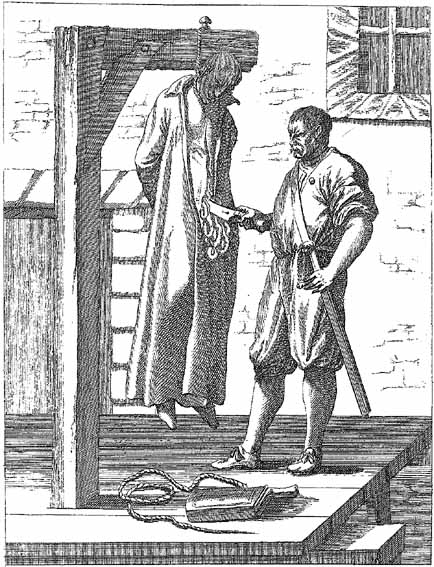
On this date in 1611, the pathetic figure of a former priest — his body shaved to expose Devil’s marks, a noose about his neck — was conveyed to the secular powers to be tortured one last time, then hauled through the streets of Aix-en-Provence and burned to ashes.
Witchsmellers were thick on the ground in pre-Thirty Years’ War France, aselsewhere.
In our scene in the south of France, we find a characteristic entry in this horrible catalogue.
Parish priest and lothario Louis Gaufridi, having seduced a local teenager, found himself in hot water when she contracted the trendy disorder of demonic possession and started raving about the times she went with the cleric to see Black Sabbath.
Not this Black Sabbath.
Other inmates at the convent to which Gaufridi’s paramour had been conveyed were soon in on the act, indicting him for cannibalism, exotic sexual perversions, and — of course — devil-worship.
Gaufridi’s denials were overcome in the usual way, with the support of doctors who filed a report scientifically vouching that the infernal powers had laid their mark upon the subject. The priest soon saw the wisdom in copping to the charges, and not only his torture-adduced confessions (which he vainly attempted to repudiate in court) but the veritable original contract specifying the terms of his demoniacal servitude was produced for magisterial consideration.
I, Louis, a priest, renounce each and every one of the spiritual and corporal gifts which may accrue to me from God, from the Virgin, and from all the saints, and especially from my patron John the Baptist, and the apostles Peter and Paul and St. Francis. And to you, Lucifer, now before me, I give myself and all the good I may accomplish, except the returns from the sacrament in the cases where I may administer it; all of which I sign and attest.
I, Lucifer, bind myself to give you, Louis Gaufridi, priest, the faculty and power of bewitching by blowing with the mouth, all and any of the women and girls you may desire; in proof of which I sign myself Lucifer.
That’s right. He did it all for the nookie.
(That, and to “be esteemed and honored above all the priests of this country.” Thomas Wright, in his omnivorous and freely available chronicle of European witch trials, remarks that these two attributed motives suggest “the reason why Gaufridi was persecuted by the rest of the clergy.” And oh, but the ladykiller — or rather, the reverse — still starred in the fantasies of the possessed years after his death. (French link))
Gaufridi’s execution immediately freed his erstwhile lover from her satanic affliction. Madeleine de la Palud, however, having officially established herself as susceptible to the penetrations of the Evil One, would remain suspect in the eyes of the inquisition for the 60 years remaining of her life. She twice faced witchcraft charges herself.
On this date in 1877, Mormon leader John D. Lee was shot at the site of (and for the crime of instigating) the Mountain Meadows Massacre 20 years before.
As the only person ever prosecuted for this dreadful affair, which saw 120 California-bound settlers slaughtered by a Mormon militia, Lee “was allowed … to carry to his grave Mormondom’s guilt for this horrible and barbaric act.” (Jan Shipps)
On this anniversary of Lee’s death, Executed Today interviews author Judith Freeman, whose historical novel Red Water tells Lee’s story through the eyes of three of his 19 wives.
You grew up Mormon — what brought you to this story? I gather that it wasn’t exactly daily discourse in your youth.
Growing up in northern Utah, I’d only heard vague, shadowy references to the massacre. It was the dirty little secret buried in the Mormon past — except for those people in Southern Utah who lived with that story as part of every generation’s experience and shame. I felt I had to write a novel about it, in part to try and understand this question: How do you get basically good people, like those Mormon settlers, to commit such evil?
You paint a picture of John Lee through the eyes of three of his wives. What kind of man was he — and how representative of the Mormon hierarchy would that be?
I think Lee was first and foremost a brilliant pioneer and survivalist and also a big blowhard, the kind of guy who would talk your head off — affable and a bit boring when it came to promoting his own virtues and experiences. He was self-aggrandizing, he’d do anything to make a buck, he had problems with the truth. He was a suck-up to Brigham Young who became his substitute father and then betrayed him.
He wasn’t entirely trustworthy because he put his own interests before all else. He could also be incredibly generous and kind, helpful to others. He wanted people to like him though they often didn’t, and he had an ingratiating quality. He was an orphan, with an orphan’s life-long neediness. In many ways I think he was good to his wives and cared deeply about his family — all sixty something kids and 19 wives. He was an amazingly talented man, skilled at many trades and businesses.
Was he representative of the Mormon Hierarchy? I don’t know. In some ways yes but I sense he was more sycophantic than some, and had a more amusing character than others, but what they all had in common was an absolute deference to church authority. I think I might have enjoyed meeting John D. Lee, he might have been more lively and fun than Brigham Young who strikes me as a misogynist and a brittle, cold man.
What about the women — three very different characters. What’s the sense you got of life for these women as pioneers, living in a polygamous family? How did they relate to one another, and how did the massacre and the execution of John Lee change their situation?
The women were also amazingly inventive as pioneers, strong, tough, formidable women though how can you generalize about 19 different personalities? Some liked each other and some couldn’t stand each other and the good thing was that Lee was a small industry and many of his wives had their own farms so they weren’t required to live on top of each other. He understood the “kitchen thing” when it comes to women, and said he wanted every one of his wives to have her own stove. The Lee family/families were devastated by his execution. His families were left penniless and destroyed, treated very cruelly, the women dispersed and shunned, the children shamed, and this shame was carried for generations.
To what extent is polygamy in the back story of the Mountain Meadows Massacre? What, for that matter, was the massacre really “about” in your judgment?
Polygamy had a small role to play in the massacre. The practice of polygamy, outlawed by the United States, was a part of what disturbed Washington and caused the federal government to send troops to Utah, which scared the Mormon populace into committing violent acts. One must remember that they had been the victims of violence and massacre, and fear turned in their minds.
What the massacre was really about, in my judgment, was the struggle for power in Utah. Would Brigham Young and the Mormon hierarchy control the territory and be masters of their own destiny, or would the federal government impose control of the “fiefdom”? The massacre came out of the idea the Indians could be made to carry out an attack and then the government would be forced to realize that if the Mormons were not allowed to control the territory and “their” natives, terrible things could happen. But the whole thing got out of control and took on a terrible life of its own.
A large party of Mormons, painted and tricked out as Indians, overtook the train of emigrant wagons some three hundred miles south of Salt Lake City, and made an attack. But the emigrants threw up earthworks, made fortresses of their wagons and defended themselves gallantly and successfully for five days! Your Missouri or Arkansas gentleman is not much afraid of the sort of scurvy apologies for “Indians” which the southern part of Utah affords. He would stand up and fight five hundred of them.
At the end of the five days the Mormons tried military strategy. They retired to the upper end of the “Meadows,” resumed civilized apparel, washed off their paint, and then, heavily armed, drove down in wagons to the beleaguered emigrants, bearing a flag of truce! When the emigrants saw white men coming they threw down their guns and welcomed them with cheer after cheer! And, all unconscious of the poetry of it, no doubt, they lifted a little child aloft, dressed in white, in answer to the flag of truce!
The leaders of the timely white “deliverers” were President Haight and Bishop John D. Lee, of the Mormon Church. Mr. Cradlebaugh, who served a term as a Federal Judge in Utah and afterward was sent to Congress from Nevada, tells in a speech delivered in Congress how these leaders next proceeded:
They professed to be on good terms with the Indians, and represented them as being very mad. They also proposed to intercede and settle the matter with the Indians. After several hours parley they, having (apparently) visited the Indians, gave the ultimatum of the savages; which was, that the emigrants should march out of their camp, leaving everything behind them, even their guns. It was promised by the Mormon bishops that they would bring a force and guard the emigrants back to the settlements. The terms were agreed to, the emigrants being desirous of saving the lives of their families. The Mormons retired, and subsequently appeared with thirty or forty armed men. The emigrants were marched out, the women and children in front and the men behind, the Mormon guard being in the rear. When they had marched in this way about a mile, at a given signal the slaughter commenced. The men were almost all shot down at the first fire from the guard. Two only escaped, who fled to the desert, and were followed one hundred and fifty miles before they were overtaken and slaughtered. The women and children ran on, two or three hundred yards further, when they were overtaken and with the aid of the Indians they were slaughtered. Seventeen individuals only, of all the emigrant party, were spared, and they were little children, the eldest of them being only seven years old. Thus, on the 10th day of September, 1857, was consummated one of the most cruel, cowardly and bloody murders known in our history.
John Lee: murderer, scapegoat, or both? How did he come to be prosecuted at all, and how to be the only one prosecuted?
John D. Lee was both murderer and scapegoat. He was bold and careless enough to hang around the area after the massacre, and to prosper from his various businesses and appear almost indifferent to what had happened — perhaps he thought he had the protection of the church authorities who continued to insist the Indians had committed this atrocity. A lot of others who’d participated in the massacre left the area, driven out by fear and shame. But Lee hung on.
John D. Lee, seated beside his coffin just before his execution.
How he was thrown to the wolves by the church authorities is a long story, as is the story of his two trials. He was the easiest person to scapegoat. He took the bullet for his church, and I think the authorities felt that they could put the affair behind them once he was dead, and they did for a very long time, until brave little Juanita Brooks wrote her book in the 1950s and was the first to tell the truth: the Mormons did it.
Does the Mormon church have some unfinished reckoning here? If so — why, after all these years?
Who cares what I think? But in my opinion, of course they do. They need to stop saying it was a “local” affair, carried out by some “local” renegade fanatics in southern Utah. The whole situation that led to the massacre was put into motion by people high up in the church, but I doubt very much they’ll ever go there and admit that. Too many lawyers, too much money, too impossible to admit culpability of prophets, seers, revelators.
Finally, I just want to say that after writing Red Water and thinking about this massacre for the five years it took to research and write the book, this is what I came to believe about how you get good people to do bad things.
You need to get three things going: First, you have to make people afraid and use that fear to manipulate them (think of 9/11). Second, you need get people to obey some greater force or consciousness other than their own — the Mormons had a principle of Perfect Obedience where you were required to subject yourself to the authority of the priesthood and church elders, but this idea could as well be inculcated in the concept of patriotism, or military duty. The point is, you subdue your own conscience in favor of deferment to an outside force. Third, you make people think their system is better than the other guy’s, that you’re doing God’s will, that your sense of right is greater than theirs. If you can make people think they are doing God’s will, you can get them to do anything. Get these three things going, and you can get good people to commit great evil.
On this date 1,150 years ago, Eulogius of Cordoba was beheaded for blasphemy in Muslim Spain.
Islamic rule in Spain was a century and a half old at this time; a period of relative comity among the Abrahamic faiths, it was nevertheless far from painless for Christians.
Islamic law exerted some (usually) non-lethal pressure on subject Christians by tolerating them as second-class citizens, subject to restricted civic privileges and additional taxes. With apostasy from Islam to Christianity punishable by death, it engineered a steadily increasing Muslim proportion of the populace.
Around 850, and continuing for the ensuing century, some Christians’ resistance to this arrangement would provoke periodoc repressions and a regular supply of martyrs.
Eulogius, a priest renowned for his eloquence and education, became a prominent exponent of the emerging trend of missionary martyrdom — Christians intentionally blaspheming Mohammad to a Muslim judge for purposes of drawing an exemplary death sentence.
We can readily infer that Eulogius’s support for such behavior was controversial; surely missionary martyrdom escalated tensions between the comingling communities in ways potentially troublesome for the go-along, get-along crowd. And Christians had good reasons to go along and get along: they could enjoy positions of wealth, influence and comfort, along with unencumbered worship.
Bishop Reccafred of Cordoba attempted to squelch any appearance of official support for these fire eaters, and threw Eulogius and other priests in prison after promulgating a decree against the martyrdoms in 852. Naturally, this made him a sellout in the eyes of the militants; Eulogius took a firm line against any attempt to derogate the martyrs of a fellow monotheism as unequal to the ancient martyrs of pagan Rome.
Those who assert that these [martyrs] of our own day were killed by men who worship God and have a law, are distinguished by no prudence … because if such a cult or law is said to be valid, indeed the strength of the Christian religion must necessarily be impaired. (Cited here)
The Cordoban martyrs’ movement claimed a few dozen lives over the 850’s — a hagiography records 48 — some taking inspiration from Eulogius’ Exhortation to Martyrdom. The author of that tract eventually followed his own advice.
Caught sheltering an apostate Muslim (she was executed a few days after Eulogius), the priest got into it with the Islamic judge, denounced the Prophet, and earned himself a death sentence. The story says he even literally “turned the other cheek” when struck by a guard en route to his decapitation.
In all the time since, Eulogius’s words have had a resonance for at least some segment of Christendom: when martyrdom has waxed popular, or confrontation with Islam loomed large. As his entry in Medieval Iberia: An Encyclopedia puts it,
Eulogius’s apologetic treatises are important, then, not only as evidence of the wide spectrum of Christian responses to life under Muslim rule — from outright rejection to almost complete assimilation — but also as one of the earliest extant sources for Western views on Islam.
On this date in 1615, Scotland’s only post-Reformation Catholic martyr was hanged at Glasgow Cross.
The Protestant-born Ogilvie had been educated in Europe and there fallen under the sway of the Catholic faith forbidden in his homeland. He converted, trained as a Jesuit, and at his own request returned to minister to the secret Catholic population in Glasgow.
Within a year he was in irons, awaiting a death sentence he refused to spurn with a timely submission to King James‘ spiritual supremacy. Ogilvie greeted his conviction for treason — and like most Catholic martyrs in the British Isles, he protested his loyalty in vain — with the words,
God have mercie upon mee! … if there bee heere anie hidden catholikes, let them pray for me, but the Prayers of Heretickes I will not have.
Update: Friend of the blog Louise Yeoman, whose guest post on a witchcraft execution remains one of the best pieces in this humble space, has an interesting correction to offer on Saint J.O. According to Yeoman, disemboweling “was not part of Scots law until 1708, when the British government wanted to hang draw and quarter some of those involved in the abortive Jacobite uprising of that year and were shocked to find that Scotland had no such penalty.” She’s backed by this contemporaneous account of Ogilvie’s death, which observes that even the “quartering” part of the sentence was not carried out.
So, what gives with the image, if Ogilvie’s corpse wasn’t carved up?
It’s from this (U.S.) Library of Congress page which marks it as a representation of Ogilvie in a late 17th-century text of Bohemian Jesuit propagandist Matthias Tanner. That provenance, of course, would be consistent with a bit of sanguinary exaggeration. It’s also possible that it’s mislabeled on the Library of Congress page, whose identification of it seems a bit oblique.
Working as I am from secondary sources, I tread cautiously here and welcome further clarification or correction.
We have the rare privilege this date* to salute 1,000 years since the martyrdom of St. Bruno of Querfurt.
St. Bruno — also Brun or Boniface — had his head chopped off, and 18 companions were allegedly simultaneously hung or hacked to pieces, by a chieftain who did not appreciate the bishop’s efforts to Christianize the Baltics. The wherefores, and even the wheres (different sources locate it in Prussia, Rus’, or Lithuania) of this missionary’s end are permanently obscure to us.
But this relatively forgotten saint has something to tell us about the fluid area of contact between the Latin and Greek Christian spheres in the decades before their schism.
Lithuanian Institute of History scholar Darius Baronas argues** that although Bruno’s missions were conducted independently under papal authorization, he received support from the courts of both the Polish king Boleslaw the Brave and the Grand Prince of Kievan Rus’ Vladimir the Great.†
Both rulers hoped to extend their influence among the still-pagan lands of Europe, a secular incarnation of the rivalry between eastern and western rites.
So why is he so little-known to posterity? Baronas observes that St. Bruno
is a supreme example of a missionary saint and his activities ranged almost from the Baltic to the Black Sea. Yet despite his activities, let alone his glorious death, he did not receive much praise from his contemporaries and still less from later generations. His subsequent cult was rather circumscribed and was largely forgotten.
Precisely because of his ambiguous place between these two competing powers, and because his mission did not conform precisely with either’s policies of statecraft, neither Boleslaw nor Vladimir promoted a cult of Bruno: each realm was uncertain which side Bruno was on, and which side would profit most from his inroads among the pagans.
* February 14, 1009 is also cited as a date for St. Bruno’s martyrdom — for instance, by the Catholic Encyclopedia; the source of this may be the chronicle of Thietmar of Merseburg. In the absence of a determinative reason to prefer that earlier date, and allowing that 1,000-year-old executions are prone to shaky dating, I’m placing it on March 9 based on the Annals of Quedlinburg.
This text, reading “St. Bruno, an archbishop and monk, who was called Boniface, was beheaded by Pagans during the 11th year of this conversion at the Rus and Lithuanian border, and along with 18 of his followers, entered heaven on March 9th,” also happens to be the earliest surviving written reference to Lithuania.
** Darius Baronas, ‘The year 1009: St. Bruno of Querfurt between Poland and Rus”, Journal of Medieval History (2008), 34:1:1-22
† Vladimir the Great is himself a saint, too — in the Catholic tradition as well as the Orthodox.
The fate of this otherwise obscure saint — he’s not to be confused with the first-century prelate to whom St. Paul addressed the shortest of his canonical epistles — is, of course, a byproduct of Christianity’s centuries-in-coming overthrow of the pagan world in which it incubated.
And in fact, Philemon the Actor’s martyrdom would have occurred towards the very end of the reign which saw the very last major anti-Christian persecutions. Already by this time, the young man whose sword arm would bear Christianity to its political triumph was a major political figure in the Empire.
The very next year, Constantine received the imperial purple, and over the ensuing years overcame his partners and rivals in that station to win unchallenged hegemony over the Roman World.
Laurels for Philemon and many others of his ilk would soon be policy for the empire that had put him to death, as celebration (perhaps exaggeration) of such travails cemented the newfound legitimacy of the formerly illicit religion elevated by Constantine.
On this date in 1716, the Mughal Empire began disposing of 700-plus Sikh prisoners taken in its grueling campaign against Banda Singh Bahadur by beheading them 100 at a time in Delhi.
The peacable-at-first Sikhs had been a thorn in the Muslim Mughal rulers’ side for a century, militarizing in response to heavy official persecution. (The kirpan, the ceremonial dagger Sikhs still wear as a religious tenet, dates to this period.)
The Mughals finally succeeded in overcoming Banda Bahadur, who sacked a Mughal provincial capital and maintained a rival kingdom in the Punjab,
His 700 doomed adherents were borne into Delhi in a procession along with the heads of slain companions mounted on pikes, and Banda Bahadur himself carried in a cage. British envoys John Surman and Edward Stephenson described in a dispatch to the mother country (available in Early Records of British India) the fate of these unfortunates.
The great rebel Guru (Bandu, the Sikh) who has been for these twenty years so troublesome in the province of Lahore, is at length taken with all his family and attendance by the Subahdar, or Viceroy, of that province. Some days ago they entered the city laden with fetters, his whole attendants which were left alive being about 780,* all severally mounted on camels, which were sent out of the city for that purpose, besides about 2,000 heads stuck upon poles, being those who died by the sword inb attle. He was carried into the presence of the King, and from thence to a close prison. He at present has his life prolonged with most of his officers, in hopes to get an account of his treasure in several parts of his kingdom, and of those that assisted him, when afterwards he will be executed for the rest. There are one hundred each day beheaded. It is not a little remarkable with what patience they undergo their fate, and to the last it has not been found that one has apostatised from the new formed religion.
According to the obviously partisan source sikhism.com, one of the prisoners was a teenage boy whose “mother appealed to the Emperor that her son should be set free because he was not a Sikh, but the boy replied that his mother was lying, that he was indeed a Sikh, and that he must be executed in the same way as the rest.”
* Surman and Stephenson may have been mistaken about the exact count of prisoners.
On this date in 1536, the namesake of a major Anabaptist strain “gave a great sermon through his death” by fire at Innsbruck.
Jacob (or Jakob) Hutter, a hatmaker from the south Tirol, became the leader of a thriving Anabaptist community in Moravia where he shocked authorities with adult baptism and managed the heretics’ affairs so smoothly that the heirs of those who survived the hard years ahead still call themselves Hutterites.
Hutter pulled multiple fractured and sometimes fractious Anabaptist groups together and instilled structure that arguably saved these communities from extinction. (More about this in Hutterite Society.)
His effective evangelism only heightened the persecution of the Habsburgs, who exasperatedly reported on “more than 700 persons” executed or expelled, adding that the re-baptizers “have no horror of punishment but even report themselves; rarely is one converted nearly all only wish to die for their faith.”
Hutter himself was so pursued that he had to take his leave of his community, by that time expelled en masse and living as vagrants;* he did not long outlive his return to his native Tirol. He was captured there, hauled to Innsbruck, and tortured for three months before suffering public burning at the express directive of Holy Roman Emperor Ferdinand I.
* Hutter’s letter of remonstrance to a governor during this period makes affecting reading; this excerpt is from The Anabaptist Story:
Now we are camping on the heath, without disadvantage to any man. We do not want to wrong or harm any human being, not even our worst enemy. Our walk of life is to live in truth and righteousness of God, in peace and unity. We do not hesitate to give an account of our conduct to anyone. But whoever says that we have camped on a field with so many thousands, as if we wanted war or the like, talks like a liar and a rascal. If all the world were like us there would be no war and no injustice. We can go nowhere; may God in heaven show us where we shall go. We cannot be prohibited from the earth, for the earth is the heavenly Father’s; may He do with us what He will.
On this date in 1600, gadfly philosopher Giordano Bruno was burnt for heresy in Rome’s Campo dei Fiori.
A figure of ridicule in the 17th century, Bruno got this statue at the site of his execution in the 19th — when the world finally began to catch up with him.
A Dominican inductee in his teens, Bruno was cast out of the order for his heterodoxy.
There followed a lifetime seemingly always on the run, with each successive safe harbor turned against his pantheistic principles and abrasive personal manner.
Bruno has been understood with hindsight to have grasped, fleetingly, the world-upending implications of the Copernican system. In “a time when more than 99% of the intellectuals believed that the Earth was the center of the Universe, and a few others, like Copernicus and Galileo, believed that it was the Sun, instead, at the center of the Universe,” Bruno intuited modern cosmology — wherein both earth and sun were merely heavenly bodies among many others, situated in an infinite universe that did not revolve around them.
More than that, he intuited the expanse of philosophical, scientific and spiritual inquiry that would follow from that idea’s comprehensive destruction of the medieval order, centuries ahead of his time.
That little of Bruno’s own scientific work has withstood the test of time, and other scientific contemporaries did not sympathize with him, enables a hostile source like the Catholic Encyclopedia to sniff that
the exaggerations, the limitations, and the positive errors of his scientific system; his intolerance of even those who were working for the reforms to which he was devoted; the false analogies, fantastic allegories, and sophistical reasonings into which his emotional fervour often betrayed him have justified, in the eyes of many, Bayle’s characterization of him as “the knight-errant of philosophy.” His attitude of mind towards religious truth was that of a rationalist. Personally, he failed to feel any of the vital significance of Christianity as a religious system.
These latter traits are precisely the reason for his reclamation by Age of Reason deists.
This historical thriller — the first of a series — features Bruno in England, where some think he might have spied for Francis Walsingham.
Bruno fled Italy for Geneva, where he was soon excommunicated by Calvinist authorities, and thence to France, impressing King Henri III before wearing out his welcome. He spent time in England and Lutheran Germany, running afoul of each new host with his radical ideas, his contempt for the dead hand of Aristotelianism, and his decided want of tact.
He returned at last to Italy and these pages, perhaps counting on the Venetians’ historic rivalry with the papacy in accepting a sponsorship in the maritime republic. There the Inquisition clapped him in irons and shipped him to Rome where for unclear reasons he spent six-plus years imprisoned before facing trial as a heretic.
“Perhaps you, my judges, pronounce this sentence against me with greater fear than I receive it.”
Refusing all opportunity to recant, Bruno was led to the stake this morning gagged against any last outrages against St. Peter’s throne, and the friar who recorded Bruno’s unyielding end — famously mythologized in turning away from the proffered crucifix — could hardly have thought he was writing Bruno’s heroic epitaph as a martyr to the spirit of critical inquiry and passionate dissent.
But he insisted till the end always in his damned refractoriness and twisted brain and his mind with a thousand errors; yes, he didn’t give up his stubborness, not even when the court ushers took him away to the Campo de’ Fiori. There his clothes were taken off, he was bound to a stake and burned alive. In all this time he was accompanied by our fraternity, who sang constant litanies, while the comforters tried till the last moment to break his stubborn resistance, till he gave up a miserable and pitiable life.
That end serves as the climax to the forgettable 1973 Italian flick Giordano Bruno.
Sole bird of the sun, thou wandering phoenix!
That measurest thy days as does the world
With lofty summits of Arabia Felix.
Thou art the same thou wast, but I what I was not:
I through the fire of love, unhappy die;
But thee the sun with his warm rays revives;
Thou burn’st in one, and I, in every place;
Eros my fire, while thine Apollo gives.
Predestined is the term of thy long life;
Short span is mine,
And menaced by a thousand ills.
Nor do I know how I have lived, nor how shall live,
Me does blind fate conduct;
But thou wilt come again, again behold thy light.
At dawn this date in 1980, the kingdom of Saudi Arabia publicly beheaded over 60 Islamic extremists who had seized Mecca’s holy Al-Masjid al-Haram the preceding November — one of the formative and strangely forgotten events in the birth of radical Islam.
On November 20, 1979, with 100,000-plus pilgrims bustling in Islam’s holiest shrine on the hajj, a few hundred multinational messianic militants took it over with a cache of smuggled firearms.
For two embarrassing weeks, the Saudi government struggled to respond, bumbling a couple of military operations and delicately negotiating the ecclesiastical permission it would require to commit violence within the Grand Mosque. (Strict Moslim prohibitions against same had left the kingdom’s unarmed guards essentially defenseless against the initial takeover.)
In exchange for that fatwa, the House of Saud struck a Faustian bargain: agreeing to roll back secularization and impose strict Islamic law.
The balance of military materiel, of course, would prove to be no contest at all; Riyadh had troops, heavy armament, and now, permission to use them (and to damage the mosque … which they did). Most of the Mahdists were slain in the decisive assault; the survivors* (except for a few who were underage) were publicly beheaded in various cities around Saudi Arabia on this date, including the operation’s leader, Juhayman al-Otaibi.
But their deed — second-tier news at the time in a United States distracted by the Iranian Revolution — would have dramatic long-term repurcussions. Though intimations of deeper bin Laden family involvement** seem sketchy, it certainly appears to have inspired the 22-year-old Osama bin Laden; he soon made his way to fight the Soviets in Afghanistan, a war that began in earnest just days after the end of the siege and to whose prosecution Saudi Arabia and the west would gratefully direct Islamist energies.
Meanwhile, the Saudi government’s pact with the clergy that gained it permission to assail the Grand Mosque saw it subsequently bankroll Wahhabi religious instruction in Saudi Arabia and beyond … arguably the hand that rocked the cradle of present-day Islamic radical movements like al-Qaeda.

 As the only person ever prosecuted for