
(Thanks for the guest post to Paul Lorrain, the Ordinary of Newgate and a pioneer through these ordinary’s accounts of true crime printed ephemera. -ed.)
The ORDINARY of NEWGATE his Account of the Behaviour, Confessions, and Last Speeches of the Malefactors that were Executed at Tyburn, on Friday the 16th day of December, 1709.
AT the Sessions held at Justice-Hall in the Old-Baily, on Wednesday, Thursday and Friday, being the 7th, 8th, and 9th instant, Eight Men, who were found guilty of Death, received their Sentence accordingly. Four of them are now order’d for Execution: The other Four are respited from it by HER SACRED MAJESTY’s most gracious Reprieve, which I hope, and here heartily intreat them, that they will take care to improve to the Glory of God, the Benefit of their Neighbour, and their own Temporal and Eternal Good.
While they were under this Condemnation, I constantly visited them, and had them brought up every day, both in the Morning and Afternoon, to the Chapel in Newgate; where I pray’d with them and instructed them in the Word of God, and in the Duties of Christianity; which they had so much neglected. They seem’d to be very serious and attentive to what I then deliver’d to them, for their Instruction and the Comfort of their Souls.
On the Lord’s Day the 11th instant, I preach’d to them and others there present, both in the Morning and Afternoon, upon part of the Epistle for the Day, viz. 1 Cor. 4. the former part of the 5th Verse; the Words being these, Therefore judge nothing before the time, untill the Lord come; who both will bring to light the hidden things of darkness, and will make manifest the Counsels of the hearts.
Which Words, with their Context, I first explain’d in general; shewing, That by them the Apostle do’s not mean, that no Judgment should be pass’d upon the open Actions of Men; for it is plain, from Reason and the revealed Will of God, that Evil-doers are to be judged and punished by the Magistrate, according to their wicked Deeds, when they come to be known and prov’d by sufficient Evidence. But for those things that are hidden and secret, and of which it is utterly impossible for such as do not know the Hearts of Men, to make a Judgment, they ought not to be meddled with, nor Sentence pass’d upon them by Men, who are absolutely ignorant of them. And therefore they must wait for the time which God has appointed for the bringing forth those hidden Things of Darkness both to Light and to Judgment, when He shall think fit to judge the World; which He will certainly do one day; and that too, in Righteousness, by that Man (i.e. Christ Jesus) whom He has ordain’d; whereof He has given assurance unto all Men, in that He has rais’d Him from the dead; as the Apostle speaks, Acts 17. 31.
Having enlarg’d on this, I then proceeded to discourse upon these two Particulars.
I. The Necessity and Certainty of a Judgment to come.
II. The Strictness and Severity of that Judgment, which shall be most terrible to impenitent Sinners.
And to these I added some Directions how Men (by Faith and Repentance) might provide against the severity of that Judgment, and avoid their final and eternal Condemnation.
In the Conclusion of both these Discourses, I apply’d my self with particular Exhortations to the Condemned; and then dismiss’d them for that time, with a Prayer, That God would be pleas’d to seal those Truths upon their Souls, which in his Name, and by his Spirit, I had deliver’d to them; and that He would render them effectual to their everlasting Salvation. This I mention to satisfie those inquisitive Persons who are often asking, What method or means I use, or can be us’d, to bring those sorts of Men to Christ, and dispose them for Eternal Life.
As I publickly taught these poor unhappy Creatures, how they might be made happy, so I had some private Discourses with ’em, wherein such of ’em as are now appointed for Death, made the following Confessions to me, viz.
1. Thomas Smith, condemn’d for a Burglary by him (and others with him) committed in the House of the Right Honourable the Earl of Westmorland,* and taking Goods from thence to a very great Value, in October last. He confess’d that he was concern’d in the Robbery, but not in the Burglary: That indeed he was in the House, but did not break it open; for it was so before he broke out of the Goal at Chelmsford in Essex, where he was a Prisoner. This is all he would confess as to this particular Matter. But as to the general Course of his Life, he acknowledg’d it to have been very bad indeed, though perhaps not so bad as some have represented it, and the generality of the World believ’d it to be. For he had never robbed any House in his Life (saving that Honourable Lord’s above-mentioned) and, That he never did wrong any Person (as it was so-much reported) at Highgate, or Hampstead, or any other Place thereabouts; but all the Facts that he ever was guilty of, were committed in London, Southwark, and Westminster: And, That those Facts were only the taking off Boxes, Trunks, & suchlike things, from behind Coaches or Wagons, and Handkerchiefs, &c. out of Peoples Pockets in the Streets: Of which sorts of Facts he had committed many; so many that he could not remember them all; neither was it (said he) necessary for him to name them, as being of no use to the Persons he had thus wrong’d, to whom he could not make any Amends or Satisfaction, but by asking their Pardon, which he did. He further said, That he was a Cooper by his Trade; That he was born at Highgate, and was now about 33 years of age; the most part of which time he had spent very ill, though his Mother and other his Friends and Relations (who are very honest) were not wanting in their giving him good Advice, which he did not follow; and for that he is now to suffer; the Providence of God having justly brought him under this Condemnation for the punishment of his wicked Deeds in this World; which Puuishment he pray’d might not be extended to the next. He added, that he had served the Crown at times for some years past, both by Sea and Land ; and that by that Service, and his Trade, (which was not a Bricklayer, as some would have it, but a Dry-Cooper) he might have maintain’d himself, and lived comfortably, had he been honest. He wish’d, that other ill Livers might take Warning by him, and be wiser and honester than he had been. He said, he was sorry he ever injur’d any Man, and now was unable to make any Reparation for those Injuries he had done to his Neighbour. He also declar’d, That he forgave all those that had been the Cause of his Ruin, and, That he dy’d in Charity with all the World. I asking him (as I was desir’d) how he made his escape out of the Goal at Chelmsford, he told me, That he broke the Ridge of the House, and so open’d himself a Passage, and went away by one of the Clock in the Morning on the 12th day of October last, unknown to any-body, and was in London on the 14th.
2. Aaron Jones, condemn’d for two Burglaries and a Murther; viz. First, for breaking open and taking by Night several Goods out of the House of Mr. John Moss at Hampstead, on the 30th of June last: Secondly, for another like Robbery committed in the House of Mr. William Heydon, on the 11th of October last: And Lastly, For the Murther of one Lamas, about Marybone, as he was walking that way with Mr. Moss the day after the first Robbery, i. e. the 1st of July, when the said Mr. Moss and Lamas there met with this Jones, and another Person concern’d with him, of whom mention shall be made hereafter, who were then (both of them) carrying away some of the Goods stoln out of Mr. Moss’s House the Day before. He deny’d both the Buglaries and the Murther, and seem’d to be very stubbon and obstinate in that his Denial; tho’ at the same time he confess’d, That he had formerly been guilty of small Thefts, as the stealing of Poultry, and such things; and, That he had been a very lewd and wicked Person; for which he asked God’s Pardon and theirs whom he had offended. He said, he was a poor Labouring-man , who came up some few years since to London for Work; That he was about 33 years of age, born at the Devizes in Wiltshire; and, That he once little thought he should ever come to such an End: But having forsaken God, God had forsook him, and left him to himself; and for his Neglect of Christian Duties, and following ill Courses, God had suffer’d him to fall by this shameful Condemnation.
3. Joseph Wells, condemn’d for the last-mention’d Facts of two Burglaries and Murther by him committed in conjunction with the aforesaid Aaron Jones. He (like his Accomplice) positively deny’d his being guilty of either of those Facts. But confess’d, he had not lived that honest Life which his good Parents had taught him; and, That he had sometimes (tho’ not in great Matters) defrauded and wrong’d his Neighbour; and (to his grief) could not make any manner of Reparation, but he was now severely punish’d, and he look’d upon that Punishment as inflicted on him by Almighty God for all his past Failures. He said, he was about 30 years of age, born at Cobley near Old-Stratford in Warwickshire; and, That he was a Black-Smith by his Trade, which he had follow’d pretty constantly both in the Country, and here. He outwardly appear’d to be very sensible of the Wrath of God upon Sinners, and cry’d for Mercy; but what his inward Thoughts were, God Almighty only knows.
4. John Long, condemn’d for assaulting and robbing upon the Queen’s High-way near Tyburn, Mr. John Nichols, and Mr. William Cure, taking from them, viz. from Mr. Nichols 36 Guineas, and from Mr. Cure 12 Guineas, a Silver-Watch, and several other Things, on the 19th day of November last. He deny’d these Facts at the first, and persisted long in that denial, and protestation of his Innocence in that Matter; but at the same time he confess’d, That though he was but a Young-man (not 20 years old) yet he had done many ill things, and been very loose in his Life and Conversation for which he craved God’s Pardon; being grieved at his heart, that he had been so wicked. He said further, That he was born of good Parents, at Leeks in Nottinghamshire; That he was a Stonecutter and Bricklayer , by his Trade, and, That he listed himself about a Twelvemonth ago. This is the substance of what he said to me before he went to Tyburn. Of which Place when I come to speak (at the end of this Paper) I will say more of him,
This Day being appointed for the Execution of these Malefactors, they were all carry’d from Newgate (in two Carts) to Tyburn, where I attended them for the last time. There I exhorted them again to stir up their Hearts to God in Faith and Repentance, and clearing their Consciences of all things they were to declare to the World, before they dy’d. I asked Jones and Wells, What they now said to the Robberies and Murther for which they were come to suffer in this Place; and, Whether they knew any thing (as I had asked before in Newgate) of the Murther of Mr. Dudley Carlton, or of any other Murther. To which they answer’d me, That they never were concen’d in the Murther of Mr. Carlton, neither knew who had committed it, nor any thing of it. As for the Crimes for which they were to suffer, Wells said, He was guilty of the Burglary, but not of the Murther of John Lamas. Jones (tho’ I press’d him much and long, to speak the Truth concerning those Burglaries, and that Murther of Lamas) he would not say any thing, but this only, That he would tell me no more Lies, and, That all he had to confess to Man, was, that he had been a great Sinner, and done too many ill things in his Lifetime. By which Answer he seem’d tacitely to own, that he had committed both the Burglaries, and the Murther, for which he was to die.
Then I asked Thomas Smith, Whether he still persisted in his Denial of the Burglary for which he was condemned, or would acknowledge it now (as it greatly concerned him to do). To which he reply’d, That he had nothing more to say in the matter than he had said already; which was, That the House was broke open long before he went into it.
Lastly, as for John Long, who had all the while deny’d the two Robberies for which he was condemned, he own’d them here; saying, That he was guilty of them, and pray’d God and the World to forgive him. He cry’d very bitterly, wished he had lived a better Life: And both he and the other three desired all Offenders to take Warning by them, and see that they do not by their wicked ways follow them to this Place.
After this, I pray’d for them all, and sung some Penitential Psalms with them, I made them rehearse the Apostle’s Creed; and when they had spoken to the Standers-by, That they would pray to GOD for their departing Souls; I returned to Prayer again; and having recommended them to their Creator and Redeemer, and to the Spirit of Grace; I left them to their private Devotions, for which they had some time allotted them.
Then the Cart drew away, and they were turn’d off; they all the while calling mightily upon GOD, to forgive their Sins, and have Mercy upon their Souls.
This is all the Account here to be given of these Dying Persons, by me, PAUL LORRAIN, Ordinary of Newgate .
Friday, Dec. 16. 1709.
ADVERTISEMENT.
Books set forth by Paul Lorrain, Ordinary of Newgate .
A Guide to Salvation, or the Way to Eternal Bliss: Being a Collection of Meditations and Prayers, suited to the Exercise of a Devout Christian. Printed for W. Meadows at the Fann in St. Paul’s Church-yard, 1709.
The Last Words of the Lady Margaret de la Musse: And, The Dying man’s Assistant. Both Printed for, and Sold by John Lawrence at the Angel in the Poultry.
A Preparation for the Sacrament: with Moral and Divine Maxims. Printed for B. Aylmer at the 3 Pidgeons in Cornhil.
ROBERT WHITLEDGE, who formerly lived at the Bible in Creed-Lane, is removed to the Bible and Ball in Ave-Mary-Lane, near Ludgate, where all Booksellers and others may be furnisht with Bibles and Common-Prayers of all Sorts, with Cuts or without, Ruled or Unruled, Bound in Turky Leather or Plain. Mr. Sturt’s Cuts Curiously Engrav’d; also other fine Cutts fitted for all Sizes and Common-Prayers. The Welsh Bible, Welsh Common-Prayer, and Welsh Almanack. The Duty of Man’s Works of all Sizes. The Duty of Man in Latin. Latin and French Common-Prayers. Tate and Brady’s New Version of Psalms, with the New Supplement. Dr. Gibson on the Sacrament. The Statutes at large, in Three Volumes. Washington and Wingate’s Abridgment of them. The Lord Clarendon’s History of the Rebellion in Folio and Octavo. The New Translation of AEsops Fables. Also Bp. Beveridge’s Works, in 5 vol. And Dean Stanhope on the Epistles and Gospels, in 4 vol. All which Books and Cuts are likewise Sold by J. Baker in Mercers-Chapel, in Cheapside.
Lately publish’d for the Use of Schools,
Vocabularium Latiale; or, a Latin Vocabulary in two parts. The First being a Collection of the most usual and easie Latin words, whether primitive or derivative; with their signification in English, after the order of the Eight parts of Speech, giving a Specimen of each, and most naturally shewing the gender, increase, declension and motion of Nouns and Pronouns, with the Conjugation-Preterperfect Tense and Supine of Verbs both Simple and Compound. The Second, shewing the variation and declining of all the declinable parts, both regular an irregular. By Tho. Dyche, School-Master in London, Author of a new Spelling-book, entitul’d, A Guide to the English Tongue. Printed for S. Butler, at Bernard’s-Inn-Gate, in Holbourn, J Holland, near St. Paul’s Church-yard, and A. Collins, at the Black-Boy in Fleet-street. Price 1 s.
Memoirs of the right Villianous John Hall, the late famous and Notorious Robber. Pen’d from his Mouth some time before his Death. Containing the exact Life and Character of a Thief in General. As also a lively Representation of Newgate, and its Inhabitants, with the Manners and Customs observed there. The Nature and Means by which they commit their several Thefts and Robberies, and the Distinctions observed in their respective Functions. To which is added, the Cant generally us’d by those Sort of People to conceal their Villanies; and Rules to avoid being Robb’d or Cheated by them. Usefully set forth for the Good of the Publick, at the Instance of many honest People. The third Edition, with large Additions, and a Description of Ludgate, the two Compers, and other Prisons for Debt.
The wooden World dissected in the Character, of, 1. a Ship of War; 2. a Sea-Captain; 3. a Sea-Lieutenant; 4. a Sea Chaplain; 5. The Master of a Ship of War; 6. The Purser; 7. The Surgeon; 8. The Gunner; 9. The Carpenter; 10. The Boatswain; 11. a Sea-Cook; 12. a Midship-man; 13. The Captain’s Steward; 14. a Sailor. By a lover of the Mathematicks. The Second Edition, corrected and amended by the Author. Price bound, 1 s.
The Satyrical Works of Petronius Arbiter, in Prose, and Verse. In three Parts. Together with his Life and Character, written by Mons. St. Evremont; and a Key to the Satyr, by a Person of Quality. Made English by Mr. Wilson, Mr. Burna by, Mr. Blount, Mr. Brown, Captain Ayloff, and several others. And adorn’d with Cuts. To which is added, the Charms of Liberty; a Poem, by the late Duke of Devonshire.
All 3 Sold by B. Bragge, at the Raven in Pater-noster-row.
London Printed, and are to be Sold by Benj. Bragge, at the Raven in Pater-noster-Row.
* The Earldom of Westmorland still exists to this day and the same family as our crime victim here still holds it: it belongs now to Anthony David Francis Henry Fane, the 16th Earl of Westmorland.
On this day..
- 2010: John David Duty, the first pentobarbital execution in the U.S.
- 1859: Four of John Brown's Raiders
- 1946: Sulaiman Murshid, Alawite prophet
- 1897: John Morgan, the last public hanging in West Virginia
- 1937: Titsian Tabidze, poet
- 1794: Jean-Baptiste Carrier, of the Noyades de Nantes
- 1678: Stephen Arrowsmith
- Themed Set: Tyburn on the cusp of the Bloody Code
- 1949: Traycho Kostov, Bulgarian purgee
- 1952: Lennie Jackson and Steve Suchan, of the Boyd Gang
- 1520: Hemming Gadh
- 1943: Elfriede Scholz, Erich Maria Remarque's sister
- 1594: Alison Balfour
 A career criminal with 17 felony convictions and three prison stints previously to his name,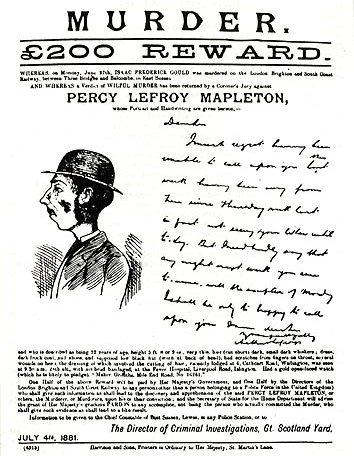
 Mapleton (he gave his name initially as Percy Mapleton Lefroy) entered the annals of crime lore at


