1888: Prado, before Gauguin

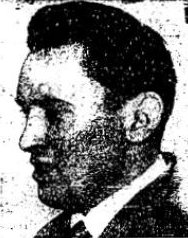
On this date in 1888, “Prado” — also known as “Count Linska de Castillon”; he never copped to his real identity — was beheaded as a thief and murderer at Paris.

The trial of this intrepid criminal promised, in the London Times‘ Nov. 6, 1888 preview, to be “one of the most extraordinary of our times”

He [Prado] is a Spaniard, and was brought up at Gijon, but he refused to say who he was. When 14 years of age he visited Mozambique, India, China, California, the West Indies, and North America. In 1872 he was a sub-lieutenant in the Carlist bands. He then lived by his wits. He once crossed the French frontier and stole 8,000f. At the battle of Somorrostro he was wounded by a shell, and removed to a hospital, from which he enticed the sister of the Order of Saint Vincent de Paul who nursed him. She belonged to one of the first families in England. He married her, and with her visited the Holy Land, but her health failed, and she died on their return to Italy. Prado says he married a second wife at Lima, with a dowry of 1,200,000f., and that after her death he committed many daring robberies.

He’s the most interesting man in the world.

This vagabond upon the overgrown lost highways of fortune eventually ditched wife #2 in penury in Spain and proceeded to France where he mooched off a local girl and her absentee American sugar daddy, until one night he slashed the throat a dame named Marie Aguetant, the lover of a late-working croupier, and plundered their domicile of chattels.

Prado eluded capture for some time, keeping his lover, taking another — both of whom ended up in the dock with their insolent Don Juan, along with various male intimates in various aspects of accesorizing. None of those others drew a death sentence, but as the interest of the London Times suggests — it fronted near-daily trial dispatches from Paris — all this stuff about cabals of swarthy men ravishing women of their virtue and their valuables made global news.

It also moved Third Republic bodice-ripping true crime like this zippy little volume, “Prado ou Le Tueur de Filles,” with a copyright notice as late as 1931.

A savage crime by a strange character, but now that it’s long departed all living memory, it scarcely stands out. Legion are the lotharios who have slain for the pedestrian motivation of gold.

In a post-bourgeois order, “we will no longer see men like Pranzini, Prado, Berland, Anastay and others who kill in order to have this metal,” the French terrorist Ravachol‘s suppressed address to the courtroom declared in 1892. “The cause of all crimes is always the same, and you have to be foolish not to see this.”

Yes, I repeat it: it is society that makes criminals and you, jury members, instead of striking you should use your intelligence and your strength to transform society. In one fell swoop you’ll suppress all crime. And your work, in attacking causes, will be greater and more fruitful than your justice, which belittles itself in punishing its effects.

-Ravachol


Just a few days before this headline-grabbing execution, impressionist painter Vincent van Gogh undertook the most famous thing he ever did off-canvas: after his latest dispute with roommate and fellow-artist Paul Gauguin, van Gogh sliced off his own left earlobe.*

It was in this abnormal circumstance that Gauguin, fresh to Paris fleeing from the scene of the self-mutilation in Arles, attended Prado’s beheading, even forcing his way through a line of gendarmes to obtain a closer view.

“[H]e may have had the counterphobic desire to reassure himself of his courage by taking an unflinching look at Prado’s execution,” writes Bradley Collins. “Gauguin may have identified with both the executioner and his victim. On the one hand, by watching the state kill a man, he could vicariously release some of his pent-up aggression toward Vincent. On the other, by identifying with Prado he could vicariously atone for the guilt he felt about precipitating Vincent’s breakdown and abandoning [Arles].”

Aptly for Gauguin’s personal demons, the guillotine managed to botch this job, too — giving Prado a non-fatal facial injury and requiring the now-wounded condemned to be repositioned for another chop.

All this pate-slashing sure seems to have found its way into Gauguin’s next creation:


Gauguin’s grotesque “Jug in the form of a Head, Self-Portrait”. “Within one work, he has become both the bloody, earless Vincent [Van Gogh] and the guillotined Prado.” –Collins

* Latter-day revisionist hypothesis: Gauguin actually cut off van Gogh’s ear in a fight, but both painters kept to a cover story to keep everyone out of trouble. That version would only thicken the psychological stew for Gauguin’s pilgrimage to the guillotine and subsequent “self-portrait”.

On this day..

1946: A triple execution in Washington, DC

“Death, administered in the law’s deliberate way, exacted a three-fold toll in the District [of Columbia]’s electric chair” on this date in 1946, announced the next day’s Washington Post.*

It was as many people as the nation’s capital had put to death in the previous four years combined. The clientele: three unconnected men, condemned for unconnected murders.

“Joseph Dunbar Medley, suave slayer of a Washington divorcee,” was the most (in)famous of the three. “The debonair man who blazed a trail of crime from the Middle West” had that April made a daring escape from District Jail — which was rather renowned for its escapability, but still, this was a guy on death row, and who was only a few weeks from his then-scheduled electrocution.

Medley and another condemned man, Earl McFarland, charmed their way into their guards’ confidence. During a card game played in one of the guards’ rooms, they imprisoned their jailers, nicked their clothes, and cut their way into a ventilation shaft and out to the roof.

Medley himself was captured hours later hiding in a sewer pipe on the Anacostia River, pithily remarking to reporters, “You can’t blame a guy for trying, and I’m going to try again.” (Chicago Tribune, April 4, 1946) If he did try again, he didn’t make it.

But the bloodhounds couldn’t pick up McFarland, whose manhunt made nationwide headlines for more than a week until he was finally tracked down in Knoxville, Tenn. (He was executed solo in July.)

While [Medley] waited [for three hours of last-second appeals to clear], the chair claimed two other slayers, both Negroes.

William Copeland, 38-year-old slayer of his sister-in-law, Mrs. Dora Johnson, walked into the chamber, jauntily smoking a cigar which he clenched in his teeth while he smiled. He helped guards adjust the straps and the leather face mask smothered his last smile …

Second to die was Julius Fisher, 32, convicted of beating to death Miss Catherine Reardon, librarian at the Washington Cathedral … bludgeoned to death with a piece of firewood and her body hidden in a sub-basement crypt. He strangled and struck her after she had complained about the way he had cleaned under her desk.

* Charles J. Yarbrough, “Death Hour Delayed by Futile Court Maneuver,” The Washington Post, Dec 21, 1946.

On this day..

1909: Valgrand in place of Fantomas

On this date* in 1909, in the first novel of the hit French Fantomas crime serial, the title character escapes the guillotine by having a duped actor beheaded in his place.

Fantomas’s Wikipedia entry calls the character “a transition from Gothic novel villains of the 19th century to modern-day serial killers“: he’s a swashbuckling anti-hero who’s a master of disguise and perfectly okay with getting his hands bloody.

His own personal Javert, an inspector by the name of Juve who has stalked him for years,** has finally managed to have Fantomas convicted of a murder and sent to await execution. (Here’s a synopsis of the book.)

The widow of that crime’s victim — also Fantomas’s lover — subsequently contrives to arrange a tete-a-tete with an actor then portraying Fantomas’s lurid crime spree on the Parisian stage. She wants him to come in costume, which excites the actor as a seriously macabre kink: little does this Valgrand suspect that his own tete will be swapped for the murderer’s by next light.

That following day finds a drugged Valgrand infiltrated into Fantomas’s cell, in a sort of travesty of the noble Sydney Carton‘s guillotine switcheroo. Still suffering the effects of the potion his supposed inamorata has plied him with only hours before, and still made up to resemble the condemned man, he’s incapable of objecting as he’s hustled to the scaffold.

Juve was watching the unhappy wretch, and could not restrain a word of admiration.

“That man is a brave man! He has not even turned pale! Generally condemned men are livid!”

The executioner’s assistants had bound the man upon the plank; it tilted upwards. Deibler grasped the head by the two ears and pulled it into the lunette, despite one last convulsive struggle of the victim.

There was a click of a spring, the flash of the falling knife, a spurt of blood, a dull groan from ten thousand breasts, and the head rolled into the basket!

But Juve … sprang towards the scaffold. He thrust the assistants away, and plunging his hands into the bran that was all soaked with blood, he seized the severed head by the hair and stared at it.

…

“Good God!” he cried in tones of anguish.

“It isn’t [Fantomas] who has just been put to death!” Juve panted brokenly. “This face has not gone white because it is painted! It is made up — like an actor’s! Oh, curses on him! Fantomas has escaped! Fantomas has got away! He has had some innocent man executed in his stead! I tell you Fantomas is alive!”

And so he was … to the tune of a staggering 32 books over three years. Eat your heart out, J.K. Rowling.

Fantomas on the silver screen

This series has enjoyed a number of adaptations to the screen, and indeed it’s a media milestone as well since the books were cranked out at record pace by a team of writers working simultaneously on modular chapters to meet publication deadlines that fed immediately into cinema deals. There were also comic and radio spinoffs, though they’re not known to have been forward-thinking enough to have had a website.

In the classic first silent adaptation of Fantomas in 1913 (the book was published in 1911), poor Valgrand catches a break: he’s recognized and spared beheading at the last moment. There’s a very thorough guide for viewing that film here.

* The book situates the action where Valgrand is seduced and tricked on December 18, and the narrative makes it clear that the execution itself is at dawn the next morning.

It can be placed in 1909 because a guard mentions the execution of Henri Duchemin, a real historical figure guillotined earlier in 1909. (That year marked a resumption of executions in France; a death penalty opponent serving as President of the Third Republic systematically blocked executions from 1905 through 1908.)

Lady Beltham, whose feminine wiles spring the master criminal, subsequently commits suicide in 1910, which leaves only the one possibility.

** Juve is a big fan of the then-trendy, now-discredited system of Bertillonage; Fantomas consistently runs circles around this “scientific” crime-fighting. Academics, if you please?

Through the incorporation of Alphonse Bertillon’s anthropometrics — the dominant mode of criminal investigation at the time –, as both the narratological and criminological impetus for its exponentially serialized representations of criminality, Fantomas articulates resistance to the representational strategies of the numerical classification of criminals as a means of social and “scientific” control, while compelling the ongoing modern capitalist cycle of mass literary production and consumption.

-Nanette Fornabai, “Criminal Factors: ‘Fantômas’, Anthropometrics, and the Numerical Fictions of Modern Criminal Identity,” Yale French Studies, No. 108 (2005)

On this day..

1883: Patrick O’Donnell, avenger

On this date in 1883, Fenian Patrick O’Donnell was hanged at Newgate for the murder of James Carey.

O’Donnell — or Padraig O Domhnaill, more Gaelically — was a casualty of the Irish nationalist struggle; his path to the gallows began on May 6, 1882, when an Irish republican group known as the Invincibles stabbed to death two prominent officials of the British crown as they walked through Dublin’s Phoenix Park.

The Invincibles were ultimately collared — and then hemp-collared — with the assistance of one of their own number who turned queen’s evidence and put five of his former confederates in the noose.

Now in peril of life and limb himself, the turncoat James Carey got a new identity and a ticket on a passenger ship from his recent British enemies. But Carey either got sloppy and blew his cover — provoking O’Donnell to take the opportunity to kill him — or was found out by the Fenians before he left — and O’Donnell sent to stalk him.

The matter is still disputed, and it was disputed at O’Donnell’s trial (further to the question of motive and premeditation; the defense claimed that O’Donnell killed in self-defense during an affray).

That defense didn’t fly. Even advancing it, O’Donnell’s defenders would rather celebrate the intrepidity of his action than plead its extenuating circumstances; riotous celebrations with Carey burned in effigy were reported in Ireland when the news of Carey’s murder broke.

O’Donnell was apparently an American citizen, and his case generated a considerable groundswell from the ample Irish immigrant community stateside.*; he had lived in the anthracite mining regions of Pennsylvania and the Pennsylvania O’Donnells were big players in the shadowy Irish labor-terrorist-revolutionary Molly Maguires.

Now he’s dead, he’s laid to rest,
Let honour be his name,
Let no one look upon him
With scorn or disdain;
His impulse it is human,
Which no one can deny,
I hope he’ll be forgiven
By the infinite Lord on high.

If every son in Erin’s Isle
Had such a heart as he,
Soon they’d set their native land
Once more at liberty;
They’d unfurl their flag unto the British,
Their rights they would redeem
In unity and friendship,
In the lands far over the sea.

–Source

O’Donnell was one of the very few hanged by the great English executioner William Marwood‘s subpar successor Bartholemew Binns. Binns and his assistant were arrested in the process, having attempted to skip the fare for the train to London.

* For instance, the Dec. 10, 1883 Freeman’s Journal and Daily Commercial Advertiser in Dublin reported that President Chester A. Arthur received a deputation urging him to press for clemency consisting of congressmen “Cox and Robinson, New York; Mirrosn, Springer, and Sinertz, Illinois; Lefevre and Foran, Ohio; Murphy, Iowa; Mabury, William Lamb, Indiana; M’Adoo, New Jersey; Collins, Massachusetts, and O’Neill and Burns, Missouri.”

On this day..

1952: Lennie Jackson and Steve Suchan, of the Boyd Gang

On this date in 1952, Steve Suchan and Lennie Jackson were hanged at Toronto’s Don Jail for the murder of a policeman.


Lennie Jackson (top) and Steve Suchan

Both Such and Jackson were members of the Boyd Gang, a swashbuckling troupe of show-stealing bank robbers in post-World War II Toronto … but in the timeless mold of the folk hero outlaws.

Not hanged with them (or ever; he died in British Columbia in 2002) was the gang’s leader and namesake, Edwin Alonzo Boyd.

The wartime commando legendarily launched his stick-up career by robbing a bank so unrecognizably made-up that he was able to walk back in and change a $20 without notice a few days later.

Boyd’s further exploits (and occasional close scrapes: he seemed to have a gift for not getting hit when people shot back at him) plundering banks, and then escaping jail with the cohorts who became the “Boyd Gang” to plunder some more, threw a splash of color across the headlines of staid 1950s Ontario that moved newspapers.

Toronto historian Mike Filey remarked in this CBC documentary

When the Boyd Gang stuck up a bank and it made the front page, people started cheering for them, because it put some excitement in their lives. And of course the interesting thing about Edwin was, if there is such a thing, he was a “good” bad guy.*


More about this movie here

Jackson and Suchan were two of that group who helped author the Boyd Gang’s most notorious larcenies. And they put a screeching halt on the “fun” of the Boyd gang’s crime spree in March 1952 when they shot a Toronto cop dead at a traffic stop.

Suddenly, it wasn’t just the banksters getting hurt. The crooks couldn’t dodge the ensuing manhunt.

But somehow the quartet of criminals locked up in the Don Jail with this murder rap hanging over them actually managed to escape again, hours ahead of their arraignment. It turned out to be the bandits’ last great exploit, worth only a few days of liberty before they were recaptured.

Jackson and Suchan went from trial to gallows — said to be a badly botched hanging — in mere weeks. Boyd and another gang member named Willie Jackson (the two Jacksons weren’t related) drew long prison sentences from which they were paroled in 1966.

Some Books about Edwin Boyd

* Or was he?

On this day..

2006: Two Egyptians who just wanted to watch the game

Nineteen-year-old shoe-shiner Hosni Ramadan Mahmoud Ahmed and his friend Ramadan Abu Al-Magd Azab were hanged in Qena, Egypt on this date in 2006 for murdering Ahmed’s two-year-old stepdaughter.

“Apparently infuriated that the crying baby was disrupting their viewing of a football match on television,” read the crime blotter. “Ahmed smashed the two year old’s head against a wall and electrocuted her.

“The two men then dumped her body in a nearby school.”


Egypt football fans would like to enjoy the game in peace. (cc) image from blogdroed.

On this day..

2008: One man pardoned during hanging

There were two hangings reported this date at the prison in the southern Iranian city of Kazeroun (or Kazerun).

One Kourosh was executed for murdering a 52-year-old in 2004.

And someone named Abolfazl — well, he was much, much luckier. The parents of his victim availed their right to pardon him, although they waited until after the hanging had commenced to do so.

I believe (because how often can this happen in one town?) that this is the failed/survived execution attributed by Amnesty International to 2 December — which Amnesty argues “illustrates the inherent cruelty of the death penalty.”

The original link given by the Amnesty press release is now dead, but this source links the same article and says it cites 7 December; this Persian news story positively attributes the event to dawn on 17 Azar on the Iranian calendar, which corresponds to 7 December.

Not seven seconds had passed when the murder victim’s mother gave her pardon. Moments later, the victim’s father gave consent. Thus, immediately the accused was brought down from the gallows and given CPR while he was transferred to hospital.

Abolfazl survived. This story sported the headline “the sweet end of an execution.”

On this day..

1209: The Oxford clerks

On an uncertain date speculatively identified with December 6, in either 1208 or (more usually attributed) 1209, the near-riotous townspeople of Oxford hanged two or three student “clerks” at that settlement’s famous university.

About this time, a certain clerk engaged in the liberal arts at Oxford killed a certain woman by accident and when he found that she was dead he decided to flee.

But when the mayor of the city and many others who had gathered found the dead woman they began to search for the killer in his house which he had rented together with three of his fellow clerks.

Not finding the man accused of the deed they seized his three fellow clerks who said they were wholly ignorant of the murder and threw them into prison; then a few days later they were, by order of the King of the English, in contempt of the rights of the church, taken outside the city and hanged.

When the deed had been done, both masters and pupils, to the number of three thousand clerks, left Oxford so that not one remained out of the whole university; they left Oxford empty, some engaging in liberal studies at Cambridge and some at Reading.

–The Flowers of History, as translated for the Beeb

This ugly affair rooted in the ancient conflict between university and town caused much of the ancient academy‘s student population to flee town — some proceeding to found Oxford’s rival institution Cambridge. (This pdf short story on the Cambridge site dramatizes events.)

The conflict between the town and university at Oxford over this bloodletting persisted until 1214 when a Papal legate settled the dispute in favor of the university.

The authors of the hanging were required to carry the bodies to an honorable resting place, and the town was required to host a dinner for poor students once every year — on St. Nicholas‘s day, Dec. 6, which on that basis has become associated with the otherwise never-specified date of the unfortunate clerks’ demise.

On this day..

1896: Fred Behme, evangelical Methodist

On this date in 1896, McLeansboro, Ill. hosted its only hanging.

German emigre Fred Behme was settled into married life when he converted from Catholicism to Methodism.

Unfortunately — so Behme saw it — his wife Mary didn’t hew to the old cuius region, eius religio principle where the man of the house was concerned, and stuck with the bishop of Rome for the salvation of her immortal soul.

And there’s just something about the zeal of a convert.

Fred Behme’s domestic missionary work grew more violent (pdf), and eventually his battered spouse moved out; when Fred coaxed her back, and found out that she’d baptized their infant son into idolatrous Catholicism while living apart from him, he chose Easter Sunday to commit what one newspaper called “one of the most hideous and blood-thirsty crimes that ever stained the good name and honor of McLeansboro”: Fred got the other kids out of the house, he attacked Mary with an axe,

drug her by the hair into the yard, and beat in the side of her head. He covered the body with corn fodder. He then took the little boy [whom Mary had baptized] to the barn and hanged him by the neck until he died. (Source)

Though the hanging was invitation-only, it was visible from McLeansboro’s public square and large crowds gathered to witness the hirsute Protestant check out with a short speech in German.

Wikipedia alleges (without a clear source indication) that one G. Phil Hanna was among this multitude, and that seeing Behme strangle to death on an inexpertly deployed rope launched a lifelong interest in the hangman’s craft that would culminate when Hanna pinch-hit on the execution team that carried out America’s last public hanging 40 years later. Others of less august accomplishment no less vividly recalled their (and their town’s) one-time walk through the valley of death.


The family that prays together … (The perp is the bearded man; the victims are the woman seated next to him, and the child in her lap.)

On this day..

1849: Anna Koch of Appenzell

This date’s pastoral story of adolescent avarice — and impressive disobedience at the scaffold — comes to us from the tiniest of Swiss cantons,* as related in this public-domain text


Anna Maria Koch and Magdalene Fessler were girls — each about seventeen years of age — living in Gonten in the year 1849. On June 12 of that year the dead body of the latter was found lying in a ditch in one of the village pastures. There were upon it no marks of violence, and a coroner’s jury was led to conclude that the girl had come to her death by falling into the ditch in the dark. A little later, the discovery was made that on June 10 Anna Koch had sold to a silversmith in Gonten a chain, a locket, and a rosary. These articles on examination were proved to have belonged to Magdalene Fessler. Anna Koch was placed under arrest and asked to make explanation. The story related by her is as follows: –On the Sunday following Frohnleichnamsfest she met Jean-Baptiste Matezenauer, a young man of the village, and he gave her the articles of jewellery, saying that he had found them. He told her that she must sell the things and put the money in a bag which she was to hide in a field. She must then take with her a friend, stroll through the field and, as though by chance, spy the bag, pick it up and say, “Oh! I have found something!” With the money she was to buy a wedding dress, Matzenauer promising in a short time to marry her. Matzenauer was arrested and confronted with his accuser. He protested innocence, but the girl adhered to her story. She did even more, she enlarged upon it. She said that on the morning of Frohnleichnamsfest she had been in Matzenauer’s company; that he had then told her he meant to kill Magdalene Fessler in the afternoon, and had asked her to station herself in the field where the ditch was. This, she said, she had done, and that while there she saw Matzenauer drag thither the body of his victim. Despite the inherent improbability of her whole account, the girl vehemently reiterated it, each time challenging Matzenauer to a denial. At last the bewildered inquisitorial fathers before whom the examination was being conducted — perhaps with some recollection of the efficacy of torture in eliciting actionable testimony in the case of Landamman Suter — ordered Matzenauer to be brought under the lash. This was done, but without the hoped-for result. Matzenauer remained obdurate.

The case dragged on till November 13. It was then suddenly terminated by the confession of Anna Koch that she alone had planned and committed the murder. The details of the confession were substantially these: –She, a poor girl, had for a long time felt hurt in pride that she had not the money with which to provide herself the chains and trinkets commonly worn by the girls of her acquaintance. So keen was this feeling that finally she resolved to purchase a chain from one of the silversmiths of Gonten and trust to fortune to enable her to pay for it. She obtained the chain, but failing to pay for it by the time agreed on with the silversmith, was asked to return it. The necessity of doing so was fully impending when, on Frohnleichnamsfest, she met Magdalena Fessler in the churchyard, at the beginning of afternoon service. The latter had about her neck a beautiful chain, and Anna Koch, seeing it, was prompted to kill her, take the ornament, sell it, and with the money realised meet her own debt to the silversmith. She told her friend that she had lost her rosary, and asked her to go with her to find it. The two girls walked on together, soon passing into the field containing the ditch. As they were crossing the latter on a plank Anna Koch pushed Magdalene Fessler, causing her to lose her footing and fall into the water. She then jumped into the ditch herself, seized the head of her victim and, holding the mouth open with her fingers, kept the head under water until death ensued from strangulation. Having made her confession, Anna Koch asked that she might suffer the extreme penalty for her crime. Young people of her acquaintance petitioned the Great Council for a pardon. This was refused, the vote standing only six for pardon and ninety-six for punishment. Decree was then entered that the guilty one be beheaded on the block.

The day before that fixed for the execution (the latter being December 3) the condemned girl spent quietly in prayer and in communion with her confessor. She expressed herself as being entirely reconciled to her fate and, in fact, as anxious to meet it. But when led forth on the day of execution, her manner changed. The wild instincts of her Appenzell nature reasserted themselves. She declared that she could not and would not die, and with fierce cries drowned the voice of the officer who read her death-warrant before the people. The reading finished, four strong men seized the girl and bound her on a sled. Thus secured she was dragged to the headsman’s block in the market-place. But here a fresh difficulty was encountered. On being released from the sled her struggles were so frantic and determined that the executioner could not perform his task. After several vain attempts he sent the Reichsvogt (the same mediaeval official personage that had figured at the execution of Dr. Anton Leu and Landamman Suter) to report the situation of affairs to the Great Council and ask advice. The reply returned was that the headsman must do his duty. After an hour and a half of cries and resistance on the part of the condemned, her head was firmly secured to the block by the braids of her hair, and the fatal stroke given.


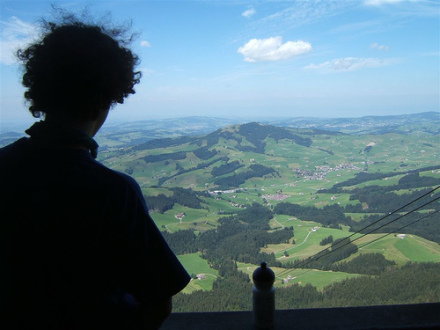
Gonten (it’s the long collection of buildings along the valley road, at the base of the slope) and environs. (cc) image from Michael Beat.

* Appenzell Innerrhoden is the smallest canton by population, and is larger by area only than the urban canton of Basel-City.

On this day..