1997: Hostage-takers in Lima

On this date in 1997, Peruvian paramilitaries stormed the Japanese ambassador’s residence held hostage for 126 days by leftist rebels.
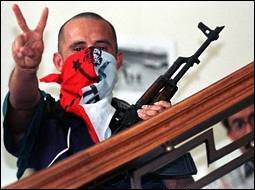
Peace out.

All 14 of the Tupac Amaru Revolutionary Movement (MRTA) were slain in the raid,* along with two of the commandos and one hostage. Officially, there were no “executions” at all.

Unofficially?

It’s pretty well-documented that some — perhaps most — of the terrorists were taken alive, and thereafter summarily executed. (pdf of Defense Intelligence Agency cable hosted by the National Security Archive)

However untoward the outcome and however unimpressive the foe, the operation was a master stroke for then-President Alberto Fujimori. Peru’s neoliberal taskmaster had introduced the world to the auto-golpe, the “self-coup”, a Cromwellian maneuver of shuttering parliament in order to rule as dictator, and he thereafter made ruthless suppression of Peru’s ruinous internal conflict the calling card of his presidency.

The DIA cable linked above claims Fujimori himself ordered the commandos to take no prisoners. He did not scruple to show himself in the middle of the bloodbath.
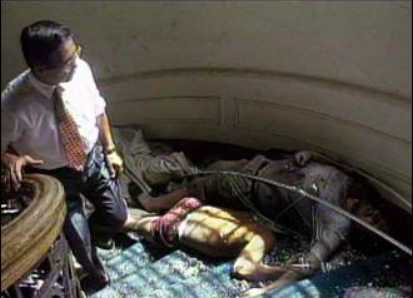

Alberto Fujimori made sure to get himself snapped standing over the bodies of the guerrillas, including MRTA leader Nestor Cerpa Cartolini.

El Presidente banked the political capital from having restored civic order, but it wasn’t the only capital he was banking. Three and a half years later, with a corruption scandal darkening his door, Fujimori absconded to Japan, faxed in his resignation, and became a fugitive.

Even there, he continued to justify his authoritarian governance.

Many Peruvians have always agreed with Fujimori’s self-assessment, even many who regret his well-publicized disregard for human rights.

But human rights researcher Michael Baney calls this day’s executions “pointless.”

“The MRTA was a spent force by the time of the embassy takeover,” said Baney. “The takeover was an act of total desperation, which is evidenced by the fact that the leader of the movement, Nestor Cerpa Cartolini, personally participated in it.”

After spending the best part of a decade in exile, Fujimori returned to the headlines by boldly returning to the hemisphere — to Chile, specifically, which arrested him and extradited him on a Peruvian warrant.

Just days ago as of this writing, Fujimori was convicted in his own former courts of authorizing death squads,** and sentenced to 25 years in prison. (Here’s some legal analysis.)

In the court of public opinion, it’s a different matter.

Fujimori’s daughter Keiko, a Peruvian congresswoman, figures to be a leading contender for the presidency in 2011, and has said she would pardon her father if given the opportunity.

“A majority of Peruvians think that Fujimori was guilty of serious human rights violations, but a majority also believe that he was a good president,” Baney observed. “And Fujimori really does believe that he single-handedly saved his country from economic and political collapse, and that Peru needs him around.”

* “Operation Chavin de Huantar”, profiled in several Spanish-language documentary videos available online. (Such as this one.)

** Not specifically related to this day’s MRTA killings, although these could be prosecuted in the future.

On this day..

1994: Rwandan Queen Dowager Rosalie Gicanda, and six attendants

When the Rwandan genocide erupted following the April 6, 1994 assassination of President Juvenal Habyarimana, the southern province of Butare went initially unscathed. Its large and powerful Tutsi population had limited the foothold of violent Hutu paramilitaries.

That calm lasted a mere fortnight, however, and was shattered this date in 1994 when the aged widow of Rwanda’s last monarch was hauled to Butare city’s national museum and shot along with several of her caregivers.

Taken in marriage in 1942 (French link) by King Mutara III, Rosalie Gicanda had stayed out of politics after he died mysteriously and Rwanda became a republic.

Being an emblematic Tutsi in April 1994, however, was all the political involvement needed to doom her. According to Human Rights Watch.

At 11 a.m. … a detachment of soldiers commanded by Lt. (jg) Pierre Bizimana, acting under the orders of Capt. Nizeyimana, invaded the modest home of Rosalie Gicanda … About eighty years old, she lived a quiet life as a devout Catholic, sharing her home with her bed-ridden mother and several women and girls who cared for them both. Because she eschewed any involvement in politics and behaved with discreet dignity, even the most anti-Tutsi politicians had left her largely undisturbed throughout the thirty years of Hutu rule…. The soldiers passed through the wooded enclosure that protected the house from the main street and entered the little house with its air of faded respectability. They seized the former queen and six others, leaving her bed-ridden mother and one girl to care for her. The soldiers passed by the ESO and then took Gicanda and the others to a place behind the national museum where they shot them. One teenaged girl, left for dead, survived to recount the murders. The soldiers returned to pillage Gicanda’s home in the afternoon and, two days later, they killed her mother. …

The news that this gracious lady and others from her household had been taken away by soldiers in the back of a pickup truck spread rapidly and alarmed Tutsi and all others who opposed the genocide. They concluded that if soldiers dared to seize even this revered person, then no one was safe.

That conclusion, of course, was well-founded. Over 200,000 Butare Tutsis are thought to have suffered Gicanda’s fate (or worse) in the ensuing months, making it the Rwandan genocide’s bloodiest province.

Pierre Bizimana was sentenced to death for Gicanda’s killing in 1998; I have been unable to document whether that sentence was ever carried out. His commanding officer, Idelphonse Nizeyimana, was arrested in October 2009.

On this day..

1945: Gen. Charles Delestraint

On this date in 1945, French general and Resistance figure Charles Delestraint was hastily disposed of, ten days before the liberation of Dachau.

Delestraint, who also spent the First World War as a POW, was among those who noticed the hidebound military dogmas of the past needed updating.

With de Gaulle, Delestraint was a forceful advocate in the interwar period for mechanized warfare.

He didn’t get far enough, certainly not as far as the soon-to-be-vaunted Wehrmacht.

In 1940, just months after retirement, Delestraint was recalled to lead a mechanized division against the Germans, which of course turned out to be a spectacular triumph of tank warfare … for the Germans. While the French distributed armor units throughout their forces, the Germans massed them at a schwerpunkt aiming to break through the French line and speedily conquer in the rear.

Delestraint later remarked of the doctrinal difference,

We had 3,000 tanks and so did the Germans. We used them in a thousand packs of three, the Germans in three packs of a thousand.

Recruited subsequently into the French Resistance and thence betrayed, Delestraint enjoined the hospitality of many concentration camps and the tender mercies of one of their more infamous torturers.

Uncertainty remains over exactly how the Germans killed Delestraint, or even why the Dachau commandants wanted to finish off him in particular, although he was a primo catch in the anti-Resistance operation. The body was immediately cremated, camp records of the execution order disappeared if they ever existed, and eyewitness testimony at variance.

But dying in Dachau for the French Resistance? By any standard, that’s a passport to hero status, as attested by any number of Rue General Charles Delestraints to be found in his native land.

On this day..

1178 B.C.E.: Penelope’s suitors, by Odysseus

On this date in 1178 B.C.E., according to some enterprising astronomers, the Greek hero Odysseus returned home to Ithaca from a 20-year absence and slaughtered the suitors who had taken up lodgings in his palace.

The date was asserted in 2008 based on astronomical clues in the text of Homer’s Odyssey.

This sort of putative historical specificity extracted from what could as well be read as literary devices — e.g., an eclipse — for a literary episode might gratify an advocate of “the higher naivete”, but the reader is well entitled to doubt.

Similarly, and more specifically for this venue, is the problem of whether the summary justice exacted by a Bronze Age chieftain meets the definition of an “execution”. This dubious case is resolved here by the unique subject matter.

Crafty quasi- (or altogether) mythical hero Odysseus (aka Ulysses), having left a generation before for the decade-long Trojan War which he finally resolved with the famous Trojan Horse strategem, then spent the next decade wandering about the sea en route to his home island.

When he gets there, he finds that 108 ill-mannered suitors have moved in, dissipated his fortune in merrymaking, and have ceaselessly dogged his faithful wife (and presumed widow) Penelope to remarry one of them.*

Together with his now-grown son Telemachus, Odysseus punishes them terribly .

“Dogs, did you think that I should not come back from Troy? You have wasted my substance, have forced my women servants to lie with you, and have wooed my wife while I was still living. You have feared neither God nor man, and now you shall die.”

They turned pale with fear as he spoke, and every man looked round about to see whither he might fly for safety, but Eurymachus alone spoke.

“If you are Ulysses,” said he, “then what you have said is just. We have done much wrong on your lands and in your house. But Antinous who was the head and front of the offending lies low already. It was all his doing. It was not that he wanted to marry Penelope; he did not so much care about that; what he wanted was something quite different, and Jove has not vouchsafed it to him; he wanted to kill your son and to be chief man in Ithaca. Now, therefore, that he has met the death which was his due, spare the lives of your people. We will make everything good among ourselves, and pay you in full for all that we have eaten and drunk. Each one of us shall pay you a fine worth twenty oxen, and we will keep on giving you gold and bronze till your heart is softened. Until we have done this no one can complain of your being enraged against us.”

Ulysses again glared at him and said, “Though you should give me all that you have in the world both now and all that you ever shall have, I will not stay my hand till I have paid all of you in full. You must fight, or fly for your lives; and fly, not a man of you shall.”

The suitors fight back, and most of the resulting deaths occur in the fray. But it’s about as one-sided as the contest on any proper scaffold.

As eagle-beaked, crook-taloned vultures from the mountains swoop down on the smaller birds that cower in flocks upon the ground, and kill them, for they cannot either fight or fly, and lookers on enjoy the sport — even so did Ulysses and his men fall upon the suitors and smite them on every side. They made a horrible groaning as their brains were being battered in, and the ground seethed with their blood.

And if many of the doomed die with their boots on, there are at least a couple of specific instances that clearly have a summary-execution character.

Leiodes then caught the knees of Ulysses and said, “Ulysses I beseech you have mercy upon me and spare me. I never wronged any of the women in your house either in word or deed, and I tried to stop the others. I saw them, but they would not listen, and now they are paying for their folly. I was their sacrificing priest; if you kill me, I shall die without having done anything to deserve it, and shall have got no thanks for all the good that I did.”

Ulysses looked sternly at him and answered, “If you were their sacrificing priest, you must have prayed many a time that it might be long before I got home again, and that you might marry my wife and have children by her. Therefore you shall die.”

With these words he picked up the sword that Agelaus had dropped when he was being killed, and which was lying upon the ground. Then he struck Leiodes on the back of his neck, so that his head fell rolling in the dust while he was yet speaking.

The minstrel Phemius, whose services had been procured by force, has better luck pleading for clemency when Telemachus intervenes before Odysseus can give him the chop. But the explorer’s son has no use at all for twelve corrupt handmaids who have abetted the suitors’ predations. I like this version in the chilling verse form quoted by Dr. Samuel Haughton in an 1866 paper on hanging that weirdly goes on to produce the physics necessary to demonstrate the intuitively obvious point that this must have required the main rope to anchor to pillars between each suspended noose, rather than all twelve on a single line.

…leading forth
The women next, they shut them close between
The lofty wall and scullery, narrow, straight,
And dreadful, whence no prisoner might escape.
Then, prudent, thus Telemachus advised:
 The death of honour would I never grant
To criminals like these, who poured contempt
On mine and on my mother’s head, and lay
By night enfolded in the suitors’ arms.
 He said, and noosing a strong galley rope
To a huge column, led the cord around
The spacious dome, suspended so aloft,
That none with quivering feet might reach the floor.
As when a flight of doves entering the copse,
Or broad-winged thrushes, strike against the net
Within; ill rest, entangled, there they find;
So they, suspended by the neck, expired
All in one line together. Death abhorred!
With restless feet awhile they beat the air,
Then ceased.

On whatever date imagined, or strictly as fiction, this whole bloodbath fixes the climax of one of seminal works of the western literary canon.

The excerpts quoted here are from the Internet Classics Archive; multiple versions of both The Odyssey and The Iliad are available on Gutenberg.org … they’ve even done The Odyssey as a TV miniseries.

* This site claims that there’s at least one alternate tradition in which the famously virtuous Penelope — wasn’t.

On this day..

1836: Goliad Massacre

On this date in 1836 — Palm Sunday, as it happened — over 300 Anglo POWs fighting to separate Texas from Mexico were executed en masse outside Goliad’s fortress

Less widely celebrated than the Battle of the Alamo preceding it by a fortnight, the Battle of Coleto on March 19-20 had seen Mexican troops surround and capture another force of Texians at Goliad.

Unaware of a Mexican order issued the previous December to execute foreign prisoners,* the men under Col. J.W. Fannin — a dithering commander whose military competence didn’t quite equal his romantic aspirations — expected to be released in a matter of weeks. They were marched out this morning on some innocuous pretext and had bare moments to apprehend their impending fate before their guards mowed them down. (Fannin was individually shot apart from his troops.)

Nineteenth-century musketry was a mediocre tool for mass slaughter, especially when the targets were nearly as many as their executioners. A number of prisoners survived the volley and managed to escape the subsequent cavalry charge and bayoneting by leaping into a nearby river. A fortunate few others were intentionally preserved. This thorough site on the massacre** preserves several survivor accounts.

These memoirs also detail life in the unit and troop maneuvers that are certainly of interest; in these pages, of course, we are most drawn to the accounts of those who stared death in the face — like this (understandably melodramatic) description by Herman Ehrenberg:

Either life or death! Behind were the bayonets of the murderers, and before me was the sword of a coward that crossed my way to the saving stream. Determinedly I rushed upon him. Forward I must go, and — the coward took flight in characteristic Mexican gallantry. Now the path was open, near was the point of my escape.

Arriving at the other bank of the river, I looked around once more to where my comrades were dying, while the bullets of the still firing enemies whistled about me. The hellish exaltations of the enemy mixed with the cries of pain of my dying brothers sounded over to me. What feelings took possession of me here! I cast another look and a farewell greeting to my dead companions and turned to flee. I had to hasten if I did not wish to fall into the hands of the lancers who were now on this side of the river less than a half a mile below me.

Which makes an interesting stylistic contrast with the story of John C. Duval, similar in its events but strikingly low-key, even ironic:

Some one near me exclaimed “Boys! they are going to shoot us!” and at the same instant I heard the clicking of a musket locks all along the Mexican line. I turned to look, and as I did so, the Mexicans fired upon us, killing probably one hundred out of the one hundred and fifty men in the division. We were in the double file and I was in the rear rank. The man in front of me was shot dead, and in falling he knocked me down. I didn’t get up for a minute, and when I rose to my feet, I found that the whole Mexican line had charged over me, and were in hot pursuit of those who had not been shot and who were fleeing towards the river about five hundred yards distant. I followed on after them, for I knew that escape in any direction (all open prairie) would be impossible, and I had nearly reached the river before it became necessary to make my way through the Mexican line ahead. As I did so, one of the soldiers charged upon me with his bayonet (his gun I suppose being empty). As he drew his musket back to make a lunge at me, one of our men coming from another direction, ran between us, and the bayonet was driven through his body. The blow was given with such force, that in falling, the man probably wrenched or twisted the bayonet in such a way as to prevent the Mexican from withdrawing it immediately. I saw him put his foot upon the man, and make an ineffectual attempt to extricate the bayonet from his body, but one look satisfied me, as I was somewhat in a hurry just then, and I hastened to the bank of the river and plunged in. The river at that point was deep and swift, but not wide, and being a good swimmer, I soon gained the opposite bank, untouched by any of the bullets that were pattering in the water around my head.


The Texas state flower — the bluebonnet — blooms in front of the monument put up to the Goliad Massacre on its centennial. Creative Commons image from Matthew Lee High.

History buffs in the Goliad environs this weekend can catch the annual re-enactment of the Goliad Massacre this weekend at Presidio La Bahia.

* The order came from the top, but the general who captured Goliad had no stomach to carry it out. He asked for leniency … but received an emphatic confirmation of the execution order.

** Also see its unit rosters tracking the particular fates of most of Fannin’s men, and these biographies of the unit.

On this day..

1938: A pig, experimentally

EXECUTION TEST MADE WITH PIG

San Quentin’s Lethal Chamber Tried Out

SAN QUENTIN, March 19 [1938]. (AP) A runt pig* died today in a slow-motion test of San Quentin’s lethal gas chamber.

The test required thirty-five minutes before the pig was formally pronounced dead, but prison officials said “nowhere near that time” would be necessary for execution of a condemned convict in the gas chamber.

The trial execution was conducted in slow motion to enable prison officials and guards to learn details of the operation. The test was conducted by representatives of the manufacturers of the chamber.

* According to the Los Angeles Times (whose March 24, 1938 edition captions a photograph of Warden Court Smith peering inquisitively through the gas chamber’s window), it was “a little thirty-pound brown pig.” According to the backgrounder in When You Read This, They Will Have Killed Me — which concerns an altogether more famous gas chamber subject — the swine was “a 155-pound pig named Oscar, raised on the prison farm.”

On this day..

1009: St. Bruno of Querfurt

We have the rare privilege this date* to salute 1,000 years since the martyrdom of St. Bruno of Querfurt.

St. Bruno — also Brun or Boniface — had his head chopped off, and 18 companions were allegedly simultaneously hung or hacked to pieces, by a chieftain who did not appreciate the bishop’s efforts to Christianize the Baltics. The wherefores, and even the wheres (different sources locate it in Prussia, Rus’, or Lithuania) of this missionary’s end are permanently obscure to us.

But this relatively forgotten saint has something to tell us about the fluid area of contact between the Latin and Greek Christian spheres in the decades before their schism.

Lithuanian Institute of History scholar Darius Baronas argues** that although Bruno’s missions were conducted independently under papal authorization, he received support from the courts of both the Polish king Boleslaw the Brave and the Grand Prince of Kievan Rus’ Vladimir the Great.†

Both rulers hoped to extend their influence among the still-pagan lands of Europe, a secular incarnation of the rivalry between eastern and western rites.

So why is he so little-known to posterity? Baronas observes that St. Bruno

is a supreme example of a missionary saint and his activities ranged almost from the Baltic to the Black Sea. Yet despite his activities, let alone his glorious death, he did not receive much praise from his contemporaries and still less from later generations. His subsequent cult was rather circumscribed and was largely forgotten.

Precisely because of his ambiguous place between these two competing powers, and because his mission did not conform precisely with either’s policies of statecraft, neither Boleslaw nor Vladimir promoted a cult of Bruno: each realm was uncertain which side Bruno was on, and which side would profit most from his inroads among the pagans.

* February 14, 1009 is also cited as a date for St. Bruno’s martyrdom — for instance, by the Catholic Encyclopedia; the source of this may be the chronicle of Thietmar of Merseburg. In the absence of a determinative reason to prefer that earlier date, and allowing that 1,000-year-old executions are prone to shaky dating, I’m placing it on March 9 based on the Annals of Quedlinburg.


This text, reading “St. Bruno, an archbishop and monk, who was called Boniface, was beheaded by Pagans during the 11th year of this conversion at the Rus and Lithuanian border, and along with 18 of his followers, entered heaven on March 9th,” also happens to be the earliest surviving written reference to Lithuania.

** Darius Baronas, ‘The year 1009: St. Bruno of Querfurt between Poland and Rus”, Journal of Medieval History (2008), 34:1:1-22

† Vladimir the Great is himself a saint, too — in the Catholic tradition as well as the Orthodox.

Part of the Themed Set: The Church confronts its competition.

On this day..

1836: The defenders of the Alamo, much remembered

On this date in 1836, Mexican forces commanded by President Antonio Lopez de Santa Anna overran the Alamo — and executed those few of its defenders who survived the day’s battle.

“Remember the Alamo!”

This most memorable battle of the Texas Revolution has since retained its place in the founding mythology of Texas and its draw as a tourist destination in San Antonio, no matter the complexities on the ground. (You can watch the earliest surviving film treatment, The Martyrs of the Alamo, free online. D.W. Griffith made it the same year he made Birth of a Nation.)

That Alamo of blood and legend, and the countervailing interpretations it eclipses, are much beyond our scope here, but we are attracted to notice the reputed summary execution of five to seven defenders who had surrendered or otherwise been captured during the fight. (A few dozen mostly civilian noncombatants in the former mission also survived, and were not executed.)

According to Robert Scott, Santa Anna was empowered by a Mexican resolution holding (not without cause) that

“foreigners landing on the coast of the Republic or invading its territory by land, armed, and with the intent of attacking our country, will be deemed pirates.”

Who counted, at this moment, as “foreigners” among the Anglo settlers trying to break away from Mexico and their supporters among from the United States to which Texas would eventually attach poses a historiographical riddle. But then, Santa Anna wasn’t there to write a dissertation, but to win a war — and he was said to be sorely annoyed at the defenders having tied him down for a week and a half.

King of the Wild Frontier

Covered by most any definition of “foreigner” would have been the Alamo’s most famous defender, Tennessee frontiersman and former U.S. Congressman Davy Crockett. He had arrived in Texas just a few months before, on a rendezvous with destiny.*

It’s a matter of dispute whether Crockett was among those last few executed; in an event this emotionally remembered, every version of the Crockett death scene — from “found dead of injuries amid a heap of Mexican casualties” to “cravenly bargained for his life” — gores someone’s ox.

Even if the account of Crockett’s presence among the executed derives from a disputed source — well, this blog has not scrupled to highlight the fictional and the mythological, those executions whose resonance transcends factual accuracy.

And even if Davy Crockett was not among those anonymous souls put to death this day, it is by his name that they have their tribute, as in the 2004 film** The Alamo:

* Destiny by way of Walt Disney.

** This Disney film diddles with the Crockett legend that Disney helped to inflate in the 1950’s — to the annoyance, of course, of traditional-minded Alamo partisans.

On this day..

1716: 100 Sikhs per day for a week

On this date in 1716, the Mughal Empire began disposing of 700-plus Sikh prisoners taken in its grueling campaign against Banda Singh Bahadur by beheading them 100 at a time in Delhi.

The peacable-at-first Sikhs had been a thorn in the Muslim Mughal rulers’ side for a century, militarizing in response to heavy official persecution. (The kirpan, the ceremonial dagger Sikhs still wear as a religious tenet, dates to this period.)

The Mughals finally succeeded in overcoming Banda Bahadur, who sacked a Mughal provincial capital and maintained a rival kingdom in the Punjab,

His 700 doomed adherents were borne into Delhi in a procession along with the heads of slain companions mounted on pikes, and Banda Bahadur himself carried in a cage. British envoys John Surman and Edward Stephenson described in a dispatch to the mother country (available in Early Records of British India) the fate of these unfortunates.

The great rebel Guru (Bandu, the Sikh) who has been for these twenty years so troublesome in the province of Lahore, is at length taken with all his family and attendance by the Subahdar, or Viceroy, of that province. Some days ago they entered the city laden with fetters, his whole attendants which were left alive being about 780,* all severally mounted on camels, which were sent out of the city for that purpose, besides about 2,000 heads stuck upon poles, being those who died by the sword inb attle. He was carried into the presence of the King, and from thence to a close prison. He at present has his life prolonged with most of his officers, in hopes to get an account of his treasure in several parts of his kingdom, and of those that assisted him, when afterwards he will be executed for the rest. There are one hundred each day beheaded. It is not a little remarkable with what patience they undergo their fate, and to the last it has not been found that one has apostatised from the new formed religion.

According to the obviously partisan source sikhism.com, one of the prisoners was a teenage boy whose “mother appealed to the Emperor that her son should be set free because he was not a Sikh, but the boy replied that his mother was lying, that he was indeed a Sikh, and that he must be executed in the same way as the rest.”

* Surman and Stephenson may have been mistaken about the exact count of prisoners.

On this day..

1613: Ivan Susanin, a life for the tsar

On an uncertain date in February (perhaps) 1613 — so says a cherished Russian national legend — a villager met a Polish army intent on deposing the Russian tsar, offered to guide it on a “shortcut,” and proceeded to lead it into a forest or fen where it succumbed to the elements.

A monument to Ivan Susanin in Kostroma. Image courtesy of Barbara Partee (Barbara adds: to help prevent future executions of the wrongly convicted, check out the Innocence Project.)

That peasant, Ivan Susanin, is supposed to have been put to death as the army realized its folly and imminent doom — the fate one would expect, although also not the sort that would leave a lot of corroborating witnesses.

Though the particulars are of doubtful veracity, Susanin’s son-in-law was awarded estates for the man’s tortures by enemy armies seeking the tsar — so the story is not completely baseless.

It was tsarist public relations, however, that gave us Susanin in his dramatic, familiar* form with the trackless wilderness.

This Susanin embodies the Russian people’s sacrificial love for their autocrat … and more specifically, since this was the Time of Troubles when the Russian crown’s succession was contested, for the Romanov dynasty whose first scion chosen in February 1613 would have been the Poles’ target.**

Thus, Glinka’s 19th century opera A Life for the Tsar.

But Glinka and Ivan proved up to the shifting needs of authority as the tsar gave way to the Politburo, and that to the post-Soviet state.

In a fascinating 2006 academic disquisition,† Marina Frolova-Walker dissects A Life for the Tsar‘s transmutation into Ivan Susanin, a Stalin-era opera with the same score but a libretto altered to expunge the tsar — and the success this adaptation of a national classic enjoyed vis-a-vis Soviet artists’ original creations under the impossible aesthetic and political restrictions of official censorship.

Not only did this now-nationalist composition thrive in the USSR, it has been successfully re-staged in its Soviet form, or as a fresh amalgamation of Stalin and Glinka, in the Putin era.‡

From the days of serfdom via the days of the gulag past the fall of the Iron Curtain, here’s Ivan Susanin‘s stirring finale performed by the Russian army at the Vatican, and broadcast on Russian television.

* Familiar to Russians, certainly, and you can call one who gets you lost “susanin”.

** And we all know how they left the throne.

† Marina Frolova-Walker, ‘The Soviet opera project: Ivan Dzerzhinsky vs. Ivan Susanin’, Cambridge Opera Journal (2006), 18:2:181-216

‡ In the Yeltsin era, the opera was staged in its pre-Soviet form. Frolova-Walker argues that the version incorporating Stalinist edits actually speaks to contemporary Russia more aptly than the original, an operatic mirror of the state’s re-adopting the Stalinist national anthem after having used a tsarist piece (written by Glinka!) during the 1990’s.

The reappearance of these cultural tokens is occurring because high Stalinism provides the most easily assimilable model for Russian nationalism today: it is less remote than its nineteenth-century counterpart … The eclectic and confident nationalist of the new Susanin contains the appropriate message for those Russian citizens wealthy enough to attend the Bolshoi today.

On this day..