1942: Mykhailo and Olena Teliha, Ukrainian artists

On this date in 1942, poet Olena Teliha and her husband Mykhailo were shot by the Nazis at Babi Yar for their Ukrainian nationalist activism.


Olena Teliha (top) and her husband, Mykhailo Teliha.

Having lived in Czechoslovakia (where they met and married) and then Poland during the interwar period, the Telihas weren’t present for the worst of Soviet depredations in Ukraine. Mykhailo, a bandurist, might have been in an especially bad way, since his musical genre of choice harkened to subversive themes of Cossack insurrection, and was therefore heavily persecuted.

Instead, they moved to Kiev as the German invasion opened the prospect of returning to their ancestral homeland. There they found their affiliation with the Organization of Ukrainian Nationalists quite unwelcome to the new occupiers.

Olena kept writing for a prohibited nationalist paper, and Mykhailo gamely stuck by her.

Without a Name

Neither love, nor caprice nor adventure–
Not everything must be named.
As not always in abysmal waters
Can one find a motionless floor.

And when Your reawakened soul
Again rushes to a luminous path,
Do not question whose inspired oars
Were able to cast aside the dark shore.

Neither love, nor tenderness, nor passion,
Only heart — tumultuous eagle!
Drink then splashes, fresh, effervescent,
Of nameless, joyful sources.

(Executed Today friend Sonechka’s original translation from the Ukrainian text, found among this collection of Olena Teliha’s work)

Their execution this date is not to be confused with the mass execution of thirty thousand-plus Jews in September 1941, the atrocity with which Babi Yar is most frequently associated. This ravine continued to be used for Nazi executioners throughout the occupation of Kiev, including for more than 600 Ukrainian nationalists — who are today honored at the site with this monument:

On this day..

1258: Al-Musta’sim, the last Abbasid Caliph

For centuries after the prophet Muhammad trod the earth, the caliph had stood as a unifying principle in the Islamic world, conferring moral authority on the sultans and amirs who in turn gave the caliph temporal security. Despite political conflicts, rival claimants, and contested successions, the office, like the papacy, had weight for all Muslims, even the usurpers who conquered to the very gates of Baghdad only to “kiss the ground … and walk astride the caliph’s stirrup.”*

Seven hundred fifty-one years ago today, that last redoubt of that single Muslim community was extinguished when the last Abbasid caliph was put to death by the Mongols.

Al-Musta’sim Billah held power in the sunset days of a once-mighty empire,

a weak and miserly creature, in whose improvident hands the Caliphate, even in quieter times, would have fared ill … we need not to travel beyond the imbecility of the Caliph and the demoralisation of his now shrunken kingdom, for the causes of impending ruin. … As characteristic of his meanness, we are told that he appro­priated the state jewels of the Chief of Kerak, who with difficulty obtained their partial restitution by proclaiming the Caliph’s dishonesty before the assembled pilgrims at Mecca. (Sir William Muir)

Retrospection, of course, aids us in appreciating the “sunset” — certainly it did not occur to Musta’sim that the ascension in Egypt of Shajar al-Durr in 1250 that marks the dawn of Mamluk rule was the seed of a successor order. On the contrary, he sent this Islamic queen a contemptuous offer to provide a man for Egypt, since it could find none to seat on its throne.

He would have done better to man up against the Mongols, who had not failed to notice that Baghdad lacked the muscle to protect its accumulated wealth.

A gold dinar from the Al-Musta’sim period. Interestingly, albeit tangentially, Sir Thomas Arnold recorded that for decades after this date, some Islamic rulers “went on putting the name of the dead Musta’sim on [their] coins, because [they] could find no other [caliph], and the Muslim theory of the state had not succeeded in adjusting itself to the fact that there was no Khalifah or Imam in existence.”

Genghis Khan‘s grandson Hulagu Khan (or Hulegu, or Hülegü) reduced Baghdad in a matter of days and plundered the city.** Al-Musta’sim having combined an impolitic bluster towards the advancing horde with an utter failure to ready the city’s defenses, Hulagu Khan was most unimpressed with his prisoner.

On February 20th, in a village near to Baghdad, Al-Musta’sim was executed. Contemporary chroniclers are silent as to the method; Marco Polo reported that he had been immured with his treasures in an opulent tower to starve to death.

According to The Cambridge History of Iran (volume 5), this was likely a later interpolation of a story that 13th century intellectual Nasir al-Din Tusi recorded:

[Hulagu Khan] set a golden tray before the Caliph and said: ‘Eat!’ ‘It is not edible,’ said the Caliph. ‘Then why didst thou keep it,’ asked the King, ‘and not give it to thy soldiers? And why didst thou not make these iron doors into arrow-heads and come to the bank of the river so that I might not have been able to cross it?’ ‘Such,’ replied the Caliph, ‘was God’s will.’ ‘What will befall thee,’ said the King, ‘is also God’s will.'”

It is more generally supposed that Al-Musta’sim was rolled in a carpet and trampled to death — the Mongols’ own method for putting princes to death without shedding royal blood.

However effected, the caliph’s demise ended the classical period of Islam. And yet, as Gustave Edmund von Grunebaum observes in his book on the period, that ending was itself a beginning for the flowering of high Islamic civilization that the days of the caliphate had prepared.

What terminates in 1258 is the major chain of political legitimacy to which reality had failed to conform for rather more than four centuries when the extent of the Muslim empire had ceased to be coterminous with the rule of Islam and the unity of tradition had become no more than a postulate.

None the less, the fall of Baghdad did more than bring home the precariousness of all human structures, even those erected on the true faith and devised to safeguard it. It demonstrated that the ‘Abode of Islam’ had become saturated with Islam, that the community no longer required a caliphate to give it a political and religious centre of gravity, that the vitality of Islam as an interpretation of man and the world, a way of life, and a style of thinking and feeling was now independent of any institutional support.

… the very irreparability of the calamity made the faithful realize that the abiding of their world, its beliefs and manifestations, had outgrown any particular political form and had indeed become too wide to be contained in history. In this realization the epigones undoubtedly rejoined the innermost intent of ancestors and founder.

* Later historian Ibn Tabataba, cited in The Middle East Remembered.

** Christians were spared the rapine, as Khan had a Coptic wife.

On this day..

1530: Tangaxuan II, the last Tarasco ruler

This date in 1530 marked the end of the pre-Columbian Tarasco Empire, when the Spaniard Nuño Beltrán de Guzmán lashed its last independent king (Spanish link) to a tree and burned him to death.

Legendary even by conquistador standards for his cruelty, Beltran de Guzman eliminated the Tarascan state in western Mexico — a onetime Aztec rival which had got off relatively easy during Cortes’s 1520s incursion by cooperating with the Spanish.

Beltran de Guzman had set out from Spanish holdings on the hunt for gold, butchering the many natives on his westward jag unable or unwilling to comply with his demand for more and better treasure.

Tangaxuan — or Tangaxoan, or Tanganxoan, or Tangaxhuan, and other such variants — met his foreign-born visitor peacefully with some gifts of gold and silver. This only whetted Nuno Beltran de Guzman’s appetite, and he promptly had the king detained and tortured for more pelf before dispatching him by dragging by horses and burning alive at the confluence of the Río Lerma and the Río Angulo. (Spanish, again.)


The monumental Juan O’Gorman mural in Michoacan, the present-day Mexican state occupying what was once Tarascan land, depicts this day’s execution above the inscription, “Tangaxhuán, the last monarch of the Purhépecha Indians was tortured and assassinated by the ferocious hordes led by the sadistic, vile, Nuño de Guzmán.”

Although even other Spanish officials viewed our bloodthirsty conquistador with distaste, his depredations were ultimately rooted in the logic of imperial expansion, and the conquest of Tarasco consolidated (Spanish link) the colonial power’s grip on “New Spain”.

On this day..

1920: The White Admiral Aleksandr Kolchak

On this date in 1920, White commander Admiral Aleksandr Kolchak was shot in Irkutsk.

Absent the Russian Revolution, Kolchak‘s epitaph would read “naval officer and arctic explorer.”*

After the Russian Revolution touched off civil war, Kolchak became Supreme Ruler — and ruthless dictator — of an anti-Bolshevik government stretching from the Urals to the Pacific Ocean.

It didn’t last.

Fleeing east, Kolchak was arrested by a Bolshevik-allied government in Irkutsk on Lake Baikal. The White army mounted an offensive to retrieve him — leading the Soviet government to order his immediate execution, along with one of his government ministers, Viktor Pepelyayev. Unable to bury them in the frozen soil, their captors unceremoniously dumped the corpses in the Ushakovka River.


A monument to Admiral Kolchak in Irkutsk, Russia. Image courtesy of Jack Sheremetoff of Baikaler.com.

* An inhospitable Arctic island he helped explore was named (and is now again named, following a Soviet change of moniker) for Kolchak.

On this day..

1968: Nguyen Van Lem

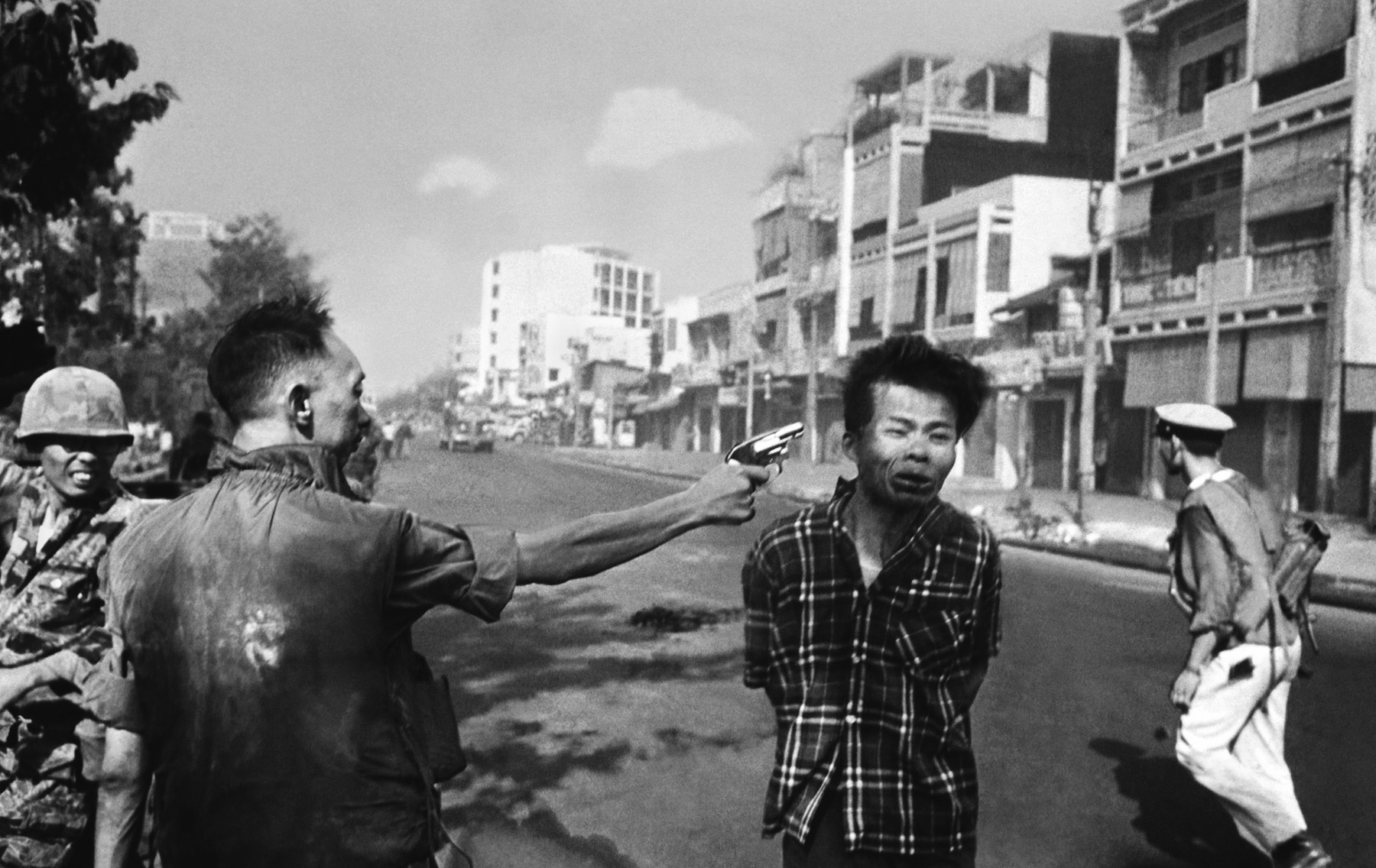
Around noon of February 1, 1968, in the opening days of the communist Tet Offensive, South Vietnamese General Nguyen Ngoc Loan summarily executed a Viet Cong prisoner on the streets of Saigon — and photographer Eddie Adams captured perhaps the war’s most unforgettable image.

An American cameraman also captured it in on celluloid. Caution: This clip shows … well, a man being shot in the head at point-blank range.

Though the image brought Adams the Pulitzer Prize, he would express discomfort with it later in life, and eulogized General Loan in Time magazine when he died in the U.S. in 1998.

The general killed the Viet Cong; I killed the general with my camera … photographs do lie, even without manipulation.

For Adams, the lie was the omission of context — that the plainclothes Lem had allegedly just been caught having murdered not only South Vietnamese police but their civilian family members; that Loan was a good officer and not a cold-blooded killer.

Adams’ editor has said that many such summary executions were taking place during the Battle of Saigon — a broader context to the image no matter its specific fairness to the executioner.

But of course, the shot gained its deeper resonance from the growing disgust with the Vietnam War … and from its concise tableau of a century’s brutality. Here is a frozen image of Orwell’s boot stamping on a human face, forever.

Like any great work of art, Adams’ serendipitous photograph took on a life of its own … and a tapestry of meanings richer than its creator could ever have intended.

On this day..

1781: Mutinous ringleaders of the New Jersey line

On this date in 1781, George Washington quelled a dangerous mutiny in his starving Continental Army with a couple of salutary summary executions.

Weeks before, the Pennsylvania Line had mutinied for better pay — successfully. (When approached by British agents offering hard currency should they turn coat, the mutinous troops patriotically arrested the agents.)

General Washington had cause to fear widespread discontent in his chronically undersupplied army, however. He circulated to Congress and to several state governors an urgent appeal (.pdf) for more aid to hold up morale.

The aggravated calamities and distresses that have resulted from the total want of pay for nearly twelve months, the want of clothing at a severe season, and not unfrequently the want of provisions, are beyond description … it is vain to think an army can be kept together much longer under such a variety of sufferings as ours has experienced … unless some immediate and spirited measures are adopted to furnish at least three months’ pay to the troops in money, which will be of some value to them, and at the same time ways and means are devised to clothe and feed them better … the worst that can befall us may be expected.

Washington vowed in the meantime to “continue to exert every means I am possessed of to prevent an extension of the mischief.”

The mischief, however, extended.

The New Jersey line at Pompton imitated — and the imitation was reportedly explicit — the Pennsylvania line. They had legitimate grievances, like nearly everyone in the Continental Army, and that was precisely the problem: if mutiny became the means to resolve grievances, Washington wouldn’t have a Continental Army much longer.

Washington detailed Gen. Robert Howe to make an example.

Sir: You are to take the command of the detachment, which has been ordered to march from this post against the mutineers of the Jersey line. You will rendezvous the whole of your command at Ringwood or Pompton as you find best from circumstances. The object of your detachment is to compel the mutineers to unconditional submission, and I am to desire you will grant no terms while they are with arms in their hands in a state of resistance. The manner of executing this I leave to your discretion according to circumstances. If you succeed in compelling the revolted troops to a surrender you will instantly execute a few of the most active and most incendiary leaders.

And as Washington reported this afternoon to New Jersey Governor William Livingstonsuccess.

Dr. Sir: I have the pleasure to inform your Excellency, that the measures concerted for quelling the mutiny in the Jersey line were this morning carried into full execution. The mutineers were unexpectedly surrounded and awed into an unconditional surrender with little hesitation and no resistance. Two of the principal actors were executed on the spot, the rest pardonned. The spirit of mutiny seems now to have completely subsided and to have given place to a genuine repentance. This was very far from being the case previous to this step, notwithstanding the apparent submission which the assurances of redress had produced; they still continued insolent and refractory and disobedient to the commands of their officers.

A general pardon was promised by Colonel Dayton, on condition of an immediate and full return to duty. This condition was not performed on the part of the mutineers and of course they were not entitled to the benefit of the promise; besides which the existence of the Army called for an example. I have the honor etc.

That second paragraph of the letter hints at a bit of ass-covering from Washington. The officer on the scene, Elias Dayton, had, according to Charles Patrick Neimeyer, already smoothed the disturbance by promising that a state commission would adjudicate discharge claims.

The placated “mutineers” were therefore surprised to be roused from their beds at Ringwood, N.J., by Howe’s forces and forced to form a firing squad to execute their own sergeants. (Neimeyer also claims that the first six-man squad intentionally missed.)

This in-the-field execution to enforce military discipline was a precedent later cited by Alexander Mackenzie to justify hanging Philip Spencer, Samuel Cromwell and Elisha Small at sea for mutiny.

On this day..

1961: Patrice Lumumba

No brutality, no torture has ever made me plead for mercy, because I prefer to die with my head up, with unshakable faith and deep confidence in the destiny of my country, rather than live in submission and spurning of scared principles.

-Patrice Lumumba’s last letter to his wife

One person’s “murdered under controversial circumstances” is another person’s “executed.” By most unbiased accounts, Patrice Lumumba was both.

A strident anti-colonialist caught in the most inflammatory of Cold War power struggles, Lumumba remains a controversial figure.

In 1956, Patrice Lumumba was a mail clerk in Belgian Congo recently out of prison for embezzlement of post office funds. Though previously involved with the Liberal Party of Belgium, a colonialist political party, after prison, he helped found the Mouvement National Congolais, a pro-independence national party (an important distinction at the time, as most pro-independence parties were at least partially tribal in nature).

Convicted in 1959 of inciting an anti-colonial riot and sentenced to 6 months in prison, Lumumba was released early as Congo won its independence and the MNC became an important political force. Just how important became apparent the following June, when the 35-year-old Lumumba was ratified as the newly independent Congo’s first prime minister.

From criminal to high statesman in just over a year, Lumumba took his new power in stride, and watched in disgust as the deposed King Baudouin of Belgium attended the new nation’s first Independence Day celebration, and before a fawning international media condescendingly congratulated Belgium’s colonial beneficence to its former slave plantation.

Struck from the day’s official celebrations in favor of the the lukewarm exhortations of the new President Kasa-Vubu, Lumumba found time on the day’s unofficial program. Strident, emotional, and unabashed in its anticolonialist, nationalist, and pan-Africanist bent, Lumumba’s famous speech was roundly criticized by the domestic and foreign press, but well-received by the crowd and ultimately delivered directly to history.

Lumumba’s tenure as prime minister was short-lived, however.

Mere weeks after independence, a mutiny on army bases broke out in reaction to Lumumba’s ill-fated decision to leave the military out of a government pay raise. The resulting anarchy quickly spread throughout the country, and the province of Katanga, with the support of King Baudouin and powerful mining companies, declared independence. As United Nations troops failed to quell the situation, Lumumba appealed to the Soviets, whose intervention succeeded only in causing Lumumba’s political support to crumble.

Kasa-Vuba dismissed Lumumba in September; in response, Lumumba declared Kasa-Vuba deposed — quite illegally, as it happens — and appealed to the Senate, from whom he managed to win a vote of confidence.

At this point, in the heat of the Cold War, things got interesting.

Deposed again, this time in a CIA-endorsed coup, Lumumba found himself under house arrest and under the protection of UN troops. Not certain whether to trust the rule of the various laws surrounding him, Lumumba slipped out under the cover of night and escaped to nearby Stanleyville (now Kisangani), where he believed he had enough supporters to set up his own government — and army, whom one supposes he had by then resolved to pay rather better.

Pursued by forces loyal to the new government, Lumumba was captured and arrested in early December 1960 and charged with “inciting the army to rebellion.” Devoid of his former UN protection, the man who would be the leader of a newly free nation watched as he became a pawn in a much larger struggle. UN Secretary General Dag Hammarskjöld appealed to the process of law –- whatever that was –- while the USSR jumped a step ahead, demanding that Lumumba be immediately released and reinstated as prime minister and all UN forces withdrawn.

So much for that. The UN Security Council convened, and, a week later, the USSR’s resolution was defeated. Another, Western-backed resolution that would have given the UN power to act as impartial arbitrator was vetoed by the USSR.

At this point, caught between hostility of Cold War politics and the ever-hazy idea of “international law,” Lumumba languished in the military barracks of an even more hostile government. Hearing of plans for his transfer to barracks at the now-subdued Katanga province, Lumumba was wild on the plane trip and was forcibly restrained after appealing to other passengers to intervene on his behalf. Late at night after his arrival at his new prison, Lumumba was driven to an isolated spot and executed by firing squad. News of his death was not released until three weeks later, when it sparked protests in several European cities over the role of the Belgian government, which denied any involvement.

The extent of US and Belgian involvement in Lumumba’s death remains the subject of ongoing speculation. So does the question of what might have been.

On this day..

1994: Mansour Kikhia?

Fifteen years ago, a Libyan-born dissident of American nationality was abducted from a human rights conference in Cairo.

The fate or current whereabouts of Mansour Kikhia remain unknown to this day — although one widely-suspected scenario (and the conclusion of a CIA report on the incident) is that he was spirited to Libya and secretly executed early in 1994.

While other speculation has had Kikhia being held alive, the insulin-dependent diabetic would have been in a bad way absent the sort of painstaking medical attention he would not likely have been receiving from his captors.

The former Libyan foreign minister and United Nations ambassador, who had broken with dictator Muammar al-Gaddafi in 1980, was in Egypt to participate in an Arab Organization of Human Rights conference. The date he vanished from his hotel, last seen in the company of unknown Egyptian men driving vehicles with Mukhabarat markings, was December 10, 1993 — the 45th anniversary of the seminal modern human rights document, the Universal Declaration of Human Rights.

Several distinguished Middle Eastern scholars wrote an open letter shortly after Kikhia’s disappearance imploring

Arabs, Americans with an interest in the Arab world and human rights organizations not to rest until he regains his freedom. Nothing could be worse than to let the governments concerned think he will be forgotten.

If not “forgotten” in the strictest sense — see some links of the bulletins issued over the years to keep alive his memory — the governments concerned sure seem to have paid no price for having disappeared Mansour Kikhia.

On this day..

1849: Sheikh Bouzian, defending Zaatcha

On this date in 1849, the French imposed a salutary example on Islamic resistance in Algeria.

Two decades into the colonization of Algeria, the blessings of French rule were not apparent to all. (Back in the homeland, the French populace had doubts of its own.)

Bouzian — or Bou Zian, Bou-Zian, or Abu Ziyan — led an uprising rooted half in resentment over confiscatory palm date taxes and half in a prophetic insurrectionary Islam that sure reads as foreshadowing from this distance.

Retiring to the defensible oasis village of Zaatcha, the rebels impressively repelled French zouaves sent to suppress them earlier in the year, sending them off to lick their wounds and regroup for several months in the nearby town of Biskra.

At last, a massive French force descended on redoubt.


Assaut de Zaatcha, 26 novembre 1849 by Jean-Adolphe Beauce

On the morning of this date, it commenced its assault, reducing the village to a ruin house by house against its desperate defenders. The savage immediacy of the fight is by this translation of a participant’s account, printed in this Google books freebie (which explores the siege in its tactical mechanics):

Bouzian holds out the longest. The 2nd battalion of Zouaves is on his track; two bags of powder placed against the house which shelters these energetic defenders produce no effect; only at the third does a mass of wall come down. Our soldiers of the different columns of assault rush in. They are received with musket-shots.

The efforts of our fine fellows triumph at last over that heroic resistance. Bouzian, his son by his side, fights desperately, but succumbs at last. He is put to death with his son, as rough a warrior as his father…

Every one of the close to 1,000 Arabs defending Zaatcha died — several dozen, at least, besides Bouzian summarily executed upon capture — and they took two hundred or so of the assailing force to the grave with them.

John Reynell Morell emits an non-partisan Orientalist tribute to everybody in this public-domain book about Algeria published shortly after the bloody affair.

What impartial pen shall chronicle the panting despair of those dauntless Saharians, fighting to the death for wives and home, and waving palms and liberty! what pen do justice to the gallatry of European discipline, establishing order amidst blazing temples and blood-stained gardens! The sweet South will continue to sigh its perfumes over that oasis; but its gardens are a wilderness, its homes a desolation, for the spirit of freedom has left it.

Those perfumed sighs, though, would not in the long run prove such an ephemeral matter for the Republic.

the outcome was intended [by the French] as a permanent lesson for the unruly inhabitants of the south. To the latter, the struggle that eventually centered upon the small oasis represented an Armageddon in miniature … [but] the determined resistance of Abu Ziyan and his forces created a heroic epic that remained in the popular collective memory long afterward. (Source)

General background on the Siege of Zaatcha is here (in English) and here (in French).

On this day..

1927: Father Miguel Pro, “Viva Cristo Rey!”

On this date in 1927, the anti-clerical Mexican government made the emblematic martyr of the Cristero War.

This video is in Spanish, but the storyline is pretty easy to follow — young man finds faith, lives faith, dies faith.

Miguel Pro‘s dying cry, “Viva Cristo Rey!” — “Long live Christ the King!” — was a refrain of Cristeros, anti-government guerrillas who in the late 1920’s fought the revolutionary Mexican government’s attempts to forcibly restrict the power of the Catholic Church.

That conflict had been brewing for years, an outgrowth of Mexico’s own complex history of colonization and development — measures to restrict the church’s size, wealth, and social reach had been mooted and sometimes implemented well back to the middle of the 19th century.

Early in the 20th, the confrontation was merely a twist on its classic form: liberal state-builders and the Catholic hierarchy were (or increasingly saw themselves as) diametrically opposed in their vision for Mexico.

That conflict came to a head under president Plutarco Elias Calles, an irreligious northerner with a project of national capital development for whom the church’s intransigence from its agrarian strongholds was most unwelcome … and who seemed to delight in provoking Rome with sport like mandatory physicals for priests, not neglecting to publicize the incidence of venereal disease thereby revealed.

Liberals had already brought about drastically reduced clerical privileges in the Mexican Constitution of 1917; its somewhat draconian measures were neither fully enforced nor fully resisted, but initiated a period where the two hostile institutions rudely grappled for their respective spheres of influence on the ground.

Calles was the rudest grappler of all, and his 1926 Calles Law pushed for anti-clericalism stricter than the letter of the constitution … and sparked armed resistance.

It was an exceptionally dirty war with routine summary executions on both sides and thousands of Catholic refugees — a dangerous environment for any priest with legal sanctions against basically every practice of the vocation. (Photos of Cristeros, some in heroic resistance and others in grisly martyrdom, can be eyeballed here.)

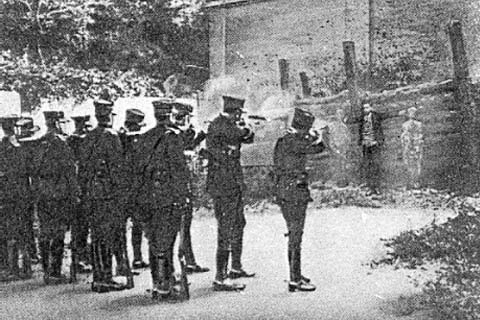
Pro, a Jesuit who like many was forced underground, was under state surveillance and got picked up in the aftermath of an assassination attempt against a prominent politician. He was chosen to make an example of — without an actual trial, possibly because there’s no actual reason to think he was involved in the bombing.

Looking at these pictures of Pro’s last moments, it’s hard to believe that they were taken and circulated at government direction to cow the Cristero movement. Fail.


Led out to execution in a police courtyard. The place of his death today is (bizarrely) Calle Loteria Nacional.


Calmly at prayer before his death, under the eye of the firing squad commander.


Pro himself refused a blindfold. But why state authorities carrying out the execution with an eye towards public relations would allow him to die in this pose is anyone’s guess.


He blessed and forgave the firing squad, of course.


Just beginning to topple at the moment the bullets struck him.


Like many firing squad executions, this one failed to kill its victim with the ceremonial volley. Pro was finished off with a coup de grace.

Calles was simultaneously — the key measures were also enacted in 1926 — involved in a confrontation with the United States over oil rights, a situation that came to the brink of war, with Washington saber-rattling about “Soviet Mexico”. It’s tempting to wonder whether the two situations weren’t related, especially since the new American ambassador* who had arrived only the month before Pro’s execution would ultimately negotiate both situations’ resolutions.

While the natural resource politics went their separate way, the Mexican Revolution’s anti-clerical strain didn’t so much disappear by negotiation as fade away over decades, with regular new outbreaks.

One thinks of Mexico today as such so staunch a Catholic country that it’s hard to imagine that some of these provisions were only officially repealed in 1998.

As for Pro, he’s welcome in Mexico by now — celebrated by Pope John Paul II who ultimately beatified him, and the inspirational source of this hymn whose refrain is his famous last cry.

There’s a faithful site in his honor here, and apparently a shrine to him in Houston, Texas run by a group pushing for his canonization.

* The American ambassador in question, Dwight Morrow, invited Charles Lindbergh on a goodwill tour to Mexico, where the aviator would meet the diplomat’s daughter not long after Miguel Pro’s martyrdom. Little could Lindbergh and Anne Morrow suspect that their love match would set them on the path to their own famous encounter with capital punishment.

On this day..