1938: Vladimir Kirshon, Bulgakov antagonist

On this date in 1938, Soviet playwright Vladimir Kirshon was shot at the Kommunarka “special object” shooting range outside Moscow.

Kirshon (English Wikipedia entry | Russian), purged as a “Trotskyist counter-revolutionary” as one might assume from the date and place. And like many peers in those terrible years, it was Kirshon’s to suffer the martyr’s fate without the merit of the martyr’s service.

In his day — which ran up to the spring 1937 fall of his patron, NKVD chief Genrikh Yagoda — Kirshon had distinguished himself with servility.

In his capacity as a Soviet writer’s guild bigwig, the ideologically rigorous Kirshon had been a point man in the depressing 1929-1932 campaign against the early Soviet Union’s rich literary heterodoxy. (Sample slogan: “For the hegemony of Proletarian literature! Liquidate backwardness!”)

This chilly period drove dystopian novelist Yevgeny Zamyatin to exile, and futurist poet Vladimir Mayakovsky to suicide.* The novelist and playwright Mikhail Bulgakov, a writer whose manuscripts from the furnace of Stalinism were forged for immortality, was also long harried by Kirshon. Kirshon’s pull nearly ruined Bulgakov’s career at what should have been its peak.

Bulgakov returned the contempt of his persecutor from a position of considerable literary superiority. Kirshon’s own work tended to the glorification of doctrinaire communism — he produced a verse celebrating the Civil War’s martyred 26 Baku commissars; Bulgakov has on his c.v. perhaps the signal achievement of 20th century Russian letters, The Master and Margarita. Little wonder to find Bulgakov complaining in private correspondence of the waste Kirshon has made of a trip to Europe, churning out the sort of tendentious and formulaic Soviet-man-abroad literature that any loyal commissar could have written without setting foot from Moscow. But despite the very real injuries Kirshon had done to him, Bulgakov found the baying denunciation theater so distasteful that he declined to say a public word against Kirshon when the latter fell.

The diary of Bulgakov’s wife Elena is not quite so diplomatic.

21 April 1937

A rumour that Kirshon and [Alexander] Afinogenov are in trouble. They say that [Leopold] Averbakh has been arrested. Is it possible that Nemesis has been visited upon Kirshon?

23 April 1937

Yes, Nemesis has come. There are very bad stories in the press about Kirshon and Afinogenov.

(These entries, quoted via J.A.E. Curtis’s Manuscripts Don’t Burn: Michael Bulgakov: a Life in Letters and Diaries, refer only to Kirshon’s professional fall. He was not arrested until that August.)

Kirshon was posthumously rehabilitated in the Khrushchev era and some of his work has even been performed in post-Communist Russia. But according to this Russian-language Bulgakov trove, that old foe made perhaps Kirshon’s lasting literary monument by using him as the model for the character Polievkt Eduardovich in Bulgakov’s short story “It Was May” (Russian link): it’s a story about a foppish critic who returns from abroad with specious critiques that force the narrator to ruin his own play by diverting the story to the arrest and purging of its principal character.

Thanks to friend of the blog Sonechka for translation and background.

* Mayakovsky shot himself at age 37; there’s also a popular hypothesis that he did this to check out at the same age as Pushkin.

On this day..

1847: Manuel Antonio Ay, Caste War harbinger

On this date in 1847, the execution of Maya leader Manuel Antonio Ay in Valladolid kicked off the Yucatan’s decades-long Caste War.

Under Spanish administration, Mexico had a dizzying 16-tiered racial caste hierarchy.

The casta system was officially abolished when Mexico attained independence in 1821, but for Amerindians the newfound equality was more aspirational than real. It’s just that now they were looking up at Mexican-born criollo elites instead of Iberia-born peninsulares.

Either caste’s powers that be had long found found the Maya especially contumacious subjects; a Yucatan Mayan stronghold had, indeed, been the very last unconquered indigenous realm of the Americas to fall to Europeans — as late as 1697.

In 1846, a heavily Maya Yucatecan peasantry, strained by the economic extractions the Mexican state was imposing for its disastrous war with the United States, began rising against the overweening local gentry.

The progress and organization of these disturbances varied, but it’s the execution of our man, the 27-year-old chief of the village Chichimila, that traditionally marks turning-point galvanizing a full-scale rebellion. On July 18, as armed Maya regiments gathered in nearby Tihosuco, Valladolid’s authorities seized Miguel Antonio Ay for planning a rebellion. He had in his possession a letter from Bonifacio Novelo, a major Maya chief who would become one of the Caste War’s leading figures in the years to come — indeed, Terry Rugeley says in Yucatan’s Maya Peasantry and the Origins of the Caste War that Ay served for his persecutors as “a temporary substitute for Novelo, whom officials feared and hated more than any Maya.”

They’d never lay hands on Novelo, but his substitute was executed in the town square of Valladolid, and the body returned to exhibit in Chichimila in a futile attempt to cow resistance: Ay had, instead, become the first martyr of the coming war. Three days later, the gathering Maya army sacked the village of Tepich, beheading the colonel who commanded its defenses — the onset of generations of general war that persisted into the 20th century.

On this day..

1683: Lord Russell, Whig martyr

On this date in 1683 at Lincoln’s Inn Fields in London the great Whig parliamentarian William, Lord Russell was beheaded with a legendary want of dexterity by Jack Ketch.

The third son of the Earl (later Duke) of Bedford, Lord Russell emerged from a decade of comfortable obscurity in the Parliament’s back benches to become a leading exponent of the nascent Whigs* opposed to royal absolutism and to Catholicism — two heads of the same coin, for the Whigs, given that the heir presumptive James had controversially converted to Catholicism.

The national freakout from 1678 over an alleged “Popish Plot” to undo Old Blighty gave Russell his cause; his leadership of the resulting parliamentary bid to exclude James from royal succession made the gregarious Russell “the governing man in the House of Commons”.

“Lord Russell was a man of great candour, and of general reputation; universally beloved and trusted; of a generous and obliging temper,” his friend Gilbert Burnet recorded of our man. “He had given such proofs of an undaunted courage and of an unshaken firmness, that I never knew any man have so entire a credit in the nation as he had.”

Russell was, Burnet allowed, “a slow man, and of little discourse, but he had a true judgment, when he considered things at his own leisure: his understanding was not defective; but his virtues were so eminent, that they would have more than balanced real defects, if any had been found in the other.”

Chief among those virtues was his wholehearted sincerity for his cause — a passion the source of both his renown, and his destruction. Russell was heard to espouse the view that James ought not merely be excluded from succession, but executed like his father.

Matters never quite approached that point, but the crisis provoked by the Exclusion Bill firebrands led King Charles II to dissolve parliament in 1681, depriving the Whigs of their legal perch. In the ensuing years politics played out not as legislation but conspiracy, and the crown’s rather more successful harassment of same: many of the chief Whig actors were driven offstage to scaffolds, dungeons, or continental exile.

The half-dozen most eminent Whigs remaining — to whom, besides Lord Russell, we number the king’s illegitimate son Monmouth, the Earl of Essex, Baron Howard of Escrick,** Algernon Sidney, and John Hampden† — formed a sort of informal Council of Six who met secretly to consider the bad options available to the fractured Whig movement. Some section of the wider Whig network in which this Council operated turned eventually to considering the most desperate of measures.

Their Rye House Plot schemed to waylay and assassinate the royal person near a fortified manor handily on the king’s route back to London from the Newmarket races. It was owned then by a radical former soldier of Cromwell‘s New Model Army.

It has been long debated to what extent any of the top Whigs knew of or actively participated in this Guy Fawkesian plot, or its complement, a projected armed rising of the sort that Monmouth would indeed mount in 1685. One school of thought is that the Tories seized it as an expedient to eviscerate the remaining Whig leadership by conflating the entire movement with a regicidal scheme; another is that the Whig insistence upon its martyrs’ innocence — and Lord Russell is the chief man in this pantheon — has amounted to a fantastic propaganda coup.‡

In June 1683, a salter who was in on the Rye House planning got a cold sweat and informed on the Whigs. This backstab earned a royal pardon for himself, and started a familiar policing sequence of incriminated conspirators turning crown’s evidence and informing in their turn on the next part of the network.

Many of the Whigs fled to the Netherlands, received there by the House of Orange which would seat itself on the English throne inside of six years.

Lord Russell, however, refused to fly. He landed in the Tower of London by the end of the month, to face trial as a traitor on the evidence of his association with other Whigs and his entertaining the plan of raising an armed revolt. (He would have been joined in the dock by Essex, but that worthy cut his own throat in the Tower.) The judge’s summation to the jury even underscored that “You have not Evidence in the Case as there was [in other Rye House cases] against the Conspirators to kill the King at the Rye. There was a direct Evidence of a Consult to kill the King, that is not given you in this Case: This is an Act of contriving Rebellion, and an Insurrection within the Kingdom, and to seize his Guards, which is urged an Evidence, and surely is in itself an Evidence, to seize and destroy the King.”

Lord Russell’s case shifted around the fringes of actual innocence — those plans for Insurrection within the Kingdom, he said, occurred sometimes at meetings he happened to attend but only off on the side, or without Lord Russell’s own involvement or support. (Speaking from the scaffold, he would several times insist that his acts were at worst misprision of treason, which was no longer a capital crime at this point.)

Against this the crown produced Lord Howard, a cravenly interested party to be sure, who saved his own skin by testifying that the six-headed cabal was down to planning the specifics of the places where a rebellion might best be stirred up, the procurements of arms and bankroll that would be necessary to same, and how to draw Scotland into the fray as an ally. “Every one knows my Lord Russell is a Person of great Judgment, and not very lavish in Discourse,” Howard allowed on the point of Russell’s active assent to the plans. “We did not put it to the Vote, but it went without Contradiction, and I took it that all there gave their Consent.”

David Hume would observe in his History of Great Britain that Russell’s “present but not part of it” parsing didn’t make for a very compelling story. “Russell’s crime fell plainly under the statute … his defence was very feeble.”


Detail view (click for the full image) of an 1825 painting of Lord Russell’s trial, commissioned of George Hayter by Lord Russell’s admiring kinsman John Russell, Duke of Bedford. John Russell also wrote a biography of his famous ancestor. The unbroken succession of Dukes of Bedford from William Russell’s father continues to the present day; the current Duke of Bedford, 15th of that line, is one of Britain’s richest men.

Conscious of the great pulpit his scaffold would offer, Lord Russell drafted with the aid of his wife a last statement vindicating his own person and the Whig cause that flew into print before the onlookers at Lincoln’s Inn Fields were dipping their handkerchiefs into his martyrs’ blood.

Nor did I ever pretend to a great readiness in speaking: I wish those gentlemen of the law who have it, would make more conscience int he use of it, and not run men down by strains and fetches, impose on easy and willing juries, to the ruin of innocent men: For to kill by forms and subtilties of law, is the worst sort of murder …

I never had any design against the king’s life, or the life of any man whatsoever; so I never was in any contrivance of altering the government. What the heats, wickedness, passions, and vanities of other men have occasioned, I ought not to be answerable for; nor could I repress them, though I now suffer for them.

These notices drew furious confutations from Tory pamphleteers aghast at the face these traitors had to forswear their malice against King Charles; a battle of broadsides to control the historical narrative ensued, and was resolved in the Whigs’ favor by the imminent conquest of power by the aforementioned House of Orange. The Whig-aligned William and Mary reversed Lord Russell’s attainder in 1689 — but that’s never stood in the way of historians’ debates.

In a much lower historical register, Lord Russell’s execution was egregiously bungled by the London headsman Jack Ketch, who had to bash repeatedly at the man’s neck before he could remove it from the shoulders. It is largely from this event that Ketch derives his lasting reputation as an incompetent and/or sadistic butcher, mutually reinforcing with Russell’s martyr status.

Ketch would later claim in a published “Apologie” issued against “those grievous Obloquies and Invectives that have been thrown upon me for not Severing my Lords Head from his Body at one blow” that his prey

died with more Galantry than Discresion, and did not dispose him for receiving of the fatal Stroke in such a posture as was most suitable, for whereas he should have put his hands before his Breast, or else behind him, he spread them out before him, nor would he be persuaded to give any Signal or pull his Cap over his eyes, which might possibly be the Occasion that discovering the Blow, he somewhat heav’d his Body

and besides that Ketch “receav’d some Interruption just as I was taking Aim, and going to give the Blow.” How would you like it if someone came to your workplace and did that?

The damage to Ketch’s reputation was already done. Two years later, en route to the block for a subsequent failed bid to topple the Stuarts, the Duke of Monmouth tipped Ketch with the scornful charge not to “hack me as you did my Lord Russell.” When Ketch botched that execution too, he was nearly lynched — but escaped the scaffold to live on in Punch and Judy and in the English tongue as the definitive lowlife executioner.

* Short for “Whiggamores”, who were Covenanter rebels in the 1640s. “Tories”, by contrast, took their name from Irish Catholic outlaws: each party became known by the slur its foes attached to it.

** Yes, another one of those Howards: this Howard’s great-grandfather lost his head for the Ridolfi intrigue.

† Hampden survived the suppression of Whig intrigues long enough to coin the term “Glorious Revolution” when the Stuarts were finally overthrownJournal of British Studies, January 1985 for a skeptical-of-Russell reading of the evidence. “The government did not concoct the plot; it was frightened by the revelations, whatever use it made of them. There is no doubt that proposals for an insurrection of some kind were discussed; Russell’s impetuosity and extremism make it more likely than not that he was an active party to these discussions. What is in doubt, since nothing came of the discussions, is how far the parties had gone in developing a concrete plan for a rising.”

On this day..

1517: Cardinal Alfonso Petrucci, plotter

On this date in 1517, the Italian cardinal Alfonso Petrucci was put to death for a conspiracy to murder Pope Leo X.

Leo had been acclaimed pope in 1513 at a conclave noted for nearly electing the worst possible pontiff when cardinals hedging their first-ballot votes while they took the temperature of the room all happened to vote alike for the feeblest candidate on the expectation that nobody else was voting for that guy.

Chastened by the near-miss, the leading candidate Giovanni de’ Medici promptly cut a deal with his chief legitimate rival for St. Peter’s seat, Raffaele Riario.*

This arrangement boosted to St. Peter’s throne the first of four popes from the Medici, intriguingly done with the acquiescence of Riario, who was kin to one of the prime movers of the anti-Medici Pazzi Conspiracy from many years before. Both Giovanni de’ Medici and Raffaele Riario were too young to have played a part in those events, but the lingering familial animosity might well bear on what transpired in the papacy of Giovanni de’ Medici — or rather, as we shall know him henceforth, Pope Leo X.

Leo was an entirely worldly character, whose enthusiasm for the peninsular politics that shaped his native habitat would help lead a German cleric to nail 95 theses to the door of a church in Wittenberg later this same year of 1517. “Why does the pope, whose wealth today is greater than the wealth of the richest Crassus, build the basilica of Saint Peter with the money of poor believers rather than with his own money?” Martin Luther demanded (thesis 86) of Leo’s increasingly shameless indulgences racket.

Acting more the Medici than the Vicar of Christ, Leo in 1516 deposed the tyrant of Florence’s neighbor and rival, Siena. The declining Sienese Republic was a prime target of Florence’s expansionist ambitions, and indeed it would be gobbled up in the mid-16th century by the Florence-based and Medici-led Grand Duchy of Tuscany.
In Leo’s time, his coup shattered Siena’s ruling Petrucci family** to the injury of one of Leo’s fellow churchmen, Cardinal Alfonso Petrucci English Wikipedia entry | the much more detailed Italian). Alfonso now had cause to use his office for the agenda of his family and his city, and sought a countervailing anti-Medici arrangement with the condottiero Francesco Maria I della Rovere, whom Leo was even then fighting a war against.

The arrangement came to nothing and Leo assured Alfonso of safe conduct for his return to Rome. It was just a lot of scheming Italian oligarchs doing what they always did, some of them while wearing cassocks.

Except upon Alfonso’s return, Leo had the Petrucci cardinal and another cardinal friendly to him clapped in prison for an alleged plot to poison the pontiff.

Cossetted court cardinals suddenly found themselves accused papicides under the threat (and, for some, the reality) of torture. Hard-to-credit “confessions” duly ensued with Leo enlivening the spring and summer of 1517 with preposterous security theatrics.

On June 8 they assembled in Consistory, when the Pope burst out into complaints. He had evidence, he said, that two other Cardinals whom he had trusted had joined in the conspiracy against him; if they would but come forward and confess he would pardon them freely; if they refused to confess he would have them carried to prison and would treat them like the other [accused]. The Cardinals gazed on one another in alarm, and no one moved. The Pope asked them to speak, and each in turn denied … Leo X’s dramatic stroke was a failure; he could not succeed in his unworthy attempt to induce some unsuspected person to criminate himself. (Source)

It’s hardly past thinking that rival factions would poison off a pope, and there’s been some latter-day research suggesting that something really was afoot. For that matter, Leo’s actual death in 1521 has often been suspected of being aided by an apothecary’s philter.

But outside the dramatics, Leo scarcely handled his prisoners in 1517 as if he were much in genuine fear for his life.

Instead, the practical pontifex maximus used it as a shakedown opportunity against anyone who could be denounced a confederate of the hotheaded young Petrucci. The Genoese Cardinal Sauli, arrested together with his friend Petrucci, was forced to buy his liberty for 50,000 ducats; Cardinal Riario, Leo’s old opposite number from the 1513 conclave, was implicated by Petrucci and Sauli as knowing himself the prospective beneficiary of the plot, and Riario was forced to retire to Naples upon payment of an exit tariff of 150,000 ducats plus his Roman palace. (It remains papal property to this day as the Palazzo della Cancelleria.) Further downmarket, Cardinals Soderini and Adrian fled Rome in despair of discharging the 25,000-ducat fines affixed upon each of them.

Money, however, would not suffice for Cardinal Petrucci, the active center of whatever conspiracy existed. Petrucci probably did murmur something one could construct as treason against his Holy Father, if one regarded them in their ecclesiastical rather than their dynastic positions, and he evidently engaged the Pope’s surgeon Giovanni Battista da Vercelli as an instrument of the proposed assassination or at least made loose talk to that effect.

While the doctor, along with Petrucci’s private secretary, were hauled through the streets to a demonstrative gibbeting, Petrucci was strangled privately in his cell on July 16, 1517. It was done by a Moor out of consideration for the impropriety of a Christian slaying a father of the Holy Church.

Beyond the rent-seeking and the rival-eradicating, Leo leveraged the purported plot to appoint 31 new cardinals in July 1517, basically doubling the College of Cardinals at one stroke while stocking the ranks with men who could offer him political support or timely bribes.

* Riario’s legacy can still be seen around the Vatican to this day: he’s the guy who brought Michelangelo to Rome.

** Leo’s coup deposed one Petrucci and raised up a different, more compliant Petrucci.

On this day..

1731: Jose de Antequera, Paraguayan comunero rebel

On this date in 1731, Jose de Antequera had his head cut off in Lima for leading a comunero rebellion against the Spanish crown in Paraguay.

Antequera, a judge, began his revolution legally in 1721 by affirming an impeachment the city council of Asuncion (Paraguay’s present-day capital) against the unpopular Spanish governor. Antequera, conveniently, also happened to be the guy who would succeed the unpopular territorial governor.

The conflict between the two would-be governors spiraled into a wider revolt for local autonomy pitting criollo settlers against the crown, though it would likely be overstating matters to call this a true bid for independence. One notable sore spot between the two parties was the prerogatives of Jesuit Reductions: these mission settlements for Christianizing natives (particularly prominent in Paraguay for the Guarani people) had originally been placed at the far fringes of Spain’s New World reach, and they enjoyed a wide autonomy, sustaining themselves economically with the yerba mate trade. For the Guarani, these were also welcome refuges from the brutal encomiendas; Guarani militias stoutly repelled slave raiders.

For these prerogatives, the Jesuits and the Guarani were loyal to the Spanish crown as against the local settlers better inclined to view the Reductions (and the potential slaves who inhabited them) as assets they’d like to get their own hands around. Antequera accordingly expelled the Jesuits near Asuncio and for a few years his word was law in Paraguay. Guarani troops mustered by the crown helped put the rebellion down, taking Antequera into custody and forwarding him to the notoriously severe Marquis of Castelfuerte, the Peruvian viceroy.

Society at Lima was in [Antequera’s] favor. Great efforts were made to delay his trial. But the viceroy was resolved to punish him, and sentence of death was passed. The judges, the university, the municipality, petitioned for pardon, as well as the people of all classes. The stern old marquis refused to listen, and Antequera was brought out for execution in the great square of Lima on July 5, 1731. There were cries for pardon, and the mob began to throw stones. Hearing the tumult, the viceroy came out on horseback and ordered his guards to fire. Antequera fell dead, as well as the two priests by his side, and several others. The viceroy then ordered the body to be taken to the scaffold and beheaded. His conduct received the approval of the king by decree of September, 1733. (Source)

The Spanish had not heard the end of Antequera.

During his imprisonment, Antequera befriended and inspired a fellow-prisoner named Fernando Mompo. After Antequera’s execution, Mompo returned to Paraguay brandishing the late rebel governor’s banner: “The authority of the commune is superior to that of the King himself!” Mompo launched a recrudescence of the comunero rebellion in the early 1730s. Mompo too shared Antequera’s fate.

A change in the political winds decades later led to the Spanish king Charles III himself expelling the Jesuits — and posthumously exonerating Jose de Antequera.

On this day..

1310: Badoer Badoer, Venetian rebel

A Venetian rebel was beheaded on this date in 1310.

Our grim tale actually tacks back to an altogether different death: the sudden January 31, 1308 demise of Azzo VIII d’Este, lord of Venice’s neighbor Ferrara.*

The resulting power vacuum saw Venice under the Doge Pietro Gradenigo tangle for influence in Ferrara with the Papal States of Pope Clement V.

This controversial intervention briefly put a Venetian puppet ruler in charge of Ferrara, but it also led Clement to excommunicate Gradenigo and place La Serenissima under a papal interdict.

The moral force which the condition of society lent to such a measure was immense … It paralyzed trade; it dried up the sources of industrial wealth; it laid a country under every civil and religiou disability; it shed over society an atmosphere of gloom; it affected every relation of life … At home it fomented agitation, gave colour and pretext to the worst motives, and evoked all the latent distempers of the public mind. Abroad, it legitimized rebellion, imparted to moribund antipathies a new vitality, and transformed wavering allies into open enemies. (From History of the Venetian Republic, vol. II, whose detailed narrative of the events relevant to this post continues in Volume III)

Clement also had more temporal weapons to fight with, and he used them to ruthless effect.

In August 1309, papal troops overran the Venetian garrison at the Ferrara fortress of Tedaldo and handled the prisoners like they had the Dolcinians, choking the Po with Venetian corpses.

Conditions were ripe for some disturbances in La Serenissima. The Ferrara thing was a complete debacle, and not only was the same guy still in charge, but his previous foreign policy resume basically consisted of being repeatedly outmaneuvered by Genoa.

Hotheads of three leading families of the Venetian opposition who had vainly counseled neutrality in the Ferrara affair, the Quirini, the Badoer, and the Tieopolo, embarked an audacious plot to mount a coup d’etat toppling the Doge and the whole Ground Council of noblemen by whom he ruled. The conspirators were to act on the morning of June 15 — but hours before that, a vacillating confederate had betrayed them. As a result, when the ferocious Marco Quirini arrived at the Piazza San Marco that morning with his men-at-arms, the Doge had a surprise force waiting to rout him under a furious downpour.

Quirini at least had the honor of dying in hopeless battle for his cause. His son-in-law and co-conspirator Bajamonte Tiepolo, who was to arrive at the same square via the Mercerie, dithered and showed up only when Quirini was already defeated and dead. Legend has it that a woman named Giustina Rosso killed Tiepolo’s standard-bearer dead by hurling (or just accidentally dropping) a mortar upon the rebels as they advanced up the street. (Present-day tourists traversing this upscale shopping street can catch a small bas-relief commemorating this character near the clock tower where the Mercerie opens onto St. Mark’s.)

Tiepolo belatedly charged the square, and was like Quirini repulsed; however, he was able to fall back across the Grand Canal, cutting the bridge against his pursuers, and holed up in a makeshift fortress hoping for reinforcements from the last-arriving of their fellows, Badoer Badoer.

The latter, however, was intercepted on his way to reinforcing the revolutionaries’ position and taken prisoner, which defeat of his hopes led Tiepolo and Doge alike to prefer a negotiated surrender to the charnel house that would have resulted from storming the redoubt. His followers were amnestied and Tiepolo himself sent into exile.

But Badoer Badoer was not covered by this deal. The Council he had proposed to overturn instead tried him for treason, and voted his condemnation on June 22 — a sentence put into immediate effect.

The exiled Tiepolo’s home was razed to the ground and replaced with a column eternally damning his memory:

This land belonged to Bajamonte
And now, for his iniquitous betrayal,
This has been placed to frighten others
And to show these words to everyone forever.

That column today has been removed to a museum — evidently one needs special permission to find it — but a worn stone outside a souvenir shop labeled “Loc. Col. Bai. The. MCCCX” marks the spot where it stood for four centuries.

The plot’s other legacy to Venice was the Council of Ten, a sort of inner secretariat of the Grand Council. Introduced in July 1310 as an emergency measure, the Ten soon became a permanent feature of the state, and an increasingly powerful one into the 17th century. The “temporary” council ended up lasting until the Napoleon finally toppled a by-then tottering Venetian Republic in 1797.

* In the Inferno, Dante accuses Azzo of assassinating his father.

On this day..

1962: Gottfried Strympe, purported terrorist

The novel East German polity was coming in the late 1950s to a crossroads that saw security paranoia ratchet up dramatically.

Emigration to West Germany accelerated considerably as the 1960s began, eventually giving rise to the infamous Berlin Wall.

In the countryside, forced collectivization implemented in 1960 produced resistance all its own. Agricultural output plummeted (the knock-on effects of a 1959 drought helped too); according to Patrick Major’s Behind the Berlin Wall: East Germany and the Frontiers of Power, groceries and everyday household items became markedly more difficult to procure in the early 1960s, sapping productivity throughout the economy as city workers queued for hours and black-market exchanges proliferated.

Following the Soviet Union’s great tradition of attributing economic trouble to running-dog wreckers, East Germany introduced the death penalty for politically motivated economic sabotage* — for example, the 206 cases of arson it attributed among 862 rural fires in 1960. (Figures as per Major.)

Our figure today, Gottfried Strympe, fell foul of these laws. In reality, he was no cackling secret agent but a disturbed loner.

He lurked about the eastern city of Bautzen opportunistically by turns the petty thief or the peeping tom.

Unfortunately for Strympe, who did some spells in psychiatric wards, his deviance extended past the titillation of spying a Hausfrau in her bustier to the much more menacing diversions of pyromania.

The poor man needed a social worker; what he got was the executioner. The charge sheet dramatically attributed his 28 acts of arson (crimes that each caused only minor property damage, and no human casualties) to the inspiration of “West German and American imperialists.”

Strympe, you see, had often visited a father (deceased in 1958) in West Berlin, back before the Wall sealed that city. Of course on those trips, Strympe picked over a Whitman’s sampler of western decadences, from pornography to Social Democracy. On this basis, the Stasi attributed his incendiarism to “terrorism” rooted in “an antisocial attitude strengthened by his stays in West Berlin.”

Strympe had a public show trial, the better that “the population of Bautzen will recognize the danger of communication and travel to West Berlin” (with props of said population — workers’ and civic groups — obligingly supplying the requisite demands for the traitor’s execution).

He was beheaded by Fallbeil at Leipzig on June 21, 1962.

* See Politische Strafjustiz in der Ära Ulbricht: Vom bekennenden Terror zur verdeckten Repression by Falco Werkentin.

On this day..

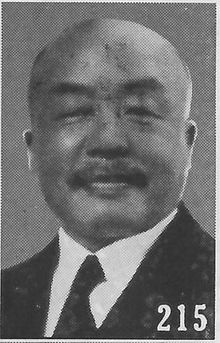
1950: Chen Yi, 228 Massacre author

On this date in 1950, Taiwan’s former nationalist governor Chen Yi was shot for a dalliance with the Reds.

A Kuomintang officer since China’s 1920s Warlord Era, Chen Yi was from 1934 Chiang Kai-shek’s governor of Fujian province — the mainland territory directly across from the island of Taiwan. Chen had the honor at the end of World War II of accepting Japan’s surrender of Taiwan — the occasion commemorated by Taiwan’s unofficial October 25 holiday, Retrocession Day. Postwar, he became governor of that island, back before it was synonymous with nationalist China itself.

His life ended in 1950, when Chiang suspected him of negotiating with the Red Chinese who had overrun the mainland. By that point, however, Chen’s political career was already history, courtesy of the most lasting of his legacies, the 228 Massacre (or more diplomatically … “Incident”).

Taiwan’s new managers — the place had been in Japanese hands since 1895 — made an immediate mess after 1945. Taiwan’s productive economy was essentially siphoned for the civil war the KMT had underway against the Communists, as well as for the venal enrichment of various well-connected mainlanders who hopped over to Formosa for plum assignments that displaced Taiwan’s own local elites.

Billowing inflation fed ethnic resentments, and the whole situation boiled over, as the name implies, on 2/28 of 1947.

On that date, frustrations boiled over* in island-wide protests that turned to riots and even took over administration of Taipei and many other cities. Chen, on whose watch the many grievances had accumulated, suppressed those with enormous violence. Chen regained control of the situation only with considerable violence: well over 10,000 are thought to have been killed in suppression during early March, many of them executed in cold blood by mainland military reinforcements.

An American who had just arrived in China from Taihoku said that troops from the mainland arrived there March 7 and indulged in three days of indiscriminate killing and looting. For a time everyone seen on the streets was shot at, homes were broken into and occupants killed. In the poorer sections the streets were said to have been littered with dead.

There were instances of beheadings and mutilation of bodies, and women were raped, the American said.

Two foreign women, who were near at Pingtung near Takao, called the actions of the Chinese soldiers there a “massacre.” … people were machine gunned. Groups were rounded up and executed.

The man who had served as the town [of Pingtung]’s spokesman was killed. His body was left for a day in a park and no one was permitted to remove it.

While effective in reasserting political power, this didn’t exactly bury the animosities between Taiwanese and mainlanders. It did put an end to Chen Yi’s governorship, however, since it was on his watch that things came to this pass in the first place. Given he then doubled as the author of the bloodbath, he assured himself a place of opprobrium in Taiwanese history.

In 1949, the Kuomintang nationalist government fled rout on the mainland and holed up on Taiwan, implementing an authoritarian state under martial law with a running “White Terror” against dissidence, often broadly conflated with communism. Until political liberalization in the late 1980s, public discussion of 228 was strictly taboo.

Today, there’s enough distance that the event is openly commemorated; indeed, Lee Teng-hui, the politician who embraced Taiwan’s democratic transition around the end of the Cold War, was himself a participant in the 228 protests. There are a variety of memorials and parks remembering 228 in present-day Taiwan … but you’d have to look very hard to find one for Chen Yi.

* The specific boiling point for the protests was a violent confrontation on February 27 when state agents had seized the unlicensed cigarettes of a local peddler. The way things were going, however, there was always going to be something like this to catalyze Taiwanese anger.

On this day..

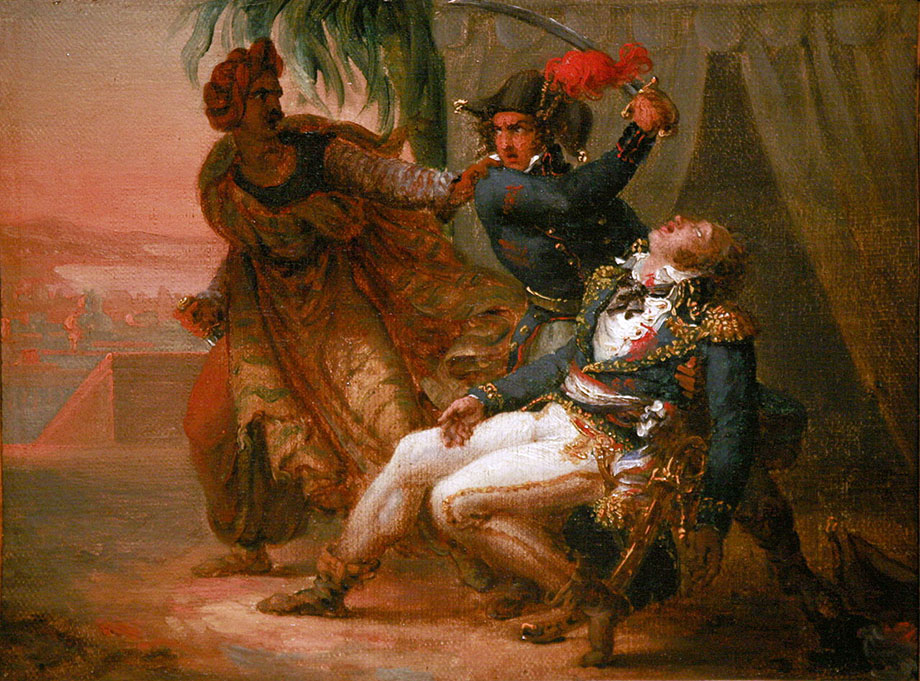
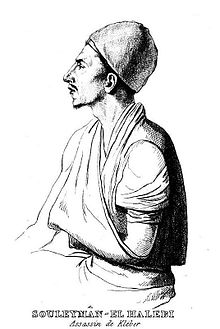
1800: Suleiman al-Halabi, assassin of General Kleber

On this date in 1800 — which was the same date they buried his victim — the 23-year-old student Suleiman al-Halabi was put to death in Cairo for assassinating French General Jean Baptiste Kleber.

Casualty of the brief Napoleonic adventure in Egypt, Kleber had received supreme command of the expedition when Napoleon himself returned to France the previous year — a mission which involved running the English naval blockade that trapped the Armee d’Orient.

Kleber, a product of the French Revolution’s military meritocracy who had attained his rank capably suppressing the Vendee royalists, was certainly up to the martial tasks at hand. He routed a larger Ottoman-English-Mamluk force in March of 1800, and then smashed a revolt in Cairo.

But the Napoleonic invasion often figures as a periodization marker for this region: the germ of liberalism and nationalism that would tear apart the Ottoman Empire and set the scene for a recognizably modern Middle East. So it’s somewhat fitting that Kleber would be undone by a figure who could be lifted from the evening news,* the anti-occupation insurgent.

Suleiman al-Halabi (English Wikipedia entry | French) was a Syrian Kurd hailing from Aleppo. (“al-Halabi” means “of Aleppo”)

He had been in Cairo to study, but after a return visit home was induced by the Turks to attend himself to punishing the invader instead. He then made his way back to to Egypt where, disguising himself as a beggar, where he was able to approach the general innocuously and dagger him to death.

The French, of course, had just a few years before this point introduced its most distinctive execution device in place of the ghastly old methods, and employed it with egalite for commoner and king alike. Nor was France, as an imperial power, reluctant about exporting its invention to the every corner of earth.

But in this particular instance, the French decided to prioritize, er, cultural sensitivity.

The committee, after carrying through the trial with all due solemnity and process, thought it necessary to follow Egyptian customs in its application of punishment; it condemned the assassin to be impaled after having his right hand burned; and three of the guilty sheikhs to be beheaded and their bodies burned.

The “guilty sheikhs” in question were men to whom the killer had confided — not his plan, exactly, but the fact that he was on a jihad mission. Hey, close enough.

As for Suleiman al-Halabi himself,

The executioner Barthèlemy sat down on Suleiman’s belly, drew a knife from his pocket, and made a large incision to widen the rectum, then hammered the point of the stake into it with his mallet. Then he bound the patient’s arms and legs, raised the stake the air and mounted it in a prepared hole. Suleiman lived for four hours, and he had lived longer save that, during the absence of Barthèlemy, a soldier gave him a drink which caused his immediate death.

(Impaling victims could live for agonizing days, but the water caused Suleiman, mercifully, to quickly bleed out.)

Not content with going all Vlad the Impaler, the French then paid homage to the invasion’s scientific sub-theme** by shipping Suleiman’s remains back to France for use as an anthropological exhibit.† His skull still remains at the Musee de l’Homme to this day. What’s left in his homeland(s) is a martyr’s memory.

According to the scholar al-Jabarti, whose chronicle is one of the principal sources on this episode, the investigation indicated that Suleiman undertook his mission for no ideology save his family’s desperate need of the purse the Porte was willing to offer. But in the ensuing decades’ growth of nationalism and, eventually, anti-colonialism, the brave young Muslim dying on a spike to slay the French commander could not help but be viewed in an exalted light. (Notably, at the acme of Arab nationalism, the Egyptian writer Alfred Farag celebrated Suleiman as an avatar of resistance in a 1965 play. “I do not kill for revenge,” Farag’s Suleiman avers — and when pressed for the reason, he has a one-word reply: “Justice.”)

* Indeed, the name has been in the news: there’s a Suleiman al-Halabi neighborhood in Aleppo that has seen fighting during the ongoing Syrian civil war. Since it’s even a Kurdish neighborhood one can’t but suspect that it’s named for the man featured in this post; however, I haven’t been able to establish that with certainty. If any reader knows, a comment would be most welcome.

** Napoleon brought a corps of scientists and intellectuals along on his invasion, kicking off the modern Egyptology craze. His mission also uncovered the Rosetta Stone — although that artifact now resides in the British Museum because of the aforementioned naval blockade.

† According to Dark Trophies: Hunting and the Enemy Body in Modern War, phrenologists hailed Suleiman’s skull as an outstanding exemplar of criminality and fanaticism.

On this day..

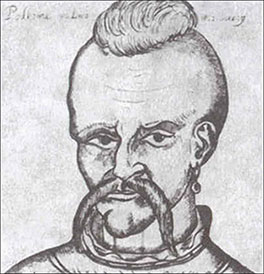
1578: Ivan Pidkova, Cossack hetman

On this date in 1578, Cossack hetman Ivan Pidkova lost his head in Lviv.

Pidkova* — the name means “horseshoe” and alludes to the horsemanship that would be de rigueur for a Cossack leader — had risen by his aptitude to leadership of the Zaporozhian Cossacks in present-day Ukraine.

His death was a bid to promote himself from the steppe to power over neighboring Moldavia, and in fairness to Ivan Moldavia was worth a go.

Its throne was held at that time by a new guy named Peter the Lame, and although the nickname just referred to Peter’s physical deformity, he was a creature of the Ottoman court who scarcely knew Moldavia before he became its vassal ruler in 1574. He was twice temporarily deposed before finally voluntarily resigning in 1591 so that he could retire to the comforts of Italy.

The first deposition came courtesy of our man Pidkova.

Claiming kinship with Peter’s late predecessor Ivan III,** Pidkova seized Iasi and proclaimed himself hospodar of Moldavia until the arrival of Ottoman reinforcements refuted the conceit.

This whole border region between the Polish-Lithuanian Empire to the north and the Ottomans to the south was a perennial trouble spot. Putatively subjects of the Polish crown, the refractory Cossacks were known to raid Ottoman territory illicitly and provoke diplomatic headaches on both sides of the border.

At this particular moment — 1578, that is — the Polish king Stephen Batory had only just concluded a truce with the Ottomans. As Batory had war with Russia to worry about, he was more than keen to keep his southern frontier calm; Polish troops captured the Cossack pretender and had him put to an exemplary death.


Monument to Ivan Pidkova in present-day Lviv. Image (c) stacy2005ua, a prolific photographer of Lviv’s environs whose work can be enjoyed at FaceAndHeart.com or on Flickr, and used with permission.

Ukraine’s national bard Taras Shevchenko celebrated Ivan Pidkova in an eponymous 1839 poem:

There was a time in our Ukraine
 When cannon roared with glee,
A time when Zaporozhian men
 Excelled in mastery!
They lived as masters — freedom’s joy
 And glory were their gain:
All that has passed, and what is left
 Is grave-mounds on the plain!
High are those ancient tumuli
 In which were laid to rest
The Cossacks’ fair white bodies
 In silken cerements dressed.
High are those mounds, serene and dark
 Like mountains they appear,
Their gentle whispers in the wind
 Of freedom’s fate we hear.
These witnesses of ancient fame
 Hold converse with the breeze;
The Cossacks’ grandson reaps the grass
 And sings old memories.
There was a time when in ukraine
 Even distress would dance,
And sorrow in a tavern drank
 In honeyed brandy’s trance.
There was a time when life was good
 In that Ukraine of ours …
Recall it then — perhaps the heart
 May briefly bathe in flowers.

II.

A murky cloud from Liman’s shore
 Covers the sun from sight;
The sea is like an angry beast
 That groans and howls with might.
It floods the mighty Danube’s mouth.
 “My fellows, come with me
Within our barks! The waves are wild.
 Let’s have a merry spree!”
The Zaporozhians rushed out;
 The stream with ships was roiled.
“Roar on, O sea!” they all sang out,
 As waves beneath them boiled.
Billows like mountains round them surged,
 They saw no land, no sky.
Yet not a Cossack heart grew faint,
 Their eagerness ran high.
A bold kingfisher flies o’erhead
 As on they sail and sing;
The brave otaman in the van
 Leads on their mustering.
He strides the deck, and in his mouth
 His pipe grows cold from thought;
He casts his glances here and there
 Where exploits may be wrought.
He curled his long black whiskers,
 He twirled his forelock free,
Then raised his cap — the vessels stopped:
&nbsp:”Death to the enemy!
Not to Sinope, comrades,
 Brave lads beyond all doubt!
We’ll drive on full to Istanbul
 To seek the Sultan out!”
“Well spoken, our fine chieftain!”
 They roared in chorus back.
“I thank you, lads!” He donned his cap.
 Again the seaward track
Beneath their keels began to boil;
 And once more thoughtfully
He paced the deck in mute content
 And gazed upon the sea.

That translation is via The Poetical Works of Taras Shevchenko; the original in Ukrainian can be enjoyed here. The exact text of that poem also comprises the lyrics of this jam:

* Or Ioan Potcoava, as Ivan came from Romanian stock.

** Moldavia’s own “Ivan the Terrible” — no relation to his Russian contemporary, of course.

On this day..