Alchemist, prophet, and dashing Italian rogue, the Jesuit-educated Giuseppe Francesco Borri (English | Italian) was burned on this date in 1661.
Luckily, he was hundreds of kilometers away.
A Milanese noble by birth, Borri was studying in Rome when he experienced a vision and started expounding a mystical theology decidedly not acceptable to Catholic orthodoxy.
That Mary’s mother was conceived of the Holy Spirit, and therefore that the Madonna was a goddess. That, with the limitless proceeds of the philosopher’s stone, he’d bankroll a spiritual army under the wings of the archangel St. Michael.
The charismatic young prophet began attracting quite a following — including the eccentric Swedish Queen Christina, then hanging around Rome after her abdication and indulging her own taste for alchemy — and was soon obliged to flee Rome for Milan, and then Milan for Switzerland, with the Inquisition at his heels. (He’s supposed to have left behind the occult markings that adorn the Porta Alchemica.)
While the heresiarch was safe abroard, the Roman Inquisition went ahead with its business without him. It was ruled that Borri was
to be punished as a heretic for his errors, that he had incurred both the ‘general’ and ‘particular’ censures, that he was deprived of all honour and prerogative in the Church, of whose mercy he had proved himself unworthy, that he was expelled from her communion, and that his effigy should be handed over to the Cardinal Legate for the execution of the punishment he had deserved.
Nothing daunted, the “executed” Borri set up as a doctor, scientist, astrologer, and alchemist in northern Europe — Strasbourg, Amsterdam, and Copenhagen. Throughout the 1660s his alchemical arts attracted the patronage of royalty as well as an endless stream of ailing patients and curious hangers-on. Borri even claimed to have accomplished the feat of transmuting a base metal into gold, which magical product can still be seen at a Danish museum.
Borri’s alchemy gold.
In a way, he did: the guy became fabulously wealthy. And he never stopped promulgating his cabalistic spiritual theorems.
Unfortunately his Danish patron died in 1670, and while en route to his next gig in Turkey he was arrested in Hapsburg territory and handed over the papacy. Borri was not put to death bodily, but spent the remainder of his life imprisoned in Rome, finally dying in the Castel Sant’Angelo in 1695.
On this date in 1946, former Nazi Kreisleiter Franz Strasser was hanged at Landsberg Prison for war crimes.
Strasser was condemned for shooting five downed American airmen in Czechoslovakia in December 1944, an American tribunal dismissing the defense: “There is not a scintilla of evidence to support STRASSER’s contention that he shot the prisoners to prevent their escape.” (A pdf scan of the entire verdict is here.)
On this date in 1841, Archilla Smith was hanged over a tree branch in Cherokee Country (since the gallows hadn’t been delivered in time) for the murder of John MacIntosh.
Payne lived with the Cherokees in Georgia immediately preceding their forcible removal to Oklahoma along the Trial of Tears, and then repaired to Oklahoma with the evicted tribe. (Payne unsuccessfully lobbied the U.S. Congress against its removal policy.)
The procurement of Cherokee signatures on the treaty that gave legal cover to the tribe’s expulsion from Georgia was a source of bitter controversy … and a generation of internecine violence. Our principal for this date’s post, Archilla Smith, himself affixed an X-mark to this notorious document, and he was defended at the trial in question here by another signer, Stand Watie.
Payne’s book, however, does not much treat the political context of Indian removal, nor even read as something like a true crime book: the brawl between the killer and the victim, two aggressive men with a passing and private quarrel, is little more than the background fact; the question for the jury turned on little but the degree of wilfulness or intent in the fatal stab wound Smith dealt, and various witnesses describe the same scene of their melee with slight differences of shading.
Rather, it’s a courtroom drama, and an outsider’s sketch of Cherokee jurisprudence (amalgamating tribal and Anglo-Saxon practices) circa 1840. It’s also the first newspaper any Oklahoma trial.
There as no appearance of bitter feeling on either side. The accused and the judge and jury and spectators, all seemed in the best of humor with one another. The accused smoked much of the time; and his judge, and most of the jury, every now and then would get up and go across the log-court to him with “Arley, lend me your pipe;” and receive his pipe from his mouth (as is the Indian custom); and revel in the loan of a five minutes’ smoke. … The wife and handsome young daughter of the accused attended … His three young sons, one a boy about ten, — the others about twelve and fifteen, were in the court room nearly all the time, and often sat by their father’s side.
-Payne
At one point, the judge digresses into the ancient right of clan vengeance and dismisses it in view of the “improved” system. But Payne’s postscript notes that one of Smith’s own jurors (from the first jury) would himself be killed just days after the execution when the juror attempted to exact family retribution on a murderer who had been acquitted in court. This is the snapshot of an evolving society.
Archilla Smith’s first jury hung. The second jury tried to hang, but was forced by the judge to come to a conclusion. Finally, it convicted Smith on December 26, 1840. Smith took word of his fate evenly.
“You are every one of you old acquaintances of mine, Jurors,” he remarked after hearing his fate. “You have been several days engaged about my difficulty. But I have no hard thoughts against any one of you, Jurors, nor Judge, against you. I believe your object has been that my trial should be a fair one.”
Cherokee law required that after five days, the sentence be executed. Accordingly, the hanging was fixed for New Year’s Day at noon.
Because there was also no tribal prison, Smith was simply held under guard in a log hut, and was able to get around the new Cherokee capital of Tahlequah with those guards. In Payne’s narrative, this invites no trouble on the part of the prisoner, whose bonhommie even after his death sentence belies the ill-tempered knife-slayer described by court witnesses. (Though Smith did once try to bribe his guard to let him escape.)
Accordingly, on one of those five days between sentence and hanging, Archilla Smith and his friends simply rode up to the Cherokee Chief John Ross to appeal personally for a pardon. He’d obtained about two hundred signatures on a petition supporting such an act of clemency.
Nevertheless, Ross, a foe of the removal treaty and of Stand Watie,* told them that the matter was out of his hands … but Smith and his party still ate dinner at Ross’s home that evening and nothing untoward occurred. Open hospitality was a Cherokee custom, and Ross regularly entertained dozens of visitors at his two-and-a-half-story log house, “as many as the table can accommodate.”
When the hang-day finally came, two different men preached under the noose.
The first, an Anglo named Worcester, who issued a bog-standard 19th century Anglo hanging sermon in English:
Almighty God! We see before us an awful instance of thy power. May it eventuate in an equally impressive exemplification of thy love. May the bitter fruit of the one sin for which atonement is now about to be exacted, procure the pardon of many. May it not only produce sincere penitence and consequent acceptance with thee, in the unhappy sufferer who now stands upon the threshold of eternity, but operate as a warning to all who either witness or hear of his fate. May it show this people to what dreadful results intemperance may lead; and when they see that the great commandment ‘whoso sheddeth man’s blood, by man shall his blood be shed’ cannot be evaded; may it bring them to a salutary meditation through which all may be converted. In the name and through the meditation of our blessed Savior, we ask that the influences of the Holy Spirit may draw this blessing on the nation; and may the victim now offered up to the violated laws have cause to bless a doom, which if it awaken him to a proper knowledge of Thee and of himself will yet prove to him a happiness and a mercy into thy hands, oh blessed Savior, we commend his spirit.
The second gallows-preacher was a half-blood Protestant minister named Reverend Young Wolf — and this reverend had actually been the foreman of the jury which condemned Archilla Smith in the first place. Young Wolf preached in Cherokee, thus:
God of heaven! Creator of all things! Thou, who knowest our inmost thoughts I pray to thee have mercy on this man. He is standing on the threshold of death. He will presently leave this world to enter the world of spirits. Thou canst see into his heart. Thou art aware whether the charge for which he suffers is true or not. If he is guilty, I supplicate thee to forgive all his sins. Into thy hand we submit ourselves. We assemble together as a people to witness the death which our friend is about to suffer; and may it make us remember that we too, are born to die sooner or later, and prepare to meet thee in peace. May the view of thy power which we are now beholding, humble us before thee. May we continue humble. We are now about to part with our friend Archilla. We give him up to thee. May he receive thy pardon for his sins, that hereafter we may all come together again before thy throne and unite there in thy praise!
The doomed addressed the multitude last.
He, too, spoke in Cherokee, and the natives whom Payne spoke with were divided as to whether the “escapes” and “third time” which Smith mentioned referred to the two times that his juries refused to convict him, or to two previous, undetected crimes.
Friends, I will speak a few words. We are to part. You will presently behold how evil comes. I do not suffer under the decree of my Creator but by the law passed at Tahlequah. — Friends, you must take warning. — I think, perhaps, that my being hated has brought me to this. No man can hope every time to escape; and the third I have been overtaken by the law. But avoid such practices. — I suppose I was preordained to be executed in this manner. I am ready to die. I do not fear to die. I have a hope, there, to live in peace. (Tears now gushed from his eyes.) I should not have shed tears had not the women come here to see me. — I have no more to say.
* Ross and Watie were lead figures of the rival factions within the Cherokee polity, and they would be recognized as opposing chiefs by the Union and the Confederacy (respectively) during the coming U.S. Civil War. Stand Watie lives on in bar bets: he has the distinction of being the last Confederate general (and his First Indian Brigade the last Confederate force in the field) to surrender to the Union, on June 23, 1865.
Inter-American Court of Human Rights
Case of Aloeboetoe et al. v. Suriname
Judgment of September 10, 1993
…
1. The instant case was brought to the Inter-American Court of Human Rights (hereinafter “the Court”) by the Commission on August 27, 1990 … the Commission asserted that “the Government of Suriname violated Articles 1, 2, 4(1), 5(1), 5(2), 7(1), 7(2), 7(3), 25(1) and 25(2) of the American Convention on Human Rights” …
2. … The events that gave rise to the petition apparently occurred on December 31, 1987, in Atjoni (village of Pokigron, District of Sipaliwini) and in Tjongalangapassi, District of Brokopondo. In Atjoni, more than 20 male, unarmed Bushnegroes (Maroons) had been attacked, abused and beaten with riflebutts by a group of soldiers. A number of them had been wounded with bayonets and knives and were detained on suspicion of belonging to the Jungle Commando, a subversive group. Some 50 persons witnessed these occurrences.
3. According to the petition, the Maroons all denied that they were members of the Jungle Commando. The Captain of the village of Gujaba made a point of informing the commander in charge of the soldiers that the persons in question were civilians from various different villages. The commander disregarded this information.
4. The petition asserts that the soldiers allowed some of the Maroons to continue on their way, but that seven of them, including a 15-year old boy, were dragged, blindfolded, into a military vehicle and taken through Tjongalangapassi in the direction of Paramaribo. The names of the persons taken by the soldiers, their place and date of birth, insofar as is known, are as follows: Daison Aloeboetoe, of Gujaba, born June 7, 1960; Dedemanu Aloeboetoe, of Gujaba; Mikuwendje Aloeboetoe, of Gujaba, born February 4, 1973; John Amoida, of Asindonhopo (resident of Gujaba); Richenel Voola, alias Aside or Ameikanbuka, of Grantatai (found alive); Martin Indisie Banai, of Gujaba, born June 3, 1955; and, Beri Tiopo, of Gujaba (cf. infra, paras. 65 and 66).
5. The petition goes on to state that the vehicle stopped when it came to Kilometer 30. The soldiers ordered the victims to get out or forcibly dragged them out of the vehicle. They were given a spade and ordered to start digging. Aside [Richenel Voola] was injured while trying to escape, but was not followed. The other six Maroons were killed.
6. The petition states that on Saturday, January 2, 1988, a number of men from Gujaba and Grantatai set out for Paramaribo to seek information on the seven victims from the authorities. They called on the Coordinator of the Interior at Volksmobilisatie and on the Military Police at Fort Zeeland, where they tried to see the Head of S-2. Without obtaining any information regarding the whereabouts of the victims, they returned to Tjongalangapassi on Monday, January 4. At Kilometer 30 they came across Aside, who was seriously wounded and in critical condition, and the bodies of the other victims. Aside, who had a bullet in his right thigh, pointed out that he was the sole survivor of the massacre, the victims of which had already been partially devoured by vultures. Aside’s wound was infested with maggots and his right shoulder blade bore an X-shaped cut. The group returned to Paramaribo with the information. After 24 hours of negotiations with the authorities, the representative of the International Red Cross obtained permission to evacuate Mr. Aside. He was admitted to the Academic Hospital of Paramaribo on January 6, 1988, but died despite the care provided. The Military Police prevented his relatives from visiting him in the hospital. It was not until January 6, that the next of kin of the other victims were granted permission to bury them.
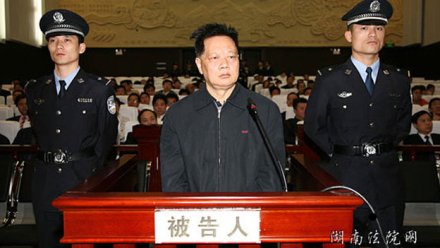
On this date in 2010, a former Communist Party of China (CPC) anti-corruption official was shot … for corruption.
Zeng, former secretary of the Chenzhou Municipal Commission for Discipline Inspection of the CPC and vice secretary of the CPC Chenzhou Municipal Committee, gorged on 31 million yuan ($4.7 million) in bribes from 1997 to 2006, doling out lucrative mining contracts and sinecures in exchange.
Although known in the Hunan coal-mining city as “a modern-day Heshen” — Chenzhou residents whose businesses had been widely subject to Zeng’s crude protection-racket shakedowns set off fireworks to celebrate his arrest — Zeng was all but impossible to dislodge.
Zeng bribed up to higher officials for protection as effectively as he squeezed those below. It’s just another piece of the graft so endemic in China that it’s frankly represented in popular literature. (And has often appeared on the execution grounds, too.)
“Officials, especially high-ranking ones, are basically not held accountable for paying bribes,” a journalist who wrote a book about Zeng told NPR. “This is because China’s judiciary is not independent enough.” Zeng wasn’t even charged with this crime — just extortion.
Zeng’s well-placed protectors defeated at least three investigations. He was only overcome by an order from the very top: President and Party Chairman Hu Jintao, who scribbled onto a secret report of Zeng’s antics,
“To Comrade Wu Guanzheng: Put more effort into investigating corruption in Chenzhou. Signed, Hu Jintao, July 19, 2006.”
Three months later, Zeng was under arrest.
The effects of power, corruption, privilege, and cutthroat economies did not go with him. After all, on the same date Zeng was put to death, officials elsewhere in Hunan province also announced the execution of one Chen Haitao for torching an airport shuttle bus. The blaze killed two and seriously injured three others.
Chen committed the arson to revenge society as he had “blamed his business failure on social injustice,” the court said in a statement.
On this date in 1934, Leonid Nikolaev was convicted and (an hour later) shot for the murder of Leningrad communist leader Sergei Kirov.
Nikolaev was a disaffected young man who’d come of age during the Revolution and latterly been expelled from the Party for his bad attitude. He took his frustration out on December 1, 1934, when he stalked into the (suspiciously unguarded) office of Kirov and shot him dead.
The victim was much the more consequential figure in this transaction — both in life, and in death. Kirov’s murder would stand as a Reichstag fire moment unleashing the darkest years of Stalinist purges.
Kirov was an old Bolshevik agitator from way back. Widely respected, he’d been the party boss of Leningrad for nearly a decade, and a few months before his murder was overwhelmingly elected to the Communist Party’s Central Committee at the party Congress.
He was also, perhaps, seen by anti-Stalin factions within the party as a potential pole of resistance to Stalin* — though his weight as an “opposition” figure has also grown with the hindsight knowledge of what came next.
Kirov’s assassination was a double gift to the Kremlin, for not only did it remove the impediment himself, it licensed a furious security crackdown against the “terrorists” who orchestrated it. Said terrorists conveniently turned out to be dozens upon dozens (and indirectly, thousands upon thousands) of officials whom Stalin found convenient to destroy. “Kirov was killed in Leningrad,” Bukharin remarked upon hearing the news. “Now Koba [Stalin] will shoot us all.”
Within weeks of the murder, the exiled Trotsky was coming to the same conclusion, and charged that the Kirov investigation’s purposes was
to terrorize completely all critics and oppositionists, and this time not by expulsion from the party, nor by depriving them of their daily bread, nor even by imprisonment or exile, but by the firing squad. To the terrorist act of Nikolaev, Stalin replies by redoubling the terror against the party.
Stalin personally oversaw the investigation, even personally interrogated Nikolaev. And no surprise: the investigation’s casualties multiplied with alacrity.
The first commissar who made it to the murder scene “fell out of a truck” the very next day. Nikolaev’s mother, wife, siblings, and other associates were all disappeared and executed. 104 prisoners already under lock and key at the time of Kirov’s murder were judged guilty of conspiring with the assassin and shot out of hand. (Source)
In January 1935, Stalin had his long-neutered old rivals Zinoviev and Kamenev** preposterously convicted for “moral responsibility” for Kirov’s murder. Though they weren’t death-sentenced directly for this “responsibility” their condemnation set them up for their fatal show trial the following year. (Which included public confessions of involvement in the Kirov affair.) Guilt in Kirov’s death would be routinely bolted onto the show trials of political opponents for the remainder of the 1930s.
Stalin mined this terrorism panic so nakedly and purged so widely that the belief that Stalin himself ordered Kirov’s murder has long predominated. This theory of Stalin’s master orchestration also happened to be very convenient (pdf) for the post-Stalin party; Khrushchev directly hinted at his predecessor’s complicity in the secret speech.
That theory remains highly contestable. Matthew Lenoe in particular has vigorously disputed the idea that Stalin ordered everything in his acclaimed The Kirov Murder and Soviet History; there’s an informative Q&A with Lenoe on the invaluable Sean’s Russia Blog here, and a podcast interview on the New Books Network here. For a bit of background on Lenoe’s research, click here.
* Foreshadowing the unwelcome independence Leningraders enjoyed post-World War II … until Stalin smashed it.
** Nikolaev, the disaffected party member, was a Leningrader himself. That meant that when he was still in the party, it was in Zinoviev’s Leningrad party, since that city happened to be Zinoviev’s base and stomping-ground. And that meant that he must ipso facto have been part of the “Zinovievite Opposition”.
On this date in 1868, Priscilla Biggadike withstood one last gallows-foot plea from her minister to admit to poisoning her husband.
‘I implore you not to pass away without confessing all your sins; not only generally, but especially this particular case, for which you are about to suffer. I had hoped that you would have made that confession, and thus have enabled me, as a minister of Christ, to have pronounced the forgiveness of your sins … It has grieved me much to find that [you] still persist in the declaration, that you are not accountable for your husband’s death; that you still say that you did not administer the poison yourself; that you did not see any other person administer it, and that you are entirely free from the crime. Do you say so, now?
The Prisoner, still in a firm voice, said, yes.
The Chaplain. — There is only one [hope] left, that you have endeavoured to confess your sins to God, though you will not to your fellow creatures. All I can now say is that I leave you in the hands of God; and may he have mercy on your soul. What a satisfaction it would be to your children, to your friends, to your relations, to know that you had passed from death into life, in the full persuasion that your sins were forgiven you … I am sorry I cannot exercise that authority [to pronounce sins forgiven] at the present moment.
Then, at the stroke of 9 a.m., she was hanged by ten-thumbed executioner Thomas Askern. True to form, Askern made a mess of it, and Biggadike painfully strangled to death with the rope’s knot infelicitously positioned under her chin* … although, since this execution was behind the walls of Lincoln Castle (in fact, it was the first female hanging after an 1868 Act of Parliament had made all hangings private), at least it didn’t incense a vast concourse of onlookers.
Posterity, though, has taken plenty of umbrage at Priscilla Biggadike’s fate.
She and her late husband Richard kept two lodgers in a two-room house in the village of Stickney.
Richard already suspected an affair between Priscilla and one of those lodgers, Thomas Procter (or Proctor), when he returned home from work on September 30, 1868, enjoyed tea and cakethat his wife had made for him, and then fell violently, fatally ill. The post-mortem examination showed Richard Biggadike had been poisoned with arsenic.
Priscilla Biggadike and Thomas Procter were both arrested on suspicion of murder but charges against Procter were soon dropped.
Priscilla was known to have quarreled with her husband over that whole infidelity thing, and she had alluded at least once to having arsenic around for killing mice. She was accordingly found guilty of poisoning him, though “only,” in the words of the jurors when the judge pressed the question, “upon the ground of circumstantial evidence.”
Indictment, trial, conviction, and execution for the “Stickney Murderess” wrapped up in two months’ time. But the discharged co-accused, Thomas Procter, years later made a deathbed confession that it was really he who poisoned Richard Biggadike.
(During the investigation, Priscilla had even attempted to blame Thomas Procter, reporting that on one occasion prior to the murder he’d even made what looked like an attempt to poison Richard by mixing white powder into his tea, after which Richard became sick. Police didn’t regard the accused as a particularly credible source for obvious reasons, but it’s hard to believe anyone would have failed to follow up on that sort of lead.)
On account of that whole wrongful-hanging mix-up, Priscilla Biggadike received a posthumous pardon. She’s even had a short musical made about her conviction, which was recently performed in Lincoln Castle. If you visit, you can still see the cell where she passed her final days.
* The bad botch of this job led Lincolnshire officials to audition for their next execution a local cobbler and amateur noose enthusiast destined to revolutionize the British hanging with his scientific approach: William Marwood.
On this day in 2001, 66-year-old Kojiro Asakura was executed by hanging at the Tokyo Detention House for the murders of almost an entire family eighteen years before.
In June 1983, he had killed Akira Shirai, age 45, and Shirai’s wife, one-year-old son and two daughters aged six and nine by beating them to death with a hammer and an ax. He then dismembered three of the bodies.
The only survivor was the family’s oldest daughter, age ten, who was away at summer camp at the time of the murders.
The motive for Asakura’s crimes lay in frustrations related to his job. A property assessor, he had bid successfully on the Shirai family’s house and land in Tokyo when they came up for public auction. He planned to resell the property at a profit, but the deal stalled when the Shirais refused to move out. Four months after the auction, they were still residing in the house illegally.
At his trial, the defense argued insanity or at least diminished capacity, pointing out that normal, sane people do not go on gruesome murder sprees. The court didn’t buy it.
Asakura was hanged on the same day as another Japanese multiple murderer, Toshihiko Hasegawa, who breathed his last at the Nagoya Detention House. These were the first executions in Japan in eleven months, and thirteen months more would pass before anyone else stepped up to the scaffold.
On this date in 1942, just two days after he had assassinated Admiral Francois Darlan, Fernand Bonnier de La Chapelle was shot by the Vichy army in Algiers.
Despite its shorthand reputation as a Nazi puppet, Vichy France — especially in 1940-42 — was a more nuanced animal that’s enjoyed increased study of late. Vichy controlled southern France under the obvious pressure of the next-door German occupation and effected state collaboration with Berlin including deportations, but it also maintained diplomatic relations with the U.S. Vichy France even shot German spies.
Vichy was one contender among several for political legitimacy in the aftermath of France’s disastrous 1940 defeat at German hands. The most obvious (and here, topical) rival was de Gaulle’s Free French.
Appropriately, the classic film Casablanca premiered in November 1942, featuring Claude Rains as the unprincipled Vichy Captain Renault. The film’s pro-Free French, anti-Vichy slant was not, however, representative of American foreign policy at the time.
This was the background when, in 1942, the US spearheaded Operation Torch to invade Vichy-controlled French North Africa. “This is not the end,” Churchill epigrammed of the Torch landings. “It is not even the beginning of the end. But it is, perhaps, the end of the beginning.”* (Correction: Churchill actually said this in reference to the November 1942 Battle of El Alamein, as a very gracious comment observes.)
At the time of that operation, Admiral Darlan happened to be in Algiers. He was the former number two man in the Vichy government, but also a guy whose cooperation with the Nazis had been half-hearted … which is the reason he was the former number two man.
Darlan nevertheless remained the chief of the Vichy armed forces, which meant that it was worth the Torch commanders’ while to come to an arrangement with him when Darlan proved amenable to cooperation.
They cut that deal. Darlan shut down armed resistance and took Vichy North Africa over to the Allies’ side. (He had, indeed, hinted previously to American diplomats that he was prepared to switch sides; see Arthur Funk, “Negotiating the ‘Deal with Darlan'” in Journal of Contemporary History, April 1973.) In exchange, the Allies installed him as High Commissioner of France for North and West Africa — big man on campus for French North Africa.
Like all good compromises, it satisfied nobody.
De Gaulle was enraged: a Vichy official remained in charge of a Vichy state now under Allied auspices. Would Allied recognition set Darlan up to direct France’s postwar direction?
Equally pissed by the defection, Hitler triggered the German contingency plan to occupy Vichy France.† This is why the “especially in 1940-1942” proviso above: after Operation Torch, Vichy France had no independent military muscle, and was significantly more beholden to Nazi Germany.
Back in North Africa, we finally come to our date’s principal.
A 20-year-old student of monarchist and anti-fascist political proclivities, Fernand Bonnier de La Chapelle (English Wikipedia entry | French) decided with a couple of friends to cut the Gordian political knot that Darlan’s adoption had created.
Bonnier de La Chapelle drew the short straw (literally, they drew straws) for the privilege/responsibility of murdering the Vichy admiral.
Officially, the young man acted alone. Unofficially, there’s been no end of speculation as to the secret intrigues at work. Nobody’s really clear on exactly how murdering Darlan was supposed to advance the gunman’s supposed agenda. And the Vichy French disposed of the killer with suspicious haste.
Just after lunch on December 24, Fernand Bonnier de La Chapelle surprised Darlan upon the latter’s return to his study and shot him through the mouth and torso at point-blank range. He was arrested attempting to flee.
The very next evening, he was condemned by a tribunal at Algiers. There was already a coffin on order before that body gaveled into session.
For some reason, the condemned thought his perceived service to the nation would out. “They will not shoot me. I have liberated France,” he assured his confessor. “The bullets will be blank cartridges.” They weren’t. Churchill recorded that Bonnier de La Chapelle was “surprised to be shot.”
Darlan was laid to rest later that morning at a dry-eyed requiem service. One British intelligence officer remembered that Darlan’s “murder fell like a stone into a small pond and the ripples were only brief. It was as if Darlan had never been.” (Source for the quotes in the last two paragraphs)
Henri Giraud, a French general who escaped German custody and took refuge in Vichy France — Vichy refusing to return him to the Germans, who openly intended to kill him — succeeded Darlan’s command of the now-Allied-aligned French North African forces and maintained the objectionable Vichy institutions. He joined the Allied Casablanca Conference a few weeks later. Giraud had already secretly arranged with the Allies to take exactly this position and had repaired to North Africa in anticipation of the invasion before being aced out by Darlan.
Giraud’s Vichy North African government gradually increased cooperation with de Gaulle’s Free French; the two eventually co-founded the French Committee of National Liberation, which de Gaulle, of course, eventually took control of.
In 1945, a postwar appeals court posthumously reversed Bonnier de La Chapelle’s conviction — on the grounds that he’d pulled the trigger “in the interest of liberation of France.”
* Stalin, whose Red Army was then fighting the Wehrmacht tooth and claw at Stalingrad, begged to differ. He’d been imploring the western allies to open a second front, and was none too impressed with their calculation that they weren’t ready to invade continental Europe in 1942. “A man who was not prepared to take risks could not win a war,” Stalin griped to Churchill.
** One knock-on effect of Operation Torch: the Germans reinforced North Africa against the Allies’ imminent push. It was in this campaign that future Hitler almost-assassin Claus von Stauffenberg lost a hand and an eye, leading to his transfer back to the Berlin desk job that would give him his opportunity to try to kill the Fuhrer.
† This resulted in Vichy France’s gesture of resistance, scuttling the Toulon fleet to keep it out of German hands … although this also irritated de Gaulle, who wanted the fleet to defect to North Africa instead.
While legend has it that Eadric Streona (“Grasping Eadric” or “Eadric the Acquisitor”) irritated the monarch by beating him in a game of chess, Middle Ages chroniclers attributed his fate to the just deserts of inveterate treachery.
A couple centuries of Viking raids and conquests had just culminated with the Northmen’s outright capture of the English throne, fifty years before the better-remembered Norman invasion.
Notwithstanding his best efforts at resistance, the Anglo-Saxon king Aethelred the Unready had been briefly driven into exile by Cnut’s father, Sweyn Forkbeard, and his house then decisively dispossessed by Cnut at the Battle of Assandun. (All kings had cooler names in the Anglo-Saxon period.)
Though not of the highest pedigree himself, “his smooth tongue gained him wealth and high rank, and gifted with a subtle genius and persuasive eloquence he surpassed all his contemporaries in malice and perfidy, as well as in pride and cruelty.” (Florence of Worcester, whose chronicle dates to a century later.) Eadric maneuvered himself into a union with Aethelred’s daughter, but he didn’t exactly follow Corleone rules where the family was concerned.*
Plenty of lords were playing both sides of the Anglo-Saxon/Danish conflict, but Eadric did it as well as anyone. He was an exponent of the policy of appeasing the Northmen with the Danegeld tribute, rather than resisting by arms. (Eadric might have been helping himself to a rake of the Danegeld that passed through his own hands.) He’s slated with, on one occasion, dissuading Aethelred from falling upon a crippled Danish force that might have been destroyed.
His nemesis on the policy front was Aethelred’s combative son and heir Edmund Ironside. (Seriously: cooler names.)
Anyway, in 1015, when Aethelred and Cnut were pressing rival claims at arms, Eadric “seduced forty ships from the king, and they went over to Cnut.” Early the next year, he defected back.
By this time, Aethelred had died and Eadric’s old rival Edmund Ironside inherited leadership. What terms these two old foes came to when Eadric returned are a matter of speculation, but it can be no surprise that Eadric switched sides back to Cnut yet again at Assandun. Some chronicles like to attribute the whole fall of England to this backstab, but it’s more than likely the guy just recognized the balance of forces (the English got routed) and tacked to the wind.
And Eadric sure could tack. He even helpfully cleared out his and Cnut’s mutual rival Edmund Ironside, allowing Cnut to claim all the lands he’d just recently agreed to leave to Edmund. The most flinch-inducingly scabrous version of the assassination story goes that Eadric’s guys shot Edmund up the backside from a privy-hole. Guess that side wasn’t so iron.
But Eadric’s belief that he’d ingratiated himself with Cnut was as sorely mistaken as Edmund Ironside’s confidence in the loo. Kings tend to look askance upon traitors, and not a few usurpers have been known to extend that opprobrium to the very people who betrayed their predecessors. Cnut valued loyalty, and it was pretty clear he couldn’t rely upon Eadric in that department.
After tolerating this underhanded underling for a decent year or so,
[a]t the Lord’s Nativity, when [Cnut] was in London, he gave orders for the perfidious ealdorman Eadric to be killed in the palace, because he feared to be at some time deceived by his treachery, as his former lords Ethelred and Edmund had frequently been deceived; and he ordered his body to be thrown over the wall of the city and left unburied.
* It needs to be said that Eadric is known through the testimony of hostile chronicles; given the dearth of primary documentation, his reputation lies at their mercy. One 20th century historian remarked that he takes on a bogeyman character in the texts, an all-purpose villain “to whom unknown crimes may be safely attributed.”

 Alchemist, prophet, and dashing Italian rogue, the Jesuit-educated Giuseppe Francesco Borri (English | Italian) was burned on this date in 1661.

 A 20-year-old student of monarchist and anti-fascist political proclivities, Fernand Bonnier de La Chapelle (