On June 6, 1662, at New Haven, there was a most unparalleled wretch (one Potter, by name, about sixty years of age) executed for damnable bestialities, although this wretch had been for now twenty years a member of the church in that place, and kept up among the holy people of God there a reputation for serious Christianity. It seems that the unclean devil which had the possession of this monster had carried all his lusts with so much fury into this one channel of wickedness that there was no notice taken of his being wicked in any other. Hence ’twas that he was devout in worship, gifted in prayer, forward in edifying discourse among the religious, and zealous in reproving the sins of the other people. Everyone counted him a saint, and he enjoyed such a peace in his own mind that in several fits of sickness wherein he seemed “nigh unto death,” he seemed “willing to die”; yea, “death,” he said, “smiled on him.”
Nevertheless, this diabolical creature had lived in most infandous buggeries for no less than fifty years together; and now at the gallows there were killed before his eyes a cow, two heifers, three sheep, and two sows, with all of which he had committed his brutalities. His wife had seen him confounding himself with a bitch ten years before; and he then excused his filthiness as well as he could unto her, but conjured her to keep it secret. He afterwards hanged that bitch himself, and then returned unto his former villainies, until at last his son saw him hideously conversing with a sow. By these means the burning jealousy of the Lord Jesus Christ at length made the churches to know that he had all this while seen the covered filthiness of this hellish hypocrite, and exposed him also to the just judgment of death from the civil court of judicature.
Very remarkable had been the warnings which this hellhound had received from heaven to repent of his impieties. Many years before this he had a daughter who dreamt a dream which caused her in her sleep to cry out most bitterly. And her father than, with much ado, obtaining of her to tell her dream, she told him she dreamt that she was among a great multitude of people to see an execution, and it proved her own father that was to be hanged, at whose turning over she thus cried out. This happened before the time that any of his cursed practices were known unto her.
On some day in June 1318, a cat and a one-eared man called John Deydras or Dydras, also known as John of Powderham, were hung in Oxford for challenging the right of Edward II to rule; indeed, John had claimed he was Edward II himself.
It had all started earlier that year when he walked into the King’s Hall in Oxford and announced before everyone that he was the rightful king of England. It was true that he resembled King Edward’s father, Edward I, except that he was missing an ear.
According to Powderham, when he was a baby and playing in the castle yard, a pig bit his ear off. His nanny, fearing the wrath of his royal parents, substituted him for a changeling. Now he was back and wanted to claim his kingdom. He even offered to fight King Edward in single combat for the right to rule.
Edward’s first response was to laugh. He welcomed the pretender, the Chronicle of Lanercost records, with a derisive cry of “Welcome, my brother!” But for the queen, struggling to maintain her husband’s dignity (and, with it, her own), and acutely conscious of the threatening consequences of Edward’s failings, jokes did not come so easily. Proud Isabella was “unspeakably annoyed.”
Proud Isabella had a reason for being so displeased, for her husband was nothing like his father, who had been an accomplished soldier and a good king. Indeed, Edward was widely despised not only for his inept leadership but his unseemly relationships with othermen.
After his arrest, Deydras confessed that the story had been a lie. He blamed his pet cat, a servant of the devil, for putting him up to it.
Modern readers can only conclude that the man was crazy. Royal pretenders had remarkablyshort lifespans, and to become one was effectively to commit suicide. (And at the urgings of a cat! Cats are not, after all, noted for their political acumen.)
Deydras’s contemporaries probably also knew he was mad, and Edward wanted to keep him as a court jester, but according to well-established precedent he was hung — and the cat too.
On this date in 2008, Curtis Osborne suffered lethal injection in Georgia for a double murder.
In the words of the Atlanta Journal-Constitution report, “Osborne was executed for shooting Arthur Jones and Linda Lisa Seaborne on Aug. 7, 1990. Osborne allegedly killed Jones because Osborne didn’t want to give him the $400 he got for selling Jones’ motorcycle. Seaborne was killed because she was there.”
Pretty awful.
It’s very difficult to capture in individual cases the structural dimensions of the death penalty system, simply because individual cases are, well, individual. Themanyplausibleactualinnocencecasesareonething. Here what you’ve got is a guy who unquestionably shot dead two humans so that he could feed his cocaine habit: making some procedural argument for Curtis Osborne is going to sound like a lot of special pleading.
But those procedural arguments are the very guts of the animal. The U.S. death penalty proposes, as an institution, to attempt not the question, does Curtis Osborne deserve to die?, but the question, among hundreds of Curtis Osbornes, do we have the apparatus to justly distinguish the ones that deserve to die?
As an impoverished drug addict, Osborne was represented at trial by a since-deceased public defender named Johnny Mostiler.
If you search this case, the thing you’ll find immediately is that another defendant being represented at the same time by Mostiler would later swear that Mostiler told him, speaking of Osborne, “that little nigger deserves the chair.” And the context of the conversation was about how Mostiler had just received a plea offer that Mostiler didn’t plan even to relay to Osborne, for the aforementioned reason.
Pretty awful.
This sort of thing is hard to substantiate: the allegation comes from a man serving a murder sentence of his own, and Mostiler isn’t around to defend himself. But on its own, it’s a shocking claim and a reminder of how profoundly the trial attorney’s performance shapes the entire legal experience. As Time magazine put it, what if your lawyer wants you executed?
Whether Mostiler really dropped an N-bomb on Osborne’s case, we really don’t know. But it’s been said that capital punishment means those without capital get the punishment, and the fact of the matter is that not many of any race who have recourse to indigent defense are served at the bar by Atticus Finch.
Leave aside even that shocking racism allegation, one that no court saw fit to adjudicate. (Prosecutors called the racism claim “outlandish”; appellate court ruled it procedurally out of bounds.) Just reckon the structural situation.
The American Prospect profiled the blinged-out, fast-living Mostiler after his death — breathing not a word about Osborne’s case, which was nowhere on anybody’s radar — and described, essentially, the neoliberal project in action for public defenders.
Mostiler represented not only Osborne, but virtually every poor defendant in Spalding County, Georgia … because, in 1990, he’d pitched the county on a fixed annual contract. Mostiler argued that the county was
wasting money paying as many as 20 court-appointed attorneys $50 an hour to handle indigent cases without knowing exactly how many hours those attorneys would bill during any given year. Mostiler proposed instead that the commissioners pay him a flat fee to handle all of the county’s indigent cases, regardless of the number. That way the county would have to deal with only one lawyer, and it would know its final bill at the start of the fiscal year rather than at the end.
Let justice be done though the heavens fallwithin the confines of fiscal probity. This grift was going to be worth a good deal more than $400 … and come with its own body count, too.
Mostiler bragged about saving the county a good million bucks over the course of the nineties. That’s a new definition of the adversarial judicial process, fresh-minted for the race-to-the-bottom era: every exertion by a defense attorney on his client’s behalf costs him part of his own paycheck.
Small wonder that Mostiler hardly ever tried cases — no more than seven a year, he said, out of as many as 900 felonies. Most were dispatched within minutes in shotgun plea deals and no small number of those momentary clients remain on the inside of a Georgia penitentiary as we speak. Did we mention that Mostiler did all this “lawyering” in only 60% of his lawyer time? He kept up a lively private civil practice, too, one where he probably averaged more than 100 minutes per case.
Death sentences, of course, don’t result from plea bargains — but at Mostiler’s zero-sum rates he also wasn’t going to prep this like the Dream Team. Slate reported that
Mostiler never hired a psychiatrist to examine evidence that Osborne was a victim of childhood abuse, and was borderline retarded, despite a court-ordered sanity evaluation that had found “indications of depression, paranoia, and suicidal ideation.” He never examined the history of mental illness in Osborne’s family because, he said, he didn’t know how to conduct that kind of investigation. Mostiler called no expert witnesses to testify for his client and didn’t bother to interview the state’s experts before they appeared at trial. And he rejected appointment of a second attorney to help with Osborne’s defense, which the American Bar Association and all serious death penalty litigators say is essential if a capital murder defendant is to receive a fair trial.
Pretty damn awful.
Once Osborne’s conviction was in the books at the trial level, no appellate court could intervene without clearing a very high bar: would the evidence un-investigated and the argument un-made likely have made a difference? Could anyone prove that Mostiler described his client with a racial slur? Nobody could really say so. End of story.
It was 18 years between the time Osborne laid those two souls in the ground and the time he laid himself down on the gurney. The irony is that all that time, all those exhaustive appeals, left the most salient and troubling questions in his case un-examined. There were substantive questions here, but Georgia prevailed in a procedural argument that those questions remain closed.
All this unsalved death and sorrow, and all for what? So Curtis Osborne could have another hit. So Spalding County, Georgia wouldn’t have to trouble the property levies with billable hours. For nothing but a little bit of money.
On this date in 1918, 21-year-old Aloïs Walput of the 2nd Belgian Grenadiers was shot at the Belgian North Sea town of Oostduinkerke, during the First World War.
He had killed his corporal two weeks before, and was one of “only” 13 Belgian soldiers executed during the Great War, either for military offenses such as desertion, or regular criminal ones such as Walput’s homicide.
Forty-five years ago today, Luis Monge was gassed in Colorado for murder — the last execution in the United States before a decade-long lull in capital punishment in the U.S.
Monge, an insurance salesman with no prior history of violence, had a hearty brood of 10 children, but when his wife found out he was having an incestuous relationship with one of them, Monge bludgeoned the wife to death, and killed three of the young children just for good measure.
Monge pleaded insanity, and then when doctors found him sane enough to stand trial, just pleaded guilty — eventually dropping all appeals and asking to be hanged in public at the Denver City and County Building.
Despite the culprit’s preferences, his execution was stayed for all of 1966 while Colorado voters weighed a referendum on continuing the death penalty. They ultimately voted 3-1 in favor. (See this detailed history of the death penalty in the Columbine State.)
Even though Monge himself embraced execution willingly, his seven remaining children (also the children of, and siblings of, his victims: surely a difficult position) still fought for clemency, and shared Monge’s last meal with him.
Had Monge maintained his appeals, he — like four other Colorado inmates whose death dates were also on hold in 1966 — would likely have made it into the nationwide unofficial moratorium on executions that settled in while courts sorted out death penalty standards in the late 1960s and early-to-mid 1970s.* That period led into 1972’s landmark Supreme Court decision Furman v. Georgia, invalidating all existing death sentences in the country and sparing men much more nefarious than Luis Monge.
Instead, this date’s principal went to his death clutching a black rosary (and allegedly, and one must suspect apocryphally, asking if the gas would trouble his asthma)** and became a nigh-forgotten denouement from a closed chapter of death penalty jurisprudence, and the last man put to death in America until Gary Gilmore almost ten years later.
Apart from his milestone status vis-a-vis capital punishment nationwide, Monge is also the last person to die in the Colorado gas chamber.
In fact, Monge is currently still the second-last put to death in Colorado, period. It would be fully 30 years before Colorado executed again — in 1997, by lethal injection. As of this writing, it hasn’t done so again since.
* If Monge had avoided execution, the “last pre-Furman execution” milestone would be held instead by California’s Aaron Mitchell, the only man executed on the authority of California governor (and future U.S. president) Ronald Reagan.
** The man who pulled the lever for Monge’s execution, Canon City penitentiary warden Wayne Patterson, was not enthusiastic about the job. He describes his experience here, saying that “Monge was a guilt-ridden man who was nearly suicidal before he was executed. Those were the [kind of] guys who were executed — not the people I thought belonged in the chamber.”
On this date in 1739, Michael Blödorn was stretched out on a scaffold at Copenhagen’s beautiful Kongens Nytorv (King’s Square), where an executioner set about smashing his limbs with heavy wagon wheels.
A 1727 illustration of Danish prisoners broken on the wheel.
Scholar Tyge Krogh’s new book titled (and about) The Lutheran Plague of suicide-murder.
As he lay suffering, Blödorn sang vigorously — a joyful hymn to lift his soul to heaven.
That, indeed, was why he was being broken on the wheel in the first place.
Blödorn was part of an alarming trend in Lutheran countries that waxed especially strong in Denmark: a homicide-to-heaven loophole apparently licensed by the Reformation theology.
Crudely put, the scam is this: you have a sure ticket to salvation if you die with no un-repented sin on your soul. But the only real way to know when you’re going to die is to kill yourself … and since that’s a mortal sin, that’s even worse than risking the everyday mischance of life.
But do like Mike and kill a random stranger to incur a death sentence, and you get to check out pure as the driven snow: assured last-minute repentance with no suicidal downside. Everybody wins!
Um.
Actually carrying out this plan required what you might call a deep commitment to your theology: in an effort to discourage the practice without backing off the death penalty for murder, penalties for apparent suicide-by-executioner cases had been ramped up into an archaic bloody theater. Blödorn, a soldier, had already been suffering weekly floggings leading up to the execution. Civilian murderers could look forward to having the flesh ripped with red-hot tongs.
Ouch. A 1727 illustration of judicial penalties that might attend a suicide-murder: tearing with hot tongs, the breaking-wheel, and severed hands.
Still, selvmordsmordpersisted (Danish link: or, here’s the same story in Norwegian).
At last in 1767, the Danes reversed course abandoned capital punishment for “melancholy and other dismal persons [who committed murder] for the exclusive purpose of losing their lives,” implementing instead sentences of humiliating hard labor: a punishment to fit the crime and also meet the larger society’s need for deterrence.
“This made Denmark a pioneer when it came to abolishing the death penalty,” said Danish academic Tyghe Kroghe, author of a new book about the suicide-murder phenomenon. “But it was not something they did proudly. The decision violated the religious understanding of the criminal system.”
Here’s Kroghe discussing his research … in Danish.
Crazy, right?
Executions of men and women who not only decline to fight their sentences, but even commit their capital crimes with the intent to engineer their own executions, are hardly confined to the foreign country that is the past.
Maybe you wouldn’t point the finger at Martin Luther any longer, but Denmark’s very last civil execution was of an arsonist so insistent about attempting murder that the authorities finally gave him the peace of the grave that he desired. We’ve seen in these pages the headsman courted by people motivated by depression and by romantic love.
Christopher Newton, who killed his cellmate to draw a death sentence and was executed in Ohio in 2007;
Daniel Colwell, who gunned down a couple randomly to “win” a death sentence in Georgia in 2003 but died before reaching execution;
Mamoru Takuma, the mentally disturbed author of Japan’s notorious Osaka school massacre, who committed the crime with no intent to escape and immediately demanded a death sentence (carried out in 2004).
Police constable George Gutteridge was found dead in September 1927 on a byway near Howe Green, dressed in his full police regalia, shot four times in the face while apparently in the process of writing up a miscreant motorist.
Frederick Browne (top) and Pat Kennedy.
Two of the shots had been through each of Gutteridge’s eyes, conceivably in deference to the ancient superstition that dead men’s eyes preserve the last image they beheld in life. If that was the reasoning, Frederick Browne, the triggerman, was living in the wrong century.
The “Gutteridge murder” investigation — a national sensation from the time the constable’s mutilated body was discovered — took several months to hone in on suspects Browne and Kennedy, known car thieves with some history of violence. But the real break in the case was, well, a case: a cartridge case from a .455 Webley recovered at the crime scene. It would be the most eloquent witness against Browne and Kennedy.
The now-familiar science of forensic ballistics was, though notquite brand new, still an occult art in Anglo courts of law. Just days before Gutteridge’s murder, Sacco and Vanzetti had been executed in the United States based in part on ballistics studies. That gun-barrel research had been continued in the post-conviction appeals and clemency investigation, and provided one of the clinching pieces of evidence against the anarchists, but it was also ferociously contested.
In Great Britain, it was the Gutteridge case that put this field on the map for the general public — courtesy of professional gunsmith and ballistics investigator Robert Churchill.
Churchill used microscope analysis of the recovered casing to match the bullet not only to a .455 Webley, but to the .455 Webley recovered from Browne’s car: to that gun, and no other.
Post-Browne and Kennedy, murderers given to gunplay became very well advised to dispose of weapons once they’d been used: this case served notice that individual handguns left a sort of fingerprint on the rounds they discharged, and could thereby incriminate their owners months or years after the fact.
This conclusion was not universally embraced, perhaps owing in part to the role of ballistics in the controversial Sacco and Vanzetti affair: according to Basil Thomson, George Bernard Shaw wrote to Browne’s family during the trial to express his skepticism, complaining of the crown’s “manufactured evidence.” In 1932, the renowned barrister Patrick Hastings successfully repelled Robert Churchill’s firearms evidence at the high-profile murder trial of Elvira Barney.
But the reason Churchill was on the stand on that occasion was because his damning testimony in 1928, explaining where a small fault in the Webley’s breech block had scarred the bullet as it launched, not only sufficed to hang Browne and Kennedy* — “hanged by a microscope”, in the words of The Sunday Dispatch — but also launched a star career for Churchill personally, and made the bones of firearm ballistics for modern criminal trials.
* More precisely, the forensic testimony hanged Browne — who stuck with a flat denial, which the ballistics associated with his own gun refuted. Kennedy lacked the wit to shut his mouth and in the course of trying to spin his story to throw all the blame onto Browne also just by the by confessed to his own involvement.
This eloquent, injudicious theologian studied at Prague, Oxford, Paris, Cologne, Heidelberg … accumulating Master’s degrees along the way like a career graduate student, but repeatedly finding himself run off the premises on suspicion of heresy.
Jerome’s “heresy” was an excessively combative hostility to ecclesiastical corruption. And although Jerome was known for his rapier tongue, he didn’t always find the pen mightier than the sword: he got into a few physical scraps with his foes.
While in England, he copied out a manuscript of preacher John Wycliffe — whose radical piety (or pious radicalism) inspired the rebellious Lollard movement.
Back on the continent, Jerome fell in with Jan Hus. Ten years Jerome’s senior, Hus was and remains the first name in Bohemian religious reform, and the “Hussite” church he founded still retains his name.
After Hus unwisely accepted a guarantee of safe conduct to dispute at the Council of Constance, the more ornery Jerome slipped into town to propagandize on his mentor’s behalf. After placarding his way to trouble, he slipped back out and must have thought he’d had his cake and eaten it too … until he was caught in the Black Forest.
Jerome spent nearly a full year in a dungeon — the Council met for four years; it had a massive schism to sort out — and at one point the privations of imprisonment led him recant. He later bitterly regretted that concession to “pusillanimity of mind and fear of death,” but on a strictly doctrinal level Jerome of Prague wasn’t anti-Catholic: he just wanted the church to be less of a bunch of corrupt, overweening racketeers.
By the time he was ready to answer for himself, and his soul, he was well past any spirit of capitulation. A witness to the procedure wrote of Jerome on trial for his life:
I have never seen any one, who, in pleading, especially in a capital offence, approached nearer the eloquence of the ancients, whom we so greatly admire. It was so amazing to see with what fluency of language, what force of expression, what arguments, what looks and tones of voice, with what eloquence, he answered his adversaries and finally closed his defence. It was impossible not to feel grieved, that so noble, so transcendent a genius had turned aside to heretical studies, if indeed the charges brought against him are true.
…
When that part of his indictment was read in which he is accused of being “a defamer of the papal dignity, an opposer of the Roman pontiff, an enemy of the cardinals, a persecutor of the prelates and clergy, and a despiser of the Christian religion,” he arose, and with outstretched hands and with lamenting tones, exclaimed: “Whither now, conscript Fathers, shall I turn myself? Whose aid can I implore? Whom supplicate, whom entreat for help? Shall I turn to you? Your minds have been fatally alienated from me by my persecutors, when they pronounced me an enemy of all mankind, even of those by whom I am to be judged. They supposed, should the accusations which they had conjured up against me, seem trivial, — you would, by your decisions, not fail to crush the common enemy and opposer of all, — such as I had been held up to view, in their false representations. If, therefore, you rely upon their words there is no longer any ground for me to hope.”
Some of them he wrung hard by the sallies of his wit; while others he overwhelmed with biting sarcasms; and from many, even in the midst of sadness, he forced frequent smiles, by the ridicule which he heaped upon their accusations.
…
At length, launching out in praise of John Huss who had been condemned to the fire, he pronounced him a good, just, and holy man, altogether unworthy of such a death, — adding that he was also prepared to undergo, with fortitude and constancy, any punishment whatsoever, yielding himself up to his enemies and the impudent lying witnesses, “who would, at length, have to give an account of all they had uttered, before God, whom they could not possibly deceive.” Great was the grief of all that stood around him. Thee was a universal desire among them to save so noble a personage, could his own consent be obtained. Persevering, however, in his opinions, he seemed voluntarily toseek death; and continuing his praise of John Huss, he declared that man had never conceived any hostility to the church of God; but that it was to the abuses of the clergy, and the pride, pageantry and insolence of her prelates alone he felt opposed; for, since the patrimony of the church was due, in the first place, to her poor; then to her guests; and finally to her on workshops; it seemed to that good man, a shameful thing, to have it expended upon courtezans and in banquets; for the sustenance of horses and dogs, the adornment of garments and other things unworthy of the religion of Christ.
Most exalted was the genius of which he showed himself possessed! Often was he interrupted in his discourse by various noises; and greatly vexed by those who carped at his opinions; yet he left none of them untouched, but equally avenging himself upon all, he either covered them with confusion, or else compelled them to hold their peace. A murmur arising against him, he paused for a moment; and then, having admonished the crowd, proceeded with his defence, — praying and beseeching them to suffer one to speak whom they would soon hear no more. At none of the noise and commotion around him did he tremble, or lose, for a single instant, the firmness and the intrepidity of his mind.
“You will condemn me iniquitously and unjustly,” he prophesied to his judges, “and when I am dead, I shall leave remorse in your consciences and a dagger in your hearts; and soon, within a hundred years, — you will all have to answer me, in the presence of a Judge most high and perfectly just.”
Reports differ as to the subsequent standing of all these men’s souls. But for the church as a going earthly concern, Jerome nailed it almost exactly: 101 years after he followed Jan Hus to the stake,* that long-suppressed spirit of reform irrevocably splintered papal authority.
* In the very same spot where Hus himself was burnt.
“I am as a grain of sand on the beach of the black race. The black race has lost its pride and dignity and is slowly dying from within and without. My death ends my tears, and the fortune of watching my race slowly die. If there is such a thing as an Antichrist, it ain’t one man, but the whole white race.”
Francois had donned a mask and, with a couple of confederates, stuck up a drug house in 1977.
The mask slipped, exposing Francois’s face — and the home invaders decided to murder the eight prisoners to keep them from making the ID. All were shot in the head execution-style.
Somehow, two survived to identify Marvin Francois. It was an easy conviction. (A confederate, Beauford White, was executed for the same crime in 1987.)
Once the death sentence was on the books, appellate attorneys developed a genuinely sympathetic profile of Francois’s background, if not his crime. A federal appeals court on the day before Marvin Francois died could not help but agree that
[t]he proffered evidence shows that Francois was the product of a sordid and impoverished childhood environment. His parents were not married. His father was a habitual heroin addict who never worked, who brought other addicts into the home for the ingestion of heroin in front of Francois when a child, and who beat Francois because he would not fight with other children when he was a boy. Francois’ mother often worked as a prostitute and was of little benefit to Francois during his childhood. She married but Francois’ step-father abused him. Francois grew up as a child of the street. At the same time he was smart, and although not finishing school, he obtained his G.E.D.
The behavioral scientists in their affidavits posit that “… some offenders, like Marvin Francois, are themselves victims of circumstances that shape their lives in ways beyond their deliberate control.” They suggest that given Francois’ chaotic antisocial upbringing, “clear mitigation of punishment compellingly surfaces.”
Nevertheless, the panel concluded that, given the extent of the crime (and his existing history of violence), all this sob-story stuff “would not have affected the sentencing outcome in this case had it been submitted to the jury.”
That was that.
It was a touching parting for at least one good friend on death row with him. “We wanted to send him out on a high,” a fellow-prisoner later remembered of sharing a last cigarette with Francois while imagining it a joint. “It took a little out of me when they killed him. I’d grown real attached to him.”
According to David von Drehle’s Among the Lowest of the Dead, that disattachment was rather unusually distant: Marvin Francois’s final resting place is … the sea off Dakar, Senegal.
Francois had asked that his ashes be scattered in Africa. Susan Cary, the longtime activist … was determined that this last wish would be honored. But it was one thing to find bus fare for a condemned man’s family, and quite another to raise the money for a trip to Africa. Cary collected the cremated remains of Marvin Francois and put them in a shoebox in her closet, where they sat for two years while she tried to figure out how to get them across the ocean.
In 1987, Michael Radelet, Cary’s frend and fellow activist, announced that he was going to Senegal to visit a relative. Take Marvin, Cary suggested. Radelet was game, but there were rules — human remains can’t just be toted from country to country. Uncertain as to the relevant legalities, Radelet contacted John Conyers, a prominent black congressman from Detroit; Conyers strongly opposed the death penalty, he was well known in Africa, and he had offered more than once to help Florida’s anti-death penalty crusaders any way he could. The congressman pulled the right strings, and shortly before his trip Radelete received an official letter announcing that the Senegalese government would be happy to welcome “Brother Marvin” home.
… Radelet had a darkly comic view of the world. Traipsing around Senegal, shoebox in hand, he would place the box on the opposite chair at restauants and say things like “Marvin, would you like some water?” On sightseeing jaunts, he would take snapshots of the shoebox in front of important buildings and picturesque vistas. Finally, Radelet carried the box to a bluff outside Dakar, a lovely spot with the city in the distance and the Atlantic spread out below. He took one more snapshot – “Marvin at the seashore” — then opened the box and sprinkled the ashes on the sun glittered waves. As he gazed into the oceanic expanse, it occurred to him that this very water might have rocked and sloshed all the way from Florida; now, the waves lapped the shores of Africa, bearing the remains of Marvin Francois to his dreamland.
The aforementioned Michael Radelet — now at Colorado University, not Florida — holding forth on more up-to-date death penalty trends:
On this date in 1686, the English executioner Paskah (or Pascha) Rose was hanged at Tyburn for burglary — by his predecessor and his successor, the famed hangman Jack Ketch.
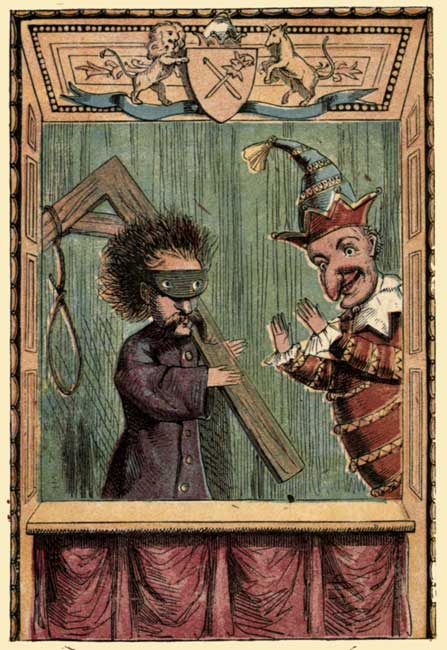
The “Jack Ketch” character from a Punch and Judy puppet show: traditionally, Punch gets the better of their meeting and hangs Jack Ketch.
The Irish immigrant Ketch is the first name in English executioners. Indeed, you can call any of his successors right down to Pierrepoint a “Jack Ketch” and be perfectly understood.
The immediate successor, however, was Ketch’s own assistant — who inherited top billing after Ketch went to jail for “affronting” a sheriff.
Jack Ketch had been trodding the scaffold-boards, hanging, beheading, and drawing-and-quartering for two-plus decades at that point: he’s thought to have been appointed in 1663, and he’d inserted himself into those performances rather more prominently than an executioner ought by botching some of Restoration England’s most high-profile executions.
There’s little reliable information about these early executioners, but it seems Ketch’s reputation for clumsiness had forced him to issue an “Apologie” justifying himself.
But the man unquestionably had longevity in his favor, which is more than Paskah Rose could say.
Within months of becoming the chief London executioner, Rose and another man were chased down in the act of burgling clothes from a house, “the Goods found in Rose’s Breeches.”
Rose and his co-defendant Edward Smith accordingly hanged along with three others at Tyburn this date — by Jack Ketch, now returned from his carceral retirement for one last tour.
Ketch died late that same year of 1686, but has lived on in any number of ballads, doggerels and broadsides immortalizing the name. He was surely aided in this by the less impressive caliber of many who succeeded him: it wasn’t long after Ketch dispatched Pascha Rose that another “Jack Ketch” — an ignoble profession that wouldn’t until centuries hence be drawn from the country’s respectable classes — also met Pascha Rose’s same fate.

 In the words of the Atlanta Journal-Constitution report, “