1943: Leonard Siffleet, beach beheading

On this date in 1943, Australian World War II commando Leonard Siffleet was beheaded on Aitape Beach in Papua New Guinea, along with two Ambonese, H. Pattiwal and M. Reharing

A photograph of the Japanese soldier Yasuno Chikao an instant before he strikes off Siffleet’s head was taken from the body of a Japanese casualty later in the war. Published in Life magazine, it became one of the war’s most iconic photos.

On this day..

1942: Three Doolittle raiders

On this date in 1942, three captured American airmen who had bombed Japan in the Doolittle Raid were shot in Tokyo.

The Doolittle Raid — named for its commander, Jimmy Doolittle — was America’s April 1942 retaliation for the Japanese attack on Pearl Harbor a few months before.

The mission: bomb the Japanese homeland.

Later in the war, American advances in the Pacific would enable the Yankee to do this regularly. In 1942, it was all but a suicide mission.

The plan involved launching 16 B-25s from an aircraft carrier — an unprecedented feat in itself — to fly light with arms and heavy with fuel to just make it 400 miles to Honshu, and with any luck on to China before the tanks ran dry.

Considering that the bombers had to launch in a panic when the carrier group was spotted a couple hundred miles too early, the raid’s success was downright miraculous: all 16 bombers made it on to (or near enough) the mainland without being shot down, where the crews bailed out and, for the most part, escaped to allied forces. Jimmy Doolittle would title his autobiography I Could Never Be So Lucky Again.

But not all were quite as lucky as Lt. Col. (later, General) Doolittle.

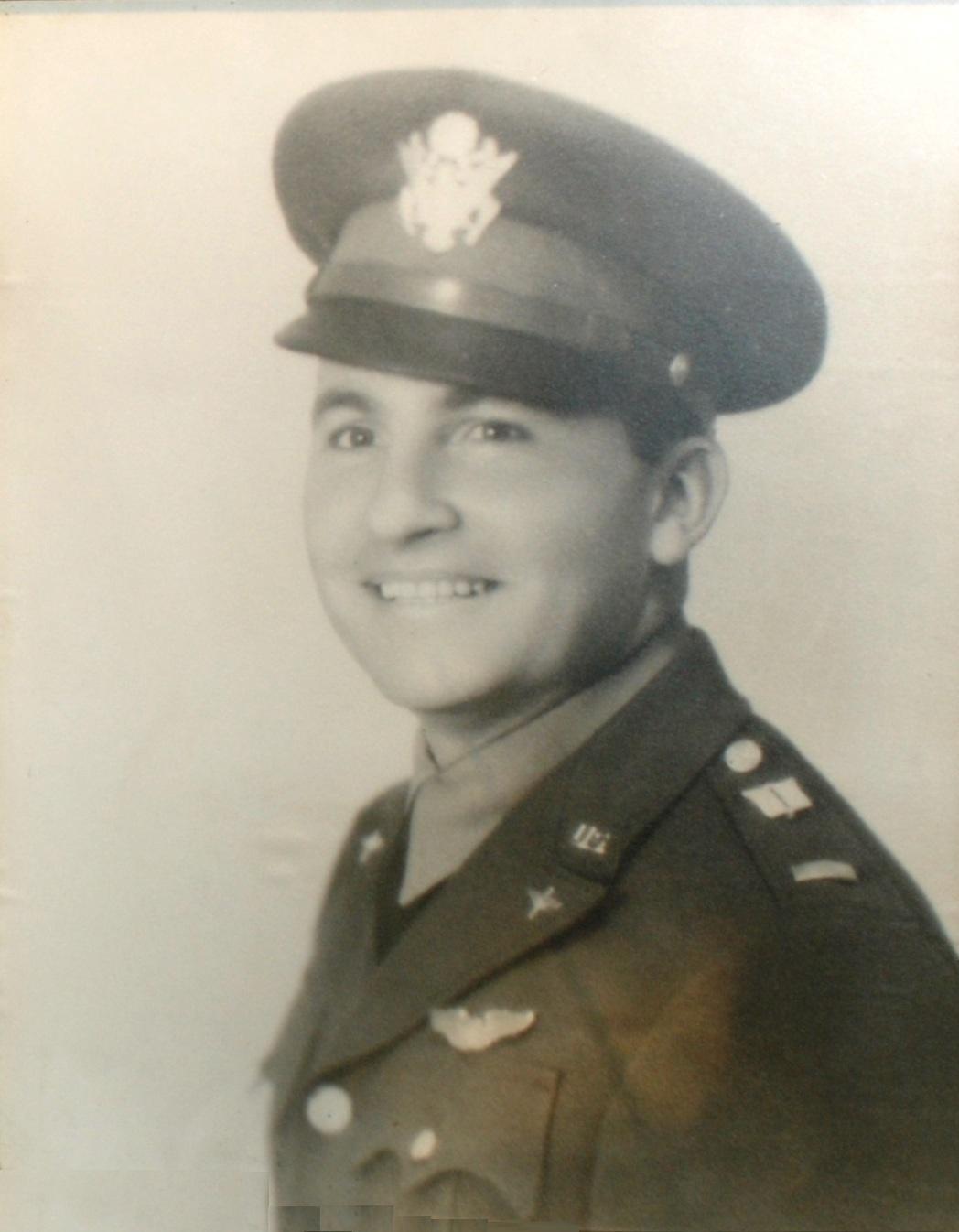
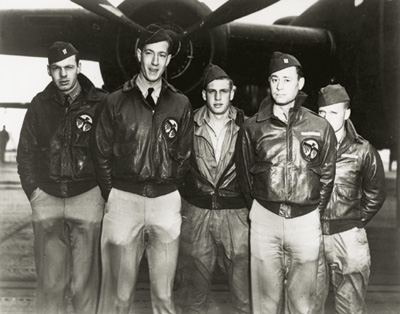
Farrow (left) and Hallmark. Spatz was a member of Farrow’s crew, and is pictured center in that plane’s crew shot here.

Two (out of eighty) drowned when their ride was ditched in the drink. Eight others were captured by the Japanese.

Four of those eight captives would survive the war to tell the tale. A fifth died in captivity. And the other three — pilots William Farrow and Dean Edward Hallmark, and (for somewhat unclear reasons) gunner Harold Spatz — were shot this day in a Shanghai cemetery following a sketchy military trial which condemned them for hitting civilian targets.

Designed largely for its psychological effect, the morale-boosting Doolittle raid has attracted interest from countless other sources who treat it in greater depth. DoolittleRaid.com and DoolittleRaider.com both provide detailed online information about the raid.

For more traditional media, one could do worse than bomber pilot Ted Lawson’s book, and its subsequent propaganda film adaptation, Thirty Seconds Over Tokyo.

On this day..

1941: Babi Yar massacre begins

(Thanks to Meaghan Good of the Charley Project for the guest post. -ed.)

Between September 29 and September 30 in 1941, the Nazis, specifically Einsatzgruppe C, shot some 34,000 Jewish people at Babi Yar, a ravine outside of the Ukrainian city of Kiev.

The United States Holocaust Memorial Museum gives a suspiciously specific death count of 33,771. This is considered the single largest mass murder of World War II, and for Kiev it was just the beginning.

In the days prior to the massacre the Nazis put up posters around the city reading:

Kikes of the city of Kiev and vicinity! On Monday, September 29, you are to appear by 08:00 a.m. with your possessions, money, documents, valuables, and warm clothing at Dorogozhitskaya Street, next to the Jewish cemetery. Failure to appear is punishable by death.

The Jews believed they were being resettled. They had no knowledge of Nazi atrocities, as the Soviet press had supressed such accounts. By the thousands they arrived at the cemetery with their belongings, expecting to be loaded onto trains.

Instead they were forced to strip naked and leave their clothes, shoes and possessions at designated places, all while being beaten by the Nazis and their Ukrainian accomplices.

A Ukrainian truck driver and innocent bystander described the scene:

The naked Jews were led into a ravine which measured approximately 150 m long, 30 m wide and 15 m deep. Two or three narrow entrances led to the ravine, through which the Jews were driven. When they arrived at the edge of the ravine they were taken by Schupo officers, and laid down on top of Jews who had already been shot. All this happened very quickly. The corpses were neatly stacked. As soon as a Jew lay there, a Schupo marksman came with an mp and shot him in the neck. The arriving Jews were so shocked when they saw this horrible scene that they were absolutely submissive. It even happened that some lay themselves down and awaited the shot.

There were only two marksmen who carried out the shootings. One marksman was at one end of the ravine, the second one at the other end. I saw the marksmen standing on the already piled-up corpses while shooting one person after another. As soon as a Jew was killed by a shot, the marksman climbed over the corpses of the killed to the next supine Jew, and shot them. This went on again and again, without any distinction being made between men, women, and children. The children were led to the ravine with their mothers, and killed with them.

Babi Yar survivor Dina Pronicheva

Much of what is known about the massacre comes from Dina Pronicheva, a survivor who later testified at the war crimes trials in 1946 and whose story is told in the most graphic terms in Anatoly Kuznetzov‘s memoir/documentary history Babi Yar: a Document in the Form of a Novel.

Contrary to popular belief, Pronicheva was not the only survivor — there were at least three or four others — but she is the most famous one and the only one to testify at the war crimes trials.

Pronicheva, an actress at the Kiev Puppet Theater, tore up her identity card when she realized what was happening. Her last name and her appearance were not typically Jewish, and she told one of the Nazis that she was a Ukrainian who had been seeing someone off and gotten caught up in the crowd.

She was told to stand aside with a group of other people in the same situation. The Nazis decided to shoot them anyway, however, as they could not allow witnesses to come back to the city and tell what they knew.

When it was her turn, Pronicheva jumped into the ravine without waiting to be shot, and played dead among the mass of bodies. As Kuznetzov put it:

It seemed to her she fell for ages — it probably was a very deep drop. When she struck the bottom she felt neither the blow nor any pain, but she was immediately spattered with warm blood, and blood was streaming down her face, just as if she had fallen into a bath of blood. She lay still, her arms stretched out, her eyes closed.

All around and beneath her she could hear strange submerged sounds, groaning, choking and sobbing: many of the people were not dead yet. The whole mass of bodies kept moving slightly as they settled down and were pressed tighter by the movements of the living.

The Germans went around the ravine firing their revolvers into anyone who appeared to be still alive. One SS man got suspicious of Pronicheva’s appearance. He kicked her hard in the chest and then stomped on her hand until the bones cracked, but she managed to remain limp and silent and he went away without shooting her. Eventually she was able to crawl out of the ravine and make good her escape.

Babi Yar continued to absorb bodies throughout the Nazi occupation of Kiev: Jews, Gypsies, Ukrainians, political activists and basically anyone who pissed the Nazis off. The total number of victims will never be known because before they were driven from the area by the Russians, the Nazis dug up the ravine and burned the corpses.


Mass execution of Soviet civilians at Babi Yar. (Source)

A guesstimate would be between 70,000 and 120,000, but some accounts run as high as 300,000. Some traces were left, as Kuznetzov remembers:

The river bed was of good, coarse sand, but now for some reason or other the sand was mixed with little white stones. I bent down and picked one of them up to look at it more closely. It was a small piece of bone … in one place we saw that the sand had turned to gray. Suddenly we realized we were walking on human ashes …

Nearby there had been a fall of sand, following the rains, which had exposed an angular projection of granite and a seam of coal about a foot thick. There were goats grazing on the hillside with three little boys, each about eight years old, looking after them. They were hacking away diligently at the coal with little picks and breaking it up on a granite block.

The coal was brown and crumbly, as though it was a mixture of ashes from a railway engine and carpenter’s glue.

“What are you doing?” I asked.

“See here!” And one of them pulled from his pocket a handful of something that glittered where it was not covered in dirt, and spread it out in his hand.

It was a collection of half-melted gold rings, earrings and teeth. They were digging for gold.

Babi Yar was filled in after the war and the site is now part of a residential neighborhood in Kiev. There were many international protests in 2009 after the city’s mayor announced plans for a hotel on the site, but he changed his mind.

On this day..

1947: Nikola Petkov, “a dog’s death”

At midnight as the calendar turned over to this date in 1947, anti-communist Bulgarian politician Nikola Petkov was hanged in Sofia’s central prison.

Petkov was a principal in a still-extant peasant party that briefly held state power in Bulgaria in the early 1920s.

His anti-fascist activities did him no favors as Bulgaria’s aligned with the Axis, and he spent the war touring his country’s internment camps.

The anti-fascist Fatherland Front that Petkov co-founded — allying with the Communist party in what would prove to be a Faustian bargain — had become the government by the end of the war, with Petkov in a ministerial role.

Unfortunately for Petkov, greater ministers of greater states were even then carving up spheres of influence in the postwar world. In the process, the Bulgarian statesman would get carved right out.

Here’s the blog of this critically acclaimed novel’s author.

With Bulgaria slated for the Soviet bloc and all its scary political purges, the Fatherland Front was soon controlled by the Communists. Petkov mounted brave but futile opposition as a Member of Parliament — until he was arrested in the parliament building itself, an apt image for Bulgaria’s entrance onto the Cold War chessboard as a red pawn.

The show trial and resultant death sentence “for having tried to overthrow the legal authority and restore Fascism in the country by conspiring with military organisations” briefly exercised western diplomats filing appeals and high-minded talk about justice during the summer of 1947.

Which stuff earned the derision of Bulgarian Premier Georgi Dimitrov, so Soviet-aligned that he was a Soviet citizen.

In this menacing speech to the Social Democrats the next January, his Don’t-Mess-With-TexasBulgaria umbrage at outside actors for having the temerity to object stands in ironic contrast to Dimitrov’s own history as a prewar international cause celebreback when he was unjustly accused in Nazi Germany for the Reichstag Fire.

So sauce for the goose-stepper is sauce for the dialectical materialist?

Negatory.

As you remember from this rostrum I many times warned your political allies from Nikola Petkov’s group. They did not listen to me. They took no notice of all my warnings. They broke their heads, and their leader is now under the ground. You should now think it over, lest you share their fate … When the trial against Nikola Petkov began you said “The court will not dare to sentence him to death. It would be too horrible. Both Washington and London will rise against it in order to stop it.” I said then: “Nobody can stop it. Those who may try to intervene from abroad will only worsen the position of the accused and his friends.’ What happened? What I said would happen. The court fulfilled its role, fulfilled the will of the people and sentenced the traitor to death.

Then you said: “If they execute the death sentence, the glass of patience will overflow. The whole world will rise against it, and all its wrath will fall on the back of the Bulgarian people.”

Of course, if there had been no interference from abroad, if they had not tried to dictate to the sovereign court, the head of Petkov could have been saved Yes, it could have been saved. His death sentence could have been commuted to another sentence. But when they tried to blackmail the Bulgarian people and question the authority of a sovereign court, it became necessary for the death sentence to be executed. And it was executed.

What happened then? Who rose against it in the country? Where were the demonstrations, the mutinies with which we were threatened? Nothing like that happened.

And what happened abroad? Not even decent diplomatic notes were delivered, which could have been expected. No one raised a hand in defense of Petkov. Some people in the West shouted for a while, but soon quietened (sic) down … The whole incident was soon forgotten.

The Balkans In Our Time

Hard to say Dimitrov was wrong about that: just one week after Petkov’s execution, the United States officially recognized a Bulgarian state dedicated (so the U.S. State Department had only just declared) “to remov[ing] all save a purely nominal opposition and to consolidat[ing], despite its professions to the contrary, a totalitarian form of government.”

“To a dog, a dog’s death,” sneered the official trade union council about Petkov — a taunt liberally repeated by Radio Sofia.

The “dog” was posthumously rehabilitated in 1990, and now has the requisite post-Soviet public monuments.

On this day..

1944: Six Jesuits in Palau

On this date in 1944, six Spanish Jesuit missionaries were executed in Palau by the island’s increasingly desperate Japanese defenders.

Fr. Elias Fernandez Gonzalez, Fr. Marino de la Hoz, and Br. Emilio del Villar were on hand to spread Catholicism in the island, which fell into Japan’s lap at the end of World War I and was therefore incorporated into the Asian hegemon’s economic plans.

Taking no chances with these foreign proselytizers, Japan had them confined when the Pacific War broke out in 1941.

By 1944, with the writing clearly visible on the wall, they were joined by three other Jesuits captured from nearby Yap, now a part of the Federated States of Micronesia, Fr. Luis Blanco Suarez, Fr. Bernardo de Espriella, and Br. Francisco Hernandez.

After a few months’ confinement, all six were summarily executed. Their remains have never been recovered; they were allegedly exhumed and burned shortly before Allied occupation, a bit of evidence-destruction similar to Wake Island.

There was a Japanese officer arrested for these executions and other war crimes, but he committed suicide before he could face judgment.

On this day..

1944: Mala Zimetbaum and Edek Galinski

(Thanks to Meaghan Good of the Charley Project for the guest post. -ed.)

On or about this day in 1944, Malka “Mala” Zimetbaum and Edward “Edek” Galinski were executed in the Auschwitz Concentration Camp after a failed escape attempt. Mala was 22 or 24; Edek was 20 or 21.

Mala Zimetbaum.

Mala, a Belgian Jew of Polish descent, had been living in Auschwitz for two years and had a privileged position because of her linguistic skill; she could speak about five languages and worked as an interpreter and courier. The staff trusted her and she had permission to go everywhere in camp. She often used her position to help the inmates.

Mala fell in love with Edek Galinski, a Polish gentile prisoner. He was also a longtime inmate, having been in Auschwitz since 1940. He also had the freedom to go anywhere in the camp in his capacity as a mechanic.

Sometime in the late spring or early summer of 1944, they escaped together. What they planned to do afterward is unclear; there are some stories that Mala carried documents from the camp and planned to tell the world what was happening there. How they were caught is also a bit of a mystery. According to some accounts, only one was arrested and the other went voluntarily so they could die together.

Their subsequent executions have been the subject of legend, and lives large in many memoirs by survivors of the camp. Among those who wrote about it were Primo Levi, Sara Nomberg-Przytyk and Fania Fenelon. A witness, Raya Kagan, also testified about it at Adolf Eichmann‘s 1961 war crimes trial.

All the accounts contradict each other; practically everything about the execution is disputed. Contrary to what the Wikipedia entry says as of this writing, we don’t even know whether it really took place on September 15; other dates have been suggested, including August 22. (Curiously, September 15 is also the date given for Mala’s arrival at Auschwitz in 1942.) Edek was apparently hung in the men’s camp, possibly alongside several other prisoners; Mala was executed in the women’s camp that same day. Edek supposedly tried to jump into the noose before the SS guard could finish reading his sentence, in defiance of protocol. His last words may have been “Long live Poland.” Everyone agrees that Mala slit her wrist with a hidden razor blade as she was standing before the crowd of woman prisoners waiting to be hanged. When the SS guards tried to intervene, she slapped one of them. They bound up her arm to keep her from bleeding to death. She may have been trampled to death at the execution site, but most accounts state the guards ordered some prisoners to cart her to the crematorium and throw her in alive. Several reports state that she either died on the way there, or was shot or poisoned by an SS guard who took pity on her.

According to some accounts, Mala’s last words were directed at the guard she hit: “I shall die a heroine, but you shall die like a dog!” Others say she addressed the crowd of prisoners and told them liberation was in sight, or urged them to revolt. We will never know what her final words truly were, but their meaning is clear enough.

On this day..

1942: Lodz ghetto “Children’s Action” begins

(Thanks to Meaghan Good of the Charley Project for the guest post. -ed.)

Between September 5 and September 13 was the great deportation of vulnerable individuals from the Lodz Ghetto, one of the largest Nazi ghettos in Europe.

The 150,000-odd Jews within had starved, slaved and suffered for nearly two years, but what came next was almost too much to bear. The Nazis demanded that Mordechai Chaim Rumkowski,* the ghetto’s controversial chairman, turn over 20,000 non-working people for deportation, including the elderly and all children under the age of ten.

Those two groups constituted only 13,000 people altogether, so the gap had to be filled with the sick. The police and other Jewish authorities in the ghetto would have a chance to round up the deportees themselves. If they didn’t accomplish this, the Germans would do it themselves.

Rumkowski’s policy had always been one of accomodating to the Nazis’ demands and appeasing them with the goal of saving as many Jews as possible. He didn’t deviate from his plan even in this instance, and tried to explain himself to the ghetto population in an electrifying speech on September 4:

A grievous blow has struck the ghetto. They are asking us to give up the best we possess — the children and the elderly. I was unworthy of having a child of my own, so I gave the best years of my life to children. I’ve lived and breathed with children, I never imagined I would be forced to deliver this sacrifice to the altar with my own hands. In my old age, I must stretch out my hands and beg: Brothers and sisters! Hand them over to me! Fathers and mothers: Give me your children! […] I must perform this difficult and bloody operation — I must cut off limbs in order to save the body itself. I must take children because, if not, others may be taken as well — God forbid.

I have no thought of consoling you today. Nor do I wish to calm you. I must lay bare your full anguish and pain. I come to you like a bandit, to take from you what you treasure most in your hearts! I have tried, using every possible means, to get the order revoked. I tried — when that proved to be impossible — to soften the order. Just yesterday, I ordered a list of children aged 9 — I wanted at least to save this one aged-group: the nine to 10-year-olds. But I was not granted this concession. On only one point did I succeed: in saving the 10-year-olds and up. Let this be a consolation to our profound grief.

There are, in the ghetto, many patients who can expect to live only a few days more, maybe a few weeks. I don’t know if the idea is diabolical or not, but I must say it: “Give me the sick. In their place we can save the healthy.” I know how dear the sick are to any family, and particularly to Jews. However, when cruel demands are made, one has to weigh and measure: who shall, can and may be saved? And common sense dictates that the saved must be those who can be saved and those who have a chance of being rescued, not those who cannot be saved in any case. […]

Although it was never explicitly stated, the beaten-down, demoralized Lodz Jews harbored few illusions about the fate of deportees; most of them knew by now that deportation meant death.

Naturally there were cries of protest. People in the crowd suggested alternatives. They should all go together. Parents’ only children should not be taken; children should only be taken from families who had several. Rumkowski would have none if it:

These are empty phrases! I don’t have the strength to argue with you! If the authorities were to arrive, none of you would be shouting! I understand what it means to tear off a part of the body. Yesterday, I begged on my knees, but it did not work. From small villages with Jewish populations of 7000 to 8000, barely 1000 arrived here. So which is better? What do you want? That 80,000 to 90,000 Jews remain, or God forbid, that the whole population be annihilated? I have done and will continue doing everything possible to keep arms from appearing in the streets and blood from being shed. The order could not be undone; it could only be reduced.

One needs the heart of a bandit to ask from you what I am asking. But put yourself in my place, think logically, and you’ll reach the conclusion that I cannot proceed any other way. The part that can be saved is much larger than the part that must be given away!

In short, Rumkowski believed that only by cooperating with the German orders could he prevent even more lives from being lost.

He did have a point: The chairman of the Warsaw Ghetto, when faced with a similar deportation order, had committed suicide, and, as the Jewish authorities dragged their feet, the Nazis stepped in and, with much terror and bloodshed, forcibly deported close to 300,000 people over the course of six weeks. Resistance in Warsaw had made no appreciable difference in the death toll.

During the days that followed Rumkowski’s announcement, a general curfew was implemented and everyone was ordered to remain in their homes while the German SS and authorities, assisted by the Ghetto police and fire department (whose own families were exempted from the deportation) went from house to house to select their victims. The orphanages and old age homes were emptied, and Rumkowski himself supervised this to make sure no one was left behind.

People worked desperately to try to save themselves and the families. They knew the Germans would not be picky, would not be closely checking birth records or doctors’ certificates; it was enough for someone to simply look old or sick or very young.

Older men and women darkened their gray hair with coffee. Sick people dragged themselves out of bed and used makeup to brighten their faces. Children tried to hide, with their parents’ help, as Gordon J. Horwitz described in his book
Ghettostadt: Lodz and the Making of a Nazi City:

Some children hid in furniture and bedding, others in basement, in heaps of garbage and laundry, or in woodpiles. Parents did whatever they could, concealing children “in barrels in the attics, in ditches in the field, covered with leaves and branches.” One child sought refuge in a tree but was shot dead when discovered. Another, thanks to his father’s efforts to fashion an unusual hideout, rode out the danger concealed in a chimney on the roof. Though isolated and abandoned by the time they had been assembled in the collection area, child captives fought and scratched at the walls in a last-ditch effort to resist removal.

One teenage girl, after many attempts, managed to escape the assembly point and hid inside a mattress until it was safe to come out. Six-year-old Sylvia Perlmutter, whose experiences were fictionalized in her niece’s verse novel Yellow Star, hid in the cemetery.

Most of these efforts were in vain, however.

The search was thorough and the hunters ruthless. On September 13, the Nazis announced that the deportation was over. The survivors could resume their daily lives. It was not as bad as it could have been; 20,000 were not taken, after all. 15,859 people had been packed into trains, taken to the Chelmno Extermination Camp and killed. A further 600 had been shot within the ghetto itself.

For a long time after this, there were no more deportations. The ghetto inhabitants, although many of them continued to perish from starvation, overwork and disease, dared to hope that perhaps the Nazis would let them survive as long as they worked. But in the end, they didn’t escape: in August 1944, with the approaching Russian Army just 60 miles away, the entire ghetto population was deported to Chelmno and Auschwitz. An overwhelming number, including Chairman Rumkowski, perished.

* It was an open secret that Rumkowski was a pedophile who sexually abused the children in his charge both before and during the war. See Lucille Eichengreen’s Rumkowski and the Orphans of Lodz, and Edward Reichter’s Country of Ash.

On this day..

1943: Eight from the Krasnodar Trials

On July 18, 1943, eight Soviet citizens who were among 11 tried for collaboration with the recently expelled German occupiers were hanged before tens of thousands in the main square Krasnodar.

The proceedings from July 14-17 were the first major, open war crimes tribunals of World War II … which, of course, was still ongoing at this point.

But the previous winter, the Soviet Union had turned the tide by winning the Battle of Stalingrad, which victory presaged the liberation of the nearby north Caucasus city where we lay our scene.

The Russians proceeded to put the murderous Nazi occupation on trial, but did so not by trying Germans or their allies — but by trying eleven Soviet citizens for collaboration. Indeed, until the end of the war, thousands of Russians were prosecuted for crimes of collaboration, but only a relative handful of Germans for actually authoring those crimes.

These eleven were mostly* men who had served the Sonderkommando 10a (part of Einsatzgruppe D) in “guarding Gestapo buildings that held arrested Soviet citizens, executing arrests, going on military searches and expeditions against the partisans and peaceful Soviet citizens, [and] exterminating Soviet citizens by hanging, mass shootings, and use of poison gases.”

That “Soviet citizen” stuff, technically accurate, soft-pedaled the Einsatzgruppe‘s predictable primary target: local Jewry.

Sonderkommando 10a arrived in the town of Krasnodar when it fell to the Germans on August 12, 1942. On August 21 and 22, all the Jews were ordered to report for transfer to a certain neighborhood in the city. They were taken to the Pervomaisk woods, where they were shot. Many of the city’s Jews did not obey the order, but they, too, were eventually caught and shot. According to a Soviet committee of inquiry report, the number of civilians — women, old people, and children — murdered in Krasnodar was in excess of 13,000. Almost all were Jews. (Source)

This in a city that was occupied for only six months.

Under any description of the victims, these depredations were plenty to condemn collaborators with even the vaguest of associations. Only a few of the men had specific acts charged against them; evidence establishing frightful Nazi atrocities in the region (not hard to find) plus confessions to having worked for the Nazis (not hard to wring out) forged a sufficient evidentiary chain without getting lost in the weeds of such minutiae as: was the collaboration really voluntary? did these collaborators themselves actually carry out war crimes? was that confession actually reliable? (good luck with that one.)

In this military tribunal, the public prosecutor had a free hand for grandstanding, the defense had almost no scope of action, and (the USSR being an old hand at the show trial game) the accused knew their own part to play with craven self-denunciations and pleas for the “mercy” of being sent to the most dangerous part of the front. This made great headlines in Pravda and Izvestia (and update memos straight to the Kremlin) about Nazi bestiality,** and great copy with inquisitorial slam dunks like,

Today Soviet law will mete out justice to the traitors, fascist hirelings, and boot-lickers now in the prisoners’ dock. Tomorrow the court of history, the court of freedom-loving nations of the world, will pronounce its inexorable verdict on the bloodthirsty rulers of Hitlerite Germany and all its associates — on the enemies of mankind who have plunged the world into the welter of the present war. Not one of them will escape stern retribution! Blood for blood, death for death!

All were convicted; three drew long prison sentences and eight hanging, and since the tribunal permitted no appeal, those sentences were executed the day after the court finished its business.

The period quotes, and much of the information about this otherwise somewhat inaccessible trial, comes from Ilya Bourtman’s 2008 article for Holocaust and Genocide Studies, “‘Blood for Blood, Death for Death’: The Soviet Military Tribunal in Krasnodar, 1943.”


It may have been a first, but one need hardly add that it was hardly the last such prosecution.

Several others war crimes show trials took place in other Soviet cities over the next few months, and these would obviously continue after the war.

Long, long after the war.

* The one exception was a 60-year-old former kulak who had illicitly escaped the deportation prescribed for this class in the 1930s. His “collaboration” consisted of having been a doorman whom a German soldier asked a question of.

** e.g., “Death to Hitler’s Butchers and Their Vile Accomplices”

On this day..

1940: Tirailleurs Senegalais, for France

On this date in 1940, German forces even then completing their rout of France — the humiliating capitulation was mere hours away — massacred a detachment of African soldiers who mounted a doomed resistance at Lentilly.

Tirailleurs Senegalais were recruited not only from Senegal but from throughout France’s domains in sub-Saharan Africa. (There were also Algerian, Tunisian, and Moroccan tirailleurs.)

Though these soldiers’ own lands were occupied, they were instrumental to defending the freedom of their occupier on European soil: over half a million African tirailleurs are thought to have served les couleurs in the two World Wars, and died in all the horrible ways those slaughterhouses could devise.

In 1940, black troops represented some 9% of the French army, a fact pilloried in German nationalist proaganda.

It’s hardly a surprise that the black man couldn’t catch a break from skull-measuring Aryan race warriors, but then, France too had its own less than comfortable relationship with these dark-hued citizens summoned from distant villages to bleed in the trenches of Europe. The military’s official guidelines emphasized (French link) the “Senegalese’s” special value as cannon fodder.

If a sacrificial mission is necessary, a defense to the death to provide cover for forces to regroup, appeal to the valor of the black fighter.

On the other hand, French authorities put up a monument to black soldiers in the aftermath of World War I. (The occupying Nazis vengefully dismantled it.) Such are the contradictions of colonialism.

Racial reservations notwithstanding, colonial troops were employed throughout the army if for no other reason than that they constituted nearly the tenth part of that army.

Their service record naturally included (French pdf) the over-before-it-started French defense against the Nazi blitz in 1940.

In this instance, knowing full well that the campaign was lost, French officers flipped open the “sacrificial mission” playbook and ordered their African charges to oppose a German march near Lyon “without thought of retreat.”

Since victory was equally out of the question, that left death. Wehrmacht troops duly prepared by Nazi racial typecasting to see their foes as savages were all too ready to wipe out African troops they greatly outclassed.


A monument to the Tirailleurs in Lentilly, France. Image (c) filoer and used with permission.

The Lentilly cemetery “Tata”, final resting place of 188 Senegalese riflemen who died under German artillery or were massacred after the battle by the 3rd SS Division Totenkopf June 19 and 20. Image (c) filoer and used with permission.

For more on the tirailleurs, there’s an extensive French-language blog.

On this day..

1948: The condemned from the Doctors’ Trial

On this date in 1948, seven SS men were hanged at Germany’s Landsberg Prison, condemned for war crimes and crimes against humanity in the so-called Doctors Trial.

Four of the hanged were doctors; three were non-physicians who assisted them. Their trial (which included 16 others, variously acquitted or sentenced to prison terms) by an American military tribunal was a conscious attempt to establish criminal responsibility among the medical profession.

As prosecutor Telford Taylor* said in his opening statement.

To kill, to maim, and to torture is criminal under all modern systems of law. These defendants did not kill in hot blood, nor for personal enrichment. Some of them may be sadists who killed and tortured for sport, but they are not all perverts. They are not ignorant men. Most of them are trained physicians and some of them are distinguished scientists. Yet these defendants, all of whom were fully able to comprehend the nature of their acts, and most of whom were exceptionally qualified to form a moral and professional judgment in this respect, are responsible for wholesale murder and unspeakably cruel tortures.

It is our deep obligation to all peoples of the world to show why and how these things happened. It is incumbent upon us to set forth with conspicuous clarity the ideas and motives which moved these defendants to treat their fellow men as less than beasts.

One of several war crimes trials after the big Nuremberg Tribunal (and held in the same courtroom), the Doctors Trial dealt with the Third Reich’s Frankenstein lab of medical experimentation.

Some of this was combat-related. How long can a downed pilot survive in the North Sea? Throw a POW into freezing water and find out.

Some was more conventional medical advancement, shorn of any ethical sense. How can we treat malaria? Inject some untermenschen and start testing.

And some of it was straight from the Nazis’ racial purification theology: euthanizing the disabled, castrating and murdering Jews and Gypsies, that sort of thing. It’s all a rich tapestry.

The doctors hanged this date included

  • Karl Brandt, Hitler’s personal physician and the co-director of the Aktion T4 euthanasia program**
  • SS hygienist Joachim Mrugowsky, for experiments with concentration camp prisoners
  • SS surgeon and German Red Cross head Karl Gebhart, who enjoyed experimenting with operations on unanaesthetized prisoners
  • Waldemar Hoven, chief doctor at Buchenwald

They kept company with three others who didn’t see the “patients” but pushed around the paper for those who did.

Many of this day’s scaffold clientele died unrepentant; Karl Brandt harangued at such length that the hood was put over his head mid-sentence to move proceedings along.

Landsberg Prison was a fitting site for their expiation. As the New York Times reported (June 3, 1948)

The men died on two black gallows erected in the courtyard of the prison where Hitler wrote “Mein Kampf” while confined after his 1923 Munich putsch.

* In 1970, Telford wrote Nuremberg and Vietnam: An American Tragedy, arguing that American officials had committed war crimes in Vietnam because “we failed ourselves to learn the lessons we undertook to teach at Nuremberg.”

Telford died in 1998, so his commentary on the accountability-free torture of the modern war machine is unavailable.

** Karl Brandt was actually condemned to death by a Nazi court in the closing days of the war and only narrowly avoided execution. His crime? Moving his family out of Berlin so that they could surrender to the Americans instead of the Russians.

On this day..