On this date in 1943, an Austrian farmer was beheaded in Berlin’s Plotzensee Prison for refusing to fight for the Third Reich.
Franz Jägerstätter, who lost his own father in World War I, was anschlussed right into the Third Reich when Germany absorbed Austria in 1938.
In Solitary Witness is the aptly-titled biography of the man; though his fatal refusal of mandatory military service (and his critique of Nazi Germany) sprang from his deep-rooted Catholicism, it was far from the norm for his German-Catholic neighbors.
“We must go courageously on the way of suffering,” he wrote, “whether we begin sooner or later.” Somewhat oddly neglected as a martyr figure in the immediate postwar period, Jagerstatter was recently beatified by Pope Benedict XVI — a German himself, of course, who did not refuse his tiny measure of youthful service to the Wehrmacht in those years, and who assuredly grasps the untapped public relations potential of this compelling figure.
An icon of Franz Jagerstatter, and a naked Nazi imp.
On this date in 1941, Nazi Berlin disposed of its railway killer.
Roger Moorhouse, author of a forthcoming book about Ogorzow, tells the story of this unjustly neglected homicidal maniac on his blog, and in a BBC History Magazine interview:
Paul Ogorzow (German link) plied his trade in a city blacked-out against British bombing, but he provides an illuminating glimpse at criminal investigation.
While Ogorzow benefited from Berlin’s preternatural darkness, he didn’t go greatly out of his way to cover his tracks otherwise. At least four of his eight murders were within a mile of his house; one woman who survived his attack reported the assailant was wearing German Railways kit.
The police, prone then as now to (sometimes hastily) settle on a theory and seek evidence to confirm it, remained blind to the seemingly obvious possibility that a railway worker was the culprit … even if he also happened to be a Nazi party member in good standing.
The official fixation on Untermenschen may not be surprising given the ideological climate, but Germany had had its share of noteworthy murderers in the interwar years who were neither Jews nor foreign laborers nor British agents — the suspect profiles favored by German investigators while Ogorzow continued his killing spree.
With the slightest measure of care, the S-Bahn Murderer might have plied his hobby unmolested until the wartime manpower shortages started making him look like an attractive bit of cannon-fodder for the eastern front. Alas for him, his voracious appetite for murder — eight victims with similar m.o. in just a few months — eventually made him so obvious that even the police could no longer overlook him.
Although the government kept the crime and its unedifying investigation fairly quiet, it was known. There was even a 1944 true crime potboiler by Wilhelm Ihde (pseudonymously writing as “Axel Alt”), Der Tod fuhr im Zug (Death Rode the Train). According to Todd Herzog,
Alt’s novel is representative of the dominant tendency of the period to celebrate the work of the criminal police while avoiding any portrayal of the totalitarian apparatus that surrounded criminal politics in the Third Reich.
Little surprise there.
Alt’s novel ultimately aligns itself with [Fritz] Lang’s film [M] in showing the methodical work of professional detectives to be ineffective in capturing the modern killer and explicitly calling for … recruitment of the public to aid the police in fighting crime.
On this date in 1942, anarchist, trade unionist and anti-fascist Joan Peiro was shot with six others at Paterna, Spain.
Joan (or Juan) Peiro (English Wikipedia page | Spanish) was a Barcelona glassworker of anarcho-syndicalist politics.
As Secretary General of the Confederacion National del Trabajo (CNT) and editor of the anarchist rag Solidaridad Obrera, Peiro mixed it up in the rough-and-tumble interwar political scene, eventually becoming Minister of Industry for Republican Spain — an untoward position to more orthodox anarchists.
When the Spanish Republic lost the Civil War, Peiro fled to France, where he was nabbed and extradited.
The nationalist general Emilio Mola had said before the war’s conclusion,
Whoever is, openly or secretly, a supporter of the Popular Front, must be shot … we must sow terror … eliminating without scruple or hesitation those who do not think as we do. (Source)
In practice, reprisals weren’t that vicious (maybe because Mola himself had died in a plane crash and wasn’t managing them) — but the leadership and intelligentsia who could rally an anti-Franco political bloc were purged ruthlessly.
The imprisoned Peiro was offered — repeatedly — a sellout package to oversee Franco’s house unions, and he repeatedly refused.
He earned martyrdom for his troubles, and after Franco’s death re-entered the public sphere as the sort of bloke to name streets after. (As an anti-Stalinist, Peiro had had all the right enemies.)
Placa Joan Peiro, a major square in Barcelona.
The Spanish judiciary, however, has thus far declined (Spanish link) to overturn his sentence.
On this date in 1947, according to the modern mystical sect of Daheshism, the eponymous founder Dahesh was shot as a spy at the Iran-Azerbaijan frontier — only to reappear perfectly alive in his native Lebanon.
Born Salim Moussa Achi, “le docteur Dahesh” — “a Franco-Arabic amalgam that translates as ‘Dr. Wonder'” — made his unusual name in Beirut in the 1930’s and 1940’s “for his mesmeric gaze, the sway he held over some highly placed Lebanese (especially women), and his propensity for performing Houdini-like ‘wonders’ — including transmuting strips of paper into banknotes, appearing and disappearing at will, removing his head before retiring, and summoning spirits.”
Expelled from Lebanon, he is supposed to have walked across Syria and Turkey to Azerbaijan,* been caught without papers in that dangerous neighborhood, and shortly thereafter executed as a suspected spy.
Next thing you know, he’s back in Beirut, ready to fulfill his destiny of dying in New York in 1984 as a collector of forgettable 19th century art. And also performing “thousands” of miracles revealing him to be the reincarnation of Jesus Christ, which we know for a fact because he never claimed to be Jesus.
Daheshism today evidently claims a few thousand followers — including the wealthy Zahid family — and no centralized church-like entity. Its most prominent public billboard is New York’s Dahesh Museum, which houses the late Doc Wonder’s collection of the official French Academy art overthrown by impressionism.
And the miracle on this date in 1947?
Sure, you (o ye of little faith!) might think that he slipped back into Beirut and seized on the shooting of some poor undocumented schmo who happened to resemble him.
But actually, the trick was to swap places with one of your six celestial avatars, a race of real good sports about suffering martyrdom since that’s also what the “crucified” Jesus did.**
* The sourcing is mixed on whether “Azerbaijan” here should be considered the Azerbaijan Soviet Socialist Republic then a constituent of the USSR, or its neighboring Iranian region, also called Azerbaijan.
** In this, Daheshism echoes very longstanding mystical approaches to spirit/body dualism; some early Gnostic Christians seem to have believed that Christ was not flesh in the literal human sense, and therefore his apparent death was otherwise. The Koran also supports the notion that Christ did not die bodily.
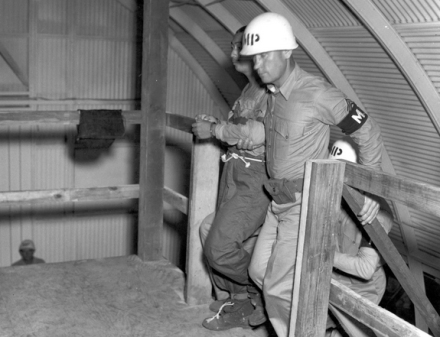
An unidentified Japanese prisoner ascends the gallows on Guam.
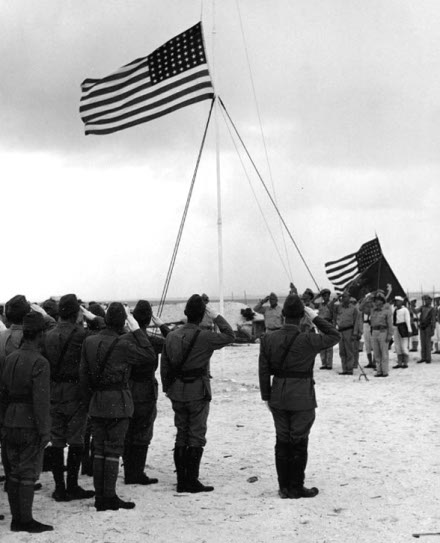
The most lastingly notable of the six was Rear Admiral Shigematsu Sakaibara, who was hanged for ordering (and perhaps in one instance, personally conducting) an infamous mass execution on Wake Island that has already appeared in these pages.
For some, the hanging of one of these six men had been a horrible tragedy and perhaps even a mistake. Rear Adm. Shigematsu Sakaibara had enjoyed the reputation of “gentleman soldier” and protector of the common man. Hailing from a wealthy family near Misawa in Tohokhu province, some 450 miles north of Tokyo, Sakaibara never forgot his roots. Forever poking fun at the fast-paced Tokyo lifestyle, the rear admiral touted the value of rural living, the integrity and honesty of those who lived in Japan’s rugged north country, and Tokyo’s need to recognize their great contributions to the war effort. Contemplating a postwar political future, he would be following in the footsteps of his politically influential family in northern Japan. That future was linked to championing the rights of returning veterans and other have-nots. Misawa had indeed had a heroic reputation as an important navy town and base for years. Sakaibara had assisted in the training exercises held there for the Pearl Harbor attack plan in late 1941. His future seemed golden no matter who won the war. But what some in his command called “The 1943 Incident” changed all that.
Shigematsu Sakaibara (right foreground) surrendering Wake Island on September 4, 1945.
These events, Sakaibara admitted in his trial, had taken place in an atmosphere of near starvation and impending doom. The defense counsel especially emphasized that point, asking the commission to understand and respect the pressures and strains on Sakaibara at the time of the incident. But the commission was not in a forgiving mood. In the chaos of retreat or not, innocent civilians had been murdered.
… Unfortunately for Sakaibara, several members of his former command expressed surprise on the witness stand when asked about the desperate situation on Wake in 1943. These men insisted that Sakaibara and his defense team’s description of a starving, chaotic Wake was an exaggerated one. There had been no unexpected miseries, confusion, or sense of peril, they said. Sakaibara’s fate was sealed.
True to form, defendant Sakaibara offered a very literate final statement to the commission. In contrast to so many of his colleagues on trial in Tokyo, on Guam, or elsewhere, Sakaibara, albeit with carefully picked words, admitted he was guilty of rash and unfortunate actions. He appeared especially convincing when he noted that he wished he had never heard of Wake Island. But his most memorable comments involved his own view of morality in war. A nation that drops atom bombs on major cities, the rear admiral explained, did not have the moral authority to try so many of his countrymen. With Hiroshima and Nagasaki in mind, Sakaibara claimed there was little difference between himself and the victors over Japan. With that statement a legend grew, particularly in his home town, of Sakaibara, the victim of American revenge.
… As late as the 1990s, some people there, not necessarily of the World War II generation, still bowed in reverence to Sakaibara family members out of respect for the “sacrificed” gentleman soldier.
His last words:
I think my trial was entirely unfair and the proceeding unfair, and the sentence too harsh, but I obey with pleasure.
* Some sources places the executions on June 19; the U.P. wire story, dated June 19th, referred to the hangings occurring “last night,” and the preponderance of evidence I have been able to locate appears to me to support the 18th rather than the 19th.
** An interesting bit of interservice-rivalry color on proceedings in Guam, courtesy of Prisoners of the Japanese:
The United States Navy had hanged fewer than a handful of men in more than a hundred years … Now on Guam they had all kinds of Japanese to try and sentence to death … They had to requisition an Army executioner to show them how to hang. He was a lieutenant with silver-rimmed glasses, a leading-man moustache, and a paunch. He used the traditional British drop formula, but he was an innovator as well: He invented a method of lowering the dead body to the stretcher without having to cut the rope.
On this date in 1944, the Gestapo shot French historian Marc Bloch among a batch of Resistance members.
When war broke out between France and Germany in 1939, the 52-year-old professor spurned advice to get out of the country. Driven by his love of France, he resigned his post at the Sorbonne to join the reserves.
I was born in France, I have drunk the waters of her culture. I have made her past my own. I breathe freely only in her climate, and I have done my best, with others, to defend her interests.
(Bloch had won the Legion of Honor for his brilliance and bravery in World War I, “always ready to March and give example.”)
High-profile intellectuals of Resistance proclivities and Jewish extraction, needless to say, had a problem in those terrible years.
The remarkable Bloch almost made it through the whole of the war in the French Resistance, but was arrested a few weeks before the Allied landing at Normandy, tortured, and shot. Comrades in arms remembered his death as an unusually sobering loss.
We couldn’t, no we couldn’t bear that image: Marc Bloch, our “Narbonne” of clandestine life, turned over to the Nazi beasts; this perfect exemplar of French dignity, of exquisite and profound humanism, this spirit become a prey of flesh in the vilest hands. We were there, a few of us, in Lyons, his friends, his comrades in the clandestine struggle, when we learned of the arrest, when we were immediately told that, “They tortured him.” A detainee had seen him in the offices of the Gestapo, bleeding from the mouth (that bloody trail in the place of the last malicious smile he had left me with on a street corner before being caught up in the horror). I remember: at those words, “He was bleeding,” we broke out in tears of rage. The most hardened lowered their heads despondently, as we do when things are just too unfair.
For months we waited, hoped. Deported? Still in Montluc? Transferred to another city? We didn’t know anything until the recent day when we were told, “There’s no more hope. He was executed at Trévoux on June 16, 1944. His clothes and papers were recognized.” They killed him, alongside a few others who he inspired with his courage.
For we know how he died. A kid of sixteen trembled not far from him. “This is going to hurt.” Marc Bloch affectionately took his hand and simply said, “No, my boy, it doesn’t hurt,” and fell first, crying out: “Vive La France!”
Marc Bloch, commemorated at this French site, bequeathed 20th century scholarship one of its great intellectual legacies. His The Historian’s Craft,* a composition halted short of completion by the Nazi firing squad, was posthumously published and remains one of the classic texts of historiography; the journal he co-founded in 1929 gave its name to a whole school of thought in the field. (Bloch’s own name also adorned a school in a more literal sense, the Marc Bloch University, now subsumed by the University of Strasbourg.)
Works By and About Marc Bloch
* The blog To The Roots is in the midst of a series of posts exploring The Historian’s Craft.
On this date in 1942, the Germans visited upon the Czechoslovakian village of Lidice one of the most notorious butcheries of World War II: the physical destruction of the town, and the execution of most of the adult population, in revenge for the assassination of Reichsprotektor Reinhard Heydrich.
Heydrich had power of life and death in Nazi-occupied Bohemia and Moravia, and did not scruple to use it.
“The Hangman of Prague” was no mere functionary, but a Nazi grand wizard from way back, who’d had a hand in the Third Reich’s most terrifying greatest hits — the Night of the Long Knives, Kristallnacht. Just four months before this date, Heydrich had chaired the Wannsee Conference.* (Watch Kenneth Branagh as Heydrich ride herd over a gaggle of bureaucrats to get the Final Solution up and running in Conspiracy.) Hitler called him his “man with the iron heart.”
So he was a natural target for the Czechoslovakian army-in-exile and their British handlers, made more so by his lordly disdain for common-sense security safeguards.
Zipping along a predictable route in an open car, he was a sitting duck for a hit squad, who gave the Nazi bastard a mortal shrapnel wound from a grenade that had him lingering painfully at death’s door for several days before he finally died of blood poisoning.
The 1964 Czechoslovakian film Atentat (“Assassination”) chronicles the plot to kill Heydrich and its aftermath.
For this effrontery, Czechoslovakians would pay a dreadful price.
But the Reich also exacted collective reprisals to make plain that the entire “protectorate” could be considered hostage against such plots in the future.
Special transports of Jews marked “Attentat auf Heydrich” were shipped to the camps, and 152 were executed on the day Heydrich succumbed. But then, the Nazis were brutalizing Jews anyway. Something more headline-grabbing would be needed.
After gaudy funerals for the slain Reichsprotektor, the Reich settled upon the small town of Lidice north of Prague — trumping up a few connections to resistance to “justify” collective punishment.
On this date, German troops stormed it, summarily executed all the men and boys** old enough to bear arms and a fair number of women, deported the others, and then physically destroyed and buried the town.
Lidice was intended as a demonstration — boldly published to the world as proof against a repeat,† it became the byword of Nazi cruelty towards subject nations. Though not by quantitative standards the greatest crime of the occupation, not even the greatest crime in reprisal for Heydrich, its three syllables distill all the evil of Hitler’s conquest for Czechoslovakia.
Lidice did live, and does yet, as an emblem par excellence those terrible years.
Less alive: Heydrich’s right-hand man Karl Hermann Frank, who was hanged in Prague after the war for engineering this monstrous crime. Those survivors of Lidice able to make the trip enjoyed priority seating.
* Heydrich’s aide at the Wannsee Conference, and taker of cleaned-up minutes, was Mr. Banality of Evil himself, Adolf Eichmann.
** Only three men of Lidice survived the destruction: two who were in England at that time, and one who was imprisoned in Prague for killing his son. The sentence for this crime, it turned out, was life.
† An effective proof — the calculated wholesale slaughter apparently did cool both the conquered populace and the enemies of Germany on enthusiasm for further assassinations.
On this date in 1948, Polish resistance hero Witold Pilecki was shot by Poland’s Communist government for a variety of subversions.
Witold Pilecki as an officer (top), imprisoned in Auschwitz (middle), and at his fatal trial (bottom).
A former cavalry officer turned Home Army figure,* Pilecki authored one of the Great War’s most daring (and oddly obscure) covert escapades. In 1940, he volunteered to infiltrate Auschwitz — whose operations were then largely opaque to the Polish resistance — and allowed himself to be rounded up by the Gestapo.
Pilecki spent 31 months in the notorious concentration camp, organizing an inmate resistance network and shipping intelligence about the camp’s operations to the Polish resistance and (through them) the western Allies.
Though his pleas for a raid to liberate Auschwitz were in vain, Pilecki’s report catalogued the today-familiar horrors of the camp.
One bit, as it turned out, was a bit of foreshadowing.
The fourth and most heavy kind of punishment was an execution by shooting: death effected quickly, how much more humane and desired by those undergoing torture. “Execution” is not the right term; the right one would be “shooting dead,” or just “killing.” … The butcher Palitsch** — a handsome boy, who did not used to beat anybody in the camp, as it was not his style, was the main author of macabre scenes in the courtyard. Those doomed stood naked in a row against the Black Wall, and he put a small calibre rifle under the skull in the back of their heads, and put an end to their lives.†
Pilecki escaped Auschwitz in 1943, rejoined the Home Army, and had the good fortune to wind up in Italy at war’s end.
Instead of retiring to write his memoirs, he slipped back into Poland to spy on the postwar Communist government … but the man who had lived through Nazi internment couldn’t pull the same trick on the reds, who were in the process of rooting out anti-Communist resistance elements.
Polish Prime Minister (and fellow Auschwitz survivor) Jozef Cyrankiewicz provided testimony against Pilecki in his show trial (Polish link) on espionage and arms charges.
Pilecki was executed May 25, 1948, at Warsaw’s Mokotow Prison just as he had seen so many killed at the Black Wall — with a single shot to the back of the head.
Pilecki was posthumously rehabilitated by the post-Cold War Polish government, and honored with the country’s highest decoration
* Pilecki co-founded an early resistance organization, the Secret Polish Army (Tajna Armia Polska, or TAP), subsequently absorbed by the Home Army.
** Gerhard Palitsch — or Palitzsch — was a notorious SS roll-call man thought to have personally executed some 20,000 people in the manner described by Pilecki.
An illustration of Gerhard Palitsch executing prisoners at the Black Wall, by Polish inmate Jan Komski
Disliked by camp commandant Rudolph Hoess, Palitsch’s proclivity for taking inmate mistresses eventually got him busted for race defilement, whereupon he himself landed in the camp’s confinement, obliged to “[beg] inmates who used to tremble before him for bread.” (People In Auschwitz)
He was not for the ovens or the Nuremberg trials, however, and instead found himself mustered to the eastern front, eventually dying in action against the Red Army in Hungary. This page (in Polish) assembles various inmate recollections of Gerhard Palitsch.
† As the translation in the cited source is a tad uneven, I’ve taken the liberty of cleaning it up a bit.
On this date in 1946, the Sudeten German whose fifth column had paved the way for the Nazi conquest of Czechoslovakia expiated his war crimes at Prague’s Pankrac Prison.
The onetime Czechoslovakian MP did well by the Anschluss, gaining the rank of Obergruppenführer and becoming one of Bohemia and Moravia’s top evildoers.
The Lidice operation formed a war crimes charge against Herr Frank after the war, and Frank’s own lasting badge of infamy: the systematic destruction of the entire male population of an arbitrarily chosen village remains the emblematic crime of the Nazi occupation to this day.
Thousands of spectators came to see the former “Protector of Bohemia and Moravia” executed in Prague’s Pankrac Prison by the Austro-Hungarian “pole hanging” method, as depicted in the film above.
Those of Lidice’s widows who were able to come — and widows of some of the 30,000 other Czechs for whose executions Frank had been adjudged indirectly responsible — occupied the second row of seats. …
Not the slightest gleam of compassion could be seen in that long row of unforgiving eyes as Frank, garbed in a ragged Nazi Elite Guard uniform, walked quietly between two guards. …
As the noose was adjusted about his neck, Frank muttered: “Deutschland wird leben auch wenn wir nicht leben” (“Germany will live even if we do not live.”)
The spectators, admitted by special cards, watched quietly in the bright sunshine. (New York Times)
On May 9, 1947, Willie Francis was executed in the same electric chair that he had walked away from a year and a week earlier, when a drunken prison guard and trustee bungled the wiring. Willie’s story had made front-page headlines around the country as the United States Supreme Court grappled with questions about what the State of Louisiana was permitted to do with regard to double jeopardy and cruel and unusual punishments.
One of the things that drew me to this story as I was working on my book, The Execution of Willie Francis, was the shroud of secrecy that surrounded the Willie Francis case.
Willie was accused and convicted of killing 53-year-old Andrew Thomas, a Cajun pharmacist who was something of a mystery to the people in the small town of St. Martinville, Louisiana. Thomas’ brother Claude was the town’s chief of police, and Willie was convicted by twelve Cajun jurors and sentenced to death by a Cajun judge. His court-appointed attorneys neither called nor cross examined any witnesses, and did not even make a case in defense of their 16-year-old client.
The prosecution based its entire case on a confession obtained while Willie was in police custody without the aid of a lawyer. In this confession, Willie wrote, “it was a secret about me and him,” which was never explained. It was obvious to me that there was more to Willie’s story than the version presented in trial and to the public.
In my research, I came across a photograph taken on the evening Willie had survived his own execution. He’d been brought back to his cell, and the sheriff allowed reporters and a photographer to visit with Willie, where he told them that death tasted “like peanut butter” and looked a lot “like shines in a rooster’s tail.” The photographer asked for a few pictures, and Willie, holding his dog-eared Bible, stood in front of a dull pink wall. The flash fired.
This picture was never used by any of the newspapers. There was a lot of glare on the wall, and the photographer had gotten a much better one of Willie smiling — the picture that ended up on the front page of many newspapers the next day. But there was some writing on the wall image that was barely legible. I scanned it onto my computer and ran it through Photoshop, adding contrast and burning and dodging until the words could be read. The handwriting matched Willie’s.
Detail of the enhanced photograph. Click for the full image.
Not surprisingly, the sheriff had testified under oath that Willie had confessed to killing Andrew Thomas in writing on the wall of his cell a month before he was scheduled to die in the chair. But the Sheriff had also taken Willie’s words out of context, reading only select portions of the writing, and mischaracterizing others. In fact, Willie Francis, just as he had when he wrote in his confession that “it was a secret about me and him,” alluded to something different than the robbery-turned killing prosecutors accused him of. Willie wrote, “Practically I killed Andrew by accident. It will happen once in a life time”
Only two people know the truth about that fateful confrontation at the house of the Cajun bachelor and the black teenager who once worked for him. Both are dead, and the official story does not ring true. Willie Francis never denied killing Andrew Thomas. But he disputed the prosecution’s accusation that he was trying to rob the pharmacist. “I wasn’t after money,” Willie insisted to a reporter before he went to the chair a second time. Yet he would never elaborate, and took whatever “secret” there was between him and Thomas to his grave.


 Joan (or Juan) Peiro (


 When war broke out between France and Germany in 1939,


 Karl Hermann Frank (
