1943: Marie-Louise Giraud, Vichy abortionist

On this date in 1943, the French executioner Jules-Henri Desfourneaux guillotined Marie-Louise Giraud as an abortionist.

Born in defeat, the Vichy regime had a program of renewing an enervated nation by restoring its values — families and proper sexual mores foremost among them. Marshal Petain famously diagnosed the reasons for France’s quick collapse under German guns: “Too few children, too few arms, too few allies.”

Interest in the fertility rate was not a Vichy innovation; worries about depopulation had become acute following the bloodbath of the First World War, and birth rates in the interwar years fell conspicuously too low for regenerating the cannon fodder. France’s scolds saw her as decadent, and eventually as deserving prey to the neighboring power that had regenerated both hearth and national purpose through fascism.

Petain placed a similar regeneration at the center of his broken nation’s agenda, and designed policy around cultivating traditional families with fecund and obedient wives.

One remarkable plank in that platform was to ramp abortion up to the stature of capital crime. Even though abortion was technically illegal before Vichy, it had long been winked at in practice.

No longer.

During the war years, the Vichy state plucked our principal Giraud from the seaside Norman village of Barneville-Cateret to prove they were serious about never again letting France get caught out with too few children.

Giraud had performed 27 illegal home abortions for hire, under hygienic conditions perfectly compatible with death by septicemia, which one of her patients suffered in January of 1942. Since the legitimate part of her economic life was as a hosteler to prostitutes, she was way out of strikes with the morals police.

The last woman ever guillotined in France, Marie-Louise Giraud is the subject of the wrenching 1988 Claude Charbol film Une Affaire de Femmes.

On this day..

1943: Rev. Leonard Kentish, kidnapped Australian civilian

On lonely scrubland at the Aru Islands port of Dobo on this date in 1943, the Japanese military beheaded kidnapped Australian Rev. Leonard Kentish.

Nobody knew his fate at the time — his wife spent years tring to discover it — but the so-called “Kentish Affair” was one of the true oddities of the Pacific War: a civilian of no particular import to the war effort who was snatched from Australian territorial waters.

On January 22, 1943, the civilian Kentish, chief of Northern Territory Methodist missions to the aboriginal peoples, had hitched a ride on the HMAS Patricia Cam, a wooden tuna trawler that had been requisitioned as a wartime naval transport. The Patricia Cam wasn’t running any blockades — she was strictly for local cargo runs, in this instance shuttling among Elcho Island and the Wessel Islands just off Arnhem Land.

She had no radar capacity, and no inkling at all of her fate that afternoon when the Aichi E13A floatplane dove out of the sky and skimmed above the Patricia Cam, within 100 feet of the mast — dropping a bomb amidships that ripped open the trawler’s belly and sent her to the bottom.

While survivors scrabbled in the Arafura Sea for “overboard drums, planks, boxes — anything that would float” the raider circled for another pass, splintering with a second bomb an emergency canoe that men were crowding into, then strafing the waves with machine gun fire. Finally, the victorious seaplane set down in the waves.

And then mysteriously, the pilot gestured Rev. Kentish into the vacant seat of his plane, and took off. Kentish was the only prisoner taken, and his countrymen never again laid eyes on him.

Sixteen other people survived the attack and were rescued a few days later. But poor Mrs. Violet Kentish remained entirely in the dark as to the fate of her husband. “I know that Len is not beyond God’s love and care wherever he may be,” she vainly pleaded to the Minister of the Navy. “But you will understand because we are only weak humans, the heartache and longing for one we loved so much.” (Quoted in Australia’s Forgotten Prisoners: Civilians Interned by the Japanese in World War Two)

After World War II, she desperately resorted to firing letters to newspaper editors, until an intelligence officer chanced to read one published in the Argus and made the necessary inquiries via U.S. Gen. Douglas MacArthur’s staff in Tokyo to unravel the mystery. In the clipped official findings:

1. The Rev KENTISH was taken on board a Jap float plane on Jan 22 43 after it had sunk the patrol vessel HMAS “PATRICIA CAM” off WESSEL IS.

2. Unfortunately no info can be obtained of the whereabouts of the Rev KENTISH until 13 Apr 43, when he arrived at DOBO.

3. The Rev KENTISH was held at DOBO as a prisoner till the 4 May 43. Throughout this period he was subjected to ill treatment by severe bashings, the most common being punches in the nose and eyes to such an extent that his nose was broken, and he had great difficulty in seeing. His diet, as such, was just sufficient to keep him alive.

4. On the morning of 4 May he was taken in to the scrub, (a distance of under 200 yds from the township of DOBO) where a grave had been prepared, and executed.

5. The execution was carried out by the order of 1st Lieut SAKIDJIMA.

6. The remains of the Rev KENTISH have been recovered, and handed over to Capt STOCKWELL, of the War Graves Unit. They will be transported to AMBON, and buried in the Internees cemetery there.

7. This case is now considered closed. All dates must be treated as approx.

The consequence of this inquiry was a 1948 war crimes case against Lt. Sagejima Maugan, who was hanged in Hong Kong on August 23, 1948 for conducting Rev. Kentish’s execution.

On this day..

1943: Michal Kruk, Przemysl Pole who aided the Jews

In the German-occupied city of Przemysl, Poland on September 6, 1943, Michal Kruk and several other non-Jewish Poles were publicly executed for their roles sheltering Jews being rounded up for the local ghetto — bound, naurally, for worse fates thereafter.

Przemysl’s Jewish community was almost completely annihilated during the Holocaust.

On this day..

1943: David Cobb, the first U.S. serviceman hanged in World War II Britain

David Cobb, Private, Company C, 827th Engineer Battalion (Aviation), on March 12, 1943 achieved the milestone distinction of becoming the first U.S. soldier executed in Great Britain.

On December 27, 1942 — a mere 11 days after arriving in Britain — Cobb was ordered by a Lt. Robert Cobner to surrender his weapon when the private popped off to him during a routine inspection. Instead, Cobb shot Cobner dead.

He was hanged by the British executioner Thomas Pierrepoint at Shepton Mallet prison — a fortress dating to 1610 and still in use to the present day. The U.S. Army employed part of the prison during World War II to carry out 18 military executions; over half of these men were, like Cobb, black.

On this day..

1943: The last five Young Guards shot in Krasnodon

On this date in 1943, days before their city was liberated, five members of the anti-occupation resistance were shot in Krasnodon in the Donbass.

That eastern Ukrainian city* had fallen under German-Italian-Romanan occupation in July 1942.

In response, some 100 local teens banded together into an anti-fascist underground — the Molodaya Gvardiya, or Young Guard. (English Wikipedia entry | Russian) Most of their number would give their lives in resistance.

During the few months of occupation, the Young Guards managed an impressive record of sabotage operations and propaganda coups. It busted 90 people out of the Germans’ concentration camp, and got the hammer and sickle hung up on government buildings to mark the silver anniversary of Red October. In December, the Young Guards managed to destroy the labor bureau (and its list of intended conscripts) on the eve of a planned deportation, sparing 2,000 people that dreadful fate.

The Germans finally got their hooks into the Young Guards and started mass arrests at the start of January. They brought in most of the Young Guards for torture and execution — smashing up the organization in their very last weeks in town.

The five put to death this date were the last of those martyrs, and the more tragic in that the occupiers were even then gearing up to evacuate as the Red Army closed in. (The Soviets took the city on February 15.) They were:


Oleg Koshevoy’s interrogation. Image from MolodGuard.ru’s stupendous images collection.

In September 1943, three Soviet citizens were publicly executed in the liberated city on charges of having aided the Germans in suppressing the Young Guards.

The Young Guards’ youth and intrepidity made them extremely congenial to the Soviets’ wartime demand for martyrs. At the urging of his Ukrainian deputy Nikita Khrushchev — who himself hailed from the Donbass — Stalin approved a number of the Young Guards (including this date’s Koshevoy and Shevtsova) as Heroes of the Soviet Union.

The Guards valorized in a 1945 novel, and then a 1948 film based on that novel. (Russian links, both.)

They’ve featured in postage stamps, public artwork, and every manner of patriotic commemoration ever since. They’ve even come in for a bit of post-Soviet “ownership” conflict (over the Guards’ degree of Communist Party affiliation) between Ukraine’s Russian- and Soviet-leaning east and the nationalist-sympathizing west.

Today the “Molodaya Gvardiya” brand might be most immediately recognizable as a youth organ of Vladimir Putin’s party — no connection to the young partisans, of course.

* Not to be confused with the Russian city of Krasnodar.

On this day..

1943: Antoni Areny, the last executed in Andorra

For murdering his two brothers, Antoni Areny was executed on this date in 1943 in Andorra — that country’s first and only execution since the 19th century.

The tiny Pyrenees principality, neutral in the continental war raging at that time, had many years before followed its neighbor Spain in adopting the garrote as its execution method. But the method being so long out of practice no satisfactory garrote executioner could be found to administer the punishment, so Areny was instead put to death by firing squad.

Andorra has the incidental distinction of being the last country in the world officially to discard the garrote as an execution method — in 1990, when Andoraa abolished the death penalty full stop.


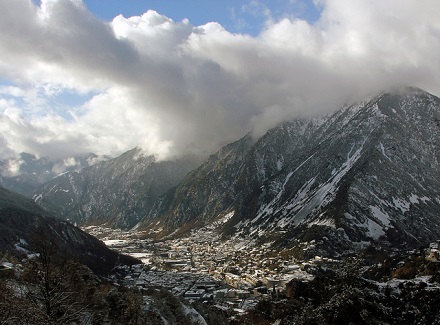
Andorra’s capital city Andorra la Vella. (cc) image from Isaac Torrontera.

On this day..

1943: Red Orchestra members, in the Nazi Paradise

From 7 to 8 p.m. on the evening of August 5, 1943 the Fallbeil at Plotzensee Prison destroyed 17 members of the Berlin Red Orchestra resistance circle.

We have touched previously on Die Rote Kapelle in the context of the first 11 executions that claimed its leadership on December 22, 1942.

But the Gestapo had a much wider network than that to break up; ultimately, there would be nearly 50 death sentences associated with Red Orchestra, for activities ranging from outright espionage to merely dissident leafletting, and other rounds of executions had taken place over the preceding months.

The executions this date were more of the sad same, and noteworthy for some sincere and ordinary citizens so sympathetic that even the Reich Military Court recommended mercy for some. Adolf Hitler refused it across the board. The victims, predominantly women who had been moved to Plotzensee for execution that very morning, included

  • Cato Bontjes van Beek, an idealistic 22-year-old ceramicist.
  • Liane Berkowitz. Two days short of her 20th birthday when she was beheaded, Berkowitz had given birth to a child while awaiting execution.
  • Eva-Maria Buch, who translated propaganda leaflets destined for illicit distribution to the forced laborers employed in German munitions factories.
  • Else Imme, an anti-fascist whose sister had emigrated to the Soviet Union.
  • Ingeborg Kummerow.
  • Anna Krauss, a 58-year-old businesswoman.
  • Klara Schabbel, a Comintern agent who in her youth had fought against the French occupation of the Ruhr after World War I.
  • Rose Schlosinger.
  • Oda Schottmuller, a dancer and sculptor who used her arts-related trips to act as a courier.
  • Writer Adam Kuckhoff. His widow Greta would go on to head the East German central bank.
  • Emil Hubner, an 81-year-old retiree, along with his daughter Frida Wesolek and her husband Stanislaus.

Besides the above, at least three others among the condemned in this group paid with their lives for an arts activism attack on Das Sowjetparadies (The Soviet Paradise), a Reich exhibition in May-June 1942 that used photographs and captured artifacts from the war’s eastern front to depict “poverty, squalor and misery” in the USSR. This associated propaganda film gives a taste of the vibe:

The Orchestra orchestrated an “attack” littering the exhibition with counter-propaganda


“Permanent Exhibition
The NAZI PARADISE
War Hunger Lies Gestapo
How much longer?”

This act of wehrkraftzersetzung was a factor in the sentences of —

  • Hilde Coppi, one of the circle’s principal members and the wife of the previously executed Hans Coppi. Like Liane Berkowitz, she was spared the first rounds of executions to bear and nurse her child.
  • Maria Terwiel, a Catholic barrister with a Jewish mother.
  • Ursula Goetze.

On this day..

1943: France Bloch-Serazin, bombmaker

On this date in 1943, French resistance heroine France Bloch-Serazin was executed by the Germans in Hamburg.

Bloch-Serazin English Wikipedia entry | French) was a Jewish Communist who had supported the Spanish Republican cause, so she was right in line for some official persecution after the Germans blitzed France.

No longer employable as a chemist, she put her training to good use manufacturing explosives in her apartment. (Today, a plaque in the 19th arrondissement marks the building.)

Arrested by French police on May 16, 1942, she was condemned to death by a German military court but deported to Germany to suffer that punishment. Her husband, Fredo Serazin, was subsequently murdered by the Gestapo in prison.

As France Bloch-Serazin was born in 1913, she has recently enjoyed a renewed appreciation around the centennial of her birth, including the homage (French link) of her native city of Poitiers.

On this day..

1943: “Native parachutists” in Morocco

LONDON, Jan. 4 (U.P.) — The Morocco radio tonight quoted an announcement from General Henri Honore Giraud’s headquarters that an unspecified number of “native” parachutists, dropped in North Africa from German planes, had been executed for trying to swing local populations to the Axis cause. [Vichy North Africa had only recently gone over to the Allies -ed.]

The “fifth column” chutists found “only rare complicity,” the announcement said.

“The natives and their accomplices have all been arrested and executed immediately after court-martial,” it continued. “Military authorities contributed efficiently to the arrest of these enemy agents.

“Large rewards have been distributed to all those who helped capture the culprits.”

(Source: New York Times, Jan. 5, 1943.)

On this day..

1943: Yitskhok Rudahevski and family

(Thanks to Meaghan Good of the Charley Project for the guest post. -ed.)

Sometime in early October 1943, fifteen-year-old Yitskhok Rudashevski and his entire family were rousted out of their hiding place in the Vilna Ghetto, taken to nearby Ponary, shot to death and buried in a mass grave.

The Rudashevski family were among the last remnants of a once-vibrant Jewish community in the city once known as “the Jerusalem of the north” for its culture and scholarship. People came there from as far away as the United States to study in its highly regarded yeshivas.

After the start of World War II, Vilna was annexed by the Soviet Union. It became a sanctuary to Jews fleeing from the Nazis, who occupied western Poland.

All of that changed on June 22, 1941, when Operation Barbarossa began. On the day Germany invaded the USSR, there were approximately 80,000 Jews living in Vilna, many of them refugees from the Nazi terror. By the time the Red Army arrived and kicked the Nazis out three years later, Vilna’s Jewish population had been reduced –through starvation, disease, deportation and executions — to zero.

Yitskhok (also spelled Yitzhak, Yitzak, etc., or anglicized to Isaac), was thirteen years old at the time his city was occupied by the Germans.

An only child, he was the son of a typesetter and a seamstress. Talented in writing, history and languages, he was also a faithful Communist and a member of the Pioneers, the Communist youth organization.

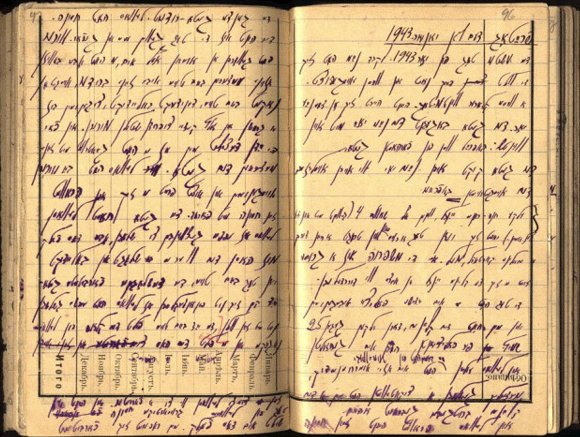
From June 1941 to April 1943 he kept a diary in Yiddish. Yitskhok had a sense of the significance of his account; at one point he wrote, “I consider that everything must be recorded and noted down, even the most gory, because everything will be taken into account.”

He not only wrote about his own life and his family and friends, but about the wider community events and the devastation the Germans wrought on his people. The historian Allan Gerald Levine called him “an astute and passionate observer of the times,” and compared him to Anne Frank.

Nor was the diary Yitskhok’s only writing project.

When one of his teachers, a beloved figure in the ghetto, died, he wrote a eulogy for the man and read it out before a large audience. He was a member of a literary group and was also attached to the ghetto’s history project, for which he interviewed ghetto residents about their lives:

I got a taste of the historian’s task. I sit at the table and ask questions and record the greatest sufferings with cold objectivity. I write, I probe into details, and I do not realize at all that I am probing into wounds … And this horror, this tragedy is formulated by me … coldly and dryly. I become absorbed in thought, and the words stare out of the paper crimson with blood.

The Vilna Ghetto, whose population initially numbered 40,000, had a rich cultural life, just like prewar Jewish Vilna had. There were theaters, cabarets, the symphony, art exhibits, a library, public lectures, and underground schools for both children and adults.

Vilna Jews saw art, music, literature and the pursuit of knowledge as a form of resistance. As Jacob Gens, head of the “ghetto’s Judenrat, put it, cultural activity gave a person “the opportunity to free himself from the ghetto for a few hours … We are passing through dark and difficult days. Our bodies are in the ghetto, but our spirit has not been enslaved.”

Reality intruded, however, and in the final analysis the Vilna Jews were doomed to extinction.

Yitskhok’s final diary entry was dated April 7, 1943, two days after five thousand Vilna Jews had been rounded up and shot at Ponary. He was understandably in a very grim mood. His prophetic last line was, “We may be fated for the worst.”

On September 23, 1943, the Nazis began the final liquidation of the Vilna Ghetto, which had by then been reduced to about 10,000 people. After a selection, those who could work were sent off to labor camps in Estonia and Latvia, where almost all of them died due to the brutal conditions there.

Children, the elderly, and the sick were shot at Ponary or sent to the extermination camp Sobibor and gassed.

Yitskhok, his parents and his uncle’s family chose to go into hiding rather than take their chances at the selection. In hiding he sank into apathy and said very little. After about two weeks in the hideout, they were discovered and taken to their deaths.

The only surviving member of Yitskhok’s family was his teenage cousin, Sarah “Sore” Voloshin. Somewhere on the route to Ponary she was able to escape. She joined a partisan group in the forest and survived until the Red Army liberated the area in the summer of 1944. After the war was over, she returned to the family’s hiding place and found Yitskhok’s diary. As of 2010, Sore Voloshin was still alive in Israel.

And the diary she retrieved had become one of the major sources on day-to-day life in the Vilna Ghetto.

Yitskhok Rudashevski suffered and died in just the same way as hundreds of thousands of others, but unlike them he did not remain anonymous: he is one of the ghetto’s most famous inhabitants. His writings have been published in their original Yiddish and in Hebrew, German and English translations. Extracts of his diary can be found in several anthologies, and it’s available in its entirety under the title The Diary of the Vilna Ghetto.

On this day..