1979: Twenty-one by revolutionary courts of the Iranian Revolution

At 5 a.m. today, 21 people were shot in Tehran by sentence of the previous day’s revolutionary court — the largest mass-execution since the Iranian Revolution three months prior. “Revolutionary courts consolidate the gains of the revolution,” exulted an official newspaper.

While the bulk of this morning’s condemned were lower-ranking Savak personnel or former policemen, several distinct VIPs were also shot along with them.

The names of all 21 people executed this date can be perused by date-searching the Iran Human Rights Memorial database.

On this day..

1979: Pin Peungyard, Gasem Singhara, and (twice) Ginggaew Lorsoungnern

For this date’s entry we turn to The Last Executioner — the memoirs of Chavoret Jaruboon, who was the last prison executioner in Thailand.


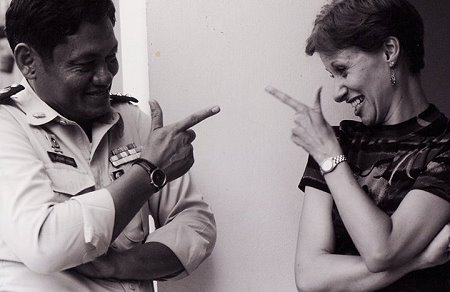
Bang. The late (he died in 2012) Chavoret Jaruboon, on the left.

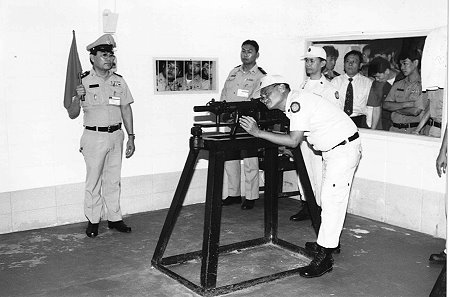
Thailand uses lethal injection today, but our narrator here was the last to conduct executions by that country’s previous execution method, a unique shooting arrangement that prevailed through 2002.*

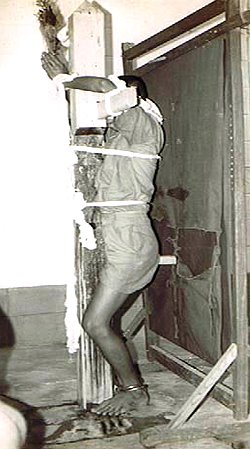
The prisoner to be executed was tied to a wooden cross, hands pinned in a prayerful position (wai), and facing a wall; behind him (or occasionally, as in today’s post, her), a screen; behind the screen, Chavoret Jaruboon with a mounted automatic rifle that would discharge a burst of up to 15 bullets into the vicinity of the heart, generally terminating life immediately.

The clientele this date were three members of a kidnap gang. Ginggaew Lorsoungnern, a former domestic for a Pathumwan, Bangkok family, had picked up from school the six-year-old child who was her former charge and delivered her to a bunch of toughs. When the ransom delivery went awry — the parents were supposed to toss the money out of a moving train at the spot of a flag, but missed the flag owing to darkness — the enraged kidnappers stabbed the little boy to death. Ginggaew allegedly flung herself over the child in a vain effort to protect him.

Inasmuch as her inside position was the lynchpin for the whole operation, however, these hystrionics would not save her from reprisal. (It wasn’t quite judicial reprisal since the execution was carried out by executive decree: not uncommon in dictatorial 1970s Thailand.) It probably didn’t help that coroners discovered soil in the victim’s lungs … meaning that when they’d dumped his body into its grave, he wasn’t yet dead.

The case was a media sensation. The late executioner’s 21st century book (copyright date: 2006) says that he was even then still “constantly asked about Ginggaew.” For what it’s worth, he thought the sentence was too harsh for her part in the crime. But executioners don’t get to make these decisions.

Ginggaew was the first woman shot in Thailand since 1942, and the first that Chavoret Jaruboon ever saw executed. In his time, he shot three women; Ginggaew is not among their number because in 1979, he was only a member of the execution team, not the man with his finger on the trigger. He was an “escort”, part of the team that brought the doomed from their cell to the execution chamber and then removed the corpse.

Escort duty was “one of the most emotional roles in the whole process of execution,” he writes. “Even the executioner does not have to see the body after he has done his job.”

And on January 13, 1979, the day Ginggaew died followed by two of her collaborators, the escorts had especially unpleasant duty.

While the men died stoic, Ginggaew was frantic, and fainted repeatedly over the hours before execution. “I didn’t do it, I didn’t kill the boy,” she pleaded. “Please don’t kill me, I didn’t kill him.”

Worse was to come.

At 5pm Ginggaew was selected to be brought to the execution room first. The escorts helped her to her feet but she immediately crumpled to the ground. She sobbed that she felt too weak to stand … As she approached the room she had to be revived from another faint.

I found this very difficult to deal with. Between us [escorts on the execution team] we finally got the stricken woman to the cross. She cried while they bound her at the waist, shoulders, and elbows. Her arms were brought up over the beam in a position of prayer. Still, she struggled and tried vainly to break free. The escorts pulled across the screen and fixed it so that the white square indicated where her heart was. Then they stepped out of range. I walked to the gun to load it and aim it at the target on the screen. I was aware that Ginggaew was still struggling. Normally once the prisoner was fixed to the cross they gave up fighting, but this was not the case with her. I secured the gun over her stifled sobs, locking it into position. When I was satisfied, I nodded at Prathom to take over. He took his position and at 5.40pm exactly he released ten bullets into Ginggaew’s body.

Doctor Porngul went up to her and checked for the pulse and retina response. As expected, he confirmed her dead. The escorts quickly untied her body, which was bleeding profusely from the chest, and laid her face down on the floor. She jerked and twitched a little. This wasn’t out of the ordinary but was distressing to witness. Her chest burst open and the blood looked like it would never stop flowing. They carried her into the morgue, the tiny room that we used just off the execution hall. I followed them just to make sure everything was alright. They placed her gently on the bed and we went out to prepare for the next one. What happened then will never leave me.

As the second prisoner, Gasem, was brought into the execution room, there was a sound from the morgue. I could see everything from where I was standing as the door was wide open — Ginggaew was trying to get up. The shocked escorts and I ran back to her. There was blood everywhere. One of the escorts rolled her over and pressed down on her back to accelerate the bleeding and help her die. Another escort, a real hard man, tried to strangle her to finish her off but I swept his arms away in disgust. We stood there watching her gasp for breath for I don’t know how long, but it could only have been a minute or two. I was filled with pity for her. I couldn’t help thinking that she was dying the way that little boy had died — except suffocating from blood instead of earth.

Meanwhile, Gasem had been shot. He died instantly from ten bullets. He had not resisted his death in any way, and spoke to nobody on the way to the cross. After the doctor confirmed that Gasem was definitely dead he checked on Ginggaew. Amazingly she was still breathing. It was a horrible, horrible situation. He told the escorts to put her back on the cross. The men complied, somewhat relieved to be able to just follow orders. It was a grim, nauseating job and they were covered in her blood when they turned to pull the screen across. This time the full quota of 15 bullets were used, and finally, she was dead.

You might wonder why we didn’t just shoot her where she lay, but it would have been against the regulations. Also, I don’t know that any of us could have stood so close to the young girl and pulled the trigger. As it was, the escorts moved as quickly as possible, each of us was concerned that her suffering should not be prolonged.

Pin had had to wait outside for ten minutes until Ginggaew was carried to the morgue for the second time. He was then brought in and tied to the cross. At 6.05pm Prathom pulled the trigger, sending 13 bullets into his back. The doctor went to check on him and discovered that he too was still alive, only just, but still breathing all the same. I loaded the gun again and Prathom shot a further ten bullets, this time killing him instantly. We were all in need of more than one stiff drink that evening.

There are a couple of reasons why Ginggaew had such a terrible death. Firstly her heart wasn’t on the left side as with most people. She most probably had Kartagener’s Syndrome, which is when a person is born with their heart on the right-hand side instead of the left. And even if it was she wasn’t secured firmly enough to the cross so she was able to move around, therefore the bullets would miss their target. It showed the importance of binding the prisoner as tightly as possible, for their own sake. I had my doubts when she was first pronounced dead. I thought I could detect some strain in her neck, and maybe that’s why I followed the escorts to the morgue. The head should normally flop backwards with the cross being the only support for the limp body.


Ginggaew, Gasem, Pin, and all others who were executed by shooting entered the execution building through this red door … now disused and overgrown since Thailand scrapped shooting. Pic from this Norwegian Amnesty International page.

After Thailand switched to lethal injection, Chavoret Jaruboon retired to a monastery. His books show no disquiet about his career. He explicitly supported the death penalty.

“What I do is empty this story (the executions) from my mind. If I don’t do that I don’t know what (the executions) will do to me.”

-Chavoret Jaruboon

* We’ve previously written about a 2001 execution by gunfire in Thailand.

On this day..

1977: Benigno Aquino condemned

On this date in 1977, former Philippines Senator Benigno Simeon “Ninoy” Aquino, Jr. was sentenced to death by firing squad under the dictatorship of Ferdinand Marcos.

Aquino, a lifetime politician from one of the archipelago’s powerbroking families, was one of the principal opposition figures against the increasingly autocratic Marcos. His 1968 denunciation of the “garrison state” — Marcos would quadruple the size of the military and infiltrate it widely into civil society — was one of the definitive and lasting brands upon that regime.

So nobody, and certainly not Aquino himself,* was surprised when the outspoken senator was arrested hours after Marcos imposed martial law in September 1972.

Unlike most such political prisoners, Aquino stubbornly refused to cut any deal for amnesty that would confer any hint of submission to Marcos. Their conflict reads, on both sides, as an intensely personal one.

Placed on trial for allegedly arming a guerrilla organization, murdering a political follower, and trying to place the Philippines under (unspecified) foreign domination, Aquino staged a headline-grabbing 40-day hunger strike in 1975 and received extreme unction. The Archbishop of Manila finally talked the wasting Aquino out of letting himself starve to death, but perhaps not out of a certain thirst for martyrdom. (New York Times, Feb. 22, 1977)

“If Marcos believes I’m guilty, I want to be shot tomorrow,” he’s supposed to have exclaimed as he was led away from the tribunal that pronounced his death. (New York Times, Nov. 26, 1977)

That didn’t happen.

While Aquino’s death sentence on this date was expected, it was also generally thought that Marcos — who had allowed only one (non-political) execution during five years of martial law to that point — would spare his foe, as indeed he did. Marcos even released Aquino to travel to the U.S. for treatment after suffering two heart attacks in 1980.

Aquino had those few years to raise his profile and that of the Philippines opposition around the states. Returning to his native country on August 21, 1983, a moment when a then-ailing Marcos seemed weakened enough for a political opening, Aquino was infamously assassinated right on the tarmac as he stepped off the plane.

This event, and the two million-strong funeral march of Aquino’s bullet-riddled body to Manila’s Rizal Park, helped galvanize the country’s opposition. By 1986, popular demonstrations sent Marcos fleeing to exile … and elevated to the presidency Ninoy Aquino’s widow, Corazon.

Today, the couple adorns the Philippines’ 500-peso banknote, and their only son, Benigno Aquino III, is the country’s president. To pay him a call, just catch the next flight to Manila’s Ninoy Aquino International Airport.


Marchers with a banner alluding to Ninoy Aquino’s assassination date pass the monument to the slain ex-senator in Makati. (cc) image from littleislanddimp

* According to In Our Image: America’s Empire in the Philippines, Aquino was disappointed at the muted public reaction to his arrest. “I judged Marcos correctly,” he told a friend, “but I misjudged the people.”

On this day..

1975: The last executions under Franquismo

Though Spain’s last execution is often misremembered as that of handsome anarchist Salvador Puig Antich in 1974, that milestone actually occurred with the shooting of five anti-Franco terrorists in three different cities on September 27, 1975.

It was an ugly coda to an ugly regime and a 40-year history of political killings.

Gen. Francisco Franco had the previous year been forced by his failing health to hand over power, raising hopes for a democratic transition. But after surprisingly recovering, Franco surprisingly took back his strongman role — and anti-Franco revolutionary movements that had been biding their time greeted the return of Franquismo with a wave of bombings and assassinations.

Spain’s cabinet met in September 1975 to consider eleven death-sentenced prisoners — three Basques of the separatist ETA, and eight members of the communist revolutionary organization FRAP. It upheld five of those sentences, all involving the killing of policemen. (Two women, who both claimed to be pregnant, were among those reprieved.)

The five who ultimately died were (and these are all Spanish Wikipedia links):


Headline from the London Times, September 27, 1975. The garrote was not, in fact, used for any of the executions.

The shootings met angry — often violent — reaction throughout Europe. Spanish embassies in the Netherlands and Turkey were attacked; several countries recalled their ambassadors; and French protesters rioted on the Champs Elysees. The EU predecessor entity EEC (Spain was not then a member) voted to freeze its trade relations with Spain.

And it was about more than just the five humans shot to death.

They had all been condemned within a month before their deaths, by military tribunals requiring harsh mandatory death sentences for crimes against public order. As the unsettled situation on the ground implied quite a lot of disorder and anti-government violence, observers worried that the regime’s willingness to actually carry out those sentences would unleash a “death machine” of unstoppable condemnations, met with inevitable reprisals, and still more unstoppable death sentences. Satans mördare, in the words of outspoken Swedish Prime Minister Olof Palme. Devilish murders.

The devil had plans for a different soul.

The ailing Franco succumbed to Parkinson’s Disease on November 20, 1975, once again introducing the period of relative calm and stability that Spain could have been enjoying for the previous year had the late caudillo just stayed in retirement. Spain abolished the death penalty under its post-Franco constitution.

Spanish-speakers may enjoy this documentary focusing on one of this day’s victims: parts 1 | 2 | 3 | 4 | 5. Indeed, this gruesome parting Franco made with his mortal coil has inspired many remembrances up the present day, especially given the martyrology-friendly anti-fascist credentials of the five. There’s also a 1991 film called The Longest Night and the Luis Eduardo Aute song “At Dawn”:

* This man’s widow Silvia Carretero, who was herself arrested and tortured (while pregnant!) under Franco, pushed an unsuccessful 2010 lawuit for her husband’s execution.

On this day..

1977: Hu Nim, Cambodian Minister of Information

On this date in 1978, peripatetic Communist intellectual Hu Nim vanished into Khmer Rouge Cambodia’s charnel house along with 126 others at Tuol Seng.

The child of a poor peasant’s family, Nim was a gifted young state worker who studied in Paris in the 1950s, where he met several future Khmer Rouge leaders.
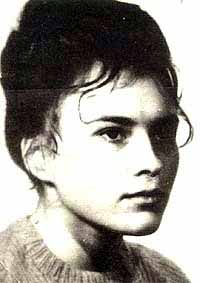
Nim charted an independent — some might say hypocritical — course over the next two decades, serving uneasily as a leftist parliamentarian in Prince Sihanouk‘s nationalist coalition government, fleeing ahead of a conservative purge into the bush to join Communist guerrillas, then returning once more to Sihanouk’s now-leftist Chinese-backed government-in-exile. It’s a period whose interests and alliances don’t map straightforwardly onto the familiar Cold War axis.

Hu Nim’s stature as Minister of Information in the government-in-exile transitioned directly to that same portfolio when the Khmer Rouge came to power.

Maybe those old ties to the ancien regime did him in — Vietnam, after invading Cambodia, would seize on the late minister’s reputation for independence to damn the Khmer Rouge for purging a moderate socialist — but there was no ideological talisman for safety during those terrible years. Hu Nim’s longstanding pro-Chinese position was also a dangerous association come 1977, and Phouk Chhay, a fellow officer of the Khmer-Chinese Friendship Association, was among the batch of prisoners shot along with Hu Nim this date.

Early in 1977, a massive internal purge shook the regime; as many people (some 1,500) went to Tuol Sleng from mid-February to mid-April of that year as had gone in all of 1976.* Almost every one of these humans would be, in the terrible bureaucrat-ese of the security apparatus, “smashed.”

Hu Nim was one of these, a denunciation wrung from a local commander leading to his April 10, 1977 arrest. Under repeated torture over the ensuing three months, the ex-Minister of Information would write and re-write his confession, fashioning himself “a counterfeit revolutionary, in fact … an agent of the enemy … the cheapest reactionary intellectual disguised as a revolutionary,” a stooge of the CIA since the high school, and a skeptic of the disastrous forced agricultural collectivization who had swallowed his doubts lest “I would have had my faced smashed in like Prom Sam Ar.” The confession ultimately tallied 200-plus pages. (Here’s some of it.)

Four days after his arrest, Hu Nim submitted the first of seven draft “confessions” to his interrogator, who appended a note to Deuch, saying: “We whipped him four or five times to break his stand, before taking him to be stuffed with water.” On April 22, the interrogator reported: “I have tortured him to write it again.” Five weeks later, Hu Nim was abject: “I am not a human being, I am an animal.” (Source

* Official count for all of 1977: 6,330 “anti-party” types tortured and executed at Tuol Sleng, as against “only” 2,404 in 1975-1976 combined.

On this day..

1970: Ibrahim Husain Muhammad

This from a May 7, 1970 London Times channeling of a Reuters report:

Mogadishu, Somalia, May 6 — Almost 50,000 people watched as a Somali soldier was executed by a firing squad today — the first public execution in the republic — for the murder of a girl.

In a statement read out at the execution, Lieutenant Ali Abdul-Rahman, the Attorney General, said: “The aim of imposing capital punishment on any citizen is to teach real justice, without which there can be no discipline here.”

Private Ibrahim Husain Muhammad was sentenced to death by a military tribunal in July, 1968. His appeals to the military High Court and to the Somali Supreme Court were rejected.

Somali dictator Siad Barre had good cause to worry about “discipline here.”

Whether the regime of the onetime Italian carabineire “taught justice” is another matter altogether.

On this day..

1975: Olga Hepnarova, tram spotter

On this date in 1975, 23-year-old Olga Hepnarova was hanged at Prague’s Pankrac Prison.

On July 19, 1973, a splenetic Hepnarova had lived out the road rager’s fantasy by barreling her three-ton Praga RN lorry into a tram stop* — killing eight elderly commuters.

Caught on the scene where her Truck of Death came to rest, Hepnarova’s authorship was not in question — only her culpability.
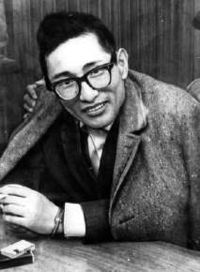
Three days after the bloodbath, she was telling police about her hatred of and alienation from her “brutal” fellow-beings, of beatings from her father and every form of humiliation and disrespect among her peers. This had been a lifelong theme with Hepnarova; the wounds of the world pierced her deeply, and she had spent time in a psychiatric institution after a teenage suicide attempt. In her short working life, she’d been unable to hold down any job for long. Truck-driving, tragically, was only her latest (and last) gig.

About the same time the tormented Hepnarova was owning her actions to the authorities, editors at two newspapers received nearly-identical letters she had posted before she made herself famous, touching much the same themes.

I am a loner. A destroyed person. A person destroyed by people… I therefore have a choice – to kill myself or to kill others. I choose – TO AVENGE MY PERSECUTORS. It would be too easy to leave this world as an unknown suicide. Society is too indifferent, rightly so. My verdict is: I, Olga Hepnarová, the victim of your bestiality, sentence you to the death penalty.

Doctors who examined her did not find her sufficiently off her rocker to have not known what she was doing, and the remorseless Hepnarova accepted the court’s verdict and sentence with equanimity. There are reports, however, that by the last day her placidity had crumbled and that she fought the execution team and had to be dragged, swooning, to the noose.

For this documentary, have your Czech handy. (And the same — or the online translator of your choice — for this Czech website about Olga Hepnarova’s life and legal case.)

Hepnarova was the last woman ever hanged in Czechoslovakia. (Or either of its death penalty-less successor states, if you want to count it that way.)

* The street where this shocking scene was enacted is today named for Milada Horakova, who preceded Hepnarova on Pankrac’s gallows.

On this day..

1971: Ousmane Balde, Barry III, Magassouba Moriba, Loffo Camara, Keita Kara Soufiana, and many others in Conakry

On this date in 1971, at least four former members of Guinea’s government were publicly hanged for supposed complicity in the previous year’s Portuguese invasion from neighboring Guinea-Bissau.*

The coup-threatened government of Sekou Toure was trying to send a message:

It did not scruple to make examples of men and women in very high places. Ousmane Balde (or Baldet) was Guinea’s former Finance Minister, Magassouba Moriba an Interior Minister, Barry III (also known as Ibrahima Barry; the link is French) the former Secretary of State. Keita Kara Soufiana had been Chief of Police. Loffo Camara was a National Assembly member.

Besides the quality of its reprisal victims, Conakry went in for quantity, too. Somewhere close to 100 death sentences were handed down with the barest of legal pretense, and the majority of them actually carried out on and around this date.

Personally arranging the grisly tableau for our hanged ex-ministers was a captain, Diarra Traore, who would one day help to overthrow the Guinean government, become Prime Minister … and wind up executed himself for his trouble.

* Guinea-Bissau was at that time still a Portuguese possession, known as Portuguese Guinea.

On this day..

1970: Akira Nishiguchi, Vengeance Is Mine inspiration

On this date in 1970, Japanese serial killer Akira Nishiguchi was hanged for murder.

Born in 1925, Nishiguchi (English Wikipedia entry | Japanese) spent the war years in juvenile detention but emerged in time to work as an interpreter for the U.S. occupation.

He was arrested repeatedly (Japanese link) as a con man during the 1950s. Police had him pegged as a nonviolent serial fraud artist, but in 1963 he killed two drivers to steal from them, then went on the run in Tokyo.

For 78 terrifying days, his face — those fraud convictions came with fingerprints that identified him as the killer — gazed out of wanted posters as Nishiguchi scraped by in cheap hotels and desperate disguises, committing three more murders in the process. Finally, an 11-year-old girl recognized him, posing as a lawyer.

Nishiguchi is the subject of the 1979 Shohei Imamura film Vengeance Is Mine. (Review | Another)

On this day..

1978: 12 coup plotters in Yemen

With president Ali Abdullah Saleh perhaps on the verge of being forced from power in the Arabian peninsula’s unmanned drone bombing range, Yemen, we thought a quick glance back at the infancy of his reign was in order.

It was this date in 1978 that Saleh, here just months on the job after a predecessor was assassinated, finished taking his demonstrative vengeance against a bushel of soldiers alleged to have been planning to overhrow him. New York Times, Nov. 6, 1978:

Vengeance is swift in the lands at the southern tip of the Red Sea. On Oct. 26, 17 persons convicted of attempting a coup against Somali President Mohammed Siad Barre last April were publicly executed by firing squad in Mogadishu. The 17 were said to have sought to overthrow President Barre because of his handling of the so-called Ogaden war with Ethiopia which led to a rupture in Somalia’s alliance with the Soviet Union and ended with Somalia forces retreating ignominiously from the Ethiopian province they had tried to annex. In a similar vein, after an abortive coup in North Yemen against President Ali Abdullah Saleh’s pro-Egyptian and pro-Western regime last month, the firing squads were busy. Soon after the attempted coup was crushed, nine army officers were executed. Yesterday, 12 more men were shot. Four of the accused were reported to have confessed at their trials that they had received money and arms from radical Libya.

On this day..