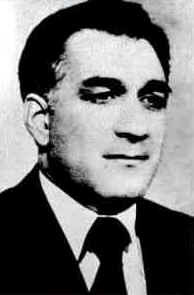
1972: Mohamed Oufkir

When last we met Mohamed Oufkir in these pages, he was violently suppressing an attempted coup against Morocco’s King Hassan II.

Mohamed Oufkir’s wife and six children were “disappeared” to a desert prison, not to emerge for 18 years. Daughter Malika, a royal favorite in happier times, wrote Stolen Lives about that ordeal. (Interview | Another)

We find him today, 13 months later as the arrow of time flies, in the same story — on the other end of the gun-barrel.

At around 4 o’clock this afternoon, a stunning attempt on the monarch took place as he flew back to Morocco from France. The king’s 727 was attacked by F-5 fighters of the Moroccan Air Force, surviving, it is said, when the quick-thinking king himself took the radio, pretended to be a flight engineer, and informed the attacking fighters that the pilots were dead and the king mortally wounded.

The ruse tricked the attacking pilots into allowing the crippled plane to make its landing in Rabat; they returned too late to strafe the airfield when they realized their mistake.

This quashed coup was swiftly laid at the door of Oufkir, the powerful Defence Minister.

Oufkir was declared to have committed suicide late this night, or else in the small hours of August 17; this still-standing official explanation has always had its doubters, with more extravagant versions implicating the offended sovereign himself in dealing out the punishment. Probably not, but here’s foreign correspondent Stephen O. Douglas’s reconstruction in Morocco Under King Hassan:

[Interior Minister Mohamed] Benhima said that when Oufkir arrived at the Skhirat palace at 11 p.m. he was met in an anteroom by General Mawlay Hafid and Colonel Dlimi, and when he realised that the king knew he had masterminded the plot he pulled out a revolver saying, ‘I know what to expect.’ Benhima added, ‘The two witnesses tried to stop him. In the struggle he fired three shots, one wounding him in the chest, the second I don’t know where, but the third was the most fatal.’ He said this was ‘the truthful and authentic version’.

‘General Oufkir committed suicide. He was not killed. It has been asked if it was a suicide of loyalty or a suicide of treason. Well then, I am authorised to tell you, to certify that since 1 p.m. today, and considering the elements of inquiry we have in our possession, I can affirm that it was a suicide of treason and not a suicide of loyalty,’ Benhima said.

Later at the same news conference, Benhima indicated he was just as astonished as most of the journalists. He said he and Oufkir were ‘great friends. We appreciated each other very much and had confidence in each other. We had a common denominator: our loyalty, and I think we wore the same decoration, given to us on the same day for the same reasons. He was a great patriot, a great minister. As I just told one of your colleagues, I cannot figure how he could have done what he did. But he is one of the most attractive people I have known, and what I have said about him today is painful to me, but the truth had to be told.’

I learned later that during the fatal night a military ambulance took Oufkir’s blood-stained body back to his Souissi house where it was placed on the floor of a playroom. His wife Fatima was away on vacation on the Mediterranean coast and there were very few people in the house. They found Oufkir had four bullet wounds, three in the back and the fourth having gone through the nape of his neck and out through his left eye, shattering his glasses, the coup de grace. Suddenly someone decided it was a mistake to send the corpse back to his family and it was hastily retrieved the same night. Thus evidence that he may have been ‘suicided’ disappeared.

Hassan somehow escaped the day with his crown, but with two attempts to overthrow him over the previous 13 months and a need to purge the many unreliable Oufkir loyalists in the armed forces — well, as the London Times put it (Aug. 22, 1972), “short of his incredible good fortune there is little else that can be cited in real terms to guarantee the perpetuation of his rule.” You could have made good coin wagering informed observers of the time that Hassan would live and reign another 27 years and be internationally saluted at his peaceful death at age 70.

On this day..

1977: 178 enemies of the people

A final example of the S-21 archives discovered by the Documentation Center is more mundane, yet poignant and telling. This particular document is of a type we refer to as an “execution log,” a daily record of executions at a given security center, in this case, at Tuol Sleng itself. Dated July 23, 1977, it is signed You Huy (a chief of guards) and authorized by Hor, the deputy director of S-21. The typewritten form lists biographical details on eighteen prisoners executed that day and, almost as an afterthought, in Huy’s handwriting a note at the bottom adds, “Also killed 160 children today for a total of 178 enemies killed.” This chilling glimpse into the Khmer Rouge internal security services is but a tiny example of the tens of thousands of documents discovered by the Documentation Center of Cambodia.

The “You Huy” named in Craig Etcheson’s After the Killing Fields: Lessons from the Cambodian Genocide is this man, Him Huy:

Huy survived his stint as a guard at the notorious Tuol Sleng prison, which was no mean feat: guards were routinely arrested and executed themselves. (Of course, prisoners had it worse.)

Now a 54-year-old farmer, Huy has been a spellbinding presence at and outside of Cambodia’s ongoing-as-of-this-writing “mixed tribunal”, reckoning with the horrors of the Khmer Rouge.

Like the method of execution.

All prisoners were blindfolded so they did not know where they were taken and their hands were tied up to prevent them from contesting us …

They were asked to sit on the edge of the pits and they were struck with stick on their necks …

Their throats were slashed before we removed their handcuffs and clothes, and they were thrown into the pits.

Him Huy has argued that guards like him “were victims too”. At least some victims and outside observers view him as a man more important to the killing process than Huy makes himself out to be.

Both accounts, though, could be true simultaneously: everyone in Cambodia was in danger of being purged, and guards at Tuol Sleng could find themselves inmates for the slightest derelictions of duty or enthusiasm. From April 17, 1975, Cambodia fell into madness.

On this day..

1976: Lt. Col. Abu Taher

At 4 a.m. this date in Dhaka Central Prison, Lt. Col. Abu Taher was hanged for treason.

A series of coups in the mirrored-sunglasses era of military governance shook the young state of Bangladesh:

  • The autocratic Sheikh Mujibur Rahman was toppled by a revolt of junior officers on August 15, 1975;
  • Senior brass in turn felled the ruling junta on November 3, 1975, jailing powerful officer Ziaur Rahman;
  • A quick counter-coup of junior officers — also remembered as the “sepoy mutiny”* — mounted by leftist war hero Abu Taher on November 7 put Ziaur Rahman’s hand back on the helm of state.

While November 7 is still marked in Bangladesh as National Revolution and Solidarity Day, its author got short shrift from its beneficiary.**

Abu Taher, a retired officer and a hero of the 1971 Bangladesh Liberation War that had detached the former East Pakistan from Islamabad, had visions of social revolution. But three coups in as many months is the sort of thing to rattle the new big man, and Zia consolidated his own power by eliminating threats to both left and right political flanks.

A mere 17 days after doing that National Revolution and Solidarity thing, the guy with the mass movement (pdf) of armed men was arrested for treason. He faced a military tribunal the following year.

Taher scorned the charges against him, but of course the fix was in.

* An allusion to colonial history.

** However, Taher’s own date of martyrdom is also still marked by his posthumous partisans.

On this day..

1977: Princess Misha’al bint Fahd al Saud and her lover

On this date in 1977, a 19-year-old royal adulteress and her paramour were executed in a Jeddah parking lot by the order of the girl’s powerful grandfather.

Princess Misha’al‘s fate has been obscured by secrecy and the Rashomon-like interpretations imposed upon it by observers.

In its outline (and the first stock interpretation we’re imposing) it’s that timeless human tragedy, the love story, in which headstrong royal daughter and suffocating traditional family square off over the seditious power of the feminine libido.

The princess, in a youthful arranged marriage by most accounts, took up with a Saudi boy while both were studying abroad in cosmopolitan Beirut, and dangerously attempted to maintain the affair back in the royal kingdom to the point of a quixotic (and obviously foiled) escape attempt. Whether under color of a judicial proceeding — the story says Misha’al refused to walk away by simply renouncing her lover and defiantly brought down the death sentence by confessing adultery — or simply on his own authority, the girl’s staunchly conservative* grandfather exercised his right as tribal patriarch to inflict an honor killing for the disgrace they had brought on the family.

The execution in Jeddah — she by gunshot,** he by a very clumsy beheading — that is supposed to have occurred on this date was public, but quiet; news of it got abroad only slowly and incompletely. Small wonder that, once it did, the blended motifs of Romeo and Juliet, harem titillation and oil politics made dynamite material for high-, middle- or lowbrow exploitation.

In 1980, the affair became the subject of one of the most notorious television programs ever aired, the docudrama Death of a Princess. This film’s airing in Britain in 1980 led Riyadh to expel the British ambassador, and cost £200 million of lost revenue for the UK from canceled orders and product boycotts by the Saudis.†

It was aired on in the United States on PBS in 1980 to similar controversy, as oil companies rushed to distance themselves from it.

Rebroadcast in 2005, Death of a Princess is available online for your judgment (as is this partial script): is this a muckraking expose of a shameful crime? orientalist heavy petting? “a sensitive and thoughtful exploration of the Arab dilemma,” as per its own advance publicity? and what did the official apologies (and in only a few countries, censorship) say about the political weight of the petroleum industry?

These, meanwhile, are the western reactions, already removed from events by a further layer of mediation, a forest of axes seeking grinding. If the writer who composed this piece is to be believed, the executed girl has posthumously achieved a sort of universal symbolic gravity in the Arab world, standing for the plight of any hopeless cause of justice dashed against authoritarian power.

* For the House of Saud, it must be recalled, the personal was political in the problematic confrontation between tradition and modernity athwart the desert kingdom’s sea of oil.

** “Princess Misha’al” was executed fully veiled, which permits the rumor that the slain woman was actually a surrogate and the onetime royal favorite lives on incognito somewhere.

† According to the July 4, 1980 London Times.

Part of the Themed Set: The Feminine Mystique.

Editor’s note: References to “Princess Misha” corrected; thanks to hannah for the clarification.

On this day..

1971: Ten failed putschists in Morocco

On this date in 1971, four generals, five colonels and a major who had attempted a coup d’etat in Morocco less than three days before were shot without trial at the military barracks in Rabat.

The senior officers* had taken military cadets and stormed the palace where birthday celebrations for King Hassan II were taking place. They captured the monarch himself before the cadets themselves wavered, and loyal troops successfully counterattacked. Ninety-two people, including the Belgian ambassador, were killed in the affair; the king was at their state funeral on this date at the time the putschists were being shot.

This selection of the coup’s leadership gunned down this day in Rabat did not make an end to the reverberations; other trials followed later in the year, and some others who were implicated were simply “disappeared”.

Although we lack the testimony of any of the coup leaders themselves for their motivations, it occurred in the context of political and social upheaval in post-colonial Morocco. Frank H. Braun (“Morocco: Anatomy of a Palace Revolution That Failed”, International Journal of Middle East Studies, Vol. 9, No. 1 (Jan., 1978)) argues that it was rooted in an eclipse of the traditional prerogatives of the military — and especially of the Berber nobility, who can be said to be the authors of the attempt.

So too can its failure be ascribed to the scant support this parochial and backward-looking cause commanded; non-Berber officers didn’t join the plot. Even so, with one of his government’s traditional pillars of support so heavily compromised (and decimated by this day’s executions and other reprisals), the coup led Hassan II to somewhat liberalize Morocco’s constitution the following year.

Which did not exactly still the tumultuous power politics scene in Rabat.

Mohamed Oufkir, the general who had coolly suppressed the 1971 coup** to become the preeminent military officer in the country, mounted his own bid for power in 1972 and suffered the same fate as this date’s doomed rebels.

* Notably, Mohamed Medbouh (French link), “one of my closest collaborators” in the estimation of the king himself (but also of “the mentality of a jackal”). His surname actually meant “cutthroat,” and was earned by his father’s literally having his throat cut — and surviving — in the 1920’s.

** A Berber himself, Oufkir may have been aware of the earlier coup — and cunning enough not to commit himself until he saw which way the wind was blowing.

On this day..

1972: The rapists of Maggie dela Riva

On this date in 1972, Jaime Jose, Basilio Pineda and Edgardo Aquino were electrocuted* in Muntinlupa for the gang-rape of actress Maggie de la Riva (or dela Riva) five years before.

The rising young actress had scarcely wavered after the assault before courageously making the always-fraught rape charge against a quartet** of attackers themselves from elite families. (The particulars are recounted in the Supreme Court ruling.)


J’accuse! Maggie de la Riva identifies two of the culprits just five days after her gang rape. Talk about facing your accuser; according to the accompanying article, “the frail-looking mestiza was a picture of righteous indignation as she extended her arms, showed her bruises, and asked Pineda, pointedly: ‘Do you remember these?'”

The case was a media sensation from day one. The Philippine film blog Video 48 republished a three-part series on the rapists’ capture (parts 1 and 2) and execution (part 3), complete with the desperate efforts of the offenders’ families to save them.

The victim herself continued her acting career.

Decades later, she’s still a public personality, and seems to have made peace with and moved on from her famous ordeal with impressive equanimity.

When that misfortune happened to me, I realized that although my body was raped my true self was never defiled and that there’s another person in me that’s beautiful, strong and true. The old Maggie has faded away. I look at my experience as something that happened to someone else who is no longer the person I am today. (Source)

* The Philippines adopted use of the electric chair in the early 20th century from the U.S., its colonial ruler at the time. It’s the only country besides the United States to have used the chair.

** One of the four condemned to death for the rape, Rogelio Canial, died in prison of a drug overdose several months before the executions.

On this day..

1975: Michael X

On this date in 1975, black revolutionary Michael X was hanged for murdering an insubordinate follower.

Born Michael de Freitas to a mixed-race parentage, the future Michael X immigrated to London from his native Trinidad in 1957.

There, he quickly established a criminal niche — drugs, racketeering, prostitution. “They’ve made me the archbishop of violence in this country,” he joked. It was a background noticeably parallel to that of Malcolm X, whose naming convention he took after a 1965 meeting.

By then, our day’s subject had been swept into the contradictory whirl of the 1960’s, emerging as Britain’s “authentic voice of black bitterness”, whose networks ran the gamut from the criminal underbelly to the rich and powerful.

(He’s a fringe character in the 2008 film The Bank Job, which imaginatively posits that he ducked prosecution for a heist by threatening to expose incriminating photos of swinging royal Princess Margaret.)

Michael’s chameleon-like identity — he was raised to pass as white, and known as “Red Mike” by black nationalist compadres — meshes well with the Rorschach-blot times he lived in. Certainly there was the eloquent spokesman of black militancy. There was also, ever more predominant, the violent avatar of social breakdown.

Michael X skipped bail in England to bolt for Trinidad and an agricultural commune with an increasingly creepy bent. Eventually, two bodies turned up: Joseph Skerritt, personally murdered by a machete-wielding Michael X for refusing to attack a police station and/or general disillusionment; and (sensationally) the socialite daughter of a Tory M.P. evidently buried alive.

Michael X — now Michael Abdul Malik — still had the cachet to draw celebrity support for his clemency campaign; Angela Davis, William Kunstler and John Lennon (who had put up Michael de Freitas’s bail in some previous legal scrapes) backed the “Save Malik” committee, but to no avail.

On this day..

1979: Hafizullah Amin

On this date in 1979, the 104-day term of Afghan president Hafizullah Amin met a violent end as a Soviet-engineered coup raised the curtain on a war destined to bring misery to both Cold War combatants.

The Soviet Union’s ongoing intervention in Afghan politics had through the 1970’s steadily mired it deeper into an unstable political situation.

Now, it was running out of patience with the country’s president, Hafizullah Amin.

He’d got the best of rival Nur Mohammad Taraki in a power struggle that September, but to the political chaos and the blossoming Islamic insurgency roiling his country, Amin added a level of brutality that was all his own, and a streak of diplomatic independence that was distinctly unwelcome in Moscow.

Amin was a Communist himself, and both he and the predecessor he’d murdered had wanted ever-increasing Soviet aid to keep the country stable.

But that proved to be a Faustian bargain.

Though Kabul radio would announce that Amin had been tried and summarily executed for “crimes against the state,” the short-lived dictator’s fate had been decided two weeks before when the Soviet Politburo passed a secret resolution for his ouster — having lost whatever confidence it had once held in him as a dependable satellite governor.

“The Soviet Union,” said the New York Times in a more innocent time,

has seemed deeply troubled by the inability of either the Taraki or Amin governments to put down the rebellions in Afghanistan, which have been largely tribal but also militantly anti-Communist.

Amin survived a KGB poisoning, so the Red Army dispensed with subtlety by raiding the palace, plucking their preferred satrap out of exile in eastern Europe to take Amin’s place.

It would not see the last of Afghanistan until 10 years, 15,000 Soviet dead, and hundreds of thousands of Afghan casualties later.


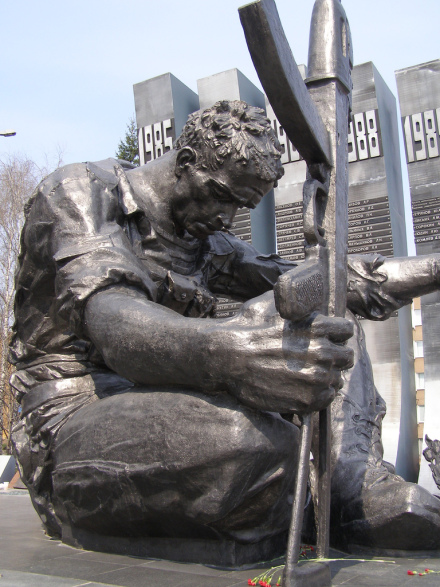
A memorial in Ekaterinburg, Russia, to the Soviet dead in the Afghan war. Image courtesy of beatdrifter (Andy Holmes).

On this day..

1977: Hamida Djandoubi, Madame Guillotine’s last kiss

On this date in 1977, the guillotine claimed its last head.

The famous and infamous blade dropped for the last time at Les Baumettes prison in Marseilles on Hamida Djandoubi, a Tunisian immigrant convicted of the torture-murder of the naive young girlfriend he had forced into prostitution. Oddly, he had already had another appendage — a leg — amputated as a result of a work accident; it was while recuperating that he caught the fascination of his hospital roommate’s 19-year-old daughter, Elisabeth Bousquet.

Though the death penalty was grinding to a halt in 1970’s France, Djandoubi was not the last person condemned (the link is French); the guillotine was only abolished with the election of the Francois Mitterand government in 1981.

Today, Executed Today discusses the case with the man who wrote the book on Djandoubi:* expat Canadian writer Jeremy Mercer. Be sure to check his photo series on the Djandoubi case — including discomfiting shots of Djandoubi re-enacting his crime with a police secretary playing the victim, and the killer in happier times.
ET: Thanks for joining us.

JM: Thanks for the opportunity to speak with Executed Today. I moved to Marseille in 2003 and shortly after I stumbled upon the rather arcane fact that the last man guillotined in France was executed at the local prison on September 10, 1977. I thought it was interesting angle on capital punishment and I decided to try and write a book that mixed true crime and death penalty philosophy. As a result, I’ve been immersed in the death penalty debate for the better part of five years.

Let’s start with Hamida Djandoubi himself — 31 years on, he looks like a nasty but fairly run-of-the-mill criminal. Was it strictly coincidental that he became the last man executed?

It was absolutely random fate. It was really odd – during the 1970s, the death penalty debate was raging in France and most capital cases became national news. But the Djandoubi case went completely under the radar, partly because his lawyer didn’t drum up any attention and partly because his victim was a presumed prostitute and the media prefers ‘sexier’ victims – the elderly, little children, a dentist of good standing walking her dog at night.

Even odder, if you surveyed most French people today, they would tell you that Christian Ranucci was the last man guillotined. Ranucci was a young white man who was accused of killing a little girl. He claimed his innocence, but was nonetheless executed in June 1976 (14 months before Djandoubi). Afterward, a best-selling book and major film were released that argued Ranucci was innocent so his name really sticks in the minds of the French.

Obviously, there’s plenty of tension with North African communities in France still today. Djandoubi was Tunisian, and he was convicted of murdering a white woman. How significant was racial marking in the way his case was handled, inside the courts and out?

This is really curious. In the 1960s and 1970s, the French courts were tainted by racism and one of the national papers even ran an editorial saying that it is better to be named “Marius than Mohamed” when appearing before a French judge. But, in this case, it was Djandoubi’s own lawyer who was a member of a far-right party and staunchly anti-Arab so his case was undermined even before it went to court.

It is one of those frustrating moments. You assume that a death penalty case is of such importance that top professionals are involved. Instead, Djandoubi chose the civil lawyer who negotiated his accident benefits after he had an accident at work and ended up with a very poor defence.

As I said above, his murder victim had worked as a prostitute, which diminished some of the public outrage. As well, his three rape victims were all Algerian girls aged 14 – 16. I guarantee you the case would have been much more explosive if those three girls had been white.

Your book is partly about Djandoubi himself, and partly about the history of the death penalty and especially the guillotine in France. How had the guillotine shifted in France’s identity by the time of this execution?

At first, when the guillotine was introduced, it was public sensation and executioners became celebrities with special edition postcards in their honour and fan mail and all that. As late as the 1860s, tour groups like Thomas Cook were actually organizing execution trips so English tourists could see the guillotine at work. But, bit by bit, the French became a little embarrassed by the fame of the machine. First, they removed the scaffolding that raised the guillotine above the crowds so that it would be brought down to earth and spectators’ views would be impaired; then, they stopped holding executions in the afternoon and held them at the less fan-friendly time of dawn; then, instead of guillotining people right downtown, they did it outside a prison in an obscure neighborhood at the edge of Paris; and, finally, in the 1930s they moved the guillotine inside the prison walls and it was no longer a public event. By the 1970s, the guillotine held such a low profile that many people thought it was defunct and that the French government was using the electric chair.

Interestingly enough, the fall from glory of the guillotine mirrors the general attitude toward capital punishment. By the late 1800s, many countries were already abolishing the death penalty and by the 1970s France was the last country in Western Europe to resort to capital punishment. In the end, the guillotine became the country’s dirty little secret that they kept hidden in their closet.

What are the bits of guillotine folklore you found most interesting?

The most popular stories involve the life in the head after it is severed from the body. It all began with the guillotining of Charlotte Corday, who had stabbed Jean-Paul Marat to death as he soaked in his bathtub. After she was guillotined, the executioner held her head up to the crowd and slapped her on the cheek. But, according to newspaper accounts, both cheeks reddened, as if Corday was indignant by this treatment. Suddenly, everyone began to wonder what a severed head can feel or think.

This curiosity became even more intense a few weeks later when the chief executioner, Charles Henri Sanson, guillotined two political rivals one after the other. He told friends that when he looked in the basket where he kept the heads, one politician’s head was biting the other politician’s head!

So, all this got the scientists really excited and the experiments began. One doctor, Dassy de Ligières, was allowed to take a head back to his laboratory where he connected it to a living dog and pumped blood back into it. He kept hoping the head would speak, but alas, no.

The definitive experiment was conducted in 1905 when Dr. Beaurieux was given permission to wait beside the guillotine and examine the head the moment it was cut. Dr. Beaurieux interviewed the condemned man in prison and came up with a pre-arranged set of signals. The day of the execution, the doctor had incredible luck –the head did a little twist when falling and landed on the stump, slowing the loss of blood. Dr. Beaurieux then called the man’s name three times. At 5 seconds, the man was able to look at the doctor and his recognize him; at 15 seconds, the man was able to look at the doctor but his eyes were unfocussed; and at 25 seconds, the man could barely glance at the doctor. So, to the best of our knowledge, a guillotined head maintains some level of consciousness for more than 20 seconds.

You’re working with Robert Badinter — tell us about him, and his upcoming tour in the U.S.

Robert Badinter is simply the greatest man I’ve ever had the honor of working with. He became a dedicated abolitionist after one of his clients was unjustly guillotined in 1972 and dedicated the next decade of his life to fighting the death penalty. In the end, he saved six lives and ultimately wrote the legislation that abolished the death penalty in 1981 when François Mitterrand named him Minister of Justice.

I interviewed Badinter for my own book in 2005 and he asked me if I could look into translating one of his books into English. When I had time in 2007, I set about the task and now Abolition has been released by Northeastern University Press.

Badinter’s Abolition, in French and in Mercer’s translation

To mark the book’s release, Badinter will be holding three conferences in America on the death penalty and strategies to abolish it:

Why, in your judgment, did France abolish the death penalty? And even before abolition, why did its use abate so dramatically in the postwar era?

For many people, it was a tremendous humiliation for France, the birthplace of human rights and the Enlightenment, to be the last country in Western Europe to use the death penalty. The abolition movement began when Portugal abolished the death penalty for common crimes in 1867 and by the late 1970s, nobody was using it in Europe. Even in Spain, one of the first things they did after the death of Franco was abolish the death penalty.

So, the use of the guillotine simply had to abate because the world was becoming aware that the death penalty is a flawed punishment: the risk of executing innocents, the cost of capital trials, the predominance of poor and minorities on death row, the lack of deterrence value. But, as long as there was a right-wing government in power in France, they couldn’t abolish the death penalty because they wanted to appear tough on crime and polls showed a majority of the French people wanted to keep the guillotine.

Once Mitterrand and the Socialists were elected in May 1981, it was clear the death penalty would be abolished, and sure enough, five months later it was gone

Where do you think the death penalty is going in America? And can one really think of worldwide abolition as a legitimate possibility?

I am absolutely convinced we will see almost worldwide abolition by 2050. There will always be a few rogue states, but the death penalty is such an obviously flawed form of punishment it will inevitably be eliminated.

In terms of America, Badinter and I have discussed it at length. He believes the country is ready for abolition and that all is needed is one trigger case: a middle class white guy with a reasonable claim to innocence who is about to executed. This would really instigate a debate on the penalty and as soon as you bring in all stats — the 130 plus people who have been exonerated while on death row, the work of the Innocence Project, the race bias, the cost of capital trials, the overworked public defenders etc etc — I think it would be a slam dunk.

Personally, I think people are selling the abolition the wrong way. Every time I meet a die-hard death penalty supporter who wants a serial killer or a child rapist killed, I ask him or her “Why are you so merciful?” Because, I honestly believe life in prison is a far worse punishment than being executed.

* Here’s a review of Mercer’s book.

On this day..

1975: Prince Faisal ibn Musa’id, royal assassin

On this date in 1975, a Saudi prince knelt in the public square before Riyadh’s Great Mosque, and 10,000 onlookers watched a golden-hilted sword took off his head for regicide.

It is little enough to say that, twelve weeks before, Faisal ibn Musa’id (transliterated several different ways — ibn or bin; Musa’id, Musaid, Musaed, or Musad) had approached his uncle King Faisal and shot him three times at point-blank range.

The reason(s) why a prince of the realm should do such an extraordinary thing are the real issue. They were murky then, and remain so to this day.

Certainly, when the monarch of the world’s leading oil producer is slain shortly after denying his product to the world’s leading oil consumer … well, speculation is bound to happen, even if the oil embargo was wrapped up a year before the murder. The assassin had studied (lackadaisically) in the United States a few years before, fueling hypotheses of a CIA hit, but there’s not even much of a satisfying just-so story to go with that, to say nothing of supporting evidence.

Whatever reasons there were seem to have been internal — a personal vendetta arising ultimately from the kingdom’s uneven confrontation with modernity so sensitively treated in Abdelrahman Munif’s Cities of Salt novels.*

The prince’s brother Khalid (or Khaled) had been slain by Saudi Arabia’s security forces in 1965 after demonstrating against television’s entry into the kingdom, an innovation authorized by King Faisal to the chagrin of strict Wahhabists. Khalid remains a martyr figure to Islamic fundamentalists to this day, and the conventional supposition is that Prince Faisal shot King Faisal in vengeance served 10 years cold; some accounts have him announcing as much at the moment of the murder.

(The conspiratorial palace intrigue version suspects Prince Fahd (or Faud) of using the aggrieved young man as his instrument in a coup; a defector from the Saudi diplomatic corps also inculpated Fahd along these lines. King Faisal’s death made Fahd the de facto ruler of Saudi Arabia upon the accession of a politically disinterested brother; Fahd ascended the throne officially when that brother died in 1982 — the succession was passing brother-to-brother, rather than father-to-son — and had steered the ship of state for 30 years by the time of his own death in 2005.)

The official inquiry concluded, as such things do, that Faisal killed Faisal alone, and though early reports had the shooter mentally unbalanced, authorities eventually figured him sane enough for trial and the full measure of the law’s majesty.

Faisal ibn Musa’id remains the only royal prince judicially executed by the House of Saud.

* An assassination inspired by Faisal’s shows up in the second novel of the cycle, Trench.

On this day..