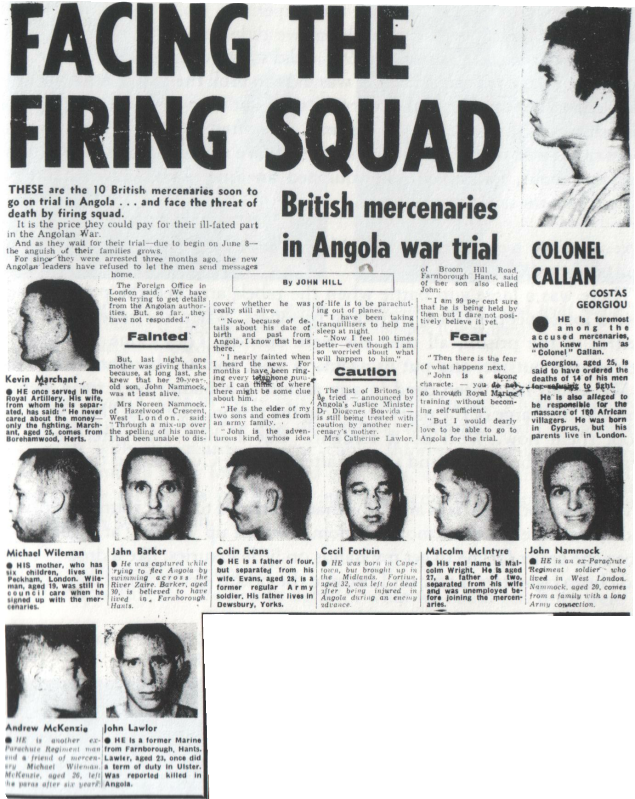
1976: Costas Georgiou and three other mercenaries in Angola

On this date in 1976, three Britons and one American were shot in Angola by a military police squad for murders committed as mercenaries earlier during the year.

Costas Georgiou.

They were among 13 foreigners sentenced at the Luanda Trial, which occurred on the pivot of Angola’s transition from generation-long anti-colonial insurrection on towards generation(s)-long civil war. Between them, more than half a million Angolans died, but this date belonged to a couple of unrepresentative Anglos.

Long story short, the immediate aftermath of Angolan independence in late 1975 was a scramble for control among the several factions who had been fighting the Portuguese … along with a scramble among interested outside states to line up their allies in this resource-rich Cold War prize.

Small wonder that foreign soldiers of fortune soon found their way into the chaotic scene.

Over the course of the first few months of independence, the Popular Movement for the Liberation of Angola (MPLA) more or less consolidated state power, and it proceeded to prosecute supporters of a rival guerrilla movement for their part in the conflict immediately after independence.

Thirteen foreign mercenaries who were captured by MPLA-supporting Cuban troops — the other nine drew long prison sentences — were charged in a show trial with war crimes for their conduct in the field in a case that made the western gun-for-hire an emblem of colonial depravity.

The most notorious of the bunch was Costas Georgiou. A Greek Cypriot emigre to Britain, he had gone to Angola as “Colonel Callan” and was wanted by Scotland Yard for there ordering a mass execution of other British mercenaries — an act he admitted at trial. Even the inevitable London Times editorial against the trial (June 29, 1976) agreed “the proceedings against Callan, if not the rigours of the sentence may be conceded.”

The others looked much less culpable, almost arbitrarily selected for death from among the ranks of unprepossessing, sometimes barely-there mercs. American Daniel Gearhart, a Vietnam veteran drowning in debt, had apparently been in the field for a mere three days and never so much as fired a shot; that he had advertised in Soldier of Fortune magazine was held to aggravate the charges against him, and in vain did the father of four insist that being tried for his life was enough to scare him straight out of the business.

Angolan defense attorneys, while also appealing against the legality of the trial on grounds of both international and domestic law, spoke that revolutionary language of decolonization in defending their charges. Georgiou, according to Maria Teresinha Lopes, was

“a colonized man … [treated in England as] a sub-human, just a Greek, just a ‘boy’.”

Another Angolan defense attorney argued against the death penalty because

“To condemn them to death while ignoring their social origin in terms of revolutionary justice would deny the theory which guided our revolution. My clients are an integral part of the exploited class.” (Both comments from London Times, June 19, 1976)

The era of decolonization was a time for idealism, but not the sort that would shrink from bloodshed.

In denying the doomed men clemency, Angola’s first independent president Agostinho Neto denounced

Mercenarism, instrument of the aggressive designs of imperialism … a scourge of the African continent and a grave threat to the peace, freedom and independence of the peoples …

It is imperative that the practice of mercenarism be banished once and for all from our planet. It is urgent that all states and peace-loving forces fight it most energetically.

We are applying justice in Angola not only in the name of our martyred people but also for the good of the brother peoples of Namibia, Zimbabwe and all the peoples of the world against whom imperialism is already getting ready to prepare new mercenary aggressions.

(Text dated July 9, and reprinted in the July 10 London Times)

You could just about substitute the word “terrorism” for “mercenarism” and read it on today’s campaign trail.

Juridically, Angola pursued these warriors as peoples who had fought unlawfully and could therefore be placed outside the protections conferred on soldiers by the Geneva Conventions — and subjected to the liberating power of revolutionary violence.

That this ad hoc concept of “mercenarism” could be exploited to license an outrage upon humanity was a notion relentlessly denounced by British and American officials,* who had not yet fully explored the utility of the “unlawful combatant” construct in extending the reach of their own security states.

As for all that peace-loving, brother-peoples stuff in the execution order?

What actually happened after the mercenaries were shot was that the two biggest former anti-colonial guerrilla movements in Angola morphed into Cold War proxies — the MPLA of the Warsaw Pact, supported by its control of the country’s oil; UNITA of NATO, supported by its control of the country’s diamonds — and bled the country dry in a horrific civil war.

* Henry Kissinger, then President Gerald Ford’s Secretary of State, complained that Angola’s decision

to ignore both the law and the facts … cannot help but affect adversely the development of relations between the United States and Angola.

On this day..

1972: Three Somali officers for an attempted coup

On this date in 1972, Somali Generals Muhammad Ainanshe Gulaid and Salad Gaveir, along with Col. Abdulkadir bin Abdulla,* were publicly shot in Mogadishu by a 90-man** (!) firing detail for attempting a coup the previous year.

Forged from the decolonized territories formerly known as British Somaliland and Italian Somaliland, Somalia had weathered a rocky 1960s before Siad Barre seized control in a 1969 military coup.

Muhammad Ainanshe Guleid had been Barre’s second vice-president (the first was also arrested for another supposed plot, though not executed), so the alleged conspiracy would have been treason at the very highest level. It’s obscure at this point to what extent the arrests might be attributed to an actual intended coup as against internecine politics within the ruling Supreme Revolutionary Council, or even whether those categories were wholly distinct.

“They were charged,” according to An Encyclopedic Dictionary of Conflict and Conflict Resolution, 1945-1966 (it makes great bathroom reading) “with treason in a plot to assassinate the president … and other high officials and to return the socialist country to capitalism.”

The Soviet-backed Barre had plenty of problems over the next two decades, but actually managed to hold the tumultuous country until 1991. Then rebels finally deposed the dictatorship. Neither those rebels nor anyone else, however, was able to establish an effective central government — leaving Somalia to become the anarchy/libertarian paradise it’s famous as today.

(Juxtapose: the Barre regime’s attempts (pdf) at establishing a more conventional tourist profile.)

* Each of these names have several possible transliterations. Actually, later this same year, Barre would announce an official choice of Latin script for the heretofore unwritten Somali language; schoolchildren at this time had to learn English, Italian, Arabic, and Somali.

** The source for the 90-man firing squad figure is I.M. Lewis, “The Politics of the 1969 Somali Coup” in The Journal of Modern African Studies, Vol. 10, No. 3 (Oct., 1972). As the title indicates, our day’s principals are not the author’s chief concern, but he adds apropos of Barre’s doomed efforts to shift loyalties away from tribes and towards the state that the massive fusillade party “was anti-tribal in composition, and that the Government would see to the funeral arrangements — traditionally a lineage responsibility.”

On this day..

1979: Ignatius Kutu Acheampong, former dictator of Ghana

On this date in 1979, former Ghanaian military strongman Ignatius Kutu Acheampong was shot in the aftermath of Jerry Rawlings’ successful coup d’etat.

Acheampong had executed a coup of his own in 1972 and run the unsteady West African state for most of the 1970s — a period of economic and political crisis — until he himself was toppled by another General, Fred Akuffo.

Acheampong was retired to his home village by the new regime, but he would not enjoy such satisfactory treatment when a national revolution ended Akuffo’s reign and brought junior officer Jerry Rawlings to power.

Less than two weeks after Rawlings was installed as Ghana’s new head of state, Acheampong was executed on a charge of corruption. This would not sate the considerable popular anger at the outgoing military clique, which went on to gorge itself on Akuffo and five others later that same month.

Former NFL defensive back Charlie Peprah is Acheampong’s grandson.

On this day..

1979: Gu Shan, of The Vagrants fame

It’s the spring equinox, but here at Executed Today, this date brings no bunnies or pastels.

However, in the spirit of softness, it brings this time only a fictional execution.

On this date in 1979, Gu Shan, the central character of Yiyun Li‘s novel The Vagrants gets a bullet to the heart in the Chinese town of Muddy River. The novel traces the lives of several townspeople in Muddy River who are touched by Shan’s death.

The short life of Gu Shan is secondary to the action of the novel itself: first a revolutionary, then a counter-revolutionary, the 28-year-old is imprisoned for acting against the government. As she sits in jail, she continues to write, and the scribbles in her journals are used in a retrial to garner a death sentence.

In a town of 80,000, her actions can be both consequential and inconsequential, but the people around her are a wholly forgotten lot. In a sense, then, Shan is important mostly because she’s noticed, and, as the saying goes, that really ties the room together.

The story tracks a cluster of characters who interact on the streets but live very different — almost uniformly bleak — lives. These range from Nini, a deformed girl whose mother was brutally assaulted by Shan when the latter was a revolutionary (a crime for which Shan suffered no consequences) to Bashi, the deranged son of China’s best Korean War-era pilot, who mutilates Shan’s corpse and shows a mild obsession for a 7-year-old boy.

Muddy River plays host to dozens of other characters connected to the execution, and Li paints a vividly depressing picture of China immediately after Mao Zedong’s death. The town is a collection of sad lives mired in moral depravity brought about by destitution and Party corruption. The most positive events transpire in quarters in a portable toilet.

Assuming you’re not looking for a pick-me-up on this equinoctial day (and why would you be at this blog if you were?), The Vagrants is well worth the read.

On this day..

1974: Salvador Puig Antich and Heinz Ches, the last garroted in Spain

On this date in 1974, in the face of an international controversy, Spain executed anarchist Salvador Puig Antich — the very last execution by garrote.

Handsome young Salvador radicalized as a youth in the 1960s under the oppressive semi-fascist Franco dictatorship.

As was the style at the time, the Catalan nationalist’s philosophy soon migrated to anarchism, and he brought his army experience to the Movimiento Ibérico de Liberación (MIL), whose direction-action credo entailed bank robberies branded as “expropriation.”

Puig Antich was caught in a police ambush that also claimed the life of a police officer — at least some of the bullets seemingly delivered by police friendly fire.

But his defense that his own gun discharged only as he was beaten senseless by the gendarmes never had a chance, since between arrest and trial, another set of proscribed leftists assassinated Prime Minister Luis Carrero Blanco.

Blanco’s successor went by the handle “Butcher of Malaga” for his depredations as a nationalist prosecutor during the Spanish Civil War.

So there was no quarter forthcoming from the Spanish regime, notwithstanding domestic general strikes and worldwide gnashing of teeth.

Salvador Puig Antich went on to a post-mortem existence as anarchist martyr. To help take the political edge off the scene, a non-political murderer, Heinz Ches (Spanish link), was garroted at almost the same time, in a different prison.

Spain soon did away with the discomfiting garrote; its very last executions were carried out by firing squad.

Salvador Puig Antich was the subject of a 2006 film, Salvador. (Here is a hostile anarchist review.)

The junior partner in the day’s twin killing, Heinz Ches, was himself the subject of a documentary, Nobody’s Death: The Enigma of Heinz Ches, exploring the weird near-total obscurity of the man who shared the headlines with Salvador Puig Antich. (A clip can be viewed here.)

On this day..

1979: Four Generals of the Shah

Shortly before midnight this date in 1979, Iranian royalist Generals Mehdi Rahimi, Reza Naji, Manuchehr Khosrodad, and Nematollah Nassiri were shot in a Tehran school courtyard after a snap trial by the newborn Iranian revolutionary regime.

General Mehdi Rahimi.

The Iranian Revolution had only just overthrown the remains of the absconded Shah’s regime; the country observes the “Decade of Fajr” over the first 11 days of February, commemorating the “Dawn” of the Islamic Republic from the return of Ayatollah Khomeini to the fall of the luckless loyalists installed by Pahlavi on his way out the door.

In this uncertain situation, the new regime seized its newfound authority … violently.

General Rahimi — probably the most voluptuously eulogized of the bunch — still pulls tribute for his loyalty to the collapsing monarchy, and his salute to the Shah even when in revolutionary custody.

Lower-profile to posterity, Naji had once governed Isfahan under martial law; Khosrodad was a general of the air force; and Nassiri headed the hated secret police SAVAK.

All were convicted of the catch-all charge of “corruption on earth” (just imagine what they’d do with the banksters!), and upon a quick confirmation of sentence from Khomeini, immediately shot. (Their property was also confiscated.)


See? Shot.

The notorious hanging judge who chaired the drumhead tribunal later recalled in his memoirs

The first people I tried and punished for their deeds were Nematollah Nasiri, head of SAVAK, and Khosrodad, air force commander; Naji, martial law administrator of Esfahan, and Rahimi, martial law administrator of Tehran and head of police force. … All the people who were sentenced to death by the Revolutionary Tribunals were the best examples of ‘corruptor on earth’ and they were executed as such.

A Corruptor on earth is a person who contributes to spreading and expanding corruption on earth. Corruption is what leads to the decline, destruction and the deviation of society from its nature. People who were executed had strived in spreading corruption and prostitution, circulating heroin, opium and licentious behavior, atheism, murder, betrayal, flattery, and, in sum, all these vile qualities. These people’s problems were aggravated by the fact that they did not repent once they saw the people’s revolution.

I believed at the time, and I still believe, that all the parliamentarians and senators, all governors, heads of SAVAK and police, who held office after 1963 and the Imam’s boycott, should be sentenced to death. High-ranking ministry officials who were instrumental in the survival of the [Shah’s] apparatus and who, for getting close to the Shah and his family, would accept any humiliation are all convicted (condemned).

To sum up, all the people that I condemned and who were executed in the early days of the establishment of the Revolutionary Tribunals and later in the Qasr prison were all corruptors on earth and, based on the Quran, their blood was a waste.

(The executions were announced on February 16, and that date is sometimes cited as the execution date. Feb. 15 appears to be more strongly attested to me. Whatever the clock said, these men’s deaths marked the start of a juridical bloodbath.)

On this day..

1974: Mun Segwang, errant assassin

This morning in Seoul, Mun Segwang (various similar transliterations possible) was hanged for an assassination attempt four months earlier.

Mun, a Japanese-reared Korean who needed a translator for his subsequent trial, tried to gun down dictator Park Chung-hee at a Independence Day speech Aug. 15.

Mun missed Park, but he did kill two others: a high school student; and, Park’s wife Yuk Yeong-su, the seated white-clad figure in the middle of the assassination footage who can be seen beginning to crumple on stage as the camera pans away.

South Korea figured him as the agent of a North Korean/Communist plot, which conclusion Japan and the North rejected vehemently. (Trial evidence also indicated that he read The Day of the Jackal.)

Park got lucky this time, but the autocrat was successfully iced five years later by his own intelligence chief. (Guess what happened to him.)

On this day..

1971: Martyred Intellectuals’ Day in Bangladesh

This date’s observance marks the systematic execution by (West) Pakistani forces of the intellectual class of East Pakistan at the end of the civil war which would detach the east as the independent nation Bangladesh — an unavenged war crime as cynical as it was brutal.


Executed intellectuals in the Dhaka Rayerbazar, 1971.

This was not a single discrete massacre, but a continuing policy during the March-December 1971 war. December 14, just two days before the Pakistani army surrendered, was the peak date of a dreadful endgame paroxysm that saw hundreds of scholars, teachers, lawyers, doctors, artists, writers, engineers, and the like rounded up and summarily executed in a bid to decapitate the new Bengali state’s intelligentsia.

Though the martyrs were subsequently venerated in Bangladesh, the higher-stakes regional geopolitics have always made effective redress a nonstarter.

On this day..

1974: Black Saturday in Ethiopia

November 23, 1974 was “Bloody Saturday” in Ethiopia for that day’s* surprise purge of some threescore politicians and soldiers by the ruling Derg.

It was barely ten weeks since the Derg — an Amharic word meaning “committee”, in this case a leftist military junta — had formally overthrown Emperor Haile Selassie, so ancient that he was already middle-aged back when he’d been leading Ethiopia’s resistance against Mussolini.

It’s strange to say in retrospect, but having spent the best part of a year systematically supplanting the political authority of the decrepit ancien regime with widespread public support, the Derg had engendered hope that its revolution would be accomplished without slaughter.

“Ityopiya tikdem/yala mimin dem” — “Let Ethiopia progress/Without any bloodshed” — became the popular slogan of that heady time. (pdf source)

Black Saturday turned the leaf on all that, and opened the sanguinary chapter of Ethiopian history today evoked by the name of the Derg.

What went wrong with Ethiopia's bloodless revolution?
“The prospect,” concluded the analysis that appeared under this headline in the Nov. 29, 1974 London Times, “is that the mass executions will be followed by further drastic action aimed at consolidating the control of the new military rulers.” The same author, Michael Knipe, had written on Nov. 16 that “the firmness of [the military’s] control appears to be matched by an overall moderation of approach, which holds promise for Ethiopia’s future.”

The Derg long remained a shadowy body, its members largely unknown and its internecine factional politics only guessed-at. The executions this date are generally read as the consolidation of the coup’s “radical” elements as against its “moderates” and the first signal event in Derg member Mengistu Haile Mariam‘s eventual conquest of supreme authority.

The crucial issue that separated radicals from moderates at the revolution’s early stage appears to be their approach to the ongoing struggle of coastal Eritrea — then still a province of Ethiopia.

Ethnically Eritrean officer Aman Michael Andom, the first titular head of the Derg who had been deposed from his position only a week ago, was a noteworthy advocate of negotiating a peacable settlement with Eritrean agitators. He was among the casualties of Black Saturday. (Aman was later reported to have been killed resisting arrest, rather than actually executed; many of the available accounts of this massacre have slightly varying numbers and particulars.) Henceforth, military force would be Addis Ababa’s only approach to the Eritrean problem.

A few other Aman supporters in the Derg shared his fate in a political wipeout. But more numerous among the 29 civilian and 31 military men announced as casualties the next morning — and there had been no prior warning that executions were imminent — were aristocrats and officials of the Haile Selassie government, including:

  • Two former Prime Ministers, Endelkachew Makonnen and Aklilu Habte-Wold (or Aklilou Wold), both of whom had been slated for trial for the recent famine in Wollo (London Times, Nov. 14, 1974);**
  • Solomon Abrahami, the former governor of Wollo;
  • Selassie’s own grandsom, Rear Adm. Iskender (Alexander) Desta;
  • 16 generals, including Selassie’s son-in-law (and former Defense Minister) Abiye Abebe.

(This Nov. 25, 1974 New York Times article — behind the paper’s pay wall — lists all 60 vicitms.)

These were a selection of some 200 political prisoners held by the Derg; how hard to come down on these officials was another point of contention between radicals and moderates. It emerged later that the Derg had met earlier on the 23rd to vote, name by name, which among its prisoners deserved execution.

So if you look at it right, summarily machine-gunning only 30% of your political prisoners is a moderate policy. Alas: these would hardly be the last.

After the Derg government was itself finally overthrown in 1991 — and the troubled province of Eritrea finally won its independence from Ethiopia — some of the perpetrators of its genocidal atrocities were themselves put on trial.

* It’s obscure — perhaps permanently so — whether the nighttime killings transpired before or after the end of the day, and both the 23rd and 24th are variously cited as the date of death. “Reliable sources said the executions were by machine gun at midnight,” the unhelpfully breezy New York Times reported on Nov. 25. This account (pdf) has the shootings occupying several batches with midnight passing during the process. We give precedence to Saturday the 23rd here because that’s the day that earned the “Bloody” appellation.

** According to Marxist Modern: An Ethnographic History of the Ethiopian Revolution, Mengistu was rumored to have disposed of Aklilu personally.

On this day..

1971: Ion Rimaru, the Vampire of Bucharest

On this date in 1971, Romania’s most notorious serial killer was dragged to the stake at Jilava Prison — fighting all the way, and shrieking “Call my father, so he can see what’s happening to me! Make him come! He’s the only guilty one!” — and shot to death for a rape-murder spree that had terrorized Bucharest for more than a year.

Ion Rîmaru (or Ion Râmaru), an emotionally stunted, sexually perverted veterinary school dropout, began in 1970 preying on lone women perambulating the Romanian capital late at night.

Though a number of Rimaru’s targets escaped with their lives,* his attacks were noted for their bestial ferocity: biting into, perhaps cannibalizing, his victims’ sex organs; necrophiliac rapes; blood-drinking (hence the nickname). Authorities loathe to cop to a serial killer were initially tight-lipped about the monster in their midst, only heightening public terror, until a very visible May 1971 dragnet finally caught the Vampire.

Though he surely met someone’s definition of nuts, his attempt to claim insanity at trial was a predictable nonstarter, leading to this day’s scene on the execution grounds. Rimaru actually got himself turned all the way round, and took the firing squad’s barrage in his back. Unseemly, all in all.

But all that carrying on about his father? Evidently it was more than just unresolved Oedipal stuff.

The next year, his father fatally “fell” (read: was pushed by police) from a train. Forensic evidence taken from the body of Florea Rîmaru (Romanian link) implicated the Vampire’s dad in four unsolved 1944 murders in wartime Bucharest.

* His infamous spree’s official tally was four killed, plus six attempted murders, five rapes, one attempted rape, one robbery and three thefts. (Romanian source)

On this day..