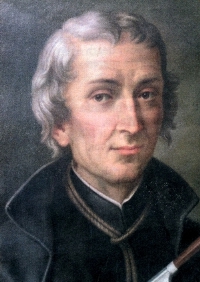
1393: John of Nepomuk, Bohemian rhapsody

This is the date in 1393 when the Catholic patron saint of Bohemia, John of Nepomuk (or John Nepomucene) was tossed from Prague’s Charles Bridge into the Vltava River to drown at the order of the Holy Roman Emperor Wenceslaus.

Baroque statue of John Nepomuk on the Charles Bridge from which he was hurled. (cc) image from Jaguar Julie

A relief detail ((cc) image from Charles Hoffman) on this statue depicts the moment of Nepomuk’s martyrdom.

This Wenceslaus — not be confused with the good King Wenceslaus of song — had a tetchy relationship with powers ecclesiastical and temporal.

But although Wenceslaus did martyr a fellow by the handle of John of Pomuk or Nepomuk, the latter makes this blog because of political tension centuries afterward. Despite the date of his corporeal death, John of Nepomuk is really a counter-reformation saint.

Between the late 14th century and Catholic Austria’s bloody 17th century triumph over Czech nationalism the historical Nepomucene parted company pretty definitively.

The real John of Nepomuk was the General Vicar of the local archbishop, John of Jenstein (or Jenzenstein), whose skirmishes with Wenceslaus over the boundaries of royal authority caused historian Albert Wratislaw to draw a Thomas a Becket comparison.*

In the event, the latest manifestation of that disputatious relationship — the king’s attempt to seize some monastic revenues — caused Wenceslaus to completely fly off the handle and arrest several of the archbishop’s advisors, among whom was our sainted martyr.

Wenceslaus personally oversaw their torture and ordered their drowning, but someone talked him out of the execution part. The king at that point had a sort of mini-Guantanamo Bay situation: he had in hand several people whom he had arrested arbitrarily and tortured, whose release would only further embarrass his own royal self. He therefore prevailed upon them to trade their silence for their liberty.

The other arrestees counted their blessings and accepted this expedient exchange. John of Nepomuk, perhaps because he was already tortured near to the point of death, refused. He was consequently “dragged through the streets to the bridge, there his hands were tied behind him, a piece of wood was thrust into his mouth, his feet were tied to his head in the form of a wheel, and he was thrown into the river.”*

The Nepomucene’s legend really grew after his death: in its most splendidly devotional form, as the proto-martyr for the seal of the confessional, which he supposedly kept as the queen’s confessor when Wenceslaus suspected her of infidelity. (An ironic inversion to say the least, since it was actually John’s more timorous co-accused who distinguished themselves with their silence.)

This is a much more edifying martyrdom altogether, so little wonder that the sourcing on John of Pomuk over the succeeding centuries is a hot mess; later scholars would actually speculate as to whether there might not have been two priests of this name who were both martyred by Wenceslaus, so dissimilar were the legends.

Nepomuk’s elevation to legend, and thereafter to the patron saint of Bohemia, would come in part thanks to a great Czech religious reformer who arose at the end of Wenceslaus’s reign — Jan Hus.

This other, heretical John became woven into the emerging Bohemian national sense; he still remains there today. When the Catholic authorities beat back a Protestant and nationalist revolt in 1620 and imposed Catholicism from above,** Saint John of Nepomuk, martyr, was ready at hand for propagandists of the new order. At least, the legendary, confessional-keeping Nepomuk was ready … because this was not a job for the random cleric-bureaucrat who’d been done to death in some forgotten dispute over rent.

For three hundred years two holy men have been rivals for the reverence of the Cech people. One of them, Saint John Nepomuk, was exalted by the Jesuits, who after the battle of the White Hill in 1620 sought to win back the Cechs to the Roman obedience. … His rival for the position of national hero has been Jan Hus, who, during the reign and under the favour of that same king Wenceslas, led the revolt of the Cechs against the ecclesiastical domination of Rome and the secular domination of Germany, and was martyred as a heretic and rebel at the council of Constance in 1415. From that date until the extinction of the independent Bohemian state by the forces of the Empire and the Counter-Reformation in 1620, Hus was publicly honoured by his fellow-countrymen as the champion of national and religious liberty. From 1620 to 1918 his rival was exalted in his place …†

John of Nepomuk today is depicted in statuary on the Charles Bridge (the spot on the bridge where he was thrown over is also marked with a plaque) and is well-represented throughout Catholic central and eastern Europe. Owing to his patronage portfolios of bridges and flood victims, you might also find the Nepomucene in many a topical posting throughout the world — like the very spot of Christianity’s European triumph, Rome’s Milvian Bridge.

(Somewhat less gloriously, the promulgation of this saint’s name and fame mean it also attaches to John Nepomuk Schrank, a Bavarian immigrant to the U.S. who attempted in 1912 to assassinate former president cum presidential candidate yet again Theodore Roosevelt.)

* Wratislaw, “John of Jenstein, Archbishop of Prague, 1378-1397,” Transactions of the Royal Historical Society, Vol. 7 (1878), pp. 30-57. Wratislaw wrote a now-public-domain book about St. John available here.

** Bohemia’s Catholicization is perhaps the classic case in early modern Europe of the Reformation being rolled back from above and from afar. The recent (and none too affordable) book Converting Bohemia: Force and Persuasion in the Catholic Reformation takes a nuanced survey of Bohemia’s transformation from a Protestant to a Catholic bastion … and as the title suggests, finds many of the Catholic components home-grown.

† R.R. Betts, “Jan Hus,” History, Volume 24, Issue 94 (September 1939), pp. 97–112.

On this day..

1601: St. Anne Line

On this date in history, Anne Line was hanged for harboring Catholic priests in Elizabethan England.

There’s not too much question of her “guilt.”

I am sentenced to die for harbouring a Catholic priest, and so far I am from repenting for having so done, that I wish, with all my soul, that where I have entertained one, I could have entertained a thousand.

-Anne Line at the scaffold

She’d been disinherited from her Calvinist family for converting to Catholicism, and scratched out a living teaching and embroidering and keeping safe houses for forbidden Catholic clergy.

That house was raided in early February of 1601, and while the priest escaped, Anne Line did not.

Just one day after conviction, she hanged at Tyburn along with two priests, Roger Filcock and Mark Barkworth.

Anne Line was canonized in 1970; she’s one of the Forty Martyrs of England and Wales.

One of the possible interpretations (.doc) of Shakespeare’s recondite allegorical poem “The Phoenix and the Turtle” is that it’s about Anne (the phoenix) and her husband Roger Line (the turtledove; he predeceased her).

Death is now the phoenix’ nest;
And the turtle’s loyal breast
To eternity doth rest,

Leaving no posterity:–
‘Twas not their infirmity,
It was married chastity.

Truth may seem, but cannot be:
Beauty brag, but ’tis not she;
Truth and beauty buried be.

To this urn let those repair
That are either true or fair;
For these dead birds sigh a prayer.

On this day..

1550: The leaders of the Prayer Book Rebellion

On this date in 1550, the leaders of England’s Prayer Book Rebellion were hanged, drawn, and quartered at Tyburn.

When Henry VIII dropped dead in 1547 and pitched his contentious realm and dubious progeny into the mid-Tudor crisis, Henry’s old theological henchman Thomas Cranmer really got to work.

During the unsteady regency of Henry’s sickly heir, Cranmer would push frenetically to make the religious reformation that his former boss never completely backed. The Archbishop sent to the continent for Protestant theologians like Peter Martyr who could help him “do away with doctrinal controversies and establish an entire system of true doctrine.”

The piece de resistance of Cranmer’s project was his Book of Common Prayer — a reformed liturgy, and in English, to go with the new English Bible. Many centuries — and revisions — later, it’s still the basis of Anglican services and of rites in many other Protestant denominations.

In 1549, it debuted to decidedly mixed reviews.

Enforced by Parliament’s Act of Uniformity, the Book of Common Prayer replaced all Latin liturgies on Whitsunday 1549, and for many of England’s Catholics, it was one affront too many. (The country’s bumpy economic realignment couldn’t have helped matters.)

On Whitmonday, traditionally-minded parishioners in West Devon unimpressed* with this newfangled vernacular service forced their local cleric to break out the old vestments and say Mass in Latin. State attempts to enforce the ban soon produced a martyr for the cause — one William Hellyons, melodramatically impaled on a pitchfork — and a march to Exeter that spiraled into outright revolt, heavy with suppressed Cornish nationalism.

We, the Cornishmen, whereof certain of us understand no English, utterly refuse this new English.

Religion, theology, the liturgy, the text of the Scripture … these were things that early modern Europeans were ready to fight and die for.

Yet the most problematic demand made by the men of Cornwall was probably not for the dead tongue of Latin, but for a partial reversal of the Dissolution of the Monasteries.

Since this considerable plunder of Church wealth had been widely redistributed to the English gentry, talk about repossessing it really emptied the pews of potential allies.

At any rate, neither Latin nor monastic restoration would be provided as carrots; London under Lord Protector Edward Seymour instead put down the rising with the more customary stick.

After the bloody Battle of Clyst Heath and the conclusive Battle of Sampford Courtenay, English troops rounded up and summarily executed survivors and sympathizers.

Such principals as remained were reserved a more awful fate: drawing and quartering at Tyburn. These seem to be the chaps who endured it:

  • Henry Bray, Mayor of Bodmin
  • Landowner and military leader Humphrey Arundell
  • Landowner John Wynslade
  • Thomas Holmes
  • John Bury

Bill Ind, Anglican Bishop of Truro, made news in 2007 acknowledging “that the English government behaved brutally and stupidly” in crushing the rebellion.

The Book of Common Prayer was never translated into Cornish, a circumstance sometimes credited with speeding the tongue‘s demise.


A stone commemorates the Prayer Book Rebellion at Penryn. (cc) image from Drewhound

* Petitioning:

We wyll haue the masse in Latten, as was before.

We wyll haue the Sacrament hang Oller the hyeghe aulter, and there to be worshypped as it was wount to be, and they whiche will not thereto consent, we wyll haue them dye lyke heretykes against the Holy Catholyque fayth.

We wyll haue . . . images to be set vp again in euery church, and all other auncient olde Ceremonyes vsed heretofore, by our mother the holy Church.

We wyll not receyue the newe seruyce because it is but lyke a Christmas game, but we wyll haue oure old seruice of Mattens, masse, Euensong and procession in Latten as it was before.

On this day..

1943: Lojze Grozde, beatified Slovenian

On this date in 1943, Slovenian student Lojze Grozde was executed by communist partisans.

An ardent young Catholic, the 19-year-old Grozde was on his way from boarding school in Ljubljana in Italian-occupied Slovenia* to visit some relatives when he was stopped at a roadblock.

Partisans who found the devotional book The Imitation of Christ on his person were a mite hostile, since the Holy See was not exactly at loggerheads with fascism.

All of Yugoslavia had become one gigantic dirty war, and though individual Catholics might fall anywhere on the political spectrum, the institutional church did not shy from working with fascists, who had the virtue of sharing the See’s hatred of communism.

Catholic Action, to which our day’s victim belonged, was among the many entities supplying volunteer paramilitaries that partnered with the Italian occupation.

We’ve seen this dynamic elsewhere in Eastern Europe; it may be too pat to say that all these paramilitaries were fascists, but it’s much too little to characterize them as unwilling about the partnership.** The headsman does not issue verdicts; he only carries them out.

The Archbishop of Ljubljana, Gregorij Rozman, an “enthusiastic Nazi collaborator,”† had only weeks before enthused over the Italians’ growing openness to their Slovenian partners:

We should be allowed to establish protective armed units under Slovene command in all rural areas … from men worthy of trust, to fully guarantee that the arms will be used exclusively against rebellious elements that endanger the land either with arms or revolutionary propaganda.

The soldiers have already dispersed the camps and groups of the rebels, but many of them are still in the woods and in villages, where they are camouflaged as peace-loving citizens. Such persons are not known to the Italian armed forces. Because of their unfamiliarity with the language and the difficulty of finding those who help those who hide in the woods, it will be very difficult to find the culprits. But for the local young men such difficulties are nonexistent or can easily be overcome…

His Excellence, General Roatta, has said that the people must now choose between order and Bolshevism. We have chosen order, and propose the only way that in our humble opinion will be effective and certain to achieve complete order in active collaboration with the authorities.

(Quoted here)

The partisans who caught our day’s principal apparently jumped to the conclusion that Grozde was an anti-communist paramilitary based on his Catholic Action association and the Italian passes he was carrying for his visit; his body, when recovered, bore the marks of torture.

Even the partisans had to cop to an over-hasty judgment in this instance, and while there’s been some dispute over the years about whether Grozde might not have been up to something more political than “visiting relatives,” Rome has been energetic about rehabilitating its man — perhaps as the thin edge of the wedge for vindicating more controversial Slovene Catholic “collaborators”.

Lojze Grozde was beatified in 2010.

* Slovenia was partitioned between the Italians and the Germans early in the war; the German occupation was the more heavy-handed, but both countries designed ethnic cleansing policies. (pdf)

** Some representative slants on the matter, from different angles both sympathetic to Slovenian Catholics’ predicament:

the communists, who were in complete command of the Partisan movement, were concerned not so much about national liberation as such, as about eliminating their political rivals, carrying out their “social revolution”, and seizing power … [anti-communist Slovenes’] great disadvantage was that they had to carry out their struggle on the side of the Germans, who, on the other hand, did not hesitate to force them into compromising actions, for example, to take an oath to Hitler. As a result, they and their political exponents were branded as collaborators.

Yugoslavia: A History of Its Demise

And:

If the Partisans had not been set on seizing power by revolution, one could speculate that the Catholics, who had dominated Slovenian politics before the war, could have conceivably regained power and run a government little different from that in Italy. The only difference was that, whereas Italian Christian Democrat leader Alcide de Gasperi had kept clear of the Fascists during the war, the Slovene Catholics collaborated … the Communist threat was real and life-threatening, and the Catholics can claim credit for opposing it consistently. However, Catholic writings of the time caricature Communists as devils and anti-Christs. Today such virulence seems overdone … the Communists equated collaboration with treason. However, this seems unfounded. The Catholics who opposed them loved their country as much as anybody else … They just wanted a different regime from the Communists to take power at the end of the war.

Slovenia 1945: Memories of Death and Survival after World War II

† “We are thankful to God,” Rozman wrote in a 1941 pastoral letter, “who inspired the leader of Greater Italy with the thoughts of generous rightfulness and considerate wisdom … [to establish] the Ljubljana province.” (From Slovenia 1945: Memories of Death and Survival after World War II)

Not everyone is so harsh Archbishop Rozman.

On this day..

1603: The men of the Bye Plot, but not those of the Main Plot

On this date in 1603, priests William Watson and William Clark were executed for a dramatic (that is, harebrained) plot “to take away ‘the KINGE and all his cubbes.'”

The year was 1603, the first in the reign of James I. (However, he’d been James VI of Scotland since the tender age of 13 months, when his mother Mary, Queen of Scots had been forced to abdicate. He made himself quite a reputation for witch-hunting.)

With the death of the Protestant Queen Elizabeth and all her schismatic Anne Boleyn mojo, hard-pressed English Catholics greeted Jamie’s ascension hopeful of relief from official persecution. Although raised Protestant, both his parents had been Catholic.

Watson was one of these hopeful adherents, and hastened himself to Scotland as Queen Elizabeth lay ailing to extract from the future English monarch the soothing blandishments of good favor that future monarchs make.

When toleration was not extended to Catholics upon the new king’s elevation in late March 1603, the disenchanted Watson almost immediately embarked on a preposterous scheme to

assemble force and strengthe, and on Midsommer-day last, in the night, to come to the Parke pale at Grenewich, to enter in by the gardein with a key, that should be borowed; and when the numbers were come in, there should be a watche set at the dores of principall persons, and at the passages; and then to goe up to the KING’S loding. And when they cam to the KING, they should surprise his person, and carry him to the Tower, and they would move him for 3 things: — 1, for there pardon; 2, for tolleration of relligion; 3, for assuraunce thereof, to preferre Catholiques to places of credit, as WATZON the priest to be Lord Keper; GREY, Erle Marshall; GEORGE BROOKE, Lord Treasorer; and MARCAM, Secretary. They concluded to cutt of many of the Privy Councill, and to have made a Proclamation, purporting howe the KING had bene misled, and to have had many things reformed. They determined to have possessed the principall ports of the realme, and to have kept the KING in the Towre a quarter of a yeare.

The Bye Plot was ironically busted by other Catholics — Jesuits, as distinct from “secular clergy” (clergy not affiliated with an order) like Watson. Jesuits and secular clergy were at loggerheads in this period over tactics, church structure … more or less everything. The need to steal the thunder of whatever restore-the-Church scheme the Jesuits might be cooking up might have helped precipitate Watson into such immediate and desperate disaffection.

At any rate, these other more respectable fathers of the church blew the whistle on the Bye Plot lest it provoke anti-Catholic pogroms, and you’d have to concur with their estimate that taking the king hostage is the sort of thing that would have prompted some blowback.

In the course of rolling up the now-exposed Bye Plot, investigators also caught wind of the parallel Main Plot, courtesy of one conspirator who was involved in both and unable to hold his tongue under torture.

The Main Plot was a sketchier affair to a similar end, allegedly among Catholic-sympathizing nobles to depose James for his cousin. As befits its title, the Main Plot implicated much bluer blood than Watson’s: Lord Cobham,* Baron Grey, and the knighted soldier Griffin Markham.

Oh, and a guy you might have heard of by the name of Walter Raleigh.

All these Main Plot gentlemen were likewise condemned to death. December 9, 1603 was the date appointed for Watson and Clark to expiate the Bye Plot in the grisly manner that commoner priests were wont to suffer in that age — they as the undercard to the beheadings of Cobham, Grey, and Markham. (Raleigh was on deck for a later date.)

The drama that unfolded on the Winchester scaffold that day was wonderfully narrated in the correspondence of Sir Dudley Carleton and well worth extracting at length.

The two priests that led the way to the execution were very bloodily handled; for they were both cut down alive; and Clarke, to whom more favour was intended, had the worse luck; for he both strove to help himself, and spake after he was cut down. They died boldly both … Their quarters were set on Winchester gates, and their heads on the first Tower of the castle.

Warrants were signed, and sent to Sir Benjamin Tichborne, on Wednesday last at night, for Markham, Grey, and Cobham, woh in this order were to take their turns … A fouler day could hardly have been picked out, or fitter for such a tragedy. Markham being brought to the scaffold, was much dismayed, and complained much of his hard hap, to be deluded with hopes and brought to that place unprepared. One might see in his face the very picture of sorrow; but he seemed not to want resolution … [and] prepared himself to the block. The sheriff, in the mean time, was secretly withdrawn … whereupon the execution was stayed, and Markham left upon the scaffold to entertain his own thoughts, which, no doubt, were as melancholy as his countenance, sad and heavy. The sheriff, at his return, told him, that since he was so ill prepared, he should yet have two hours respite, so led him from the scaffold, without giving him any more comfort, and locked him into the great hall … The lord Grey, whose turn was next, was led to the scaffold by a troop of the young courtiers … and thereupon entered into a long prayer for the king’s good estate, which held us in the rain more than half an hour; but being come to a full point, the sheriff stayed him, and said, he had received orders from the king, to change the order of the execution, and that the lord Cobham was to go before him … he had no more hope given him, than of an hour’s respite; neither could any man yet dive into the mystery of this strange proceeding.

The lord Cobham, who was now to play his part, and by his former actions promised nothing but matiere pour rire, did much cozen the world; for he came to the scaffold with good assurance, and contempt of death. … [he] would have taken a short farewel of the world, with that constancy and boldness, that we might see by him, it is an easier matter to die well than live well.

He was stayed by the sheriff, and told, that there resteth yet somewhat else to be done; for that he was to be confronted with some other of the prisoners, but named none. So as Grey and Markham being brought back to the scaffold, as they then were, but nothing acquainted with what had passed, no more than the lookers-on with what should follow, looked strange one upon the other like men beheaded, and met again in the other world. Now all the actors being together on the stage (as use is at the end of a play,) the sheriff made a short speech unto them, by way of the interrogatory of the heinousness of their offences, the justness of their trials, their lawful condemnation, and due execution there to be performed; to all which they assented; then, saith the sheriff, see the mercy of your prince, who, of himself, hath sent hither to countermand, and given you your lives. There was then no need to beg a plaudite of the audience, for it was given with such hues and cries, that it went from the castle into the town, and there began afresh, as if there had been some such like accident. And this experience was made of the difference of examples of justice and mercy; that in this last, no man could cry loud enough, ‘God save the King;’ and at the holding up of [the previously executed] Brookes’s head, when the executioner began the same cry, he was not seconded by the voice of any one man, but the sheriff. You must think, if the spectators were so glad, the actors were not sorry; for even those that went best resolved to death, were glad of life … Raleigh, you must think (who had a window opened that way), had hammers working in his head, to beat out the meaning of this strategem. His turn was to come on Monday next; but the king has pardoned him with the rest, and confined him with the two lords to the Tower of London, there to remain during pleasure.

Turns out that James wanted to do only the minimum amount of butchery necessary to establish his bona fides, and it sure seems like the mercy play proved a public relations triumph.** Raleigh was left by this reprieve languishing in the Tower for years, before his own final adventure saw him to the block after all in 1618.

Would you like some bootless speculation that Raleigh’s being caught up in this mess led him to nurture during his imprisonment a decade-long grudge against William Shakespeare and eventually murder the playwright? Of course you would.

In the world of more demonstrable historical consequences, the failure of these plots and continuing frustration with Catholics’ lot under a new boss who seemed a lot like the old led two years later to the ne plus ultra of English sectarian terrorism, Guy Fawkes‘s Gunpowder Plot to blow King James and his court straight to kingdom come.

* Cobham was a descendant of John Oldcastle and is supposed to have forced Shakespeare to redact the family name in his Henry V plays — giving us, instead, the character of Falstaff.

** One is obliged to notice Carleton’s disquieting footnote indicating that the entire affair was staged so well that someone almost actually lost his head:

… there was another cross adventure; for John Gib could not get so near the scaffold, that he could speak to the sheriff, but was thrust out amongst the boys, and was fain to call out to sir James Hayes, or else Markham might have lost his neck.


Topical sourcing: Mark Nicholls, “Treason’s Reward: The Punishment of Conspirators in the Bye Plot of 1603” The Historical Journal, Vol. 38, No. 4 (Dec., 1995).

On this day..

1896: Fred Behme, evangelical Methodist

On this date in 1896, McLeansboro, Ill. hosted its only hanging.

German emigre Fred Behme was settled into married life when he converted from Catholicism to Methodism.

Unfortunately — so Behme saw it — his wife Mary didn’t hew to the old cuius region, eius religio principle where the man of the house was concerned, and stuck with the bishop of Rome for the salvation of her immortal soul.

And there’s just something about the zeal of a convert.

Fred Behme’s domestic missionary work grew more violent (pdf), and eventually his battered spouse moved out; when Fred coaxed her back, and found out that she’d baptized their infant son into idolatrous Catholicism while living apart from him, he chose Easter Sunday to commit what one newspaper called “one of the most hideous and blood-thirsty crimes that ever stained the good name and honor of McLeansboro”: Fred got the other kids out of the house, he attacked Mary with an axe,

drug her by the hair into the yard, and beat in the side of her head. He covered the body with corn fodder. He then took the little boy [whom Mary had baptized] to the barn and hanged him by the neck until he died. (Source)

Though the hanging was invitation-only, it was visible from McLeansboro’s public square and large crowds gathered to witness the hirsute Protestant check out with a short speech in German.

Wikipedia alleges (without a clear source indication) that one G. Phil Hanna was among this multitude, and that seeing Behme strangle to death on an inexpertly deployed rope launched a lifelong interest in the hangman’s craft that would culminate when Hanna pinch-hit on the execution team that carried out America’s last public hanging 40 years later. Others of less august accomplishment no less vividly recalled their (and their town’s) one-time walk through the valley of death.


The family that prays together … (The perp is the bearded man; the victims are the woman seated next to him, and the child in her lap.)

On this day..

1610: Blessed George Napier

On this date in 1610, the Catholic priest George Napier (or Napper, or Nappier) was hanged, drawn, and quartered at Oxford, having said Mass that very morning.

A son of Oxford himself who went abroad to France for ordination in his outlawed faith, Napier cut a fairly typical martyrology for the Catholic clergy. He was caught red-handed with the implements of the Roman church, refused to avow the supremacy of the English crown, and aggravated his offense by converting a fellow-prisoner to Catholicism.

This unfortunate has made headlines recently around the fourth centennial of his martyrdom, for which occasion a pilgrimage of Catholic faithful unveiled a plaque in Nappier’s honor at Oxford Castle.


Archbishop Bernard Longley blessing on Oct. 23, 2010 the marker honoring George Napier. Images on this page (cc) Joseph Shaw.

On this day..

1635: Francisco de Nava, precipitating a church-state conflict

[S]trife* [between Manila archbishop Hernando Guerrero and the Spanish governor Don Sebastián Hurtado de Corcuera] being greatly inflamed … became entangled with one of the most memorable disputes that have occurred in the islands — a necessary occasion for the sharpest encounter between the two jurisdictions, and one from which Don Fray Hernando Guerrero could not excuse himself, as it concerned the most sacred part of the ecclesiastical immunity. That was a matter in which the archbishop could not neglect to sally out with all his might, in order to comply with the obligation of a true prelate. The case was as follows: There was an artilleryman in Manila, named Francisco de Nava, who had a female slave with whom he had illicit communication, as came to the ears of the archbishop. The archbishop ordered him to remove from himself this occasion [for sin] by selling the slave-girl to another person; and had the latter placed, for that purpose, in the house of a lady who was related to Doña María de Francia, who became fond of her and arranged to buy her from the artilleryman. The latter was so beside himself over the loss of the said slave that he refused to sell her at any price, saying that he wished, on the contrary, to marry her. But Doña María de Francia so arranged matters that the slave was sold, and came into her possession with very slight effort. The artilleryman, grieved and regretful for what had happened, almost became mad, and, it having been given out that he was mad, certain violence was shown him; and on one occasion he had received a sound beating at the house of Doña María de Francia, because he had gone there to request that they should give him the slave, as he had resolved to make her his wife.

Aggrieved and rendered desperate in this way, he saw the girl pass one day in a carriage with Doña María de Francia. Going to her he asked her whether she knew him, who was her master. The slave answered him with some independence, whereupon he, blind with anger, drew his dagger in the middle of the street and killed her by stabbing her, before anyone could prevent it. All the people, both those in the carriage and those in the street, ran tumultuously [after him]; but the artilleryman escaped them all, and took refuge in the church of our convent in Manila. The governor heard of what had happened, and ordered Don Pedro de Corcuera, his nephew (who was then sargento-mayor of the camp), to take the artilleryman from the church, saying that he could not avail himself of the sanctuary of the church, as he had committed a treacherous act — although it was only a homicide, and the settlement of this question did not concern the governor. However, his action arose mainly from the anger that he felt that what had happened was in the presence of his nephew, Don Pedro de Corcuera — who, also being angered at what concerned his wife, made use of his commission with less prudence than he ought to exercise in executing such orders from his superiors. He caused the church and convent to be surrounded; and, going inside, examined everything, not excepting even the sacristy; and it is even said that he declared that, if he found the artilleryman there, he would take him out a prisoner. But not having been able to find him then, Don Pedro left the church and convent surrounded by a double guard. The governor added to that that he would not allow the religious to enter or leave, until he had hold of the refugee. The latter was finally found, and taken from the sacristy, and surrendered to the commander of artillery, in order that he might proceed with the trial as his competent judge; and he, either carried away by flattery, or in obedience to the commands of the governor, proceeded so hastily that in a very short time he condemned the artilleryman to death.

The archbishop’s provisor, Don Pedro Monroy,** bore himself on this occasion with the prudence that was fitting, and proceeded against the commander of artillery, requesting him to deliver his prisoner and return him to the church. Having been informed that the commander of artillery was a mere instrument, and that all his actions were according to the impulses of the governor, he sent three lay priests to the palace to intimate to the latter that the judge should deliver the refugee to him. The priests entered, without anyone hindering them; and finding that the governor had already retired, as it was then an advanced hour of the night, they started to withdraw in order to return next morning; but the soldiers of the guard would not permit them to leave, saying that such was the order of the governor.

The sentence against the artilleryman having been given — which it is said that the governor sent ready made out to the judge, to sign — they proceeded to execute it,† notwithstanding that the provisor proceeded to threaten censures, and to impose an interdict and suspension from religious functions [cessatio de divinis]. The governor ordered a gallows to be erected in front of the very church of St. Augustine, and the criminal was hanged thereon — to the contempt of the ecclesiastical immunity, for the [proper] place assigned for such punishments was very distant from there. The governor, seeing that the sentence was already executed, and that he had now obtained the chief object of his desire, wrote to the archbishop, requesting him to have the censures removed and the interdict raised, and the churches opened on the day of the nativity of our Lady. The archbishop, recognizing the duplicity of the governor, refused to answer that letter without first consulting the orders; and, after consulting with some of them, decided that he would not raise the interdict, since there was less inconvenience in having it imposed [even] on so festive a day, than there would be in his yielding on an occasion so inimical to the ecclesiastical immunity. However, the requests of the Recollect fathers of our father St. Augustine, who had charge of the advocacy of the nativity, had so much influence that the archbishop ordered the interdict to be removed, and it was done.


Manila’s historic St. Augustine church. (cc) image from Jun Acullador

The commander of artillery was condemned to some pecuniary fines, from which he appealed to the judge of appeals, who was the bishop of Camarines. The ecclesiastical judge refusing to admit the appeal, he threatened the royal aid of fuerza; and this question having been examined in the royal Audiencia (which at that time consisted of but the governor and only one auditor, Don Marcos Zapata), it was declared in his favor, and the appeal went to the bishop of Camarines. The latter — namely, Don Francisco Zamudio, of the order of our father St. Augustine, and a son of the province of Méjico — declared the commander of artillery to be free from the sentence given by the ecclesiastical judge. The trial of the commander of artillery had its second hearing. On that account there did not fail to result certain charges against the governor, such as his having ordered the secular priests to be detained in the guard-house; his declaration that he could not be excommunicated by anyone except the pope; and that if an order were given to him to arrest the pontiff, he would arrest him, and even drag him along by one foot (which he was proved to have said by several persons). The governor freed himself from all these charges by excuses in a manifesto which he published; but as it is not a part of my duty to examine their adequacy, I shall not do so. I shall refer the reader to the reply made to him by a learned ecclesiastic of the university of Méjico; for there is no liberty in Filipinas to enable any one to complain, or to speak his mind against what the government manipulates

The Philippine Islands, 1493-1898 — Volume 25 of 55

* “The underlying reason for this public dissension was racial,” says this source.

The rivalry between Spaniards born in the peninsula and those born in the colonies, the creoles or americanos, affected not only the clergy but also the lay population. The Augustinians, and the Hospitaller Orders of San Juan de Ojos, San Hipolito and Guadalupe, whose members were creoles, were opposed by the Carmelites and the apostolic colleges in that country. “While legally they [both factions] were on complete equality,” writes Dr. Domingo Abella, Philippine ecclesiastical historian, “class distinctions were apparently encouraged as much as possible by the Spanish colonial policy, because the principle of divide et impera of every aristocratic system was the leading idea for the permanent subjection of the colonies.”

The rivalry reached such an extent that in 1627 the Dominican Order in Mexico refused to admit creoles into its ranks, an act which the Spanish king disapproved. In the Philippines the situation had not openly reached that extreme. The insular hierarchy managed to keep the number of creoles, mestizos and indios who were embracing the religious life down to a minimum. But the racial discrimination rankled among those born in the colonies. Archbishop Guerrero and Bishop Zamudio were both Augustinians, but the former was a peninsular, while the latter was a creole, and this was probably the reason for their taking opposite sides.

** Later exiled to Formosa.

† A letter quoted elsewhere in the same text confirms “the execution of the sentence on the night of Thursday, September six”

On this day..

1679: St. David Lewis, the last Welsh martyr

On this date in 1679, the Jesuit David Lewis was hanged, drawn and quartered.

Lewis suffered just days after a fellow priest and fellow victim of Titus Oates’ “Popish Plot” concoctions, John Kemble.

Lewis was arrested at the Wales town of Llantarnam where he was Tad y Tlodion, “father of the poor”; hauled to London’s Newgate Prison, he was returned to Usk, also in Wales, for execution.

As with Kemble, Lewis “discover the plot I could not, as I knew of none; and conform I would not, for it was against my conscience.” Where terroristic plotting could not be established, taking Holy Orders in the church would do just as well.

Lewis is not actually the last Catholic martyr in Britain* — Oliver Plunkett earned that distinction in 1681 — but at this late date he goes down as the last Welsh martyr, which is also the title of an energetic Catholic blog all about the man and his milieu.

Seems that site has a virtual pilgrimage to go along with the annual meatspace tradition that takes place this year on Sunday, August 29. The faithful might also enjoy friendsofsaintdavidlewis.co.uk.

* An inventory of martyrs for the faith in the Isles is here.

On this day..

1679: St. John Kemble, 80-year-old priest

On this date in 1679, 80-year-old Catholic priest John Kemble was martyred for the faith at Hereford.

Kemble had been discreetly performing the offices of his faith — still illicit, but less liable to get you killed at this late date — for over five decades since ordination.

Unhappily, Titus Oates and his tall tales of a Popish Plot to assassinate King Charles II came along at the end of that run. In the ensuing anti-Catholic spasm, Kemble was one of the unlucky ones rousted.

Even in the hysteria of the times, nobody could make an actual conspiracy charge stick against this ancient cleric, but in the hands of a sufficiently hostile judiciary, his demonstrable exercise of the priesthood could be enough to make him a traitor. And at his age, the opportunity to buy his life at the cost of his conscience didn’t look the bargain:

According to the course of nature I have but a few years to live. It will be an advantage to suffer for my religion and therefore I will not abscond.

He got the mild consolation of hanging to death before the unpleasant drawing-and-quartering bits were executed upon him, and calmly puffed a pipe and shared a bowl of wine with the sympathetic representatives of the law before it all happened. As a result, Herefordshire long called the comforts enjoyed before a parting a “Kemble pipe” and “Kemble cup”.

He’s been elevated to sainthood on the strength of his posthumous miracles, like healing the jailer’s daughter of throat cancer; the holy man’s severed hand, held at St. Francis Xavier’s in Hereford, is supposed to have saved a man from death as recently as 1995.

(The rest of St. John Kemble reposes at Welsh Newton, and is venerated at an annual pilgrimage.)

Kemble was among the last of the Forty Martyrs of England to die for the Catholic faith; a fellow-inmate, David Lewis, paid his own penalty just five days later.

On this day..