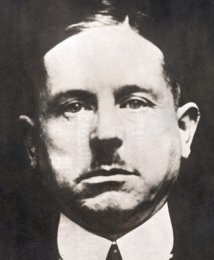
On this date in 1931, the “Vampire of Düsseldorf” was beheaded for that city’s most infamous serial murder binge.
It was, perhaps, the logical end of a terrible journey.
A factory moulder and World War I deserter in his late forties, Peter Kürten commenced a series of uncommonly bestial rape-murders in early 1929 … the harvest of a lifetime’s twisted brutality.
He’d been the oldest of 11 children stuffed in a hellish one-room apartment with a violent drunk of a father who battered the children and openly raped their mother. Well, “if they hadn’t been married, it would have been rape,” in Peter’s words.
The future vampire took his refuge turning his own abuse on younger siblings and, with the help of a degenerate dogcatcher in the neighborhood, on obliging animals he could lay his hands on — which creatures he was soon learning to torture, and to rape, alongside more conventional human delinquencies like arson and burglary.
Kürten is known to have strangled at least one ten-year-old prior to World War I (he would also claim to have surreptitiously drowned a couple of school chums in his boyhood) but it was on the far side of the Great War — which he’d spent mostly in miserable prisons, nursing increasingly twisted fantasies of vengeance — that the beast truly emerged.
The spree that carried him to these pages began in Febuary 1929, when he slew an eight-year-old, attacked a middle-aged woman, stabbed a mechanic to death. Kürten’s crimes were irregular, but distinguished by a fiendish wrath: he abducted one young woman and hammered her to death in the woods outside town; he stabbed a five-year-old to death with scissors as he achieved his orgasm; he asked a teenager to run off and get him some cigarettes, so he could use her absence to slit her younger sister’s throat; he stabbed strangers randomly.
“I derived the sort of pleasure from these visions” of mayhem and cruelty, he said, “that other people would get from thinking about a naked woman.”
Düsseldorf endured a year of terror, finally aborted when Kürten’s own wife — whom he seems to have loved genuinely — turned him in, at Kürten’s own request, for the reward money.
At a packed trial, the accused’s accumulated hatred for the sadistic world poured out in words just as it had done in deeds over the months preceding.
I said to myself in my youthful way ‘You just wait, you pack of scoundrels!’ That was more or less the kind of retaliation or revenge idea. For example, I kill someone who is innocent and not responsible for the fact that I had been badly treated, but if there really is such a thing on this earth as compensating justice, then my tormentors must feel it, even if they do not know that I have done it …
Never have I felt any misgiving in my soul; never did I think to myself that what I did was bad, even though human society condemns it. My blood and the blood of my victims will be on the heads of my torturers. There must be a Higher Being who gave in the first place the first vital spark to life. That Higher Being would deem my actions good since I revenged injustice. The punishments I have suffered have destroyed all my feelings as a human being. That was why I had no pity for my victims.
-Kürten
Amateurs though we are, we incline to doubt the sufficiency of the tit-for-tat explanation. Kürten might well have believed that about himself, but the “vampire” moniker gets at an essential, organic sensuality about his crimes whose roots go quite a bit deeper than revenge.
“Tell me,” the doomed murderer is supposed to have asked a prison doctor shortly before facing the guillotine, “after my head has been chopped off will I still be able to hear; at least for a moment, the sound of my own blood gushing from the stump of my neck?”
“That,” mused the killer, “would be the pleasure to end all pleasures.”
Kürten is one of several predatory sex-slayers — also see the likes of Fritz Haarman and Carl Grossman — who prospered in interwar Germany, and helped to inspire Fritz Lang’s cinematic classic M. (Kürten is often thought the most direct model for that movie’s murderer, played by Peter Lorre. Lang denied that was the case, but in some countries’ releases it went out under the title not of M, but of The Vampire of Düsseldorf.)
It was on this date in 2010 that Texas executed Michael Perry by lethal injection for his part in a triple homicide that netted a cherry-red Camaro.
Perry is the subject of the 2011 Werner Herzog documentary Into the Abyss; being a Herzog film, it comes recommended.
Abyss is “not an issue film; it’s not an activist film against capital punishment,” Herzog has said. “In this particular case, with this very senseless crime, so senseless it’s staggering, what fascinated me was that it points to a decay in family values and the cohesion of society, all these things that looked so big and beyond this case.”
On this date in 1917, Romanian Lieutenant Emil Rebreanu was hanged for attempted desertion by the Austro-Hungarian army.
Here’s Rebreanu’s entry at the Enciclopedia Romaniei, which says in brief that he was one of 14 (!) brothers born in the part of present-day Romania that was then attached to the Kingdom of Hungary.
Upon the outbreak of World War I, Rebreanu was drafted into the Austro-Hungarian forces and fought on several fronts. But his removal to the lines to fight against the independent Romanian state was a front too far: he attempted to cross the lines to the Romanians on the night of May 10-11, but was captured, court-martialed, and sentenced to hang.
However, tragedy for the sizable Rebreanu family was a boon to world literature.
One of Emil’s many brothers was author Liviu Rebreanu, one of the greats of Romanian letters.
The latter’s 1922 novel Forest of the Hanged clearly draws upon his brother’s fate: in Forest, a Romanian officer uneasily serving in the Habsburg army first condemns a Czech deserter to death as part of a tribunal, then attempts himself to desert to Romania.
I am full of ambition and hope and of full charm of life. But I can renounce all at the time of need, and that is the real sacrifice. These things can never be hinderance in the way of man, provided he be a man. You will have the practical proof in the near future.
On this date in 1931,* India revolutionary Bhagat Singh was hanged by the British in Lahore, together with Shivaram Rajguru and Sukhdev Thapar. The hanging was surreptitiously done, on the evening before it was officially scheduled, with the men’s cremated ashes scattered into the nearby Satluj River.
Statue of the three March 23 martyrs near Amritsar, Punjab, close to the Pakistani border. (cc) image from Alicia Nijdam.
Though only 23 years of age when he hanged, Singh’s renown as a nationalist freedom-fighter was already considerable. It has not lessened in the intervening decades.
Till that time I was only a romantic revolutionary, just a follower of our leaders. Then came the time to shoulder the whole responsibility. … I began to study in a serious manner. My previous beliefs and convictions underwent a radical change. The romance of militancy dominated our predecessors; now serious ideas ousted this way of thinking. No more mysticism! No more blind faith! Now realism was our mode of thinking.
“It takes a loud noise to make the deaf hear,” read their leaflet, vindicating the (non-lethal) ordnance.
Singh’s arrest, along with a fellow bomb-tosser, was an intended consequence, but the official pursuit of the case against him also led back to Singh’s fellow-revolutionaries and bomb-manufacturers. Some of these were induced to inculpate Singh, Rajguru, and Thapar to the theretofore-unsolved murder of Lahore policeman John Saunders in December 28.
Saunders had been mistakenly assassinated: Singh et al took him for John Scott, a police superintendent who ordered a baton charge against protesters and personally helped beat to death one of the independence movement’s revered fathers.
While the law wrapped its coils about him, Singh led a successful hunger strike for better prison conditions, and kept churning out writing.
His example of sacrificial revolutionary ardor — not to mention his leftist politics — kept him a popular martyr figure for years after his death, all the way down to the present day.
Climactic execution scene from the 2002 Hindi flm The Legend of Bhagat Singh — one of many different cinematic adaptations of his story.
The Shaheedi Mela (Martyrdom Fair) is observed across Punjab each March 23 in honor of these men.
A spirit of hatred and revenge took possession of me. I had numerous fights in defense of what I believed to be my rights and those of my countrymen. I believed we were unjustly deprived of the social rights that belonged to us.
On this date in 1879, legendary Californio outlaw Tiburcio Vasquez was hanged in San Jose.
Born to a respectable family (his grandfather was the first mayor of San Jose) when the land was under Mexican control, Vasquez was among the many chagrined to find themselves demoted to second-class citizenry by the norteamericanoconquest of the Mexican-American War.
That occurred when Vasquez was in his early teens, and soon thereafter the young man was plying California’s ill-policed byways with the whole litany of depredations characteristic of the frontier outlaw: livestock rustling, highway robbing, shopkeep stickups.*
One of the latter furnished the proximate cause of his death and probably the most infamous single incident among his exploits: an armed robbery in Tres Pinos** that resulted in three shooting deaths and a serious manhunt.
For Vasquez, the end of the rope (last word: “Pronto”) was just the last act of a legendary career, of poetry and horsemanship and countless enchanted inamoratas. He was renowned in his own time, and has graduated since into a mythical, and potently symbolic, figure of the other peoples of the Golden West.
For this anniversary of Tiburcio Vasquez’s execution, we’re pleased to welcome John Boessenecker, author of the recent biography Bandido: The Life and Times of Tiburcio Vasquez . (Find another topical interview with this same author here.)
How did you separate fact from folklore researching this outlaw? How much do we really know about him?
Generally speaking the whole genre of outlaws and lawmen is sort of known for bad research and myths and crazy stories. It tends to attract — here I’m denigrating myself– people who are a little off. Like myself. The movie buffs tend to get reality mixed up with what they’ve seen in the movies.
The whole genre has attracted poor research and sensational writers since the days of the dime novels. Though there are real historical groups: the Wild West History Association is probably the best example — True West magazine and Wild West magazine do a god job of publishing authentic history.
With Vasquez in particular, he became a folk hero in his own lifetime to disadvantaged Hispanics.
He was personally very well-liked; as a general rule, he didn’t rob Hispanics (although he did from time to time); he paid for safe harbor and food; he was a terrific dancer; he wrote poetry to is female admirers. He was a bigger-than-life personality, sort of the life of the party.
Among the larger Hispanic community as he became more notorious in the 1870s, he became a folk hero in his own lifetime. A lot of the myths are exaggerations of things he really did.
When the colonized cannot earn a living within the system, or when they are degraded, they strike out. The most physical way is to rebel. This can be done in an organized way, as was done by Juan Cortina in Texas, or it can express itself in bandit activity. An analysis of the life of Tiburcio Vasquez clearly demonstrates that, while in the strict sense of the word he was a criminal, at the same time his underlying motivation was self-defense. Some Anglo-American folklorists have attempted to portray Tiburcio Vasquez as a comical and oversexed Mexican bandit … dismiss[ing] the legitimate grievance of Chicanos during the nineteenth century. While it is true that Tiburcio Vasquez was an outlaw, many Mexicans still consider him a hero.
His outlaw career seems like it’s bound up in this Anglo-Hispanic cultural collision. To what extent does that influence how he’s “read” by others?
His life is sort of a microcosm of what was going on. The first portion of my book deals with the rise and fall of the native settlers of California.
With the loss of California in the Mexican-American War and then the discovery of gold, they became second-class citizens in their own land. So Vasquez becomes a folk hero — he robbed stagecoaches, thumbed his nose at the sheriff, and got away.
But he was also a bandit.
In the 1960s, the so-called Chicano historians (pdf) latched on to Vasquez, and they actually believed he was a Robin Hood figure or a “social bandit”. This is a total crock.
You find these same outlaw myths in all cultures. Vasquez is no different, though he’s better documented than most. People would sing corridos about him.
There were some quotes by him that says that he was driven to it, the Anglos drove me to it — but that’s no different from Jesse James or Billy the Kid saying they were driven to it, even if it’s true. Most of these guys I’m talking about are or were history professors; they should have known better.
What led you to this story?
When I was a kid in the early 60s I watched all the westerns. Clint Eastwood and Steve McQueen were my favorite. But then I wanted to know, was there a Wild West here in California? So when I got into high school I went and read everything I could get my hands on about early California history.
Vasquez and Black Bart were pretty much the most famous early California outlaws. So I started researching Vasquez in high school, and collected information for about 40 years, but it took me another four years to write it.
There’s never been a biography about Vasquez. There were three paperback books published about him, one after he was captured and two right after he was hanged — they’re not dime novels, but they’re sort of semi-fictional. There have been many magazines, many book chapters since, but everything published about him has just been a rehash of those three books. (n.b. — here’s a pdf of one of those original 1870s books -ed.)
It must have been a compelling story for you to stick with it for 40 years.
It’s just sort of a great story from early California. Vasquez was very colorful.
He fell under the influence of a guy named Anastacio Garcia when he was about 16 years old, and his parents seem to have separated. He had a large family; all of them were extremely honest. One of his brothers was a very prominent rancher; another brother served a term as a justice of the peace in Los Angeles County.
Vasquez, possibly because his father wasn’t around, fell under the influence of Garcia and got involved in the Roach-Belcher feud. Garcia was a hired gun, and the two of them were involved in a brawl in a Fandango house in 1854 and one of them killed a local constable. Tiburcio Vasquez fled Monterrey and never appeared openly after that.
But he basically did not change.
He was engaged to Garcia’s sister when he was 17 and she apparently broke it off. That seemed to have embittered him because he never had another serious relationship again with another woman. He was a real rounder, he got shot over women, took off with the wives of other gang members.
That was very foolish — that’s what got him the noose, when a cuckolded gang member testified against him at trial. He never made any effort to change; he was what you call a career criminal.
He was a very cultured person, and even if you compare him to more modern-day criminals like Clyde Barrow or Pretty Boy Floyd or John Dillinger, none of them had that kind of culture. He really was sort of the prototype of that sort of charismatic bandit who at the same time is both charming and deadly.
Probably the thing to me that was the most fascinating was the information I dug up about his family: his parents, his sisters who were very loyal to him; his brothers who all tried to get him to go straight. I was very pleased to meet the descendants of some of his brothers, so it was fascinating to reconstruct his family life to try to explain his personality.
So what was the nature of that bandit career?
Well, he wasn’t a remorseless killer, though he was involved in nine murders — he always said it was someone else.
The one that he was hanged for, his gang killed three people in a robbery. He claimed someone else pulled the trigger. Some witnesses said it was Vasquez himself, but under the law then and now, if you band together to commit a felony and someone dies, everyone involved is culpable for murder.
He’d been doing a lot of robberies before then, but he’d do them in remote areas. He tried not to kill anyone; he’d tie people up — but he was also involved in a lot of gunfights. Basically he’d shoot to escape. In doing the research I found that he had fired into a brothel in Santa Cruz and wounded three people; another time he fired into a stagecoach station.
One of the great Vasquez stories is, he gets out of San Quentin and he goes to San Juan Bautista which is one of the most picturesque villages in California then and now — it was one of his favorite hangouts. One of his gang members, Salazar, had tried to go straight. Vasquez shows up at San Juan and finds out that Salazar has married this gorgeous 15-year-old named “Pepita” and he and another gang member lust after her and get her to run off with the gang. So Salazar comes gunning for him; they have a gunfight right there in front of the mission, and Salazar shoots Vasquez through the chest and damn near kills him. His gang gets him out of it … the girl gets pregnant, evidently with Tiburcio’s child and she dies of a botched abortion. It’s sort of the Vasquez story in a microcosm, it looks pretty romantic on the surface and you look a little deeper and it becomes pretty grisly.
He gave a lot of interviews after he was captured and they give color to the story. There’s the natural human inclination to paint yourself in the best light.
None of which helped him avoid execution.
His hanging was actually the most publicized hanging in the history of the Pacific coast; newspapers came from Canada, New York all over the country to witness the hanging.
He was hanged in front of a big crowd, a thousand people or more present. People climbed trees and telegraph poles became the jailhouse was packed. The sheriff had 300 or 400 invitations issued and then many many more were clustered around.
Executed Today would be remiss not to add that our day’s gallows-bird was the namesake of the Vasquez Rocks, a small Natural Area Park north of Los Angeles where the outlaw used to hide out.
This striking triangular rock formation, thrust out of the earth by tectonic action, has been used extensively in film productions of every genre since at least the 1930s, including with almost compulsive frequency in the Star Trek franchise — e.g., Captain Kirk fighting the Gorn:
* There’s a good deal of material about Tiburcio’s career linked here.
On this date in 1995, Filipina maid Flor Contemplacion was hanged for murder in Singapore.
Contemplacion had, four years before, strangled a fellow-maid and drowned that maid’s four-year-old charge.
That’s what she confessed to, at least. Even though Contemplacion’s camp would eventually argue that the confession had been coerced, or that she’d been possessed by a strange epileptic, Contemplacion herself never really walked back that admission.
Still, Flor Contemplacion the cause celebre and Flor Contemplacion the cultural phenomenon was never only about the woman’s innocence, even if many do still believe she was framed.
By whatever happenstance of timing and circumstance, widespread publicity of her case in the Philippines during the months leading up to her hanging tapped a national discontent among her countrymen and -women about “OFWs” — overseas Filipino workers.
This economic sector — exported labor — had been intentionally nurtured (pdf) by Manila beginning with a 1974 labor code, and over the ensuing generation ballooned twentyfold into a positively enormous phenomenon.* By the time Flor Contemplacion hanged, everybody in the Philippines knew people who had worked overseas, and whose wage remittances were indispensable (pdf) for supporting their families in the Philippines. (And increasingly, the entire national economy.)
Boom of the overseas Filipino workers sector, 1975 – 2000 (1975 = 1). Source of figures; there are more official OFW stats here.
Ascendance of the OFW industry brought with it the discontents attendant with scattering wholesale quantities of the populace to unfamiliar corners of the globe, many of them to confront the timeless varieties of workplace abuse from positions of special vulnerability: “The dark reality,” one organization says this year, of “low wages, horrid working conditions, little protection for human rights, exploitation, harassment, threats, illegal arrests, imprisonment, criminalization, and deportation.”
To say nothing of the political discontents raised by such a discomfiting abdication of autarky, and the “domestic anxieties” (pdf) of developing “the embarrassing reputation that we are a country of DHs [domestic helpers], entertainers, and even prostitutes.” This is, truly, a rich and complex tapestry.
Flor Contemplacion is practically the patron saint of the indicted Filipino/a abroad, and her fruitless clemency appeal the political breakout of OFWs and their allies as a constituency to reckon with.
The effect was immediate. Contemplacion hadn’t had any great level of consular support early in her criminal process — the time when it might have made the most difference. (The Philippines embassy in Singapore later took considerable heat for this fact.)
But as the story made headlines and some sketchy witnesses accused the victim’s widower husband of being the real perpetrator, the case became a national sensation. Recently-elected president Fidel Ramos, who campaigned on restoring the previously-abolished death penalty in the Philippines, not only had to put on the full-court press for this condemned woman but incongruously declared her a “national hero”; his wife personally received Contemplacion’s remains at the airport. Leaders and ordinary people from Catholics to Communists rallied (sometimes rioted) in anger.
(Singapore was just at this time establishing its own reputation as the place that never gives diplomatically expedient clemencies. Never.)
Whatever the domestic controversies, the labor-export business has only continued to grow in the generation since Contemplacion’s hanging. To this day, the Filipino public has shown great sympathy with OFWs entangled in alien criminal justice systems, and demanded diplomatic support — regardless of particular individuals’ putative guilt.
Regrettably, it is often called to do so: from Saudi Arabia to China, the plight of Filipinos executed abroad remains a recurrent and emotionally charged theme in the country.
Flor Contemplacion’s name, well-known still anywhere in the archipelago, was back in the news last year … when her three sons all drew lifetime prison sentences for drug-smuggling.
What I done, I did in self-defense, or I would have been killed myself. Where I was I could not overcome it.
-Lena Baker’s final statement
The state of Georgia has only ever electrocuted a single woman: African-American maid Lena Baker, put to death on this date in 1945 for murdering her abusive employer.
Baker was a sharecropper and a former sex worker hired to care for white mill owner Ernest Knight as he recuperated from a broken leg. This, as Baker’s biographer Lela Bond Phillips puts it, “developed into a sexual relationship.”
Both Knight and Baker were alcoholics, and the Knight liked to keep his domestic in the gristmill for days on end.*
As an interracial liason, it was also entirely taboo; Knight’s son tried everything to separate his dad from this scandalous arrangement, including moving the family and beating up Baker.
Knight pere was even more committed to keeping her.
On the night of April 29-30, 1944, the elder Knight locked Baker up in the mill, after she’d attempted to flee him. Baker testified that after Knight got back from church — it was Sunday, after all — Baker tried to leave over Knight’s threats. The two fought over Knight’s pistol, and the fight ended when the pistol discharged through Knight’s head. As to how it went off or who pulled the trigger, Baker said she didn’t know.
Although the irascible, hard-drinking Knight wouldn’t have won any popularity contests among his white neighbors, this breach of the color line was prosecuted both vigorously and speedily: a one-day trial that August (the all-white, all-male jury goes without saying, right?) sufficed to send the maid to her death.**
** In 2005, the Georgia Board of Pardons and Paroles — which turned down Baker’s clemency application in early 1945 — issued a posthumous pardon suggesting that a non-death penalty manslaughter charge would have been the more appropriate conviction. Baker’s family and defenders read that as vindication; there’s a detailed NPR story about it here.
On this date in 1952, the short and brutal life of William Cook ended in the San Quentin gas chamber.
A quintessential “terrible upbringing” criminal, young Billy was ditched with his siblings by their alcoholic widower father in an abandoned mine when he was a small child.
Though brothers and sisters found foster parents, Billy — afflicted by physical deformity and an ungovernable temper — had to make his way as a ward of the state. Constantly delinquent through his adolescence, he was institutionally handed off to the state penitentiary at age 17.
He got out at 22, with a grudge against the world and a knuckle tattoo reading “H-A-R-D L-U-C-K”, resolved — so he told his derelict father — to “live by the gun and roam.”
In a 22-day spree looping from California to Texas and Oklahoma and then back again, Cook slew six people: an entire vacationing family in Oklahoma, and then another kidnapped motorist in California. Taking drivers hostage was how he navigated America’s growing intercity road network, making the Cook story readily adaptable to titillate cinema-goers who knew the loneliness of the open road, in 1953’s The Hitch-Hiker. (Teaser line: “Who’ll be his next victim … YOU?”)
Cook took little care for his own secrecy and had to flee to Mexico to avoid a dragnet. Surprisingly, even the police chief of Santa Rosaria in Baja California recognized the wanted man, and he was captured there unawares and extradited back to the Golden State.
“I hate everybody’s guts,” he reportedly explained upon his capture. “And everybody hates mine.”
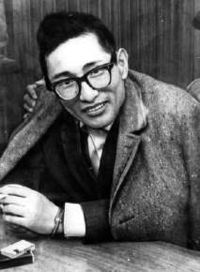
On this date in 1970, Japanese serial killer Akira Nishiguchi was hanged for murder.
Born in 1925, Nishiguchi (English Wikipedia entry | Japanese) spent the war years in juvenile detention but emerged in time to work as an interpreter for the U.S. occupation.
He was arrested repeatedly (Japanese link) as a con man during the 1950s. Police had him pegged as a nonviolent serial fraud artist, but in 1963 he killed two drivers to steal from them, then went on the run in Tokyo.
For 78 terrifying days, his face — those fraud convictions came with fingerprints that identified him as the killer — gazed out of wanted posters as Nishiguchi scraped by in cheap hotels and desperate disguises, committing three more murders in the process. Finally, an 11-year-old girl recognized him, posing as a lawyer.
On this date in 1988, a trio that had once formed an abusive family were all hanged in Singapore for their shocking ritual murders.
Top to bottom: Lim, Tan Mui Choo, and Hoe Kah Hong.
The Toa Payoh murders stunned Singapore in early 1981, when the brutalized bodies of a nine-year-old girl and a ten-year-old boy turned up in that district of the city-state.
A literal trail of blood led police from the second victim to a nearby seventh-floor flat cohabitated by a self-proclaimed spirit medium named Adrian Lim and his “holy wives” Tan Mui Choo and Hoe Kah Hong. In the apartment was a bevy skin-crawling incriminating evidence, like papers with the victims’ names written down, hairs later matched to the kids, and spatters of blood.
So this wasn’t a case so much for crime scene investigators as for psychologists.
Eschewing the forgettable life of a mere cable TV bill collector, a thirtysomething Adrian Lim had cultivated a side business in quack spiritualism in the early Seventies. He soon found this rewarding scam, in which troubled bar hostesses seeking personal guidance could be induced to pay him for a holistic regimen of eggs, needles, prayer to miscellaneous deities, and (often as not) sex with their “healer”, sufficient to support his lifestyle without further remuneration from the broadcast industry, so he went full time. And then he went right around the bend.
Even as a 9-to-5 desk jockey, Lim had already reeled in one depressed young woman as his live-in lover and business partner and willing enabler of Lim’s carnal con artistry. Lim did not scruple to pimp her out as a prostitute. This was Tan Mui Choo. (Click here for an interesting profile of a nun who counseled Tan Mui Choo, and later many other condemned prisoners, on death row.)
Hoe Kah Hong fell into Lim’s clutches a few years later, and although it was that young woman’s own mother who brought her in for Lim’s hocus-pocus, the charismatic witch doctor soon turned her against her family and moved her into the place, too. He eliminated Hoe’s husband by conning him into an electroshock treatment that Lim used to shock him dead.
This twisted family’s run of good luck and absurdly gullible customers came to an end late in 1980, when a cosmetics salesgirl whom Lim had drugged and raped (sometimes the spirits need a chemical assist with these things) started blackmailing him — and shopped him when he didn’t pay enough.
Under a pending sex-assault investigation, Lim conceived some bizarre plan to draw police attention away (or induce the goddess Kali to help him out of the pickle) by … murdering children. Makes sense, right?
It made enough sense to his holy wives to get them to help drug little Agnes Ng Siew Hock on January 24, 1981, help Adrian Lim rape her, help smother her with pillows, and help smear her blood on the apartment’s little sacrificial shrine. Two weeks later, they did much the same (less the rape) to Ghazali bin Marzuki. They were taken into custody the very next day.
While there’s little doubt about whether, the little matter of why was the topic on all Singapore’s lips.
In an eight-week trial that kept the public riveted with the ghastly and/or ludicrous particulars of the medium’s operation, dueling psychiatrists went front and center and measured out competing takes on the prisoners’ respective culpability. In he end, the draught was half-full for all three.
The trial’s “gruesome accounts of sexual perversion, the drinking of human blood, spirit possession, exorcism and indiscriminate cruelty” (Singapore Straits Times) made Lim a Bundy-esque object of public hatred; even others condemned to death refused to associate with him. He was the subject of the first feature-length domestic Singaporean film in English, 1992’s The Medium.

 It was, perhaps, the logical end of a terrible journey.
 However, tragedy for the sizable Rebreanu family was a boon to world literature.
 Born to a respectable family (his grandfather was the first mayor of San Jose) when the land was under Mexican control, Vasquez was among the many chagrined to find themselves demoted to second-class citizenry by the norteamericano


 The state of Georgia has only ever electrocuted a single woman: African-American maid Lena Baker, put to death on this date in 1945 for murdering her abusive employer.
 A quintessential “terrible upbringing” criminal, young
  Born in 1925, Nishiguchi (


