1958: Imre Nagy, former Prime Minister of Hungary

Fifty years ago today, the onetime Hungarian Prime Minister and three others associated with the country’s shattered 1956 revolution were hanged in Budapest for treason by the Soviet-backed Hungarian government.

A moderate Communist, Imre Nagy assumed leadership of Hungary from 1953 to 1955, a period of ideological thawing after the death of Joseph Stalin.

Nagy charted a “new course” towards Austrian-style neutrality or Yugoslavian-style “national Communism” not yoked to Moscow, opposed domestically by his predecessor and rival Matyas Rakosi, who eventually ousted the reform-minded minister.

But Nagy’s anti-Soviet credentials saw him elevated back to the office by popular acclamation during the 1956 Hungarian Revolution — an interval of the nation’s history still deeply cherished in Hungary today. Here’s a recollection by newsreel montage to the strains of Beethoven’s salute to the national martyrs of another time and place.

Nagy held the office for only ten days before Soviet intervention crushed the revolution. He issued this radio appeal to the world (in Hungarian, followed by the English version at about 0:34) on November 4, 1956:

[audio:Imre_Nagy_broadcast.mp3]

It was an appeal against all geopolitical realities; Hungary was the Soviet Union’s sphere, and western counter-intervention could have precipitated World War III. Verbal outrage abounded, of course:

But Khrushchev gibed that the United States had “supported” the revolution “in the nature of the support that the rope gives to a hanged man.”

For all that, the abortive revolution has won the benediction of history: still venerated in Hungary, and arguably a turning point in the postwar world when the Soviet Union set itself unmistakably and, eventually, fatally against the legitimate aspirations of its subjects.

Nagy’s statue in Budapest’s Martyrs’ Square. Creative Commons photo by Martin Ujlaki.

Less the leader of this stirring movement than carried along by it, Nagy nevertheless embraced the revolution fully.

His government hardly had the opportunity to implement any sort of programme, but it gestured towards multiparty parliamentary democracy. Nagy attempted to withdraw Hungary from the Warsaw Pact. And to the fame of his memory, he refused Soviet blandishments after his capture to recant and accede publicly to the new Hungarian government.

For these principles, Nagy, his defense minister Pal Maleter, and revolutionary officials Miklos Gimes and Jozsef Szilagyi underwent a weeklong trial June 9 to 15, culminating in execution on this date — all strictly hush-hush, and not announced until the bodies were cold.

Though secret, the trial was tape-recorded in its entirety. This past week, to coincide with the anniversary of the affair, the full 52 hours of audio were publicly aired for the first time — over the same June 9-15 span, and at the location of the original trial. The recordings are held by the Open Society Archives, which maintains a wealth of information on the 1956 revolution (such as, topically, this ‘death circular’ issued by anti-Soviet Hungarians). Formerly held under lock and key, the audio files are not yet published for public distribution at this point, but one would expect that it’s only a matter of time.

Nagy and his companions were officially rehabilitated and, on this date in 1989, reburied with honors; tens of thousands turned out to pay respects that had been officially prohibited for 33 years. In this chaotic period as Soviet domination of eastern Europe crumbled, their fellow-traveler Bela Kiraly (who gives a fascinating account from the inside of the Revolution in this 1996 interview) returned from exile for the reinternment ceremony and found that he was technically still under the sentence of death he had received in absentia at Nagy’s trial.

On this day..

1937: Mikhail Tukhachevsky and seven other Soviet commanders purged

Early this date in 1937,* Soviet Marshal Mikhail Tukhachevsky was executed by a gunshot to the head for allegedly plotting a coup d’etat against Stalin.

One of the most infamous trials** of the Soviet Union’s Great Purge, which would strip the Red Army of much of its officer corps on the eve of its existential test against the Wehrmacht, the Case of the Trotskyist Anti-Soviet Military Organization has always offered fodder for debating the whys and wherefores.

The bare facts are that nine extremely high-ranking members of the military brass were suddenly arrested and within a few weeks (except the one who committed suicide first) shot on the staggering charge of counterrevolutionary conspiracy. Foremost among the victims was Marshal of the Soviet Union Mikhail Tukhachevsky, notable in the annals of military history for pioneering (along with several other Soviet officers, notably Triandafillov) the military doctrine of “deep battle” or “deep operations”.

Deep Battle

Reflecting on the grinding, indecisive struggles of attrition that characterized World War I and the Russian Civil War (both conflicts Tukhachevsky served in), he sought a theory of offensive warfare for modern armies fighting in large and complex engagements — the operational art. In an early (1923) formulation, Tukhachevsky noted

the impossibility in the presence of modern wide fronts to destroy an enemy army by a single blow compels us to achieve this by a series of successive operations … A series of annihilating operations, introduced successively and combined by continuous pursuit, can replace the annihilating engagement, which in former armies was a better type of combat. (Cited here.)

Deep operations would require sophisticated application of technology to strike an opposing army’s entire support structure behind its lines in coordinated operations, rather than the unproductive World War I tactic of throwing waves of cannon fodder across No Man’s Land in the hope of achieving a breakthrough by sheer mass alone. It ripened into official Red Army doctrine in the 1930’s, decreeing

[s]imultaneous assault on enemy defenses by aviation and artillery to the depths of the defense, penetration of the tactical zone of the defense by attacking units with widespread use of tank forces and violent development of tactical success into operational success with the aim of the complete encirclement and destruction of the enemy. The main role is performed by the infantry, and the mutual support of all types of forces are organized in its interests. (Cited here.)

What Happened?

The mystery has always been exactly why Stalin should shoot Tukhachevsky, even if any question beginning “why should Stalin shoot …” nearly answers itself.

Explanations particular to Tukhachevsky range from rivalries within the army (early blocs of officers appointed by Trotsky and Stalin formed professional rivalries; Trotsky had given Tukhachevsky his first Soviet command) to purely personal enmity between the two men. Many have speculated that a genuine “plot” of some sort — whether a coup or assassination, or more mundane political scheming — was indeed afoot against the Soviet dictator. Tukhachevsky’s (officially sanctioned) links with a German military then developing its own similar operational concepts have told against him in some readings.

Author Robert Conquest put about the theory that Heinrich Himmler’s intelligence operatives had contrived to pass the Soviets forged documents pointing to Tukhachevsky’s German collaboration, the better to weaken the Bolshevik defenses. Conversely — and in his diary, Goebbels attributed this riff on the Dolchstosslegende to Hitler himself — a contrarian take has long defended at least this particular purge as a judicious one by Uncle Joe, insuring that wartime Russia would not be hamstrung by “defeatist” elements or other players who might develop both the means and motive for ending the war on German terms.

Inquiries along these lines, of course, expand beyond the particular case into the larger questions of why Stalin purged the army as a whole, and what ultimate effect that purge had on the Soviets’ military readiness in 1941.

Legacy

With Tukhachevsky’s fall, accompanied by other military reformers, the “deep operations” school acquired sufficient taint to abjure the company of the judicious officer. Nevertheless, Tukhachevsky’s influence would play its part in the Great War: his onetime associate Georgy Zhukov, who may have only accidentally avoided being purged himself, deployed Tukhachevskian mobile tactics to crush Japan’s Siberian aspirations at the Battle of Khalkhin-Gol in 1939; duly elevated for this victory to the precarious post of Marshal of the Soviet Union, Zhukov was a crucial commander in the defeat of Nazi Germany.

Tukhachevsky, along with all those shot this day, was rehabilitated during the Khrushchev era.

Sorry about shooting you in the head. Here’s a commemorative stamp.

* The condemned received their death sentence at 23:35 on June 11, the sentence to be carried out “immediately” — it seems likely but not completely certain that it had become the 12th by the time the executions actually took place, and different sources report different different dates of death. According to the contemporaneous New York Times report, Soviet authorities announced that the executions had taken place on the 12th. (As an interesting side note, the Times that day also blurbed exiled Stalin rival Leon Trotsky reading in the tea leaves of Tukhachevsky’s death “the beginning of the end for the Stalinist dictatorship.”)

** Not, however, a show trial — Tukhachevsky et al were tried in secret.

On this day..

1887: Alexander Ilyich Ulyanov, Lenin’s brother

On this date in 1887, a young revolutionary went to the gallows with four other comrades for an attempt on the life of Tsar Alexander III.

Alexander (or Aleksandr) Ilyich Ulyanov was among 15 members of Narodnaya Volya, the terroristic revolutionary organization, nabbed (in an “amateurish” scheme) trying to blow up the monarch on the anniversary of his father’s assassination. The five of these who refused to plead for mercy paid for their principles with their necks.

The young man had kept his political affiliations rigorously secret from his close-knit bourgeois family. Little could he have suspected that the boy he shared a room with —

— would render his own passion a footnote in perhaps the 20th century’s epochal event.

Seventeen-year-old Vladimir Ilyich Ulyanov, years yet from the moniker “Lenin” by which history knows him, was supposedly fired by this event with a vow for vengeance and the politically mature resolve that “we will go another way!” — that is, another way than terrorism. Here’s the manful young Bolshevik* consoling his grief-stricken mother with revolutionary ardor:

But Lenin’s radicalization seems in fact to have not even begun as of this date, when he was consumed with studying for his exams (in a month’s time, he would graduate with a gold medal from a school headed by the father of Lenin’s future opponent during the Russian Revolution).

Though Lenin’s eventual political persona would comprehensively reject his brother’s tactics, the impression Alexander left upon him must have been profound. According to Tony Cliff in Building the Party: Lenin, 1893-1914, Vladimir Ilyich grappled with Narodism, Marxism and their proper relationship throughout his political development during his university years, and at least at certain moments Narodism appeared compelling to him.

According to Cliff, Lenin’s wife considered this passage from his What Is To Be Done? somewhat autobiographical:

Many of them [Russian Social Democrats] had begun their revolutionary thinking as adherents of Narodnaya Volya. Nearly all had in their early youth enthusiastically worshipped the terrorist heroes. It required a struggle to abandon the captivating impressions of those heroic traditions, and the struggle was accompanied by the breaking off of personal relations with people who were determined to remain loyal to the Narodnay Volya and for whom the young Social Democrats had profound respect.

Lenin mastered that struggle. In the end, he indeed went another way.

* Except there was no such thing yet, but never mind.

On this day..

1977: Alphonse Massamba-Débat, Congolese Communist

On this date in 1977, the former president of the Congo, Alphonse Massamba-Debat, was summarily shot after his successor was assassinated.

A teacher by training and a member of the country’s powerful namesake tribe, Massamba-Debat (the link is to his French wikipedia page, which has considerably more information than the English entry) was a government minister who took power in a 1963 military coup that overthrew the former French territory’s first post-colonial government.

In a revolutionary age, Massamba-Debat swung with a Marxist-Leninist ideology. He ran a one-party state — winning a post-coup 1963 election by the comfortable margin of 100-0 — and met with Che Guevara during the latter’s African mission, while also setting up the first stirrings of industrialization.

The mix of true belief and opportunism in that formula is anyone’s guess; the brutality of his militias steadily eroded his “unanimous” popular support, and in 1968 he was toppled by another leftist, Marien Ngouabi.

That marked the end of Massamba-Debat’s meaningful political career.

Oddly, he was tried immediately after his overthrow for some of his regime’s notable political murders, but was acquitted and allowed to retire to his village: the new government plainly didn’t consider him much of a threat.

But when Ngouabi was assassinated in his turn on March 18, 1977 — for causes that remain unclear but that may have had to do with French energy interests in the region — the army seized control and purged numerous officials for supposed participation in the plot. Massamba-Debat, notwithstanding a dearth of evidence actually implicating him, was by virtue of being an overthrown former ruler far enough under the shadow of official distrust to find his name on that deadly list.

Massamba-Debat was officially rehabilitated in 1991, and is now far enough clear from the taint of treachery against his still-popular successor to have a stadium named after him. (the link is in French)

On this day..

1938: Seventeen former Bolshevik officials from the Trial of the 21

(Thanks to Dmitri Minaev of De Rebus Antiquis Et Novis for the guest post. Be sure to read his corollary piece on cameos by some of this day’s victims in Bulgakov’s Master and Margarita.)

On 15 March 1938, 17 former executives of the Communist Party were executed at the “special object” Kommunarka near Moscow.

As head of the NKVD, Yagoda had arranged show trials before. This time, the shoe was on the other foot.

The names of some of them are found in any history book’ others were totally unknown even in 1930s. Alexey Rykov and Nikolay Bukharin were the topmost (well, almost) leaders of the USSR. Nikolai Krestinsky was a member of the Central Committee Secretariat and the Soviet ambassador to Germany. Christian Rakovsky was a diplomat, the head of the government of the Ukrainian SSR. Genrikh Yagoda was the minister of internal affairs, head of NKVD (the late name of Cheka). P. Kryuchkov was an officer of OGPU (an NKVD department) and the secretary of Maxim Gorky, the “official writer” of the communist USSR.

The others were ex-finance minister of the USSR Grigory Grinko, the general secretary of the Communist Party of Uzbekistan Vladimir Ivanov, ex-prime-minister of the Uzbek SSR Faizullo Hojayev, ex-minister of foreign trade of the USSR Arkady Rozengoltz, ex-minister of agriculture Mikhail Chernov, Isaac Zelensky, S. Bessonov, Akmal Ikramov, Vasily Sharangovich, Prokopy Zubarev, Pavel Bulanov, Veniamin Maksimov-Dikovsky and the doctors Lev Levin, Ignaty Kazakov and Dmitri Pletnyov (one of the founders of the Soviet cardiology).

There were 21 of them under trial, but three (Pletnyov, Rakovsky and Bessonov) were sentenced to imprisonment* and the date of execution of Yagoda remains unknown. The others all died this day.

Railroaded

“The trial of the 21” was officially known as “the case of the anti-Soviet right-Trotskyite block”. They were accused of “treason, espionage, sabotage, terror, undermining Soviet military power and provoking foreign countries to attack the USSR”. The other accusations were: a conspiracy to restore capitalism and to separate the Soviet republics and the Far East from the USSR; ties with foreign intelligence (including that of Nazi Germany, via Trotsky or directly); preparation of military aggression against the USSR; organizing peasants’ revolts in the USSR; the murders of Kirov, Menzhinsky, Kuibyshev, Maxim Gorky and his son Maxim Peshkov; and attempts to assassinate Lenin, Stalin and N. Yezhov (note this name).

After having his memory jogged, Krestinsky remembered that he really was part of the right-Trotskyite conspiracy.

Only the three doctors were provided with a legal defense. The others “voluntarily” refused.

All of them confessed to committing most of the various supposed crimes, although several had unavailing caveats. Krestinsky denied the charges, but it took only one day to convince him of his “failing” memory. “I fully and completely admit that I am guilty of all the gravest charges brought against me personally, and I admit my complete responsibility for the treason and treachery I have committed,” he said on the next day. Bukharin denied some of the charges brought against him. The doctors insisted that they killed Menzhinsky because of fear of Yagoda. Yagoda himself confirmed that he participated in the murder of Gorky’s son Peshkov, but said that motives were personal and not anti-Soviet.

According to the documents found in the archives, Bukharin, Rykov and Krestinsky were sentenced to death on 2 March, on the first day of the process. It could be an error, but on the other hand, it could indicate that the sentence was determined before the trial.

Neverending Story

The first draft of this article started like this: “This story began in …”

Then I stopped and scratched my head. The date when this story really began is not very clear. Some would argue that it began in 1922 when Stalin became the general secretary of VKP(b), others might say that it started in 1918, when the Bolsheviks dissolved the Constituent Assembly, and so on. What is clear is that 1937, when many of those twenty one were arrested, was not the beginning.

Then I decided to begin the other way round: “This story ended in…”

And once again I stopped. This trial had too many interesting corollaries and, of course, the story did not end in 1938. So, in the end the article became a mess of jumps in time to and fro. We are nearly as far removed today from Stalin’s purges as the purges were from the age of Russian serfdom — and those trials throw a shadow across the entire span of time.

Terror

Here’s a small extract from the series of events that preceded and followed the trial. In 1936 Bukharin and Rykov zealously supported the prosecutions of Zinoviev and Kamenev, two other old faithful Bolsheviks, accused by Stalin in opposing the policy of the party. The campaign ended with their trial and execution. Bukharin wrote letters to Stalin:

“I have always sincerely supported the line of the party and Stalin … These are the glorious milestones: industrialization, collectivization, elimination of kulaks, two great five-year plans, concern for the working man, new technologies and stakhanovism, wealthy life, the new constitution.”

“It’s great that the rascals [Zinoviev and Kamenev] were shot. The air became cleaner.”

Bukharin kept busy awaiting trial by writing Philosophical Arabesques … and three other books.

In 1925-1926, when Stalin organized the first campaign against Zinoviev and Kamenev, Bukharin and Rykov also applauded him. “I hand the broom to comrade Stalin,” said Rykov, “to wipe our enemies away.” Yet earlier, Bukharin and Rykov together with these “enemies” Zinoviev and Kamenev helped Stalin to repel the attempts of Trotsky to become the leader of the Soviet state after the death of Lenin.

Bukharin was not an idiot. He understood that he was not any different from Zinoviev. He was the first candidate to replace Stalin if something happened to Stalin — which made him automatically suspect in the eyes of the boss.

Moreover, he was a Bolshevik and he knew the habits of Bolsheviks very well. Caricaturist Boris Yefimov recalled that on 1 December 1934, when Bukharin learned of the assassination of Kirov, he told the other people who were in the room: “Kirov was killed in Leningrad. Now Koba will shoot us all.” (Koba was Stalin’s nom de guerre) But, being a professional revolutionary and conspirator, he knew only one strategy for survival: hypocrisy.

In this 1927 photo at Lenin’s mausoleum, two of today’s victims — Rykov (on the far left) and Bukharin (by his side) — share the platform with Joseph Stalin (far right). Between them is Kalinin, the rare old Bolshevik who managed to survive the 1930’s. (Source)

This strategy did not guarantee success with Stalin. The proof for this may be found in what happened during and after the trial.

Ostracism

Let’s have a look at the newspapers of 1938.

From the resolution of the meeting of the workers of the institute of physiology of the Ukrainian Academy of Sciences and the institute of experimental biology and pathology of the Ukrainian ministry of health care.

With the deepest resentment and indignation we hold up to shame the traitors of their motherland, the mercenaries of the fascist secret services, mean Trotskyite-Bukharin’s scoundrels. The history of humanity hardly knows other examples of similar crimes.

We proclaim that the fascist mercenaries will never succeed in dismembering the great Soviet Union and in handing the flourishing socialist Ukraine to the capitalists. We add our voices to the voice of the many million Soviet people demanding to exterminate all the mean traitors, spies and murderers.

From the resolution of the third conference on physiology of the Academy of Sciences of the USSR.

The traitors Bukharin, Rykov, Yagoda and others did not disdain any means in their vile job. These traitors never eschewed any mostrous crime.

The doctors Pletnyov, Kazakov, Vinogradov and Levin in this repellent union consciously used the trust of their patients to kill them. History never saw such crimes. Death to these murderers! Destroy all the gang of the “right-trotskyite” block!

From the article “We demand merciless retaliation against the vile traitors of our great Motherland”.

Having sold themselves to the fascists, plotting with the diplomats and the general staffs of some aggressive imperialist states, a despicable handful of human degenerates, servants of the fascist cannibals, led by a Gestapo agent, gangster Trotsky, sold our socialist motherland and its treasures to the most evil enemies of the human progress.

We demand from our Soviet court merciless retaliation against the vile traitors! We demand the extermination of the despicable degenerates!

The last article was signed by many outstanding scientists: the chairman of the Academy of sciences Komarov, professor Valeskalns, academics Keller, Bach, Vavilov, Gorbunov and others. N. Vavilov died in prison in 1943. N. Gorbunov was sentenced to death and executed in 1938. I am not certain about the others, but about 70% of the members of the Central Committee of the Communist party who supported Stalin’s proposal to arrest Bukharin and Rykov were later arrested themselves, and many of them died or were killed.

Here’s another quotation from a newspaper:

While accepting responsibility for the endless chain of dreadful bloody crimes which history never saw before, Bukharin attempts to give an abstract, ideological, sissy nature to his concrete criminal guilt. He fails to do so, the court and the prosecutor easily discern these attempts, but this trick is very typical for Bukharin’s nature of the right-Trotskyite political prostitute.

The pretensions of the garrulous, hypocritically vile murderer Bukharin to look as an “ideologist” lost in theoretical blunders are hopeless. He will not succeed in separating himself from the gang of his accomplices. He will not succeed in averting full responsibility for the chain of monstrous crimes. He will not wash his academic hands. These hands are stained with blood. These are the hands of a murderer.

I ask myself, “If you must die, what are you dying for?” With startling vividness a black void immediately rises before my eyes. “There is nothing to die for, if one wants to die unrepentant. If, on the contrary, one repents, everything fine and good that shines in the Soviet Union acquires in one’s mind a new dimension.” In the end it was this thought that completely disarmed me. I went down on my knees before the Party.
Bukharin

This article was written by a gifted poet, journalist Mikhail Koltsov on 7 March 1938. He was shot by NKVD on 2 February 1940, less than two years later.

By the way, N. Yezhov (the “assassination” target of Bukharin’s party), who replaced Yagoda as the head of NKVD, was also arrested and executed in 1940 as a spy and conspirator.

Krestinsky, Ikramov, Hojayev and Zelensky were acquitted in 1963.

On 4 February 1988 the Supreme Court of the USSR ruled that confession cannot be interpreted as a proof of guilt and acquitted ten out of twenty one victims. (I could not find information on the cases of Grinko, Bessonov, Sharangovich, Zubarev and Pletnyov.) The sentence against Yagoda, to whose ruthless secret police history has been less generous, was left in force.

* Pletnyov, Rakovsky and Bessonov, the three to avoid death sentences at the Trial of the 21, were later summarily executed together with 154 other political prisoners when the Nazi armies approached the city Oryol in September 1941.

On this day..

1939: Georgy Nikolayevich Kosenko (aka Kislov), NKVD spy

(Thanks to Dmitri Minaev of De Rebus Antiquis Et Novis for the guest post.)

One thing about the first years of Soviet history that always puzzled me is how the Bolsheviks managed to create a wide and reliable network of foreign intelligence and counter-intelligence so fast. Below is a history of life and death of a typical spy from the early Soviet years.

Georgy Nikolayevich Kosenko was born on 12 May 1901 in Stavropol. He was a smart schoolboy. Foreign languages, especially French, were among his favorite subjects. He graduated from school when the Russian Civil War began and his parents became active Bolsheviks.
Stavropol was a region of fierce struggle between the Whites and the Reds. On the one hand, the anti-Bolshevik Volunteer Army had good support in Southern Russia, but on the other hand, the factory workers who concentrated in the cities tended to support the Bolsheviks.

Georgy’s father participated in the revolt in Stavropol and in 1918 he was executed by the Whites. Georgy’s sister was a Bolshevik since 1914 and actively worked for the revolutionary underground. Soon after the death of their father she too was caught and hanged. I don’t know what was her crime, but most probably it was sabotage.

So, choosing sides in the civil war was not difficult for young Georgy. In 1920 he became a secret agent of Cheka in Stavropol; in 1921 he joined the RCP(b) (Russian Communist Party, bolsheviks) and became a private in the OGPU military detachment. From 1924 he was a full-fledged officer of OGPU (the new name of Cheka) and continued his work in Stavropol and other cities: Novorossiysk, Vladikavkaz, Rostov, Sverdlovsk and Moscow.

A Lethal Career

In 1933 the Foreign department of OGPU noticed the young officer with good command of French and offered him a post in Soviet foreign intelligence. On 30 April 1933 he was appointed the deputy of the chief agent of OGPU in Kharbin in Manchuria, then occupied by the Japanese. According to the usual practice of the OGPU, he received false documents and became Georgy Nikolayevich Kislov. He became the secretary of the Soviet embassy in Kharbin. In June 1935 he was promoted to the chief agent and, automatically, to the vice-consul of the USSR.

Anti-communist forces were still active in Siberia in the 1930s and the main task of Soviet agents in Kharbin was identifying organized groups of Whites. There was a large colony of Russian emigrants in Manchuria and many of them eagerly helped the anti-Soviet fighters. By the end of 1935 Kosenko-Kislov and his colleagues had identified about 180 members of this movement. The gathered information helped to intercept three armed groups on the border of the USSR. Another important target of Soviet counter-intelligence was Japanese spies. Kosenko identified about 300 of them. He also helped to prevent an operation of Japanese saboteurs who planned to destroy a railroad tunnel.

In the end of 1935 Kosenko fell ill and was evacuated to Moscow. Having spent some months in a hospital he got better and in May was sent to Paris.

The French Connection

France played a crucial role in international politics and the main goal of Soviet intelligence was to learn more about the position of the French government toward Germany and USSR. The network led by Kosenko received information from government sources, from the president’s office and from the French army and intelligence. They also gathered important information on new models of tanks, aeroplanes and handguns.

Another target of Soviet intelligence was the so called Russian All-Military Union (ROVS, Rossiyskiy Obshche-Voinskiy Soyuz). This organization united the soldiers and officers of the Russian army who were forced to leave Russia in 1920 but who still hoped to return. The organization was then headed by General Yevgeny Miller. NKVD thought that if they could make Miller disappear, the leadership would go to General Skoblin, who was an agent of Soviet intelligence. Miller was kidnapped to the USSR in an operation assisted by Alexander Orlov — remember that name — the head of Soviet intelligence in Spain and by Georgy Kosenko.

Kosenko was awarded the order of the Red Banner — but the most important operation of his life was still to come.

Another anti-Soviet organization also located in Paris was the international secretariat of the Fourth International, founded by Leo Trotsky. The secretariat was managed by Leo Sedov, Trotsky’s son. An agent of Soviet intelligence, Mark Zborovsky, became Sedov’s personal secretary and transferred to NKVD the letters of Trotsky and Sedov. In August 1936 Sedov left Paris and left all his papers to Zborovsky. Zborovsky got access to the list of Trotsky’s correspondents in many countries and immediately sent it to NKVD. He also informed Soviet intelligence that Trotsky sent a large part of his personal archive to the Institute of Historical Research in Paris. Stalin ordered the archive captured. A special NKVD group headed by Yakov Serebryansky was sent to Paris and Kosenko organized the operation. On 6-7 November 1936 Kosenko received the archive — about 80 kilograms of documents, articles and letters — and sent it to Moscow with the diplomatic mail.

In February 1937 Kosenko received a report from Mark Zborovsky that Sedov had asked Zborovsky to organize Stalin’s assassination. When Kosenko sent this information to Moscow, Stalin was infuriated and ordered Trotsky and his top aides killed. Among other operations to this end, Moscow sent Trotsky’s eventual murderer Ramon Mercader from Spain to France. Kosenko had to help him to enter the circle of Trotsky’s close friends.

Although this intrigue turned out to be a success, it would claim Kosenko’s life before Trotsky’s.

Purged

In July 1938, Kosenko’s Spanish opposite number and sometime collaborator Alexander Orlov fled to the USA, guaranteeing his own safety (and that of the mother he left in the USSR) by threatening to reveal Soviet intelligence secrets if pursued. Orlov sent a letter to Trotsky warning him that a Soviet agent named Mark had penetrated his son’s circle, and that the NKVD was preparing the assassination of Trotsky at the hands of either Mark or an unknown Spaniard. (Trotsky thought the tip was a provocation, and fatefully ignored it.)

Stalin went mad. He ordered the new head of NKVD Lavrentiy Beria to punish all spies involved in the debacle. Kosenko was one of them. In November 1938 Kosenko received an order to return to Moscow and on 27 December he was put to the same jail where General Miller was still imprisoned. Kosenko was accused of participation in a counter-revolutionary organization and on 20 February he was sentenced to death. That same night of 20-21 February 1939 he was shot and his body was buried in an tomb without any name or date.

So, this story does not answer the question I asked in the beginning, but rather dismisses it by proving that the Soviet intelligence network was wide but far from reliable and that eventually these spies either eagerly got rid of each other or simply fled as far as they could.

On this day..

1989: Nicolae and Elena Ceausescu

On this date in 1989, 71-year-old dictator Nicolae Ceausescu and his wife Elena were condemned by a secret military tribunal and immediately shot in Targoviste as Communism in Romania suddenly, stunningly collapsed.

The last of the Revolutions of 1989 that toppled Communism through much of Eastern Europe in a matter of weeks left the indelible image of the man who had dominated Romanian politics since the mid-60’s bewildered as a party-summoned mass rally at Bucharest’s Revolution Square turned against him.

It was to be Ceausescu’s last public address. Within a day, the country had slipped from his control; before week’s end, he would face a firing squad with “The Internationale” on his lips at the conclusion of a drumhead trial.

In a confused political situation — the police who intercepted Ceausescu and his wife held them for several hours, attempting to divine which way the winds were blowing before handing them over to the mutinous army — Romanian state television would soon broadcast footage of the trial and the first couple’s corpses (though not the execution itself).

Caution: This video contains graphic footage

Immediately afterwards, Romania abolished the death penalty. Nicolae and Elena Ceausescu remain the last people executed in that country.

On this day..

1948: Amir Sjarifuddin

On this date in 1948, leftist former Indonesian Prime Minister Amir Sjarifuddin was summarily executed by forces of the infant Indonesian Republic for his participation in an attempted coup d’etat three months before.

A Dutch-educated Communist politician who had adhered to an anti-fascist “common front” position, Sjarifuddin was a vigorous activist against the Japanese occupation during World War II — and lucky to avoid execution for it.

Indonesia’s declaration of independence following the war sparked the National Revolution, during which Sjarifuddin emerged a leading player of the left as rival factions maneuvered against each other within Indonesia under pressure from the Dutch colonial power looking to reassemble its old dominions.

Sjarifuddin briefly served as the fledgling state’s second prime minister, but resigned in January 1948 after an unpopular diplomatic foray to calm tensions with the Dutch. His support for a botched and premature revolt by Communist officers in September sealed his end as a political factor and eviscerated left influence in the revolution, confining the latter’s character to an essentially nationalist one.

The rising’s suggestion of internal division may also have encouraged the Dutch incursion into Java on this date. There was a touch of poetic justice if that was the case: Republican troops, melting away from superior firepower for an insurgency campaign, opted to execute Sjarifuddin and about 50 other captured leftists before retreating rather than free them.

According to George Kahin, Sjarifuddin rendered with his death one last service to his nationalist — if not his Communist — ambitions:

[O]nce the [Indonesian] government … had put down the [September] rebellion and shot its leaders, it was no longer possible for the Dutch to make American officials and the US Congress believe — as previously many of them had — that most leaders of the Republic were under strong Communist influence and that their government was providing a bridge to an ultimately Communist Indonesia.

Its Marshall Plan aid threatened, the Netherlands recognized Indonesian independence in 1949.

On this day..

1937: Teido Kunizaki

On this date in 1937, Japanese intellectual Teido Kunizaki was shot as a “spy of the Japanese army” in Moscow.

The reader is not deceived to infer from the date and place the dread hand of Stalin’s NKVD at the height of the Soviet purges. The fate of the Soviet Union’s tiny community of Japanese emigres, one of the hidden chambers in a house of horrors, only became fully understood after the Soviet Union collapsed.

The leader of the Japanese section of the German Communist Party in Weimar Germany, Kunizaki’s opposition to Japanese intervention in China and involvement in a publication as subversively titled as Revolutionary Asians had made him unwelcome in Germany shortly before Hitler took power.

But arriving in Russia in September 1932 with his German wife, he stepped into a struggle for power within the Japanese Communist Party’s Russian organs.

According to Tetsuro Kato, the professorial Kunizaki was among those denounced by another seminal Japanese communist, Kenzo Yamamoto — a working-class activist who distrusted intellectuals.

Kunizaki’s execution this day was only one of many wrought on the Japanese party by the Soviet secret police in the dangerous exchange of accusations and denunciations. On this date, Yamamoto himself was already in prison; early in 1939, he would swallow the same draught as Kunizaki — denounced, as it emerged after the Cold War, by yet another of Japan’s revered old Marxists.

In the 1920s and 1930s, there were about 100 Japanese who dreamed of living in “the paradise of the working class” and went to the USSR. These people were mainly communists, who were oppressed by the imperial police in Japan. There were also ordinary workers, intellectuals and artists who were not communist … Almost all Japanese living in the USSR [in the 1930’s] faced the same destiny. The exact number of victims is not yet known, but I now estimate there to have been about 80 Japanese [shot by the NKVD].

On this day..

1952: Rudolf Slansky and 10 “conspirators”

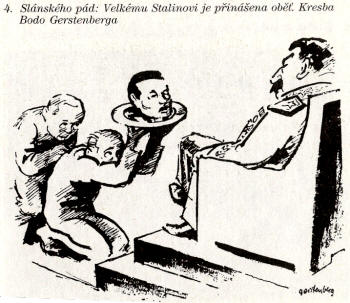
On this date in 1952, eleven high-ranking Czechoslovakian politicians were hanged at Prague’s Pankrac Prison two weeks after a show trial purging unreliable elements from the Communist party.

One of the most infamous show trials in Czechoslovakia saw 14 high-ranking Communists — eleven of them Jews — railroaded for a “Trotskyite-Titoist-Zionist activities in the service of American imperialism”. Three received life sentences. The other eleven went to the gallows.

While the roots of the persecution, especially the undertones of anti-Semitism, sink into the id of the Stalinist Eastern bloc, the most evident proximate cause was the USSR’s assertion of control over its satellite states at a time when Josip Tito was successfully charting a course of independent communism. Purges in Poland, Bulgaria and Hungary had taken place in the years before.

The Soviet agents rounding up suspects for Stalin did not trifle with small game. Rudolf Slansky was General Secretary of the Communist Party and therefore the second-most powerful man in the country; by the time he was tried, after a year in prison under torture, he was publicly denouncing himself.

Otto Sling, whose name became synonymous with forbidden heterodoxy, did likewise — “I was a treacherous enemy within the Communist Party … I am justly an object of contempt and deserve the maximum and the hardest punishment.”

And Vladimir Clementis, the Slovak Minister of Foreign Affairs, was erased from a photo taken with the Czechoslovakian President, a circumstance Milan Kundera reflected upon in The Book of Laughter and Forgetting:

In February 1948, the Communist leader Klement Gottwald stepped out on the balcony of a Baroque palace to harangue hundreds of thousands of citizens massed in Old Town Square … Gottwald was flanked by his comrades, with Clementis standing close to him.

The propaganda section made hundreds of thousands of copies of the photograph taken on the balcony where Gottwald, in a fur hat and surrounded by his comrades, spoke to the people. On that balcony the history of Communist Bohemia began. Every child knew that photograph, from seeing it on posters and in schoolbooks and museums.

Four years later, Clementis was charged with treason and hanged. The propaganda section immediately made him vanish from history and, of course, from all photographs. Ever since, Gottwald has been alone on the balcony. Where Clementis stood, there is only the bare palace wall.

The hanged were rehabilitated in 1963.

Artur London, who received a life sentence and was released after rehabilitation, wrote about his experiences in The Confession, subsequently a 1970 Costa-Gavras film. The wife and son of Deputy Minister of Foreign Trade (and Auschwitz survivor) Rudolf Margolius have also both written memoirs covering the trial.

The younger Margolius in particular, who has staunchly defended his father as an essentially apolitical man and not a Communist apparatchik, has been in the thick of present-day disputes in Czechoslovakia’s successor states over whom is due sympathy and recognition for bygone political crimes.

On this day..