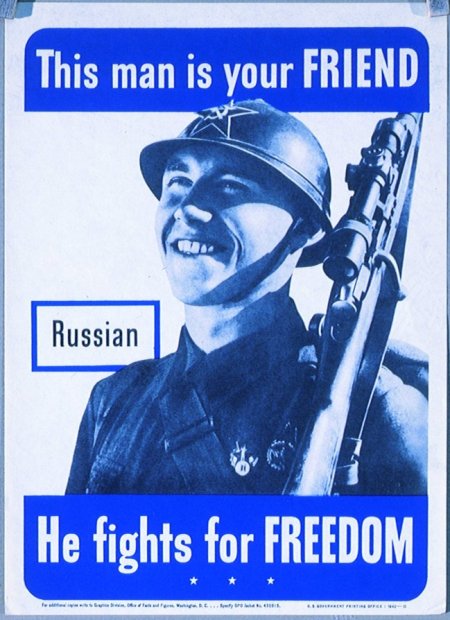
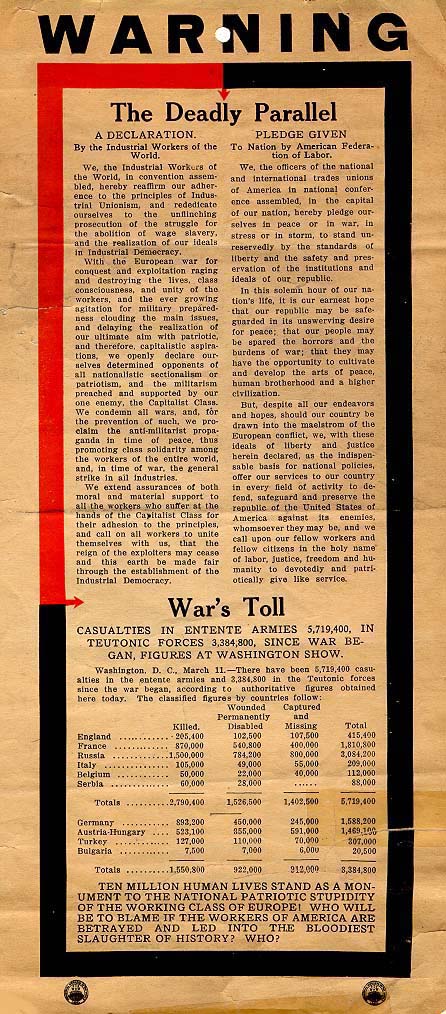
On this date in 1945, according to a fringe faction of American conservatism, the first victim of the Cold War was shot by Chinese Communists at Suchow, China, near Xi’an.
John Birch, a military chaplain proselytizing in China and an agent of the CIA’s precursor entity Office of Strategic Services, had the kind of portfolio sure to rub Mao’s boys the wrong way.
Apparently it was his personality that got him into trouble.
On recon duty days after the end of World War II, he bumped into a patrol of Red Chinese. According to Time, he failed his diplomacy check.
As the scene has been reconstructed, Birch argued violently with the Communist officer who wanted to disarm him. Birch was seized and shot after his hands had been tied. The Communists then bayoneted him at least 15 times and tossed his body on a heap of junk and garbage.
“In the confusing situation,” said [Birch’s commanding officer Major Gustav] Krause last week, “my instructions were to act with diplomacy. Birch made the Communist lieutenant lose face before his own men. Militarily, John Birch brought about his own death.”
Days after World War II — how does that square with your international Communist conspiracy? The incident was not especially notable at the time, but some elements later conceived John Birch the first American casualty of Communism during the Cold War, and in this guise he became the namesake of the John Birch Society (Wikipedia entry | homepage — evidently forward-thinking enough to have grabbed their own three-letter acronym)
Here’s candy magnate and founder Robert Welch, Jr., explaining:
Despite the young lieutenant’s credentials as a martyr of evangelical anti-Communism, the oft-loopy Society’s relationship to the mainstream conservative movement and the Republican Party it took over was never completely comfortable and eventually came to a definite sundering.
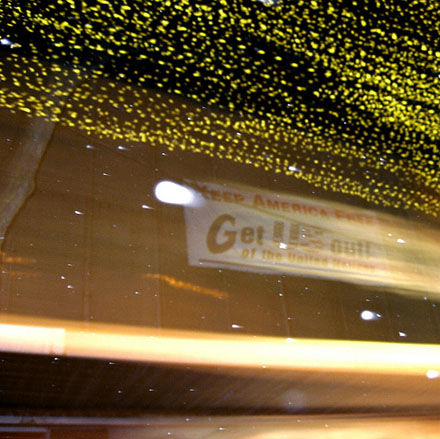
The Society soldiers on, its “Get US out of the United Nations” billboards a minor fixture of Americana from Port Angeles, Washington to this one in Ypsilanti, Michigan.
On this date in 1917, Wobbly labor organizer Frank Little was abducted from his hotel and hanged from a railroad trestle in Butte, Montana.
An executive board member of the radical Industrial Workers of the World, the half-Cherokee Little had only rolled into Montana’s copper mining hub two weeks before. A roving agitator who had organized workers all around the west, he would be a signal martyr to America’s nascent Red Scare.
It was a fraught moment nationwide, and worldwide. After winning re-election on the slogan “He kept us out of war,” Woodrow Wilson upon his inauguration immediately (try to act surprised) got the United States into World War I. Just as it had in Europe, the question of war put American labor to the test: would it transfer opposition to war into resistance, or would it line up patriotically with its state?
This outstanding IWW poster (via the University of Arizona’s web exhibit on the labor deportations that had expelled Frank Little from Arizona just days before he arrived in Butte) pits the militant Wobbly position against the nationalist American Federation of Labor.*
And Little was one of the most stridently anti-war in his movement.
Either we’re for their capitalist slaughter fest or against it. I’m ready to face a firing squad** rather than compromise. (Source)
Anaconda Copper could nowise welcome this character’s arrival, where he would organize already-striking miners and mix in militant anti-war rhetoric with incendiary potential in the cocktail of immigrant workers being asked (in many cases) to wage war on their homelands.
The local labor conflict, an exceptionally brutal instance of a pattern across the country and especially in western mining country, was probably savage enough on its own to make Little a marked man. Whether his anti-war activity or his union activity motivated his death is not sure, but the dilemma was probably a false one for his killers just as it was for Little himself: they were two heads of the coin. As American troops poured into Europe, and particularly as the Bolshevik Revolution later in 1917 spurred a worldwide Communist scare (and a separate American military expedition), both public and private power violently pursued left-wing elements.
Caption: Copper Trust to the Press: “It’s all right, pal; just tell them he was a traitor.” (Source.)
The film An Injury To One (review) deftly weaves those themes and others together into the tale of a crime which is also the tale of a time and place:
This note was found pinned to Little’s body. “3-7-77”, a Montana vigilante calling card, indicates the dimensions of a grave.
Officially (again, act surprised), it’s an unsolved crime. Even though the New York Timesreport the day after the hanging quoted a labor official claiming “certain” knowledge of five of the six men in the posse, and a prosecutor vowing, “it is a cold-blooded murder and every effort will be used to apprehend the men who did it,” nobody ever went on trial for lynching Little.
Company goons, likely aided by the infamous union-busting Pinkerton detective agency, are the presumed culprits. And it is the nature of lynchings to make extrajudicial the rough justice sought by a certain constituency, as expressed by Montana’s Helena Independent:
Good work! Let them continue to hang every I.W.W. in the state. The time has come. It is beyond the comprehension of the average citizen why the war department has not ordered certain leaders arrested and shot. The people will not stand for much more.
A massive funeral turnout brought federal troops to quash labor unrest in Butte … and in the years to come, the IWW would be hunted from pillar to post.
Pro-Wobbly sites give adoring biographical treatment and fairly extensive resource lists on Little here and here.
On this date in 1963, Iraq’s infant Ba’ath government executed at least 21 soldiers — all Shi’a — who had participated in a Communist coup attempt on July 3.
The Ba’ath were newly in the saddle after overthrowing Qasim earlier that year, and would be ousted again a few months hence before their definitive seizure of power several years later.
For the moment, they were a fledgling government trying to tilt away from the Soviet bloc and towards the west while navigating a minefield of domestic politics. If the coup really occurred as described, it was the fruit of an Iraqi Communist Party with daggers drawn for the regime after the Ba’athists had massacred their membership with CIA help in the course of offing Qasim. (The name is also transliterated Qassim or Kassem.) If it was bogus, it was probably an official cover story to keep massacring Shi’a Communists.
The affair, in either guise, amounted to a minor hazard in the jagged path of the Ba’ath — but of course, we come by that judgment with benefit of hindsight. Far more interesting to follow, courtesy of this site‘s library of historic cables, the perceived unfolding of the situation through the anxious American diplomatic pouch:
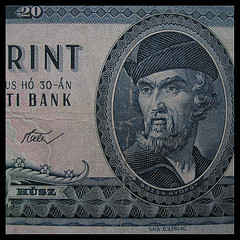
On this date in 1514, the leader of a Hungarian peasant uprising that scared the ermine robes off the feudal nobles met a punishment from the unspeakable depths of their medieval imaginations.
While Marki Sandor’s 1913 biographical treatment of this character — also rendered Georghe Doja or Dosa, or as György Székely for his native soil — is available online, it seems to be available only in Hungarian.
Since readily-accessible non-Magyar sources such as Dozsa’s Wikipedia page all appear to spring root and branch from the public domain edition of the 1911 Encyclopedia Britannica … well, who is Executed Today to buck the trend? (Some paragraph breaks added for readability.)
GYORGY DOZSA (d. 1514), Hungarian revolutionist, was a Szekler squire and soldier of fortune, who won such a reputation for valour in the Turkish wars that the Hungarian chancellor, Tamas Bakocz, on his return from Rome in 1514 with a papal bull preaching a holy war in Hungary against the Moslems, appointed him to organize and direct the movement.
In a few weeks he collected thousands of so-called Kuruczok (a corruption of Cruciati), consisting for the most part of small yeomen, peasants, wandering students, friars and parish priests, the humblest and most oppressed portion of the community, to whom alone a crusade against the Turk could have the slightest attraction.
They assembled in their counties, and by the time Dozsa had drilled them into some sort of discipline and self-confidence, they began to air the grievances of their class. No measures had been taken to supply these voluntary crusaders with food or clothing; as harvest-time approached, the landlords commanded them to return to reap the fields, and on their refusing to do so, proceeded to maltreat their wives and families and set their armed retainers upon the half-starved multitudes. Instantly the movement was diverted from its original object, and the peasants and their leaders began a war of extermination against the landlords.
By this time Dozsa was losing control of the rabble, which had fallen under the influence of the socialist parson of Czegled, Lorincz Meszaros. The rebellion was the more dangerous as the town rabble was on the side of the peasants, and in Buda and other places the cavalry sent against the Kuruczok were unhorsed as they passed through the gates. The rebellion spread like lightning, principally in the central or purely Magyar provinces, where hundreds of manor-houses and castles were burnt and thousands of the gentry done to death by impalement, crucifixion and other unspeakable methods.
Dozsa’s camp at Czegled was the centre of the jacquerie, and from thence he sent out his bands in every direction, pillaging and burning. In vain the papal bull was revoked, in vain the king issued a proclamation commanding the peasantry to return to their homes under pain of death. By this time the rising had attained the dimensions of a revolution; all the feudal levies of the kingdom were called out against it; and mercenaries were hired in haste from Venice, Bohemia and the emperor.
Meanwhile Dozsa had captured the city and fortress of Csanad, and signalized his victory by impaling the bishop and the castellan. Subsequently, at Arad, the lord treasurer, Istvan Telegdy, was seized and tortured to death with satanic ingenuity. It should, however, in fairness be added that only notorious bloodsuckers, or obstinately resisting noblemen, were destroyed in this way. Those who freely submitted were always released on parole, and Dozsa not only never broke his given word, but frequently assisted the escape of fugitives. But he could not always control his followers when their blood was up, and infinite damage was done before he could stop it.
At first, too, it seemed as if the government were incapable of coping with him.
In the course of the summer he took the fortresses of Arad, Lippa and Vilagos; provided himself with guns and trained gunners; and one of his bands advanced to within five leagues of the capital. But his halfnaked, ill-armed ploughboys were at last overmatched by the mailclad chivalry of the nobles. Dozsa, too, had become demoralized by success. After Csánad, he issued proclamations which can only be described as nihilistic. His suppression had become a political necessity.
He was finally routed at Temesvar* by the combined forces of Janos Zapolya and Istvan Bathory.
The radicalism of this revolt is not to be downplayed; Friedrich Engels’ The Peasant War in Germany, reports that Dozsa declared a republic and abolished nobility.
As with his French predecessor Guillaume Cale, his punishment would demarcate the feudal order by horrifically mocking its victim’s pretension to political authority. This description of Dozsa’s unenviable end comes from The History of Hungary and the Magyars, a 19th century text available free at Google Books, beginning with :
[After hearing his sentence, Dozsa] exclaimed — addressing the crowd whom he saw shuddering at his approaching doom — “Come back tomorrow, you miserable slaves, and see if I shrink in the midst of my sufferings! If a single groan escapes my lips, may my name be covered with eternal infamy!”
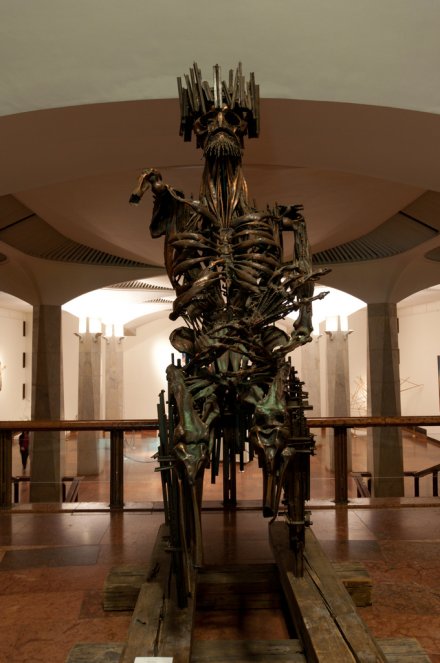
On the following day, he was placed almost naked on a burning throne, and his head was encircled by a crown of red-hot iron. Fourteen of his followers had been kept without food for several days, and were then brought into his presence, and while he was yet living the flesh was torn from his bones and cast to them that they might satiate their hunger. “To it hounds!” was his bitter exclamation, “ye are of my own rearing!”
This insurrectionist’s confrontation with backward power structures would offer plentiful fodder for those lands’ now-fallen Communist regimes; his name adorns many streets and monuments in Hungary and Romania.
However, Dozsa was well on his way into the nationalist pantheon before Communist ascendancy. Nineteenth-century composer Ferenc Erkel, for instance,** wrote an opera about him, and poet/nationalist revolutionary Petofi Sandor saluted him in verse in 1847.
* aka Timisoara — in modern-day Romania, where the execution actually took place.
** Dozsa was actually captured in a fortress constructed by John Hunyadi, whose executed son is a fellow nationalist martyr (playing for the traditional-authority team), and the subject of one of Erkel’s more famous operas.
In the small hours after midnight on the night of July 16-17 90 years ago, the former Tsar Nicholas II, his wife, children, and four family retainers, were shot in a Yekaterinburg basement by their Bolshevik jailers.
Doting family man, vacillating dictator, as weak and rich as Croesus … the doomed Emperor and Autocrat of All the Russias was a man small of stature. His reign emerged under a bad star when 1,300 Muscovites were trampled to death in the crush for his coronation largesse; 18 years later, Nicholas‘s support for Serbia against Austria-Hungary was instrumental in pitching Europe into World War I, a blunder for which he reaped a whirlwind long in the making.
When an anti-Bolshevik force approached Yekaterinburg (or Ekaterinburg), where the deposed royals had been stashed in a commandeered private residence,* Yakov Sverdlov (for whom the city was subsequently renamed) ordered the prisoners shot — not only the tsar, but his beloved wife, their hemophiliac heir, and those four daughters who had to be bayoneted because the state jewels secreted in their corsets shielded them from the gunfire.
The executioners (here’s the account of their leader; here’s another guard’s version) did their best to destroy and conceal the remains, helping fuel subsequent rumors that one of the children had survived and escaped.
Those rumors are only now, with post-Soviet investigation and DNA forensics, being debunked, and not yet to the satisfaction of all comers. This very week, Moscow affirmed (though the Orthodox church has not accepted) that the last of Nicholas’s family had been accounted for:
Modern nostalgia for this unimpressive sovereign is making a minor comeback, with Nicholas absurdly contending in a current poll for the title of “greatest Russian” … supported not only by the miseries of the state that succeeded his, but by the family’s decent and accessible private life.
Even a monarchist — especially a monarchist! — shouldn’t reason that the greatest monarch is the one who drove the bus over the cliff. But much is forgiven a martyr. Indeed, like Charles I of England, the last Romanov monarch has been posthumously saddled with divine sanction; he and all the family are certified “passion bearers”. (Update: And possible future relics!)
A handful of the many books about the Romanovs and their fall
* The Ipatiev House where the tsar was held (and shot) no longer stands. On its spot is a church consecrated five years ago yesterday to the Romanov canonization.
Update: The Romanovs were officially rehabilitated by the Russian Supreme Court on October 1, 2008.
On this date in 1535, Sir — later Saint — Thomas More kept his conscience at the expense of his head on Tower Hill.
For all More‘s greatness — as intellectual, polemicist, lawyer, statesman, father — none of his many gifts at the end could avail him beside his commitment to Catholicism at the dawn of the English Reformation.
Yet it is for those gifts that he cut such a commanding presence in his times, for those very reasons that his sovereign hounded his first citizen to assent to the divorce and remarriage he was fixed upon.
A devotee and friend of Erasmus from years before, More was in Henry’s more orthodox youth the king’s very scourge of Protestantism. His scatological invective against Martin Luther in Responsio ad Lutherum — much in the impolite tenor of Catholic-Protestant rhetoric continent-wide, it should be noted — is of the sort to crimson the cheeks of the milquetoast modern:
Since he has written that he already has a prior right to bespatter and besmirch the royal crown with shit, will we not have the posterior right to proclaim the beshitted tongue of this practitioner of posterioristics most fit to lick with his anterior the very posterior of a pissing she-mule until he shall have learned more correctly to infer posterior conclusions from prior premises?
Over that hairshirt, he wore the robes of state. But his engagement with the world had a selective bent that must have exasperated his colleague and predecessor as Lord Chancellor, Cardinal Wolsey. Orson Welles and Paul Scofield spar here in the definitive More hagiography A Man for All Seasons over the intellectual’s delicate refusal to dirty his gloves with the great matter of state before them — the annulment the king demanded of his marriage to the Queen (and More’s friend) Catherine of Aragon:
Peas in a pod, these two: Wolsey, the cleric grounded in realpolitik; More, the barrister who trusts to God. (More considered holy orders as a young man.)
Our man’s reputation for honesty in a den of hypocrites has certainly outrun Wolsey’s. Still, all More’s disdain for the deal-making that invests the sovereign majesty and all his foreboding for the relationship he had with his dangerous king were not quite enough to stop him accepting the Chancellorship and the opportunity to stamp out Lutheranism … knowing perfectly well the simultaneous thrust of Henry’s boudoir policy.
It all cuts quite a contrast to More’s (barely) pre-Reformation text, Utopia (available free from Project Gutenberg), which named a literary genre and described an imagined society of tolerant primitive communism that surely would have blanched at its inventor’s coming role in the state’s machinations:
I can have no other notion of all the other governments that I see or know, than that they are a conspiracy of the rich, who, on pretence of managing the public, only pursue their private ends, and devise all the ways and arts they can find out; first, that they may, without danger, preserve all that they have so ill-acquired, and then, that they may engage the poor to toil and labour for them at as low rates as possible, and oppress them as much as they please
…
[E]very man might be of what religion he pleased, and might endeavour to draw others to it by the force of argument and by amicable and modest ways, but without bitterness against those of other opinions; but that he ought to use no other force but that of persuasion, and was neither to mix with it reproaches nor violence* …
It’s not a given that More himself agrees with every (or even any) sentiment expressed in Utopia, but his most famous work’s criticism of the death penalty too liberally applied makes interesting reading.
[E]xtreme justice is an extreme injury: for we ought not to approve of those terrible laws that make the smallest offences capital … God has commanded us not to kill, and shall we kill so easily for a little money [i.e., execute petty thieves]? But if one shall say, that by that law we are only forbid to kill any except when the laws of the land allow of it, upon the same grounds, laws may be made, in some cases, to allow of adultery and perjury: for God having taken from us the right of disposing either of our own or of other people’s lives, if it is pretended that the mutual consent of men in making laws can authorise man-slaughter in cases in which God has given us no example, that it frees people from the obligation of the divine law, and so makes murder a lawful action, what is this, but to give a preference to human laws before the divine? and, if this is once admitted, by the same rule men may, in all other things, put what restrictions they please upon the laws of God.
This insistence on the supremacy of divine law over human institutions forms the basis of his objection to parliament’s overthrowing the papacy — which he expressed openly only after he was convicted by obviously perjured “jailhouse snitch” testimony
[Y]ou have no authority, without the common consent of all Christians, to make a law or Act of Parliament or Council against the union of Christendom.
Paul Scofield bears enjoying in the role in A Man for All Seasons:
More is sometimes suspected of desiring martyrdom since he marched so unerringly into it, but he also made every attempt to survive Henry’s demand the he affirm the royal remarriage and the king’s ecclesiastical supremacy by withdrawing silently from the public sphere rather than openly opposing it. More had by every account an enviable, downright happy life at his own hearth, and a tender and intellectual relationship with his favorite daughter Meg. (Meg corresponded with her father in prison, collected his works, and retrieved his head from London Bridge.)
But by his way of thinking — Meg tried to talk him out of it — he couldn’t swear to the Act of Succession acknowledging the king’s right to divorce Queen Catherine and disinherit her daughter Mary if Henry decided to force the choice. And in the king’s eyes, there was no middle ground for someone of the ex-Chancellor’s stature.
Henry could see to it, though, to cut his old friend a break and commute the sentence from drawing and quartering to “mere” beheading, here depicted in the past season of the Showtime series The Tudors.
More’s last moments as rendered here — the ironic remark at the foot of the scaffold, “See me safe up: for my coming down, I can shift for myself”;** his generous answer to the headsman’s plea for forgiveness — are well-documented. Undoubtedly, his sturdy martyr’s bearing, the extension of a life of joyful piety, helped cement for posterity the fame he held in life.
And that dying address — “I die the King’s good servant, but God’s first” — gathers in one sentiment free of bombast or self-pity the irreconcilable demands of conscience that would lead many thousands besides More to Henry VIII’s scaffolds, and rings equally true to less lethal challenges to the conscience in every land and time since.
Anne Boleyn, who caused More’s fate, shared it less than a year afterwards.
Thomas More was canonized by the Catholic Church in 1935 — the patron saint of politicians. Rather bizarrely, July 6 is also his feast day on the Anglican calendar, a tribute to the nearly universal regard his memory enjoys.
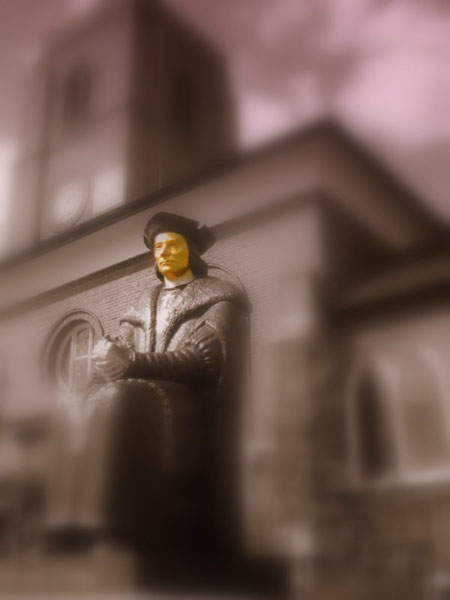
Chelsea resident Thomas More’s statue at the (Anglican) Chelsea Old Church.
* Despite its religious tolerance, More’s Utopia — anticipating Dostoyevsky — maintains:
a solemn and severe law against such as should so far degenerate from the dignity of human nature, as to think that our souls died with our bodies, or that the world was governed by chance, without a wise overruling Providence … since a man of such principles must needs, as oft as he dares do it, despise all their laws and customs: for there is no doubt to be made, that a man who is afraid of nothing but the law, and apprehends nothing after death, will not scruple to break through all the laws of his country, either by fraud or force, when by this means he may satisfy his appetites.
On this date in 1947, Ding Mocun was shot for “conspiring with a foreign government to overthrow China” in Shanghai by the Kuomintang.
This former Communist turned right-wing radical may be most readily recognizable outside China as the real-life inspiration behind Ang Lee’s steamy 2007 art-house menace to undergarments Lust, Caution.
That incident was authored by Ding’s young plaything, who turned out to have a very serious side indeed. (Ding had her shot.)
While the attempt on the turncoat spy’s life really happened, there’s some dispute over whether Chang really had this particular woman strongly in mind over the twenty-plus years she composed her story. There’s more about the evolution of the fictional story here, but you’ll need Chinese skills to follow the links to Chang’s evolving text.
At any rate, Ding’s actual death would come by order of a more august character: Chiang Kai-shek.
Why so many people out to get him?
Despite his nationalist credentials, when Ding lost a party struggle in 1938, he found a gig with the collaborationist government of Japanese-occupied China running a nasty intelligence unit that made nationalists and Communists disappear. That’s the sort of resume anyone would be touching up come the mid-1940’s, and Ding went with a revision (not widely credited, though it has its advocates) that he was secretly passing information to the nationalist resistance all along. And as the nationalists and Communists turned on one another in the postwar power vacuum, it looked like his usefulness to the Kuomintang might get him off the hook after all.
It worked for a while, but Chiang — or so goes the story — caught a tabloid expose about Ding catching R&R at a lake when he’d used a medical pass to get out of prison, and impulsively ordered him shot.
Perhaps Ding’s status as official evildoer vis-a-vis a China whose messy birth many are old enough to remember helps account for the resonance of literary works that engage him as a human being. In a nonfiction vein, Konrad Lawson’s layered critique of the pro-Ding apologia linked above thoughtfully evokes the complexity of Ding’s era and the challenges it poses for historiography.
On this date in 1950, Milada Horakova was hanged with three others in Prague’s Pankrac Prison as a spy and traitor to the Communist Czechoslovakian government.
Not (yet) as internationally recognizable as Rudolf Slansky,* the Communist General Secretary in Horakova’s time who would run afoul of Stalin and die on the same gallows two years later, Horakova (English Wikipedia page | Czech | the detailed French) is a potent symbol domestically of her country’s Cold War nightmare.
Lawyer, social democrat, and a prominent feminist in the interwar and postwar periods — her life’s work, rather overshadowed by an end that was memorable for different reasons — Horakova survived Nazi imprisonment and was a member of parliament when the Communists seized power in 1948.
She spurned counsel to flee the country, and found herself the headline attraction at a show trial for a supposed plot to overthrow the government. In a hopeless scenario, she distinguished herself with off-script defiance despite having broken under torture and signed a confession; Albert Einstein, Winston Churchill and Eleanor Roosevelt all pleaded in vain for clemency.
Horakova left the world clear in her purpose. In a letter to her teenage daughter awaiting execution, she justified her own dangerous choices:
The reason was not that I loved you little; I love you just as purely and fervently as other mothers love their children. But I understood that my task here in the world was to do you good … by seeing to it that life becomes better, and that all children can live well. … Don’t be frightened and sad because I am not coming back any more. Learn, my child, to look at life early as a serious matter. Life is hard, it does not pamper anybody, and for every time it strokes you it gives you ten blows. Become accustomed to that soon, but don’t let it defeat you. Decide to fight.
Hours before her hanging, she wrote a few last words for her loved ones:
I go with my head held high. One also has to know how to lose. That is no disgrace. An enemy also does not lose honor if he is truthful and honorable. One falls in battle; what is life other than struggle? (Both excerpts cited here)
The only woman among Czechoslovakia’s postwar political executions was abortively rehabilitated during the 1968 Prague Spring. Since the fall of the Iron Curtain, her resistance to both Naziism and Communism — worthy of an opera (topical interview) and a forthcoming film — have elevated her into her country’s official pantheon.
As a result, this date is “Commemoration day for the victims of the Communist regime” in the Czech Republic.
Meanwhile, Horakova’s now-octogenerian prosecutor Ludmila Brozova-Polednova, whose repulsive legal barbs at trial (“Don’t break her neck on the noose. Suffocate the bitch — and the others too.”) were probably the consequence of the foregone conclusion more than the cause, was convicted late last year for her role in the trial. That verdict has kept in the news these past several months — most recently, the Czech Supreme Court returned it for retrial after an appeals court overturned the sentence — a tangible symbol of the challenges inherent to confronting the past. (Brozova-Polednova, for her part, is unapologetic.)
* One of the goons who tortured confessions out of the conspirators in Horakova’s “terrorist center,” Karel Svab, was among those later hanged with Slansky.
On this date in 1953, a guerrilla with the nom de guerre “Khmara” was shot in Kiev’s Lukianivka Prison for his involvement in a still-controversial resistance movement.
Dmytro Bilinchuk on the forest moon of Endor. UPA regs supposedly strictly prohibited photography; being rebels by nature, they snapped enough to fill up this page.
History is lived forward but understood backward. Therein lies the ambiguity of the Ukrainian Insurgent Army (UPA), a nationalist organization that operated in Galicia and environs after the Nazi invasion and persisted several years afterwards.
At its height, the UPA is said to have had up to 100,000 members, famously operating out of subterranean forest bunkers. This day’s victim was the captain of one of its companies; there is very little about him available online in English — principally his death date — but Ukrainian sites add the folklorish but poignant detail of his supposed adoption of an orphaned bear cub.
But about his organization, the name alone is sufficient to invite the most acrimonious debate:* were these partisans Nazi collaborators? Ukrainian patriots? Both?
Ukrainian nationalists, under the leadership of a man who had abandoned socialism for a fascist national ideology (everyone was doing it), entered the World War II era having conspicuously failed to grasp independence in a period when nationhood was being handed out like candy to small European states.
The specific kettle for Ukraine’s stewing ethnic aspirations was Galicia, the northeastern shoulder of the Carpathian mountains presently in western Ukraine. Galicia had been at the heart of both Polish and Ukrainian national movements, and they fought for it after World War I — a war won by Warsaw. (Meanwhile, Bolshevik victory in the Russian Civil War forestalled national ambtions further east.)
Brewed with the movement’s right-wing ideology, Ukrainian nationalism developed an anti-Polish, anti-Russian, anti-Communist programme, and it gazed around 1930’s Europe wondering if it couldn’t find an aggressive great power with a similar outlook that might take Ukraine under its wing.
Fast forward to the eve of World War II: by the terms of the Molotov-Ribbentrop Pact, Hitler and Stalin carved up the Ukrainians’ rival and thrust Galicia into Soviet hands, incidentally exposing its inhabitants to the pleasures of life under Stalin.
For Ukrainian nationalists, the altered situation of the Poland partition — followed shortly by Hitler’s initially successful invasion of Russia — offered an apparent opportunity to realize the dream of statehood under the patronage of a somewhat congenial Nazi government.
Though there’s a great deal of contention this author is not remotely qualified to referee about precisely which organs collaborated with or resisted the Nazis in precisely which ways, it seems fair summation to say that Ukraine’s nationalist movement was happy to treat with Berlin. Berlin being more reserved about a Slavic nationalist movement in its conquered territory, the UPA’s proposed institutional alliance with the Wehrmacht never quite came to pass as such, but that left many nationalists as freelance collaborators instead.** The hypothetical Ukrainian state in a Nazi-dominated Europe was not going to come about by sabotaging the Germans.
Instead, the UPA got busy laying the groundwork for an ethnically homogeneous Ukrainian homeland by fighting a reciprocal dirty war of ethnic cleansing against Poles in Galicia (most notoriously and emblematically, at Volhynia) — eventually developing into inter-partisan civil warfare against both Polish and Communist units (who had their own differences) with the odd brush with the Wehrmacht mixed in, and giving way to full concentration upon Soviet authorities as Red Army drove out the Germans.
The fact of having engaged German troops is a loudly bandied point in the UPA’s modern defense — the elevator pitch is that they “fought the Nazis and the Communists,” though it sure looks like they fought the one a lot harder than the other, and fought both less eagerly than they fought the Poles. There may be no cause to call UPA fighters other than sincere patriots of a nation whose aspirations were no less worthy than any other, who under beastly circumstances and for motives they believed noble committed sins no uglier than many other nationalists: even so, the thing separating that militia and its movement from, say, the Croatian Ustashi looks like opportunity rather than principle. Most perceived at the strategic plane a clear choice between Nazi victory with Ukrainian independence and Nazi defeat without, and most consciously preferred the former. No doubt the UPA would retort that its only other option was worse.
While Ukraine had a predictable exodus of anti-communist types as World War II drew to a close,† thousands of UPA guerrillas stuck around to keep up their fight (already underway) against the Soviets — including Dmytro Bilinchuk, whose biography can be enjoyed by readers of Ukrainian here.
It took a decade or more for Russia to extirpate this movement by hunting down its Bilinchuks. Buried in obscurity for the remainder of the Cold War, however, the martyrs of the OUN and UPA have pried open their tombs since Ukraine separated from the USSR in 1991 and become a contentious symbol in present-day Ukraine.
The OUN successor Congress of Ukrainian Nationalists has been part of Ukraine’s governing alliance since the Orange Revolution, and has pressed to treat its dead forebears as national heroes — renaming streets and attempting to rehabilitate UPA veterans into a class with those of the Red Army, a problematic enterprise since the two groups spent years killing one another. Old warriors may never reconcile, but the self-conscious reconstruction of the Ukrainian partisan movement in the service of shaping modern Ukrainians’ identity is a going concern:
Proving Faulkner’s old aphorism that the past isn’t dead and isn’t even past, this latter-day party and others of the Orange coalition remain electorally rooted in the UPA’s old western Ukraine stomping grounds, and tend to lean towards western Europe in outlook; eastern Ukraine remains more heavily Russian-oriented, and more inclined to the Russians’ distasteful view of the OUN and UPA.
** Late in the war, Germany would eventually form its own Galician SS Division. UPA proponents take pains to separate this German-officered formation from UPA guerrillas.
† Ironically, Ukrainians who bolted west — including the Galician SS division, which undertook a forced march to surrender in Italy rather than to the Soviets — profited greatly from having been “occupied” by Poland before the war, and from bloodily moving the border during the war. A refugee screening report (cited in Poland’s Holocaust — a source hostile to the UPA, as the title suggests) commented that Ukrainian detainees
are really having the best of both worlds. They do not qualify as Soviet citizens because their place of birth and/or habitual domicile on 1.9.39 were in Poland, and they therefore by our definition escape all punishment by the Russians for their having assisted the enemy; and they are not presumably eligible now for punishment by the Polish authorities because that part of the country from which they came is no longer part of Poland.
On this date in 1953, Julius and Ethel Rosenberg were put to death in Sing Sing’s electric chair as Soviet spies.
Divisive since it was handed down — or more precisely, since a famous article in London’s Guardian challenged the verdict and helped elevate it into a latter-day Dreyfus case — the Rosenbergs‘ sentence has inspired so much acrimony over several generations that merely to observe the date is to invite a debate capable of eminently more heat than light.
Where to begin with a case so towering in the recent cultural milieu?
A textbook might say that Julius and Ethel were convicted of passing atomic secrets to the Russians, that they maintained their innocence and their defenders carried that flame years after their deaths, and that intelligence files opened after the Cold War — notably the Venona project — apparently confirmed that Julius was a spy after all, though Ethel seems to have been little more than an approving bystander and Julius, come to think of it, never had anything so worthwhile as atomic secrets to share with Moscow. This information (which does have its own skeptics, albeit a small minority) undermines the maximal “absolute innocence” position that this day’s victims always asserted, but it’s a curious leap to take it as vindicating the legal outcome.
“My husband and I must be vindicated by history; we are the first victims of American fascism.”
Half a century on, juridical guilt or innocence seems distinctly secondary in the lasting importance of the Rosenberg trial, the two-year battle to save them, and their potent symbolic afterlives.
The Rosenbergs are the only stateside judicial executions for espionage since the Civil War.* That is a remarkable distinction, after all; so, how comes it that it is held by — to state the case against them in its strongest imaginable terms — two enthusiastic but bush-league players, and not by the likes of Aldrich Ames? How was it that a judge with a largely center-liberal career on the bench would read them a sentence of death hysterically accusing these Lower East Siders of causing the Korean War?
[Y]our conduct in putting into the hands of the Russians the A-bomb years before our best scientists predicted Russia would perfect the bomb has already caused, in my opinion, the Communist aggression in Korea, with the resultant casualties exceeding 50,000 and who knows but that millions more of innocent people may pay the price of your treason.
…
I feel that I must pass such sentence upon the principals in this diabolical conspiracy to destroy a God-fearing nation, which will demonstrate with finality that this nation’s security must remain inviolate; that traffic in military secrets, whether promoted by slavish devotion to a foreign ideology or by a desire for monetary gains must cease.
It is here in the age of McCarthyism, in the shadow of the USSR’s balance-altering A-bomb test in 1949, that the Rosenbergs stand in sharpest relief — not because of “guilt” or “innocence”, but as the ne plus ultra of that era’s range of social discipline.
A few years before, the United States and the Soviet Union had made common cause against Hitler in World War II, the United States pumping war materiel to Russians bearing the brunt of the fighting.
No longer operative.
The Communist Party USA enjoyed membership rolls pushing six figures; other socialist parties and movements had found niches in American life in the interwar years.
As the Great War gave way to the Cold War, the great powers remained nominal allies (that’s the reason the Rosenbergs weren’t tried for treason), but shifted rapidly into conflict. The American polity organized to expel the red menace by rendering it foreign and criminal — ideological rigging for the forty years’ imperial contest ahead. Loyalty oaths, blacklists, the House Un-American Activities Committee … in the whole of the self-conscious construction of communism as “contagion”, the power and willingness of the state to kill Julius and Ethel Rosenberg formed the tip of the spear, and an ugly contrast to that same state’s solicitous handling of Nazi scientists then developing the vehicles to deliver atomic technology to Moscow in mushroom cloud form.
Though different in many particulars, the thrust will be familiar to any sentient denizen of post-9/11 America: the extreme penalty enforces a wall between the suspect and abject (but tolerated) loyal liberal and the enemy left. Depend upon Ann Coulter for the most brutal articulation:
We need to execute people like John Walker [the American-born soldier captured fighting for the Taliban in 2001] in order to physically intimidate liberals, by making them realize that they can be killed, too. Otherwise, they will turn out to be outright traitors.
Like most symbols, the Rosenbergs came by their exaltation by accident; at the strictly personal level, their deaths are nearly operatic performances of human stubbornness and bureaucratic inertia. Investigators rolling up a spy ring** were looking for confessions and names to keep the indictments coming.
Julius refused to provide either, so his wife was arrested for leverage against him on the reasoning that he would confess to protect her. The gambit failed: both prisoner and hostage remained obstinate. The government’s bluff had been called, and it ruthlessly executed its threat.
Had the two really been responsible for starting a war, execution would hardly begin to cover the bill — yet to the very foot of the chair, the condemned, and Julius especially for the sake of his wife, were pressed with offers of mercy for confessing and “naming names”.
Abjure or expire: show trial logic.
[audio:Julius_and_Ethel_Rosenberg.mp3]
An Execution in the Family
Given names to name, the personal mystery of their silence — the ultimate heroism or folly or tragedy or transcendence — only deepens the resonance of their fate both for contemporaries and posterity, the poignance of their orphaned children’s subsequent path, the contrast with Ethel’s brother David Greenglass who has since admitted to perjuring testimony against Ethel in order to shield his own wife. (Greenglass says the Rosenbergs died from the “stupidity” of not copping a deal of their own.)
Even before Julius and Ethel went to the chair this date,† they had become the emblem of a paranoid age. In the days following, Sartre savaged the United States for trying “to stop scientific progress by a human sacrifice”:
Your country is sick with fear. You’re afraid of everything: the Russians, the Chinese, the Europeans. You’re afraid of each other. You’re afraid of the shadow of your own bomb.
Decades later, the shadows haven’t faded altogether. In playwright Tony Kushner’s imagination, the spirit of Ethel stalks her real-life prosecutor, closeted McCarthy henchman Roy Cohn, as he succumbs to AIDS in the 1980’s.‡
Rosenberg resources — and vitriol — are in plentiful supply online and off. A good starting point on the case is this page at the University of Missouri – Kansas City. Be sure to check the tale of a last-ditch legal maneuver that almost succeeded.
* There is one partial exception in the unusual case of six German saboteurs electrocuted in Washington, D.C., during World War II on a charge sheet that included espionage. The hearing was held by a military commission and only one of the six was an American citizen, so it was far from the regular judicial process — if one can call it that — the Rosenbergs faced.
** Originating in the investigation of Klaus Fuchs, the man who actually did what Julius and Ethel Rosenberg were accused of doing — passing atomic secrets to Moscow — although with debatable ultimate effect for the Soviets’ research. Fuchs served nine-plus years in a British prison and was released to East Germany; more than a few were galled at the difference between his sentence and the Rosenbergs’.
Stateside, George Koval was another spy far more valuable to Moscow in the nuclear race than were the Rosenbergs. Koval got away clean and died in Moscow in 2006.
† Julius first, then Ethel. Her execution was botched; repeated shocks were required to kill her.
‡ Cohn’s posthumous autobiography did acknowledge illegally rigging the Rosenberg trial, as his Kushner character does.

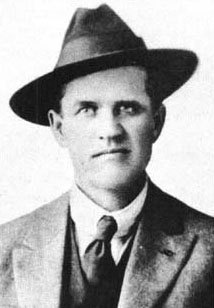 An executive board member of the radical Industrial Workers of the World, the half-Cherokee


 [After hearing his sentence, Dozsa] exclaimed — addressing the crowd whom he saw shuddering at his approaching doom — “Come back tomorrow, you miserable slaves, and see if I shrink in the midst of my sufferings! If a single groan escapes my lips, may my name be covered with eternal infamy!”

 Based on