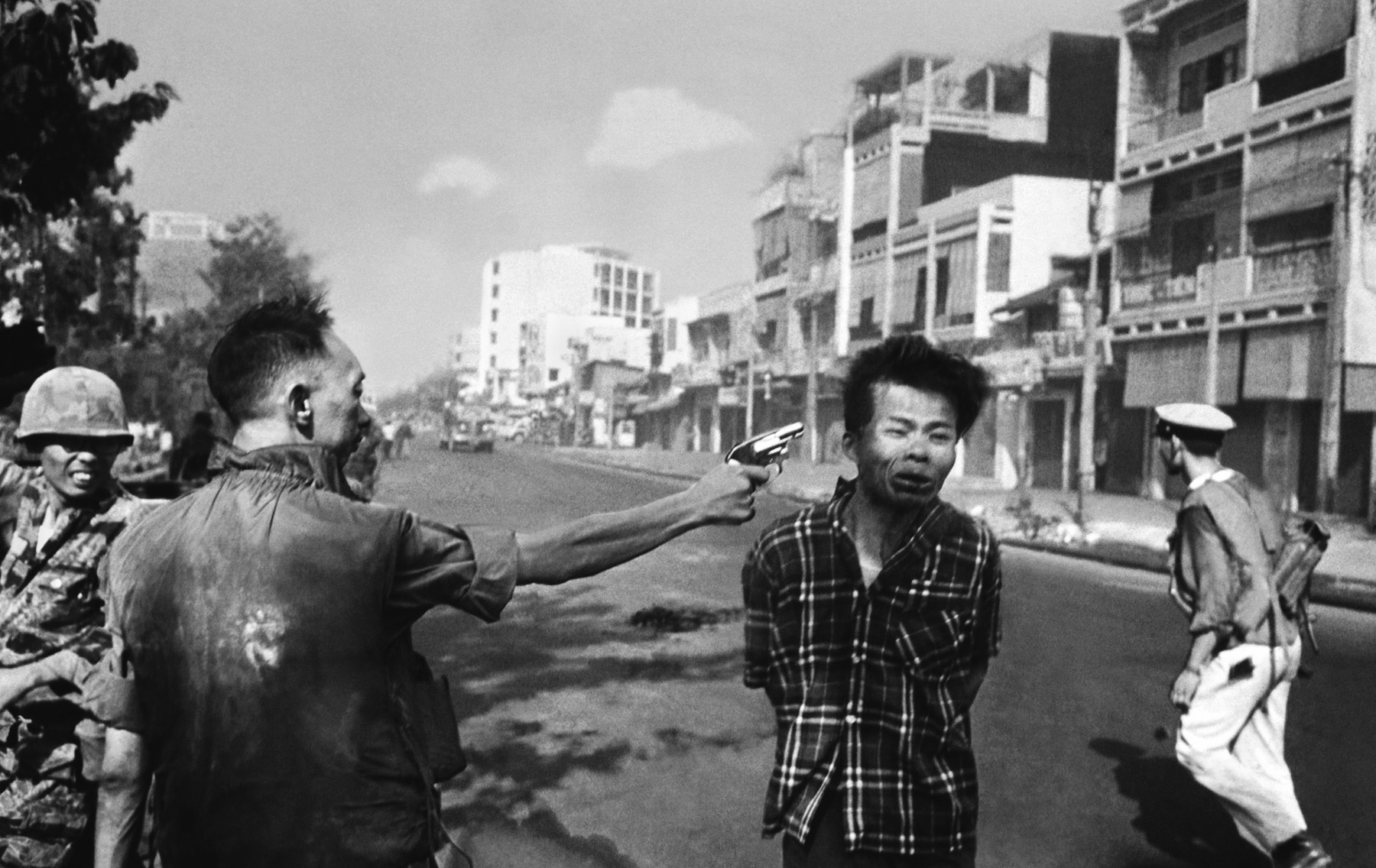
Around noon of February 1, 1968, in the opening days of the communist Tet Offensive, South Vietnamese General Nguyen Ngoc Loan summarily executed a Viet Cong prisoner on the streets of Saigon — and photographer Eddie Adams captured perhaps the war’s most unforgettable image.
An American cameraman also captured it in on celluloid. Caution: This clip shows … well, a man being shot in the head at point-blank range.
The general killed the Viet Cong; I killed the general with my camera … photographs do lie, even without manipulation.
For Adams, the lie was the omission of context — that the plainclothes Lem had allegedly just been caught having murdered not only South Vietnamese police but their civilian family members; that Loan was a good officer and not a cold-blooded killer.
Adams’ editor has said that many such summary executions were taking place during the Battle of Saigon — a broader context to the image no matter its specific fairness to the executioner.
But of course, the shot gained its deeper resonance from the growing disgust with the Vietnam War … and from its concise tableau of a century’s brutality. Here is a frozen image of Orwell’s boot stamping on a human face, forever.
Like any great work of art, Adams’ serendipitous photograph took on a life of its own … and a tapestry of meanings richer than its creator could ever have intended.
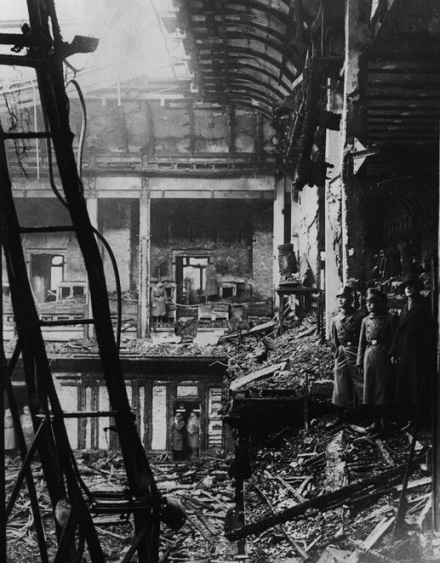
On this date in 1934, Dutch bricklayer Marinus van der Lubbe was beheaded by guillotine in Leipzig for setting the Reichstag Fire.
A watershed event* in the formation of the Nazi dictatorship, the Reichstag fire days before a parliamentary election enabled Hitler to stampede voters, suspend civil liberties, suppress left-wing parties on grounds of a suspected Communist plot, and seize “emergency” powers he would never relinquish.
Heil Hitler.
This clip from an American miniseries on Hitler with the characters chattering in unaccented English portrays the fascists’ opportunistic use of the attack on a national symbol … something not exactly unknown to later generations.
Van der Lubbe, who was arrested on the scene, suffered the predictable fate. Four other Communists charged as accomplices were acquitted, in a trial with the gratifying spectacle of Hermann Goering personally testifying, and being undressed on cross-examination by one of the reds. One is reminded here that Hitler did not yet have everything in the state apparatus at his beck and call … although he did have a great deal already, inasmuch as the arson law under which van der Lubbe died was passed after the Reichstag fire and made retroactive.
If the big-picture outcome of the Reichstag fire is pretty clear-cut, its real origin and the corresponding rightness of the judicial verdicts have remained murky ever since. The fact that the scene of the crime became Nazi ground zero for the next decade sort of obscures the evidence.
Van der Lubbe confessed, so his participation is generally taken as a given.
Whether he was really able to start the blaze acting alone, as he insisted, and the Nazis “only” exploited this fortuitous calamity; whether he was part of a larger leftist plot, as his prosecutors claimed; or whether, as Shirer and many others since have viewed him, he was a patsy in a false flag operation set up by the Nazis with an eye towards creating a politically advantageous national emergency — these possibilities remain very much up for debate.
For what it’s worth, postwar West German courts reversed and un-reversed the sentence before officially rehabilitating van der Lubbe last year on the non-specifically indisputable grounds that the legal machinery brought to bear on the Reichstag fire “enabled breaches of basic conceptions of justice.”
I do not see that one can blame the majority of Germans who, in 1933, believed that the Reichstag fire was the work of the Communists. What one can blame them for, and what shows their terrible collective weakness of character … is that this settled the matter. With sheepish submissiveness, the German people accepted that, as a result of the fire, each one of them lost what little personal freedom and dignity was guaranteed by the constitution, as though it followed as a necessary consequence. If the Communists had burned down the Reichstag, it was perfectly in order that the government took “decisive measures”!
Next morning I discussed these matters with a few other Referendars. All of them were very interested in the question of who had committed the crime, and more than one of them hinted that they had doubts about the official version; but none of them saw anything out of the ordinary in the fact that, from now on, one’s telephone would be tapped, one’s letters opened, and one’s desk might be broken into. “I consider it a personal insult,” I said, “that I should be prevented from reading whichever newspaper I wish, because allegedly a Communist set light to the Reichstag. Don’t you?” One of them cheerfully and harmlessly said, “No. Why should I? Did you read Forwards and The Red Flag up to now?”
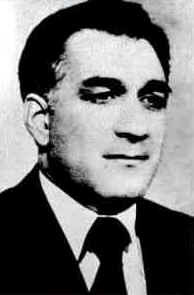
On this date in 1979, the 104-day term of Afghan president Hafizullah Amin met a violent end as a Soviet-engineered coup raised the curtain on a war destined to bring misery to both Cold War combatants.
The Soviet Union’s ongoing intervention in Afghan politics had through the 1970’s steadily mired it deeper into an unstable political situation.
Now, it was running out of patience with the country’s president, Hafizullah Amin.
He’d got the best of rival Nur Mohammad Taraki in a power struggle that September, but to the political chaos and the blossoming Islamic insurgency roiling his country, Amin added a level of brutality that was all his own, and a streak of diplomatic independence that was distinctly unwelcome in Moscow.
Amin was a Communist himself, and both he and the predecessor he’d murdered had wanted ever-increasing Soviet aid to keep the country stable.
Though Kabul radio would announce that Amin had been tried and summarily executed for “crimes against the state,” the short-lived dictator’s fate had been decided two weeks before when the Soviet Politburo passed a secret resolution for his ouster — having lost whatever confidence it had once held in him as a dependable satellite governor.
has seemed deeply troubled by the inability of either the Taraki or Amin governments to put down the rebellions in Afghanistan, which have been largely tribal but also militantly anti-Communist.
Amin survived a KGB poisoning, so the Red Army dispensed with subtlety by raiding the palace, plucking their preferred satrap out of exile in eastern Europe to take Amin’s place.
It would not see the last of Afghanistan until 10 years, 15,000 Soviet dead, and hundreds of thousands of Afghan casualties later.
A memorial in Ekaterinburg, Russia, to the Soviet dead in the Afghan war. Image courtesy of beatdrifter (Andy Holmes).
On this date in 1937, Japanese emigre Masao Sudo was shot in Moscow as a spy.
The executed man’s son, Dr. Mikhail Masaovich Sudo.
A true-red Communist who had fled increasingly right-wing Japan in the 1920’s and become a labor organizer in the far east, Sudo shared the tragic fate of the Japanese community in Stalin’s USSR, decimated by denunciations of one another.
Today is International Students’ Day and a public holiday in the Czech Republic and in Slovakia thanks to the martyrdom of nine at the hands of the Nazi occupation forces this day in 1939.
The previous fall, Hitler had cowed the allied powers into ceding the mountainous Czechoslovakian Sudetenland to the Third Reich in order to avert war — leading to Neville Chamberlain‘s famously mistaken “peace in our time” speech.
In March 1939, Germany reneged its part of the bargain and gobbled up Bohemia and Moravia, essentially the modern Czech Republic.
That this would collapse Chamberlain’s vision of peace and set Europe’s powers on the road to war with Berlin was cold comfort to the occupied Czechs. They had their own problems.
On October 28, youth demonstrations in Prague against the occupation resulted in the shooting of Charles University medical student Jan Opletal
Two weeks later he succumbed to the injury, and his funeral turned into an anti-occupation riot forcibly quashed by German arms. According to the London Times account:
On November 17 at 3 a.m., the Gestapo entered all students’ colleges, men’s and women’s, without allowing them to dress, tied the students in groups of three, and dragged them away … Between 3 o’clock and 8 o’clock in the morning the Gestapo visited students’ homes and lodgings. Those opposing arrests and parents who withheld information were immediately shot at, and the wounded were refused attention. The Gestapo broke into high schools as well as into the university …
The prisoners were taken to the Ruzyn barracks and to the Sparta football stadium, where cold water was flung over them and were made to wait until the evening. Then, in the barrack yard, 124 students and teachers* were shot before their fellow-students, the first nine being presidents of students’ associations, including the brilliant young sociologist Dr. Matoushek [English Wikipedia entry | Czech], son of a former Minister of Commerce.
Universities in the cities were declared closed for three years; they would not in fact re-open until after the war.
The day, subsequently memorialized as den boje studentu za svobodu a demokracii (Day of the Students’ Fight for Freedom and Democracy), entered Czech history a second time a half-century later. A student protest at Opletal’s grave on this date in 1989 helped catalyze the Velvet Revolution that toppled Czechoslovakia’s Communist government.
* The larger figure was circulated in the days following by Czech sources. It is not clear to me whether that number proved unfounded, or whether subsequent memorials simply came to focus on the leading nine — whose executions are certain, and were even announced by German communique.
At dawn this date in 1954, the last Foreign Minister of democratic Iran was shot in Tehran.
It was a year since the dramatic events of 1953, when a CIA-backed coup d’etat overthrew Iranian Prime Minister Mohammed Mossadegh (or Mosaddegh, or Mossadeq, or Mosaddeq) for contemplating oil nationalization.
Over several chaotic days of “Operation Ajax” (or TPAJAX), the Mossadegh government repulsed a first coup attempt, then succumbed to another.
After Mossadegh initially appeared to have maintained his hold on power, the autocratic Shah Mohammad Reza Pahlavi fled for his life to Iraq and thence to Rome. Fatemi, Mossadegh’s forceful young foreign minister, excoriated the Shah in words that themselves raised the specter of execution.
A traitor is afraid. The day when you, O traitor, heard by the voice of Teheran that your foreign plot had been defeated you made your way to the nearest country where Britain has an embassy. (Quoted in the New York Times.)
Either way, it was high stakes for all concerned in oil country. There’s been contentious debate over the extent to which the affair was also a Cold War proxy conflict — or whether the involvement of the country’s Communist party was incidental, a smokescreen, or an outright stalking-horse for the west.
The coup against Mossadegh has emerged as a major historical turning point — and after the Shah was himself dramaticallyoverthrown in the 1979 Iranian Revolution, not necessarily so successful for American foreign policy goals as it seemed at the time.
Appropriately — in fact, with eerie prescience given the events that then lay a generation in the future — a recently declassified 1954 CIA report on the coup made the first known use of a neologism that has since grown increasingly familiar: blowback.
Possibilities of blowback against the United States should always be in the back of the minds of all CIA officers involved in this type of operation. Few, if any, operations are as explosive as this type.
Maybe those possibilities should be in the front of the mind.
Today, there’s a street named for Fatemi in Tehran, and — strange to say — still some number of Americans who anticipate the greeting due liberators should they ever manage to roll a tank down it.
The Argentinian-born doctor turned Cuban revolutionary icon and the man who wrote the book on guerrilla warfare had put abroad to foment insurgency. His efforts in the Congo foundered; his bid to replicate the Cuban revolution in Bolivia was doing likewise when he was captured.
After holding him overnight, the government sent a coded order to execute him in the field. Che had done the same thing with his own hands to several who betrayed the Sierra Maestra guerrillas.
CIA asset (and George Bush Sr. confidante) Felix Rodriguez took his watch as a trophy. The rest of Che Guevara belongs to the world.*
This site could hardly attempt a definitive rendering of such a towering and controversial figure, a task fit for two, three, many biographies.
Lengthy video documentaries are here and here. Many of Che’s own words are collected here. Declassified U.S. National Security Archive documents relating to his capture and death are here.
Last year on this day, six people were reportedly trampled to death when a massive crowd stampeded after watching the execution of a 75-year-old factory manager in North Korea.
The man, who is not named in English-language sources I’ve perused, had fabricated his father’s past as a good Communist when in fact dad worked to suppress the reds. That con kept the family among North Korea’s privileged elite for years.
According to the South Korean nonprofit Good Friends, he faced a snap tribunal and immediate execution in Suncheon this day, in a stadium with 150,000-plus* onlookers, part of a campaign of stepped-up public executions that Good Friends says (.doc) has been driven by the insular country’s decade-long famine. (See another one — illicitly filmed graphic video included — here.)
And he wasn’t the only one to depart the premises in a body bag. The stampede is said to have occurred after the proceedings as spectators were leaving; the cause, if there was one, is sketchily described, although some news reports call it a “melee.” Thirty-four others were reportedly injuried in the crush.
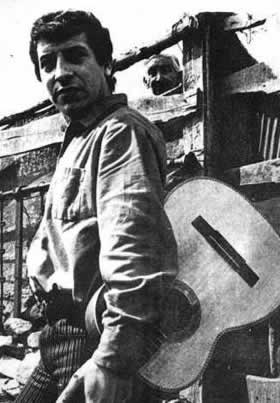
At an unknown time on this evening in 1973, or else the early hours of the following day, Chilean putschists ushering in the Pinochet dictatorship machine-gunned folk singer Victor Jara near the Santiago stadium that today bears his name.
“I don’t see why we need to stand idly by and let a country go communist due to the irresponsibility of its own people,” said Henry Kissinger of Allende’s election. Victor Jara had another idea.
Four days before, Chile’s September 11 had seen General Augusto Pinochettopple the elected leftist government of Salvador Allende, murdering the president in his palace. (Or, go some accounts, Allende committed suicide — “pausing only twice to reload.”)
A long pall of evil settled over the country, with all the accustomed chilling familiars: “disappeared” people, mirrored shades, Jeane Kirkpatrick.
The day after the CIA-backed coup, popular folk singer and activist Victor Jara, a pioneer of the Nueva Cancion (“New Song” movement) then teaching at Santiago’s Technical University, was among thousands of undesirables rounded up and packed off to a makeshift prison camp at the city’s Chile Stadium — a stadium Jara had performed at.*
Left there to the tender mercies of a thuggish Chilean officer, Jara was beaten and tortured over the intervening days — evocative but possibly undependable tradition holds that the guitarist’s hands were cut off, shattered or otherwise destroyed. According to the U.S.-based United States Institute of Peace,
[t]he the last day Víctor Jara was seen alive was September 15. During the afternoon he was taken out of a line of prisoners who were being transferred to the National Stadium. In the early morning of the next day, September 16, shantytown dwellers found his body, along with five others, including that of Littré Quiroga Carvajal, near the Metropolitan Cemetery. As the autopsy report states, Víctor Jara died as a result of multiple bullet wounds (44 entry wounds and 32 exit wounds).
The Commission came to the conviction that he was executed without due process of law by government agents, and hence in violation of his fundamental human rights.
To say the least.
And as the text implies, Jara was only the most recognizable name among unknown hundreds killed as the military cemented its control of the country.
Jara remains larger-than-life martyr figure in Latin America and liberation movements worldwide, but he’s almost unknown north of the Rio Grande. Pinochet was our bastard; in the weird way history writes its own geography, Jara became a political emblem behind the Iron Curtain for the perfidy of the capitalist powers: obscure in Peoria, but a household name in Potsdam, as the credit roll from this 1978 East German film suggests.**
That’s Jara himself on the soundtrack, of course. The pat conclusion for such a figure is that his art is his legacy, and that Jara’s body of work as against Pinochet’s will be a walkover in posterity. Is that enough? Pinochet died in his bed at age 91; earlier this year, the Jara case was closed in underwhelming fashion. Thirty-five years down the road, most authors of Pinochet’s human rights depredations are dead or lost or decrepit. Justice delayed is justice denied.
Victor’s widow, Joan Jara — today director of the Fundacion Victor Jara (it’s a Spanish-only site); you can hear her interviewed on Democracy Now! for the 25th anniversary of her husband’s death in 1998 — managed to leave the country with some of his works.
Her publication of a poem he wrote while imprisoned, an untitled, unfinished work generally known as “Estadio Chile,” made it a signature cry of hope amid desperation. Here it is in the Spanish rough-hewn under the shadow of death; there’s an English translation here.
Somos cinco mil
en esta pequena parte de la ciudad.
Somos cinco mil
¿Cuantos seremos en total
en las ciudades de todo el pais?
Solo aqui, diez mil manos que sembran
y hacen andar las fabricas.
¡Cuanta humanidad
con hambre, frio, panico, dolor
presion moral, terror y locura!
…¡Y Mexico, Cuba y el mundo?
¡Que gritan esta ignomonia!
Somos diez mil manos menos
que no producen.
¿Cuanto somos en toda la Patria?
La sangre del companero Presidente
golpea mas fuerte que bombas y metrallas.
Asi golpeara nuestro puno nuevamente.
¡Canto que mal me sales
cuando tengo que cantar espanto!
Espanto como el que vivo
como el que muero, espanto.
De verme entre tanto y tantos
momentos de infinito
en que el silencio y el grito
son las metas de este canto.
Lo que veo nunca vi,
lo que he sentido y lo que siento
hara brotar el momento…
Whether or not it’s enough, his work is his legacy after all.
* Some 7,000 people were held at Chile Stadium in the days after the coup, most later moved in with other detainees at the larger Estadio Nacional. The USIP excerpt alludes to Jara being pulled out for execution during such a move.
** In a similar vein, Stanford has a small online exhibit of Jara-themed East German propaganda art. Not to be outdone, there’s a Soviet rock opera about Jara, and an asteroid discovered by a Soviet astronomer was named in Jara’s honor within a week of his execution.
A short-drop strangulation is not the way you’d want to go. It turns out, though, that Steven Spielberg (ever the sentimentalist) seriously tidied up the proceedings.
As you watch the video of the real Amon Goeth’s exit below — and it’s a snuff film, so proceed advisedly — consider the following:
Amon Goeth does bear a passing fair resemblance to Ralph Fiennes.
To judge by their getup — dig the masks! — the executioners might have been Batman and Robin.
To judge by the discharge of their duties, the executioners might have been Larry, Moe and Curly. Goeth survived two drops (notice the executioner on the right gesticulating in frustration as the second try fails) before they finally got it right:

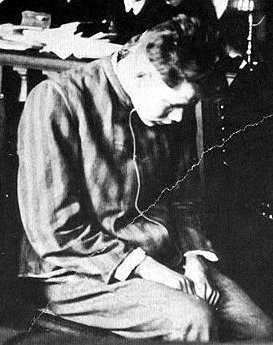 Van der Lubbe, who was arrested on the scene, suffered the predictable fate. Four other Communists charged as accomplices were acquitted, in a trial with the gratifying spectacle of Hermann Goering personally testifying, and being undressed on cross-examination by one of the reds. One is reminded here that Hitler did not yet have everything in the state apparatus at his beck and call … although he did have a great deal already, inasmuch as the arson law under which van der Lubbe died was passed after the Reichstag fire and made retroactive.
 Now, it was running out of patience with the country’s president,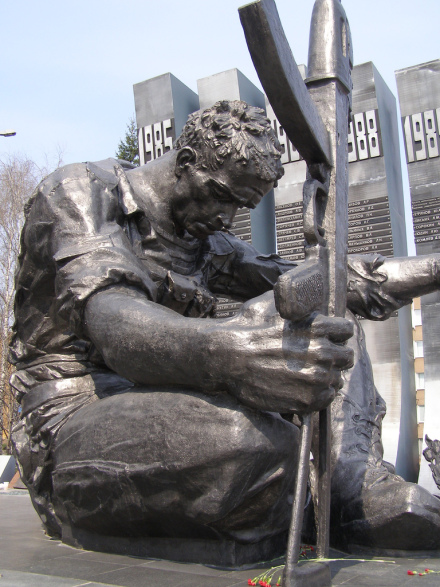

 In March 1939, Germany reneged its part of the bargain and
  Over several chaotic days of