1942: Lodz ghetto “Children’s Action” begins

(Thanks to Meaghan Good of the Charley Project for the guest post. -ed.)

Between September 5 and September 13 was the great deportation of vulnerable individuals from the Lodz Ghetto, one of the largest Nazi ghettos in Europe.

The 150,000-odd Jews within had starved, slaved and suffered for nearly two years, but what came next was almost too much to bear. The Nazis demanded that Mordechai Chaim Rumkowski,* the ghetto’s controversial chairman, turn over 20,000 non-working people for deportation, including the elderly and all children under the age of ten.

Those two groups constituted only 13,000 people altogether, so the gap had to be filled with the sick. The police and other Jewish authorities in the ghetto would have a chance to round up the deportees themselves. If they didn’t accomplish this, the Germans would do it themselves.

Rumkowski’s policy had always been one of accomodating to the Nazis’ demands and appeasing them with the goal of saving as many Jews as possible. He didn’t deviate from his plan even in this instance, and tried to explain himself to the ghetto population in an electrifying speech on September 4:

A grievous blow has struck the ghetto. They are asking us to give up the best we possess — the children and the elderly. I was unworthy of having a child of my own, so I gave the best years of my life to children. I’ve lived and breathed with children, I never imagined I would be forced to deliver this sacrifice to the altar with my own hands. In my old age, I must stretch out my hands and beg: Brothers and sisters! Hand them over to me! Fathers and mothers: Give me your children! […] I must perform this difficult and bloody operation — I must cut off limbs in order to save the body itself. I must take children because, if not, others may be taken as well — God forbid.

I have no thought of consoling you today. Nor do I wish to calm you. I must lay bare your full anguish and pain. I come to you like a bandit, to take from you what you treasure most in your hearts! I have tried, using every possible means, to get the order revoked. I tried — when that proved to be impossible — to soften the order. Just yesterday, I ordered a list of children aged 9 — I wanted at least to save this one aged-group: the nine to 10-year-olds. But I was not granted this concession. On only one point did I succeed: in saving the 10-year-olds and up. Let this be a consolation to our profound grief.

There are, in the ghetto, many patients who can expect to live only a few days more, maybe a few weeks. I don’t know if the idea is diabolical or not, but I must say it: “Give me the sick. In their place we can save the healthy.” I know how dear the sick are to any family, and particularly to Jews. However, when cruel demands are made, one has to weigh and measure: who shall, can and may be saved? And common sense dictates that the saved must be those who can be saved and those who have a chance of being rescued, not those who cannot be saved in any case. […]

Although it was never explicitly stated, the beaten-down, demoralized Lodz Jews harbored few illusions about the fate of deportees; most of them knew by now that deportation meant death.

Naturally there were cries of protest. People in the crowd suggested alternatives. They should all go together. Parents’ only children should not be taken; children should only be taken from families who had several. Rumkowski would have none if it:

These are empty phrases! I don’t have the strength to argue with you! If the authorities were to arrive, none of you would be shouting! I understand what it means to tear off a part of the body. Yesterday, I begged on my knees, but it did not work. From small villages with Jewish populations of 7000 to 8000, barely 1000 arrived here. So which is better? What do you want? That 80,000 to 90,000 Jews remain, or God forbid, that the whole population be annihilated? I have done and will continue doing everything possible to keep arms from appearing in the streets and blood from being shed. The order could not be undone; it could only be reduced.

One needs the heart of a bandit to ask from you what I am asking. But put yourself in my place, think logically, and you’ll reach the conclusion that I cannot proceed any other way. The part that can be saved is much larger than the part that must be given away!

In short, Rumkowski believed that only by cooperating with the German orders could he prevent even more lives from being lost.

He did have a point: The chairman of the Warsaw Ghetto, when faced with a similar deportation order, had committed suicide, and, as the Jewish authorities dragged their feet, the Nazis stepped in and, with much terror and bloodshed, forcibly deported close to 300,000 people over the course of six weeks. Resistance in Warsaw had made no appreciable difference in the death toll.

During the days that followed Rumkowski’s announcement, a general curfew was implemented and everyone was ordered to remain in their homes while the German SS and authorities, assisted by the Ghetto police and fire department (whose own families were exempted from the deportation) went from house to house to select their victims. The orphanages and old age homes were emptied, and Rumkowski himself supervised this to make sure no one was left behind.

People worked desperately to try to save themselves and the families. They knew the Germans would not be picky, would not be closely checking birth records or doctors’ certificates; it was enough for someone to simply look old or sick or very young.

Older men and women darkened their gray hair with coffee. Sick people dragged themselves out of bed and used makeup to brighten their faces. Children tried to hide, with their parents’ help, as Gordon J. Horwitz described in his book
Ghettostadt: Lodz and the Making of a Nazi City:

Some children hid in furniture and bedding, others in basement, in heaps of garbage and laundry, or in woodpiles. Parents did whatever they could, concealing children “in barrels in the attics, in ditches in the field, covered with leaves and branches.” One child sought refuge in a tree but was shot dead when discovered. Another, thanks to his father’s efforts to fashion an unusual hideout, rode out the danger concealed in a chimney on the roof. Though isolated and abandoned by the time they had been assembled in the collection area, child captives fought and scratched at the walls in a last-ditch effort to resist removal.

One teenage girl, after many attempts, managed to escape the assembly point and hid inside a mattress until it was safe to come out. Six-year-old Sylvia Perlmutter, whose experiences were fictionalized in her niece’s verse novel Yellow Star, hid in the cemetery.

Most of these efforts were in vain, however.

The search was thorough and the hunters ruthless. On September 13, the Nazis announced that the deportation was over. The survivors could resume their daily lives. It was not as bad as it could have been; 20,000 were not taken, after all. 15,859 people had been packed into trains, taken to the Chelmno Extermination Camp and killed. A further 600 had been shot within the ghetto itself.

For a long time after this, there were no more deportations. The ghetto inhabitants, although many of them continued to perish from starvation, overwork and disease, dared to hope that perhaps the Nazis would let them survive as long as they worked. But in the end, they didn’t escape: in August 1944, with the approaching Russian Army just 60 miles away, the entire ghetto population was deported to Chelmno and Auschwitz. An overwhelming number, including Chairman Rumkowski, perished.

* It was an open secret that Rumkowski was a pedophile who sexually abused the children in his charge both before and during the war. See Lucille Eichengreen’s Rumkowski and the Orphans of Lodz, and Edward Reichter’s Country of Ash.

On this day..

1936: Aboune Petros, Ethiopian bishop

On this date in 1936, the Italian forces occupying Ethiopia executed anti-occupation cleric Aboune Petros.

War on Ethiopia had been Benito Mussolini‘s monument to muscular Italian nationalism.

By May of 1936, it had forced Haile Selassie into exile and established control of the country. Mission accomplished!

At last Italy has her empire.

-Mussolini

As is often the case, the war of conquest instead transmogrified into a war against continuing resistance to foreign military occupation, and the colony of Italian East Africa was a short-lived and bloody affair.

The Duce will have Ethiopia, with or without the Ethiopians.

-Italian Gen. Rodolfo Graziani

(Though the progressive counterpart to Italy’s iron-fisted approach to troublemakers was monumental construction, and 1930s-era fascist architecture is still to be seen in Addis Ababa today.)

Ethiopian Orthodox patriarch Aboune — it’s a title that can also be rendered Abuna or Abune — Petros cut a public profile a little too sympathetic to the native subversives. When the Italians demanded that he tone it down, he replied (according to a hagiography that appears several places online),

The cry of my countrymen who died due to your nerve-gas and terror machinery will never allow my conscious to accept your ultimatum. How can I see my God if I give a blind eye to such a crime?

On July 28, Italians repelled a large* Abyssinian insurgent attack by the sons of Ras Kassa between Addis Ababa and Petros’s stomping-grounds of Dessie; the next day, Petros was escorted to an abrupt martyrdom to the mirroring causes of national self-determination and anti-insurgency realpolitik.

His sacrifice is commemorated in statuary as well as a couple of notable theatrical pieces, Yedam Dems (The Voice of Blood) by Makonnen Endalkachew** and Petros Yachin Saat (Petros At That Hour) by Tsegaye Gebre-Medhin.

* On the scale of thousands. It “showed a certain tenacity,” according to the London Times‘ droll Rome correspondent in a July 30 story.

** Not the same guy as the post-colonial Prime Minister who was executed in a 1974 purge.

On this day..

1940: Tirailleurs Senegalais, for France

On this date in 1940, German forces even then completing their rout of France — the humiliating capitulation was mere hours away — massacred a detachment of African soldiers who mounted a doomed resistance at Lentilly.

Tirailleurs Senegalais were recruited not only from Senegal but from throughout France’s domains in sub-Saharan Africa. (There were also Algerian, Tunisian, and Moroccan tirailleurs.)

Though these soldiers’ own lands were occupied, they were instrumental to defending the freedom of their occupier on European soil: over half a million African tirailleurs are thought to have served les couleurs in the two World Wars, and died in all the horrible ways those slaughterhouses could devise.

In 1940, black troops represented some 9% of the French army, a fact pilloried in German nationalist proaganda.

It’s hardly a surprise that the black man couldn’t catch a break from skull-measuring Aryan race warriors, but then, France too had its own less than comfortable relationship with these dark-hued citizens summoned from distant villages to bleed in the trenches of Europe. The military’s official guidelines emphasized (French link) the “Senegalese’s” special value as cannon fodder.

If a sacrificial mission is necessary, a defense to the death to provide cover for forces to regroup, appeal to the valor of the black fighter.

On the other hand, French authorities put up a monument to black soldiers in the aftermath of World War I. (The occupying Nazis vengefully dismantled it.) Such are the contradictions of colonialism.

Racial reservations notwithstanding, colonial troops were employed throughout the army if for no other reason than that they constituted nearly the tenth part of that army.

Their service record naturally included (French pdf) the over-before-it-started French defense against the Nazi blitz in 1940.

In this instance, knowing full well that the campaign was lost, French officers flipped open the “sacrificial mission” playbook and ordered their African charges to oppose a German march near Lyon “without thought of retreat.”

Since victory was equally out of the question, that left death. Wehrmacht troops duly prepared by Nazi racial typecasting to see their foes as savages were all too ready to wipe out African troops they greatly outclassed.


A monument to the Tirailleurs in Lentilly, France. Image (c) filoer and used with permission.

The Lentilly cemetery “Tata”, final resting place of 188 Senegalese riflemen who died under German artillery or were massacred after the battle by the 3rd SS Division Totenkopf June 19 and 20. Image (c) filoer and used with permission.

For more on the tirailleurs, there’s an extensive French-language blog.

On this day..

1948: The condemned from the Doctors’ Trial

On this date in 1948, seven SS men were hanged at Germany’s Landsberg Prison, condemned for war crimes and crimes against humanity in the so-called Doctors Trial.

Four of the hanged were doctors; three were non-physicians who assisted them. Their trial (which included 16 others, variously acquitted or sentenced to prison terms) by an American military tribunal was a conscious attempt to establish criminal responsibility among the medical profession.

As prosecutor Telford Taylor* said in his opening statement.

To kill, to maim, and to torture is criminal under all modern systems of law. These defendants did not kill in hot blood, nor for personal enrichment. Some of them may be sadists who killed and tortured for sport, but they are not all perverts. They are not ignorant men. Most of them are trained physicians and some of them are distinguished scientists. Yet these defendants, all of whom were fully able to comprehend the nature of their acts, and most of whom were exceptionally qualified to form a moral and professional judgment in this respect, are responsible for wholesale murder and unspeakably cruel tortures.

It is our deep obligation to all peoples of the world to show why and how these things happened. It is incumbent upon us to set forth with conspicuous clarity the ideas and motives which moved these defendants to treat their fellow men as less than beasts.

One of several war crimes trials after the big Nuremberg Tribunal (and held in the same courtroom), the Doctors Trial dealt with the Third Reich’s Frankenstein lab of medical experimentation.

Some of this was combat-related. How long can a downed pilot survive in the North Sea? Throw a POW into freezing water and find out.

Some was more conventional medical advancement, shorn of any ethical sense. How can we treat malaria? Inject some untermenschen and start testing.

And some of it was straight from the Nazis’ racial purification theology: euthanizing the disabled, castrating and murdering Jews and Gypsies, that sort of thing. It’s all a rich tapestry.

The doctors hanged this date included

  • Karl Brandt, Hitler’s personal physician and the co-director of the Aktion T4 euthanasia program**
  • SS hygienist Joachim Mrugowsky, for experiments with concentration camp prisoners
  • SS surgeon and German Red Cross head Karl Gebhart, who enjoyed experimenting with operations on unanaesthetized prisoners
  • Waldemar Hoven, chief doctor at Buchenwald

They kept company with three others who didn’t see the “patients” but pushed around the paper for those who did.

Many of this day’s scaffold clientele died unrepentant; Karl Brandt harangued at such length that the hood was put over his head mid-sentence to move proceedings along.

Landsberg Prison was a fitting site for their expiation. As the New York Times reported (June 3, 1948)

The men died on two black gallows erected in the courtyard of the prison where Hitler wrote “Mein Kampf” while confined after his 1923 Munich putsch.

* In 1970, Telford wrote Nuremberg and Vietnam: An American Tragedy, arguing that American officials had committed war crimes in Vietnam because “we failed ourselves to learn the lessons we undertook to teach at Nuremberg.”

Telford died in 1998, so his commentary on the accountability-free torture of the modern war machine is unavailable.

** Karl Brandt was actually condemned to death by a Nazi court in the closing days of the war and only narrowly avoided execution. His crime? Moving his family out of Berlin so that they could surrender to the Americans instead of the Russians.

On this day..

1945: Friedrich Fromm, Claus von Stauffenberg’s executioner

On this date* in 1945, Friedrich Fromm found out that you have to pick a side.

The cunning career army officer had been serving as the head of the Replacement Army.

This position provided access to the Fuhrer for Fromm — and for his chief of staff, Col. Claus von Stauffenberg. And it gave his office the authority to issue the “Valkyrie” orders for quelling civil unrest that Stauffenberg’s circle would use to attempt to seize Berlin.

Fromm realized that his underling was involved in a plot against the Nazi dictator, but neither joined it nor smashed it.

This play-it-safe approach turned out not to be safe at all. When Stauffenberg’s attempt to assassinate Hitler failed, Fromm hastily attempted to cover his tracks by summarily executing Stauffenberg and co-conspirators.

Not all that subtle, really. “You’ve been in a damned hurry to get your witnesses below ground,” Joseph Goebbels sneered.

Heinrich Himmler quickly had Fromm arrested. “Fate does not spare the man whose convictions are not matched by his readiness to give them effect,” wrote July 20th conspirator Hans Speidel. (As cited by Shirer.)

Although in Friedrich Fromm’s case, that wasn’t entirely true.

In recognition of the general’s calculated but not-unhelpful show of loyalty on the decisive date (enacted when Fromm realized the plotters had made a dog’s breakfast of everything) Hitler generously permitted the general to be “honorably” shot … rather than strangled from a meathook.

* Some sources give March 12, rather than March 19. I have been unable to establish primary documentation, but the sites for March 19 are far more numerous. (Years-later update: I probably got this wrong. I’d be better inclined to believe March 12.)

On this day..

1942: Boris Vilde, linguist

On this date in 1942, Estonian linguist and ethnographer Boris Vilde was shot with his French Resistance circle at Fort Mont-Valerien.

St. Petersburg-born, Estonian-raised, the young scientist came to Paris at age 25 (French link) with his life in a backpack.

In the eight short years remaining to him before he gave his life for his adopted land’s anti-Nazi resistance, Vilde cofounded the Paris Musee de l’Homme. (When visiting, be sure to look for the skull of Suleiman al-Halabi, a Syrian executed for assassinating one of Napoleon’s Egyptian officers in 1800.)

It says here that Vilde even imported the French word “resistance” into Estonian.

Boris knew whereof he spoke.

His Musee de l’Homme group recruited scientists and intellectuals and published anti-fascist propaganda.

When the Vichy government infiltrated it and had its principals condemned, one of Vilde’s compatriots is said to have bellowed at the firing squad at the last moment,

Imbeciles, it’s for you, too that I die.

On this day..

1945: Denise Bloch, Lilian Rolfe and Violette Szabo

On or about this date in 1945, three women who had been caught behind German lines working for the British Special Operations Executive were shot at Ravensbruck.

Left to right: Denise Bloch, Lilian Rolfe, Violette Szabo.

Denise Bloch, Lilian Rolfe, and Violette Szabo were all fluent young Francophones who volunteered their services for Britain’s dangerous spying-and-sabotage operations in support of the French Resistance.

Bloch and Rolfe were wireless operators; Szabo, the most famous of the three, got her hands dirtier with explosives and sabotage.

One evening towards 1900 hours they were called out [of the punishment block] and taken to the courtyard by the crematorium. Camp Commandant Suhren [German Wikipedia link] made these arrangements. He read out the order for their shooting in the presence of the chief camp doctor, Dr. Trommer, SS Sergeant Zappe, SS Lance Corporal Schult, SS Corporal Schenk, and the dentist Dr. Hellinger

All three were very brave, and I was deeply moved. Suhren was also impressed by the bearing of these women. He was annoyed that the Gestapo did not themselves carry out these shootings.

Extensive and illustrated biographies on all three, as well as other SOE agents, can be found at 64 Baker Street: Bloch; Rolfe; Szabo.

Violette Szabo in particular was much written-of after the war (long out of print, the classic Carve Her Name With Pride was recently republished), and was posthumously awarded a variety of decorations by both England and France.

Szabo has what looks to be a charming museum in Herefordshire (phone ahead to Miss Rigby before visiting!); for a younger generation, she’s the inspiration behind “Violette Summers”, the protagonist of the video game Velvet Assassin.

On this day..

1942: Eleven members of the Red Orchestra

On this date in 1942, eleven members* of a Berlin-based anti-Nazi resistance circle were executed at Plotzensee Prison — five by hanging, six by guillotine.

These members of the group organized around leftist Luftwaffe communications officer Harro Schulze-Boysen and intellectual Arvid Harnack were one of three Soviet intelligence nodes all of whom were confusingly designated Die Rote Kapelle.

That designation, assigned by Nazi intelligence rather than the networks themselves, has basically stuck and colored their postwar reputation with the anti-Communist politics of the Cold War.


Red affiliations that blackened Die Rote Kapelle’s memory west of the Berlin wall were more readily embraced by the Warsaw Pact. This East German stamp also honors John Sieg, a member of the circle who committed suicide upon his arrest.

And not only in retrospect: according to Gerald Reitlinger, the capture of known lefties misbehaving became the occasion of a McCarthyesque freakout full of internal political score-settling among the Nazis.

The affair of Burgess and Maclean will give some idea what capital can be made when someone with a leftish record enters and betrays a position of trust. The emotions roused are out of all proportion to the things that have been betrayed. [German military intelligence chief Wilhelm] Canaris declared that the conspiracy had cost the lives of 200,000 German soldiers.

While the cells in France/Belgium and Switzerland also covered by the “Red Orchestra” designation look like straight NKVD espionage operations, the Berliners were apparently more of a loose network of civilian dissidents who got pulled into (amateurish) spying as a part of their variety of quixotic protests from the very citadel of the Third Reich. When not nicking sensitive documents from Schulze-Boysen’s day job and haplessly attempting to ship them to the Russians, they made futile White Rose-like gestures of conscience, like anti-Nazi placarding under the cover of darkness, and more calculated stuff, like collecting war crimes evidence in the hopes of indicting their perpetrators after the war.

Well, what is one supposed to do as an anti-Nazi in Berlin in 1941?

And what if one is in a position to answer that question with, “provide effectual aid to the enormous army poised to destroy Hitler”?

Anne Nelson’s Red Orchestra: The Story of the Berlin Underground and the Circle of Friends Who Resisted Hitler (review | another) attempts to rehabilitate the Berlin circle from postwar red-smearing and underscore the everyday-ness of the participants (not all of them politically left) and the courage of their respective decisions to oppose Hitler actively.

Nelson’s book is new, but her argument is not unique.

Other books also titled Red Orchestra (Perrault, Tarrant | review of both) more strongly emphasize the commie-taskmaster dimension in what by any standard is thrilling real-life fare.

The German Resistance Memorial Center has salutes to the Red Orchestra’s members, networks and activities.

* Arvid Harnack’s American wife Mildred, initially condemned only to a prison term for her part in the Orchestra, had her sentence upgraded and followed her comrades’ fate on February 16, 1942.

On this day..

1944: Georges Suarez, collaborationist editor

On this date in 1944, the restored French Republic shot the editor of the collaborationist newspaper Aujourd’hui (Today).

Suarez‘s (linked page in French) writings (French again) had endorsed the German occupation and called for steps even beyond what the Germans were prepared to take: the wholesale taking of Anglo hostages as proof against Allied bombing raids, for instance.

His trial and execution were the first of many suffered by pro-Vichy writers and journalists condemned by the vengeful free French courts for their part in the Nazi occupation, especially in the first months after liberation. The public intellectuals of the wartime government were, as a matter of fact, in the dock faster than the government itself.

Alice Kaplan, writing of the more infamous collaborationist writer Robert Brasillach who would follow Suarez’ footsteps in a few weeks, observes:

Writers were easy to try. Their files, crumbling now, are rather thin: clippings of their articles from the collaborationist press, underlined in red and blue ink with an occasional commentary; a report by the prefecture of police outlining their political affiliations and behavior during the Occupation; a list of witnesses called by the defense and the prosecution; interviews of the accused, before the trial, going over the charges against him; letters from friends — and enemies — sent to the judge before the trial. It was easier to organize a case against a journalist than a case against a common-law criminal or a financial collaborator. The bulk of the evidence was in newspaper clippings, quickly compiled.

“Treason is a matter of dates,” Suarez’ lawyer averred, channeling Talleyrand. But at this early date of freedom, not six months after Omaha Beach had been wrenched from German hands, there was much less sympathy for the philosophic vagaries of history than some subsequent writers would enjoy — and there was a good deal of indictable behavior:

Whether they faced the charge of treason or of national indignity, the writers were accused of having espoused numerous elements of Nazi ideology: anti-communism; anti-Semitism; support for the releve (the system designed to send French workers to Germany in exchange for French POWs); support for the Milice (Vichy’s police force); support for the German and French troops fighting the Soviets on the Eastern front; attacks against de Gaulle and the Resistance; participation in collaborationist organizations; trips to Germany during the Occupation, in particular to the International Writers’ Congress at Weimar in 1941.

Philip Watts, Allegories of the Purge

In addition to its noteworthy history in the postwar purge of journalists, Kaplan reports that Suarez’s trial may also have been the first in French history for which women were eligible to serve as jurors — although none of the women in the jury pool were ultimately seated, and the milestone seems not to have been widely noticed even at the time.

The execution itself was badly botched: Suarez is said to have survived both the initial fusillade and a second barrage from the firing squad before a third round finished him off.

On this day..

1941: Masha Bruskina, Kiril Trus, and Volodia Shcherbatsevich, partisans

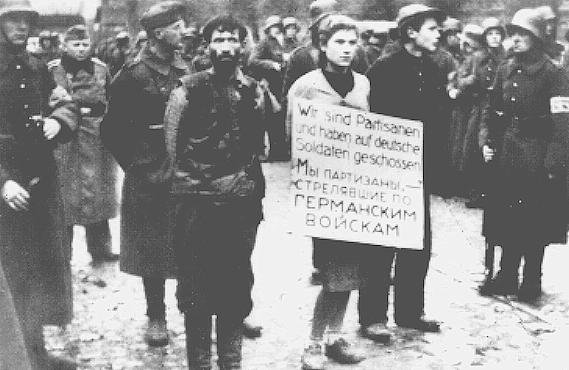
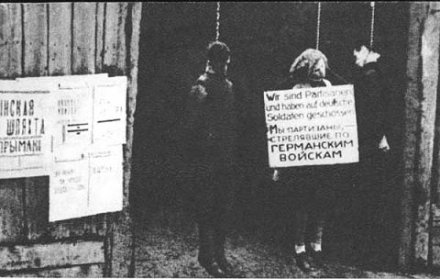
On this date in 1941, the German occupiers of Minsk conducted an infamous public hanging of partisans — perhaps the first such salutary public execution of resistance members of the war.

Jewish* 17-year-old Maria (Masha) Bruskina was the central figure of the grim tableau, and wore the placard announcing “We are partisans and have shot at German soldiers.” Evidently, she also attracted the most attention** from the onlookers to whom the scene was addressed.

Before noon, I saw the armed German and Lithuanian soldiers appear on the street. From over the bridge they escorted three people with their arms tied behind their backs. In the middle there was a girl with a sign-board on her chest. They were led up to the yeast factory gate. I noticed how calmly these people walked. The girl did not look around … The first one led to the gallows was the girl.

She was hanged with bewhiskered World War I vet Kiril Trus and the 16-year-old Volodia Shcherbatsevich. The men were members of a partisan cell organizing anti-fascist resistance; Masha Bruskina was a nurse who had been caught aiding the partisans by providing civilian clothes and papers for wounded Red Army soldiers under her care to smuggle them back to the resistance.

The scene of their deaths was captured in a series of powerful photographs taken by one of the Lithuanian Wehrmacht collaborators.

(More images here and here.)

* Phototextualities: Intersections of Photography and Narrative claims that Bruskina lightened her hair and changed her name to prevent her Jewishness affecting her resistance work; even though she was a Minsk native, her initial identification didn’t happen until 1968. The men who suffered with her were named almost immediately after the war.

** Despite the eye-catching place of the girl, she was officially unidentified for decades even after the name Masha Bruskina surfaced. In “A Historical Injustice: The Case of Masha Bruskina,” (Holocaust Genocide Studies 1997, 11:3) Nechama Tec and Daniel Weiss argued that Soviet authorities, and later Belarusian ones, found her Jewishness problematic and resisted identifying her because of it — while an ethnically Russian female partisan like Zoya Kosmodemyanskaya could be more conveniently accepted as a heroine. Maybe, but bureaucratic inertia and simple precedence (since Zoya Kosmodemyanskaya was known immediately while Masha Bruskina was not) are also plausible contributing factors.

A plaque unveiled at the Minsk yeast factory in 2009 finally called her Maria Bruskina.

On this day..