1793: Olympe de Gouges, a head of her time

On this date in 1793, Olympe de Gouges’ forward thoughts were removed from her shoulders in the Place de la Revolution.

Most recognizable today for her Declaration of the Rights of Woman and the Citizen* — a proto-feminist call for equality of the sexes issued in response to the day’s revolutionary but guy-centric Declaration of the Rights of Man and of the Citizende Gouges was much more than a one-issue woman.

Fully engaged with the liberal intellectual currents of the Enlightenment, de Gouges spent the 1770’s and 1780’s in Parisian salon circles cranking out plays (over 40) and petitions, pamphlets and manifestos on animal welfare, poverty, the treatment of orphans, and ending slavery.

The latter issue, and not women’s rights, was the cause her contemporaries would have most associated with her.

But the natural-born gadfly didn’t pick her battles with injustice, and the Terror was a bad period to be indiscriminate. Like some of her Girondist associates, she risked the Paris mob’s wrath by openly opposing Louis XVI‘s execution — right in character, Olympe was down on the whole idea of the death penalty — and she carried principle into foolhardiness by printing broadsides savaging Robespierre.

Show trial time.

There can be no mistaking the perfidious intentions of this criminal woman, and her hidden motives … calumniating and spewing out bile in large doses against the warmest friends of the people, their most intrepid defender.

Misogynist condescension veined the prevailing interpretation of this misbehavior.

Olympe de Gouges, born with an exalted imagination, mistook her delirium for an inspiration of nature. She wanted to be a man of state. She took up the projects of the perfidious people who want to divide France. It seems the law has punished this conspirator for having forgotten the virtues that belong to her sex.

And strange to say, that condescension outlived Robespierre by centuries.

Only recently, as mainstream thought has (sort of) caught up with de Gouges, has the scope of her work (French link) attracted renewed appreciation, and Olympe been acknowledged an Olympian herself.

* Article 10: “Woman has the right to mount the scaffold; she must equally have the right to mount the rostrum.” The work was dedicated to Marie Antoinette.

On this day..

1793: The Girondists

On this date in 1793, in a revolutionary Paris where the machinery of the Terror was clattering to life, five tumbrils bore to the guillotine twenty former Girondist ministers to the National Convention — plus the corpse of their late colleague Dufriche de Valazé, who had cheated the executioner by killing himself.

Named for the region of Aquitaine from which their leading lights hailed, the Girondists (or Girondins) had in the compressed history of the Revolution ascended from fringe democratic party to governing party even as the political facts shifted under their feet. Finding themselves the conservative party in an assembly increasingly dominated by radical Montagnards and the Paris mob, the Girondists’ tactlessness and stubborn refusal to deal with Georges Danton after his (still historically murky) involvement in the riotous slaughter of prisoners during the September Massacre eroded their position.

As the terrible year of 1793 unfolded, the Girondins discovered themselves successively overthrown, expelled from the Convention, proscribed, and hunted. Though many more — Girondists and others — were to follow in their steps, the trial of these 21 before the Revolutionary Tribunal and subsequent guillotining, the first notable mass-execution of the Revolution, raised the curtain on the Terror.


L’ultime adieu des Girondins le 31 Octobre 1793, by Paul Delaroche

Decades later, the English historian Lord Acton remembered the faction’s doomed heroism.

[The Girondins] stood four months before their fall. During that memorable struggle, the question was whether France should be ruled by violence and blood, or by men who knew the passion for freedom. The Girondins at once raised the real issue by demanding inquiry into the massacres of September. It was a valid but a perilous weapon. There could be no doubt as to what those who had committed a thousand murders to obtain power would be capable of doing in their own defence.

Almost to the last moment Danton wished to avoid the conflict. Again and again they rejected his offers. Open war, said Vergniaud, is better than a hollow truce. Their rejection of the hand that bore the crimson stain is the cause of their ruin, but also of their renown. They were always impolitic, disunited, and undecided; but they rose, at times, to the level of honest men.

They were easily beaten and mercilessly destroyed, and no man stirred to save them. At their fall liberty perished; but it had become a feeble remnant in their hands, and a spark almost extinguished. Although they were not only weak but bad, no nation ever suffered a greater misfortune than that which befell France in their defeat and destruction.

That Pierre Vergniaud who scorned the hollow truce was the last to mount the scaffold this day — a shining orator of the Revolution who captured the calamity engulfing his nation in another well-remembered aphorism, “the Revolution devours its own children.”

On this day..

1793: Marie Antoinette

This afternoon in Paris, 1793, the French Revolution devoured the Queen.

Thirteen-year-old Madame Antoine — a year before marriage, and rebranding as Marie Antoinette. A vast gallery of her portraiture awaits here.

Among the most emblematic death penalty victims in history, Marie Antoinette — the “widow Capet,” as she was styled in egalite, after the guillotine shortened her husband — had the bad luck to personify the decadence of the ancien regime under the hegemony of the sans-culotte.

(And, of course, the good luck to be born heir to all the perks of absolutism she enjoyed for the first thirty-plus years of life. So, you know: a mixed bag.)

Those infamous excesses — and her infamous alleged bon mot, “let them eat cake” — are said to have been greatly exaggerated, nothing that everyone wasn’t doing, nothing that wasn’t understandable under the circumstances.

She had a gift, it seems, for accumulating to her personal reputation the outrage incurred by every gross and petty indulgence of the old order. And she had a popular press, the libelles, ready to embroider them salaciously.

Poor Marie.

Jacques-Louis David sketched this portrait of a haggard Marie Antoinette en route to the guillotine.

Cruel, wanton, senseless … her death was all of these, but then many others in the Terror suffered the same, as many others had under the Bourbons.

As royal dynastic pairings go, she’d been dealt a bad hand.

Her mere presence in France was fruit of the controversial policy of alliance with the Austrian Habsburgs from the Seven Years’ War, and she was trundled off with her dowry and her teenage wiles to the foreign snakepit of Versailles just as the minister advancing that policy fell. Distrusted by the French as an Austrian catspaw, castigated by her family for her inadequacies thereto, socially expected to display conspicuous regal largesse during a budget crisis not of her making, and unable for the longest time to get a successful coition from her indifferent and/or impotent husband, it must have seemed to her some days like every play was a losing one.

She struggled to gain traction at court. But she would lose much more than influence.

I was a queen, and you took away my crown; a wife, and you killed my husband; a mother, and you deprived me of my children. My blood alone remains: take it, but do not make me suffer long. (WikiQuote)

Her bearing she kept forever: in a kangaroo court with a foreordained outcome where her imperious dignity still managed to turn aside an accusation of sexual abuse her son had been cajoled into supplying; on the scaffold, when she did not neglect courtesy to the executioner whose foot she trod:

“Monsieur, je vous demande pardon. Je ne l’ai pas fait exprès.”

For much more queenliness, Marie-Antoinette.org delivers what the url promises, in quantity. If this figure or this period appeals, be sure to browse its forums.

Naturally, the doomed queen has had plenty of attention from printed word as well:

A few books about Marie Antoinette

As well as less, er, traditional media.

Part of the Themed Set: Belles Epoque.

On this day..

1795: Tula, Curacao’s Nat Turner

On this date in 1795, the slave whose rebellion had shaken the Dutch Caribbean colony of Curaçao was publicly tortured to death with his chief confederates.

The Landhuis Knip commands the plantation where Tula’s revolt began — the dark history behind the Dutch Antilles’ charming facade.

On August 17, 1795 Tula (English Wikipedia page | Dutch) launched a well-planned insurrection on the island, one of the major transit points in the Atlantic slave trade.

Inspired by the Haitian Revolution — and reasoning that, since France occupied the Netherlands, that whole Declaration of the Rights of Man thing ought to be trickling down to Dutch colonies — the rebels freed slaves plantation to plantation and quickly swelled near 1,000.

Of course, Jean-Jacques Rousseau aside, the slaves were also irate that they were damn slaves.

Although the outside forces of international geopolitics played a role in inspiring the 1795 revolt, slaves could find sufficient justification for insurrection in the domestic policies that Dutch planters employed to keep their slaves laboring in Curacao. The planters maintained a harsh regime in which many privileges that had traditionally been bestowed upon slaves had been removed in order to heighten productivity and increase plantation profitability. By 1795, most slaves were being forced to work on Sundays, which had generally been a day of rest in the past, and many planters hired their slaves out to maximize profits by exploiting their labor. It had also become customary for all of the slaves on a plantation to be punished in response to the offense that an individual slave among them had committed. (Source)

A priest was sent as envoy from the worried white community to the rebel encampment, with an offer of amnesty for submission.

Tula (sometimes surnamed as Tula Rigaud) and fellow leaders Bastiaan Karpata (or Carpata), Pedro Wakao (or Wacao) and Louis Mercier received him politely, hosted him overnight, and told him to get lost. This is Tula:

Father, do not all the persons spring from Adam and Eve? Was I wrong in liberating twenty-two of my brothers who were unjustly imprisoned? Father, French liberty was a disaster for us. Each time one of us is punished, we are told: “Are you also looking for your freedom?” One day I was arrested, and I begged mercy for a poor slave; when I was liberated, my mouth was bleeding. I fell on my knees and I cried to God: “O Divine Majesty, O Most Pure Spirit, is it Your will that we are ill-treated? Father, they take better care of an animal.”

And subhuman was the torture Tula, Karpata and Wakao* bore for their insistence on freedom when a fellow slave finally — inevitably? — betrayed them.

At a spot now commemorated by a beachfront monument, the three had their bones systematically shattered with an iron rod, their heads lopped off, and their bodies tossed into the sea. (Despite the metadata on this post, it wasn’t precisely “breaking on the wheel” — but the bone-shattering was pretty much the same idea.)

Curacao remains today a Dutch possession; slavery was abolished there in 1863. August 17, the dawn of these Dutch slaves’ inspiring and fatal revolt for freedom, is now honored on the island — and off it.

* It’s unclear to me whether Mercier, who was captured earlier, was also executed with the others, or whether Mercier’s sentence had already been carried out by this time.

On this day..

1792: Jacques Cazotte, occultist

On this date in 1792, Jacques Cazotte, a writer distinctly out of step with his times, was guillotined for treason in Paris.

The Martinique-born Cazotte (English Wikipedia entry | French) was into his 40s when he launched the writing career that earns him notice enough for this blog.

He wasn’t a liberte, egalite, fraternite kind of guy: Cazotte’s works, like Le Diable Amoureux (The Devil in Love),* were fantastical, Gothic — far from the rationalist fare of the Enlightenment.

And that wasn’t exclusively a literary posture.

Cazotte fancied himself gifted with prophecy — enthusiasts’ accounts have him prophesying the course of the Revolution — and preferred the mystical enlightenment of the illuminati to the Voltairean kind.** He viewed the onset of the French Revolution with horror.

When some scribblings to that effect were discovered in his papers, the mystical goose was cooked. The French Wikipedia entry credits his daughter with saving his life during the September Massacres … buying the 72-year-old only a few weeks of life.

Cazotte’s Le Diable Amoureux has the devil as a young man’s servant girl, endeavoring to seduce him. Here is Cesare Pugni‘s balletic rendition, Satanella, with its grand pas de deux, “Le Carnaval de Venise”:

Cazotte finds his way to us, as the dark arts are wont to do, through more meandering channels as well.

Le Diable Amoureux inspired supernatural mystery The Club Dumas by Spanish author Arturo Perez-Reverte. That novel in turn was riffed by Roman Polanski for the weird 1999 flick The Ninth Gate (review), starring Johnny Depp. (Cazotte’s book is explicitly referenced in both its progeny.)

Although only tangentially related, this digression into the occult gives us leave to notice one of the many cultural ephemera of executions linked to no particularly blog-friendly date. The Club Dumas and The Ninth Gate make use of striking woodcuts of modern vintage but after a style of centuries past that help unlock the central puzzle.

Charged with esoterica, the topical-looking “hanged man” print comes clearly modeled after its tarot cousin … although the tarot version, in most instances, is hoped to be of less deadly effect upon the plot.

* Available free in the original French at Project Gutenberg.

** Voltairean rationalism had its own ways of getting in trouble. It may have been an age of ideas, but it was hardly safe to have them.

On this day..

1794: Maximilien Robespierre, Saint-Just and the Jacobin leadership

On this date in 1794, the curtain — and the blade — fell on the Terror.

Maximilien Robespierre, who had breakfasted the previous day as master of France, was guillotined this evening with his chief lieutenants and partisans.

His fall came as sudden and inevitable as his rise had been unpredictable.

Five years before, Robespierre was an unprosperous Arras attorney of fashionably liberal philosophies, and you wouldn’t have given a sou for the prospects of his being remembered five minutes after he died. Yet it would come that his inseparable lieutenant Saint-Just would remark with understatement, “The words we have spoken will never be forgotten on earth.”

The historic convocation of the Estates-General thrust him onto the political stage where he would make the dread name that follows him, starting off in the Revolution’s inception as a far-left deputy. He took a notable early stand against the death penalty, with several arguments that are quite familiar by our day:

The first obligation of a legislator is to form and preserve public morals, the source of all freedom, source of all social happiness. When in running to a particular goal he turns away from this general and essential goal he commits the most vulgar and dire of errors. The king must thus present to the people the purest model of justice and reason. If in place of this powerful, calm and moderate severity that should characterize it they place anger and vengeance; if they spill human blood that they could spare and that they have no right to spread; if they spread out before the people cruel scenes and cadavers wounded by torture, it then alters in the hearts of citizens the ideas of the just and the unjust; they plant the seed in the midst of society of ferocious prejudices that will produce others in their turn. Man is no longer for man so sacred an object: we have a less grand idea of his dignity when public authority puts his life at risk. The idea of murder inspires less fear when the law itself gives the example and the spectacle. The horror of crime is diminished when it is punished by another crime. Do not confuse the effectiveness of a penalty with the excess of severity: the one is absolutely opposed to the other. Everything seconds moderate laws; everything conspires against cruel laws.

For Robespierre, it was an abomination for the nation to deal out death within its community, but his Rousseauan elevation of the collective and abstract People made extirpating existential threats to the community itself an altogether different matter.

The future tyrant’s anti-death penalty case for executing the deposed Louis XVI, flowing directly from those principles, makes interesting reading and is excerpted at length (all emphases added) here for its topicality:

When a nation has been forced to resort to the right of insurrection it returns to a state of nature as regards its tyrant. How can the latter invoke the social compact? He has annihilated it. The nation can preserve it still, if it thinks fit, in whatever concerns the interrelations of its citizens: but the effect of tyranny and insurrection is to break it entirely as regards the tyrant; it is to throw them into mutual war; the tribunals, the judiciary procedures, are made for the members of the city. … The right to punish the tyrant and that to dethrone him are the same thing. The one does not admit of different forms from the other. The tyrant’s trial is insurrection; his judgment is the fall of his power; his penalty, whatever the liberty of the people demands.

Peoples do not judge like judiciary courts. They pass no sentences; they hurl the thunderbolt. They do not condemn kings: they thrust them back into oblivion; and this justice is not inferior to that of courts. If they arm themselves against their oppressors for their own safety, why should they be bound to adopt a mode of punishing them which would be a new danger to themselves?

As for me, I abhor the penalty of death so lavish in your laws, and I have neither love nor hatred for Louis. Crimes only I hate. I have asked the Assembly, which you still call Constituent, for the abolition of the death penalty, and it is not my fault if the first principles of reason seem to it moral and political heresies. But if you never bethought yourselves to invoke them in favor of so many unfortunates whose offenses are less their own than those of the government, by what fatality do you remember them only to plead the cause of the greatest of all criminals? You ask an exception to the death penalty for him alone against whom it can be legitimate! Yes, the penalty of death generally is a crime, and for that reason alone, according to the indestructible principles of nature, it can be justified only in cases when it is necessary for the safety of individuals or the social body. Public safety never demands it against ordinary offenses, because society can always guard against them by other means and make the offender powerless to harm it. But a dethroned king in the bosom of a revolution which is anything but cemented by laws, a king whose name suffices to draw the scourge of war on the agitated nation, neither prison nor exile can render his existence immaterial to the public welfare: and this cruel exception to ordinary laws which justice approves can be imputed only to the nature of his crimes.

It is with regret that I utter this fatal truth. But Louis must die, because the country must live.

“Pity is treason.”

Months later, as head of the Committee of Public Safety — the Orwellian name harkens to the body’s power to judge who lay inside the community and who, lying outside, made war upon it — he would find an inexhaustible fifth column of kindred threats to the Revolution.

But Revolutionary France really was in a war for its survival, against external and internal foes alike. The monarchist for whom crime multiplied upon crime every day after the Tennis Court Oath has the easiest time of this period, for every step brings a new monstrosity. And it is well enough to call Robespierre illiberal, to shudder at his prim and icy persona.

But if the French Revolution’s liberte, egalite, fraternite is a legacy for celebration — as it is to much of the west, and much of the world — one must grapple with the place of this man and his methods.

Merely because they are the paths not taken, one hardly seems entitled to assume that at that tumultuous moment the rule of a constitutional monarchy heir to all the monstrosity of the ancien regime, the government of the Girondins who had launched the nearly fatal war against Austria, or that of Danton‘s haute bourgeoisie would necessarily have delivered France to a better place, or even a different one.

For a Dickens, Robespierre’s Terror is simply the appalling wrong turn of a high-minded movement. For Trotsky, “the Incorruptible”* is the admirable sword of France’s bourgeois revolution who effects the needful task of annihilating the feudal nobility, who presses fearlessly forward seeing that the only alternative is the slide into Bonaparte. Between the two lie many readings of the man.

Whether an aberration, a visionary, or a necessity, he waded a sea of blood for his frightening twins Virtue and Terror.

The fall of 9 Thermidor preceded Robespierre’s execution by a full — and very eventful — day. Arrested by the Convention, he was promptly liberated by his base in the Paris Commune which came within a whisker of overthrowing the Convention at that very moment. Instead, a frantic few hours of marshaling the armed power of the Revolution’s rival claimants to leadership ensued ending in a fray which saw the Robespierrists overpowered.

Robespierre was shot through the jaw in the process of signing an appeal to arms — some say a botched suicide, but a wound from the invading national guard is more generally believed; at any rate, the bloodied document with his signature begun “R-o-” is one of the age’s most arresting historical artifacts.

Horrifically injured, he lay most of the following day exposed for public derision before he was hauled with his party to the guillotine, re-erected in the Place de la Revolution for this most memorable execution. In Carlyle’s florid (and free) narration:
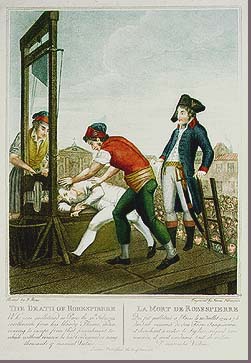
Robespierre lay in an anteroom of the Convention hall, while his Prison-escort was getting ready; the mangled jaw bound up rudely with bloody linen: a spectacle to men. He lies stretched on a table, a deal box his pillow; the sheath of the pistol is still clenched convulsively in his hand. Men bully him, insult him: his eyes still indicate intelligence; he speaks no word. … -O reader, can thy hard heart hold out against that? His trousers were nankeen; the stockings had fallen down over the ankles. He spake no more word in this world.

Fouquier had but to identify; his Prisoners being already Out of Law.** At four in the afternoon, never before were the streets of Paris seen so crowded. From the Palais de Justice to the Place de la Revolution … it is one dense stirring mass; all windows crammed; the very roofs and ridge-tiles budding forth human Curiosity, in strange gladness. … All eyes are on Robespierre’s Tumbril, where he, his jaw bound in dirty linen, with his half-dead Brother, and half-dead Henriot, lie shattered; their “seventeen hours” of agony about to end. The Gendarmes point their swords at him, to show the people which is he. A woman springs on the Tumbril; clutching the side of it with one hand; waving the other Sibyl-like; and exclaims: “The death of thee gladdens my very heart, m’enivre de joie;” Robespierre opened his eyes; “Scelerat, go down to Hell, with the curses of all wives and mothers!” — At the foot of the scaffold, they stretched him on the ground till his turn came. Lifted aloft, his eyes again opened; caught the bloody axe. Samson wrenched the coat off him; wrenched the dirty linen from his jaw: the jaw fell powerless, there burst from him a cry; — hideous to hear and see. Samson, thou canst not be too quick!

Samson’s work done, there bursts forth shout on shout of applause. Shout, which prolongs itself not only over Paris, but over France, but over Europe, and down to this generation. Deservedly, and also undeservedly. O unhappiest Advocate of Arras, wert thou worse than other Advocates? Stricter man, according to his Formula, to his Credo and his Cant, of probities, benevolences, pleasures-of-virtue, and such like, lived not in that age. A man fitted, in some luckier settled age, to have become one of those incorruptible barren Pattern-Figures, and have had marble-tablets and funeral-sermons. His poor landlord, the Cabinet-maker in the Rue Saint-Honore, loved him; his Brother died for him. May God be merciful to him, and to us!

Part of the Themed Set: Thermidor.

* Even his enemies agreed — sometimes adding it to the bill of particulars against him — that Robespierre lived a life of personal moderation; he lived as a boarder with a working-class family, and disdained to avail the politician’s typical harvest of political graft.

** The Convention had decreed Robespierre’s outlawry when he escaped custody; his immediate execution was, of course, akin to the logic he had once turned against the king.

On this day..

1794: The last cart of the Terror, not including the Marquis de Sade

July 27th, 1794 — the 9th of Thermidor, year II — is inscribed in history as the day Robespierre fell, when a parliamentary coup d’etat between the right and the remnants of the parties he had destroyed shouted him down as he readied the National Convention for his next purge.

This scene from the multinational bicentennial epic La Revolution Francaise conflates the events of 8 Thermidor — when Robespierre delivered a menacing two-hour address but provoked outcries by failing to name the deputies he implicated in “conspiracy” — and 9 Thermidor, when Robespierre’s lieutenant Saint-Just was shouted down from the podium and Robespierre ended up staggering through the benches appealing against the imprecations of his colleagues as his arrest is decreed.

Even as the month of Thermidor’s eponymous epochal event was unfolding, the daily gears of Revolutionary justice were turning: the usual haul of unfortunates condemned, including seven women from the previous day’s batch of Saint Lazare prison conspirators who had pled their bellies to buy a day.

That day was one day too little.

Stanley Loomis is overtly hostile to the Revolution, but his middlebrow sensibilities are well-tuned for the pathos of the scene:

Indifferent to the storms that were raging in the Convention, the Revolutionary Tribunal continued to go about its implacable business with cold efficiency. The arrest of its President [the Robespierrist Rene-Francois Dumas (the link is French), who was taken in the courtroom] startled no one. Since its inception that court had been witness to too many dramas to be astonished any further. Dumas quietly departed; the trials continued. Forty-two prisoners were sentenced to death. By four o’clock their hair had been cut and they were ready to be sent on their way. But Samson, aware of disturbances in the St. Antoine quarter of the city, suggested to [prosecutor] Fouquier[-Tinville] that the executions be deferred until the morrow.*

“Justice must take its course,” snapped the Public Prosecutor. “Do your work.”

And so the last “batch” lumbered off in the direction of the Faubourg St. Antoine and the Place de la Nation. With the exception of the Princesse de Monaco, they were nearly all obscure and humble members of the petite bourgeoisie. Hanriot, waving his sabre, conducted the procession to the place of execution. By seven o’clock that evening, as the minutes of the military escort poignantly show, the unfortunate victims, who had been so close to deliverance, had all been executed.

Henriot proceeded directly from his escort service to the Convention to liberate Robespierre for the night’s brief pitched battle against the Convention, and here we take our leave of them, for now. We shall meet both of them on the scaffold tomorrow.

Not on the wagon** with the Princess of Monaco was a man whom Loomis would have pitied rather less.

The bloated, penniless 54-year-old fruit of an ancient noble house, Donatien Alphonse François de Sade, Marquis de Sade had, in the most recent chapter of his astounding career, navigated the Revolution in the improbable guise of a proletarian section head and revolutionary tribunal judge, until his own arrest late the previous year.

This day, de Sade’s name was on a list of prisoners to be seized from Madelonnettes Prison — “Sade, former count, captain of Capet’s guards in 1792, has corresponded with enemies of the republic,” it said — which he had occupied until a recent transfer to Picpus, a monastery converted into a prison adjacent to the guillotine’s place at the Place de la Nation. Whether the result of another of the many bureaucratic snafus we’ve witnessed this week or a well-placed bribe from his friend and/or mistress Marie-Constance Quesnet, the guards were in the wrong place, didn’t find him, and didn’t care to dig any further.

Three months later, he was — for the last time in his life — a free man.

One could hardly say that the Revolution made the author of Justine the man he so (in)famously was — but having lived within sight of the blade that might any day be called upon to chop off his own head, and the entire tableau of the years preceding, left their impression. Hundreds of bodies from the Terror were stuffed in the unpropitious clay of the makeshift jail’s yards under de Sade’s cell. “Those few months in the shadow of the guillotine did me more harm than all the years of my incarceration under the King,” he wrote a friend.

According to Writing the Orgy: Power and Parody in Sade, Revolutionary France would inexorably influence his subsequent work,

strangely mixing real memories with very Sadean embellishments … Plots, betrayals, denunciations, beheadings: these fictional motifs and Sadean phantasies are linked with the reality and the imaginary of the Revolution.

Good for what ails you.

* Sanson’s diaries — a memoir of the family business constructed by the famous executioner’s grandson — leave off before the events of Thermidor and suggest that the hecatombs of the Terror were taking their toll on the aging headsman. Other accounts of this day have the tumbrils stopped in the streets by clemency-inclined onlookers, only to be forcibly extricated by Henriot.

** Also not (really) on the cart: the fictional occultist Zanoni, who is beheaded in this batch in the novel of the same title by legendary awful writer Edward George “it was a dark and stormy night” Bulwer-Lytton.

Part of the Themed Set: Thermidor.

On this day..

1794: Loizerolles and others for the Conspiracy of the Prisons

On this date in 1794, the Jacobin government struck what would prove to be its last blow against the “Conspiracy of the Prisons.”

The “conspiracy” was really a cover story for Robespierre‘s boys to wield their purifying torch against prisons and (of course) tighten the grip of authority by wild reference to treasonable plots abroad.

Supposedly, the prisons had birthed a scheme to effect a mass escape further to some sort of counterrevolutionary insurrection, or assassination of Robespierre. Marvelously, these conspiracies simultaneously spanned most all of Paris’ prisons, and their “authors” formed a dominant demographic among the Terror’s last tumbrils as the authorities purged each prison in turn.

While we have tarried to profile select victims individually this week, we have in fact repeatedly met so-called prison conspirators.

Luxembourg Prison — whose warders had concocted the earlier “conspiracy” involving Camille Desmoulins’ wife — had been purged repeatedly earlier in the month; its last spasm swept up the Noailles women.

An efficient detour to the Carmelite Monastery converted by revolutionary Paris into another gaol netted Alexandre de Beauharnais.

And the first batch of St. Lazare Prison felled Andre Chenier, where, as elsewhere, dozens were punished for some impressively villainous designs.

Being convicted of having declared themselves the enemies of the republic, by keeping up communications with the enemies of the state; by furnishing them with assistance; by participating in the plots, conspiracies, and assassinations of the tyrant and his wife, against the people; by conspiring in the maison d’arret (lock-up house), called Lazare, to escape, and to dissolve, by the assassination and murder of the representatives of the people, and more especially of the members of the committees of public safety and general security, the republican government, and to re-establish royality; — in fine, by wishing to destroy the unity and indivisibility of the republic.

(The march of the penal inquisitors through the plots is covered in a French Wikipedia page.)

Charles-Louis Muller’s 19th century painting of the Saint Lazare Prison “conspirators” being summoned to their doom. Seated in the center is Andre Chenier.

Each of these famous figures is a noticeable face among dozens of hapless wretches, largely drawn from the Third Estate and often laughably implausible escape artists and assassins — such as, among this day’s victims, an 80-year-old priest. The most poignant fate among the many forgotten threads threads of life clipped short is undoubtedly one Jean Simon Loizerolles, who was imprisoned with his son.

On the 7th Thermidor, about four o’clock, p.m., the bailiff of the tribunal presented himself at the prison with the mortuary list, or, in other words, the death-warrant.

Loizerolles was called for: it was Loizerolles, junior, whom death surrounded. Loizerolles, the father, did not hesitate to present himself; and, comparing his sixty-one years to the twenty-two years of his son, he determined to give him life a second time: the father went down, and was conducted to the Conciergerie.

He there received the bill of accusation, drawn up by order of the Committee of Public Safety, and headed Prison Conspiracy.

This bill bore the name of Loizerolles, junior.

The next day the father appeared for examination, with his twenty-five companions of misfortune.

The bill of accusation, which was joined to the depositions, stated that it was Francois Simon Loizerolles, junior, aged twenty-two.

The declaration of the sentence, prepared in anticipation upon the bill, bore the same designations. The recorder contented himself with effacing the name of Francois, and putting above it Jean.

Finally, the questions submitted, for the sake of form, to the jury, and drawn up in anticipation upon the same bill of accusation, contained the names and the designation mentioned in the accusation. But, at the time of the trial, when the charge was made to the jury, Coffinhal took care to efface the name of Francois, to substitute that of Jean, and to erase te word son, which was replaced by the word father. He rudely altered the two figures from twenty-two to sixty-one, and added the former profession of the father, which the accusation did not state.

And Jean Simon Loizerolles, against whom there was no accusation, was put to death on the 8th Thermidor.

Loizerolles is renowned for nothing in life save the touching valor of his death, but his name was a watchword for paternal devotion in France in the 19th century; Jadin wrote a short opera to his honor, and Victor Hugo references Loizerolles (bizarrely side by side with Robespierre’s younger brother) in Les Miserables as the sort of paragon of loyalty disdained by a gauche skeptic. But the gambit worked: Loizerolles junior survived the last days of the Terror, and was later pensioned by Charles X.

For every triumph, there were countless tragedies. The prisoners had wind of the enterprise to decimate their number days before; an anonymous account printed here (also the source of the Loizerolles story) describes a ramping-up of abuses great and petty in an effort to provoke a rising that would license a bloodbath, and the fear and desperation of the prisoners as death circled them.

Our melancholy and dejected hearts prepared themselves for death. The prison appeared surrounded by a funeral veil, and the death-like silence which pervaded it produced a dreadful feeling of misery in its inmates. Games and amusements were banished from the grounds, and our cadaverous countenances afforded an index of our afflicted souls; the refectory, which was wont to inspire a sentiment of cheerfulness, became a meeting of moving spectres, who quitted each other without exchanging a word.

The prisoners at St. Lazare could no longer indulge in illusions on the fate that awaited them … old age and infancy had ceased to be respected; all were alike condemned as guilty of the project of escape; and the man who was the most harmless and the most devoted to his country was no longer exempt from accusation.

But there was a small favor: a third repetition of the scene was postponed two days, which turned out to be all the difference between life and death.

[T]he Robespierrists, delighted in perpetuating our terrors, announced that the tragic scene would be renewed on the 10th.

The two days which we passed in anticipation of our destiny were two days of unmitigated agony: a general mourning reigned through our asylum; our eyes, in fancy, beheld on all sides the palpitating and struggling bodies of the victims of Robespierre, and of the villainy of his agents; tranquility quite abandoned us; death was hovering over our heads; and the prison appeared, to our diseased fancies, like a sea of blood, on which we had suffered shipwreck …

In this deplorable situation we saw no end to our sorrows but in death; and, however terrifying the grim visitant may naturally be, yet we deemed his arrival too long delayed, and invoked his coming, while we regretted that we had not been of the number of the first victims. When, about ten o’clock, p.m., of the 9th Thermidor, it was reported in the prison, that Robespierre was formally accused, the news, which had been brought by three new prisoners from without, inspired distrust, and savoured too much of the miraculous to be easily believed.

The following morning … the information was confirmed … in such a positive and circumstantial manner that we could no longer entertain a doubt of its truth.

It may easily be conceived how sudden was the change which was effected in the prison of St. Lazare: the prisoners began, for the irst time, since the 5th, to breathe more freely; their hearts, which had been so long cast down, received a fresh inspiration; their countenances cleared up; the full use of their suspended faculties was restored; and the images of death, which had affrighted them, were dissipated; and if they could have forgotten the assassination of their companions, they might have entirely lost the recollection of their misfortunes.

The death of Robespierre, and the close of his dark crimes, were the subject of an epigram, which an individual wrote upon the wall; it describes the monster too accurately, not to find a place here:

Il s’abreuva du sang d’un million de victimes, —
Il parla de vertus, et commit tous les crimes.

A thousand victims slaked his thirst for blood,–
He spoke of virtues while he swam in crimes.

Part of the Themed Set: Thermidor.

On this day..

1794: Andre Chenier, poet

On this date in 1794, proto-Romantic poet Andre Chenier went to the guillotine the unfortunate victim of his father’s love.

In the operatic version of this Istanbul-born poet‘s life story, Chenier is accused by a rival in love, convicted, and guillotined the next day together with his beloved Maddalena, who effects a Sydney Carton-like swap into the lot of the condemned in order to share his fate.

Chenier’s real end was both more mundane, and far more tragic.

A revolutionary of the constitutional monarchist variety and an open opponent of the Jacobins bold enough to compose an ode to Marat’s murderess, Chenier had spent a year staying out of sight when the police picked him up almost accidentally.

Prisoners suffocating in the Paris jails were suspended horribly between life and death, but the anonymity of this living tomb offered — as with Tom Paine — a measure of occasional safety.

When Chenier’s father blunderingly appealing to the authorities for his son, he accidentally stripped away that anonymity. Chenier had been under lock and key for three-plus months — writing, the whole time, in minuscule letters on scraps of paper he arranged to have smuggled out to his father — but once reminded of the writer’s existence, the authorities promptly had it snuffed out. (A friend and fellow poet, Jean-Antoine Roucher, shared his tumbril.)

Chenier’s prison verses are among the most affecting of his 32 years — like the acidic Iambes blistering his persecutors, and the heartbreaking “La Jeune Captive”, in which he gives voice to the young fellow-prisoner who has smitten him, excerpted here:

Mon beau voyage encore est si loin de sa fin!
Je pars, et des ormeaux qui bordent le chemin
J’ai passé les premiers à peine.
Au banquet de la vie à peine commencé,
Un instant seulement mes lèvres ont pressé
La coupe en mes mains encor pleine.

Je ne suis qu’au printemps, je veux voir la moisson;
Et comme le soleil, de saison en saison,
Je veux achever mon année.
Brillante sur ma tige et l’honneur du jardin,
Je n’ai vu luire encor que les feux du matin:
Je veux achever ma journée.

Chenier was not broadly published or extremely well-known in his own lifetime; many critics think he was pinched out while still maturing. The poet himself told a friend in parting, “I leave nothing for posterity; and yet, (touching his forehead) I had something there.” In the backstory to one of the tales in Balzac’s La Comedie Humaine, a grocer who annoys one of Robespierre‘s associates is also among this day’s batch and arouses more notice than the man of letters:

Though Descoings died, he had the honour, at any rate, of going to the scaffold with Andre de Chenier. There, no doubt, grocery and poetry embraced for the first time in the flesh; for they have always had, and will always have, their private relations. Descoings’ execution made a far greater sensation than Andre de Chenier’s. Thirty years elapsed before it was recognised that France had lost more by Chenier’s death than by that of Descoings.

Robespierre’s sentence had this good result — until 1830 grocers were still afraid of meddling in politics.

The salutary effect upon grocers has long faded, but Chenier’s reputation has steadily ripened like wine since his demise. And the title part of the late-19th century opera Andrea Chenier — however scant its resemblance to the man who inspired it — is one of the most gorgeous tenor roles in opera.

Part of the Themed Set: Thermidor.

On this day..

1794: Not Thomas Paine

An avidity to punish is always dangerous to liberty. It leads men to stretch, to misinterpret, and to misapply even the best of laws. He that would make his own liberty secure must guard even his enemy from oppression; for if he violates this duty he establishes a precedent that will reach to himself. -Thomas Paine

On this date in 1794, revolutionary firebrand Thomas Paine got a date with the guillotine when the public prosecutor Antoine-Quentin Fouquier-Tinville put his name on the list for the next batch of heads.

Paine — “Mad Tom” to foes of his fire-eating opposition to despotic church and crown — is best-known for his part in the American Revolution; his pamphlet “Common Sense” made an incendiary and influential case for revolution.

More so than any other high-profile compatriot in the cause of American independence, Paine took to heart the age’s revolutionary spirit, the fine principles of solidarity, the zeal to put life and fortune at liberty’s service.

Not content to retire to the estate granted him for his services to the fledgling United States of America — Paine coined that name, by the way — the hellraiser sailed for the Old World to help overthrow the sclerotic Bourbon despotism whose geopolitically-minded aid* had had such material effect for American liberty.

Paine served in France’s National Convention, one of the highest-profile and least-impeachable members of that body as well as one of only two foreigners. These distinctions offered him some safety in the Revolution’s internecine tempests — some, but not quite enough. He drew the ire of the Montagnards by opposing the execution of Louis XVI.

The terrible gears of mass fratricide which apparently doomed Paine as the Terror unfolded turned out to be his refuge, and that of three fortunate fellows with him. Had he gone to the scaffold as a single high-profile traitor, there would have been no mistake about it; now, at the height of the Terror, jailers marked dozens for death by the fallible expedient of chalking their cell doors. If the guillotine made mass execution feasible, the bureaucratic apparatus to manage it was still catching up.

Here’s the version of a Paine’s preservation that he himself later related — albeit second-hand, since he was suffering this day “a violent fever which had nearly terminated my existence” and “was not in a condition to be removed, or to know of what was passing, or of what had passed, for more than a month. It makes a blank in my remembrance of life. The first thing I was informed of was the fall of Robespierre.”

[T]he manner in which I escaped that fate is curious, and has all the appearance of accident.

The room in which I was lodged was on the ground floor, and one of a long range of rooms under a gallery, and the door of it opened outward and flat against the wall; so that when it was open the inside of the door appeared outward, and the contrary when it was shut. I had three comrades, fellow-prisoners with me, Joseph Vanhuile, of Bruges, since president of the municipality of that town, Michael Robins, and Bastini, of Louvain.

When persons by scores and hundreds were to be taken out of prison for the guillotine, it was always done in the night, and those who performed that office had a private mark or signal by which they, knew what rooms to go to, and what number to take. We, as I have said, were four, and the door of our room was marked unobserved by us with that number in chalk; but it happened, if happening is a proper word, that the mark was put on when the door was open and flat against the wall, and thereby came on the inside when we shut it at night, and the destroying angel passed by it. A few days after this Robespierre fell, and the American ambassador arrived and reclaimed me and invited me to his house.

During the whole of my imprisonment, prior to the fall of Robespierre, there was no time when I could think my life worth twenty-four hours, and my mind was made up to meet its fate.

Presumably this would have been a short reprieve, had not Jacobin rule (and rulers) promptly expired.

We noticed two days ago the U.S. mission’s willingness to exert itself for Lafayette’s wife, who surely had not done better service for the American Revolution than had Paine himself.

Paine waited in vain for American intervention, and was incandescent with rage at George Washington and his envoy Gouverneur Morris for abandoning him (Morris was replaced by the more Paine-friendly James Monroe a few weeks later). In a wide-ranging 1796 denunciation of Washington’s conduct and American political tilt towards Britain and away from France, Paine accused his country** of giving the Jacobins the green light to cut off a gadfly’s head.

Could I have known to what degree of corruption and perfidy the administrative part of the Government of America had descended, I could have been at no loss to have understood the reservedness of Mr. Washington toward me, during my imprisonment in the Luxembourg. There are cases in which silence is a loud language.

Soon after I was put into arrestation and imprisonment in the Luxembourg, the Americans who were then in Paris went in a body to the bar of the Convention to reclaim me. They were answered … that I was born in England, and … their reclamation of me was only the act of individuals, without any authority from the American Government.

A few days after this, all communication from persons imprisoned to any person without the prison was cut off by an order of the police. I neither saw, nor heard from, anybody for six months; and the only hope that remained to me was that a new Minister would arrive from America to supersede Morris …

One hundred and sixty-nine were taken out of the Luxembourg one night, in the month of July, and one hundred and sixty of them guillotined. A list of two hundred more, according to the report in the prison, was preparing a few days before Robespierre fell. In this last list I have good reason to believe I was included. A memorandum in the hand-writing of Robespierre was afterwards produced in the Convention, by the committee to whom the papers of Robespierre were referred, in these words:

Demander que Thomas Payne soit de decrete d’accusation pour les interets de l’Amerique, autant que de la France.

I had then been imprisoned seven months, and the silence of the Executive part of the Government of America (Mr. Washington) upon the case, and upon everything respecting me, was explanation enough to Robespierre that he might proceed to extremities.

This venomous open letter and the deistic tract The Age of Reason he was banging out during the Revolution, combined with the frightening turn of the French Revolution itself, helped send Paine’s public regard into decline. “Atheist,” they tutted, and he’s been the most untouchable Founding Father ever since.

Next year is the bicentennial of his death in obscurity and pauperhood; his homelessness, so to say, in the annals of political thought and national pantheons testifies in some ways to the defeat his principles suffered in his very lifetime. The American Revolution turned conservative; France’s fell to despotism; England’s was strangled in its crib.

Even so, he fired the imaginations of many troublemakers still to come. A man of no wealth or position who etched in fire the spirit of his times, Paine saw further and spoke plainer than most of his contemporaries. If a prophet is not welcome in his own country, it scarcely diminishes the power of the prophecy.

And/or, enjoy this free biography at Google Books.

* Given by the French crown in opposition to France’s great rival Britain, of course.

** Paine certainly considered himself American, though he wouldn’t have made that inconsistent with being French, too. The matter of his citizenship between England (where his pamphlets had him attainted in absentia on a capital charge), France and the United States was a contested one at a time when the very notion was being reforged in the heat of revolution; at any rate, as diplomatic pretext for failing to ask for his life, citizenship makes a feeble excuse.

Republican radicals in England didn’t mind claiming him as their own, developing this alternate lyric sheet to the national anthem:

[audio:God_Save_the_Queen.mp3]

God save great Thomas Paine
His ‘Rights of Man’ explain
To every soul.
He makes the blind to see
What dupes and slaves they be,
And points out liberty,
From pole to pole.

Thousands cry ‘Church and King’
That well deserve to swing,
All must allow:
Birmingham blush for shame,
Manchester do the same,
Infamous is your name,
Patriots vow.

Part of the Themed Set: Thermidor.

On this day..