1691: William Fielding, scammer

Four men and four women stretched their necks at Tyburn on this date in 1691.

Among them we find one William Fielding, condemned for robbing three houses by using a 17th century variant of the Nigerian prince email scam:

The Prisoners came to all the Prosecutors and pretended that there was a Lady Dead who had left them Legacys, and Wheedled them to go to look after it, and the whilest Robbed their Houses; which was lookt upon as a very wicked Invention.

Proving that even confidence men are vulnerable to their own trick, however, the Ordinary of Newgate‘s dispatch from the foot of the gallows reports that Fielding

said, That he was afraid that if he might be spared that he should be tempted to Rob again, because of his extream poverty: Therefore he now submitted to dye willingly, that he might not add sin to sin, and so encrease his future punishment.

Well might he fear hellfire if he took the judiciary for his example. In a time when property was far dearer than life, Fielding himself and all but one of the other seven to hang with him (the one was an infanticidal mother) died for felony thefts of various types — ranging from the pathetic (“stealing from Charles Thurston, on the 4th of this Instant May, one Linnen Bag, value 1 d. and 20 l. in Mony”) to the ludicrous (“Robbing Daniel Leery, on the 12th Instant, in the Street, as he was going along, in St. James’s Parish, snatching his Hat and Perrywig off his Head, in the Night”).

On this day..

1536: Anne Boleyn’s supposed lovers

Beware, trust not in the vanity of the world, and especially in the flattering of the court … if I had followed God’s word in deed as I did read it and set it forth to my power, I had not come to this.

-From the last statement of George Boleyn

This was the execution date in 1536 of Anne Boleyn‘s co-accused, the undercard to the deposed queen’s beheading.

It was the accusation of adultery that furnished Anne’s downfall; some adulterers were perforce required. These were William Brereton, Henry Norris, Sir Francis Weston, Mark Smeaton … and the ex-queen’s own brother, George Boleyn.

They had just days prior been subjected to a trial whose outcome was a foregone conclusion. All pleaded their innocence save Smeaton, a commoner court musician who could not withstand torture and “admitted” fooling around with Queen Anne.*

Along with Smeaton, three gentlemen-doomed plucked from the Tudor court’s shadowy recesses — joined to the legendary queen at the chopping-block, if not very probably in her bed.

  • Norris, the Groom of the Stool
  • Weston, a Gentleman of the Privy Chamber
  • Brereton, a Groom of the Privy Chamber

“Everyone was moved at their misfortune, especially at the case of Weston, who was young and of old lineage and high accomplishments,” one contemporary recorded of the fearful pall cast upon King Henry’s court by the purge. “But no one dared plead for him, except his mother, who, oppressed with grief, petitioned the King, and his wife, who offered rents and goods for his deliverance.”

The most egregious charge, naturally, did not concern these men. To put the fallen queen beyond the reach of sympathy it was alleged that she

following daily her frail and carnal lust … procured and incited her own natural brother, Geo. Boleyn, lord Rocheford, gentleman of the privy chamber, to violate her, alluring him with her tongue in the said George’s mouth, and the said George’s tongue in hers, and also with kisses, presents, and jewels; whereby he, despising the commands of God, and all human laws, violated and carnally knew the said Queen, his own sister, at Westminster; which he also did on divers other days before and after at the same place, sometimes by his own procurement and sometimes by the Queen’s.

This outrageous smear on the extremely specious grounds that big brother “had been once found a long time with her, and with certain other little follies,” invited as much skepticism among the Boleyns’ contemporaries as it does for posterity. Even after Anne had been condemned for adultery and incest in her stage-managed trial, George — the last of the bunch to face the tribunal — fought his corner so vigorously “that several of those present wagered 10 to 1 that he would be acquitted, especially as no witnesses were produced against either him or her, as it is usual to do, particularly when the accused denies the charge.”

A foolish bet, but perhaps one placed from a position of willful hope. If a peer of the realm could be condemned a traitor for hanging out with his sister, then no Henrician nobleman could hope to sleep securely.

Little could their dread fathom the bloody years to come. Many who saw the Boleyns’ heads drop would in time have cause to make of their gambling winnings a purse to tip their own executioners.

Thomas Cromwell, who engineered the Boleyn faction’s fall, outlived it by barely four years. The Earl of Surrey, who sat in judgment on this occasion, lost his head in 1547; his father the Duke of Norfolk,** who was the presiding judge, only avoided execution because Henry VIII died hours before Norfolk was to go to the block. George Boleyn’s wife, Lady Rochford, is supposed to have provided evidence against him; she was later swept up in the fall of Catherine Howard and beheaded for her trouble on that occasion.

But those were tragedies for later days.

In the spring of 1536, from his window in the Tower, the poet Thomas Wyatt witnessed this date’s executions: the young Anne’s last lover before the king descended on her, Wyatt too had been initially implicated in debauching the queen and he was fortunate not to be among their number. (Wyatt’s son would not be as lucky.) The shaken Wyatt wrote his fellow courtiers’ heartbreaking eulogy, and perhaps that of his era too, in his verse reflection on that terrible fall from fortune. (Via)

V. Innocentia
Veritas Viat Fides
Circumdederunt
me inimici mei

by Sir Thomas Wyatt, the Elder

Who list his wealth and ease retain,
Himself let him unknown contain.
Press not too fast in at that gate
Where the return stands by disdain,
For sure, circa Regna tonat.†

The high mountains are blasted oft
When the low valley is mild and soft.
Fortune with Health stands at debate.
The fall is grievous from aloft.
And sure, circa Regna tonat.

These bloody days have broken my heart.
My lust, my youth did them depart,
And blind desire of estate.
Who hastes to climb seeks to revert.
Of truth, circa Regna tonat.

The bell tower showed me such sight
That in my head sticks day and night.
There did I learn out of a grate,
For all favour, glory, or might,
That yet circa Regna tonat.

By proof, I say, there did I learn:
Wit helpeth not defence too yerne,
Of innocency to plead or prate.
Bear low, therefore, give God the stern,
For sure, circa Regna tonat.

* In the Tower awaiting execution, Anne would voice worry for Smeaton’s soul when she learned that he had failed to retract this confession at the block. But Smeaton and all the men were beheaded in preference to a sentence of drawing and quartering, and had reason to be cautious about their comportment on the scaffold lest crueler torments be reinstated for them.

** Norfolk was Anne Boleyn’s uncle.

Circa Regna tonat: “Around the throne it thunders”, from Seneca’s Phaedra.

On this day..

1726: Three molly-house sodomites

Nine men and one notorious women died at Tyburn on this date in 1726 at a more than usually raucous execution-day.

“At the Place of Execution, Map got himself loose, threw himself out of the Halter, and jump’d 3 or 4 Yards from the Cart, upon the Heads of the numerous Crowd of People, but the Officers following after him, wounded him with their Pikes, and the Executioner and some others soon brought him back again,” the Ordinary’s account remarked. “Vigous got himself free of the Halter also, which was immediately observ’d: Gillingham was the more desirous of Prayers, having the Night before taken Poyson, and conscious of his Guilt.”

And that’s just what was happening under the nooses.

Out in the audience,

Just before the Execution, a Scaffold that had been built near Tyburn, and had about 150 People upon it, fell down. A Snuff Box Maker in Castle-Street, and a Gentleman then not known, were, as ’tis believed, mortally Wounded; and about 12 other Men and Women, Maimed and Wounded in a most cruel Manner: Some having their Legs, others their Arms, &c. broke.

Some part of the Scaffold being left standing, the Mob gathered upon it again in Numbers; and in about Half an Hour more, that also fell down, and several were hurt. Soon after another Scaffold broke down, with about 100 Persons upon it; but the People that were damaged by it, being immediately carried off on Mens Backs, and in Coaches, we must defer the Particulars of that Mischief … (Daily Journal, May 10, 1726)

We will leave for a future May 9th the notorious fate of the woman, Catherine Hayes, and focus for this post on the fate of the notorious men: sodomites Gabriel Lawrence, William Griffin, and Thomas Wright.

A mere three months before, this trio had been among dozens of men rounded up in a raid on London’s thriving “molly house”.

These establishments catered to what we might anachronistically call the gay scene of Georgian London — or the molly scene, if you like, from the slang term for effeminate, cross-dressing, or homosexual men encompassing a panoply of alternate sexual identities and preferences. What these behaviors “among Christians not to be named” had in common, of course, was the opprobrium of the surrounding world.

Rictor Norton, who keeps the voluminous Homosexuality in Eighteenth-Century Enland site and wrote a book about Mother Clap’s Molly House, records a 1726 letter to the editor demanding an exemplary punishment to check the misuse of genitalia.

It being too notorious, that there are vile Clubs of Miscreants in and about this City, who meet to Practise and Propagate the detestable Sin of Sodomy, a Crime which drew down the flaming Vengeance of God upon the City of Sodom, in a Day when they had not that Light which we are bless’d with now, ’tis humbly propos’d that the following Method may not only destroy the Practice, but blot out the Names of the monstrous Wretches from under Heaven, viz. when any are Detected, Prosecuted and Convicted, that after Sentence Pronounc’d, the Common Hangman tie him Hand and Foot before the Judge’s Face in open Court, that a Skilful Surgeon be provided immediately to take out his Testicles, and that then the Hangman sear up his Scrotum with an hot Iron, as in Cases of burning in the Hand.

Old Blighty was never favored with courtroom scrotum-searings, but connoisseurs of same-sex love “must risque our necks for” it well into the next century.

But what pleasures welcomed the man who was ready to wager his life! An informant reported from that same Mother Clap’s that he

found between 40 and 50 Men making Love to one another, as they call’d it. Sometimes they would sit on one another’s Laps, kissing in a lewd Manner, and using their Hands indecently. Then they would get up, Dance and make Curtsies, and mimick the voices of Women. O, Fie, Sir! – Pray, Sir. – Dear Sir. Lord, how can you serve me so? – I swear I’ll cry out. – You’re a wicked Devil. – And you’re a bold Face. – Eh ye little dear Toad! Come, buss! – Then they’d hug, and play, and toy, and go out by Couples into another Room on the same Floor, to be marry’d, as they call’d it.

Several such informers were stalking the city’s molly-houses in the 1720s, goaded (or forced) by both police and private bluenoses. One of the resulting court records notes that “[t]he discovering of the Molly Houses, was chiefly owing to a Quarrel betwixt Mark Partridge and – Harrington: For upon this Quarrel Partridge to be revenged on Harrington, had blab’d something of the Secret, and afterwards gave a large Information of a great many others.”

Many lives hung on this lover’s spat. Mother Clap’s was raided in February 1726, but it was just the most famous of a whole series that forced into public awareness “a new, distinct molly ‘sodomite’ identity.”

The saving grace for the twoscore arrestees at Mother Clap’s was that even in Bloody Code England, a fairly high bar was required to execute for same-sex sodomy: penetratio, that is res in re (“thing in thing”)* — often quite difficult to prove.** As nobody had actually been caught in flagrante delicto, most of those initially arrested were simply released un-charged.

But the informants raise their scaly heads once more here: as they were themselves habitues of the molly circuit, they could provide firsthand eyewitness testimony about the acts of buggery several men had committed with them.

Five men were put on trial for their lives in April on the strength of accusations made by informants Mark Partridge, Thomas Newton, and Edward Courtney. The cases are described in some detail at Norton’s site: Gabriel Lawrence and William Griffin, both 43-year-old married men, were Mother Clap regulars who implausibly claimed to have no idea it was a molly house. (The place was a coffee shop/tavern.) Griffin actually lived there. Both these men were easily condemned but refused to the end to admit their proclivities to the Newgate Ordinary, and insisted that they had been framed.

Thomas Wright, seller of ale, had gone so far to set up his own molly house where he both slept with Newton, and procured Newton for his other customers. Wright, who “inclin’d to the Anabaptist-Way,” also said that Newton had perjured himself; nevertheless, he “could not deny his following this abominable Courses, only he refus’d to make particular Confessions.”

A third informant keyed two additional capital trials that didn’t end at Tyburn. George Kedger (Keger) and George Whittle (Whytle) both mounted much stronger defenses casting much greater doubt on the circumstances of their entrapment.

Charged with taking Courtney into his bed, Kedger contended that he had in fact resisted Courtney’s advances until the latter threatened to “swear my Life away”. Kedger was condemned, but pardoned. Whittle did still better by forcing his accuser to admit that he was a convict three times over and insinuating that rumors about his buggery were started by a disgruntled lodger. With a parade of character witnesses at his back, Whittle was acquitted outright.

* This was also the standard for same-sex rape; we’ve seen in these pages a man’s life hang on a question of just the tip.

** Attempted buggery — a charge which could result from making a sexual advance on another man that he rejected, or as a judicial punt when same-sex activity was afoot but no penetration could be proven — might land one a fine and a trip to the pillory. This was no mean sentence; the pillory could be quite a dangerous (sometimes lethal) ordeal for homosexuals or for anyone else.

Mother Clap herself, whose molly house we have referred to throughout this post, was also pilloried, not executed. Her eventual fate is not known; a marker in Holborn notes the former site of her famous establishment.

On this day..

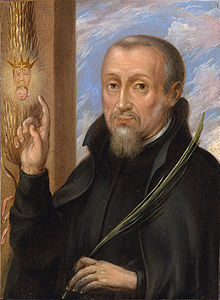
1606: Henry Garnet, Gunpowder Plot confessor

On this date in 1606, the English Jesuit Henry Garnet was hanged, drawn and quartered in the churchyard of Old St. Paul’s Cathedral.

Garnet, “the prime scholar of Winchester College” as a gifted young student, left England to enter the Society of Jesus and study under Robert Bellarmine, a theologian so Catholic that he would later bring the hammer down on Galileo’s heliocentrism.

After eleven years in letters on the continent, the Society called Garnet to return to England in 1586 as the lead missionary to his native realm’s Catholic minority. It was a lonely burden for Garnet, especially after his opposite number Robert Southwell was arrested in 1592. (Southwell, too, went to the scaffold.) But Garnet carried it off as well as anyone. He remained free for nearly twenty years — creating an underground press and numerous illegal cells.

“Under his care the Jesuits in the English mission increased from one to forty, and that not a single letter of complaint, it is said, was sent to headquarters against him,” lauds the Catholic Encyclopedia.

Theologically, Garnet was noted for his defense of the doctrine of equivocation — that is (in the hostile reading of its Protestant interlocutors) of finding hair-splitting rationales for lying. It was an intellectual exercise of many centuries’ vintage, but for England’s beleaguered Catholics it was as urgent as life and death. Most specifically, this doctrine reckoned an oath insufficient to compel a truthful response to official inquiries as to the whereabouts and activities of fellow-Catholics who’d be liable with discovery to attain martyrdom. The liberal definition of “truth” to include an outright lie with a “secret meaning reserved in [one’s] mind” was obviously ripe for the scorn of persecutors for whom it was little but treason neatly clothed.

Knock, knock! Who’s there, in th’ other devil’s name?
Faith, here’s an equivocator that could swear in both
the scales against either scale, who committed
treason enough for God’s sake, yet could not
equivocate to heaven. O, come in, equivocator.

Macbeth (c. 1606), Act 2, Scene 3

Much of Garnet’s last weeks in custody ahead of his execution were spent in harrowing the doctrine of equivocation; indeed, this is even the very last exchange he had with doctors of the English church sent to accompany him.

One of those standing near him then asked him, “Whether he still held the same opinion as he had formerly expressed about equivocation, and whether he thought it lawful to equivocate at the point of death?” He refused to give an opinion at that time; and the Dean of St. Paul’s sharply inveighing against equivocation, and saying that seditious doctrine of that kind was the parent of all such impious treasons and designs as those for which he suffered, Garnet said, “that how equivocation was lawful, and when, he had shewn his mind elsewhere, and that he should, at any rate, use no equivocation now.”

There were nevertheless equivocations that Garnet would never countenance. His A Treatise of Christian Renunciation, compiling quotes from Church fathers detailing the things a good Catholic must be prepared to renounce for his faith, excoriated those who attended Anglican chuches. Their pretense, he said, was nothing but their own comfort.

Certaine private persons, who have wholly addicted them selves to make them Gods either of their belly and ease, or of the wicked mammon, setting God behind all things which may delight them … refuse also to beleeve that the do amisse …

Judas with a kisse dost thou betray me? amongst hereticks dost thou professe me? no other place to professe chastity, but in the bedd of a harlott?

Harried as they were, England’s Catholics greeted with anticipation the 1603 accession of King James: raised Protestant, but the son of the Catholic Mary, Queen of Scots. Garnet shared Catholics’ hope that James would ease off harassment of the Old Faith; he even authorized the betrayal of fellow-Catholics’ regicidal Bye Plot as a show of loyalty and to pre-empt a possible backlash. “Quiete et pacifice,” he begged.

But toleration was still not quickly forthcoming, and soon Catholics had reverted to “a stage of desperation.” James was only in his thirties: would the trials be neverending?

Garnet continued endeavouring to keep Catholics calm and give the new sovereign the political space necessary to relax persecution. But many of his flock soon tired of quiete et pacifice.

In 1605, there would be another try — one that is still remember, remembered to this day.

Here Garnet again gets into hot water with theological doctrine. Garnet caught indirect wind of Guy Fawkes’ terrorist plot — but he heard it kind-of-sort-of under the seal of the confessional: another priest who himself had heard the design under confession told it to Garnet in a more ambiguous circumstance.

Garnet’s excuses here might strike the reader as far too fine; certainly that is how his prosecutors viewed it. The circumstances of the plot’s revelation certainly appeared to give the priest enough leave to find a way to reveal it, especially since he knew about it for many months before that almost-fateful Fifth of November. Garnet seems to have wanted the resolution — or loathed to plant another Judas-kiss. Maybe he thought his exhortations could stop it without anyone winding up drawn on a hurdle. Maybe, after 19 furtive years knowing every morning that his next sleep might be in a dungeon, his heart of hearts wanted to see it to go ahead.

When the attempt to explosively decapitate the English state was discovered Garnet was hunted to ground; his last days of “liberty” were spent stuffed in a coffin-sized priest hole at Hindlip Hall before the “customs of nature which must of necessity be done” finally forced him to out into the sight of his captors.

His fate looks like a foregone conclusion in retrospect, but Garnet did fight it — for two months before his condemnation, and five more weeks after from trial until his execution during which he maneuvered to exculpate himself. (See Investigating Gunpowder Treason for an exploration of this.) Since Reformation English law of course did not recognize the seal of the confessional, the most charitable reading of Garnet’s own admissions start at misprision of treason. It is but a single step from there to the scaffold if one supposes his long silence shrouded any sort of approval of or aid to the plotters.

Garnet received the mercy of being hanged to death before he was cut down for the public butchery part of his sentence.

On this day..

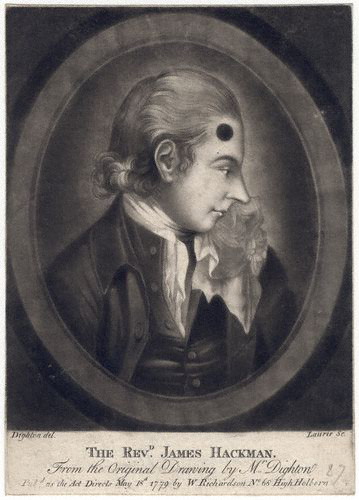
1779: James Hackman, sandwich wrecker

On this date in 1779, Londoners crowded Tyburn to witness the hanging of James Hackman for a sensational high-society murder.

Just twelve days before his date with the hemp, Hackman had walked up to Martha Ray at the Royal Opera and shot her in the head with a single-shot pistol. Then, he turned a second weapon on himself in a vain attempt to commit suicide.

The reader is not mistaken to detect here the mania of unrequited passion. Several years before the young Hackman was a handsome lieutenant introduced to Martha Ray’s social circle. She was a successful soprano on the London stage and though unmarried lived with the Earl of Sandwich as his wife in all but the illustrious name.


(cc image) from Molly Elliott.

Yes, this is the very Earl of Sandwich who pioneered the eating of things stuck between bread slices.* Sandwich — John Montagu to his parents — had other interests besides the munchies; he was the capable First Lord of the Admiralty throughout the 1770s. (As a result, Captain Cook, whose seafaring explorations were occurring at that time, kept naming islands for the Earl of Sandwich).

Domestic life for the Earl and his legal Countess — not “Earless”; that’s a different thing — wasn’t quite as satisfying. Dorothy Montagu, going gradually insane, separated from Sandwich. The lord plucked 17-year-old commoner Martha Ray — a quarter-century Sandwich’s junior — in 1759 and she lived as his mistress from there on out.*

Despite their age difference and never-formalized status they had a comfortable arrangement; Ray bore Sandwich five children** and the two appeared in public as a couple. The Earl sponsored Martha Ray’s opera career and education.

James Hackman met the Earl’s mistress around 1775 and the two formed an intimacy. Just how intimate they might have been has never been firmly established but is clear that as time passed the infatuation increasingly ran in only one direction. Hackman sold his commission in the 68th Regiment of Foot to become a Church of England deacon, perhaps angling by this expedient to woo Martha Ray away from Sandwich to a wholly respectable union.

She understandably demurred on this “opportunity” — leading the greenhorn Reverend to his blackguard act.

Hackman’s pointless waste of Martha Ray’s life and his own plucked his contemporaries’ sentimental heartstrings like nothing else. “All ranks of people … pitied the murderer’s fate,” remarks the Newgate Calendar. One newspaper report of the death sentence noted that “all present were greatly affected” at Hackman’s agitations “and however we may detest the crime, a tear of pity will fall from every humane eye on the fate of the unhappy criminal.” (General Advertiser and Morning Intelligencer, Apr. 17, 1779)

James Boswell was fascinated by the crime; he attended the trial and spilled many public and private words on its subject.

Boswell empathized with Hackman: in a report of the trial for the St. James’s Chronicle (Apr. 15-17, 1779) he opined that the “natural Effect of disappointed Love, however, shocking it may appear, is to excite the most horrid Resentment against his Object, at least to make us prefer the Destruction of our Mistress, to seeing her possessed by a Rival.” Not that Boswell condoned the murder, but “I would say to all that are conscious that their Passions are violent, Think ye that htis unfortunate Gentleman’s general Character is … worse than yours? No, it is not.”

While Human Justice is to be satisfied, let us consider that his Crime was neither premeditated‡ Cruelty, nor base Greediness. He is therefore an Object neither of Abhorrence nor of Contempt … Let us unite our fervent Prayers to the Throne of Heaven, that this our Brother may obtain Forgiveness through Jesus Christ, and be admitted in another State of Being to everlasting Happiness.

The kinship so many Londoners felt for this homicidal stalker moved print copy high and low, before Martha’s body had gone quite cold. Its most notable product was the 1780 Love and Madness, an epistolary novel of tragic passion presented via the (fictitious) letters exchanged by the supposed lovers. So heavily did this understanding of events by Hackman’s contemporaries color its subsequent remembrance that Love and Madness is also the title or subtitle of two 21st century nonfiction considerations of the affair. (1, 2 | Review of both)

Hackman for his part carried off the requisite public posture of resigned tragic nobility in the few days before he satisfied human justice. The General Evening Post, April 17-20 1779 described the execution:

This unfortunate gentleman received the sacrament in the morning with all the fervency and devotion of a sincere repenting criminal: — he repeated that affecting acknowledgment of his guilt, which on his trial drew tears from the audience, and seemed in a state of composure, unruffled with the idea of punishment, which, he said, was no more than he deserved.

At nine o’clock he came into the press-yard, where a great crowd of persons assembled to gratify their curiosity. That all might have an equal share of the sight, a lane was formed by the multitude on each side, through which Mr. Hackman passed, dressed in black, leaning on the arm of his friend the Rev. Mr. Porter, whose hand he squeezed as he muttered the solemn invocation to Heaven, not to forsake a sinner of so enormous a degree, in the trying hour of death.

Mr. Hackman was conveyed from Newgate in a mourning coach, attended by the Rev. Mr. Porter Mr. Villette, the ordinary of Newgate, and Mr. Leapingwell, a Sheriff’s officer.

He reached Tyburn about a quarter before eleven o’clock. When he arrived at the fatal tree, a cart lined with black was under the gallows ready to receive him. Mr. Porter and Mr. Villette ascended it by a pair of steps, and he followed them unsupported. As soon as he had got into it he walked forward, and fell on his knees, (a position seldom used by persons in his circumstances at Tyburn, as they always pray standing) and the Clergymen did the like, one on each side of him, where they remained praying for about fifteen minutes, then got up, when the rope was put about his neck, and tied to the gallows.

In this manner he remained praying between the two Divines for ten minutes more, when the Rev. Mr. Porter embraced him, and Mr. Villette took his leave, and both left the cart. The convict[‘]s cap being pulled over his face, he told the executioner to leave him to himself for a few minutes, and he would drop his handkerchief as a signal when he was ready, which he did after a few minutes pause, and was thereupon launched into eternity.

His whole behaviour was manly, but not bold: his mind seemed to be quite calm, from a firm belief in the mercies of his Saviour.

He wore not hat, not any bandage on his face where he gave himself the wound, that the public curiosity might not be interrupted in looking at him; saying, “that he wished to be made a public spectacle of, and hoped his death might be of service to mankind.”

He was no ways convulsed, nor was their [sic] any motion of the body that tended to shew it experienced any pain. Nothing more was to be seen than what proceeded from the jerk on quitting the cart.

The mob was more numerous than on any other occasion since the death of Dr. Dodd. It was expected Mr. Hackman would suffer at Covent-garden, and preparations were made by some speculating carpenters, who met with a mortifying disappointment.

After hanging the usual time, his body was put into a hearse, and taken to Surgeons-hall in the Old Bailey, where it was prepared for the inspection of the public.

Mr. Harkman expressed a wish to his friends, that the ceremony of anatomizing his body might be dispensed with; and that his corpse might be treated in the same manner as that of Lord Ferrers.

Mr. Hackman intimated to a particular friend, that if his remains could be deposited near those of Miss Ray he should feel inexpressible happiness in the hour of death.

A man who was standing near a dray in Oxford-street to see Mr. Hackman pass, was thrown down under one of the horses by the crowd; the horse being frightened, stamped on the man, and beat out his brains.

* Allegedly so that the Earl wouldn’t have to leave his beloved gambling table to dine.

** There is a wonderful bon mot that has enlivened compendia of anecdotes through the years, consisting of more or less the following exchange:

First speaker: You will either die on the gallows or of some social disease.

Second speaker: That depends upon whether I embrace your principles or your mistress.

Though it’s been variously attributed, it appears that the retort was originally delivered by the comic Samuel Foote to Lord Sandwich — about Martha Ray.

† Notable among the five children of Sandwich and Martha Ray: jurist Basil Montagu.

Sandwich’s wife also bore him a legitimate son, who eventually succeeded to the father’s Earldom; the title still exists today.

‡ Hackman had to be talked off simply pleading guilty but in the end he hung his trial hopes on arguing that he intended to kill himself, in Martha’s presence, and was overwhelmed by a momentary “phrensy”. A letter in his pocket meant to be delivered posthumously to his brother-in-law supported this claim; the fact that he brought two guns to meet her rebutted it.

Trial judge William Blackstone pointed out to Hackman’s jurors that the composure of the accused before and after the crime did not suggest a madman and that accepting Hackman’s claim of only an instant’s insanity could present a very slippery slope indeed for future murder prosecutions.

On this day..

1635: Elizabeth Evans, “Canonbury Besse”

On this date in 1635, Elizabeth Evans (known as “Canonbury Besse”) was hanged for murder.

Sometimes characterized as one of early modern Europe’s pioneer serial killers, Evans was not driven to slaughter by compulsion — merely by its emoluments. Using an early version of the timeless “Lonely Hearts killer” scheme familiar to a later era of classified adverts and Craigslist postings,* Evans and her beau Tom Sherwood committed at least five homicides via the expedient of Canonbury Besse’s allures.

Once the prospect had been enticed to a private rendezvous, Sherwood — “Country Tom” — would jump him, and the couple would rob the body. A straightforward enterprise, with a straightforward consequence. (Sherwood had already gone to the gallows on April 14th.)

The ballad “Murder Upon Murder” blames Evans for seducing Sherwood, “a man of honest parentage”, both bodily and spiritually:

she sotted so his minde,
That unto any villany,
fierce Sherwood was inclind,
His coyne all spent he must have more,
For to content his filthy (Whoore).

So shocking was the spree these lovebirds carried out — as reflected in nicknames that denote a degree of celebrity — that they were doomed to posthumous terrors as well.

Sherwood was hung in chains near St. Pancras Church where he so notably failed to deter crime that a later group of thieves, frustrated at finding their mark penniless, contempuously lashed him naked to Country Tom’s gibbet.

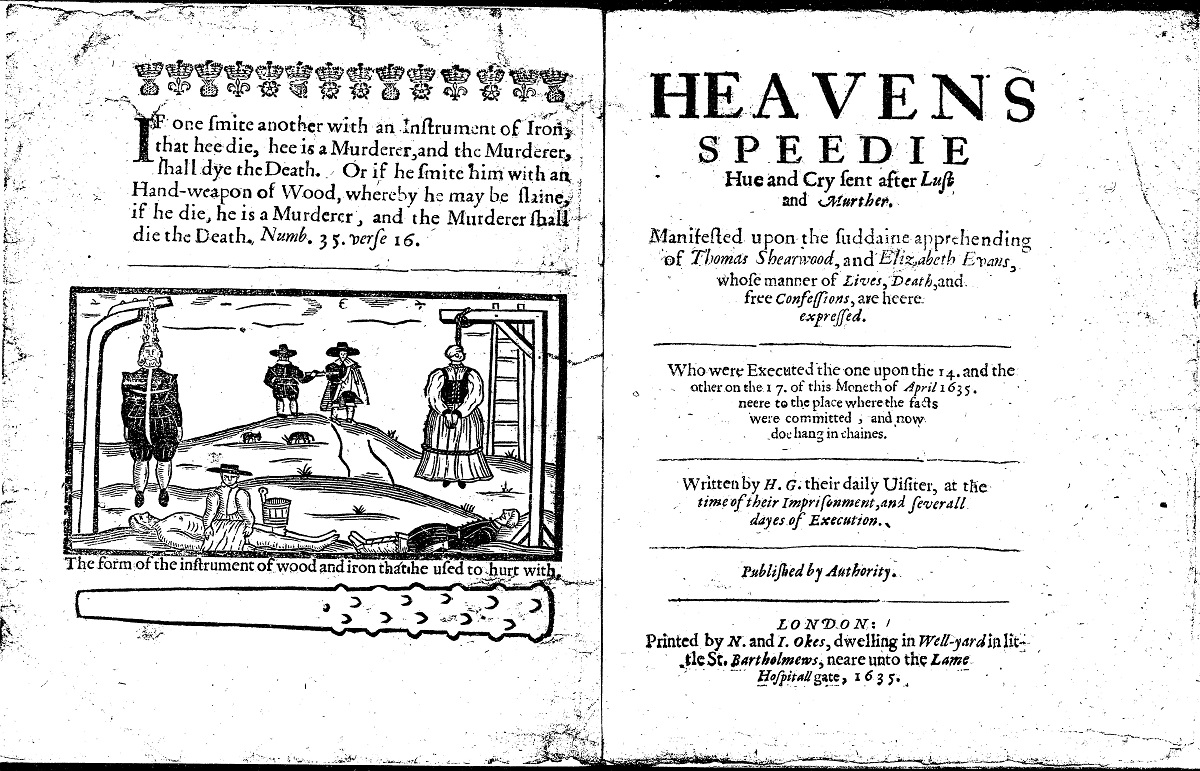
“Oh pity! Still running on to more mischief, having such a fearful spectacle before their eyes as Country Tom, which should rather have frightened and hindered them from doing this bold and insolent act,” laments Henry Goodcole in Heaven’s Speedie Hue and Cry, a narrative pamphlet trading on that same “fearful spectacle.”


Detail view (click for the full image) of Heaven’s Speedie Hue and Cry, a pamphlet narrating the crimes of Sherwood and Evans.

Canonbury Besse was bound over to the surgeons for anatomizing — well before this particular terror became a common extension of murder sentences. According to The Body Emblazoned: Dissection and the Human Body in Renaissance Culture, both Sherwood’s and Evans’s skeletons would ultimately became ornaments on permanent display at Inigo Jones‘s 1636 London anatomy theater,** and could be seen there as late as 1784.

* Consider, for instance, America’s Lonely Hearts Killers, Raymond Fernandez and Martha Beck — or Henri Landru, French predator of World War I widows.

** Diarist Samuel Pepys described a visit to this theater in 1663.

On this day..

1745: Martha Stracey, whore and reprobate-creature

Martha Stracey or Tracey hanged at Tyburn on this date in 1745 for assaulting a man named Will Humphreys and robbing him of one single guinea a few months before.

Stracey, about 18 or 20 years old, was a prostitute and pickpocket — “a perverse, vicious Girl, void of all good Dispositions, and wholly untractable and unadviseable, giving herself up to the vilest Company on Earth, both of Men and Women,” the Newgate Ordinary judged. The Ordinary’s accounts are a reliable feast of purple prose and do not disappoint in discoursing on the young bawd and her fall.

Having no interest in honest work and “renounc[ing] every thing resembling Goodness or Virtue,” she “went idling her Time away on the Streets with her hellish wicked Companions, who induc’d her to commence Whore, upon which she turn’d a meer reprobate-Creature” and “became known to all the Constables, and inferior Officers of Justice in that End of the Town.” Stracey, says the Ordinary, “own’d she was naturally inclined, and not over-persuaded by others, as some of them may or do alledge in Extenuation of their Guilt.”

During the night of Dec. 22-23, Humphreys testified, Stracey and Humphreys met on the Strand. According to Humphreys, she approached him unbidden, and when Humphreys insulted her, two men clobbered him as Stracey skillfully went through his pockets in a few seconds and plucked out the gold coin.

Stracey claimed the affair began when Humphreys “pulled me into an alley, and wanted to be concerned with me.”

No other eyewitnesses could testify to the substance of their rendezvous, but Humphreys’s story about the mysterious male accomplices who after thumping him went on their own way and left Stracey alone with him mid-robbery has the definite whiff of a cover story. The jury — perhaps searching for some grounds to avoid sending the woman to the gallows* — even asked the arresting constable, William Dunn, whether Humphreys’s clothes were really dirty, since he claimed to have been knocked down in the scuffle. (The constable didn’t know.)

But the simple fact was that Stracey did have Humphreys’s gold guinea, whether she achieved by main force or plucked it during a roadside assignation. With the convenient disappearance of her supposed goon squad, Humphreys was now able to seize the hustler on the spot and drag her to the watch. Constable Dunn had someone “search her behind and before (I ask pardon, my Lord)” and finally found the guinea under Martha’s profane tongue.

Before her execution, Stracey did confess that she had stolen the gold piece, under the circumstances that Humphreys’s shady account might lead one to infer:

Martha own’d the Fact she died for, that meeting a Man in the Street in the Evening, about Nine or Ten o’Clock, they speedily came to speak of an Agreement about a certain Affair; and as they were adjusting Matters, Martha thought fit to examine the Gentlemen’s Pockets, and amongst other Things, finding a Guinea, she robb’d him of it, as he Swore against her, and upon this she was convicted of a Street-robbery, one of the greatest Crimes in the Eye of the Law. She did not well remember the Circumstances of this robbery, as being very Drunk, which all of them generally are, when attempting to perpetrate so soul and black Crimes in an audacious manner.

Martha owned her committing of several robberies of this Kind before, she being a constant Street-walker , but did not well remember the Circumstances of the Robbery, she died for, nor the others which were conceal’d, it being impossible to recollect them, for the was always dead Drunk when they were committed. She was very ignorant of Religion, and what Things pertained to the state of her Soul; I endeavoured to instruct her, as the Brevity of Time allow’d, but she was of a mean Capacity and slow of Understanding, and had been so accustomed to do Evil, that she could scarce do any Thing that was good.

* The denomination of the stolen coin made “pious perjury” impossible.

On this day..

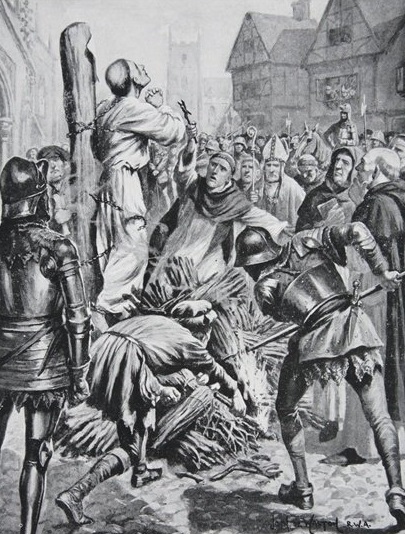
1401: William Sawtre, Lollard heretic

On this date in 1401, Lollard priest William Sawtre(y) was burned at Smithfield for heresy — the first known heresy execution in England.

The highlight of late 14th century English literature, Piers Plowman, was a great favorite of Lollards. Though this lengthy allegorical poem is not itself a Lollard text, it spawned a Piers Plowman tradition with many spinoffs that are overtly Wycliffite.

Witness Wycliffe, who told them the truth;
For in good nature he greatly warned
To mend their wickedness and sinful works.
Who these sorry men damned his soul
And overall lolled him with heretics’ works!

Piers Plowman’s Creed*

Sawtre was a follower of John Wycliffe, the Biblical translator and church reformer 16 years dead as we lay our scene.

Wycliffe anticipated much of Luther’s later critique of the Catholic Church. His call to study Scripture directly without the intercession of doctors in Rome touched a spiritual thirst; his summons to apostolic poverty for the wealthy vicars of Christ was a message with a ready audience.

“From about 1390 to 1425, we hear of the Lollards in all directions,” notes this public domain history, “so that the contemporary chronicler was ale to say that of every two men found on the roads, one was sure to be a Lollard.”

Lollardy did not immediately manifest as an outlaw movement; it had many adherents among England’s elites and even the royal household. Although the papacy had declared various Wycliffe doctrines heretical in that prelate’s time, England had shown little appetite for calling an Inquisition — a step that would project papal authority into the kingdom.**

But with a ferocious ecclesiastical pushback and a change in the occupancy of the throne,† the English state gradually shifted over the course of the 1390s and 1400s towards recognizing Wycliffe’s principles as heresy — and towards treating that heresy into a capital crime. Through spectacles like Sawtre’s burning, Lollards were gradually made to understand that the price of their scruples might run all the way to martyrdom.

This was novel territory for English jurisprudence, and part of a centuries-long European transition towards treating doctrinal dispute as capital crime. There are only a bare handful of alleged quasi-precedents in English history, sketchily documented — like the unnamed apostate deacon burnt to ashes for Judaizing. It was only as late as William Sawtre that Old Blighty clearly established the practice and legal machinery for putting men and women to death for heresy.

Many Lollards capitulated as they came under pressure. This was true of our man Sawtre, a humble parish vicar. When put to questioning by the bishop in 1399, Sawtre initially recanted his unorthodox skepticism as to the transubstantiation of communion bread into Christ’s own literal body — a doctrinal mystery that would be a tougher and tougher sell to dissidents yet to come.

But upon moving from Lynn to London where he served at St. Osyth’s, Sawtre relapsed — and some stirring moved his soul to vindicate himself in the face of mortal peril.

Charged before Parliament, Sawtre now defended his heresies under close questioning by the Archbishop of Canterbury, Thomas Arundel. Arundel was even then pressuring this same Parliament for a statute, which he did indeed soon receive — one with the ominous title De Heretico Comburendo, at last elevating heresy to a death penalty offense and making the bishops themselves the decisive arbiters on the matter. It is overtly and all-but-explicitly aimed at the Lollards.

divers false and perverse people of a certain new sect, of the faith of the sacraments of the church, and the authority of the same damnably thinking and against the law of God and of the Church usurping the office of preaching, do perversely and maliciously in divers places within the said realm, under the color of dissembled holiness, preach and teach these days openly and privily divers new doctrines, and wicked heretical and erroneous opinions contrary to the same faith and blessed determinations of the Holy Church, and of such sect and wicked doctrine and opinions they make unlawful conventicles and confederacies, they hold and exercise schools, they make and write books, they do wickedly instruct and inform people, and as such they may excite and stir them to sedition and insurrection, and make great strife and division among the people, and other enormities horrible to be heard daily do perpetrate and commit subversion of the said catholic faith and doctrine of the Holy Church …

the diocesans of the said realm cannot by their jurisdiction spiritual, without aid of the said royal majesty, sufficiently correct the said false and perverse people, nor refrain their malice, because the said false and perverse people do go from diocese to diocese and will not appear before the said diocesans…

[let] none within the said realm or any other dominions subject to his Roval Majesty, presume to preach openly or privily, without the license of the diocesan of the same place first required and obtained, curates in their own churches and persons hitherto privileged, and other of the Canon Law granted, only except; nor that none from henceforth anything preach, hold, teach, or instruct openly or privily, or make or write any book contrary to the catholic faith or determination of the Holy Church, nor of such sect and wicked doctrines and opinions shall make any conventicles, or in any wise hold or exercise schools; and also [let] none from henceforth in any wise favor such preacher or maker of any such and like conventicles, or persons holding or exercising schools, or making or writing such books, or so teaching, informing, or exciting the people, nor any of them maintain or in any wise sustain, and that all and singular having such books or any writings of such wicked doctrine and opinions, shall really with effect deliver or cause to be delivered all such books and writings to the diocesan of the same place within forty days from the time of the proclamation of this ordinance and statute.

Any Lollard not so complying could be arrested on the say-so of the diocesan bishop and tried for the offending heterodoxy; if convicted, the clergy was then empowered to hand the unfortunate fellow over to the civil authorities who were obliged to carry out an execution without any further inquiry or say-so. Judge, jury, and (virtually) executioner … the same as the guy waiting for you in the confessional.

[I]f any person … do refuse duly to abjure, or by the diocesan of the same place or his commissaries, after the abjuration made by the same person be pronounced relapsed, so that according to the holy canons he ought to be left to the secular court … [then] after such sentence promulgate shall receive, and them before the people in an high place cause to be burnt, that such punishment may strike fear into the minds of others, whereby, nosuch wicked doctrine and heretical and erroneous opinions, nor their authors … be sustained or in any way suffered.

With such wicked doctrine and heretical and erroneous opinions afoot Sawtre was not suffered to live even the enactment of the law that killed him: De Heretico Comburendo was passed only on March 10, but Sawtre was eight days’ dead by that point. It’s a bit unclear how the sentence was legally effected, but it would seemingly have proceeded under canon, not civil, law.

Both the law and the execution were great victories for the Church. “The king and the archbishop hurried to burn their victim to show that they could send a heretic to the stake whenever they wished, without relying on statute” Leonard Williams Levy writes. “Parliament could neither give nor take the authority to burn a heretic. If the scepter supported the miter, canon law prevailed.”

Be that as it may, the victims of the Lollard-burning period were not nearly so numerous as the chilling language of De Heretico Comburendo might lead one to anticipate. The next Lollard to go to the stake was John Badby in 1410; two merchants were executed in 1415, and the Lollard rebel John Oldcastle was burnt “gallows and all” in 1417. Another handful suffered in the 1420s. It’s thought that about 50 people overall (Lollards and otherwise) were executed as heretics from the enactment of De Heretico Comburendo until Henry VIII broke with Rome 133 years later — an occasion that made heresy-hunting a whole different animal.

The History of England podcast covers Sawtre and Lollardy in episode 141.

* My artless rendering from the Middle English version given in D.A. Lawton in “Lollardy and the ‘Piers Plowman’ Tradition”, The Modern Language Review, Oct. 1981.

** Despite overall caution about the authority of Rome onto Albion’s soil, the English had no overall principled rejection of Inquisitors as such: they convoked such a tribunal to deal with Joan of Arc.

† The political situation in the realm was also been a factor: the usurper Henry IV had taken the crown only in 1399 by deposing, and later murdering, King Richard II. One readily supposes Henry’s keen interest in shoring up the loyalty of the church and keeping tabs on itinerant rabble-rousers, the latter of whom appear to have disproportionately skewed towards Richard’s faction. (All those heretics in the king’s household were in Richard’s household.)

On this day..

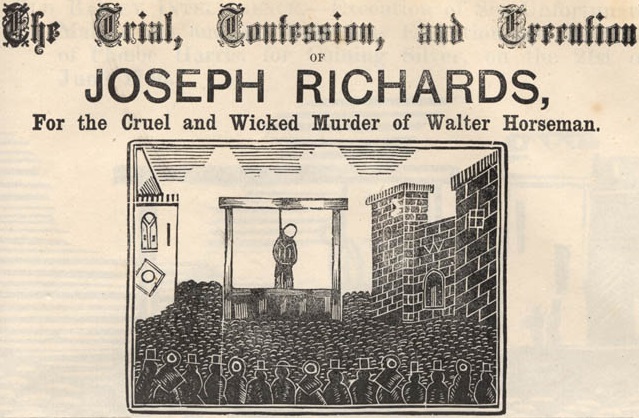
1786: Joseph Rickards, aspiring milkman

(Thanks to Meaghan Good of the Charley Project for the guest post. -ed.)

On this day in 1786, Joseph Richards or Rickards was executed in Kentish Town, London for the murder of his former employer, Walter Horseman, whom he attacked on February 11.

Graham Jackson and Cate Ludlow described the crime in the most graphic terms in their book A Grim Almanac of Georgian London:

At around 2:00 a.m., Mary Horseman of Kentish Town was woken by the sound of her ten-year-son calling out that his father, London milkman Walter Horseman, needed her… Mary found her husband sitting on his bed. By the light of the moon, which was flooding through the large bay windows, she could see that he was quite black with blood, which covered him from his face to his waist. “Lord bless me,” he said. “Something has run over my face!”

“Run over your face?” she responded. “Why, you are nothing but blood!” She ran for a candle, and when she returned, the light revealed a truly hideous sight: her husband was cut to pieces, his forehead, eyes and nose smashed. His skull, which was broken, was described in court as “cut and mangled in a desperate manner.” The two sections of the skull had broken apart, and his eye sockets had been smashed into shards.

There was nothing to be done for Walter, but amazingly, he lingered until the 19th, over a week after the assault. Due to his head injuries and the fact that he’d been attacked while he was sleeping, he wasn’t able to provide any useful information as to what happened.

The murder weapons were left behind at the crime scene: they proved to be a wooden hedge stake and an iron bar, which was “jellied” with gore.

Only a few farthings were missing from the house. The Horsemans’ four-year-old daughter, who was sleeping in the same room as her father, was not harmed. Suspicion quickly fell on Rickards, the Horsemans’ former apprentice, whom they’d recently sacked for laziness. He had no alibi for the night of the murder, a night watchman saw him near the Horsemans’ home about an hour after the attack, and Mary identified the hedge stake as one he had cut several days before the attack.

Nevertheless, he seemed confident and didn’t bother to leave the area. In fact, in an incredible display of chutzpah, he actually visited his ailing former master and shook his hand before Walter died. Perhaps his cockiness — or obliviousness — was a product of his immaturity; in an age of doubtful record-keeping, we can’t be sure of Joseph Rickards’s age but he was certainly quite young. Mary Horseman speculatively pegged the ex-apprentice as an 18-year-old; the London Times (Feb. 24, 1786) thought that he did “not appear to be more than sixteen years of age.” Although even 16 would be quite old enough to hang in Bloody Code London, the magistrate felt constrained on account of the boy’s age to caution his jurors against excess confidence in the confession he ultimately produced:

I should not for one, though he is very near the state of manhood, chuse to rest singly and merely on his confession, as he is not at full age, though he is above that age of discretion, which the law assigns to be at the age of fourteen years, and certainly it is near the time that human reason is supposed to be mature.

On the 20th, the day after Walter’s death, Rickards was arrested. Within a day he had admitted to concealing himself in a large cupboard in one of the bedrooms in order to beat his former boss to death in his bed. (The trial records are here.) He tried to shift some of the blame to Mary Horseman, claiming they had frequently kissed and he had “laid hold of” her breasts, and that she had told him she wished her husband was dead.

He was hanged in a field across the way from the Horseman family’s dairy — a pathetic spectacle, to judge by the account of the Public Advertiser (Feb. 28, 1786), during which he recanted his allegations against the milkman’s widow.

In his way to the place of execution, the convict appeared to be in a state of mind bordering upon stupefaction: He had no book, nor did he employ the short remnant of time in those preparations for eternity which his miserable situation rendered so indispensably necessary.

Before being turned off, the prisoner desired to see the widow of the deceased; she was sent for to her house, but was gone to London: he declared he had no accomplice in the fact, and that he was induced to the perpetration thereof by the supposition, that after the decease of his master he should succeed to his business as a milkman. Just before coming to the village, he burst into tears, and when he came to the place of execution wept bitterly; his expressions of sorrow and contrition being only interrupted by fervent appeals to Heaven for mercy till the last moment of his existence. He desired his hat might be given to one, and his buckles to another man; and he also made some other trifling dispositions.

One of the Sheriffs, and a great number of their officers on horseback and on foot, attended on the above occasion. Considering the nature of the criminal’s offence, and the disposition of the English to behold spectacles of horror, the crowd was not near so great as might have been expected, owing, no doubt, to the fall of snow, and going so early. The body of the malefactor was conveyed from Kentish Town to Surgeons Hall for dissection, without a shell, and covered only with a coarse cloth, which by the motion of the cart was frequently so removed, that the head and different parts of the body were frequently seen by the passengers on the road and in the streets.

The anatomization, and accompanying public lecture on the late Rickards’s thorax, was performed by a “Dr. Cooper” (General Evening Post, Feb. 28-Mar. 2, 1786); this would appear to be the budding anatomist Astley Cooper who was only 17 years old himself at this time — just at the outset of a scintillating medical career.


THE TRIAL.

Old Bailey, February 24th, 1786.

Joseph Richards was arraigned for the wilful murder of Walter Horseman, milkman, in Kentish Town. The deceased’s widow deposed, that the prisoner was formerly a servant to her husband; that he was discharged for negligence; that he had frequently threatened vengeance on the deceased; that on the morning the murder was committed, she was awakened by a noise, and on entering the room her husband slept in, she found him sitting up in the bed, and as far as his waist in blood; that a stick which the prisoner had cut some time before, lay in the room, and an iron bar, covered with blood; that her husband was mangled in a shocking manner: — he lingered a few days, and died a shocking spectacle.

Four other witnesses were examined, whose testimony proved certain corroborating circumstances; such as, being from his lodging the night the murder was committed, being seen to melt lead, and to pour it into the stick that was found in the deceased’s room, &c.

The prisoner confessed the murder to one of the magistrates who committed him for trial; but pleaded Not Guilty at the bar.

The jury, after a few minutes’ consideration, brought in their verdict Guilty.

Mr. Recorder pronounced judgment. He said the voice of innocent blood cried to heaven for vengeance. He dwelt upon the atrociousness of the crime of murder, observing, that the Divine Law had ordained, that whoever sheddeth man’s blood, &c., and then expatiated on the peculiar circumstances of the murder, the murder of an innocent master, to whom he owed duty and reverence.

The sentence was then passed as usual, that he be hanged till dead, and anatomized; and an order of Court was made out, to execute him on Monday, at Kentish Town, as near as possible to the house of the deceased.

THE EXECUTION.

Joseph Richards, a youth about eighteen, who was convicted on Friday last, for the wilful murder of Walter Horseman, with whom he lived servant, was executed at Kentish Town, opposite the house where the horrid fact was perpetrated. The malefactor came out of Newgate about twenty minutes before eight o’clock, and with some alertness stepped into the cart, which conveyed him through Smithfield, Cow Cross, and by the two small-pox hospitals to the spot, where he was removed from that society of which he had proved himself a most unworthy member, at a time of life when such atrocity of guilt as he possessed has been seldom known to degrade humanity. In his way to the place of execution, the convict appeared to be in a state of mind bordering upon stupefaction; he had no book, nor did he employ that short remnant of time in those preparations for eternity which his miserable situation rendered so indispensably necessary.

Before being turned off, the prisoner desired to see the widow of the decreased; she was sent for to her house, but was gone to London; he declared he had no accomplice in the fact, and that he was induced to the perpetration thereof by the supposition, that after the decease of his master he should succeed to his business as a milkman. Just before coming to the village, he burst into tears and when he came to the place of execution, wept bitterly; his expressions of sorrow and contrition being only interrupted by fervent appeals to Heaven for mercy till the last moment of his existence.

On this day..

1601: Robert Devereux, Earl of Essex

On this date in 1601, Queen Elizabeth’s last great favorite became the last man beheaded in the Tower of London.

Vain and dashing Robert Devereux rolled into the royal court in 1584 around age 19 and immediately established himself as the new favorite of the monarch, 30-some years his senior. They spent long walks and late nights in enchanted private company, and Devereux “commeth not to his owne lodginge tyll the birdes singe in the morninge.” Ye olde walke of shayme.

In becoming the (presumed) lover* of the aging Virgin Queen, the Earl of Essex was only following the family** trade: his stepfather Robert Dudley was the younger Elizabeth’s longtime intimate.

It is up to the artists to postulate the relative measures of passion and cynicism in these dalliances; many have tried, inspired by the scaffold sundering of one of history’s great May-December affairs. The Essex-Elizabeth drama was a popular topic for broadsides, ballads, and stage treatments from the 17th century to the present day.


Benjamin Britten put the Elizabeth-Essex romance into opera in Gloriana, based on Lytton Strachey’s popular book.

He was wildly popular in London, but Essex was also afflicted by the follies of youth. Rash, temperamental, vainglorious; he aspired to leverage the favor of his sovereign into statesmanship and he achieved heroic repute for his swashbuckling raid on Cadiz.

Yet Essex reads like a whelp who never quite grew into a man’s boots. Every sketch of Essex includes, because it seems so starkly illustrative of his unstable character, the story of the time his impertinence led the queen to box his ears publicly — and the hothead’s hand flew instinctively to his sword-hilt. Everyone reconciled over this brush with lese-majeste, but only after Essex scribbled some skulking reproaches (“What, cannot princes err? cannot subjects receive wrong? is an earthly power or authority infinite?”) that he had the petulance to actually send to Elizabeth.

The less mercurial Earl of Salisbury, Robert Cecil, who was the son of Elizabeth’s earliest close advisor and the protege of her spymaster, was just two years Essex’s senior but smoothly outmaneuvered the loverboy in their mutual pursuit of England’s Secretaryship of State.†

Essex chased martial glory with mixed results. His last great enterprise was an ill-starred 1599 offensive in Ireland to bring Gaelic rebels to heel in the Nine Years’ War.

Not for the last time an Englishman found this conquest more easily aspired than achieved. Essex liberally overused his authority to knight men as a reward for their service, but his soldiers mostly slogged to and fro with little headway to show for it. After a frustrating campaign season chasing his tail, Essex defied the increasingly strident directives to attack issuing from Elizabeth’s irate pen, and made terms with the Irish commander Hugh O’Neill, Earl of Tyrone. Then he defied Elizabeth’s order to remain in Ireland and hastened back to London to justify himself. It was said of him that he “never drew sword but to make knights.”

This was the beginning of Essex’s end. Elizabeth’s fury at the aimless military campaign was compounded when her churlish captain turned up from Ireland unbidden and burst into her private chambers while she was still dressing to report on his unauthorized summit. Cecil et al, whose ascendance Essex had meant to reverse with the triumph of his arms, now murmured that the earl had strayed near outright treason to parley with the rebel whom he was supposed to be routing. The Privy Council put him under house arrest.

Heaped in debt and deprived of the prestigious proximity to power he had enjoyed literally throughout his adulthood, the man’s turbulent spirit stirred strangely in York House. We have seen that Robert Devereux, Earl of Essex, was a man to abhor an indignity even past the point of self-preservation. He unwisely sent secret missives to try to turn the ongoing succession negotiations‡ against Robert Cecil; when the Privy Council caught wind of this intrusion, he refused its demand that he present himself to account for his actions. Instead, he made matters worse by mounting a pathetic march through London with his supporters.

This “Essex Rebellion” was meant to rally the citizenry to him and turn some sort of coup against Robert Cecil. It seems so foolhardy and ill-considered that it’s difficult to think what was in the earl’s head. If you squint at it just so, it perhaps had a big-R Romantic quality, a gallant band of brothers saving the nation from its duplicitous ministers; the night before the rebellion, Essex (a liberal arts patron in his time) splurged to have William Shakespeare’s company§ stage a special performance of Richard II — a play wherein the English monarch is deposed. Presumably this was his inspirational pregame speech.

Thinking much more clearly than Essex, Londoners vigorously ignored his summons and the marching party trudged alone — and surely increasingly frightened — through the city until it was stopped by a barricade. Its participants then fled back to Essex House where they soon found themselves surrounded.

Whatever the fancy that led the Earl of Essex on his fatal February 8 march, and whatever the extent of his ambitions for that occasion, the careless threat to the public peace went several bridges beyond a boyish foible that Elizabeth could overlook in her impulsive courtier. He was prosecuted for treason within days and Elizabeth signed his death warrant on February 20th. The only mercy extended the ex-favorite was to suffer the noble execution of beheading, rather than a traitor’s drawing and quartering. Essex also successfully appealed for a private execution within the walls of the Tower, away from the gawks of those London masses who had so signally failed to rebel along with him.

On the specially built wooden platform, Essex favored his select audience with a bog-standard execution-day mea culpa:

My sins are more in number than the hairs on my head. I have bestowed my youth in wantonness, lust and uncleanness; I have been puffed up with pride, vanity and love of this wicked world’s pleasures. For all which, I humbly beseech my Saviour Christ to be a mediator to the eternal Majesty for my pardon, especially for this my last sin, this great, this bloody, this crying, this infectious sin, whereby so many for love of me have been drawn to offend God, to offend their sovereign, to offend the world. I beseech God to forgive it us, and to forgive it me — most wretched of all.

He prayed a Psalm. Then, stretching out his neck on a low block and thrusting his arms from his sides, he bid the headsman strike. The executioner had to oblige his patient in triplicate in order to sever the puffed-up head.

The Earl of Essex has the distinction of being the last person beheaded on the Tower Green, within the walls off the Tower of London — the last name on the little placard of headless notables photographed by tour groups. Note that Essex was not the last person beheaded at the Tower, when the adjacent Tower Hill is included (that distinction belongs to Jacobite rebel Simon Fraser); nor was he the last person executed within the Tower (that distinction belongs to World War II spy Josef Jakobs, who was not beheaded but shot).

Weary and depressed, Elizabeth died little more than two years afterwards.

* There’s a mind-bending speculative hypothesis out there — cousin to the Shakespeare-focused Prince Tudor theory — that Essex was actually Elizabeth’s secret, illegitimate son. This secret history is obviously more congenial with the queen’s early favoritism for Essex than with her eventually chopping off his head.

** Essex was also a distant cousin of Elizabeth herself: his maternal great-grandmother was Mary Boleyn, sister of Anne Boleyn — who was Elizabeth’s mother.

Walter Raleigh was a notable Cecil ally in this factional conflict. Raleigh attended Essex’s execution … and, of course, shared that fate many years afterwards.

‡ Elizabeth was nearing age 70; her childless death was imminent. James VI of Scotland was being vetted by Robert Cecil as the successor. Essex tried to stick his thumb in the pie by warning James that the Cecil faction would conspire to foist the English crown on the Spanish infanta — daughter of the Spanish king who had been the Catholic Mary Tudor’s husband. (The infanta was not Mary’s own daughter.) This was no idle threat, as at this point it was only a few years since the Spanish Armada had sallied for English seas.

§ Another noteworthy Shakespeare connection: one of the participants in the Essex Rebellion was the Earl of Southampton (he was spared execution). Southampton, whose given name was Henry Wriothesley, is often identified as the “Fair Youth” to whom Shakespeare dedicated numerous love sonnets. (Some of those are directly addressed to a Mr. “W.H.”)

On this day..